
Showing 138 items matching "the royal women's hospital melbourne"
-
 St Vincent's Hospital Melbourne Archives
Certificate - The Royal Women's Hospital Melbourne postgraduate certificate in Gynaecological Diseases Nursing awarded to Vivienne Ethel Pearce in 1961
... The Royal Women's Hospital Melbourne postgraduate certificate in Gynaecological Diseases Nursing awarded to Vivienne Ethel Pearce in 1961. ......The Royal Women's Hospital Melbourne...Sister Vivienne Pearce completed a post graduate course in Gynaecological Diseases Nursing at The Royal Women's Hospital to further her already completed certified trained nurse and midwife training at St Vincent's Hospital Melbourne. ...Vivienne Pearce The Royal Women's Hospital Melbourne Gynaecological Diseases Nursing Postgraduate Nursing St Vincent's Hospital Melbourne St Vincent's Midwifery Hospital Melbourne. ...Sister Vivienne Pearce completed a post graduate course in Gynaecological Diseases Nursing at The Royal Women's Hospital to further her already completed certified trained nurse and midwife training at St Vincent's Hospital Melbourne. The certificate is signed by the President, the Manager, the Matron, the Examiners and Vivienne Pearce.vivienne pearce, the royal women's hospital melbourne, gynaecological diseases nursing, postgraduate nursing, st vincent's hospital melbourne, st vincent's midwifery hospital melbourne. -
 Alfred Hospital Nurses League - Nursing History Collection
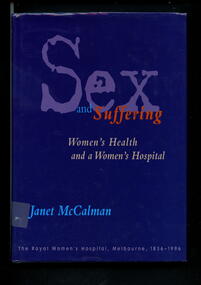
Book - Illustrated book, Janet McCalman, Sex and suffering: women's health and a women's hospital: the Royal Women's Hospital Melbourne 1856-1996, 14/12/1995
... Sex and suffering: women's health and a women's hospital: the Royal Women's Hospital Melbourne 1856-1996...Many AHNL members undertook midwifery training at The Royal Women's Hospital. Royal Women's Hospital-Melbourne-History Women's Health Obstetrics and Gynacology Hospitals-Victoria-History Nursing An absorbing social history of women's health seen through the workings of Australia's oldest women's hospital: the Royal Women's Hospital, from 1856-1996. ...An absorbing social history of women's health seen through the workings of Australia's oldest women's hospital: the Royal Women's Hospital, from 1856-1996.Illustrated book with dust jacket. Book is bound in dark blue, with abbreviated title, author's surname, and publishers mark printed in gilt on spine. Dust jacket has a dark blue background, full title and author's name printed in multicolour on front. Abbreviated title, author's surname and publishers mark in multicolour print on spine.An absorbing social history of women's health seen through the workings of Australia's oldest women's hospital: the Royal Women's Hospital, from 1856-1996.royal women's hospital-melbourne-history, women's health, obstetrics and gynacology, hospitals-victoria-history, nursing -
 Kew Historical Society Inc
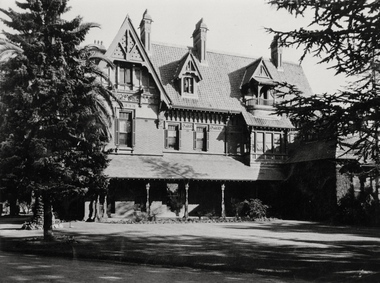
Photograph - 'Tara Hall', Studley Park Road, Marc Strizic (attrib), c.1960
... Typed inscription on reverse: "Tara Hall at the time it was a home for nurses from the Royal Women's Hospital, Melbourne. (Royal Women's Hospital, Melbourne)."...(Royal Women's Hospital, Melbourne)." Tara Hall, Studley Park Road, circa 1957. ...'Lost Glories: a memorial to forgotten Australian buildings' was published by David Latta in 1986. It tells the story of a number of significant Australian buildings that had previously been demolished. A chapter in the book was devoted to Goathland, later known as Tara Hall. To supplement the text, he sourced photographs from a range of suppliers, chiefly the Royal Women's Hospital which had once owned Tara Hall, but had sold it in 1960. This is one of the photographs donated to KHS by the author.Tara Hall, Studley Park Road, circa 1957. The front of Tara Hall (previously named Byram, Goathland and Lowan). This triple-storey mansion with its elaborate gabled, steeply-pitched roofs and verandah was set back from Studley Park Road and concealed by a high brick fence. E. G. Kilburn, of Ellerker & Kilburn, designed Byram for the industrialist George Ramsden in 1888. Typed inscription on reverse: "Tara Hall at the time it was a home for nurses from the Royal Women's Hospital, Melbourne. (Royal Women's Hospital, Melbourne)."byram, goathland, tara hall, lowan, studley park (kew), george ramsden, sir malcolm mceacharn, edward george kilburn (architect), studley park road (kew) -
St Vincent's Hospital Melbourne Archives
Book - The Midwife's Text-Book of the Principles and Practice of Midwifery by R.W.Johnstone of Scotland, circa 1947
... ...The Royal Women's Hospital Melbourne...Margaret Slattery R.W.Johnstone St Vincents Hospital Melbourne The Royal Women's Hospital Melbourne Midwifery Nursing Training In an indented circle on the hardcover is "Blacks Medical Series: " with the image of the Rod Of Asclepius, the symbol of medicine featuring the single serpent wrapped around a simple staff. ...Text reference book for midwives with illustrations and photographs.In an indented circle on the hardcover is "Blacks Medical Series: " with the image of the Rod Of Asclepius, the symbol of medicine featuring the single serpent wrapped around a simple staff. Margaret Slattery's name is hand written in ink on the inner cover. margaret slattery, r.w.johnstone, st vincents hospital melbourne, the royal women's hospital melbourne, midwifery nursing training -
 Kew Historical Society Inc
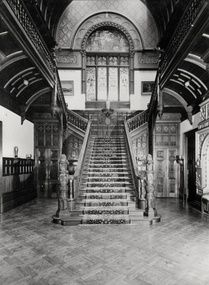
Photograph - Grand Staircase, Tara Hall', Studley Park Road, Marc Strizic (attrib), c.1960
... Typed inscription on reverse: "The Grand Staircase of Tara Hall (Royal Women's Hospital, Melbourne)....Royal Women's Hospital which had once owned Tara Hall, but had sold it in 1960. This is one of the photographs donated to KHS by the author. byram, goathland, tara hall, lowan, studley park (kew), george ramsden, sir malcolm mceacharn, edward george kilburn (architect), studley park road (kew) Typed inscription on reverse: "The Grand Staircase of Tara Hall (Royal Women's Hospital, Melbourne). ...'Lost Glories: a memorial to forgotten Australian buildings' was published by David Latta in 1986. It tells the story of a number of significant Australian buildings that had previously been demolished. A chapter in the book was devoted to Goathland, later known as Tara Hall. To supplement the text, he sourced photographs from a range of suppliers, chiefly the Royal Women's Hospital which had once owned Tara Hall, but had sold it in 1960. This is one of the photographs donated to KHS by the author. The Grand Staircase of Tara Hall, circa 1957. The central hallway and stairs of Tara Hall, (previously named Byram, Goathland and Lowan). Edward George Kilburn, of Ellerker & Kilburn, designed this Studley Park Road mansion, of which the hallway was a significant feature, for the industrialist George Ramsden in 1888. Tara Hall, one of the great houses in Kew was demolished in 1959-60. Possibly Marc Strizic, photographer (1928-2012). Typed inscription on reverse: "The Grand Staircase of Tara Hall (Royal Women's Hospital, Melbourne).byram, goathland, tara hall, lowan, studley park (kew), george ramsden, sir malcolm mceacharn, edward george kilburn (architect), studley park road (kew) -
 Kew Historical Society Inc
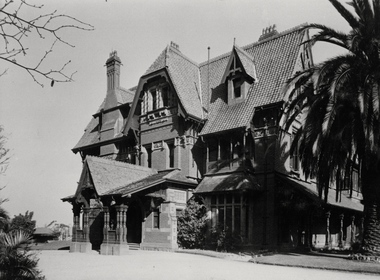
Photograph - Porte-cochere, 'Tara Hall', Studley Park Road, Marc Strizic (attrib), c.1960
... Typed inscription on reverse: "Goathland, also known as Tara Hall (Royal Women's Hospital, Melbourne)."...Royal Women's Hospital which had once owned Tara Hall, but had sold it in 1960. This is one of the photographs donated to KHS by the author. Goathland -- Kew (Vic) Byram -- Kew (Vic) Tara Hall - Kew (Vic) Studley Park road Typed inscription on reverse: "Goathland, also known as Tara Hall (Royal Women's Hospital, Melbourne)." ...'Lost Glories: a memorial to forgotten Australian buildings' was published by David Latta in 1986. It tells the story of a number of significant Australian buildings that had previously been demolished. A chapter in the book was devoted to Goathland, later known as Tara Hall. To supplement the text, he sourced photographs from a range of suppliers, chiefly the Royal Women's Hospital which had once owned Tara Hall, but had sold it in 1960. This is one of the photographs donated to KHS by the author. Porte-cochere, Tara Hall, circa 1957. The main entrance to Tara Hall (previously named Byram, Goathland and Lowan). The entrance, through a porte-cochère, was located on the side of the house facing east. During construction, commentators described the house as being in the ‘Elizabethan style’. The architectural style of the exterior, with its innovatory use of red brick and Italian tiles was more influenced by American models. Edward George Kilburn, of Ellerker & Kilburn, designed Byram for the industrialist George Ramsden in 1888. Typed inscription on reverse: "Goathland, also known as Tara Hall (Royal Women's Hospital, Melbourne)."goathland -- kew (vic), byram -- kew (vic), tara hall - kew (vic), studley park road -
 Kew Historical Society Inc
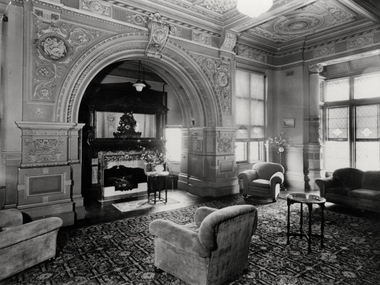
Photograph - Drawing Room, 'Tara Hall', Studley Park Road, Marc Strizic (attrib), c.1960
... Typed inscription on reverse: "A sitting room, one of many handsomely decorated rooms at Tara Hall.( Royal Women's Hospital, Melbourne)."...Royal Women's Hospital which had once owned Tara Hall, but had sold it in 1960. This is one of the photographs donated to KHS by the author. byram, goathland, tara hall, lowan, studley park (kew), george ramsden, sir malcolm mceacharn, edward george kilburn (architect), studley park road (kew) Typed inscription on reverse: "A sitting room, one of many handsomely decorated rooms at Tara Hall.( Royal Women's Hospital, Melbourne)." ...'Lost Glories: a memorial to forgotten Australian buildings' was published by David Latta in 1986. It tells the story of a number of significant Australian buildings that had previously been demolished. A chapter in the book was devoted to Goathland, later known as Tara Hall. To supplement the text, he sourced photographs from a range of suppliers, chiefly the Royal Women's Hospital which had once owned Tara Hall, but had sold it in 1960. This is one of the photographs donated to KHS by the author. The Drawing Room, Tara Hall, circa 1957. A reception room in Tara Hall (previously named Byram, Goathland and Lowan). The room is presumed to be the original drawing room. In the La Trobe collection, there is a drawing by Charlie Hammond, depicting a group of painters who are gilding the elaborate stucco ceiling of this room. The drawing is dated 16 September 1889. The elaborate stucco decoration is characteristic of E. G. Kilburn’s late style. Kilburn, of Ellerker & Kilburn, designed Byram for the industrialist George Ramsden in 1888. Typed inscription on reverse: "A sitting room, one of many handsomely decorated rooms at Tara Hall.( Royal Women's Hospital, Melbourne)."byram, goathland, tara hall, lowan, studley park (kew), george ramsden, sir malcolm mceacharn, edward george kilburn (architect), studley park road (kew) -
 Returned Nurses RSL Sub-branch
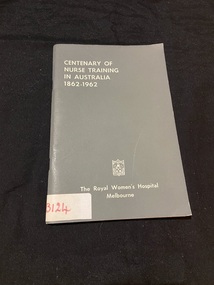
Booklet - Paperback booklet, Leo Butler et al, Centenary of Nurse training in Australia 1862-1962, 1962
... The bottom of the page shows the emblem and name of The Royal Women's Hospital Melbourne....The bottom of the page shows the emblem and name of The Royal Women's Hospital Melbourne. Centenary of Nurse training in Australia 1862-1962 Booklet Paperback booklet Leo Butler Royal Women's Hospital Melbourne Royal Women's Hospital ...History of 100 years of nurses training in Australia.Dark grey booklet with two staples down the side and the title printed in white text in the upper left corner. The bottom of the page shows the emblem and name of The Royal Women's Hospital Melbourne.non-fictionHistory of 100 years of nurses training in Australia.royal women's hospital melbourne, nursing - history, nursing - in service training -
 Kew Historical Society Inc
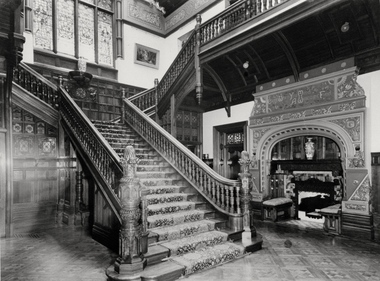
Photograph - Staircase of 'Tara Hall', Studley Park Road, Marc Strizic (attrib), c.1960
... Above the ornate fireplace is the legend 'Come When You Mind, A Welcome Find'. (Royal Women's Hospital, Melbourne)." ...Royal Women's Hospital which had once owned Tara Hall, but had sold it in 1960. This is one of the photographs donated to KHS by the author. byram, goathland, tara hall, lowan, studley park (kew), george ramsden, sir malcolm mceacharn, edward george kilburn (architect), studley park road (kew) Typed inscription on reverse: "The Staircase at Tara Hall. Above the ornate fireplace is the legend 'Come When You Mind, A Welcome Find'. (Royal Women's Hospital, Melbourne ...'Lost Glories: a memorial to forgotten Australian buildings' was published by David Latta in 1986. It tells the story of a number of significant Australian buildings that had previously been demolished. A chapter in the book was devoted to Goathland, later known as Tara Hall. To supplement the text, he sourced photographs from a range of suppliers, chiefly the Royal Women's Hospital which had once owned Tara Hall, but had sold it in 1960. This is one of the photographs donated to KHS by the author. The Staircase at Tara Hall, circa 1957. An angled view of the main hallway and staircase of Tara Hall (previously named Byram, Goathland and Lowan). To the right of the staircase in this Studley Park Road mansion, a large inglenook fireplace was located, which was surrounded by stucco decoration. The latter was a characteristic of E. G. Kilburn’s late style.Typed inscription on reverse: "The Staircase at Tara Hall. Above the ornate fireplace is the legend 'Come When You Mind, A Welcome Find'. (Royal Women's Hospital, Melbourne)." byram, goathland, tara hall, lowan, studley park (kew), george ramsden, sir malcolm mceacharn, edward george kilburn (architect), studley park road (kew) -
 Geoffrey Kaye Museum of Anaesthetic History
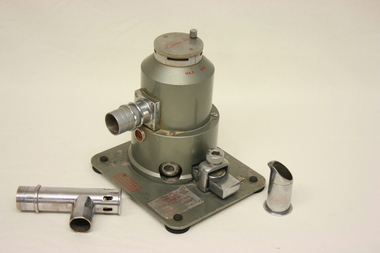
Equipment - Tecota trilene inhaler, Cyprane Ltd
... The item was donated by Dr K McCaul of the Royal Women's Hospital, Melbourne, in 1966....The item was donated by Dr K McCaul of the Royal Women's Hospital, Melbourne, in 1966. trilene inhaler tecota anaesthesia beaker mask vaporise obstetrics childbirth dr k mccaul royal women's hospital melbourne 1966 vapor face mask vaporising chamber cyprane ltd keighley Red markings identifying the manufacturer and the measurement scale are located on both the stand and top twist dial. ...The item was donated by Dr K McCaul of the Royal Women's Hospital, Melbourne, in 1966.Anaesthetic trilene was administered to the patient via rubber tubing from the Trilene inhaler, within which the anaesthetic was converted into a vapor. The cylindrical metal apparatus sits atop a flat, square stand with four black rubber feet. Item includes ports and valves for connection to a face mask and vaporising chamber, as well as mask attachment and metal pouring jug with spout.Red markings identifying the manufacturer and the measurement scale are located on both the stand and top twist dial. The base of the mask attachment piece is inscribed with the manufacturer's details: 'Cyprane Ltd'. The metal beaker is engraved with a line marked at the 15cc level. trilene inhaler, tecota, anaesthesia, beaker, mask, vaporise, obstetrics, childbirth, dr k mccaul royal women's hospital melbourne, 1966, vapor, face mask, vaporising chamber, cyprane ltd, keighley -
 Alfred Hospital Nurses League - Nursing History Collection
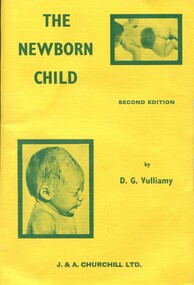
Book - Illustrated textbook, David G Vulliamy 1917-2013, The newborn child, 1967
... At top right of this page the previous catalogue number is handwritten [black ink] , underneath 'Sister Beverley Satchell/Royal Womens Hospital/ Melbourne/ February 1968...At top right of this page the previous catalogue number is handwritten [black ink] , underneath 'Sister Beverley Satchell/Royal Womens Hospital/ Melbourne/ February 1968 Illustrated book with yellow binding. ...This textbook was traditionally used as a clinical guide for medical students and nursing staff detailing the physical characteristics, commom disorders, and general care of infants during the neonatal periodIllustrated book with yellow binding. Green print on front cover. In additon to title, edition, author and publisher details there are two photographs of newborn infants. Title, edition and author also printed on spinenon-fictionThis textbook was traditionally used as a clinical guide for medical students and nursing staff detailing the physical characteristics, commom disorders, and general care of infants during the neonatal periodnewborn infants, neonatal period, premature infants -
 Royal Australian and New Zealand College of Obstetricians & Gynaecologists (RANZCOG)
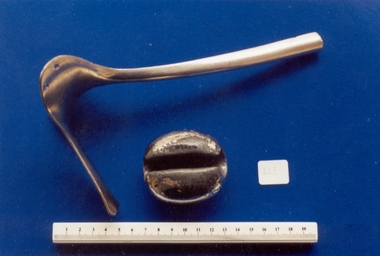
Auvard-style speculum associated with Dr Kelvin Churches, Ramsay
... This speculum had belonged to Dr Kelvin Churches who was an honorary at the Royal Women's Hospital, Melbourne. ...This speculum had belonged to Dr Kelvin Churches who was an honorary at the Royal Women's Hospital, Melbourne. Obstetrics "C.K.C" "RAMSAY" Auvard-style speculum, with detachable weight. ...Auvard's specula were used primarily for douching and operating with continuous irrigation. Some examples had fixed weights, others were detachable. This speculum had belonged to Dr Kelvin Churches who was an honorary at the Royal Women's Hospital, Melbourne. Auvard-style speculum, with detachable weight. Inscribed with initials " C.K.C" (for Kelvin Churches). Stamped "RAMSAY", which is the manufacturer."C.K.C" "RAMSAY"obstetrics -
 Warrnambool and District Historical Society Inc.
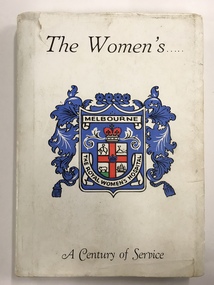
Book, The Women's..... A Century of Service, 1956
... This is a soft-cover book of 170 pages printed in 1976 and giving the history of the first 100 years of the Royal Women’s Hospital, Melbourne. It has a white cover of thick paper with the emblem of the hospital on the front in blue, red, black and white. ...Melbourne The Royal Women's Hospital... Hospital in Melbourne and because a Warrnambool identity, Dr William Dixon Saltau, was the Medical Superintendent of this hospital for 25 years. His name is listed in this book. warrnambool medical staff royal women’s hospital melbourne saltau family warrnambool dr william dixon saltau Statement of Significance Melbourne The Royal Women's Hospital This is a soft-cover book of 170 pages printed in 1976 and giving the history of the first 100 years of the Royal Women’s Hospital, Melbourne. ...This book by C.E. Sayers details the history of the Royal Women's Hospital from the time of its foundation as the Lying In Hospital in 1856.It includes information on doctors and nurses and managerial staff connected with the hospital. Some Warrnambool medical staff in the past have been connected with the Women's Hospital. Apart from its detailing of the history of an important institution in Victoria, this book is of particular interest to the Warrnambool and District Historical Society because William Dixon Saltau (1894-1970), born in Warrnambool, was the Medical Superintendent of the Women’s Hospital from 1924 to 1951. Dr Saltau was the son of Marcus Saltau (M.L.A.) and his wife Jean and the grandson of Henry Saltau who came to Australia in 1860 and who founded in the 1870s the Warrnambool firm of Saltau and Son, general carriers, coal, wood and produce merchants and forwarding agents. Dr Saltau’s father Marcus was Mayor of Warrnambool and a generous benefactor of the Warrnambool Hospital (Marcus Saltau House and Jean Buick Saltau Maternity Ward). Dr Saltau was educated at Warrnambool Academy (Richard Lawson, Headmaster), Scotch College, Melbourne and Melbourne University. He specialized in obstetrics and gynaecology and practised in England, Adelaide and Melbourne. .This book is of general historical interest as it describes the history of the Royal Women’s Hospital in Melbourne and because a Warrnambool identity, Dr William Dixon Saltau, was the Medical Superintendent of this hospital for 25 years. His name is listed in this book. This is a soft-cover book of 170 pages printed in 1976 and giving the history of the first 100 years of the Royal Women’s Hospital, Melbourne. It has a white cover of thick paper with the emblem of the hospital on the front in blue, red, black and white. There is also a dust cover with the same material on it. The book has 26 Chapters and ten Appendices, an Index, a Foreword and an Introduction. It has a black and white sketch of the entrance to the first hospital and portraits of the two medical founders of the hospital. The pages have been bound using glue.Melbourne The Royal Women's Hospitalwarrnambool medical staff, royal women’s hospital, melbourne, saltau family, warrnambool, dr william dixon saltau, statement of significance -
St Vincent's Hospital Melbourne Archives
Photograph - Photographs of Midwife Margaret Slattery during her nursing overseas experience and exchange program in America, circa 1955
... Following her General Nurse Training at St Vincent's Hospital Melbourne, Sister Margaret Slattery completed her Midwifery Training at Royal Women's Hospital Melbourne, travelled overseas to England, Canada and then an exchange program in America. ...Following her General Nurse Training at St Vincent's Hospital Melbourne, Sister Margaret Slattery completed her Midwifery Training at Royal Women's Hospital Melbourne, travelled overseas to England, Canada and then an exchange program in America. ...Following her General Nurse Training at St Vincent's Hospital Melbourne, Sister Margaret Slattery completed her Midwifery Training at Royal Women's Hospital Melbourne, travelled overseas to England, Canada and then an exchange program in America. One of the photographs shows the elaborate bassinet covers that were in use in hospital baby nurseries circa 1955 in America.Inscription reads Toronto Western Hospital Canada, November 1955 - "Baby Cart,- 8 of 'em!". Another reads: "The Doorway of Dickens house. We did not enter the threshold-we didn't have the bob!"margaret slattery, st vincent's hospital melbourne, royal women's hospital., midwifery nursing -
 The Beechworth Burke Museum
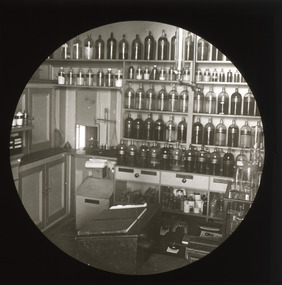
Photograph - Lantern Slide, c1900
... women in business...david mcewan...john mcewan...national trust...national trust victoria...north-east victoria national trust...heritage buildings...industrial heritage...helene grey...pharmaceutical society of victoria...victorian college of pharmacy...country women's association...caroline copp...royal melbourne hospital...She was a member of the Pharmaceutical Society of Victoria, a hospital committee and Board, the Red Cross and the Infant Welfare Association and held office for the Chiltern branch of the Country Women's Association. Her sister Helene Grey received an OBE for her work as Lady Superintendent of the Royal Melbourne Hospital. ...She was a member of the Pharmaceutical Society of Victoria, a hospital committee and Board, the Red Cross and the Infant Welfare Association and held office for the Chiltern branch of the Country Women's Association. Her sister Helene Grey received an OBE for her work as Lady Superintendent of the Royal Melbourne Hospital. ...Chiltern Pharmacy, now called Dow's Pharmacy, opened in 1859 at a time when the township of Chiltern was experiencing a second-wave gold rush that redistributed the balance of commercial and social activity in the region. David McEwan, father of Prime Minister John McEwan, was one of the first pharmacists practicing at the business. It was purchased in 1929 by pharmacist Hilda Dow who ran the business with her apprentice and husband, Roy Dow, until they closed the business in 1968. In 1988, after founding the North East branch of the National Trust, the Dows donated the premises with its entire fittings and stock. Some of the more than 4,000 items in stock at the time of closure in 1968 were present in the shop when the Dows took charge in 1929 and date to the late Nineteenth Century (around the time this image was taken). Hilda Dow (nee Grey) was born in 1897, the daughter of a police magistrate. She enrolled to study at the Victorian College of Pharmacy in 1919 and worked initially for Poynton's Pharmacy in Morwell before purchasing the Chiltern Pharmacy that was later named after her. She was a member of the Pharmaceutical Society of Victoria, a hospital committee and Board, the Red Cross and the Infant Welfare Association and held office for the Chiltern branch of the Country Women's Association. Her sister Helene Grey received an OBE for her work as Lady Superintendent of the Royal Melbourne Hospital. Although Hilda Dow was not Australia's first female pharmacist (this was Caroline Copp in 1880) the preservation of the pharmacy and the stories it presents sheds light on the general issue of recognition for female medical pioneers in Australia. Lantern slides, sometimes called 'magic lantern' slides, are glass plates on which an image has been secured for the purpose of projection. Glass slides were etched or hand-painted for this purpose from the Eighteenth Century but the process became more popular and accessible to the public with the development of photographic-emulsion slides used with a 'Magic Lantern' device in the mid-Nineteenth Century. Photographic lantern slides comprise a double-negative emulsion layer (forming a positive image) between thin glass plates that are bound together. A number of processes existed to form and bind the emulsion layer to the base plate, including the albumen, wet plate collodion, gelatine dry plate and woodburytype techniques. Lantern slides and magic lantern technologies are seen as foundational precursors to the development of modern photography and film-making techniques.This image is significant as it provides insight into social and commercial infrastructure available in the North-East region of Victoria in the late Nineteenth and early Twentieth Centuries. The business pictured is also associated with a Prime Minister of Victoria and some of Victoria's first female medical and pharmaceutical practitioners. Thin translucent sheet of glass with a circular image printed on the front and framed in a black backing. It is held together by metals strips to secure the edges of the slide.burke museum, beechworth, lantern slide, slide, glass slide, plate, burke museum collection, photograph, monochrome, hilda dow, roy dow, chiltern pharmacy, dow's pharmacy, chiltern, indigo shire, north east victoria, history of pharmacies, women in pharmacy, women in medicine, women in business, david mcewan, john mcewan, national trust, national trust victoria, north-east victoria national trust, heritage buildings, industrial heritage, helene grey, pharmaceutical society of victoria, victorian college of pharmacy, country women's association, caroline copp, royal melbourne hospital, red cross, infant welfare association -
 Federation University Historical Collection
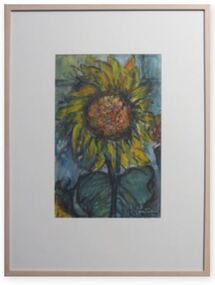
Article - Article - Women, Ballarat School of Mines: Women of Note; Isabel Huntington, Artist, Teacher, (1905 - 1971), 13/07/2023
... women of note...isabel huntington...ballarat school of mines...ballarat high school...ballarat technical art school...royal melbourne institute of technology...rmit...victorian division of red cross...director of handcrafts...rosanna high school...montmorency...heidelberg military hospital...Born Isabel McCausland, she married Robert Huntington in 1931. women of note isabel huntington ballarat school of mines ballarat high school ballarat technical art school royal melbourne institute of technology rmit victorian division of red cross director of handcrafts rosanna high school montmorency heidelberg military hospital supervisor of handcrafts art shows melbourne ballarat hamilton mccausland robert huntington Ballarat School of Mines: Women of Note; Isabel Huntington, Artist, Teacher, (1905 - 1971) Article Article - Women ...Isabel Huntington was a painter, craft officer and craft worker. She studied at Ballarat High School, Ballarat Technical Art School (a division of the School of Mines) and RMIT, and was a member of the Victorian Artists' Society and the Contemporary Art Society. In 1945 she was appointed Director of Handcrafts for the Victorian Division of the Red Cross Society. Isabel Huntington had previously held the position of Supervisor of Handcrafts at Heidelberg Military Hospital for three and a half years. She was a member of the Arts and Crafts Society. Isabel Huntington had five 'one-man" shows, three in Melbourne, one in Ballarat and one in Hamilton, Victoria. Ursula Hoff (from the National Gallery Victoria) judged the 1965 Albury awards for watercolour, and religious paintings in oils, awarding the prize to Isabel Huntington. In the same year Isabel Huntington travelled to Europe. After returning from overseas she taught at Rosanna High School, Victoria. Isabel Huntington lived at Montmorency, Victoria, and was there at the time of her death. Born Isabel McCausland, she married Robert Huntington in 1931. women of note, isabel huntington, ballarat school of mines, ballarat high school, ballarat technical art school, royal melbourne institute of technology, rmit, victorian division of red cross, director of handcrafts, rosanna high school, montmorency, heidelberg military hospital, supervisor of handcrafts, art shows, melbourne, ballarat, hamilton, mccausland, robert huntington -
 Eltham District Historical Society Inc
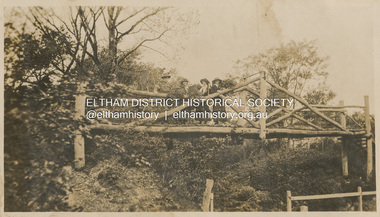
Photograph, "Curry, Byrne, McGeachy & self on rustic bridge, Eltham", 22 Oct 1919
... This photo is part of the Alice Broadhurst collection held by Yarra Plenty Regional Library, a series of 12 photo albums compiled by Alice Broadhurst (1896-1981), initially while working as a Voluntary Aid Detachment nurse with the Australian Red Cross at the Mont Park Military Hospital (No. 16 AGH) and subsequently as a nurse at the Royal Melbourne and Royal Women’s hospitals alongside many pioneering doctors of their fields. ...This photo is part of the Alice Broadhurst collection held by Yarra Plenty Regional Library, a series of 12 photo albums compiled by Alice Broadhurst (1896-1981), initially while working as a Voluntary Aid Detachment nurse with the Australian Red Cross at the Mont Park Military Hospital (No. 16 AGH) and subsequently as a nurse at the Royal Melbourne and Royal Women’s hospitals alongside many pioneering doctors of their fields. ...The old Diamond Street bridge in Eltham had a raised section seen here and a lower section, the railings of which can just be seen. The upper pedestrian crossing provided continual access for foot traffic during times of flood. This photo is part of the Alice Broadhurst collection held by Yarra Plenty Regional Library, a series of 12 photo albums compiled by Alice Broadhurst (1896-1981), initially while working as a Voluntary Aid Detachment nurse with the Australian Red Cross at the Mont Park Military Hospital (No. 16 AGH) and subsequently as a nurse at the Royal Melbourne and Royal Women’s hospitals alongside many pioneering doctors of their fields. This photo depicts an outing with fellow VAD nurses McGeachy and Byrne and two patients of Mont Park, Curry and Caffery to Eltham in spring 1919 Digital file"Curry, Byrne, McGeachy & self on rustic bridge, Eltham, Oct 22, 1919"eltham, diamond creek, diamond street bridge, alice elizabeth broadhurst, byrne, caffery, curry, mcgeachy, nursing staff, mont park, 16 agh -
 Eltham District Historical Society Inc
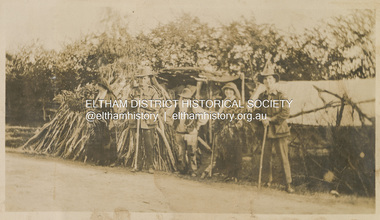
Photograph, "McGeachy, Curry, Byrne & Caffery with an old man who lives there at Eltham", 22 Oct 1919
... This photo is part of the Alice Broadhurst collection held by Yarra Plenty Regional Library, a series of 12 photo albums compiled by Alice Broadhurst (1896-1981), initially while working as a Voluntary Aid Detachment nurse with the Australian Red Cross at the Mont Park Military Hospital (No. 16 AGH) and subsequently as a nurse at the Royal Melbourne and Royal Women’s hospitals alongside many pioneering doctors of their fields....This photo is part of the Alice Broadhurst collection held by Yarra Plenty Regional Library, a series of 12 photo albums compiled by Alice Broadhurst (1896-1981), initially while working as a Voluntary Aid Detachment nurse with the Australian Red Cross at the Mont Park Military Hospital (No. 16 AGH) and subsequently as a nurse at the Royal Melbourne and Royal Women’s hospitals alongside many pioneering doctors of their fields. eltham alice elizabeth broadhurst byrne caffery curry mcgeachy nursing staff mont park 16 agh old timer pioneer cottage wood pile "McGeachy, Curry, Byrne & Caffery with an old man who lives there at Eltham" Digital file "McGeachy, Curry, Byrne & Caffery with an old man who lives there at Eltham" Photograph Photograph ...This photo depicts an outing of VAD nurses Alice Broadhurst, McGeachy and Byrne and two patients of No. 16 AGH Macleod (Mont Park Military Hospital), Curry and Caffery to Eltham in spring 1919. Broadhurst's companions pose with an old timer from Eltham on the roadside verge with a large collection of sticks stacked vertically outside a cottage. This photo is part of the Alice Broadhurst collection held by Yarra Plenty Regional Library, a series of 12 photo albums compiled by Alice Broadhurst (1896-1981), initially while working as a Voluntary Aid Detachment nurse with the Australian Red Cross at the Mont Park Military Hospital (No. 16 AGH) and subsequently as a nurse at the Royal Melbourne and Royal Women’s hospitals alongside many pioneering doctors of their fields.Digital file"McGeachy, Curry, Byrne & Caffery with an old man who lives there at Eltham"eltham, alice elizabeth broadhurst, byrne, caffery, curry, mcgeachy, nursing staff, mont park, 16 agh, old timer, pioneer, cottage, wood pile -
 Eltham District Historical Society Inc
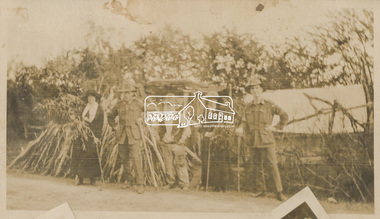
Photograph, "Same group with self instead of Byrne, Eltham", 22 Oct 1919
... This photo is part of the Alice Broadhurst collection held by Yarra Plenty Regional Library, a series of 12 photo albums compiled by Alice Broadhurst (1896-1981), initially while working as a Voluntary Aid Detachment nurse with the Australian Red Cross at the Mont Park Military Hospital (No. 16 AGH) and subsequently as a nurse at the Royal Melbourne and Royal Women’s hospitals alongside many pioneering doctors of their fields....This photo is part of the Alice Broadhurst collection held by Yarra Plenty Regional Library, a series of 12 photo albums compiled by Alice Broadhurst (1896-1981), initially while working as a Voluntary Aid Detachment nurse with the Australian Red Cross at the Mont Park Military Hospital (No. 16 AGH) and subsequently as a nurse at the Royal Melbourne and Royal Women’s hospitals alongside many pioneering doctors of their fields. eltham alice elizabeth broadhurst byrne caffery curry mcgeachy nursing staff mont park 16 agh old timer pioneer cottage wood pile "Same group with self instead of Byrne, Eltham, Oct 22" Digital file "Same group with self instead of Byrne, Eltham" Photograph Photograph ...This photo depicts an outing of VAD nurses Alice Broadhurst, McGeachy and Byrne and two patients of No. 16 AGH Macleod (Mont Park Military Hospital), Curry and Caffery to Eltham in spring 1919. Broadhurst's companions pose with an old timer from Eltham on the roadside verge with a large collection of sticks stacked vertically outside a cottage. This photo is part of the Alice Broadhurst collection held by Yarra Plenty Regional Library, a series of 12 photo albums compiled by Alice Broadhurst (1896-1981), initially while working as a Voluntary Aid Detachment nurse with the Australian Red Cross at the Mont Park Military Hospital (No. 16 AGH) and subsequently as a nurse at the Royal Melbourne and Royal Women’s hospitals alongside many pioneering doctors of their fields.Digital file"Same group with self instead of Byrne, Eltham, Oct 22"eltham, alice elizabeth broadhurst, byrne, caffery, curry, mcgeachy, nursing staff, mont park, 16 agh, old timer, pioneer, cottage, wood pile -
 Eltham District Historical Society Inc
Photograph, Picnic at Eltham with Caffery, Curry, Byrne and McGeachy, 22 Oct 1919
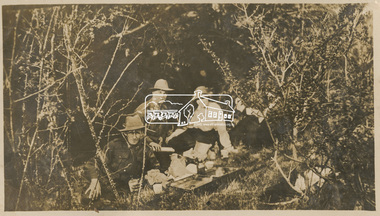
... This photo is part of the Alice Broadhurst collection held by Yarra Plenty Regional Library, a series of 12 photo albums compiled by Alice Broadhurst (1896-1981), initially while working as a Voluntary Aid Detachment nurse with the Australian Red Cross at the Mont Park Military Hospital (No. 16 AGH) and subsequently as a nurse at the Royal Melbourne and Royal Women’s hospitals alongside many pioneering doctors of their fields....This photo is part of the Alice Broadhurst collection held by Yarra Plenty Regional Library, a series of 12 photo albums compiled by Alice Broadhurst (1896-1981), initially while working as a Voluntary Aid Detachment nurse with the Australian Red Cross at the Mont Park Military Hospital (No. 16 AGH) and subsequently as a nurse at the Royal Melbourne and Royal Women’s hospitals alongside many pioneering doctors of their fields. eltham alice elizabeth broadhurst byrne caffery curry mcgeachy nursing staff mont park 16 agh diamond creek picnic Digital file Picnic at Eltham with Caffery, Curry, Byrne and McGeachy Photograph Photograph ...This photo depicts an outing of VAD nurses Alice Broadhurst, McGeachy and Byrne and two patients of No. 16 AGH Macleod (Mont Park Military Hospital), Curry and Caffery to Eltham in spring 1919. Broadhurst's companions pose sitting on a creek bank around a open suitcase which containes their picnic spread. This photo is part of the Alice Broadhurst collection held by Yarra Plenty Regional Library, a series of 12 photo albums compiled by Alice Broadhurst (1896-1981), initially while working as a Voluntary Aid Detachment nurse with the Australian Red Cross at the Mont Park Military Hospital (No. 16 AGH) and subsequently as a nurse at the Royal Melbourne and Royal Women’s hospitals alongside many pioneering doctors of their fields.Digital fileeltham, alice elizabeth broadhurst, byrne, caffery, curry, mcgeachy, nursing staff, mont park, 16 agh, diamond creek, picnic -
 Eltham District Historical Society Inc
Photograph, "Resting, Eltham", 22 Oct 1919
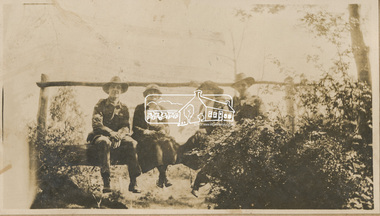
... This photo is part of the Alice Broadhurst collection held by Yarra Plenty Regional Library, a series of 12 photo albums compiled by Alice Broadhurst (1896-1981), initially while working as a Voluntary Aid Detachment nurse with the Australian Red Cross at the Mont Park Military Hospital (No. 16 AGH) and subsequently as a nurse at the Royal Melbourne and Royal Women’s hospitals alongside many pioneering doctors of their fields....This photo is part of the Alice Broadhurst collection held by Yarra Plenty Regional Library, a series of 12 photo albums compiled by Alice Broadhurst (1896-1981), initially while working as a Voluntary Aid Detachment nurse with the Australian Red Cross at the Mont Park Military Hospital (No. 16 AGH) and subsequently as a nurse at the Royal Melbourne and Royal Women’s hospitals alongside many pioneering doctors of their fields. eltham alice elizabeth broadhurst byrne caffery curry mcgeachy nursing staff mont park 16 agh log bridge Digital file "Resting, Eltham" Photograph Photograph ...This photo depicts an outing of VAD nurses Alice Broadhurst, McGeachy and Byrne and two patients of No. 16 AGH Macleod (Mont Park Military Hospital), Curry and Caffery to Eltham in spring 1919. Broadhurst's companions pose sitting on a log bridge. This photo is part of the Alice Broadhurst collection held by Yarra Plenty Regional Library, a series of 12 photo albums compiled by Alice Broadhurst (1896-1981), initially while working as a Voluntary Aid Detachment nurse with the Australian Red Cross at the Mont Park Military Hospital (No. 16 AGH) and subsequently as a nurse at the Royal Melbourne and Royal Women’s hospitals alongside many pioneering doctors of their fields.Digital fileeltham, alice elizabeth broadhurst, byrne, caffery, curry, mcgeachy, nursing staff, mont park, 16 agh, log bridge -
 Warrnambool and District Historical Society Inc.
Document, University of Melbourne, First half of 20th C
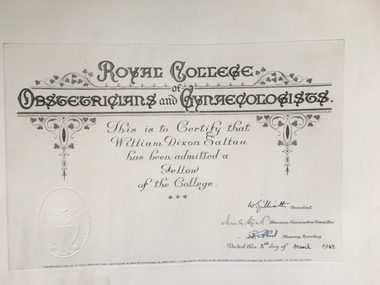
... Hospital Board and a long-serving State politician. William Dixon Saltau was educated at Warrnambool Academy and Scotch College and graduated from Melbourne University in 1918. He worked as a doctor in Melbourne and Adelaide hospitals and in England. He was the Medical Superintendent of the Women’s Hospital in Melbourne for 25 years and was elected to the Fellowship of the Royal...Hospital Board and a long-serving State politician. William Dixon Saltau was educated at Warrnambool Academy and Scotch College and graduated from Melbourne University in 1918. He worked as a doctor in Melbourne and Adelaide hospitals and in England. He was the Medical Superintendent of the Women’s Hospital in Melbourne for 25 years and was elected to the Fellowship of the Royal ...These three items give details of the medical qualifications of Dr William Dixon Saltau. Born in Warrnambool, Dr Saltau (1894-1970) was the son of Hon. Marcus Saltau. M.L.C. and Jean Saltau (nee Anton). The Saltau family had been prominent in Warrnambool affairs since Henry Saltau arrived in Warrnambool in the 1870s and founded the business of Saltau and Son – general carriers, coal, wood and produce merchants and forwarding agents. Marcus Saltau was active in Warrnambool community affairs as Mayor, Chairman of the Warrnambool Hospital Board and a long-serving State politician. William Dixon Saltau was educated at Warrnambool Academy and Scotch College and graduated from Melbourne University in 1918. He worked as a doctor in Melbourne and Adelaide hospitals and in England. He was the Medical Superintendent of the Women’s Hospital in Melbourne for 25 years and was elected to the Fellowship of the Royal College of Obstetricians and Gynaecologists in 1947. These items are of considerable importance as they are original documents connected to the medical career of Dr William Saltau. He came from a prominent Warrnambool family and had a distinguished medical career. These are three items belonging to Dr William Dixon Saltau:- Item One: Certificate of Dr William Saltau’s admission to the British Royal College of Obstetricians and Gynaecologists – a cream sheet of parchment paper with the stamp of the Royal College and black printed material and three signatures and two ornamental scrolls under the heading. Item Two: Oval cardboard cylinder to hold the certificate. It has one enclosed end and a label on the outside with a British stamp and a typed address. Item Three: A leather bound folder containing 37 pages, 34 of them with details of the medical courses completed at the University of Melbourne by Dr Saltau. The cover has a gold border. Item Three Cover: ‘University of Melbourne Certificates of the Degrees of M.B. & B.S.’saltau family, history of warrnambool, dr william dixon saltau -
 Geoffrey Kaye Museum of Anaesthetic History
Document - Certificate, 1980
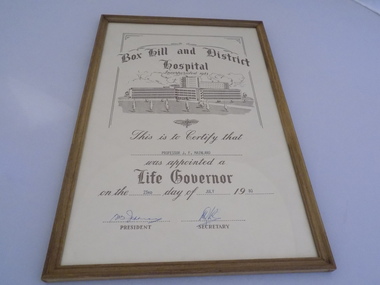
... Melbourne in 1950 with a Bachelor of Science degree. After researching and completing his medical degree, Mainland entered into the field of anaesthetics, training at the Royal Women's and Royal Children's Hospitals, later Alfred Hospital, in 1959. ...Melbourne in 1950 with a Bachelor of Science degree. After researching and completing his medical degree, Mainland entered into the field of anaesthetics, training at the Royal Women's and Royal Children's Hospitals, later Alfred Hospital, in 1959. ...The certificate and tie clips were in the possession of Dr John Mainland. Mainland graduated from the University of Melbourne in 1950 with a Bachelor of Science degree. After researching and completing his medical degree, Mainland entered into the field of anaesthetics, training at the Royal Women's and Royal Children's Hospitals, later Alfred Hospital, in 1959. He completed training in 1964 and remained at the Alfred Hospital. During his career, he also became the first anaesthetist appointed to the position of Professor in Victoria. His other achievements include manufacturing a respiratory monitoring module that accompanied astronauts on the United States moon landing and developing a stimulator to lessen the risk of deep vein thrombosis in surgical patients. Mainland became a Fellow of the Australian and New Zealand College of Anaesthetists in 1992, retiring from the profession in 1997.The certificate rests beneath a thin layer of glass kept in a light wooden frame. The certificate is cream in colour with dark brown writing. In the middle is an illustration of Box Hill and District Hospital building. At the bottom of the certificate is the signature of the President and Secretory. On the back of the frame there are two metal loops connected by a thin piece of metal wire. Hanging on this wire are two clips from the Alfred Hospital. The face of the clips is consists of the Alfred Hospital emblem in red and gold surrounded by a border of blue with the name of the hospital inscribed. Masking tape runs the border of the frame.Printed in black ink on back of frame: marlow Galleries / 968 Whitehorse Rd, Box Hill / Ph: 89 2062, 1st floor •Inscribed on face of clips: Alfred Hospital Melbourne For Service •Printed in brown ink on the certificate: Box Hill and District / Hospital / This is to Certify that / Professor J. F. Mainland / was appointed a / Life Governor / on the 23rd day of July 1980 / President Secretary •Signed in blue ink by the President and Secretarycertificate, box hill and district hospital, life governor, mainland, john, alfred hospital -
 Geoffrey Kaye Museum of Anaesthetic History
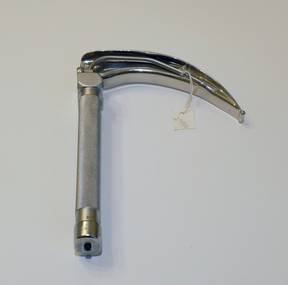
Tool - Laryngoscope, Macintosh
... Melbourne in 1950 with a Bachelor of Science degree. After researching and completing his medical degree, Mainland entered into the field of anaesthetics, training at the Royal Women's and Royal Children's Hospitals, later Alfred Hospital, in 1959. ...Melbourne in 1950 with a Bachelor of Science degree. After researching and completing his medical degree, Mainland entered into the field of anaesthetics, training at the Royal Women's and Royal Children's Hospitals, later Alfred Hospital, in 1959. ...A laryngoscope is an instrument used to view the larynx (voice box), which is the opening to the trachea and lungs. It consists of a “blade,” which goes into the patient’s mouth, and a handle. Prior to 1943 when Macintosh introduced his curved blade, most laryngoscope blades were long and straight. The straight blades were used to directly hold the epiglottis. Macintosh’s curved blade works differently: it indirectly opens the epiglottis by applying pressure to a space between the root of the tongue and epiglottis, called the vallecula. The flange running along the left lower edge of Macintosh’s blade was also a novel innovation. It was designed to move the tongue to the side, which improved the view of the larynx and made more room for a breathing tube. The Macintosh Laryngoscope remains one of the most popular blades worldwide. (Source: Wood Library Museum) This laryngoscope was previously owned by John Mainland, as evidenced by the name etched into the handle. Mainland graduated from the University of Melbourne in 1950 with a Bachelor of Science degree. After researching and completing his medical degree, Mainland entered into the field of anaesthetics, training at the Royal Women's and Royal Children's Hospitals, later Alfred Hospital, in 1959. He completed training in 1964 and remained at the Alfred Hospital. During his career, he also became the first anaesthetist appointed to the position of Professor in Victoria. His other achievements include manufacturing a respiratory monitoring module that accompanied astronauts on the United States moon landing and developing a stimulator to lessen the risk of deep vein thrombosis in surgical patients. Mainland became a Fellow of the Australian and New Zealand College of Anaesthetists in 1992, retiring from the profession in 1997.Oblong shaped handle with textured grip. Attached is a laryngoscope blade in a cruved shaped with light tube running through one side.Etched into top of handle: J.F. MAINLAND •Stamped into top of handle: REGD TRADE MARK / PENLON / MADE IN ENGLAND •Stamped into base of handle: CLOSE [arrow] •Etched into base of blade: MAC / 4 •Stamped into side of blade: REGD TRADE MARK / PENLON / MADE IN ENGLAND •Stamped into side of blade: STAINLESSmacintosh, robert reynolds, new zealand, laryngoscope, mainland, john, alfred hospital, moon landing -
 Geoffrey Kaye Museum of Anaesthetic History
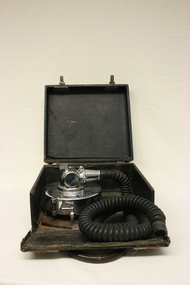
Machine - Small ether inhaler
... Royal Women's Hospital in Sydney during the 1930s. The inhaler is compact and portable. Initially, Small experimented with other agents for the relief of labour pain but was not happy with any of them. He also tried various agents on himself, including nitrous oxide/oxygen, chloroform and ethyl chloride. Finally he settled on ether via a Clover inhaler as the best analgesic. This inhaler is only described in use in Australia and New Zealand, although it was used for almost 40 years. ether small thomas analgesia obstetrics anaesthesia anaesthetic royal women's sydney queen victoria melbourne ...Dr Thomas Small designed this ether anaesthesia and analgesia machine while he was an Honorary Medical Officer at the Royal Women's Hospital in Sydney during the 1930s. The inhaler is compact and portable. Initially, Small experimented with other agents for the relief of labour pain but was not happy with any of them. He also tried various agents on himself, including nitrous oxide/oxygen, chloroform and ethyl chloride. Finally he settled on ether via a Clover inhaler as the best analgesic. This inhaler is only described in use in Australia and New Zealand, although it was used for almost 40 years. Black leather box with leather handle, lockable latches on either side and drop down front case panel containing a metal ether inhaler and length of black corrugated rubber hose with one end attached to the inhaler and the other end open for attaching a mask. The metal inhaler drum is circular and attached to the floor of the case with a small tap/lever to one side and a mixing valve on the top near the hose connection. The lever has incised gradings of quarter increments from 0 to 1. The box is designed for the ether inhaler to be portable.ether, small, thomas, analgesia, obstetrics, anaesthesia, anaesthetic, royal women's, sydney, queen victoria, melbourne -
 Geoffrey Kaye Museum of Anaesthetic History
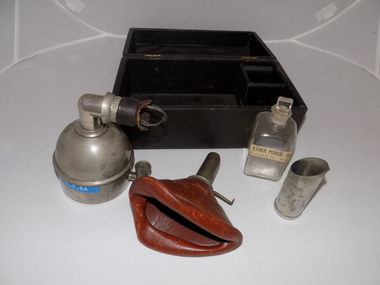
Equipment - Inhaler, Clover, Mayer & Meltzer, 1877
... (Source: Wood Library Museum) clover, joseph mollison, crawford henry george bankin mccaul, kevin royal women's hospital coroner freemason surgeon gynaecologist obstetrician mayer & meltzer francis & co, melbourne ether purus Printed in gold leaf inside lid of box: MAYER & MELTZER [?] ...Dr. Joseph Clover (1825-1882), an English physician, first described his Portable Regulating Ether Inhaler on Jan. 20, 1877. Clover was an especially sought after anesthesiologist and early pioneer in the specialty. This was the best-known of many inhalers that Clover designed. The dome-shaped reservoir was turned to points on a control dial to gradually increase or decrease the percentage of the air that passed over the ether. Several inventors based new inhalers on this, while the original continued to be manufactured as late as the beginning of WWII. (Source: Wood Library Museum)Black round topped box with brass hooks at front and brass hinges at rear. There is a black fabric handle on the top. Inside the box is black padding with the manufacturer's logo printed in gold leaf. There is a square section in the base of the box for holding the square clear glass bottle for ether. There is also a dome-shaped metal inhaler with a "whistle tip" type connection to the mask. The mask is made of tan leather. There is also a metal ether measure for pouring the ether.Printed in gold leaf inside lid of box: MAYER & MELTZER [?] PORTLAND ST. / MAKERS •Engraved on side of inhaler: Mayer & Meltzer / London •Stamped on connector of inhaler: MAYER & MELTZER RN NO 212327 •Engraved on rear of inhaler: Clover's Inhaler •Printed in white on blue sticker: O.2.5A •Measurements have been stamped on the bottom of the inhaler. •Printed in black ink on mask: MADE IN ENGLAND •Stamped on metal connector inside mask: 6 •Printed in black ink on white manufacturer's label on glass bottle: ETHER PURUS '720 / H. Francis & Co., Melbourne.clover, joseph, mollison, crawford henry, george bankin, mccaul, kevin, royal women's hospital, coroner, freemason, surgeon, gynaecologist, obstetrician, mayer & meltzer, francis & co, melbourne, ether purus -
 Royal Australian and New Zealand College of Obstetricians & Gynaecologists (RANZCOG)
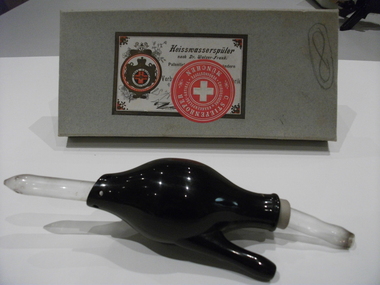
'Heisswasserpülar' vaginal douche associated with Dr Edward Rowden White
... Melbourne, from the Sir Edward Rowden White Estate. Sir Edward (1884-1958) was a Foundation Fellow of the Australian Regional Council of RCOG and was the first Chairman of the Arthur Wilson Foundation, and created (with his brother) the EA Rowden White and Edward R White Foundation for Medical Research at the Royal Women's Hospital in 1955. ...This douche, with the manufacturers object description of "heisswasserspulungen" which translates as healing water douche, came from the Edward Rowden White Estate. The heisswasserpular designed by Dr Walzer-Frank was used as a vaginal douche by attaching a rubber hose to the glass connector which was then inserted into the vagina. Acquired from Dr Harold Attwood, the Curator of the Medical History Unit, University of Melbourne, 2 April 1996. In a letter to Geoff Bishop ... " I think they are best held in your collection rather than here." (see accession file)Transferred from the collection of the Medical Unit (Brownless Medical Museum) University of Melbourne, from the Sir Edward Rowden White Estate. Sir Edward (1884-1958) was a Foundation Fellow of the Australian Regional Council of RCOG and was the first Chairman of the Arthur Wilson Foundation, and created (with his brother) the EA Rowden White and Edward R White Foundation for Medical Research at the Royal Women's Hospital in 1955. Black bakelite bulb with glass douche nozzle and irrigator connections at each end. Stored in original box. Handwritten in blue pencil on side of box: "Vaginal Douche".vaginal irrigation -
 Royal Australian and New Zealand College of Obstetricians & Gynaecologists (RANZCOG)
Cervical dilation instrument set
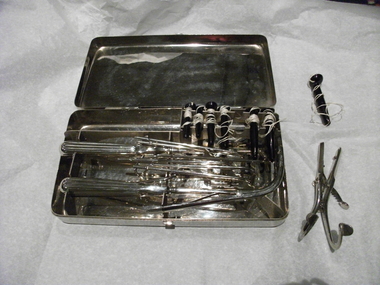
... Donated by Professor Harold Attwood, University of Melbourne Faculty of Medicine in 1963, originally from the Edward Rowden White Estate.Sir Edward Rowden (1884-1958) was a Foundation Fellow of the Australian Regional Council of RCOG and was the first Chairman of the Arthur Wilson Foundation, and created with his brother the EA Rowden White and Edward R White Foundation for Medical Research at the Royal Women's Hospital in 1955....Donated by Professor Harold Attwood, University of Melbourne Faculty of Medicine in 1963, originally from the Edward Rowden White Estate.Sir Edward Rowden (1884-1958) was a Foundation Fellow of the Australian Regional Council of RCOG and was the first Chairman of the Arthur Wilson Foundation, and created with his brother the EA Rowden White and Edward R White Foundation for Medical Research at the Royal Women's Hospital in 1955. ...Donated by Professor Harold Attwood, University of Melbourne Faculty of Medicine in 1963, originally from the Edward Rowden White Estate.Sir Edward Rowden (1884-1958) was a Foundation Fellow of the Australian Regional Council of RCOG and was the first Chairman of the Arthur Wilson Foundation, and created with his brother the EA Rowden White and Edward R White Foundation for Medical Research at the Royal Women's Hospital in 1955.Cervical dilation Instrument set, seven graduated dilators, black plastic with string attached, a tennaculum, 2x handled instruments for attachment and a surgical retractor in a metal box. [See page 498 George Tiemann catalogue, similar],cervical dilation, edward rowden white professor harold atwood -
 Royal Australian and New Zealand College of Obstetricians & Gynaecologists (RANZCOG)
Painting - Portrait of Dr Lance Townsend, Sir William Dargie CBE, n.d
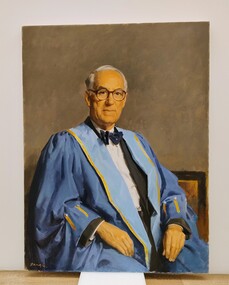
... Melbourne's first Professor of Obstetrics and Gynaecology in 1951. During his quarter of a century tenure of the chair, Professor Townsend oversaw tremendous growth in the clinical services, undergraduate and postgraduate education and research in Obstetrics and Gynaecolology at the Royal Women's Hospital and was a major national and international figure in the field over this period. ...Melbourne's first Professor of Obstetrics and Gynaecology in 1951. During his quarter of a century tenure of the chair, Professor Townsend oversaw tremendous growth in the clinical services, undergraduate and postgraduate education and research in Obstetrics and Gynaecolology at the Royal Women's Hospital and was a major national and international figure in the field over this period. ...Captain Sir William Alexander Dargie CBE (4 June 1912 – 26 July 2003) was a renowned Australian painter, known especially for his portrait paintings. He won the Archibald Prize, Australia's premier award for portrait artists on eight separate occasions; a record held since 1952. (Wikipedia) Dr Sydney Lance Townsend (1913-1983) was appointed the University of Melbourne's first Professor of Obstetrics and Gynaecology in 1951. During his quarter of a century tenure of the chair, Professor Townsend oversaw tremendous growth in the clinical services, undergraduate and postgraduate education and research in Obstetrics and Gynaecolology at the Royal Women's Hospital and was a major national and international figure in the field over this period. In recognition of his contribution, which included the establishment of a second University of Melbourne Department of Obstetrics and Gynaecology and which was located at the Mercy Hospital for Women under the direction of his protégé, Professor Norman Beischer, Professor Townsend was knighted for his services to Obstetrics and Gynaecology. (Melbourne Medical School - History) Oil on canvas painting. Colour portrait of a man seated in a chair. The man is wearing a white shirt, dark suit, and blue bowtie, beneath a dark blue robe. The robe has light blue front panels and gold trim, with decorative buttons and gold stripes at the cuffs. The man has grey receding hair, dark rimmed glasses, and is facing the artist with his body angled towards the bottom right-hand corner. He is pictured against a dark grey background, with the corner of a bench or chair visible next to his left elbow. Signature painted at bottom left corner of portrait reads 'Dargie.' Brass plaque attached to back of painting frame is engraved with the text 'PROFESSOR S.L. TOWNSEND/ President - Chairman/AUSTRALIAN REGIONAL COUNCIL, RCOG/1963-1966'. -
 Alfred Hospital Nurses League - Nursing History Collection
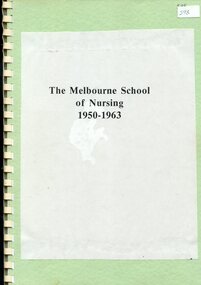
Book - Illustrated book (photocopy), Norman J Marshall, The Melbourne School of Nursing 1950-1963, 1985
... The Melbourne School of Nursing was formed in 1950 when the Royal Melbourne Hospital’s School of Nursing joined with those of the Queen Victoria Hospital, Fairfield Hospital and the Royal Women’s Hospital . ...The Melbourne School of Nursing was formed in 1950 when the Royal Melbourne Hospital’s School of Nursing joined with those of the Queen Victoria Hospital, Fairfield Hospital and the Royal Women’s Hospital . ...History of the Melbourne School of Nursing, includes list of all graduatesIllustrated book with white comb binding. Has clear plastic protective covers front and back. Title printed [in black ink] on white paper and fixed to larger pale green cardboardnon-fictionHistory of the Melbourne School of Nursing, includes list of all graduatesmelbourne school of nursing-history, the royal melbourne hospital and associated hospitals school of nursing, the royal melbourne hospital
