
Showing 13 items matching "the silver blue bird"
-
 Moorabbin Air Museum
Book - General aviation, Earlybird The Story of Phil Lightband
... ...The silver blue bird...General aviation The child bird Air born The helmet speaks Solo Old enough Dancing Discipline Crossroads War bird Grounded Sea gulls The silver blue bird First leg Bogged Foreign skies Winged Jail birds Wings clipped Bikes & prams Phoenix Between two worids Amphibians Rainmakers Biography of NZ pilot Phil Lightbrand & his involvement in NZ general aviation, circa 1996 Earlybird The Story of Phil Lightband Book General aviation ...Biography of NZ pilot Phil Lightbrand & his involvement in NZ general aviation, circa 1996non-fictionBiography of NZ pilot Phil Lightbrand & his involvement in NZ general aviation, circa 1996the child bird, air born, the helmet speaks, solo, old enough, dancing, discipline, crossroads, war bird, grounded, sea gulls, the silver blue bird, first leg, bogged, foreign skies, winged, jail birds, wings clipped, bikes & prams, phoenix, between two worids, amphibians, rainmakers -
 The Beechworth Burke Museum
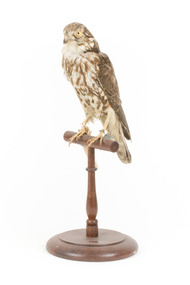
Animal specimen - Merlin
... blue, black, silver or grey. This species is predominantly found in the Northern Hemisphere. They are small, fast and highly skilled in hunting. The Merlin is generally a solitary bird...blue, black, silver or grey. This species is predominantly found in the Northern Hemisphere. They are small, fast and highly skilled in hunting. The Merlin is generally a solitary bird ...This Merlin specimen is large for the falco columbarius species. It is brown and white in colouring which suggests that this particular specimen is female. This is because male Merlin's are usually blue, black, silver or grey. This species is predominantly found in the Northern Hemisphere. They are small, fast and highly skilled in hunting. The Merlin is generally a solitary bird outside of the mating season when it will socialise with other Merlins. The Merlin will consume smaller birds, mammals and bugs. This specimen is part of a collection of almost 200 animal specimens that were originally acquired as skins from various institutions across Australia, including the Australian Museum in Sydney and the National Museum of Victoria (known as Museums Victoria since 1983), as well as individuals such as amateur anthropologist Reynell Eveleigh Johns between 1860-1880. These skins were then mounted by members of the Burke Museum Committee and put-on display in the formal space of the Museum’s original exhibition hall where they continue to be on display. This display of taxidermy mounts initially served to instruct visitors to the Burke Museum of the natural world around them, today it serves as an insight into the collecting habits of the 19th century.This specimen is part of a significant and rare taxidermy mount collection in the Burke Museum. This collection is scientifically and culturally important for reminding us of how science continues to shape our understanding of the modern world. They demonstrate a capacity to hold evidence of how Australia’s fauna history existed in the past and are potentially important for future environmental research. This collection continues to be on display in the Museum and has become a key part to interpreting the collecting habits of the 19th century.This female Merlin has a medium brown back with light brown and white speckled chest. The edges of her wings are dark brown and underneath her tail is white but also patterned in spots of light brown. It's bright yellow eyes are framed by tan coloured feathers and elaborate spotted patterns throughout it's body. Her small hooked beck ranges from orange to dark brown and feet are a faded yellow.Swing tag: 28 / Merlin / Catalogue, page 6 / Other swing tag: 56 / Falco / Cesalon Metal tag: 4033 /taxidermy mount, taxidermy, animalia, burke museum, beechworth, australian museum, skin, bird, northern hemisphere, falcon, falco columberius, merlin, pigeon hawk -
Glenelg Shire Council Cultural Collection
Poster - Poster - 1984 Portland 150th celebration poster, 1984
... Bower Bird Museum, Heywood. 1984 Portland 150th celebration poster- blue background, silver printing and images. ...Bower Bird Museum, Heywood.1984 Portland 150th celebration poster- blue background, silver printing and images. -
 Flagstaff Hill Maritime Museum and Village
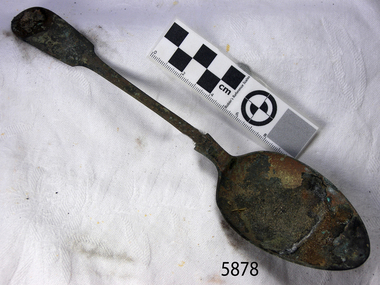
Domestic object - Spoon, circa 1878
... Bird Island LOCH ARD Gorge electroplated cutlery loch ard shipwreck william page and co birmingham brass plating table spoons Unrestored table spoon from the wreck of the LOCH ARD. The spoon design has a flattened fiddle-back handle, with a thin stem or shank, flared collar, and a shallow rounded bowl. The spoons metallic composition is a thin layer of brass alloy which has partially corroded back to a nickel-silver base metal. Approximately 25% of original plate remains, 20% bears sediment, and 15% is covered by blue ...This table spoon is from the wreck of the LOCH ARD, a Loch Line ship of 1,693 tons which sailed from Gravesend, London, on 2 March 1878 with 17 passengers and a crew of 36 under Captain George Gibbs. “The intention was to discharge cargo in Melbourne, before returning to London via the Horn with wool and wheat”. Instead, on 1 June 1878, after 90 days at sea, she struck the sandstone cliffs of Mutton Bird Island on the south west coast of Victoria, and sank with the loss of 52 lives and all her cargo. The manifest of the LOCH ARD listed an array of manufactured goods and bulk metals being exported to the Colony of Victoria, with a declared value of £53,700. (202 bills of lading show an actual invoice value of £68, 456, with insurance underwriting to £30,000 of all cargo). Included in the manifest is the item of “Tin hardware & cutlery £7,530”. This table spoon is one of 482 similar items of electro-plated cutlery from the LOCH ARD site, comprising spoons and forks of various sizes but all sharing the same general shape or design and metallic composition. 49 of these pieces display a legible makers’ mark — the initials “W” and “P” placed within a raised diamond outline, which is in turn contained within a sunken crown shape — identifying the manufacturer as William Page & Co of Birmingham. An electroplater’s makers’ marks, unlike sterling silver hallmarks, are not consistent identifiers of quality or date and place of manufacture. A similar line of five impressions was usually made to impress the consumer with an implication of industry standards, but what each one actually signified was not regulated and so they varied according to the whim of the individual foundry. In this case, the maker’s marks are often obscured by sedimentary accretion or removed by corrosion after a century of submersion in the ocean. However sufficient detail has survived to indicate that these samples of electro-plated cutlery probably originated from the same consignment in the LOCH ARD’s cargo. The generally common range of marks are drawn from 255 tea spoons, 125 dessert spoons, and 99 table forks. These marks are clearly visible in 66 instances, while the same sequence of general outlines, or depression shapes, is discernible in another 166 examples. Suggested trade names for William Page & Co’s particular blend of brass plating are ‘roman silver’ or ‘silverite’. This copper alloy polishes to a lustrous gold when new, discolouring to a murky grey with greenish hue when neglected. HISTORY OF THE LOCH ARD The LOCH ARD belonged to the famous Loch Line which sailed many ships from England to Australia. Built in Glasgow by Barclay, Curdle and Co. in 1873, the LOCH ARD was a three-masted square rigged iron sailing ship. The ship measured 262ft 7" (79.87m) in length, 38ft (11.58m) in width, 23ft (7m) in depth and had a gross tonnage of 1693 tons. The LOCH ARD's main mast measured a massive 150ft (45.7m) in height. LOCH ARD made three trips to Australia and one trip to Calcutta before its final voyage. LOCH ARD left England on March 2, 1878, under the command of Captain Gibbs, a newly married, 29 year old. She was bound for Melbourne with a crew of 37, plus 17 passengers and a load of cargo. The general cargo reflected the affluence of Melbourne at the time. On board were straw hats, umbrella, perfumes, clay pipes, pianos, clocks, confectionary, linen and candles, as well as a heavier load of railway irons, cement, lead and copper. There were items included that intended for display in the Melbourne International Exhibition in 1880. The voyage to Port Phillip was long but uneventful. At 3am on June 1, 1878, Captain Gibbs was expecting to see land and the passengers were becoming excited as they prepared to view their new homeland in the early morning. But LOCH ARD was running into a fog which greatly reduced visibility. Captain Gibbs was becoming anxious as there was no sign of land or the Cape Otway lighthouse. At 4am the fog lifted. A man aloft announced that he could see breakers. The sheer cliffs of Victoria's west coast came into view, and Captain Gibbs realised that the ship was much closer to them than expected. He ordered as much sail to be set as time would permit and then attempted to steer the vessel out to sea. On coming head on into the wind, the ship lost momentum, the sails fell limp and LOCH ARD's bow swung back. Gibbs then ordered the anchors to be released in an attempt to hold its position. The anchors sank some 50 fathoms - but did not hold. By this time LOCH ARD was among the breakers and the tall cliffs of Mutton Bird Island rose behind the ship. Just half a mile from the coast, the ship's bow was suddenly pulled around by the anchor. The captain tried to tack out to sea, but the ship struck a reef at the base of Mutton Bird Island, near Port Campbell. Waves broke over the ship and the top deck was loosened from the hull. The masts and rigging came crashing down knocking passengers and crew overboard. When a lifeboat was finally launched, it crashed into the side of LOCH ARD and capsized. Tom Pearce, who had launched the boat, managed to cling to its overturned hull and shelter beneath it. He drifted out to sea and then on the flood tide came into what is now known as LOCH ARD Gorge. He swam to shore, bruised and dazed, and found a cave in which to shelter. Some of the crew stayed below deck to shelter from the falling rigging but drowned when the ship slipped off the reef into deeper water. Eva Carmichael had raced onto deck to find out what was happening only to be confronted by towering cliffs looming above the stricken ship. In all the chaos, Captain Gibbs grabbed Eva and said, "If you are saved Eva, let my dear wife know that I died like a sailor". That was the last Eva Carmichael saw of the captain. She was swept off the ship by a huge wave. Eva saw Tom Pearce on a small rocky beach and yelled to attract his attention. He dived in and swam to the exhausted woman and dragged her to shore. He took her to the cave and broke open case of brandy which had washed up on the beach. He opened a bottle to revive the unconscious woman. A few hours later Tom scaled a cliff in search of help. He followed hoof prints and came by chance upon two men from nearby Glenample Station three and a half miles away. In a state of exhaustion, he told the men of the tragedy. Tom returned to the gorge while the two men rode back to the station to get help. By the time they reached LOCH ARD Gorge, it was cold and dark. The two shipwreck survivors were taken to Glenample Station to recover. Eva stayed at the station for six weeks before returning to Ireland, this time by steamship. In Melbourne, Tom Pearce received a hero's welcome. He was presented with the first gold medal of the Royal Humane Society of Victoria and a £1000 cheque from the Victorian Government. Concerts were performed to honour the young man's bravery and to raise money for those who lost family in the LOCH ARD disaster. Of the 54 crew members and passengers on board, only two survived: the apprentice, Tom Pearce and the young woman passenger, Eva Carmichael, who lost all of her family in the tragedy. Ten days after the LOCH ARD tragedy, salvage rights to the wreck were sold at auction for £2,120. Cargo valued at £3,000 was salvaged and placed on the beach, but most washed back into the sea when another storm developed. The wreck of LOCH ARD still lies at the base of Mutton Bird Island. Much of the cargo has now been salvaged and some was washed up into what is now known as LOCH ARD Gorge. Cargo and artefacts have also been illegally salvaged over many years before protective legislation was introduced. One of the most unlikely pieces of cargo to have survived the shipwreck was a Minton porcelain peacock - one of only seven in the world. The peacock was destined for the Melbourne International Exhibition in 1880. It had been well packed, which gave it adequate protection during the violent storm. Today, the Minton peacock can be seen at the Flagstaff Hill Maritime Museum in Warrnambool. From Australia's most dramatic shipwreck it has now become Australia's shipwreck artefact and is one of very few 'objects' on the Victorian State Heritage Register most valuable The LOCH ARD shipwreck is of State significance – Victorian Heritage Register S 417. Flagstaff Hill’s collection of artefacts from LOCH ARD is significant for being one of the largest collections of artefacts from this shipwreck in Victoria. It is significant for its association with the shipwreck, which is on the Victorian Heritage Register (VHR S417). The collection is significant because of the relationship between the objects, as together they have a high potential to interpret the story of the LOCH ARD. The LOCH ARD collection is archaeologically significant as the remains of a large international passenger and cargo ship. The LOCH ARD collection is historically significant for representing aspects of Victoria’s shipping history and its potential to interpret sub-theme 1.5 of Victoria’s Framework of Historical Themes (living with natural processes). The collection is also historically significant for its association with the LOCH ARD, which was one of the worst and best known shipwrecks in Victoria’s history. Unrestored table spoon from the wreck of the LOCH ARD. The spoon design has a flattened fiddle-back handle, with a thin stem or shank, flared collar, and a shallow rounded bowl. The spoons metallic composition is a thin layer of brass alloy which has partially corroded back to a nickel-silver base metal. Approximately 25% of original plate remains, 20% bears sediment, and 15% is covered by blue-tinged white powdery substance. Outlines of four makers marks are visible but details are unclear. flagstaff hill maritime museum, shipwreck coast, great ocean road, loch line, loch ard, mutton bird island, loch ard gorge, electroplated cutlery, loch ard shipwreck, william page and co, birmingham brass plating, table spoons -
 Flagstaff Hill Maritime Museum and Village
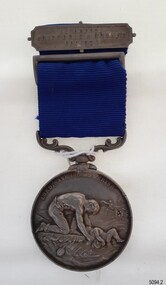
Award - Medal, ca. 1872
... blue ribbon by a decorative, swivelling silver connector. The top of the ribbon has a silver pin bar threaded through it. The obverse of the medal has a design of a man kneeling on a floating part of a wreck. He is rescuing a child from the sea. There is a manned boat in the distance rescuing someone from the sea. In the far background there is a sailing ship. The top third of the medal has an inscription around it. The reverse shows a long-legged hen cormorant with extended wings holding an olive branch in its beak. The bird...blue ribbon by a decorative, swivelling silver connector. The top of the ribbon has a silver pin bar threaded through it. The obverse of the medal has a design of a man kneeling on a floating part of a wreck. He is rescuing a child from the sea. There is a manned boat in the distance rescuing someone from the sea. In the far background there is a sailing ship. The top third of the medal has an inscription around it. The reverse shows a long-legged hen cormorant with extended wings holding an olive branch in its beak. The bird ...This medal is the Liverpool Shipwreck and Humane Society’s “Bramley-Moore medal for saving life at sea 1872”. The Society was formed in 1839. In 1872 Mr John Bramley-Moore donated £500 on condition that the medal have the specific inscription above on its reverse. The Bramley Morre medal was first awarded in 1874 and records show that since that time only one gold medal has been awarded, twenty-two silver medals and seventeen bronze medals, the last being in 1945. This Bromley-Moore medal was awarded to Peter Carmody for his bravery in saving lives on the Newfield shipwreck. The Newfield was a three-masted iron and steel barque, built in Dundee, Scotland, in 1889 by Alexander Stephen and Sons. It was owned by the Newfield Ship Company in 1890 and later that year It was registered in Liverpool to owners Brownells and Co. The Newfield left Sharpness, Scotland, on 28th May 1892 with a crew of 25 under the command of Captain George Scott and on 1st June left Liverpool. She was bound for Brisbane, Australia, with a cargo of 1850 tons of fine rock salt, the main export product of Sharpness. At about 9pm on 28th August 1892, in heavy weather, Captain Scott sighted, between heavy squalls, the Cape Otway light on the mainland of Victoria but, due to a navigational error (the ship’s chronometers were wrong), he assumed it to be the Cape Wickham light on King Island, some 40 miles south. He altered his course to the north, expecting to enter Bass Strait. The ship was now heading straight for the south west Victorian coast. At about 1:30am the Newfield ran aground on a reef about 100 yards from shore and one mile east of Curdie’s Inlet, Peterborough. The ship struck heavily three times before grounding on an inner shoal with 6 feet of water in the holds. Rough sea made the job of launching lifeboats very difficult. The first two lifeboats launched by the crew were smashed against the side of the ship and some men were crushed or swept away. The third lifeboat brought eight men to shore. It capsized when the crew tried to return it to the ship for further rescue The rescue was a difficult operation. The Port Campbell Rocket Crew arrived and fired four rocket lines, none of which connected with the ship. Peter Carmody, a local man, volunteered to swim about one mile off shore to the ship with a line to guide the fourth and final lifeboat safely to shore. He was assisted by James McKenzie and Gerard Irvine. Seventeen men survived the shipwreck but the captain and eight of his crew perished. The Newfield remained upright on the reef with sails set for a considerable time as the wind slowly ripped the canvas to shreds and the sea battered the hull to pieces. The Marine Board inquiry found the wreck was caused by a "one man style of navigation" and that the Captain had not heeded the advice of his crew. According to Jack Loney ‘… when the drama was over . . the Newfield was deserted except for the Captain’s dog and two pigs.’ Peter Carmody was awarded the Bramley-Moore medal by the Liverpool Shipwreck and Humane Society for Saving Life at Ssea, which he received by mail on January 21st 1893. The medal and a letter of congratulations were donated to Flagstaff Hill Maritime Museum by Peter Carmody’s grand-daughter Norma Bracken and her son Stuart Bracken on 25th May 2006. The Medal and Letter of Congratulations join other items in the Newfield collection.The Carmody Medal recognises the bravery of Peter Carmody in risking his life to rescue crew members of the Barque Newfield when it was wrecked near Curdies Inlet in August 1892. The ‘Bramley-Moore medal for saving life at sea, 1872’ was presented by the Liverpool Shipwreck and Humane Society. The medal and accompanying letter have local and international historic significance as they demonstrate both the difficulties associated with navigation and the dangers of shipping along the South West Coast of Victoria in the 19th century and the medal’s association with the Liverpool Shipwreck and Humane Society and John Bramley-Moore, who provided £500 to found the Bramley-Moore medal. The medal is socially significant. It emphasises the importance of Peter Carmody in rescuing victims of shipwrecks with little thought for his own safety. The medal reminds us of the importance of local people to Victoria’s maritime history. The Carmody Medal and Humane Society letter were in the Carmody family until they were presented to Flagstaff Hill Maritime Village, by the grand-daughter and great-grandson of Peter Carmody, on the 25th May 2006. The medal is significant for its complete provenance recorded in the donation documentation. The medal is in very good condition and relatively rare with only 22 silver medals awarded between 1874 and 1945. The Carmody Medal and letter add a human element to the story of the shipwrecks. They give life and significance to the Newfield, its victims and its artefacts. Bramley-Moore medal from the Liverpool Shipwreck and Humane Society, awarded to Peter Carmody. The round,silver medal is attached to a looped blue ribbon by a decorative, swivelling silver connector. The top of the ribbon has a silver pin bar threaded through it. The obverse of the medal has a design of a man kneeling on a floating part of a wreck. He is rescuing a child from the sea. There is a manned boat in the distance rescuing someone from the sea. In the far background there is a sailing ship. The top third of the medal has an inscription around it. The reverse shows a long-legged hen cormorant with extended wings holding an olive branch in its beak. The bird is surrounded by a wreath of oak leaves made from two branches. There is an inscription between the design and the rim that goes all the way around the circumference. There is a name engraved around the edge of the medal. The medal in embedded in a purple velvet panel that rests inside a brown, leather-covered case. The lid of the case has a gold embossed emblem in the cemtre. Both the lid and base have a rectangular gold border. The lid is attached to the base with two brass hinges. The base has a brass push-button catch. The box is lined with padded cream silk. The lining inside the lid has a gold emblem in the centre.The obverse has the words "LORD, SAVE US, WE PERISH". The reverse has the words "BRAMLEY-MOORE MEDAL FOR SAVING LIFE AT SEA" and "1872". Around the edge of the medal are the words "PETER CARMODY, FOR HAVING BEEN MAINLY INSTRUMENTAL IN RESCUING THE CREW OF THE BARQUE NEWFIELD, AUG 29 1892" The pin bar has the words “LIVERPOOL SHIPWRECK & HUMANE SOCIETY” written across it. The gold embossed emblem on the lid of the box has the words in the centre "SHIPWRECK AND …. …. ….FOUNDED 1839" The gold emblem on the cream silk lining has the words “BY APPOINTMENT ELKINGTON & CO” printed on it.medal, shipwrecked coast, flagstaff hill, flagstaff hill maritime museum, maritime museum, flagstaff hill maritime village, shipwreck coast, warrnambool, peter, peter carmody, carmody, bramley moore, newfield, liverpool shipwreck and humane society, 1892, 28 august 1892, august 1892, port campbell, bravery, shipwreck, rescue, nineteenth century, ship, curdie s river, victorian shipwrecks, barque, stuart bracken, norma bracken, gerard irvine, james mckenzie -
 Bendigo Historical Society Inc.
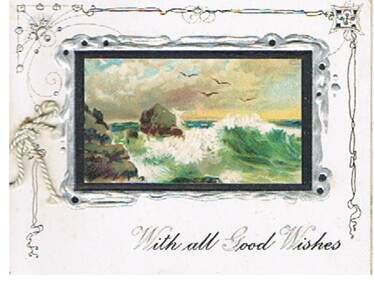
Document - MALONE COLLECTION: GREETING CARDS
... silver drawn border top and sides. In the centre is a coloured picture of the waves hitting the rocks and birds flying overhead. Around the picture is a black border and an irregular silver border with black spots. Underneath is written: With all Good Wishes (The W, G & W are in silver capital letters, the rest are black.) The card and insert are held together with a pale blue...silver drawn border top and sides. In the centre is a coloured picture of the waves hitting the rocks and birds flying overhead. Around the picture is a black border and an irregular silver border with black spots. Underneath is written: With all Good Wishes (The W, G & W are in silver capital letters, the rest are black.) The card and insert are held together with a pale blue ...Document. Malone Collection. Small white card with a black & silver drawn border top and sides. In the centre is a coloured picture of the waves hitting the rocks and birds flying overhead. Around the picture is a black border and an irregular silver border with black spots. Underneath is written: With all Good Wishes (The W, G & W are in silver capital letters, the rest are black.) The card and insert are held together with a pale blue piece of cord.B. B. London and New Yorkperson, greeting cards, malone collection, malone collection, greeting cards -
 National Vietnam Veterans Museum (NVVM)
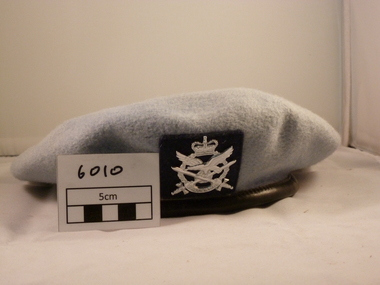
Headwear, RAAF Beret
... Royal Australian Air Force Uniform 161 Reconnaissance Flight Badge has a Queen's crown, two crossed swords, flying bird and the word "Vigilance" Light blue wool felt beret with adjustable black ribbon headband. Pinned to the front is a silver metal badge. ...Light blue wool felt beret with adjustable black ribbon headband. Pinned to the front is a silver metal badge.Badge has a Queen's crown, two crossed swords, flying bird and the word "Vigilance"royal australian air force, uniform, 161 reconnaissance flight -
Tatura Irrigation & Wartime Camps Museum
CD, Susan Morey, Cussen Park Tatura Victoria, 2007/2008
... Photographs taken by Susan Morey at Cussen Park, Tatura of bird life in the Park between November 2007 and February 2008. susan morey cussen park birds in tatura Pale blue coloured CD, silver and black text. Clear and black plastic case. ...Photographs taken by Susan Morey at Cussen Park, Tatura of bird life in the Park between November 2007 and February 2008.Pale blue coloured CD, silver and black text. Clear and black plastic case.susan morey, cussen park, birds in tatura -
 Embroiderers Guild, Victoria
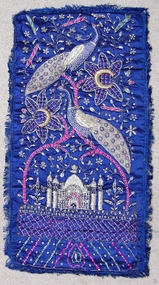
Textile - Wall panel
... blue satin with fringed edge. The design is of an Indian temple and large birds embroidered in gold and silver threads with some brightly coloured floss silks. ...blue satin with fringed edge. The design is of an Indian temple and large birds embroidered in gold and silver threads with some brightly coloured floss silks. ...Information in 1980 - Possibly Indian village workDeep blue satin with fringed edge. The design is of an Indian temple and large birds embroidered in gold and silver threads with some brightly coloured floss silks. It is edged with matching blue fringe.embroidery, panels, india, metal thread, silk embroidery, oriental -
 Whitehorse Historical Society Inc.
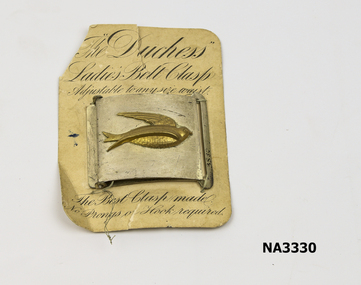
Clothing - Belt clasp
... Metal clasp for belt; silver coloured with gold coloured blue bird decoration. Attached to cardboard display packaging...No prongs or hooks required Metal clasp for belt; silver coloured with gold coloured blue bird decoration. Attached to cardboard display packaging Clothing Belt clasp ...Metal clasp for belt; silver coloured with gold coloured blue bird decoration. Attached to cardboard display packaging(On display cardboard) The 'Duchess' ladies belt clasp|The best clasp made. No prongs or hooks requiredcostume accessories, female -
 Whitehorse Historical Society Inc.
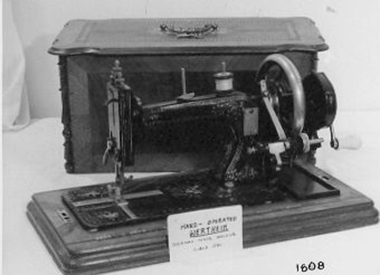
Machine - Sewing Machine, 1880s
... Decorations include blue and red bird and silver angels. Machine on wooden base and with wooden cover, both with inlaid decorations. ...Decorations include blue and red bird and silver angels. Machine on wooden base and with wooden cover, both with inlaid decorations. ...Black machine transverse shuttle Serial No. 496547, with gold and some coloured decorations. Decorations include blue and red bird and silver angels. Machine on wooden base and with wooden cover, both with inlaid decorations. Cover also has turned corner decorations. Cover can be locked to base. 'D' Syst 182.|S No. 496547'Superba' Plate with series of numbers. Card in box inscribed 'Wertheim German made machine in 1880'domestic items, sewing, textile machinery -
 Whitehorse Historical Society Inc.
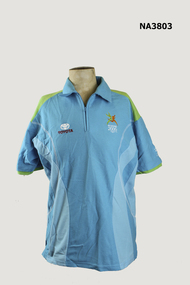
Clothing - Shirt, 2004
... Bob was a Silver Medalist at the 1970 Edinburgh Commonwealth Games and is also a member of this Historical Society costume male Toyota Male shirt with collar and zip-up neck. Green panel on shoulder; pale blue panels down front and back. Embroidered on left front, 'Melbourne 2006' and bird ...Shirt worn by Bob Gardiner; volunteer at the 2006 Commonwealth Games.Part of the uniform worn by Bob Gardiner, a volunteer at the 2006 Commonwealth Games. Bob was a Silver Medalist at the 1970 Edinburgh Commonwealth Games and is also a member of this Historical SocietyMale shirt with collar and zip-up neck. Green panel on shoulder; pale blue panels down front and back. Embroidered on left front, 'Melbourne 2006' and bird logo. Red embroidered Toyota on right front. The back is stamped, 'Melbourne 2006'. Short sleeves are embroidered with 'Victoria the place to be' and 'Red hard yakka', and piped in green. Coat of arms and 'Australian Government' also stamped on sleeve.|See also NA3802 - hatToyotacostume, male -
 Ambulance Victoria Museum
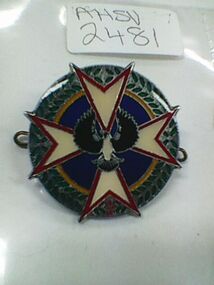
Badge, Hat, South Australian Ambulance Service, A.J.Parkes, unknown
... badge ON FRONT;Image of a bird (Shrike) symbolising the South Australian Ambulance Service ON REAR " A. J Parkes" (Manufacturer) Silver coloured metal badge with decoration on front surface in white, blue, green, yellow and red enamel. ...Silver coloured metal badge with decoration on front surface in white, blue, green, yellow and red enamel. At back are two metal loops and separate metal pins for use in attaching the badge to a hat. ON FRONT;Image of a bird (Shrike) symbolising the South Australian Ambulance Service ON REAR " A. J Parkes" (Manufacturer)badge
