
Showing 4 items matching "the what where when and how to book"
-
 Federation University Historical Collection
Booklet - BCAE Hand Booklet, The What, Where, When and How-To Book of the BCAE 1981, 1981
... The What, Where, When and How-To Book of the BCAE 1981......The What Where When and How to Book...The What, Where, When and How-To Book of the BCAE 1981 Booklet BCAE Hand Booklet ...Ballarat College of Advanced Education (BCAE) is a predecessor of Federation University White a5 Booklet with blue, yellow, and red writing with a pocket design stitch border. ballarat college of advanced education, the what where when and how to book, booklet, how to apply, location, admission requirements, fees, other costs, library, computer centre, courses, sporting facilities -
 Kiewa Valley Historical Society
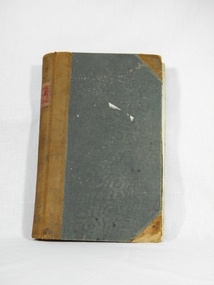
Book - Ledger Commercial, Cash Book for General Store, 5/3/1906; Commenced on 5th March 1906 to December 1906
... When names in the register are indexed it may be possible to determine where the store was located. Historically significant. This shows who the families of the Kiewa Valley were and what type of things they purchased. ...Records names of local people and purchases bought from a local general store. When names in the register are indexed it may be possible to determine where the store was located. Historically significant. This shows who the families of the Kiewa Valley were and what type of things they purchased. This would be the only register for this store in 1906.It gives a good historical record of what families purchased during this period and how much they could spend. It also displays the importance of general stores to the community Leather spined cash book for general store, for period from 5th March 1906 to circa December 1906. Green cover with brown spine. Hand writtern entries record date, purchaser, account number and items purchased. 382 pages. "Commenced March 5th 06" on front page book, general store, customers, shop, store, cash book, ledger, 1906, groceries, accounts, kiewa valley, pioneers -
 Eltham District Historical Society Inc
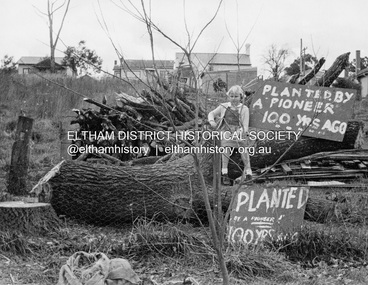
Photograph - Black and White Print, George W. Bell, Tree Protest, Franklin Street, Eltham, 1956
... when some S.E.C. workers cut down two 100-year old Oak trees in Franklin Street. We have examined aerial photos from February 1956 and two large trees are present near where number 91 is today and were gone in a January 1960 image. Alistair Knox wrote about their protest against the depradations of the State Electricty Commission in his 1980 book, We are what...when some S.E.C. workers cut down two 100-year old Oak trees in Franklin Street. We have examined aerial photos from February 1956 and two large trees are present near where number 91 is today and were gone in a January 1960 image. Alistair Knox wrote about their protest against the depradations of the State Electricty Commission in his 1980 book, We are what ...This was a protest that came about when some S.E.C. workers cut down two 100-year old Oak trees in Franklin Street. We have examined aerial photos from February 1956 and two large trees are present near where number 91 is today and were gone in a January 1960 image. Alistair Knox wrote about their protest against the depradations of the State Electricty Commission in his 1980 book, We are what we stand on, pp48-49. You can read about online at https://alistairknox.org/chapters/45 “Protest against the depradations of the State Electricity Commission 1956” - Alistair Knox (1980), We are what we stand on, pp48-49 “The fact that the number of trees in central Eltham has more than doubled since 1945 is an indication of how universal and powerful the movement has been. Eltham was fighting the S.E.C. and other government authorities in the 40's and 50's over the retention of indigenous trees. In the Christmas season of 1956 our conflict with them came to a dramatic confrontation that made headline news in all the daily papers for a week. It started in the Herald, was repeated in the Sun and taken up by the Age two days later. After four days, it was appearing in the New York Times.” “Some S.E.C. workers cut down two 100-year-old oak trees in Franklin Street. The inner Eltham community launched a frontal attack on bureaucratic bungling and arrogance that they have never forgotten.” “When the chairman of the Commission delivered his New Year's speech some weeks later, he emphasised that the commission's first responsibility was to protect trees. This was the antithesis of their previous attitude. For many years to come, tree-lopping Commission workers always pretended they were not there when our small explosive group passed by. With Council assistance, we also carried out free native tree plantings on the nature strips of most roads in the Central Riding in the l 950's, when the rhododendron and the gladioli flanked by pampas grass and flowering fruit trees were still being introduced into the most 'desirable' eastern suburbs.” The protest involved personalities such as Matcham Skipper; Lesley Martin; Alistair and Margot Knox and youn Hamish; Jack, Susan, Mavis and Laurel Gill; Hal Peck; Tim Burstall and Gordon Ford The location is about halfway between Main Road and Bible Street looking north, around number 91. Looking up the hill in a northerly direction, the house on the left is George Stebbing's original cottage at 88 Pitt Street, built around 1861. Little is recorded of this early Eltham builder and we have no picture of him. He arrived from England in August 1857 and settled at Eltham after a short period at Kangaroo Ground. His occupation is often listed as a farmer but he built a number of important buildings between 1860 and 1880. Those remaining include Shillinglaw Cottage (c.1858), St. Margaret’s Church (1860), Uniting Church (formerly Methodist Church 1880) and his house at 88 Pitt Street (1861). This photo was possibly used in a presentation by Russell Yeoman to the 10 November 2004 Society meeting on "Significant Trees, Wildflowers and Local Gardens" - Research by Peter Pidgeon, EDHS, June 2026 Black and white print on photo paper Also black and white slide copy of print Mount - white 7 dots (Technodia Italy)trees, eltham, protests, george w bell collection, significant tree, alistair knox, george w. bell collection, gordon ford, hal peck, hamish knox, jack gill, laurel gill, lesley martin, margot knox, matcham skipper, mavis gill, stebbing cottage, susan gill, tim burstall -
 Melton City Libraries
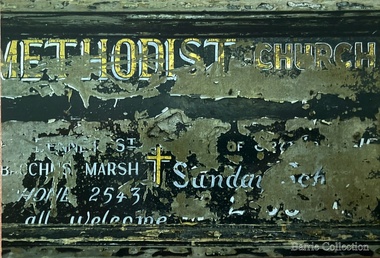
Photograph, Signboard, 1972
... where he lived for about a year. In May 1911 he purchased “Darlingsford” in Melton when it came on the market. The address Elizabeth St Moonee Ponds appears in the family records during this period and during WW 1 they also lived at Ascot Vale where the Lang parents lived. On returning after the war to Melton to occupy the Darlingsford house, which had been occupied by a caretaker. The family joined the Presbyterian Church. Evidenced in the Church Minute Book. 1920 What...where he lived for about a year. In May 1911 he purchased “Darlingsford” in Melton when it came on the market. The address Elizabeth St Moonee Ponds appears in the family records during this period and during WW 1 they also lived at Ascot Vale where the Lang parents lived. On returning after the war to Melton to occupy the Darlingsford house, which had been occupied by a caretaker. The family joined the Presbyterian Church. Evidenced in the Church Minute Book. 1920 What ...Edna Barrie handwritten notes – copied 18th October 2013 web The early story of the Wesleyan Methodist Church in Victoria At Melton between Bal [Ballarat] and Melb [Melbourne] was introduced by the Revd Wlm Blamires in 1862 ably seconded by the late Mrs Westlake (afterwards Mrs Spargo). Mr J James, the active and indefatigable Revd Eb Taylor and such workers as Atkinson Corr and Ferris. Mawson and John Dare 1867 the foundation stone of the present church was laid. Revd D Waugh 1867. Melton and Toolern Vale have benefited by the generous help of Mr J Browne esquire of White Hills Station Diggers Rest and are now comprised in the Sunshine Circuit. Written at a later date – Wesleyan 16-4-1867 then Methodist 3-10-1867. Bluestone building cost Lsd 350-13-6. Seating 40 pounds Rev Ken Moore Methodist opened at Brooklyn Rd Melton South c1940 closed c 1972. Timber Church shifted from Staughton Vale, prior to this Services held in Victoria Hall Melton South. The source of the information – ? and date notes were made On the Chart outlining Melton Churches the following additional notes- At opening (nil Plaster, nil ceiling) Slate roof. Closed 1910-1911- most likely from 1867 Express My research - Melton Express noted 15th Aug 1939 porch added to Church at Melton South making the date earlier than 1940. Photographs taken when the building was being used as the UC Opp Shop and demolition of the building showing the porch. Charles Ernest Barrie was prominent in the life of the Methodist Church and established a thriving Sunday School. He built the Chaff Mills at Melton South in 1900. In 1910 he sold the Mill to Glover Onians and moved to a farm at Trundle NSW, where he lived for about a year. In May 1911 he purchased “Darlingsford” in Melton when it came on the market. The address Elizabeth St Moonee Ponds appears in the family records during this period and during WW 1 they also lived at Ascot Vale where the Lang parents lived. On returning after the war to Melton to occupy the Darlingsford house, which had been occupied by a caretaker. The family joined the Presbyterian Church. Evidenced in the Church Minute Book. 1920 What happened to the Methodist Church between 1910 – 1920? How long did it exist while in the Bluestone building in Palmerston St (Heritage listed 2008) When did the church commence in Victoria Hall? Built 1910 on land donated by C E Barrie. I attended the Methodist Church Melton Sth when monthly services were held in the afternoons. We were members of the Presbyterian Church and also supported the Melton Sth Church during the 1950’s Signboard from Melton South Methodist Churchchurches
