
Showing 50 items matching "theatrical plays"
-
 Tatura Irrigation & Wartime Camps Museum
Document, Adolf Wilke et al, Die Nibelungen - besprechung (The Nibelungen Conference)
... ...theatrical...plays...tatura illustrations watercolours performing arts theatrical plays documents pamphlets Black A4 display folder, typed pages of English translations of the accompanying photographs of illustrated German pages. ...Created by Adolf Wilke, written down & illustrated by Hans Wolter von Gruenewaldt. Translated by Mr. Michael of Shepparton High School (?).Black A4 display folder, typed pages of English translations of the accompanying photographs of illustrated German pages. Photographic copies of original illustrated poem / ballad, with English translation.tatura, illustrations, watercolours, performing, arts, theatrical, plays, documents, pamphlets -
Tatura Irrigation & Wartime Camps Museum
Theatre Programmes, 1991
... ...theatrical plays...Don Carlos, Der Kaufman, Von Vene Dig (Merchant of Venice) W Shakespeare; William Tell. internee theatre productions theatrical plays don carlos der kaufman von vene dig merchant of venice william shakespear william tell Deutsche's Theatre Tatura program on 3: Minna Von Barnhelm Oder Das Goldatenglust Under that a medieval warrior Fawn coloured theatre programs with theatre logo on 3. ...Theatre was a significant part of the internees as evidenced by the many photos in the museum. Don Carlos, Der Kaufman, Von Vene Dig (Merchant of Venice) W Shakespeare; William Tell.Fawn coloured theatre programs with theatre logo on 3. Printed in black. Laminated.Deutsche's Theatre Tatura program on 3: Minna Von Barnhelm Oder Das Goldatenglust Under that a medieval warriorinternee theatre productions, theatrical plays, don carlos, der kaufman, von vene dig, merchant of venice, william shakespear, william tell -
Tatura Irrigation & Wartime Camps Museum
Document, Camp 3 theatre group, 1991 photocopy
... ...theatrical plays...In charge of production Wm Fugmann would probably be one of the main stays and initiator of the Camp 3 theatre group. internment camp fugmann michael bar a. sturzenhofecker burkhard drude minna von barnhelm a soldiers luck camp theatre theatrical plays Camp 3 internees - Wilhelm Fugman Red back clear front plastic folder with a head and shoulders drawing of Wilhelm Fugmann under which is a brief biography. ...In charge of production Wm Fugmann would probably be one of the main stays and initiator of the Camp 3 theatre group.Red back clear front plastic folder with a head and shoulders drawing of Wilhelm Fugmann under which is a brief biography. The back page has 3 similar drawings of Burkhard Drude, Michael Bar and A. Sturzenhofecker, in the roles of Marquees Posa "Don Carloss, Tell "Wilhelmtell" and Major Tellheim in "Minna Von Barnhelm" (A soldiers luck) respectively.Camp 3 internees - Wilhelm Fugmaninternment camp, fugmann, michael bar, a. sturzenhofecker, burkhard drude, minna von barnhelm, a soldiers luck, camp theatre, theatrical plays -
Tatura Irrigation & Wartime Camps Museum
Document, Schiller Friedrich Von 1759 - 1805, Theatre program. Deutiches Theater Tatura, 1991 photocopy (original 1942)
... ...theatrical plays...One of the progammes and/or plays presented by the Camp 3 theatre group to Tatura Museum. deutiches theatre william tell internment camps internment camp theatre groups theatrical plays Camp 3 Theatre program "Wilhelm Tell" Palastine Temple Society Internees Theatre program in clear plastic front cover with blue margin left hand side and back. ...Theatre program. Deutiches Theater Tatura. Wilhelm Tell left hand page above Wahrend Der Pause Erwartet Sie Vor Kaffee and Kuchen im theater foyer. The test is likewise in German. Camp 3 theatre group. One of the progammes and/or plays presented by the Camp 3 theatre group to Tatura Museum.Theatre program in clear plastic front cover with blue margin left hand side and back.Camp 3 Theatre program "Wilhelm Tell" Palastine Temple Society Interneesdeutiches theatre, william tell, internment camps, internment camp theatre groups, theatrical plays -
 Tatura Irrigation & Wartime Camps Museum
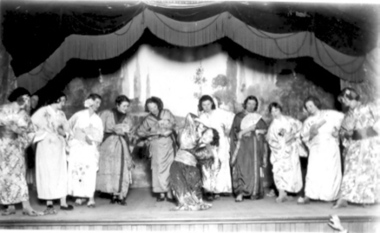
Photograph, Geisha Girls in Cherry Blossom
... ...theatrical...plays...tatura hall costume female performing arts theatrical plays Performance of Cherry Blossom, Geisha Girls, c1930s? ...Performance of Cherry Blossom, Geisha Girls, c1930s?tatura, hall, costume, female, performing, arts, theatrical, plays -
 Tatura Irrigation & Wartime Camps Museum
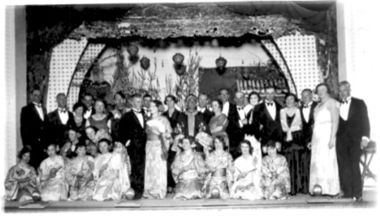
Photograph, Cast of Cherry Blossom
... ...theatrical...plays...tatura hall festivals costume female male performing arts theatrical plays Cast photo of Cherry Blossom performers, taken on stage with set features in the background. ...Cast photo of Cherry Blossom performers, taken on stage with set features in the background.tatura, hall, festivals, costume, female, male, performing, arts, theatrical, plays -
 Flagstaff Hill Maritime Museum and Village
Furniture - Chair, Harnisch & Co, 1876-1918
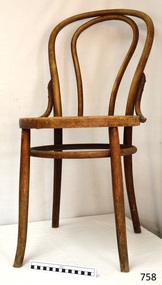
... The Warrnambool Town Hall played a significant role in the both the local government and the social events of local and district areas. It was a place for Council meetings, community events and entertainment, theatrical and musical. flagstaff hill warrnambool shipwrecked-coast flagstaff-hill flagstaff-hill-maritime-museum maritime-museum shipwreck-coast flagstaff-hill-maritime-village bentwood chair café chair restaurant chair thonet design chair neusohler fabrik fur nobel k.u.k. approved manufacturer hungry Harnisch & Co k.u.k. public hall chair Toc H Marks; pressed into rim under seat is "3", and "Crown [over] (N)", Paper label, cream with black print, on rim; Left side has Mark “N inside circle under crown”. ...The design of this pair (RN 758 & 759) is based on Thonet’s No. 18 chair, which was originally produced in 1876 by Thonet, and is still one of the best-selling designs for café and restaurant owners. It is elegant, sophisticated and durable. The label notes the design as “AUS MASSIV GEBOGENEM HOLZE vorm” which translates to “solid curved sandals shape”, a good description for the back of the chair. The chairs have marks, paper labels and symbols on them that show that the maker was Harnisch & Co., Neuschler (also called Banská Bystrica) Furniture Factory in Neuschol (Beszterczebanya), Hungary, privileged makers for the Imperial and Royal Austrian-Hungarian Empire 1867 – 1918. Bentwood chairs are made by a process of wetting wood in water, bending it into curved shapes, then allowing it to dry so that the shape becomes permanent. This process originated by Michael Thonet, who had been given the right to bend wood into desired curves by the Austrian Courts in 1842. In 1856 he was granted a 13 year patent to manufacture chairs and table legs of bent wood treated by steam or boiling water. In 1859 his company Gebruder Thonet produced his original design. Thonet’s early designs also featured hand carved or laminated wooden seats. His Model No. 14 produced in the 1850’s, was his most popular design. After Michael’s death in 1871 the family went on designing and producing chairs. The No. 18 chair was produced in 1876, one of a group of chars with back inserts consisting of curves and loops of bentwood. These bentwood chairs are believed to be associated with the either the original Warrnambool Town Hall or the Toc H Group in Warrnambool. The Warrnambool Town Hall played a significant role in the both the local government and the social events of local and district areas. It was a place for Council meetings, community events and entertainment, theatrical and musical.Chair, bentwood, 'French Bistro Chair' with a floral pattern carved in seat. Backrest has inverted U shape inside that extends to the seat. Supports on either side of backrest's base join to back of seat. Legs have a wooded bracing ring. Marks are embossed into rim under seat. Paper label, cream with black print, on rim; Right side of label has the symbol of Heraldic Shield. Text on label. Made by NEUSOHLER FABRIK FUR MOBEL, AUS MASSIV GEBOGENEM HOLZE, vorm. HARNISCH & Co, NEUSOHL (BESZTERCaZEBANYA) UNGARN ' Hand written under seat "T H" in black paint, "T H " in white chalk.Marks; pressed into rim under seat is "3", and "Crown [over] (N)", Paper label, cream with black print, on rim; Left side has Mark “N inside circle under crown”. Right side has symbol of Heraldic Shield. Text on label “Trade – K.u.K.- Mark / NEUSOHLER FABRIK FUR MOBEL/ AUS MASSIV GEBOGENEM HOLZE, vorm. HARNISCH&Co / NEUSOHL (BESZTERCaZEBANYA) UNGARN ' Hand written under seat "T H" in black paint, "T H " in white chalk. flagstaff hill, warrnambool, shipwrecked-coast, flagstaff-hill, flagstaff-hill-maritime-museum, maritime-museum, shipwreck-coast, flagstaff-hill-maritime-village, bentwood chair, café chair, restaurant chair, thonet design chair, neusohler fabrik fur nobel, k.u.k. approved manufacturer, hungry, harnisch & co, k.u.k., public hall chair, toc h -
 Flagstaff Hill Maritime Museum and Village
Chair, 1907-1914
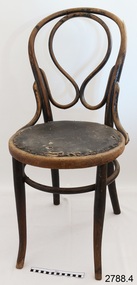
... The Warrnambool Town Hall played a significant role in the both the local government and the social events of local and district areas. It was a place for Council meetings, community events and entertainment, theatrical and musical. flagstaff hill warrnambool shipwrecked-coast flagstaff-hill flagstaff-hill-maritime-museum maritime-museum shipwreck-coast flagstaff-hill-maritime-village bentwood chair café chair restaurant chair josef jaworek austrian chairs furniture Marked with handwritten "TH", in both black paint & white chalk. ...The design of this set of four lightweight chairs is based on Thonet’s bentwood designs, which are still some of the best-selling designs for café and restaurant owners. It is elegant, sophisticated and durable. Some of these chairs still have their original seat, under which the letters “TH” or “RSL” are hand written. Flagstaff Hill has several bentwood chairs with these letters on them, in either chalk, black paint, or both. It is believed that the chairs were used in the original Warrnambool Town Hall, and later the RSL. The Town Hall was completed in 1891, built on the corners of Timor and Liebig Streets. (In 1977 the Town Hall was declared unsafe and was later replaced by the Warrnambool Performing Arts Centre.) Some of the chairs have marks, paper labels and symbols on them that show that the maker was Josef Jaworek, who had a small furniture factory in east Sinensia, which was at that time in Austria, from 1907 - 1914. Bentwood chairs are made by a process of wetting wood in water, bending it into curved shapes, then allowing it to dry so that the shape becomes permanent. This process originated by Michael Thonet, who had been given the right to bend wood into desired curves by the Austrian Courts in 1842. In 1856 he was granted a 13 year patent to manufacture chairs and table legs of bent wood treated by steam or boiling water. In 1859 his company Gebruder Thonet produced his original design. Thonet’s early designs also featured hand carved or laminated wooden seats. His Model No. 14 was produced in the 1850’s and his most popular design. After Michael’s death in 1871 the family went on designing and producing chairs. These bentwood chairs are believed to be associated with the original Warrnambool Town Hall. The Warrnambool Town Hall played a significant role in the both the local government and the social events of local and district areas. It was a place for Council meetings, community events and entertainment, theatrical and musical.Bentwood chair (4 of 4), painted black, inner back is curled loop, seat has leather cover attached with studs, ventilation holes under seat, legs are splayed and have a bracing ring. Marks: under seat, handwritten and stamped into wood.Marked with handwritten "TH", in both black paint & white chalk. Under rim is label printed "65" Stamped into wood on rim under chair "95".flagstaff hill, warrnambool, shipwrecked-coast, flagstaff-hill, flagstaff-hill-maritime-museum, maritime-museum, shipwreck-coast, flagstaff-hill-maritime-village, bentwood chair, café chair, restaurant chair, josef jaworek, austrian chairs, furniture -
 The Beechworth Burke Museum
Photograph - Lantern Slide, c1900
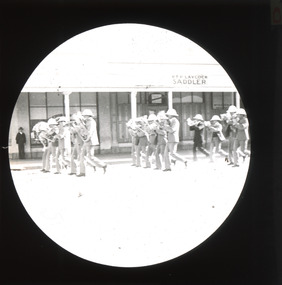
... playing instruments as they walk through Ford Street. The slide was captured right as the Band was passing RTP Laycock Saddler. Marching bands, choirs, circus acts, theatrical...playing instruments as they walk through Ford Street. The slide was captured right as the Band was passing RTP Laycock Saddler. Marching bands, choirs, circus acts, theatrical ...The glass slide captures the Beechworth Band performing down Ford Street, Beechworth circa 1900. In the slide three rows with five people in each row wearing the Beechworth Band uniform playing instruments as they walk through Ford Street. The slide was captured right as the Band was passing RTP Laycock Saddler. Marching bands, choirs, circus acts, theatrical performances, races, and seasonal activities were among the entertainments on offer in Beechworth. The location is also significant as Ford Street is, and was when this slide was taken, considered one of the two main streets of Beechworth. Today Ford Street is lined with updated shopfronts. This glass slide is socially and historically significant as it captures a moment of celebration for the Beechworth residents. The image is historically and socially significant for attesting to the enduring appeal of local musical associations, which were a popular means of entertainment that fostered social connections among settlers from diverse ethnic backgrounds.A thin translucent sheet of glass with a circular image printed on the front and framed in a black backing. It is held together by metals trips to secure the edges of the slide.burke museum, beechworth, lantern slide, slide, glass slide, plate, burke museum collection, photograph, monochrome -
 The Beechworth Burke Museum
Photograph, c1999/2000
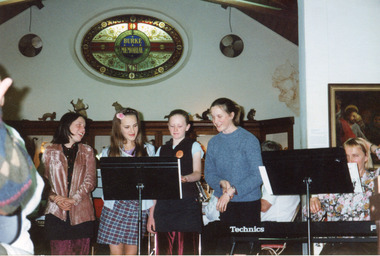
... theatrical performances, races, and seasonal activities, such as Mr. Spiller's roller skating rink, which was founded in the late 1860s, were among the entertainments on offer in Beechworth. This photograph of the Beechworth Band playing ...This photograph depicts female singers accompanied by members of the Beechworth Band at a 'Liedertafel' concert in the main hall at the Burke Museum in 1999. The concert related to an exhibition titled, 'From the Liedertafel to the Skating Rink: Entertainment in Beechworth 1852 - early 1900s', which celebrated the rich and diverse entertainments that were part of Beechworth life in the nineteenth and early twentieth centuries. 'Liedertafel' is a German tradition that accompanied European settlers to Australia. It refers to a friendly society of men united by an enthusiasm for singing. The Beechworth Liedertafel was established 14 March 1894 at the London Tavern, Camp Street, Beechworth, by president, Mr. A.A. Billson, and a visiting conductor, Mr. H. Fielder. The Beechworth Brass Band was formed by Mr. H. Vandenberg in 1887. Marching bands, choirs, circus acts, theatrical performances, races, and seasonal activities, such as Mr. Spiller's roller skating rink, which was founded in the late 1860s, were among the entertainments on offer in Beechworth.This photograph of the Beechworth Band playing at the Burke Museum is historically significant for the information it conveys about an exhibition at the Burke Museum between September and November 1999. The use of the contemporary Beechworth Band in a 'Liedertafel' performance provides insight into curatorial approaches at the turn of the twenty-first century and improves our understanding of how exhibitions use objects in the Burke Museum's Collection to tell stories about the past in the present. The image is historically and socially significant for attesting to the enduring appeal of local musical associations, which were a popular means of entertainment that fostered social connections among settlers from diverse ethnic backgrounds. Liedertafel choirs were originally male-only, therefore, the presence of female singers at the 1999 exhibition reflects progressive social and community values with regard to gender and inclusion.Rectangular colour photograph printed on matte photographic paper.Reverse: 7030 / Label: Burke Museum / Liedertafel Exh / Emily Messen, Luetta / Schier, Hannah / Routledge, Sarah / McKinley 2000 (?) / 2000 (?) / liedertafel, beechworth band, burke museum, exhibition 1999, from the liedertafel to the skating rink, entertainment in beechworth 1852 - early 1900s, past exhibitions, performances at the burke museum, european settlers, german community, german choral societies, brass bands, male choir, colonial passtimes, colonial entertainments, cultural traditions, gold rush, immigration, beechworth's german heritage, london tavern beechworth, camp st beechworth, beechworth historic district, beechworth's first brick tavern, spiller's skating rink, vandenberg's beechworth brass band, benevolent societies, intellectual societies, protestantism, billson brewery beechworth, teetotallism, fancy dress carnivals, skating carnivals, fundraising societies, german musicians, crimean war, beechworth german association, freemasonry, yma's, beechworth athenaeum, beechworth skating rink -
 Flagstaff Hill Maritime Museum and Village
Chair, 1907-1914
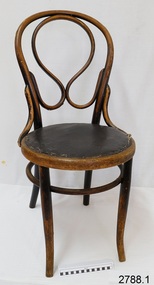
... The Warrnambool Town Hall played a significant role in the both the local government and the social events of local and district areas. It was a place for Council meetings, community events and entertainment, theatrical and musical. ...The design of this set of four lightweight chairs is based on Thonet’s bentwood designs, which are still some of the best-selling designs for café and restaurant owners. It is elegant, sophisticated and durable. Some of these chairs still have their original seat, under which the letters “TH” or “RSL” are hand written. Flagstaff Hill has several bentwood chairs with these letters on them, in either chalk, black paint, or both. It is believed that the chairs were used in the original Warrnambool Town Hall, and later the RSL. The Town Hall was completed in 1891, built on the corners of Timor and Liebig Streets. (In 1977 the Town Hall was declared unsafe and was later replaced by the Warrnambool Performing Arts Centre.) Some of the chairs have marks, paper labels and symbols on them that show that the maker was Josef Jaworek, who had a small furniture factory in east Sinensia, which was at that time in Austria, from 1907 - 1914. Bentwood chairs are made by a process of wetting wood in water, bending it into curved shapes, then allowing it to dry so that the shape becomes permanent. This process originated by Michael Thonet, who had been given the right to bend wood into desired curves by the Austrian Courts in 1842. In 1856 he was granted a 13 year patent to manufacture chairs and table legs of bent wood treated by steam or boiling water. In 1859 his company Gebruder Thonet produced his original design. Thonet’s early designs also featured hand carved or laminated wooden seats. His Model No. 14 was produced in the 1850’s and his most popular design. After Michael’s death in 1871 the family went on designing and producing chairs. These bentwood chairs are believed to be associated with the original Warrnambool Town Hall. The Warrnambool Town Hall played a significant role in the both the local government and the social events of local and district areas. It was a place for Council meetings, community events and entertainment, theatrical and musical.Bentwood chair (1 of 4), painted black, inner back is curled loop. Seat is padded leather, attached by studs. Splayed legs. Patterned ventilation holes under seat. Under seat are various Marks; hand painted, printed on small piece of paper, stamped in wood.Under seat are various Marks; hand painted in black "TH", printed on small piece of paper "400", stamped in wood "400" flagstaff hill, warrnambool, shipwrecked coast, flagstaff hill maritime museum, maritime museum, shipwreck coast, flagstaff hill maritime village, great ocean road, bentwood chair, café chair, restaurant chair, josef jaworek, austrian chairs -
 Flagstaff Hill Maritime Museum and Village
Book, Plays
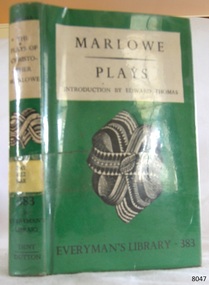
... Plays The following is on an inside loose endpaper. "Christopher Marlowe, son of a shoemaker, born at Canterbury in 1564. Educated at Cambridge. Attached himself to the Earl of Nottingham's theatrical...Plays The following is on an inside loose endpaper. "Christopher Marlowe, son of a shoemaker, born at Canterbury in 1564. Educated at Cambridge. Attached himself to the Earl of Nottingham's theatrical ...This item is from the ‘Pattison Collection’, a collection of books and records that was originally owned by the Warrnambool Mechanics’ Institute, which was founded in Warrnambool in 1853. By 1886 the Warrnambool Mechanics’ Institute (WMI) had grown to have a Library, Museum and Fine Arts Gallery, with a collection of “… choice productions of art, and valuable specimens in almost every branch and many wonderful national curiosities are now to be seen there, including historic relics of the town and district.” It later included a School of Design. Although it was very well patronised, the lack of financial support led the WMI in 1911 to ask the City Council to take it over. In 1935 Ralph Pattison was appointed as City Librarian to establish and organise the Warrnambool Library as it was then called. When the WMI building was pulled down in 1963 a new civic building was erected on the site and the new Warrnambool Library, on behalf of the City Council, took over all the holdings of the WMI. At this time some of the items were separated and identified as the ‘Pattison Collection’, named after Ralph Pattison. Eventually the components of the WMI were distributed from the Warrnambool Library to various places, including the Art Gallery, Historical Society and Flagstaff Hill. Later some were even distributed to other regional branches of Corangamite Regional Library and passed to and fro. It is difficult now to trace just where all of the items have ended up. The books at Flagstaff Hill Maritime Village generally display stamps and markings from Pattison as well as a variety of other institutions including the Mechanics’ Institute itself. RALPH ERIC PATTISON Ralph Eric Pattison was born in Rockhampton, Queensland, in 1891. He married Maude Swan from Warrnambool in 1920 and they set up home in Warrnambool. In 1935 Pattison accepted a position as City Librarian for the Warrnambool City Council. His huge challenge was to make a functional library within two rooms of the Mechanics’ Institute. He tirelessly cleaned, cleared and sorted a disarrayed collection of old books, jars of preserved specimens and other items reserved for exhibition in the city’s museum. He developed and updated the library with a wide variety of books for all tastes, including reference books for students; a difficult task to fulfil during the years following the Depression. He converted all of the lower area of the building into a library, reference room and reading room for members and the public. The books were sorted and stored using a cataloguing and card index system that he had developed himself. He also prepared the upper floor of the building and established the Art Gallery and later the Museum, a place to exhibit the many old relics that had been stored for years for this purpose. One of the treasures he found was a beautiful ancient clock, which he repaired, restored and enjoyed using in his office during the years of his service there. Ralph Pattison was described as “a meticulous gentleman whose punctuality, floorless courtesy and distinctive neat dress were hallmarks of his character, and ‘his’ clock controlled his daily routine, and his opening and closing of the library’s large heavy doors to the minute.” Pattison took leave during 1942 to 1945 to serve in the Royal Australian Navy, Volunteer Reserve as Lieutenant. A few years later he converted one of the Museum’s rooms into a Children’s Library, stocking it with suitable books for the younger generation. This was an instant success. In the 1950’s he had the honour of being appointed to the Victorian Library Board and received more inspiration from the monthly conferences in Melbourne. He was sadly retired in 1959 after over 23 years of service, due to the fact that he had gone over the working age of council officers. However he continued to take a very keen interest in the continual development of the Library until his death in 1969. The Warrnambool Mechanics’ Institute (WMI) was formed by a voluntary community group in 1863, within six years of Warrnambool’s beginnings, and its Reading Room opened in 1854. The WMI operated until 1963, at which time it was one of the oldest Mechanics’ Institutes in Victoria. Mechanics’ Institutes offered important services to the public including libraries, reading rooms and places to display and store collections of all sorts such as curiosities and local historical relics. In 1886 a Museum and Fine Arts Gallery were added to the WMI and by the beginning of the 20th century there was also a billiards room and a School of Art. By this time all Mechanics’ Institutes in country Victoria had museums attached. Over the years the Warrnambool Mechanics’ Institute Library was also known as the Warrnambool Public Library the Warrnambool Library and the Free Library. Early funding from the government was for the “Free Library”. The inscription in a book “Science of Man” was for the “Warrnambool Public Library”, donated by Joseph Archibald in 1899. Another inscription in the book “Catalogue of Plants Under Cultivation in the Melbourne Botanic Gardens 1 & 2, 1883” was presented to the “Warrnambool Library” and signed by the author W.R. Guilfoyle. In 1903 the Warrnambool Public Library decided to add a Juvenile Department to library and stock it with hundreds of books suitable for youth. In 1905 the Public Library committee decided to update the collection of books and added 100 new novels plus arrangements for the latest novels to be included as soon as they were available in Victoria. In July 1911 the Warrnambool Council took over the management of the Public Library, Art Gallery, Museum and Mechanics’ Institute and planned to double the size of the then-current building. In 1953, when Mr. R. Pattison was Public Librarian, the Warrnambool Public Library’s senior section 10,000 of the 13,000 books were fiction. The children’s section offered an additional 3,400 books. The library had the equivalent of one book per head of population and served around 33 percent of the reading population. The collection of books was made up of around 60 percent reference and 40 percent fiction. The library was lending 400 books per day. In 1963 the Warrnambool City Council allocated the site of the Mechanics’ Institute building, which included the Public Library, Museum and Art Gallery, for the new Municipal Offices and the Collections were dispersed until 1971. The Warrnambool Library took over the Mechanics’ Institute Library’s holdings on behalf of the Warrnambool City Council. Since the closure of the Warrnambool Mechanics’ Institute the exact location and composition of the original WMI books and items has become unclear. Other materials have been added to the collection, including items from Terang MI, Warrnambool Court House and Customs House. Many of the books have been identified as the Pattison Collection, named after the Librarian who catalogued and numbered the books during his time as Warrnambool Public Librarian in the time before the Mechanics’ Institute closed. It seems that when Warrnambool became part of the Corangamite Regional Library some of the books and materials went to its head office in Colac and then back to Warrnambool where they were stored at the Art Gallery for quite some time. Some then went to the Warrnambool Historical Society, some stayed at the Art Gallery and some were moved to Flagstaff Hill Maritime Village. The various stamps and labels on the books held at Flagstaff Hill show the variety of the collection’s distribution and origin. The books in the collection at Flagstaff Hill Maritime Village date from the 1850’s to the late 1950’s and include rare and valuable volumes. Many of the books are part of the “Pattison Collection” after the Warrnambool’s Public Librarian, Mr. R. Pattison. The Pattison Collection, along with other items at Flagstaff Hill Maritime Village, was originally part of the Warrnambool Mechanics' Institute’s collection. The Warrnambool Mechanics’ Institute Collection is primarily significant in its totality, rather than for the individual objects it contains. Its contents are highly representative of the development of Mechanics' Institute libraries across Australia, particularly Victoria. A diversity of publications and themes has been amassed, and these provide clues to our understanding of the nature of and changes in the reading habits of Victorians from the 1850s to the middle of the 20th century. The collection also highlights the Warrnambool community’s commitment to the Mechanics’ Institute, reading, literacy and learning in the regions, and proves that access to knowledge was not impeded by distance. These items help to provide a more complete picture of our community’s ideals and aspirations. The Warrnambool Mechanics Institute book collection has historical and social significance for its strong association with the Mechanics Institute movement and the important role it played in the intellectual, cultural and social development of people throughout the latter part of the nineteenth century and the early twentieth century. The collection of books is a rare example of an early lending library and its significance is enhanced by the survival of an original collection of many volumes. The Warrnambool Mechanics' Institute’s publication collection is of both local and state significance. SIGNIFICANCE The Warrnambool Mechanics' Institute Collection is primarily significant in its totality, rather than for the individual objects it contains. Its contents are highly representative of the development of Mechanics' Institute libraries across Australia, particularly Victoria. A diversity of publications and themes has been amassed, and these provide clues to our understanding of the nature of and changes in the reading habits of Victorians from the 1850s to the middle of the 20th century. The collection also highlights the Warrnambool community’s commitment to the Mechanics’ Institute, and to reading, literacy and learning in the regions, and proves that access to knowledge was not impeded by distance. These items help to provide a more complete picture of our community’s ideals and aspirations. As with many Mechanics' Institutes in Australia, the one which operated in Warrnambool was established and overseen for many years by key individuals associated with the development of the city itself. The WMI publication collection is historically significant because of its association with local people, places and the key historical themes in the development of Warrnambool of rural development, industry, farming, education, and community. The collection documents and illustrates the changing interests, focus and tastes of Victorians, especially those in regional cities. Generally the individual items in the collection are not particularly rare, as examples of all probably exist in other public collections in Victoria. It is primarily because there are so very few surviving Mechanics' Institute collections in Victoria, which lends this overall collection its significance. Many items in the WMI Collection have the potential to support further research, both as individual objects and through the collection in its entirety. This material is significant for its ability to assist in the interpretation of the history of the area and adds to the general understanding of the development of the township. Many components of the WMI publication collection complement and reinforce the Flagstaff Hill Maritime Museum Collection, the Warrnambool Art Gallery Collection, and that in the Warrnambool Historical Society, and also contribute to a clearer understanding of the original Warrnambool Mechanics' Institute collections. This will greatly enhance the appreciation of the few surviving Mechanics' Institute collections across Victoria, and also in New South Wales. The similarities and differences between the small number of collections that have survived can provide further insights into how the people of Victoria in general, and Warrnambool in particular, constructed a civic culture of adult learning to foster an informed citizenry. The Warrnambool Mechanics' Institute publication collection is of both local and state significance. Plays The following is on an inside loose endpaper. "Christopher Marlowe, son of a shoemaker, born at Canterbury in 1564. Educated at Cambridge. Attached himself to the Earl of Nottingham's theatrical company, and subsequently associated with the leading men of letters. Killed in a brawl at Deptford in 1593 while a warrant for his arrest on a charge of blasphemy had been issued." Author: Christopher Marlowe Publisher: J M Dent & Sons Date: 1947Label on spine cover with typed text PAT 822 MAR Front loose endpaper has a stamp from Warrnambool Public Library covered by a sticker from Corangamite Regional Library Service Front loose endpaper has a stamp from Corangamite Regional Library Servicewarrnambool, shipwrecked-coast, flagstaff-hill, flagstaff-hill-maritime-museum, maritime-museum, shipwreck-coast, flagstaff-hill-maritime-village, shipwrecked-artefact, book, pattison collection, warrnambool library, warrnambool mechanics’ institute, ralph eric pattison, corangamite regional library service, warrnambool city librarian, mechanics’ institute library, victorian library board, warrnambool books and records, warrnambool children’s library, great ocean road, plays, christopher marlowe -
 Flagstaff Hill Maritime Museum and Village
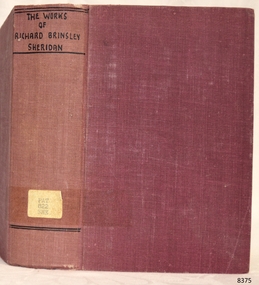
Book - Compalation of Plays, Prologues, Sociatal Observations, Richard Brinsley Sheridan, The Works of Richard Brinsley Sheridan, 1874
... Rather than just printing his famous plays, this single-volume edition compiles his complete theatrical catalog (The Rivals, The School for Scandal, The Duenna, The Critic, Pizarro, etc.). ...Richard Brinsley Sheridan (1751–1816) was an Irish-born playwright, impresario, wit, and prominent Whig politician. He was a dazzling figure in late 18th-century London high society. The book, The Works of Richard Brinsley Sheridan, edited by Francis Stainforth, is an omnibus collection showcasing the full breadth of his career. The volume opens with a substantial biographical introduction (the "memoir"). It traces Sheridan's meteoric rise from an impoverished Irish theater family to the heights of Parliament and Westminster Abbey, balanced against his chaotic personal finances and battles with alcoholism. Rather than just printing his famous plays, this single-volume edition compiles his complete theatrical catalog (The Rivals, The School for Scandal, The Duenna, The Critic, Pizarro, etc.). Also included are his lesser-known verse, prologues written for the theater, classical translations, a selection of his most famous parliamentary orations, and fragments of plays and essays he never completed. The addition of a collection on “ANA,” noted on the book's flyleaf, refers to a 19th-century publishing term for a collection of anecdotes, memorable sayings, table-talk, and biographical trivia regarding a famous person. The "Sheridaniana" section in this book compiles the sharp-witted jokes, pranks, and clever remarks Sheridan made throughout his life.The Works of Richard Brinsley Sheridan Author: Richard Brinsley Sheridan Publisher: Chatto and Windus Date: 1874 Editor: Francis Edward StainforthfictionRichard Brinsley Sheridan (1751–1816) was an Irish-born playwright, impresario, wit, and prominent Whig politician. He was a dazzling figure in late 18th-century London high society. The book, The Works of Richard Brinsley Sheridan, edited by Francis Stainforth, is an omnibus collection showcasing the full breadth of his career. The volume opens with a substantial biographical introduction (the "memoir"). It traces Sheridan's meteoric rise from an impoverished Irish theater family to the heights of Parliament and Westminster Abbey, balanced against his chaotic personal finances and battles with alcoholism. Rather than just printing his famous plays, this single-volume edition compiles his complete theatrical catalog (The Rivals, The School for Scandal, The Duenna, The Critic, Pizarro, etc.). Also included are his lesser-known verse, prologues written for the theater, classical translations, a selection of his most famous parliamentary orations, and fragments of plays and essays he never completed. The addition of a collection on “ANA,” noted on the book's flyleaf, refers to a 19th-century publishing term for a collection of anecdotes, memorable sayings, table-talk, and biographical trivia regarding a famous person. The "Sheridaniana" section in this book compiles the sharp-witted jokes, pranks, and clever remarks Sheridan made throughout his life.flagstaff hil, warrnambool, flagstaff hill maritime museum, maritime museum, shipwreck coast, great ocean road, book, pattison collection, warrnambool library, warrnambool mechanics’ institute, ralph eric pattison, corangamite regional library service, warrnambool city librarian, mechanics’ institute library, victorian library board, warrnambool books and records, warrnambool children’s library, the works of richard brinsley sheridan, richard brinsley sheridan, f stainforth, plays, drama -
 Flagstaff Hill Maritime Museum and Village
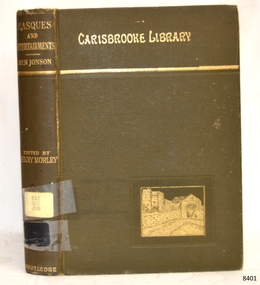
Book - Compilation of Dramatic Artistic Performances, George Routledge, Masques and Entertainments, 1890
... A masque was not a standard theater play; it was an incredibly expensive, lavish, and exclusive form of festive royal court entertainment that combined music, singing, and poetry, as well as elaborate acting and choreographed dancing. Often associated with these theatrical...A masque was not a standard theater play; it was an incredibly expensive, lavish, and exclusive form of festive royal court entertainment that combined music, singing, and poetry, as well as elaborate acting and choreographed dancing. Often associated with these theatrical ...Masques and Entertainments by Ben Jonson (edited by Henry Morley and published by George Routledge & Sons in 1890) is a compilation of the dramatic courtly performances written by the legendary Renaissance playwright and poet Ben Jonson. Issued as Volume IX of the popular "Carisbrooke Library" series, this specific late-Victorian edition gathered works that Jonson originally wrote in the early 17th century (between 1603 and 1630) for the courts of King James I and King Charles I.Masques and Entertainments Author: Ben Jonson Publisher: George Routledge & Sons Date: 1890fictionMasques and Entertainments by Ben Jonson (edited by Henry Morley and published by George Routledge & Sons in 1890) is a compilation of the dramatic courtly performances written by the legendary Renaissance playwright and poet Ben Jonson. Issued as Volume IX of the popular "Carisbrooke Library" series, this specific late-Victorian edition gathered works that Jonson originally wrote in the early 17th century (between 1603 and 1630) for the courts of King James I and King Charles I.flagstaff hil, warrnambool, flagstaff hill maritime museum, maritime museum, shipwreck coast, flagstaff hill maritime village, great ocean road, book, pattison collection, warrnambool library, warrnambool mechanics’ institute, ralph eric pattison, corangamite regional library service, warrnambool city librarian, mechanics’ institute library, victorian library board, warrnambool books and records, warrnambool children’s library, masques and entertainments, ben jonson -
 City of Moorabbin Historical Society (Operating the Box Cottage Museum)
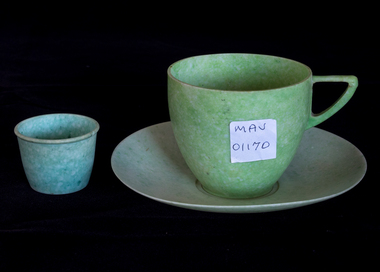
Kitchen Equipment, Bakelite Green, Cup,saucer, eggcup, c1930
... plays and musicals the City of Moorabbin. Bakelite became affordable and plentiful so it was used in many homes like Gladys Reed in City of Moorabbin c1960 bakelite, crockery, clothing, manufactured lace, dressmaking, blouses, theatrical props, craftwork, sequins, beading, early settlers, moorabbin shire, mechanics institute cheltenham, ormond choral society, postworld war 11 settlers, housing estates moorabbin 1950, bentleigh, ormond, moorabbin, cheltenham, drama societies, musical society cheltenham, clark judy Green bakelite cup, saucer, egg cup c1930 Kitchen Equipment, Bakelite Green, Cup,saucer, eggcup ...Bakelite crockery became inexpensive and popular c 1930 and was used for a variety of goods because of its almost unbreakable quality. . Gladys Reed was a member of the Ormond Choral Society c 1950. who performed plays and musicals the City of Moorabbin. Bakelite became affordable and plentiful so it was used in many homes like Gladys Reed in City of Moorabbin c1960 Green bakelite cup, saucer, egg cup c1930bakelite, crockery, clothing, manufactured lace, dressmaking, blouses, theatrical props, craftwork, sequins, beading, early settlers, moorabbin shire, mechanics institute cheltenham, ormond choral society, postworld war 11 settlers, housing estates moorabbin 1950, bentleigh, ormond, moorabbin, cheltenham, drama societies, musical society cheltenham, clark judy -
 City of Moorabbin Historical Society (Operating the Box Cottage Museum)
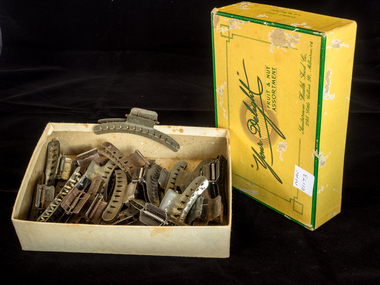
Manufactured Object, Hair 'Butterfly clips' stainless steel, c1960
... Gladys Reed, who was a member of the Ormond Choral Society c 1950.that performed plays and musicals the City of Moorabbin used these 'butterfly clips' hairdressing finger wave hairstyle steel fashion theatrical props craftwork sequins beading early settlers moorabbin shire mechanics institute cheltenham ormond choral society postworld war 11 settlers housing estates moorabbin 1950 bentleigh ormond moorabbin cheltenham drama societies musical society cheltenham clark judy reed gladys reed george hairdressing salons Steel spring 'butterfly clips' used for crimping hair to form waves. ...These are stainless steel Hair styling Clips that are used for creating definite, non permanent Waves in a lady's hair c 1920 to 1960. Ladies usually went to the hairdresser for this styling but they could do it themselves at home Gladys Reed was a member of the Ormond Choral Society c 1950. who performed plays and musicals the City of Moorabbin Finger waves were very a fashionable Hairstyle 1920 - 1960. Gladys Reed, who was a member of the Ormond Choral Society c 1950.that performed plays and musicals the City of Moorabbin used these 'butterfly clips'Steel spring 'butterfly clips' used for crimping hair to form waves. Sanitarium Health Food Company Box c 1960 used for storage.hairdressing, finger wave hairstyle, steel, fashion, theatrical props, craftwork, sequins, beading, early settlers, moorabbin shire, mechanics institute cheltenham, ormond choral society, postworld war 11 settlers, housing estates moorabbin 1950, bentleigh, ormond, moorabbin, cheltenham, drama societies, musical society cheltenham, clark judy, reed gladys, reed george, hairdressing salons -
 City of Moorabbin Historical Society (Operating the Box Cottage Museum)
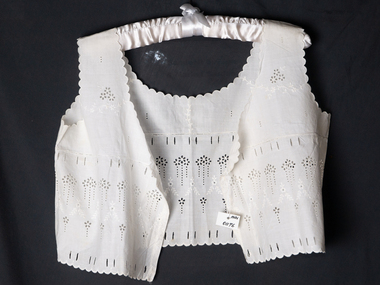
Clothing, white cotton lace blouse, c1960
... plays and musicals the City of Moorabbin and she was an accomplished dressmaker and made this blouse for her daughter Judy. Manufactured lace became affordable and plentiful so it was used by home dressmakers like Gladys Reed in City of Moorabbin c1960 clothing, manufactured lace, dressmaking, blouses, theatrical props, craftwork, sequins, beading, early settlers, moorabbin shire, mechanics institute cheltenham, ormond choral society, postworld war 11 settlers, housing estates moorabbin 1950, bentleigh, ormond, moorabbin, cheltenham, drama societies, musical society cheltenham, clark judy, reed gladys, reed george A white cotton lace, sleeveless blouse c 1960 with opening front fastened by hooks and eyes Clothing, white cotton lace blouse Mrs Gladys Reed ...Gladys Reed was a member of the Ormond Choral Society c 1950. who performed plays and musicals the City of Moorabbin and she was an accomplished dressmaker and made this blouse for her daughter Judy.Manufactured lace became affordable and plentiful so it was used by home dressmakers like Gladys Reed in City of Moorabbin c1960A white cotton lace, sleeveless blouse c 1960 with opening front fastened by hooks and eyes clothing, manufactured lace, dressmaking, blouses, theatrical props, craftwork, sequins, beading, early settlers, moorabbin shire, mechanics institute cheltenham, ormond choral society, postworld war 11 settlers, housing estates moorabbin 1950, bentleigh, ormond, moorabbin, cheltenham, drama societies, musical society cheltenham, clark judy, reed gladys, reed george -
 City of Moorabbin Historical Society (Operating the Box Cottage Museum)
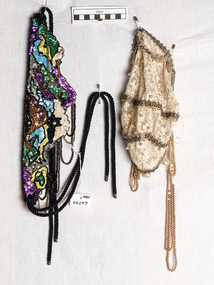
Clothing - Clothing, Theatrical prop, Hat, beaded evening wear, c1950
... Gladys Reed was a member of the Ormond Choral Society c 1950. and these clothing props were used in the plays and musicals when performed in the City of Moorabbin c1950 Drama, Musical and Choral Societies were founded by local residents in the City of Moorabbin c1950 to provide social, artistic and musical entertainment and development in their communities early settlers, moorabbin shire, mechanics institute cheltenham, ormond choral society, postworld war 11 settlers, housing estates moorabbin 1950, bentleigh, ormond, moorabbin, cheltenham, drama societies, musical society cheltenham, clark judy, reed gladys, reed george A theatrical prop for the Ormond Choral Society c1950 that simulates a 1920's flapper beaded evening wear cloche hat. ...Gladys Reed was a member of the Ormond Choral Society c 1950. and these clothing props were used in the plays and musicals when performed in the City of Moorabbin c1950 Drama, Musical and Choral Societies were founded by local residents in the City of Moorabbin c1950 to provide social, artistic and musical entertainment and development in their communities A theatrical prop for the Ormond Choral Society c1950 that simulates a 1920's flapper beaded evening wear cloche hat. White lace is over sewn with small pearl beads and 3 rows of shiny beading with large pearls and beading around edge of hat. Loops of small pearls hang from each side . Shown with beaded waistband MAV 00297 early settlers, moorabbin shire, mechanics institute cheltenham, ormond choral society, postworld war 11 settlers, housing estates moorabbin 1950, bentleigh, ormond, moorabbin, cheltenham, drama societies, musical society cheltenham, clark judy, reed gladys, reed george -
 City of Moorabbin Historical Society (Operating the Box Cottage Museum)
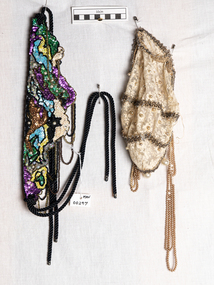
Clothing - Theatrical prop, waistband beaded eveningwear, c1950
... Gladys Reed was a member of the Ormond Choral Society c 1950. and this beaded sequined clothing prop was used in the plays and musicals when performed in the the City of Moorabbin clothing, theatrical props, craftwork, sequins, beading, early settlers, moorabbin shire, mechanics institute cheltenham, ormond choral society, postworld war 11 settlers, housing estates moorabbin 1950, bentleigh, ormond, moorabbin, cheltenham, drama societies, musical society cheltenham, clark judy, reed gladys, reed george A Theatrical prop, evening wear as a taffeta waistband with beading, multi coloured sequins, and corded cotton waist ties.c1950 Shown with Theatrical prop white beaded lace hat MAV 00295 Clothing Theatrical prop, waistband beaded eveningwear Mrs Gladys Reed &Ormond Choral Society ...This beaded sequined waist band for evening wear was a clothing prop used in the plays and musicals performed in the the City of Moorabbin. Gladys Reed was a member of the Ormond Choral Society c 1950. Gladys Reed was a member of the Ormond Choral Society c 1950. and this beaded sequined clothing prop was used in the plays and musicals when performed in the the City of Moorabbin A Theatrical prop, evening wear as a taffeta waistband with beading, multi coloured sequins, and corded cotton waist ties.c1950 Shown with Theatrical prop white beaded lace hat MAV 00295clothing, theatrical props, craftwork, sequins, beading, early settlers, moorabbin shire, mechanics institute cheltenham, ormond choral society, postworld war 11 settlers, housing estates moorabbin 1950, bentleigh, ormond, moorabbin, cheltenham, drama societies, musical society cheltenham, clark judy, reed gladys, reed george -
 The Beechworth Burke Museum
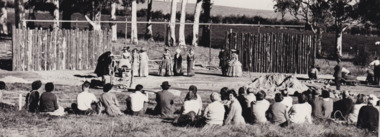
Photograph, Mid 1900s
... play...theatrical performance...theatrical performance of 10 adult actors dressed in Victorian era costumes. The actors are performing on a make-shift stage that features upright logs as a background. Next to the stage is a group of workers laying bricks. The audience is seated on a grassy ground in front of the stage. entertainment album beechworth burke museum performance play ...The photograph depicts a group of adults dressed in everyday clothing viewing a theatrical performance of 10 adult actors dressed in Victorian era costumes. The actors are performing on a make-shift stage that features upright logs as a background. Next to the stage is a group of workers laying bricks. The audience is seated on a grassy ground in front of the stage.Black and white rectangular reproduced photograph printed on matte photographic paper.Reverse: 5655 (in black pen)/ Beechworth (in blue pen)/entertainment album, beechworth, burke museum, performance, play, theatrical performance, performers -
 The Beechworth Burke Museum
Photograph
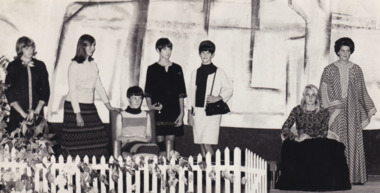
... ...theatrical group...play...Collectively, these records enrich the community's understanding of how the arts have developed in Beechworth since the mid-twentieth century. entertainment entertainment album beechworth arts performance theatre theatrical group play recreation Reverse: THE OVENS AND MURRAY / 5665 / Black and white rectangular photograph printed on matte photographic paper. ...The photograph depicts seven unidentified female theatrical performers. They are posing on a stage with a white picket fence and foliage.The photograph provides insight into entertainment, performance and recreation in Beechworth during the 1950s. The item's interpretive capacity is enhanced by its strong relationship to other photographs in the catalogue. Collectively, these records enrich the community's understanding of how the arts have developed in Beechworth since the mid-twentieth century.Black and white rectangular photograph printed on matte photographic paper.Reverse: THE OVENS AND MURRAY / 5665 /entertainment, entertainment album, beechworth, arts, performance, theatre, theatrical group, play, recreation -
 The Beechworth Burke Museum
Photograph
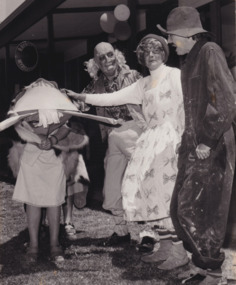
... play...theatrical group...Collectively, these records enrich the community's understanding of how the arts have developed in Beechworth since the mid-twentieth century. entertainment entertainment album performance arts theatre play theatrical group myrtleford beechworth rayner st Reverse: 5667 / Black and white rectangular photograph printed on matte photographic paper. ...Depicted are five unidentified performers. Two of them are guiding a prop. One of the male performers is wearing a mask. A sign in the background reads "Rayner Myrtleford", referring to Rayner St in Myrtleford; a town located approximately 28km south of Beechworth.The photograph provides insight into entertainment, performance and recreation in Beechworth during the 1950s. The item's interpretive capacity is enhanced by its strong relationship to other photographs in the catalogue. Collectively, these records enrich the community's understanding of how the arts have developed in Beechworth since the mid-twentieth century.Black and white rectangular photograph printed on matte photographic paper.Reverse: 5667 /entertainment, entertainment album, performance, arts, theatre, play, theatrical group, myrtleford, beechworth, rayner st -
 Ringwood and District Historical Society
Newspaper, Scrapbook Clipping, Library Collection, Ringwood, Victoria
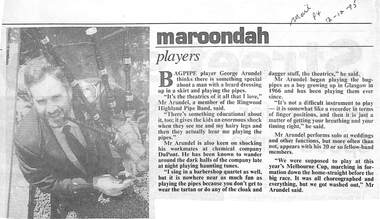
... Bagpipe player George Arundel thinks there is something special about a man with a beard dressing up in a skirt and playing the pipes. "It's the theatrics of it all that I love", Mr Arundel, a member of the Ringwood Highland Pip[e Band, said. ...Bagpipe player George Arundel thinks there is something special about a man with a beard dressing up in a skirt and playing the pipes. "It's the theatrics of it all that I love", Mr Arundel, a member of the Ringwood Highland Pip[e Band, said. ...Newspaper Clipping from "The Mail", 12-12-95. P 4 "Maroondah players"'. George ArundelBagpipe player George Arundel thinks there is something special about a man with a beard dressing up in a skirt and playing the pipes. "It's the theatrics of it all that I love", Mr Arundel, a member of the Ringwood Highland Pip[e Band, said. Mr Arundel began playing the bagpipesas a boy growing up in Glasgow in 1966, and has been playing them ever since. -
 Orbost & District Historical Society
program, 1797
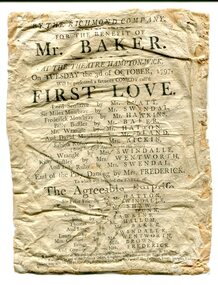
... theatrical entertainments. The theatre had disappeared by 1865. It would have been a touring company who were playing on the night of 3 October 1797...theatrical entertainments. The theatre had disappeared by 1865. It would have been a touring company who were playing on the night of 3 October 1797." ( information from Ray Elmitt, historian of Hampton Wick ) The doors were to be opened at 6 to begin precisely at 7 o'clock,. ..."The theatre itself was located in a barn close to the village pond. Its location is indicated on the attached 1827 map of Hampton Wick and the Swan arrowed where tickets were to be had. The picture of Ye Swan around 1900 is probably not too dissimilar to how it would have looked in 1797. One of the regular patrons at the theatre is believed to have been William, Duke of Clarence (later King William IV, uncle of Queen Victoria). The Duke lived in Bushy House about a mile away from the village and was a known devotee of theatrical entertainments. The theatre had disappeared by 1865. It would have been a touring company who were playing on the night of 3 October 1797." ( information from Ray Elmitt, historian of Hampton Wick ) The doors were to be opened at 6 to begin precisely at 7 o'clock,. Boxes were 3 shillings, Pit seats were 2 shillings and seats in the gallery were 1 shilling. Tickets could be bought at the printing office in Kingston or from Mr Ansel of Adam and Eve in Kingston or from Mr Pattenden of the Swan in Hampton Wick. "First Love" is a 1795 sentimental comedy play by the British playwright Richard Cumberland. It was first performed at the Drury Lane Theatre in May 1795. Frederick Mowbray becomes the protector of Sabrina Rosny after her abandoment by Lord Sensitive. The Agreeable Surprise is a 1781 comic opera to music by Samuel Arnold and a libretto by John O'Keeffe. The work in two acts was first performed at the Theatre Royal, Haymarket (London), on 3 September 1781. It was one of the most performed works of its kind in London in the last quarter of the 18th century. In England the 18th century saw the flourishing of theatre as a popular pastime. Many theatres were enlarged and new playhouses built in London and the provinces. This item was kept as a souvenir / memento and brought to Australia by an early settler.A very old program from the Richmond Company at the Theatre Hampton-Wick. It is white with black print. There are two performances - First Love and The Agreeable Surprise. There is a cast list for each. theatre hampton-wick-richmond-company -
 Bendigo Historical Society Inc.
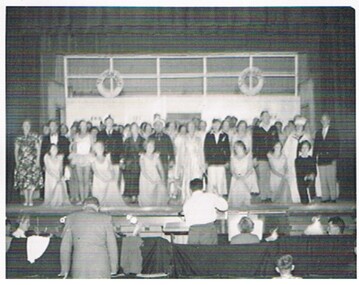
Photograph - GERTRUDE PERRY COLLECTION: PHOTOGRAPHS - THEATRICAL
... play) Photographs. Gertrude Perry Collection. Two larger and sixteen smaller black & white photographs of various actors from 'You're in Love'. Photographs in a brown envelope with The National Cash Register Co. Pty. Ltd. At the Capital City of State of Address printed on the front. Photograph GERTRUDE PERRY COLLECTION: PHOTOGRAPHS - THEATRICAL ...Photographs. Gertrude Perry Collection. Two larger and sixteen smaller black & white photographs of various actors from 'You're in Love'. Photographs in a brown envelope with The National Cash Register Co. Pty. Ltd. At the Capital City of State of Address printed on the front.gertrude perry collection, celia doag?, you're in love (play) -
 National Vietnam Veterans Museum (NVVM)
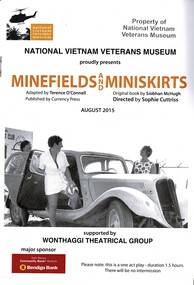
Document, A Collection of Articles for the Minefields and Miniskirts Performance in August 2015, 2015
... play...Minefields and Miniskirts...Australian Army Nurses...Wonthaggi Theatrical...National Vietnam Veterans Museum Stage play Minefields and Miniskirts Australian Army Nurses Wonthaggi Theatrical Group A Collection of Articles for the Minefields and Miniskirts Performance in August 2015. ...A Collection of Articles for the Minefields and Miniskirts Performance in August 2015. This inclues three copies of National Vietnam Veterans Museum proudly presents Minefields and Miniskirts, two advertising flyers and three coloured articles from the Advertiser and Sentinel Times. See media files for more information.national vietnam veterans museum, stage play, minefields and miniskirts, australian army nurses, wonthaggi theatrical group -
 Ithacan Historical Society
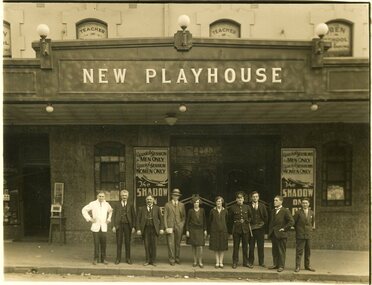
Photograph, New Playhouse Theatre, 1927
... theatrical productions at the Playhouse. Greek school concerts were also held at the theatre. The Playhouse Theatre was situated in the former Aikman Street, South Melbourne (now Southbank) near Princes Bridge and was a venue repertory theatre. It first opened in 1912 as the Snowden Picture Theatre in the days of silent films and was rebuilt in 1916 as legitimate play ...Pictured is staff and actors from the new Playhouse Theatre, Melbourne. At some point Theodore Polities (pictured third from left) from Lefkada ran the theatre's confectionary bar and he also took on the operational management of the theatre when it was experiencing financial difficulties. Ithacan Gerasimos Dionysios Gavrilis (know as George Denis Gabriel) appeared in various theatrical productions at the Playhouse. Greek school concerts were also held at the theatre. The Playhouse Theatre was situated in the former Aikman Street, South Melbourne (now Southbank) near Princes Bridge and was a venue repertory theatre. It first opened in 1912 as the Snowden Picture Theatre in the days of silent films and was rebuilt in 1916 as legitimate play house theatre. As the Playhouse it was the original home of the Melbourne Repertory Society. It was renamed the Garrick in 1933. The property was sold in 1937 for ₤17 500 ($35 000) to the Australian Paper Manufacturers company following which they donated the seating to the University of Melbourne's Union Theatre. A sepia photograph of eight men and two women standing outside the New Playhouse Theatre (Garrick Theatre). -
 Warrnambool and District Historical Society Inc.
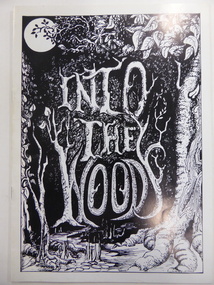
Program, Into the woods, 1997
... Warrnambool has had many drama and theatrical groups throughout its history, with the present day Warrnambool Theatre Company evolving from the Warrnambool Theatre Group which was founded in 1948. Plays...The booklet contains advertisements, information on the play and the theatrical performers and producers and black and white photographs. ...The booklet contains advertisements, information on the play and the theatrical performers and producers and black and white photographs. ...This is a programme for the 1997 Warrnambool Theatre Company production of ‘Into the Woods’. Warrnambool has had many drama and theatrical groups throughout its history, with the present day Warrnambool Theatre Company evolving from the Warrnambool Theatre Group which was founded in 1948. Plays and musicals have been produced each year since, with most productions being staged at the Warrnambool Town Hall/Performing Arts Centre/Lighthouse Theatre. This programme is of interest as an example of the productions staged by the Warrnambool Theatre Company. This is a booklet of 16 pages with a white cover. On the front cover is an illustration of a wooded forest in black and white tonings with the lettering in black and white. The back cover has an advertisement in black and white. The booklet contains advertisements, information on the play and the theatrical performers and producers and black and white photographs. The booklet is bound with metal staples. warrnambool theatre company, history of warrnambool -
 Melbourne Athenaeum Archives
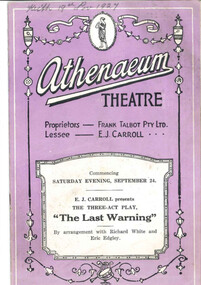
Theatre program, Cass & Clothier (Printers), The Last Warning (play in three acts) by Thomas S Fallon performed at the Athenaeum Theatre in 1927, 1927
... The play was based on the novel "House of fear" by Wadsworth Camp and was presented at the Athenaeum Theatre by E.J. Carroll Staged by Eric Edgley (Theatrical family); advertisements show cost of living of the period - two course meal for 2 shillings and 3 pence; holiday suggestions by Government Tourist Bureau are to Mt Buffalo and Gippsland Lakes. athenaeum theatre program programme the last warning e j carroll richard white eric edgley frank talbot pty ltd thomas f fallon Paper program for a play performed at the Athenaeum Theatre Saturday September 24 1927; coloured cover; 16 p. includes articles about the film, the actors and advertisements The Last Warning (play in three acts) by Thomas S Fallon performed at the Athenaeum Theatre in 1927 Theatre program Cass & Clothier (Printers) ...The plot of the play is concerned with the performance of a play "The snare" at the imaginary Woodford Theatre; a separate, small paper program for this play within a play is included with the program. The play was based on the novel "House of fear" by Wadsworth Camp and was presented at the Athenaeum Theatre by E.J. Carroll Staged by Eric Edgley (Theatrical family); advertisements show cost of living of the period - two course meal for 2 shillings and 3 pence; holiday suggestions by Government Tourist Bureau are to Mt Buffalo and Gippsland Lakes. Paper program for a play performed at the Athenaeum Theatre Saturday September 24 1927; coloured cover; 16 p. includes articles about the film, the actors and advertisementsathenaeum theatre, program, programme, the last warning, e j carroll, richard white, eric edgley, frank talbot pty ltd, thomas f fallon -
 Melbourne Athenaeum Archives
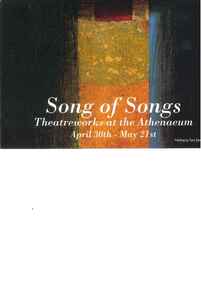
Theatre Flyer, Songs of Songs : a love poem outside time (musical theatre) by Theatreworks performed at Athenaeum commencing 30 April 1994
... Theatrical adaptation of the ''Song of Solomon'' will challenge your perception of love. Cost at the door: $19.90 Full / $17 Friends and $12 Concession. Directed by Robert Draffin Designed by Lloyd James Cast : Mary Sitarenos , Paul English , Kerry Armstrong , Margaret Mills , Deidre Rubenstien. Musician : Chris Young .Music by Tyrone Landau and Chris Young It was played ...''It's dangerous to allow yourself to be loved'' This Theatrical adaptation of the ''Song of Solomon'' will challenge your perception of love. Cost at the door: $19.90 Full / $17 Friends and $12 Concession. Directed by Robert Draffin Designed by Lloyd James Cast : Mary Sitarenos , Paul English , Kerry Armstrong , Margaret Mills , Deidre Rubenstien. Musician : Chris Young .Music by Tyrone Landau and Chris YoungIt was played as a limited three week performance. It was sponsored by the Sidney Myer Fund, SBS 1224, Arts Victoria and Australian Council for the Arts.coloured flyersong of songs, athenaeum theatre, kerry armstrong
