
Showing 3 items matching "theological dictionaries"
-
 Flagstaff Hill Maritime Museum and Village
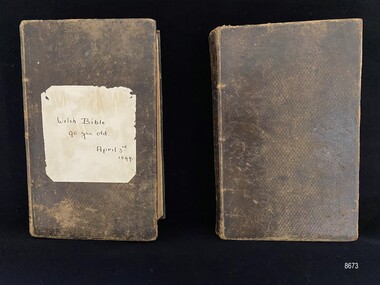
Book - Welsh Theological Dictionary - 2 volume, William Jones, A THEOLOGICAL DICTIONARY, 1837 & 1839
... ...Theological Dictionaries...The Theological Dictionaries belonged to David and Alice Ellis, a young couple married in Dublin in 1855. ...A two volume set Theological Dictionary in Welsh. Both books are covered in brown leather with gold embossed patterns and words on the spine. ...The Theological Dictionaries belonged to David and Alice Ellis, a young couple married in Dublin in 1855. ...The Theological Dictionaries belonged to David and Alice Ellis, a young couple married in Dublin in 1855. They left for Australia on the Schomberg clipper ship on October 6 that same year, joining the other passengers for the luxury sailing ship’s first voyage, bound for Melbourne, Australia. The Schomberg was grounded on a sand spit near Peterborough. All passengers and crew were safely rescued. They had been allowed to take something small with them when leaving the sinking vessel, and as such, Alice took a small cane basket and coin purse. The Dictionaries were also amongst the couple’s possessions, along with a metal trunk, a Bible and a pair of candlesticks. These items were all later retrieved from the ship’s deck by the crew of a steamer sent from Melbourne. At that time, David was 23 years old (born in Wales, in 1832) and Alice was 26 (born in Ireland, 1829). The couple lived in Tasmania for a short period before settling in the Western Districts of Victoria. David worked as a gardener and, when land in the area was available to purchase, David and Alice claimed a selection on Noorat Road near Terang. They settled there for the remainder of their lives, expanding the property that they named, ‘Allambah’, and had six children. David died in 1911, aged 79, and Alice passed away the following year, aged 83. Two of David and Alice’s children, David jnr. and Grace adopted a daughter Nell Margaret Crick (nee Ellis). The Dictionaries were passed onto Nell with the misunderstanding (due to being written in the Welsh language) that they were Bibles. Nell pasted a piece of paper onto the front of the first volume recording ‘Welsh Bible 90 yrs old. April 3rd 1844’. The April date relates to the inscription inside both volumes and the 90 yrs old relates to the year Nell possibly received them, 1934. She has also added to the inscription page inside the first volume again recording ’Welsh Bible 90 yrs old. Miss. G Ellis “Allambah” Terang’. This implies that Grace Ellis had been the ‘keeper’ of the dictionaries. Grace and David Ellis were devout Christians which they passed on to their adopted daughter Nell, and were prominent members of the Noorat and Terang Presbyterian Churches. As David and Alice Ellis came out on the Schomberg in 1855, and the inscription inside both volumes of the Dictionary carries the date April 3rd 1844 and the name Thomas Ellis, it could be presumed that this was a family gift of significance to the couple as they began their new life in a country far away.The theological dictionaries are part of a group of donated possessions of David and Alice Ellis that have great significance as personal belongings, providing an insight into what emigrants considered important possessions to bring as they began a new life on the other side of the world. They are part of Flagstaff Hill’s collection of artefacts from the Schomberg shipwreck, which is listed on the Victorian Heritage Register (VHR S612). All items had been saved from the sinking luxury clipper ship, the Schomberg, in 1855. The ship has historical significance as a rare example of a large, fast clipper ship on the England to Australia run, built to carry emigrants at the time of the Victorian gold rush. The ship’s design included the technical advances needed to break sailing records between Europe and Australia. The relationship of the objects in Flagstaff Hill’s Schomberg collection allows potential interpretation of the story of the Schomberg. The collection of objects is archaeologically significant as the remains of an international passenger ship, as it represents aspects of Victoria’s shipping history, in addition to its association with the shipwreck and the ship.A two volume set Theological Dictionary in Welsh. Both books are covered in brown leather with gold embossed patterns and words on the spine. The words 'GEIRIADUR DUWINYDDOL' (Theological dictionary) are on both spines towards the top and towards the bottom the number 1 or 2 dependent on the volume. The first volume, at around 900 pages, is slightly larger than the second volume, around 740 pages. The first volume has had a plain piece of paper glued to the front with the words 'Welsh Bible, 90 yrs old, April 3rd 1844'. Each volume has an inscription to Thomas Ellis inside the front cover, the date April 3rd 1844 and other words in Welsh. The first volume has added writing (in different handwriting) on the inscription page. The books are laid out in dictionary format with the first volume going from ABE to HYP. The second volume begins at IAC and ends at YST, followed by an Appendix and Index. The first volume was published in 1837 and the second volume in 1839.Volume 1 - Thomas Ellis ... 6 words in Welsh ... Aprill 3/44 (Handwriting 1) - Welsh Bible 90 yrs old, Miss G. Ellis, "Allambah" Terang. (Handwriting 2) Volume 2 - Thomas Ellis ... 6 words in Welsh (same as volume 1) ... Aprill 3/44flagstaff hill maritime museum and village, great ocean road, shipwreck coast, theological dictionaries, welsh theological dictionaries, welsh bible, schomberg, sailing ship, schomberg passengers, schomberg ship, 1855, 1855 shipwreck, peterborough shipwreck, david and alice ellis, david ellis jnr, grace ellis, nell ellis, nell crick, allambah terang, terang presbyterian church -
 Flagstaff Hill Maritime Museum and Village
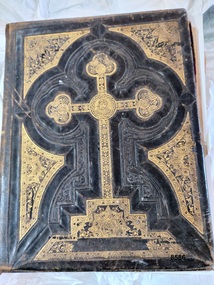
Book - Bible, Thomas Kelly & Sons, The Holy Bible - Douay Bible and Rheims Testament, 1880
... The Bible includes the Old and New Testaments, approbations from Pope Pius the Sixth and Archbishops of the United States and other countries (including Archbishop Vaughan of Sydney), a Family Register with handwritten notes on births, deaths and marriages from the Kermond family (as well as a description of how they obtained the bible), a Catholic dictionary of the Bible, a history of the Holy Scriptures, a chronological list of heretics (Theological history) and a description of the "Centennial Award - Diploma of Honor and medal of Merit" won by Thomas Kelly (for the "Best Catholic Bible") at the Centennial Exhibition at Philadelphia in 1876. ...The Bible includes the Old and New Testaments, approbations from Pope Pius the Sixth and Archbishops of the United States and other countries (including Archbishop Vaughan of Sydney), a Family Register with handwritten notes on births, deaths and marriages from the Kermond family (as well as a description of how they obtained the bible), a Catholic dictionary of the Bible, a history of the Holy Scriptures, a chronological list of heretics (Theological history) and a description of the "Centennial Award - Diploma of Honor and medal of Merit" won by Thomas Kelly (for the "Best Catholic Bible") at the Centennial Exhibition at Philadelphia in 1876. ...The Douay (Douai) Rheims Bible is an English translation of the Latin Vulgate Bible (which had been the Latin Bible used by the Catholic Church since the 4th century). It was produced by Roman Catholic scholars in exile from Elizabethan Protestant England at the English College of Douai (then in the Spanish Netherlands but later part of France). The New Testament translation was published in 1582 at Rheims where the English College had temporarily located in 1578. The Old Testament was translated shortly afterwards but was not published until 1609-1610 in Douay (which makes it older than the King James version). The completed work was the only authorized Bible in English for Roman Catholics until the 20th Century. Its purpose was to uphold the Catholic tradition in the face of the Protestant Reformation and was produced as an alternative to the several Protestant translations then in existence. Prior to it being published, the Roman Catholic practice had restricted personal use of the Bible, in the Latin Vulgate, to the clergy. Bishop Richard Challoner issued a series of revisions (1749 - 1772) intended to make the translation more easily understandable and subsequent editions (including this one) were based upon this revision. In 1871, an edition of the Douay - Rheims Bible was published by Thomas Kelly & Sons of Philadelphia (and later, New York). Thomas Kelly described himself as a "Publisher, Printer, Binder, Lithographer and Steel Plate Engraver". In 1876, Thomas Kelly won an award (a Diploma of Honor and a Medal of Merit) for "the Best Catholic Bibles and Prayer Books" at the International Centennial Exhibition held in Philadelphia and his firm continued to print editions of the Bible throughout the 1870's but little is known of him after 1880 when this edition was published. This Bible has been in the Kermond family from 1888 until 1984 when Laurence Kermond (its last owner) died. The Kermonds were an old Warrnambool family with ties to the district going back to the mid 1840's. Joseph Kermond's mother, Catherine (1818 - 1895) and her husband John Kermond,, an ex-convict (1809 - 1877), had moved from Tasmania around 1843 and were living in the Warrnambool area in 1844 where their eldest son was born. They had six more children born at Port Fairy (or Belfast as it was then called). Catherine is buried at the Tower Hill cemetery. The last owner of the Bible was Laurence Kermond (1918 - 1984). He was the great grandson of John and Catherine Kermond and was a well known painter who lived in the Merimbula and Paynesville areas of N.S. W. and Victoria during the 1970's and early 1980's. The story of Joseph Kermond finding the Bible on a beach on the Shipwreck Coast near Peterborough on the southern coast of Victoria, Australia is plausible as it was not uncommon for items from shipwrecks to be washed ashore. However this Bible would not have come from the wreck of the Loch Ard as the dates don't align. The Loch Ard was wrecked in 1878 and this Bible was printed in 1880. It appears to have been printed for the Australian market as there is a page (with an engraved portrait) dedicated to the "Most Rev. Roger Bede Vaughan, O. S. B. Archbishop of Sydney, N. S. W.". It may also have been aimed at the Irish immigrants as the four "Family Register" pages are decorated with borders of shamrocks. The donor found the Bible in a box of secondhand books on a market stall in Gippsland and recognised its links to the Shipwreck Coast through the name of previous owners (a well-known Warrnambool name) and the story of it being found on a beach near Peterborough. This Bible is a rare example of Douay and Reims Catholic Bible of the late 19th century that was once a treasured item belonging to the Kermond family - one of Warrnambool's early settlers. It also has a most unusual story attached to it - being found (and rescued) washed up on a local beach and almost one hundred years later, being rescued again from a secondhand book stall.This Catholic Bible is an 1880 edition of a "Douay Bible and Rheims Testament", printed and published by Thomas Kelly of New York. Its full title is "The Holy Bible translated from the Latin Vulgate Diligently Compared with The Hebrew, Greek and Other Editions in Various Languages". It is revised with annotations by the Right Rev. R. Challoner D.D. The Bible has brown leather embossed front and back covers decorated with identical ornate gilt patterns and a central picture of a cross. It has two coloured illustrations and numerous black and white lithographs and engravings including portraits of past popes, events and places from Bible stories and decorative borders. The Bible includes the Old and New Testaments, approbations from Pope Pius the Sixth and Archbishops of the United States and other countries (including Archbishop Vaughan of Sydney), a Family Register with handwritten notes on births, deaths and marriages from the Kermond family (as well as a description of how they obtained the bible), a Catholic dictionary of the Bible, a history of the Holy Scriptures, a chronological list of heretics (Theological history) and a description of the "Centennial Award - Diploma of Honor and medal of Merit" won by Thomas Kelly (for the "Best Catholic Bible") at the Centennial Exhibition at Philadelphia in 1876. The Records section has a note on the Memoranda page written by William John Kennard in 1920.Spine: HOLY BIBLE Title Page: THE/ HOLY BIBLE /TRANSLATED FROM/ THE LATIN VULGATE/ DILIGENTLY COMPARED WITH/THE HEBREW, GREEK AND OTHER EDITIONS/ IN VARIOUS LANGUAGES/ THE OLD TESTAMENT WAS FIRST PUBLISHED BY THE ENGLISH COLLEGE AT DOUAY, A.D. 1600 / AND THE NEW TESTAMENT, BY THE ENGLISH COLLEGE AT RHEIMS, A.D. 1582./ REVISED WITH ANNOTATIONS/ BY THE RIGHT REV. R. CHALLONER D.D./ TOGETHER WITH REFERENCES, AND AN HISTORICAL AND CHRONOLOGICAL INDEX./ NOW CAREFULLY CORRECTED ACCORDING TO THE CLEMENTINE EDITION OF THE SCRIPTURES/ NEW YORK / THOMAS KELLY, PUBLISHER/ 17 BARCLAY STREET. / 1880 Dedication Page: DEDICATION OF THE ORIGINAL EDITION/ TO/ THAT LOYAL, RELIGIOUS AND ENLIGHTENED BODY OF MEN / THE/ CATHOLICS OF THE UNITED STATES OF AMERICA/ IN ADMIRATION OF THE STEADY ZEAL WITH WHICH THEY HAVE KEPTTHE/DEPOSIT OF FAITH/ BEQUEATHED THEM BY THEIR FOREFATHERS/ AND HANDED DOWN, WITHOUT INTERRUPTION OT ADULTERATION, TO THEIR GRATEFUL POSTERITY/ THIS EDITION/ OF THE/DOUAY BIBLE AND RHEIMS TESTAMENT/ IS / WITH GRATITUDE FOR PAST FAVORS AND HOPES OF FUTURE ENCOURAGEMENT/ MOST RESPECTFULLY ENSCRIBED. Handwritten note: ""This Holy Book was found . on the beach . near Peterborough Vic. having been washed ashore . from the wreck of the Loch Ard, (sailing ship) in the year 1888 . By .Joseph . Kermond; and presented to . his mother . Catherine Kermond , who in turn passed it - on . to her youngest . son ; one Jacob Kermond. He in turn presented . it to his son . William John Kermond , (the writer), 23/3/20)" [Original punctuation]flagstaff hill maritime museum and village, warrnambool, shipwreck coast, peterborough, kermond, kermond family, loch ard, bible, douay and rheims bible, catholic bible, thomas kelly and sons publiisher, douai, rheims, holy bible, religious bible, catherine kermond, john kermond, william john kermond' -
 Uniting Church Archives - Synod of Victoria
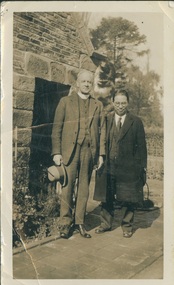
photograph, May 10th or 11th 1935
... His theological focus was on the redemptive love of God, manifest in the life of Jesus Christ, to whom people can commit themselves through a mystical experience of faith and intellectual creativity. Kagawa was known more as a Christian social reformer than as a religious leader both in and out of Japan, but he was fundamentally an evangelist throughout his life. Robert M. Fukada, “Kagawa, Toyohiko” in Biographical Dictionary...His theological focus was on the redemptive love of God, manifest in the life of Jesus Christ, to whom people can commit themselves through a mystical experience of faith and intellectual creativity. Kagawa was known more as a Christian social reformer than as a religious leader both in and out of Japan, but he was fundamentally an evangelist throughout his life. Robert M. Fukada, “Kagawa, Toyohiko” in Biographical Dictionary ...Kagawa, Toyohiko (1888-1960) Japanese evangelist and social movement leader Kagawa was born in Kobe to Kame and Junichi Kagawa. In lonely years following the death of his parents at age four, he met Harry W. Myers and Charles A. Logan, missionaries of the (Southern) Presbyterian Church, U.S., and was baptized by Myers on February 14, 1904, at the Tokushima church. He pursued theological study at Meiji Gakuin in Tokyo and Kobe Theological Seminary. During his student days in Kobe he moved into the Shinkawa slum to serve the physical and spiritual needs of some 7,500 people. Between August 1914 and May 1917 Kagawa studied in the United States at Princeton Theological Seminary and then became involved in labor and peasants movements in Japan and in organizing religious programs, with the Jesus Band of Kobe as the base of his work. In 1921 Kagawa organized the Friends of Jesus. This Franciscan-like band of young people strove for spiritual discipline, compassion for the poor, and an evangelical life of witness. When Tokyo suffered a massive earthquake in 1923, he shifted the main emphasis of his work to that city. He promoted economic cooperatives in Japan and peace and social reform programs before and after World War II. Kagawa was a prolific writer. Most of his writings are collected in the twenty-four volume Kagawa Toyohiko Zenshu (The work of Kagawa Toyohiko) (1964). His theological focus was on the redemptive love of God, manifest in the life of Jesus Christ, to whom people can commit themselves through a mystical experience of faith and intellectual creativity. Kagawa was known more as a Christian social reformer than as a religious leader both in and out of Japan, but he was fundamentally an evangelist throughout his life. Robert M. Fukada, “Kagawa, Toyohiko” in Biographical Dictionary of Christian Missions, ed. Gerald H. Anderson (New York: Macmillan Reference USA, 1998), 350. This article is reprinted from Biographical Dictionary of Christian Missions, Macmillan Reference USA, copyright © 1998 Gerald H. Anderson, by permission of Macmillan Reference USA, New York, NY. All rights reserved. B & W informal photograph of the Rev. H.C. Matthew and Toyohiko Kagawa standing in front of the door to Captain Cook's Cottage in the Fitzroy Gardens, Melbourne. "Melbourne May 19th or 11th 1935. H.C. Matthew & Toyohiko Kagawa standing by the cottage recently removed to Australia & re-erected in Melbourne Botanical Gardens in which Captain Cook was born."toyohiko kagawa, h.c. matthews, captain cook's cottage, friends of jesus, christian missions.
