
Showing 89 items matching "thermal"
-
 Bendigo Military Museum
Uniform - UNDERGARMENT, UNDAWEAR THERMAL, NEW ZEALAND, Unknown
... Olive green coloured wool knit fabric. Possibly thermal undergarment and doesn't appear to be military issue. ...Manufacturer's details - black coloured embroidery "UNDAWEAR/THERMAL/ MADE IN NEW ZEALAND/ SIZE: L"...UNDAWEAR THERMAL, NEW ZEALAND...Uniform UNDERGARMENT UNDAWEAR THERMAL, NEW ZEALAND ...Collection re Paul Denis AHEARN, No 331325 Refer Cat No. 11108 for his service details.Undergarment - long sleeved T-shirt design, with sleeve cuff. Olive green coloured wool knit fabric. Possibly thermal undergarment and doesn't appear to be military issue. Manufacturer's information, white coloured fabric label at back of neckband.Manufacturer's details - black coloured embroidery "UNDAWEAR/THERMAL/ MADE IN NEW ZEALAND/ SIZE: L"uniforms, undergarment, paul denis ahearn, ahearn collection -
 Moorabbin Air Museum
Manual (item) - Bob Nash; Engineering Notes; MIL-P-16610; Taper Pins; Terminal Accessories; Temperature Sensitive Coatings; Terminal - Press Fit; Terminal Strip; Thermal Jointing Compound; Thermocouple Accessories; Tube - Rubber Synth; Wire - Electrical; Wire-Control Cable; Jindivik';Specifications
... Bob Nash; Engineering Notes; MIL-P-16610; Taper Pins; Terminal Accessories; Temperature Sensitive Coatings; Terminal - Press Fit; Terminal Strip; Thermal Jointing Compound; Thermocouple Accessories; Tube - Rubber Synth; Wire - Electrical; Wire-Control Cable; Jindivik';Specifications...Red 3-ring Binder with stiff paper section dividers Bob Nash; Engineering Notes; MIL-P-16610; Taper Pins; Terminal Accessories; Temperature Sensitive Coatings; Terminal - Press Fit; Terminal Strip; Thermal Jointing Compound; Thermocouple Accessories; Tube - Rubber Synth; Wire - Electrical; Wire-Control Cable; Jindivik';Specifications Manual Bob Nash; Engineering Notes; MIL-P-16610; Taper Pins; Terminal Accessories; Temperature Sensitive Coatings; Terminal - Press Fit; Terminal Strip; Thermal Jointing Compound; Thermocouple Accessories; Tube - Rubber Synth; Wire - Electrical; Wire-Control Cable; Jindivik';Specifications ... -
 Numurkah & District Historical Society
Domestic object - Cooker
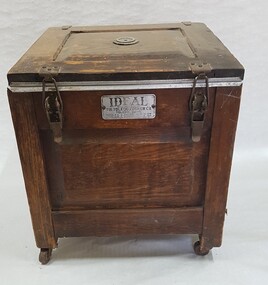
... ...thermal...Toledo Thermal Cooker - wooden box on legs with aluminium insulated centre. ...cooking thermal Toldedo Cooker see photos Toledo Thermal Cooker - wooden box on legs with aluminium insulated centre. ...Toledo Thermal Cooker - wooden box on legs with aluminium insulated centre. Cookpot fits on top. Hook includedsee photoscooking, thermal, toldedo, cooker -
 Eltham District Historical Society Inc
Book, Research Recipe Book produced by Research Primary School Mothers' Club, 1972
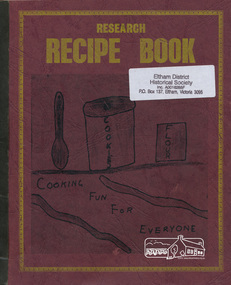
... 82 pages. Thermal Bound....This is a rare local community cookbook published by Research Primary School (established in 1892) documenting cookery customs in 1972 as well as a snapshot of local businesses at that time. research primary school community cookbook cookbook recipes research (vic.) 82 pages. Thermal Bound. Research Recipe Book produced by Research Primary School Mothers' Club Book ..."This book is a collection of favourite recipes of the children and their parents of the Research Primary School, 1972, and was compiled and collated by members of the Mothers Club. ... Mrs Cynthia Jenkins and Mrs Di Warrell who are responsible for all the illustrations and sketches". Recipes include name of contributor. Illustrated advertisements for local business also included. Actual maker unknown.This is a rare local community cookbook published by Research Primary School (established in 1892) documenting cookery customs in 1972 as well as a snapshot of local businesses at that time.82 pages. Thermal Bound.research primary school, community cookbook, cookbook, recipes, research (vic.) -
Federation University Historical Collection
Book, Ballarat College of Advanced Education Bachelor of Arts Performing Arts (Specialisation in Musical theatre), 1988
... Orange soft covered, 86 page, book with thermal binding. ...Ballarat College of Advanced Education Performing Arts Musical Theatre David Addenbrooke Adrian Thomas Hugh Halliday David Forrest music studies dance studies theatre studies hugh halliday garry west Ballarat lyric Theatre btv6 stereo television michael j. faulkener elizabeth joll fred fargher Orange soft covered, 86 page, book with thermal binding. Ballarat College of Advanced Education Bachelor of Arts Performing Arts (Specialisation in Musical theatre), 1988 Book ...Orange soft covered, 86 page, book with thermal binding. ballarat college of advanced education, performing arts, musical theatre, david addenbrooke, adrian thomas, hugh halliday, david forrest, music studies, dance studies, theatre studies, hugh halliday, garry west, ballarat, lyric theatre, btv6 stereo television, michael j. faulkener, elizabeth joll, fred fargher -
 8th/13th Victorian Mounted Rifles Regimental Collection
Book, An introduction to the study of the principles of war
... Green soft covered booklet, 22 pages, thermal binding....Green soft covered booklet, 22 pages, thermal binding. An introduction to the study of the principles of war Book ...An introduction lecture to the study of the principles of war drawing on examples from history.Green soft covered booklet, 22 pages, thermal binding.non-fictionAn introduction lecture to the study of the principles of war drawing on examples from history.history, principles, war, macklin -
 8th/13th Victorian Mounted Rifles Regimental Collection
Book, The Burma Campaign
... Green soft covered booklet, 93 pages, maps and diagrams,, thermal binding....Green soft covered booklet, 93 pages, maps and diagrams,, thermal binding. The Burma Campaign Book ...A series of study notes covering the military campaign in Burma during the Second World War.Green soft covered booklet, 93 pages, maps and diagrams,, thermal binding.non-fictionA series of study notes covering the military campaign in Burma during the Second World War.wwii, world war two, moore, history, burma -
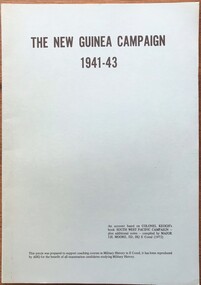 8th/13th Victorian Mounted Rifles Regimental Collection
Book, The New Guinea Campaign 1941-43
... Green soft covered booklet, 28 pages double sided printing, thermal binding....Green soft covered booklet, 28 pages double sided printing, thermal binding. The New Guinea Campaign 1941-43 Book ...A series of study notes covering the military campaign in Papua and New Guinea during the Second World War.Green soft covered booklet, 28 pages double sided printing, thermal binding.non-fictionA series of study notes covering the military campaign in Papua and New Guinea during the Second World War.wwii, new guinea, papua, world war two, moore, history -
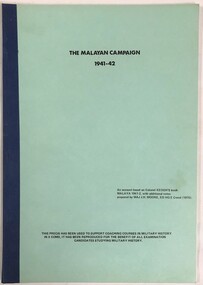 8th/13th Victorian Mounted Rifles Regimental Collection
Book, The Malayan Campaign 1941-42
... Green soft covered booklet, 42 pages, fold out appendix, two maps, thermal binding....Green soft covered booklet, 42 pages, fold out appendix, two maps, thermal binding. The Malayan Campaign 1941-42 Book ...A series of study notes covering the military campaign in Malaya during the Second World War.Green soft covered booklet, 42 pages, fold out appendix, two maps, thermal binding.non-fictionA series of study notes covering the military campaign in Malaya during the Second World War.wwii, world war two, moore, history, malaya -
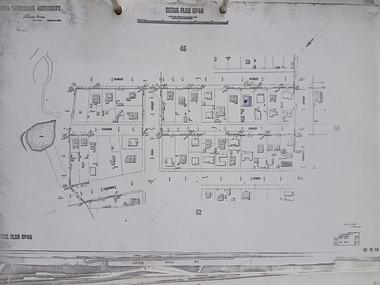 Bendigo Regional Archives Centre
Administrative record (item) - Bendigo Sewerage Authority Plans - Photocopies, Bendigo Sewerage Authority Plans - photocopies of microfiche versions of Plans 1 - 284 (incomplete), Post 1917
... Cardboard Lever arch folder 35cm x 25 cm x 8cm with thermal photocopy paper plans...Plans show footprits of houses and other structures in situ when plans were made Buildings Structures Sewerage Networks Nil Cardboard Lever arch folder 35cm x 25 cm x 8cm with thermal photocopy paper plans Bendigo Sewerage Authority Plans - photocopies of microfiche versions of Plans 1 - 284 (incomplete) Administrative record Bendigo Sewerage Authority Plans - Photocopies ...Plans show footprits of houses and other structures in situ when plans were madeNilbuildings, structures, sewerage networks -
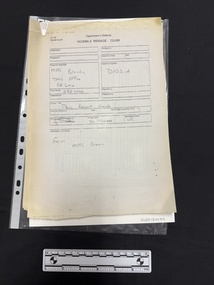 Returned Nurses RSL Sub-branch
Document - Facsimilie and photocopy of Service Record, Department of Defence, 19910918
... Document on thermal fax paper held together with a white archival paperclip. ...WWII WW2 World War 2 Edith Lydia Shaw Royal Red Cross Australian Army Nursing Service AANS Document on thermal fax paper held together with a white archival paperclip. ...Faxed document containing service records including personal record card, leave information and war service of Edith Lydia Shaw. Fax was received on 18 September 1991 from the Department of Defence DNS-A from MAS Brown. Information includes Shaw's biographical pre-enlistment details, ranks during service, leave details, unit served with, war service units and dates, general remarks including awards and termination information.Document on thermal fax paper held together with a white archival paperclip. Photocopy of same document also held together with a white archival paperclip. wwii, ww2, world war 2, edith lydia shaw, royal red cross, australian army nursing service, aans -
 8th/13th Victorian Mounted Rifles Regimental Collection
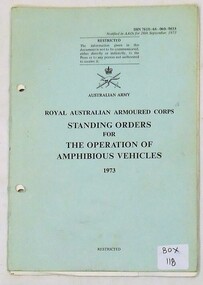
Manual
... Green covered booklet, thermal bound, 32 pages, being Standing Orders for the Operation of Amphibious Vehicles. ...Green covered booklet, thermal bound, 32 pages, being Standing Orders for the Operation of Amphibious Vehicles. ...8/13 VMR was issued with M113 Armoured Personnel Carriers in 1973. These vehicles had an Amphibious capability Technical manuals and User Handbooks were essential equipment for Royal Australian Electrical and Mechanical Engineers (RAEME) tradesmen permanently attached to Armoured Corps regiments as Light Aid Detachments (LAD) or AFV Workshops and were responsible for repairs and maintenance of a nature beyond the expertise of AFV crewmen and just short of major rebuilds undertaken by Base Workshop detachments.Part of a collection of workshop manuals and user handbooks relating to equipment on issue to 8th/13th Victorian Mounted Rifles during the latter half of the twentieth century.Green covered booklet, thermal bound, 32 pages, being Standing Orders for the Operation of Amphibious Vehicles. Published by Royal Australian Armoured Corps, Australian Army. 1973Ink stamp on title page " 8/13 VMR Regimental Collection ". Inside back page list of names and numbers.8/13 victorian mounted rifles, light aid detachment, manual -
 8th/13th Victorian Mounted Rifles Regimental Collection
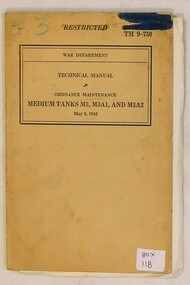
Manual
... Buff colour covered booklet, 160 pages, thermal bound being Technical Manual Ordnance Maintenance Medium Tanks M3, M3A1 and M3A2. ...Ink stamp on title page " 8/13 VMR Regimental Collection " Buff colour covered booklet, 160 pages, thermal bound being Technical Manual Ordnance Maintenance Medium Tanks M3, M3A1 and M3A2. ...Australian Army was equipped with M3 General Grant tanks during WW11. CMF Armoured Regiments had M3 General Grant tanks 1948 - 1955. Technical manuals and User Handbooks were essential equipment for Royal Australian Electrical and Mechanical Engineers (RAEME) tradesmen permanently attached to Armoured Corps regiments as Light Aid Detachments (LAD) or AFV Workshops and were responsible for repairs and maintenance of a nature beyond the expertise of AFV crewmen and just short of major rebuilds undertaken by Base Workshop detachments.Part of a collection of workshop manuals and user handbooks relating to equipment on issue to 8th/13th Victorian Mounted Rifles during the latter half of the twentieth century.Buff colour covered booklet, 160 pages, thermal bound being Technical Manual Ordnance Maintenance Medium Tanks M3, M3A1 and M3A2. Published by US War Department 9th May 1942Ink stamp on title page " 8/13 VMR Regimental Collection " -
4th/19th Prince of Wales's Light Horse Regiment Unit History Room
Booklet, Armored Fighting Vehicles & Attack Helicopter Identification, Feb 2000
... It gives line drawings, identification features and thermal cues for various vehicles...It gives line drawings, identification features and thermal cues for various vehicles Armored Fighting Vehicles & Attack Helicopter Identification Booklet School of Armour ...A soft covered loose leaf plastic clipped booklet to assist the identification of selected AFV's that RAAC crews may see on future battle fields. It gives line drawings, identification features and thermal cues for various vehiclesafv, attack helicopter recognition -
 National Vietnam Veterans Museum (NVVM)
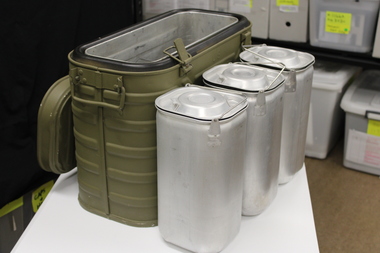
Equipment - US army Hot Box
... A "hot box" in the US Army typically refers to a thermal food container used to transport hot group meals to the field. ...A "hot box" in the US Army typically refers to a thermal food container used to transport hot group meals to the field. ...A "hot box" in the US Army typically refers to a thermal food container used to transport hot group meals to the field. Transportable hot or cold food containers with a large insulted box with three inserts.US/DO NOT HEAT CONTAINTERS OVER OPEN FLAMEvietnam, hot box, us army, united states army, captain glass, 2 field ambulance -
Federation University Historical Collection
Plans, Ballarat College of Advanced Education Building Plans, 1972, 10/1972
... It includes lecture theatre control dials, M.V. systems diagram, lighting and thermal alarm layouts and lighting and power workshop details. ...It includes lecture theatre control dials, M.V. systems diagram, lighting and thermal alarm layouts and lighting and power workshop details. ...Ballarat College of Advanced Education (BCAE) is a predecessor institution of Federation University.Four plans and one set of specifictions for the electrical services for the Ballarat College of Advanced Education Eletrical Engineering Building (E Building) at Mount Helen Campus. It includes lecture theatre control dials, M.V. systems diagram, lighting and thermal alarm layouts and lighting and power workshop details. electrical engineering, plans, ballarat college of advanced education, irwin, johnston, mcguibess & simpson, architectural plans -
 Bendigo Historical Society Inc.
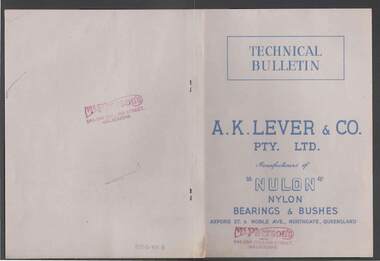
Booklet - BILL ASHMAN COLLECTION: CORRESPONDENCE
... Headings include: General Characteristics, Co-efficients of friction for Nylon on steel, Chemical Resistance, Water Absorption, Condition of material, General, Lubrication, Load and Speed, Heat Conductivity - Wall thickness, Thermal Expansion, Fitting and Wear - Running in,...Headings include: General Characteristics, Co-efficients of friction for Nylon on steel, Chemical Resistance, Water Absorption, Condition of material, General, Lubrication, Load and Speed, Heat Conductivity - Wall thickness, Thermal Expansion, Fitting and Wear - Running in, Booklet BILL ASHMAN COLLECTION: CORRESPONDENCE ...Technical Bulletin from A. K. Lever & Co. Pty. Ltd., manufacturers of 'Nulon' Nylon Bearings & Bushes. Headings include: General Characteristics, Co-efficients of friction for Nylon on steel, Chemical Resistance, Water Absorption, Condition of material, General, Lubrication, Load and Speed, Heat Conductivity - Wall thickness, Thermal Expansion, Fitting and Wear - Running in,sciences, bill ashman collection - correspondence, a k lever & co pty ltd, nulon nylon bearings & bushes technical bulletin, mcpherson's limited -
 Uniting Church Archives - Synod of Victoria
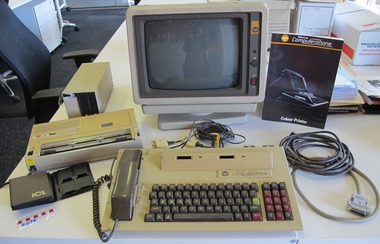
Computer phone, Telecom computer phone executive series, 1985
... Telecom computer phone Executive Series consisting of monitor; keyboard with handset; Teledrive unit model number: TELDV1.3; Thermal colour printer Okimate 20 mdoel number EN3212; 8 ICL microdrive cartridges in 2 cases: one labelled "Demonstration", one labelled "Welcome", one labelled "Help"; Cables; 51 page printer manual....Telecom log on monitor and keyboard Telecom computer phone Executive Series consisting of monitor; keyboard with handset; Teledrive unit model number: TELDV1.3; Thermal colour printer Okimate 20 mdoel number EN3212; 8 ICL microdrive cartridges in 2 cases: one labelled "Demonstration", one labelled "Welcome", one labelled "Help"; Cables; 51 page printer manual. ...Used at the UCA Synod Offices 130 Little Collins Street. Possibly by Cliff Wright.Telecom computer phone Executive Series consisting of monitor; keyboard with handset; Teledrive unit model number: TELDV1.3; Thermal colour printer Okimate 20 mdoel number EN3212; 8 ICL microdrive cartridges in 2 cases: one labelled "Demonstration", one labelled "Welcome", one labelled "Help"; Cables; 51 page printer manual.Telecom log on monitor and keyboard -
 Ballarat Tramway Museum
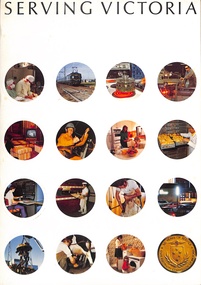
Booklet, State Electricity Commission of Victoria (SECV), "Serving Victoria", 1974
... Book prepared by the SECV Public relations, 1974 looking at how the SECV was producing power, both thermal and hydro for Victorians and its industries. ...Book prepared by the SECV Public relations, 1974 looking at how the SECV was producing power, both thermal and hydro for Victorians and its industries. ...Book prepared by the SECV Public relations, 1974 looking at how the SECV was producing power, both thermal and hydro for Victorians and its industries. Includes a map of the power distribution network at the time. Has many colour photos, technical details and notes.Demonstrates an item used by the SECV to distribute public relations materials. Has a close association with the organisation that ran Ballarat's trams from 1934 to 1971.Booklet - 36 A4 pages + card cover, colour centre stapled.secv, publicity, public relations, power stations, power generation, latrobe valley -
 The Beechworth Burke Museum
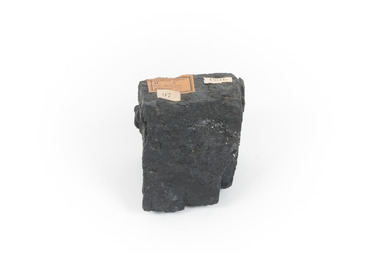
Geological specimen - Black Coal
... This is an example of Australian black coal which is used as either thermal or coking coal for electricity generation or manufacturing processes. ...This is an example of Australian black coal which is used as either thermal or coking coal for electricity generation or manufacturing processes. ...This specimen was recovered from Wonthaggi in Victoria. Coal is a sedimentary rock which is composed of peat after it has been exposed over millions of years. This is an example of Australian black coal which is used as either thermal or coking coal for electricity generation or manufacturing processes. It is predominantly composed of Carbon which is 'C' on the periodic table of elements. This early example of a coal sample, shows the important role that coal played/plays in Australia's energy generation and manufacturing processes. This specimen is part of a larger collection of geological and mineral specimens collected from around Australia (and some parts of the world) and donated to the Burke Museum between 1868-1880. A large percentage of these specimens were collected in Victoria as part of the Geological Survey of Victoria that begun in 1852 (in response to the Gold Rush) to study and map the geology of Victoria. Collecting geological specimens was an important part of mapping and understanding the scientific makeup of the earth. Many of these specimens were sent to research and collecting organisations across Australia, including the Burke Museum, to educate and encourage further study.Small piece of black coal with museum original labelGeological survey / R..... S...../ Locality Cape Patterson coal specimen, burke museum, geological survey of victoria, geological specimen, geology -
 Bendigo Military Museum
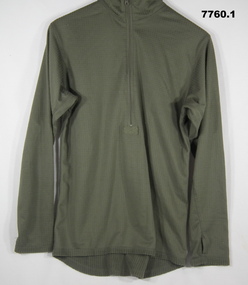
Uniform - THERMALS, UNDERWEAR - ARMY, Unknown
... Thermals, top and pants, jungle green colour, polyester/spandex fabric, grid structure and fleece lining. ...Uniform Army Underwear Thermals Manufacturers information on label - white and gold print. 1. ...Thermals, top and pants, jungle green colour, polyester/spandex fabric, grid structure and fleece lining. Nylon and metal zipper. 1. Top - polo shirt shape with collar, long sleeves with thumb hole and half zipper front closure. Black colour polyester manufacturers label, back below collar. 2. Pants - Long Johns - elastic waistband, front fly opening, long legs. Manufacturers label, back below waistband - black colour polyester fabric.Manufacturers information on label - white and gold print. 1. "GEN111/ SIZE M/ LONG SLEEVED TOP/ LEVEL 2/ HELIKON.TEX.COM/ ART.ID: BL-UH2-PO/ STOCK NO. 9415-09-229-1357/ NATO SIZE 7585/ 9404/ ACCORDING TO U.S. ARMY / SPECIFICATION." 2. "GEN111/ SIZE M/ LONG-JOHNS/ LEVEL 2/ HELIKON.TEX.COM/ COMFORT DRY/ HELIKON-TEX.COM/ 95% POLYESTER 5% SPANDEX/ AVOID USE OF FABRIC SOFTENERS/ ART.ID: SP.UN2.PO/ STOCK NO. 9415-09-229-1357/ NATO SIZE 7585/ 9404/ ACCORDING TO U.S. ARMY / SPECIFICATION." "PO#1325" uniform, army, underwear, thermals -
 8th/13th Victorian Mounted Rifles Regimental Collection
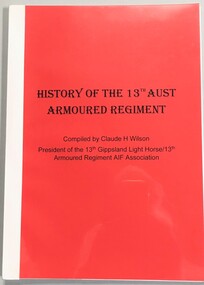
Document - 13th LH History
... The text is handwritten and includes the World War diary of lieutenant Vernon C Walker, who was a member of the AIF regiment. A4 format, thermal bound 27 pages with 6 page addendum....The text is handwritten and includes the World War diary of lieutenant Vernon C Walker, who was a member of the AIF regiment. A4 format, thermal bound 27 pages with 6 page addendum. ...The 10th Light Horse was raised in 1903 from Victorian Mounted Rifles companies in Gippsland. In 1912 the regiment was renumbered 13th Light Horse. In 1920 the regiment had the territorial title Gippsland Light Horse added. The regiment was raised as 13th Light Horse (Gippsland), a Citizen Forces unit. In 1940 the regiment converted from horse to mechanised, initially as 13th Motor Regiment then 13th Armoured Regiment. It trained in Victoria and Queensland but as the Japanese threat to the mainland declined, was disbanded in October 1943 with men going to other units. The 13th Light Horse Regiment (AIF) was raised at Broadmeadows Victoria in March 1915. Following service at Gallipoli the regiment was broken up with squadrons going to France as Divisional Cavalry Squadrons of 2nd, 4th and 5th Divisions. The regiment was reformed as firstly 1st Anzac Corps Mounted Troops and later Australian Corps Mounted Troops.History of 13th Armoured Regiment and its preceding regiments 10th Light Horse (VMR), 13th Light Horse (VMR), 13th Light Horse (AIF) and 13th Light Horse (Gippsland Light Horse) compiled by the President of the regimental association, Claude H Wilson c.1970. The text is handwritten and includes the World War diary of lieutenant Vernon C Walker, who was a member of the AIF regiment. A4 format, thermal bound 27 pages with 6 page addendum.history, light horse, armour, 13th, gippsland, wilson, walker -
 Federation University Historical Collection
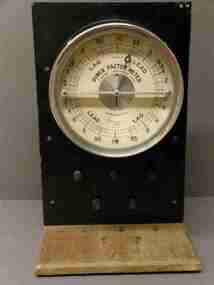
Scientific Instrument, Power Factor Meter
... They have been specifically designed to provide excellent service under demanding thermal and electrical applications. Sindanyo is a non-asbestos, non-combustible product that is easily machined. ...They have been specifically designed to provide excellent service under demanding thermal and electrical applications. Sindanyo is a non-asbestos, non-combustible product that is easily machined. ...Item looks to have been adapted for bench top use Sindanyo high temperature insulation boards are manufactured from cement based products, reinforced with selected fibres. They have been specifically designed to provide excellent service under demanding thermal and electrical applications. Sindanyo is a non-asbestos, non-combustible product that is easily machined. This insulation board is a popular option when a high quality, strong and rigid material is required.400/500 Volt, 5 amp, 50 Hz 3-phase balanced load. Circular scale with lead and lag markings and graduations. The 22cm diameter meter rear-mounted to black sindanyo board, supported by wood brackets on wood base. Five terminal posts on panel below meter. Wire connections at rear. No maker's name Patent Number: 162471/20 Serial Number 263475scientific instruments, power factor maker, lead and lag markings, terminal posts, power factor meter, wire connections, sindanyo board, non-combustible, insulation, electrical applications -
 Warrnambool and District Historical Society Inc.
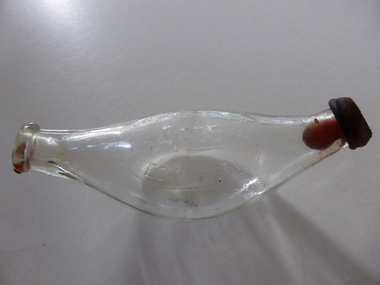
Bottle, The Perfect Agee Feeding Bottle, Mid 20th century
... Pyrex is a clear low-thermal-expansion borosilicate glass used for laboratory glassware and kitchenware. ...Pyrex is a clear low-thermal-expansion borosilicate glass used for laboratory glassware and kitchenware. ...This baby’s feeding bottle was made by Agee (Australian Glass Manufacturers) and marketed by the Crown Crystal Glass Company. It is made of pyrex which is a brand of glass first produced by Corning Inc. of America in 1908. Pyrex is a clear low-thermal-expansion borosilicate glass used for laboratory glassware and kitchenware. The use of pyrex bottles became more prevalent in Australia in the second half of the 20th century and baby’s bottles made of pyrex were popular as they were easily sterilised in the home environment. This baby’s bottle has no known local provenance but it is retained because it is a good example of the advancement in infant health and welfare over the past 80 years. This is a baby’s feeding bottle made of glass (pyrex). The body of the bottle is hexagonal-shaped (circular with rounded edges). It has a circular-shaped neck and an open top with a moulded glass around it. The bottle has no feeding nipple or stopper. There are measurement marks on the side of the bottle up to 8 ounces. ‘The Ideal Agee Pyrex Feeder’ ‘AGM 1S 1561 6’ infant welfare, history of warrnambool -
 Warrnambool and District Historical Society Inc.
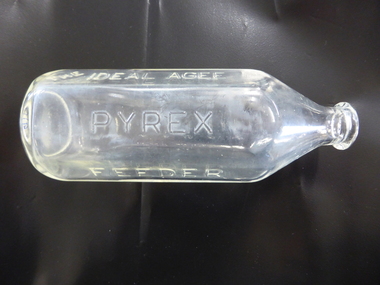
Bottle, Feeder Bottle Pyrex, Mid 20th century
... Pyrex is a clear low-thermal-expansion borosilicate glass used for laboratory glassware and kitchenware. ...Pyrex is a clear low-thermal-expansion borosilicate glass used for laboratory glassware and kitchenware. ...This baby’s feeding bottle was made by Agee (Australian Glass Manufacturers) and marketed by the Crown Crystal Glass Company. It is made of pyrex which is a brand of glass first produced by Corning Inc. of America in 1908. Pyrex is a clear low-thermal-expansion borosilicate glass used for laboratory glassware and kitchenware. The use of pyrex bottles became more prevalent in Australia in the second half of the 20th century and baby’s bottles made of pyrex were popular as they were easily sterilised in the home environment. This baby’s bottle has no known local provenance but it is retained because it is a good example of the advancement in infant health and welfare over the past 80 years. This is a baby’s feeding bottle made of glass (pyrex). The body of the bottle is hexagonal-shaped (circular with rounded edges). It has a circular-shaped neck and an open top with a moulded glass around it. The bottle has no feeding nipple or stopper. There are measurement marks on the side of the bottle up to 8 ounces.‘The Ideal Agee Pyrex Feeder’ ‘AGM 1S 1561 6’ infant welfare, history of warrnambool -
 Kiewa Valley Historical Society
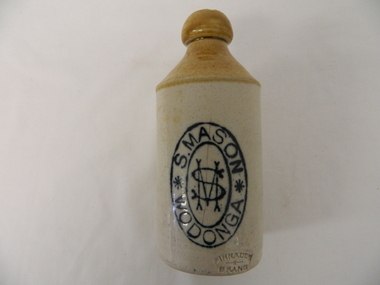
Jar Stone Earthenware, circa early 1900s
... The qualities of the glazed pottery (stone) drinking containers made from this natural thermal insulation material was to contain the liquid to a prescribed temperature either hot or cold, as required. ...The qualities of the glazed pottery (stone) drinking containers made from this natural thermal insulation material was to contain the liquid to a prescribed temperature either hot or cold, as required. ...This type of "stone" jar drinking container was used before glass and later plastic material made it "out of date" as a drink container. The qualities of the glazed pottery (stone) drinking containers made from this natural thermal insulation material was to contain the liquid to a prescribed temperature either hot or cold, as required. This was particularly important in rural environments that lacked adequate refrigeration means. The rural regions where the last areas in Australia where this type of drinking container remained in use. The late 1960's saw a revival of the basic rural ethos by the "hippie" culture of going to basic survival non "commercial" living.This particular stone jar drinking container was also a method of advertising for a Wodonga Stone masonry manufacturer. It is both relevant and significant to the Kiewa Valley because it highlights the type of industry that has breached the evolutionary trend for cheaper "throw away" drinking containers. Although this particular type of container is limited to quality liquids and it is still available in most rural sectors of the Australian "bush" environment.This stone/earthenware jar has a lip 250mm in length and 150mm thick. This lip will allow the thumb and forefinger to be used to grip the container for either pouring its contents out or securing it for any movement. The external glazed surface may become slippery when wet. The jar is heavy even when empty and would be too heavy for small children to carry. By using a cork seal the jar can be reused and therefore become more economical for the longer term. The thickness of the vessel provides a good insulation for the liquid contained. Most of this type of container would have contained ginger beer.Within two elliptical circles are painted (in freehand) "S. MASON" in the top half and "WODONGA" in the bottom half.These are separated by an asterisk on both sides. A large "S" overlaid by a similarly large "M" is within the inner circle. Stamped into the jar when still wet during manufacture is "PINNACLE BRAND" in 5mm lettering.drinking container, stone jar, ginger beer container, s. mason, wodonga earthen ware -
City of Moorabbin Historical Society (Operating the Box Cottage Museum)
Manufactured Object, 'Crest' Home Hair Perm Kit in box, c1950
... A permanent hairstyle, commonly called a perm or "permanent" is a hairstyle consisting of styles set into the hair lasting a number of months using thermal or chemical means. In the latter method, chemicals are applied to the hair, which is then wrapped around forms / rods to produce hairstyles with varying degrees of wave or curls. ...A permanent hairstyle, commonly called a perm or "permanent" is a hairstyle consisting of styles set into the hair lasting a number of months using thermal or chemical means. In the latter method, chemicals are applied to the hair, which is then wrapped around forms / rods to produce hairstyles with varying degrees of wave or curls. ...A permanent hairstyle, commonly called a perm or "permanent" is a hairstyle consisting of styles set into the hair lasting a number of months using thermal or chemical means. In the latter method, chemicals are applied to the hair, which is then wrapped around forms / rods to produce hairstyles with varying degrees of wave or curls. Usually this styling is performed by Hairdressers, in Beauty Salons, however, manufacturers appealing to the 'thriftiness' of the post world war 2 women produced products that could be used at home. It became very popular for women in the new estates to gather with their neighbours to give each other this new 'Home perm' with some success and failure. Gladys Reed used this type of Home perm while a resident of City of Moorabbin c 1950Typical Home Hair Perming equipment used to style their own hair by women in City of Moorabbin c1950A cardboard box containing solution, equipment and instruction booklet for home treatment of hair to produce permanent waves.hairdressers, hairdressing equipment, permanent wave, hair fashion, hair styling 1950, grooming, personal effects, early settlers, post world war 2 estates moorabbin, reed gladys. reed george, clark judy, bentleigh, moorabbin, highett, ormond. -
 Kiewa Valley Historical Society
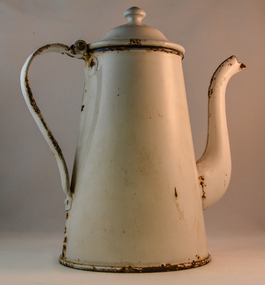
Pot Coffee, Circa 1950
... The enamel coating was used as a thermal barrier to keep the contents hot. This could have been used as an all day coffee source for busy farm workers or breakfast and lunch times. ...The enamel coating was used as a thermal barrier to keep the contents hot. This could have been used as an all day coffee source for busy farm workers or breakfast and lunch times. ...This coffee pot was made for flat heating surfaces and not the open fire. The enamel coating was used as a thermal barrier to keep the contents hot. This could have been used as an all day coffee source for busy farm workers or breakfast and lunch times. When this pot was used at dinner time, it was a time period when dinner was more formal, with the whole family sitting at the dinner table. The white enamel would have been sufficient for the majority of households. When this pot was in use the dinner period was when the whole family was together and communication within the family was considered very important as a cohesive force. This was a time before television intruded into the atmosphere of relaying the day's activities to the whole family.In small rural communities within the Kiewa Valley a good cup of tea or coffee was a time for relaxation from the hard work of the day. This relaxation period was beneficial for not only the mind but also the body. This was particularly for the house bound mother with domestic chores that had, at this time in history not many "time saving" pieces of domestic equipment. A good pot of tea or coffee at "smoko" was a god sent. Although regarded by well groomed city folk that a coffee pot was for coffee only the less social etiquette standards of country folk permitted its use for tea. Versatility even within the household was of great benefit to the folk in the Kiewa Valley. This was even so for the immigrants that joined in and were warmly welcomed within this rural sector of Australia.This coffee pot is in the French style with a goose neck. It is fully coated in white enamel and has a concave bottom. It has a hinged lid and the main body has been rolled fastened to the bottom plate. The sandwiched steel body is approximately 1mm thick. The two piece neck has been welded together similarly the hinged lid and handle. Rivets are installed to the both bases of the handle. country kitchens, well heated coffee, coffee break in rural regions -
The Ed Muirhead Physics Museum
Microtome/W... (H.A. Waters)
... The Waters microtome is of thermal expansion type - the rod “A” is heated and by expansion pushes the resin block forward by a fraction. ...The Waters microtome is of thermal expansion type - the rod “A” is heated and by expansion pushes the resin block forward by a fraction. ...Microtome for cutting resin embedded tissues for electron microscopy. In 1957 a modified hodge microtome redesigned and built by H.A. Waters of the Melbourne University Department of Physics was acquired. The Waters microtome is of thermal expansion type - the rod “A” is heated and by expansion pushes the resin block forward by a fraction. It is mounted on a long cast iron base. The movement of the block is eccentric drawing the specimen away from the knife after cutting, The glass knife ‘B’ is adjustable by means of a modified microscope column screws ‘C’. The microtrome is driven by a continuous action electric motor mounted on the common base. Hand cutting can also be done. The cutting was controlled by viewing through a Leitz Binocular microscope mounted on the same base. The original microscope was subjected to nine modifications by Dr S Weiner from whose PhD Thesis (1962) ‘Electron Microscopical Studies of the Liver’ this information was obtained. (text provided by Professor H Attwood) Microtome made of metal and enamelled in light blue. Components are identified by the use of stick on labels. The microtome is mounted on a long cast iron rectangular base and has an electrical cord for connection to a power point.Plaque on back: “Pathology Department, University of Melbourne Serial No. 0091. Date: 7/7/1968” -
 City of Moorabbin Historical Society (Operating the Box Cottage Museum)
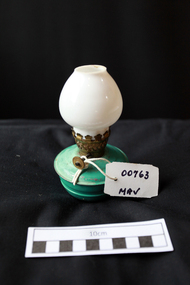
Lights, paraffin lamp c1950, c1950
... Four prongs hold the glass chimney, which acts to prevent the flame from being blown out and enhances a thermally induced draft. The glass chimney needs a "throat," or slight constriction, to create the proper draft for complete combustion of the fuel; the draft carries more air (oxygen) past the flame, helping to produce a smokeless light which is brighter than that produced by an open flame. ...Four prongs hold the glass chimney, which acts to prevent the flame from being blown out and enhances a thermally induced draft. The glass chimney needs a "throat," or slight constriction, to create the proper draft for complete combustion of the fuel; the draft carries more air (oxygen) past the flame, helping to produce a smokeless light which is brighter than that produced by an open flame. ...A flat-wick lamp is a simple type of kerosene lamp, which burns kerosene drawn up through a wick by capillary action. A flat-wick lamp has a fuel tank (fount), with the lamp burner attached. Four prongs hold the glass chimney, which acts to prevent the flame from being blown out and enhances a thermally induced draft. The glass chimney needs a "throat," or slight constriction, to create the proper draft for complete combustion of the fuel; the draft carries more air (oxygen) past the flame, helping to produce a smokeless light which is brighter than that produced by an open flame. The lamp burner has a flat wick, usually made of cotton. The lower part of the wick dips into the fount and absorbs the kerosene; the top part of the wick extends out of the wick tube of the lamp burner, which includes a wick-adjustment mechanism. Adjusting how much of the wick extends above the wick tube controls the flame. The wick tube surrounds the wick, and ensures that the correct amount of air reaches the lamp burner. Adjustment is usually done by means of a small knob operating a toothed, metal sprocket bearing against the wick. A paraffin lamp with a green metal base to hold fuel with a side screw to adjust wick length. An opaque white glass shield sits in a metal frame attached to base* moorabbin, bentleigh, cheltenham, pioneers, early settlers, market gardeners, lights, lamps, paraffin, oil lamps
