
Showing 3 items matching "tourmaline"
-
 The Beechworth Burke Museum
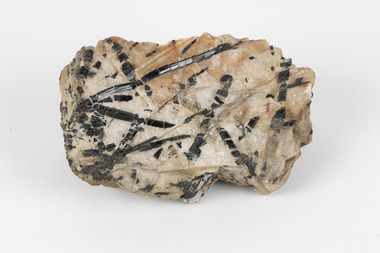
Geological specimen - Tourmaline in Quartz, Unknown
... ...tourmaline...On assessment, it was noted that the crossed lines (XIs) of this tourmaline have been fractured and rehealed by the quartz matrix in which the tourmaline rests. ...A solid medium-sized piece of Black Schoalou/Tourmaline in a cream and peach coloured quartz matrix. ...Existing label: Black Schoalou / Tourmaline in / quartz. / Tourmalines XIs have / been fractured and / rehealed with / quartz / C. ...Geological specimen Tourmaline in Quartz ...Tourmaline specimens are members of a crystalline silicate mineral group based on boron but influenced by elements including aluminium, iron, magnesium, sodium, lithium, or potassium. Specimens present a wide variety of colours and forms according to the specific mix of these elements. Tourmalines are semi-precious gemstones with many applications, including commercial jewellery production. The word 'tourmaline' derives from the Sinhalese term for the carnelian or red-shaded specimens, "tōramalli". This specimen has been classified by geologists as 'Black Schoalou/Tourmaline in quartz'. Schoalou may equate to a common black-hued type of Tourmaline associated since around 1400 with mines in Saxony, Germany near a village called Schorl (today's Zchorlau). If this specimen is part of the 'Schorl' species of tourmaline it is a member of the most common group of Tourmalines, a divalent sodium ion influenced group accounting for 95% of specimens. On assessment, it was noted that the crossed lines (XIs) of this tourmaline have been fractured and rehealed by the quartz matrix in which the tourmaline rests. This item is significant as an example of its type of gemstone and the geological processes leading to its formation. A solid medium-sized piece of Black Schoalou/Tourmaline in a cream and peach coloured quartz matrix. Existing label: Black Schoalou / Tourmaline in / quartz. / Tourmalines XIs have / been fractured and / rehealed with / quartz / C. Willman / 15/4/21 /geological specimen, geology, geology collection, burke museum, beechworth, indigo shire, north-east victoria, tourmaline, quartz, boron, crystals, minerals, gemstones, semi-precious, black schoalou, zchorlau, schorl -
 The Beechworth Burke Museum
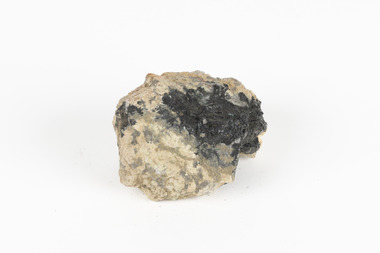
Geological specimen - Tourmaline (schorl), Unknown
... ...tourmaline...Tourmaline is a group of minerals belonging to the complex borosilicate mineral class. ...TOURMALINE (schorl) / (Silicate of boron and aluminum) ...Tourmaline is a group of minerals belonging to the complex borosilicate mineral class. ...Tourmaline is a group of minerals belonging to the complex borosilicate mineral class. These minerals are known for their striking and varied colours, making them prized gemstones. Tourmaline crystals can come in various shades, including pink, green, blue, brown, black, and colourless. They are often transparent or translucent. Tourmaline's chemical composition is complex, but it typically includes elements such as aluminium, iron, magnesium, sodium, lithium, and potassium. The specific arrangement of these elements in the crystal lattice gives rise to the different colours and properties of tourmaline specimens. Tourmaline specimens from Beechworth, Victoria, Australia, are a notable part of the region's mineral heritage. These tourmalines are of interest to mineral collectors and enthusiasts. While the tourmaline found in Beechworth is not as well-known as some other tourmaline varieties, it has unique characteristics and a historical context associated with the gold mining areas in Beechworth.The significance of tourmaline in Beechworth, Victoria, Australia, lies in its unique geological and historical context, contributing to both scientific and cultural aspects. The tourmaline mined in Beechworth is a rare and unique variety of tourmaline that is primarily found in the historic gold mining areas surrounding Beechworth. Its occurrence is closely linked to the geological processes that shaped the region during the Gold Rush era. The discovery of tourmaline in Beechworth adds to the rich mineral heritage of the area, which was historically known for gold mining. The specimens serve as a tangible connection to the region's mining history and contribute to preserving its geological legacy. The presence of tourmaline in Beechworth showcases the mineralogical diversity of the area. Tourmaline is known for its wide range of colours and unique properties, making it a valuable subject of study for mineralogists and geologists. Tourmaline specimens from Beechworth have educational significance, providing opportunities for research and study. They offer insights into the geological processes and mineral formation in the region, contributing to a better understanding of Earth's geological history.A hand-sized solid mineral specimen in shades of brown, green, light grey and dark greyTOURMALINE (schorl) / (Silicate of boron and aluminum) burke museum, beechworth, indigo shire, geological, geological specimen, mineralogy, tourmaline -
 Federation University Historical Collection
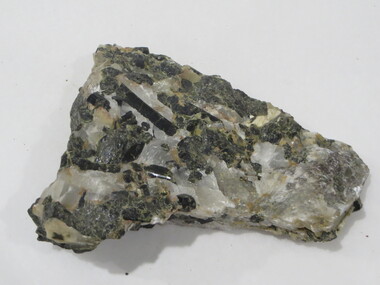
Rocks, Tourmaline in Calcite
... Tourmaline in Calcite......tourmaline...From the Ballarat School of Mines. rocks geology tourmaline calcit Geological Specimen Tourmaline in Calcite Rocks ...From the Ballarat School of Mines.Geological Specimenrocks, geology, tourmaline, calcit
