
Showing 13 items matching "tournament of the minds"
-
 Galen Catholic College
Tournament Of The Minds, 1996
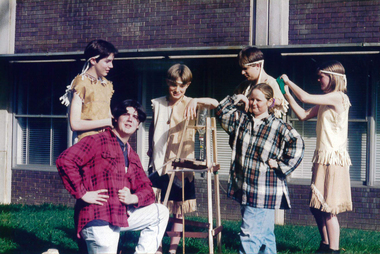
... Tournament Of The Minds, 1996...Tournament Of The Minds, 1996......Tournament Of The Minds...Galen Catholic College in the 1990s, competed in the national Tournament Of The Minds competition. School teams had to solve problems in four disciplines: The Arts, Language-literature, S.T.E.M, and Social Sciences. ...Galen Catholic College Galen College Tournament Of The Minds Tournament Of The Minds, 1996 Tournament Of The Minds, 1996 ...Galen Catholic College in the 1990s, competed in the national Tournament Of The Minds competition. School teams had to solve problems in four disciplines: The Arts, Language-literature, S.T.E.M, and Social Sciences. This photo was of Galen's team, in 1996.galen catholic college, galen college, tournament of the minds -
 Bialik College
Photograph (Item) - Tournament of the Minds 2000
... Tournament of the Minds 2000...On 20 August 2000, five groups of seven students from Bialik College attended the Tournament of the Minds. Notes in the Meg Rynderman Collection Box 6 Folder 1/1 May 2000 to Sept 2000 provides details. ...Indicates developed in August; reverse of two images states "tournament of the minds" unique skills GUEST...Photograph Tournament of the Minds 2000 ...On 20 August 2000, five groups of seven students from Bialik College attended the Tournament of the Minds. Notes in the Meg Rynderman Collection Box 6 Folder 1/1 May 2000 to Sept 2000 provides details. The Tournament was held at Swinburne University in the categories of Language/Literature, Maths/Engineering and Social Science. Five weeks of preparation and hard work preceded the event, during which the students gained skills in the areas of cooperation, creativity and perseverance. Each team was led by a facilitator from the teaching staff and put in many hours guiding and encouraging the students. Bialik can be very proud of the way each team conducted itself on judging day and of the high standard achieved. Please contact [email protected] if you have details to provide. Indicates developed in August; reverse of two images states "tournament of the minds" unique skills GUEST -
Bialik College
Booklet (item) - Rosenkranz Centre for Excellence and Achievement in Education, 1997, 1997
... ...tournament of the minds...Please contact [email protected] to request access to this record. chess debating maths tournament of the minds 1990s building and planning Booklet Rosenkranz Centre for Excellence and Achievement in Education, 1997 ...Booklet about the opening of the Rosenkranz Centre for Excellence in Achievement in Education at Bialik in 1997, in honour of Betty and Shmuel Rosenkranz. Please contact [email protected] to request access to this record.chess, debating, maths, tournament of the minds, 1990s, building and planning -
 Ringwood and District Historical Society
Article, Tintern CEGS RIngwood East - Newspaper Clipping 14-9-1994 - Battle of the Minds
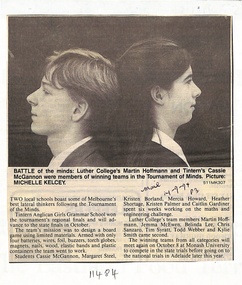
... Article and photograph about Tournament of the Minds winning team - Tintern won the regional finals. ...Caption: Battle of the minds Luther College's Martin Hoffmann and Tintern's Cassie McGannon were members of the winning team in the Tournament of the Minds Text (from Windows CO-Pilot) TWO local schools boast some of Melbourne’s best lateral thinkers following the Tournament of the Minds. ...Caption: Battle of the minds Luther College's Martin Hoffmann and Tintern's Cassie McGannon were members of the winning team in the Tournament of the Minds Text (from Windows CO-Pilot) TWO local schools boast some of Melbourne’s best lateral thinkers following the Tournament of the Minds. ...Article and photograph about Tournament of the Minds winning team - Tintern won the regional finals. Caption: Battle of the minds Luther College's Martin Hoffmann and Tintern's Cassie McGannon were members of the winning team in the Tournament of the Minds Text (from Windows CO-Pilot) TWO local schools boast some of Melbourne’s best lateral thinkers following the Tournament of the Minds. Tintern Anglican Girls Grammar School won the tournament’s regional finals and will advance to the state finals in October. The team’s mission was to design a board game using limited materials. Armed with only four batteries, wires, foil, buzzers, torch globes, magnets, nails, wood, elastic bands and plastic containers the team went to work. Students Cassie McGannon, Margaret Steel, Kristen Borland, Mercia Howard, Heather Shortage, Kristen Palmer and Caitlin Gardiner spent six weeks working on the maths and engineering challenge. Luther College’s team members Martin Hoffmann, Jemma McEwen, Belinda Lee, Chris Sanzaro, Tim Syratt, Todd Webber and Kylie Smith came second. The winning teams from all categories will meet again on October 8 at Monash University to compete in the state trials before going on to the national trials in Adelaide later this year. -
 Bendigo Historical Society Inc.
Document - JOHN WILLIAMS COLLECTION: PHOTO OF 'TOURNAMENT OF MINDS' AUGUST 2003, 2003
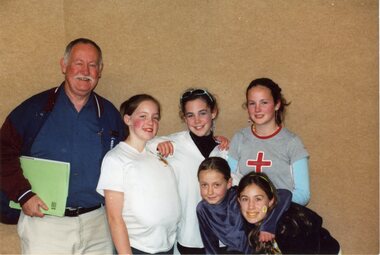
... JOHN WILLIAMS COLLECTION: PHOTO OF 'TOURNAMENT OF MINDS' AUGUST 2003 Written on back of photo: Tournament of Minds August 2003 Quarry Hill P.S. ...John Williams Tournament of Minds JOHN WILLIAMS COLLECTION: PHOTO OF 'TOURNAMENT OF MINDS' AUGUST 2003 Written on back of photo: Tournament of Minds August 2003 Quarry Hill P.S. ...JOHN WILLIAMS COLLECTION: PHOTO OF 'TOURNAMENT OF MINDS' AUGUST 2003 Written on back of photo: Tournament of Minds August 2003 Quarry Hill P.S. L-R John Williams, Amelia Eddy, Marnie Stevens, Kate O'Brien Front: Amber Gresham, Eloise Kendrickjohn williams, tournament of minds -
Whitehorse Historical Society Inc.
Article, Students
... Pictured 4 students from Vermont Secondary College working together to solve a maths-engineering problem for the Tournament of Minds event....Secondary Schools Vermont Secondary College Parry Stephanie Lulianetti Tenille Cheng Jason Chambers Chris Tournament of Minds Pictured 4 students from Vermont Secondary College working together to solve a maths-engineering problem for the Tournament of Minds event. ...Pictured 4 students from Vermont Secondary College working together to solve a maths-engineering problem for the Tournament of Minds event.secondary schools, vermont secondary college, parry, stephanie, lulianetti, tenille, cheng, jason, chambers, chris, tournament of minds -
Stawell Historical Society Inc
Photograph, Stawell West Primary School Award “Tournament Of Minds” -- Named 1991
... Stawell West Primary School Award “Tournament Of Minds” 1991...Stawell West Primary School Award “Tournament Of Minds” 1991 Stawell Education Stawell West Primary School Award “Tournament Of Minds” -- Named 1991 Photograph ...Stawell West Primary School Award “Tournament Of Minds” 1991stawell education -
 Greensborough Historical Society
Newspaper Clipping, Students in top frame of mind for finals, 09/09/2015
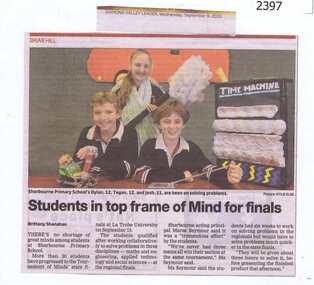
... Twenty student of Sherbourne Primary School progressed to the state final of Tournament of Minds....Twenty student of Sherbourne Primary School progressed to the state final of Tournament of Minds. sherbourne primary school tournament of minds News clipping, black text, colour image. ...Twenty student of Sherbourne Primary School progressed to the state final of Tournament of Minds.News clipping, black text, colour image.sherbourne primary school, tournament of minds -
 Bendigo Historical Society Inc.
Photograph - JOHN WILLIAMS COLLECTION: QUARRY HILL PRIMARY SCHOOL
... One showing the Quarry Hill primary school tournament of minds team 1. One showing the grade 6 graduation in 2004 and the other grade 6 teacher John Williams reading his annual poem at the 2004 graduation day....One showing the Quarry Hill primary school tournament of minds team 1. One showing the grade 6 graduation in 2004 and the other grade 6 teacher John Williams reading his annual poem at the 2004 graduation day. ...Set of three coloured photographs. One showing the Quarry Hill primary school tournament of minds team 1. One showing the grade 6 graduation in 2004 and the other grade 6 teacher John Williams reading his annual poem at the 2004 graduation day.bendigo, education, quarry hill primary school -
Bialik College
Documents, Certificates, 1990s-2010s, 1990s - 2010s
... Includes certificates from Jewish Care, National Australia Day Council, Tournament of Minds, and correspondence re the University of Melbourne Kwong Lee Dow Young Scholars Program and Premier's VCE Award 1999. ...Includes certificates from Jewish Care, National Australia Day Council, Tournament of Minds, and correspondence re the University of Melbourne Kwong Lee Dow Young Scholars Program and Premier's VCE Award 1999. ...Certificates awarded to Bialik College and to individual students, 1990s-2010s. Includes certificates from Jewish Care, National Australia Day Council, Tournament of Minds, and correspondence re the University of Melbourne Kwong Lee Dow Young Scholars Program and Premier's VCE Award 1999. Please contact [email protected] to request access to this record.community, award, 2000s, 1990s -
 Ruyton Girls' School
Magazine, William Troedel & Co, Ruyton Reporter, 2002
... Front Page: PRINT POST APPROVED PP 341999 000226 / R / RECTE ET FIDE LITER / THE RUYTON REPORTER / SUMMER 2002/2003 / out of this world / Charlotte Franich performing in / Tournament Of Minds - just part of / Enrichment at Ruyton: / pages 4+5 / STOP PRESS: 2003: Ruyton Celebrates 125 Years / Ruyton's Development Plan Meet the Deputy Principal / Artefacts Old Girls: Their Brilliant Careers / S4/23 /...Ruyton Girls' School Ruyton School Students Newsletter Ruyton Reports Ruyton News Kew Victoria Melbourne Girls School Front Page: PRINT POST APPROVED PP 341999 000226 / R / RECTE ET FIDE LITER / THE RUYTON REPORTER / SUMMER 2002/2003 / out of this world / Charlotte Franich performing in / Tournament Of Minds - just part of / Enrichment at Ruyton: / pages 4+5 / STOP PRESS: 2003: Ruyton Celebrates 125 Years / Ruyton's Development Plan Meet the Deputy Principal / Artefacts Old Girls: Their Brilliant Careers / S4/23 / Colour publication printed on paper with staple binding. 24 pages. ...The Ruyton Reporter (formerly known as Ruyton Reports) captures the essential Ruyton Girls' School experience for the broader school community. It has been produced since 1986.The record has strong historic significance as it pertains to one of the oldest girls' school in Victoria, Australia. Ruyton was founded in 1878 in the Bulleen Road, Kew, home of newly widowed Mrs Charlotte Anderson (now High Street South). Thus, the record can be used as a reference example for research into Victorian school history. It also gives insight into the types of activities and events undertaken at Ruyton Girls' School during the period of its production. The record's significance is further enhanced by its exceptionally well-documented provenance, having remained the property of Ruyton Girls' School since its production.Colour publication printed on paper with staple binding. 24 pages.Front Page: PRINT POST APPROVED PP 341999 000226 / R / RECTE ET FIDE LITER / THE RUYTON REPORTER / SUMMER 2002/2003 / out of this world / Charlotte Franich performing in / Tournament Of Minds - just part of / Enrichment at Ruyton: / pages 4+5 / STOP PRESS: 2003: Ruyton Celebrates 125 Years / Ruyton's Development Plan Meet the Deputy Principal / Artefacts Old Girls: Their Brilliant Careers / S4/23 /ruyton girls' school, ruyton, school, students, newsletter, ruyton reports, ruyton news, kew, victoria, melbourne, girls school -
 City of Melbourne Libraries
Photograph, Bull, Hugh Jones, 1897-1993, Photograph, Scotch College v. Xavier College football match, 1934
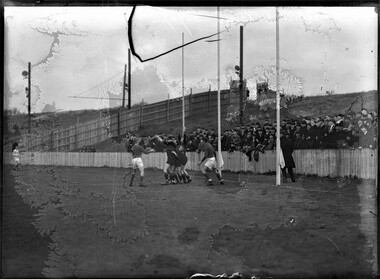
... mind about the matter very early on.” The resounding answer was- “Well, I’d like to see the man that would stop me!” At the final match of the 1934 tournament on August 2, Melbourne Grammar finished the season unbeaten, winning their tenth Public Schools premiership in 16 years. ...mind about the matter very early on.” The resounding answer was- “Well, I’d like to see the man that would stop me!” At the final match of the 1934 tournament on August 2, Melbourne Grammar finished the season unbeaten, winning their tenth Public Schools premiership in 16 years. ...At the first match of the 1934 Public Schools Premiership and Championships at Olympic Park (where AAMI Park is now) between Scotch College (white shorts) and Xavier College, (black shorts) a mark is missed by Xavier players and then taken by a Scotch player. Research by project volunteer, Fiona Collyer: A crowd of schoolboys standing behind a picket fence, watch with anticipation as two teams contest a football at the goalposts. The Public Schools Premiership and Championship was an Australian Rules football tournament held every winter over five weeks between six schools- Scotch College, Xavier College, Melbourne Grammar, Wesley College and traditional rivals Geelong Grammar and Geelong College. The school that won the most games out of the five played, won the competition. As the 1933 Premiers, Xavier College had the honour of playing the opening match of the season on 28 June against runners-up Scotch College at Olympic Park (where AAMI Park is now). The Public Schools Premiership matches were widely reported in Melbourne’s daily newspapers with photographs and commentary of every game. Weekly society magazine “Table Talk” featured reports and seven photographs of the first games of the season. Australian Broadcasting Commission (ABC) wireless station 3AR interspersed their afternoon program of reproduced music with detailed descriptions of the matches. Also reporting the matches was “Forty-Years-On”, presumably a student in the 1890s, whose regular column in The Herald newspaper “Activities In The Public Schools” published all the latest news on Victoria’s public (private) schools. In his column for The Australasian 7 July 1934, “Old Boy” writes about the Scotch versus Xavier match: “For more than half the game last week, Scotch was outplayed, but took the lead early in the last term and kept it. Scotch surprised even its own supporters by its dash in the last 25 minutes. Xavier, who became over confident by the prospects of victory, could not withstand the final onslaught. In the last quarter Scotch was the better side and won by seven points.” The final score was Scotch 11.11 (77 points) and Xavier 10.10 (70 points). At the end of this exciting match the overjoyed Scotch boys swarmed over the Olympic Park fences to chair their captain, Stanley Steele and carry him shoulder high, to the pavilion. The first documented game of a variation of Australian Rules football was played at Richmond Paddock (now Yarra Park) from 7 August 1858. Australian Rules football writer Hugh Buggy of The Argus 16 April 1952 explains: “It began when boys and masters of Scotch College and Melbourne Grammar School decided to play a 40-a-side game, with the first team to score two goals to be the winner. Goal posts were pitched more than a mile apart, one set on the Jolimont Hill and the other at Punt road Richmond. Nobody defined the boundary, and the play swung over the broad acres of the park and around the gum trees. It went on and on like a Test match, from noon till dusk. After 15 hours of play on three Saturdays the score was one goal all, and the game was abandoned for that season.” Rules of the game hadn’t been decided at this time - the earliest known rules were codified a year later in 1859. A sculpture and plaque located outside the Melbourne Cricket Ground (MCG), created by sculptor Louis Laumen in 2001, commemorates this game. It depicts two school boys chasing a ball along with umpire Tom Wills, a co-writer of the rules and promoter of Australian Rules football. A medley of Gaelic football, an Aboriginal game called marngrook as well as football played in English public (that is private) schools have been cited as inspiration for Australian Rules football. The word “Marngrook” meaning “game ball”, comes from the language of the Gunditjmara, First Nations people of southwestern Victoria. Marngrook was played at gatherings and celebrations and involved players competing to jump and catch the ball after it was kicked high into the air. The player that catches the ball then gets to kick it. The ball was made from possum skin, filled with pounded charcoal and tied with kangaroo sinews. Protector of Aborigines in Victoria, William Thomas (1794-1867) observed in 1841- “The men and boys joyfully assemble when this game is to be played. One makes a ball of possum skin, somewhat elastic, but firm and strong… The players of this game do not throw the ball as a white man might do, but drop it and at the same time kick it with their feet, using the instep for that purpose. The tallest men have the best chances in this game. Some of them will leap as high as five feet from the ground to catch the ball. The person who secures the ball kicks it. This continues for hours and the natives never seem to tire of the exercise.” The Victorian Football League (VFL), was founded in 1897 with eight teams playing Australian Rules football and held its first Grand Final at the MCG in 1902. From the start the games attracted large enthusiastic crowds, which included women. “Viva” writing in the Supplement to The Weekly Times - 3 July 1886 LADIES COLUMN (By Viva) FOOTBALL. A Social Sketch. “…Of the popularity of football and footballers among women, there can be no doubt. Young, soft hearted girls, who would not “tread upon a worm," avow that football matches are "awfully jolly," and seem to regard accidents as a necessary part of the amusement…a great proportion of the spectators were ladies.” “Minetta” writing for Punch Magazine - “Ladies Letter, Holmby House, Toorak” 22 June 1905 “The "Football Girl" is a feminine genus at present much to the fore in Melbourne. Not that she plays football—at least not beyond a kick in the backyard or paddock—oh, dear, no! Her interest in the game is purely from a spectacular point of view. "Football Girls" usually hunt in couples, with two male barrackers attached. They know all about So-and-So's form, and whether he is a trier or has been bought. They go to each match of their particular club, and watch the play intently, their faces wearing a decidedly strained expression when their club is getting the worst of it. They are not ashamed to barrack either, when matters are progressing successfully… Yours ever, MINETTA.” The Herald 2 July 1909 published a cartoon by Ambrose Dyson depicting women football fans, which asked- “THE QUESTION OF THE DAY. Should Girls Go To Football Matches? Should they? The sex made up their mind about the matter very early on.” The resounding answer was- “Well, I’d like to see the man that would stop me!” At the final match of the 1934 tournament on August 2, Melbourne Grammar finished the season unbeaten, winning their tenth Public Schools premiership in 16 years. The Weekly Times 11 August 1934 reported-“Melbourne Grammar…had a rather lucky escape against Xavier…Had a Xavier player not touched a shot, kicked by a team-mate, as it was going through goal Grammar would have been beaten.” Final score - Melbourne Grammar 13.7 (85 points) defeated Xavier College 12.9 (81 points). Ladder for the 1934 Season- Melbourne Grammar-5 wins Wesley College- 4 wins Scotch College- 3 wins Xavier College- 2 wins Geelong Grammar- 1 win Geelong College- 0 wins The Associated Public Schools of Victoria (APS) exists today where eleven member (private) schools, including co-educational schools, participate in 21 sporting competitions throughout the year. (The descriptor “Public School” references the historical usage of the term and the model of the British public). PUBLIC SCHOOLS FOOTBALL BEGINS WITH SCOTCH--XAVIER MATCH. (1934, June 29). The Age (Melbourne, Vic. : 1854 - 1954), p. 11. Retrieved June 23, 2025, from http://nla.gov.au/nla.news-article204824484 PUBLIC SCHOOLS FOOTBALL AT OLYMPIC PARK (1934, July 5). Table Talk (Melbourne, Vic. : 1885 - 1939), p. 5. Retrieved May 30, 2025, from http://nla.gov.au/nla.news-article149682433 PUBLIC SCHOOLS FOOTBALL. (1936, July 3). The Argus (Melbourne, Vic. : 1848 - 1957), p. 18. Retrieved May 30, 2025, from http://nla.gov.au/nla.news-article11888301 PUBLIC SCHOOLS. (1934, June 29). The Age (Melbourne, Vic. : 1854 - 1954), p. 5. Retrieved August 6, 2025, from http://nla.gov.au/nla.news-article204824486 https://en.m.wikipedia.org/wiki/History_of_Australian_rules_football COLLEGE SPORTS (1934, July 7). The Australasian (Melbourne, Vic. : 1864 - 1946), p. 48 (METROPOLITAN EDITION). Retrieved August 6, 2025, from http://nla.gov.au/nla.news-article145238393 GRAMMAR CHAMPIONS (1934, August 11). Weekly Times (Melbourne, Vic. : 1869 - 1954), p. 72. Retrieved August 6, 2025, from http://nla.gov.au/nla.news-article224562842 LETS LOOK AT FOOTBALL with HUGH BUGGY (1952, April 16). The Argus (Melbourne, Vic. : 1848 - 1957), p. 9. Retrieved August 6, 2025, from http://nla.gov.au/nla.news-article23174340 FOR YOUNG PEOPLE AMONG THE SCHOOLS. (1934, August 7). The Age (Melbourne, Vic. : 1854 - 1954), p. 4. Retrieved August 6, 2025, from http://nla.gov.au/nla.news-article205521661 https://www.nma.gov.au/defining-moments/resources/australian-rules-football#:~:text=In%20the%20winter%20of%201858,games%20of%20Australian%20Rules%20football. https://apssport.org.au/about/ http://lindsaymagazine.co/from-marngrook-to-australian-rules-football/ https://collection.australiansportsmuseum.org.au/objects/70993/possum-skin-ball FOOTBALL. (1886, July 3). Weekly Times (Melbourne, Vic. : 1869 - 1954), p. 6 (SUPPLEMENT TO THE STORY TELLER). Retrieved September 7, 2025, from http://nla.gov.au/nla.news-article221741193 Ladies' Letter. (1905, June 22). Punch (Melbourne, Vic. : 1900 - 1918; 1925), p. 28. Retrieved September 22, 2025, from http://nla.gov.au/nla.news-article175410975 THE QUESTION OF THE DAY. (1909, July 2). The Herald (Melbourne, Vic. : 1861 - 1954), p. 9. Retrieved September 22, 2025, from http://nla.gov.au/nla.news-article242062970Photographer notations on slide: "Scotch v. Xavier - Olympic Park B42".football, schools -
 City of Melbourne Libraries
Photograph, Bull, Hugh Jones, 1897-1993, Scotch College v. Xavier College football match
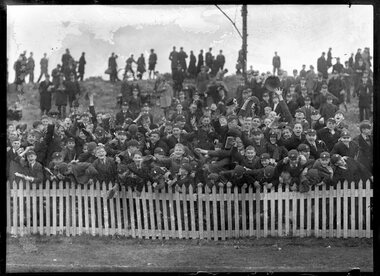
... mind about the matter very early on.” The resounding answer was- “Well, I’d like to see the man that would stop me!” At the final match of the 1934 tournament on August 2, Melbourne Grammar finished the season unbeaten, winning their tenth Public Schools premiership in 16 years. ...mind about the matter very early on.” The resounding answer was- “Well, I’d like to see the man that would stop me!” At the final match of the 1934 tournament on August 2, Melbourne Grammar finished the season unbeaten, winning their tenth Public Schools premiership in 16 years. ...Published: 29 June 1934 Published title: PUBLIC SCHOOLS FOOTBALL BEGINS WITH SCOTCH--XAVIER MATCH. Published caption: “The Public Schools 1934 Football season began yesterday when Scotch met Xavier on the Olympic Park ground, and after a wonderful recovery in the third term, Scotch registered a narrow win. Pictured above is the crowd of Scotch boys who congregated behind the goal after the addition of another goal to their score.” Description: Scotch College pupils exuberantly cheer their team’s goal at the first football match of the Public Schools Premiership and Championship for 1934 between Scotch College and Xavier College at Olympic Park, Melbourne (where AAMI Park is now). Research by project volunteer, Fiona Collyer: The Public Schools Premiership and Championship was an Australian Rules football tournament held every winter, over five weeks between six schools- Scotch College, Xavier College, Melbourne Grammar, Wesley College and traditional rivals Geelong Grammar and Geelong College. The school that won the most games out of the five played, won the competition. As the 1933 Premiers, Xavier College had the honour of playing the opening match of the season on 28 June against runners-up Scotch College at Olympic Park (where AAMI Park is now). The Public Schools Premiership matches were widely reported in Melbourne’s daily newspapers with photographs and commentary of every game. Weekly society magazine “Table Talk” featured reports and seven photographs of the first games of the season. Australian Broadcasting Commission (ABC) wireless station 3AR interspersed their afternoon program of reproduced music with detailed descriptions of the matches. Also reporting the matches was “Forty-Years-On”, presumably a student in the 1890s, whose regular column in The Herald newspaper “Activities In The Public Schools” published all the latest news on Victoria’s public (private) schools. In his column for The Australasian 7 July 1934, “Old Boy” writes about the Scotch versus Xavier match- “For more than half the game last week, Scotch was outplayed, but took the lead early in the last term and kept it. Scotch surprised even its own supporters by its dash in the last 25 minutes. Xavier, who became over confident by the prospects of victory, could not withstand the final onslaught. In the last quarter Scotch was the better side and won by seven points.” The final score was Scotch 11.11 (77 points) and Xavier 10.10 (70 points). At the end of this exciting match the overjoyed Scotch boys swarmed over the Olympic Park fences to chair their captain, Stanley Steele and carry him shoulder high, to the pavilion. The first documented game of a variation of Australian Rules football was played at Richmond Paddock (now Yarra Park) from 7 August 1858. Australian Rules football writer Hugh Buggy of The Argus 16 April 1952 explains- “It began when boys and masters of Scotch College and Melbourne Grammar School decided to play a 40-a-side game, with the first team to score two goals to be the winner. Goal posts were pitched more than a mile apart, one set on the Jolimont Hill and the other at Punt road Richmond. Nobody defined the boundary, and the play swung over the broad acres of the park and around the gum trees. It went on and on like a Test match, from noon till dusk. After 15 hours of play on three Saturdays the score was one goal all, and the game was abandoned for that season.” Rules of the game hadn’t been decided at this time - the earliest known rules were codified a year later in 1859. A sculpture and plaque located outside the Melbourne Cricket Ground (MCG), created by sculptor Louis Laumen in 2001, commemorates this game. It depicts two school boys chasing a ball along with umpire Tom Wills, a co-writer of the rules and promoter of Australian Rules football. A medley of Gaelic football, an Aboriginal game called marngrook as well as football played in English public (that is private) schools have been cited as inspiration for Australian Rules football. The word “Marngrook” meaning “game ball”, comes from the language of the Gunditjmara, First Nations people of southwestern Victoria. Marngrook was played at gatherings and celebrations and involved players competing to jump and catch the ball after it is kicked high into the air. The player that catches the ball then gets to kick it. The ball was made from possum skin, filled with pounded charcoal and tied with kangaroo sinews. Protector of Aborigines in Victoria, William Thomas (1794-1867) observed in 1841- “The men and boys joyfully assemble when this game is to be played. One makes a ball of possum skin, somewhat elastic, but firm and strong… The players of this game do not throw the ball as a white man might do, but drop it and at the same time kick it with their feet, using the instep for that purpose. The tallest men have the best chances in this game. Some of them will leap as high as five feet from the ground to catch the ball. The person who secures the ball kicks it. This continues for hours and the natives never seem to tire of the exercise.” The Victorian Football League (VFL), was founded in 1897 with eight teams playing Australian Rules football and held its first Grand Final at the MCG in 1902. From the start the games attracted large enthusiastic crowds, which included women. “Viva” writing in the Supplement to The Weekly Times-3 July 1886- LADIES COLUMN (By Viva) FOOTBALL. A Social Sketch. “…Of the popularity of football and footballers among women, there can be no doubt. Young, soft hearted girls, who would not “tread upon a worm," avow that football matches are "awfully jolly," and seem to regard accidents as a necessary part of the amusement…a great proportion of the spectators were ladies.” “Minetta” writing for Punch Magazine - “Ladies Letter, Holmby House, Toorak” 22 June 1905 “The "Football Girl" is a feminine genus at present much to the fore in Melbourne. Not that she plays football—at least not beyond a kick in the backyard or paddock—oh, dear, no! Her interest in the game is purely from a spectacular point of view. "Football Girls" usually hunt in couples, with two male barrackers attached. They know all about So-and-So's form, and whether he is a trier or has been bought. They go to each match of their particular club, and watch the play intently, their faces wearing a decidedly strained expression when their club is getting the worst of it. They are not ashamed to barrack either, when matters are progressing successfully… Yours ever, MINETTA.” The Herald 2 July 1909 published a cartoon by Ambrose Dyson depicting women football fans, which asked- “THE QUESTION OF THE DAY. Should Girls Go To Football Matches? Should they? The sex made up their mind about the matter very early on.” The resounding answer was- “Well, I’d like to see the man that would stop me!” At the final match of the 1934 tournament on August 2, Melbourne Grammar finished the season unbeaten, winning their tenth Public Schools premiership in 16 years. The Weekly Times 11 August 1934 reported-“Melbourne Grammar…had a rather lucky escape against Xavier…Had a Xavier player not touched a shot, kicked by a team-mate, as it was going through goal Grammar would have been beaten.” Final score - Melbourne Grammar 13.7 (85 points) defeated Xavier College 12.9 (81 points). Ladder for the 1934 Season- Melbourne Grammar-5 wins Wesley College- 4 wins Scotch College- 3 wins Xavier College- 2 wins Geelong Grammar- 1 win Geelong College- 0 wins The Associated Public Schools of Victoria (APS) exists today where eleven member (private) schools, including co-educational schools, participate in 21 sporting competitions throughout the year. (The descriptor “Public School” references the historical usage of the term and the model of the British public school). PUBLIC SCHOOLS FOOTBALL BEGINS WITH SCOTCH--XAVIER MATCH. (1934, June 29). The Age (Melbourne, Vic. : 1854 - 1954), p. 11. Retrieved June 18, 2025, from http://nla.gov.au/nla.news-article204824484 PUBLIC SCHOOLS FOOTBALL AT OLYMPIC PARK (1934, July 5). Table Talk (Melbourne, Vic. : 1885 - 1939), p. 5. Retrieved June 18, 2025, from http://nla.gov.au/nla.news-article149682433 PUBLIC SCHOOLS. (1934, June 29). The Age (Melbourne, Vic. : 1854 - 1954), p. 5. Retrieved June 3, 2025, from http://nla.gov.au/nla.news-article204824486 PUBLIC SCHOOLS FOOTBALL. (1936, July 3). The Argus (Melbourne, Vic. : 1848 - 1957), p. 18. Retrieved August 6, 2025, from http://nla.gov.au/nla.news-article11888301 https://en.m.wikipedia.org/wiki/History_of_Australian_rules_football COLLEGE SPORTS (1934, July 7). The Australasian (Melbourne, Vic. : 1864 - 1946), p. 48 (METROPOLITAN EDITION). Retrieved May 30, 2025, from http://nla.gov.au/nla.news-article145238393 GRAMMAR CHAMPIONS (1934, August 11). Weekly Times (Melbourne, Vic. : 1869 - 1954), p. 72. Retrieved June 1, 2025, from http://nla.gov.au/nla.news-article224562842 LETS LOOK AT FOOTBALL with HUGH BUGGY (1952, April 16). The Argus (Melbourne, Vic. : 1848 - 1957), p. 9. Retrieved June 15, 2025, from http://nla.gov.au/nla.news-article23174340 FOR YOUNG PEOPLE AMONG THE SCHOOLS. (1934, August 7). The Age (Melbourne, Vic. : 1854 - 1954), p. 4. Retrieved June 14, 2025, from http://nla.gov.au/nla.news-article205521661 https://www.nma.gov.au/defining-moments/resources/australian-rules-football#:~:text=In%20the%20winter%20of%201858,games%20of%20Australian%20Rules%20football. https://apssport.org.au/about/ http://lindsaymagazine.co/from-marngrook-to-australian-rules-football/ https://collection.australiansportsmuseum.org.au/objects/70993/possum-skin-ball FOOTBALL. (1886, July 3). Weekly Times (Melbourne, Vic. : 1869 - 1954), p. 6 (SUPPLEMENT TO THE STORY TELLER). Retrieved September 7, 2025, from http://nla.gov.au/nla.news-article221741193 Ladies' Letter. (1905, June 22). Punch (Melbourne, Vic. : 1900 - 1918; 1925), p. 28. Retrieved September 11, 2025, from http://nla.gov.au/nla.news-article175410975 THE QUESTION OF THE DAY. (1909, July 2). The Herald (Melbourne, Vic. : 1861 - 1954), p. 9. Retrieved September 17, 2025, from http://nla.gov.au/nla.news-article242062970 Photographer notations on slide: "Scotch v Xavier - Olympic Park B42".schools, football
