
Showing 52 items matching "town and country planning board"
-
 Federation University Historical Collection
Book, Wendy Jacobs et al, Maldon Conservation Study, 1977, 1977
... ...town and country planning board......Town and Country Planning Board...Maldon Conservation Study, 1977 Book Wendy Jacobs Miles Lewis Town and Country Planning Board Elizabeth Vines ...Brown soft covered book of 94 pages. It includes pull out maps and plans. conservation, maldon, planning, john templeton, porcupine flat, tarrengower, mining, architecture, town and country planning board, wendy jacobs, miles lewis, elizabeth vines -
Lakes Entrance Historical Society
Booklet, Town and Country Planning Board Melbourne, Gippsland Lakes Planning Guidelines, 1973
... Town and Country Planning Board Melbourne...A folder contains planning guidelines for Gippsland Lakes Oct 1973 Orange cover with 7 pages Gippsland Lakes Planning Guidelines Booklet Town and Country Planning Board Melbourne ...A folder contains planning guidelines for Gippsland Lakes Oct 1973Orange cover with 7 pagesnon-fictionA folder contains planning guidelines for Gippsland Lakes Oct 1973 -
Lakes Entrance Historical Society
Book, Gippsland Lakes Use Strategy Plan Background Report, 1978
... Town and Country Planning Board Melbourne...Background report from Planning Board 1978 Townships Planning Committee Paperback with 125 pages Gippsland Lakes Use Strategy Plan Background Report Book Town and Country Planning Board Melbourne ...Background report from Planning Board 1978Paperback with 125 pagestownships, planning committee -
Lakes Entrance Historical Society
Book, Town and Country Planning Board Melbourne, Gippsland Lakes Land Use Strategy Plan, 1978
... Town and Country Planning Board Melbourne...Waterways Recreation Background report to the strategy plan to guide future development of the Gippsland Lakes Gippsland Lakes Land Use Strategy Plan Book Town and Country Planning Board Melbourne ...Background report to the strategy plan to guide future development of the Gippsland Lakeswaterways, recreation -
Lakes Entrance Historical Society
Book, Town and Country Planning Board Melbourne, Gippsland Lakes Strategy, 1978
... Town and Country Planning Board Melbourne...Contains plans and maps Gippsland Lakes Strategy Book Town and Country Planning Board Melbourne ...A strategy plan to guide future development of the Gippsland Lakes in a rational manner, to benefit all residents and visitors to the area. Contains plans and mapsgovernment, community facilities, recreation -
 Phillip Island and District Historical Society Inc.
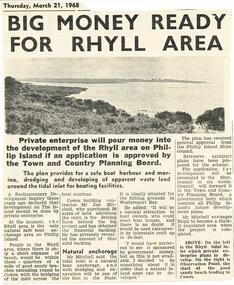
Newspaper Clipping, Rhyll Development, 21/3/1968
... ...Town & Country Planning Board...Private enterprise seek approval of Town & Country Planning Board for major development of Rhyll Inlet....Collection of newspaper clippings from Scrap Book 1960 - 1973 Rhyll Development Town & Country Planning Board Private Enterprise Newspaper clipping Jean Jamieson Private enterprise seek approval of Town & Country Planning Board for major development of Rhyll Inlet. ...Collection of newspaper clippings from Scrap Book 1960 - 1973Private enterprise seek approval of Town & Country Planning Board for major development of Rhyll Inlet.rhyll development, town & country planning board, private enterprise, newspaper clipping, jean jamieson -
 Bendigo Historical Society Inc.
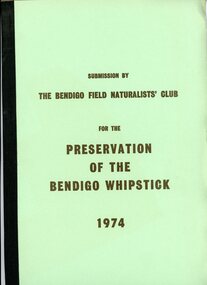
Document - PETER ELLIS COLLECTION: SUBMISSION BY THE BENDIGO FIELD NATURALIST CLUB FOR THE PRESERVATION OF THE WHIPSTICK 1974, 1974
... PETER ELLIS COLLECTION: SUBMISSION BY THE BENDIGO FIELD NATURALIST CLUB FOR THE PRESERVATION OF THE WHIPSTICK 1974 The submission was sent to: the Minister for Local Government and the Town and Country Planning Board The Minisry for Conservation and its agency, the Forests Commission and Lands Department Federal Government Ministeries for Environment, Concervastion and Science, and the National Estate. ...PERSON Individual peter ellis oam PETER ELLIS COLLECTION: SUBMISSION BY THE BENDIGO FIELD NATURALIST CLUB FOR THE PRESERVATION OF THE WHIPSTICK 1974 The submission was sent to: the Minister for Local Government and the Town and Country Planning Board The Minisry for Conservation and its agency, the Forests Commission and Lands Department Federal Government Ministeries for Environment, Concervastion and Science, and the National Estate. ...PETER ELLIS COLLECTION: SUBMISSION BY THE BENDIGO FIELD NATURALIST CLUB FOR THE PRESERVATION OF THE WHIPSTICK 1974 The submission was sent to: the Minister for Local Government and the Town and Country Planning Board The Minisry for Conservation and its agency, the Forests Commission and Lands Department Federal Government Ministeries for Environment, Concervastion and Science, and the National Estate. Opening Paragraphs: This re-submission was compiled to bring to the attention of the authorities many aspects relating to the preservation of the Bendigo Whipstick which were not so apparent at the time of the earlier submission. In fact the 19721 submissions was mainly aimed at having reserved forest (which lie a opposite extremities to the Whipstick scrub) declared Forest Park. It is the central belt of Whipstick scrub that is of scientific interest and considered unipue and which we were primarily concerned in preserving and retaining as one viable ecological unit. The Submission consists of: INTRODUCTION Opening Explanation Whipstick Eucalyptus Cutting for Oil Distallation (Photographs) Agricultural Intrusions into the Whipstick (Photographs) CONTENTS Illustrations The Significance of the Bendigo Whipstick Diary of Whipstick Conservation Events Socialogical Implications Conservation policies and reccomendations Agricultural Aspects Eucalyptus Oil Situation Alternatives for the Eucalyptus Oil Industry Future Conservation of the Whipstick Reccomendation for Acquisition Programperson, individual, peter ellis oam -
 Sunshine and District Historical Society Incorporated
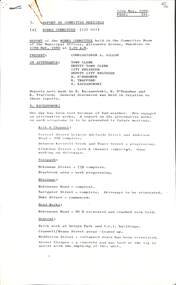
Administrative record - City of Sunshine - Commissioner Mr Alexander Alex George Gillon Collection 1976 - 1982 - Report of committee meetings 12th May 1980, City of Sunshine, 12th May 1980
... Thomson Reserve completed Tree Planting anticipated to commence this week Albion Tennis Club request for turf courts is dependent upon lease of area Albion Tennis Club Pavilion roof being erected this week Aycliffe Avenue Infant Welfare & Pre-School Centre roof completed. Town & Country Planning Board has now requested nine car park spaces to be provided Cherry Crescent Child Care Centre documentation completed. ...Thomson Reserve completed Tree Planting anticipated to commence this week Albion Tennis Club request for turf courts is dependent upon lease of area Albion Tennis Club Pavilion roof being erected this week Aycliffe Avenue Infant Welfare & Pre-School Centre roof completed. Town & Country Planning Board has now requested nine car park spaces to be provided Cherry Crescent Child Care Centre documentation completed. ...Report of Committee Meetings 12th May 1980 Report of Works Committee Meeting Kerb & Channel Forrest Street between Adelaide Street and Anderson Road 95% complete Kerb & Channel Forrest Street between Kororoit Creek and Tower Street progressing Kerb & Channel Lindenow Street completed gang working on driveways Footpath McLennan Street 75% complete Footpath Braybrook Area work progressing Drainage Robinsons Road complete Drainage Navigator Street complete driveways to be reinstated Drainage Duke Street commenced Road Works Robinsons Road 80% excavated and crush road laid Brick work at Sassella Park and I.C.I. Buildings Cranwell Street / Evans Street area cleaned up Middleton Street collapsed drain has been reinstated Street Cleaner a concrete pad was laid at the Sunshine Tip to assist with emptying this unit I.C.I. Oval car park area is being graded Sassella Park worked delayed awaiting delivery of soil Advanced Trees D.F. Thomson Reserve completed Tree Planting anticipated to commence this week Albion Tennis Club request for turf courts is dependent upon lease of area Albion Tennis Club Pavilion roof being erected this week Aycliffe Avenue Infant Welfare & Pre-School Centre roof completed. Town & Country Planning Board has now requested nine car park spaces to be provided Cherry Crescent Child Care Centre documentation completed. To be submitted to the Health Department for approval Ridgeway Parade Infant Welfare & Pre-School Centre documentation completed. To be submitted to the Health Department for approval Eppalock Crescent Infant Welfare & Pre-School Centre documentation completed. To be submitted to the Health Department for approval Central Library Extensions sketch plans are being developed Car Park Bon Thomas Reserve design nearing completion Pavilions Sports Grounds the basic design for a standard pavilion is nearing completion House of Sunshine design being prepared for extensions to the Caretaker's flat Railway House McCracken Street the eastern side of the house situated at 7 McCracken Street has been modified for the parking of bookmobiles Sunshine Youth Club some maintenance works have been carried out Skinner Reserve alterations are in progress Pennell Reserve Pavilion tender documents are being prepared Selwyn Park Pavilion fire service quotations received. These are included in the Extraordinary Meeting for Council Meeting 12th May 1980 Report of the Finance Committee Meeting Report of the Town Clerk Arrears of Fire Hazards Charges Abandonments Rates, Sanitary & Interest Statements as at 14th April 1980 Project Cost Analysis for Period Ended 7th April 1980 Rates, Sanitary & Interest Charges Adjustments / Abandonments Sundry Debtors Charges Adjustments / Abandonments Report of the Forward Planning Committee Protean Holdings Appeal Nickson Estate House Numbering Sub Contract Works Station Road Drain, Westerngate Drain & Furlong Road Drain Western Metropolitan Market Trust Sunshine Golf Club Fairbairn Road Traffic Lightsforrest street, adelaide street, anderson road, albion, ardeer, kororoit creek, tower street, lindenow street, maidstone, mclennan street, braybrook, robinsons road, deer park, navigator street, maribyrnong, duke street, i.c.i., sassella park, station road, cranwell street, evans street, middleton street, sunshine tip, i.c.i. oval, ballarat road, d.f. thomson reserve, albion tennis club, selwyn park, selwyn street, aycliffe avenue infant welfare & pre-school centre, aycliffe avenue, cherry crescent child care centre, cherry crescent, eppalock crescent infant welfare & pre-school centre, eppalock crescent, st. albans, bon thomas reserve, quinn street, house of sunshine, mccracken street, sunshine youth club, skinner reserve, churchill avenue, pennell reserve, burke street, furlong road, sunshine golf club, fairbairn road, sunshine west -
 Sunshine and District Historical Society Incorporated
Administrative record - City of Sunshine - Commissioner Mr Alexander Alex George Gillon Collection 1976 - 1982 - Minutes of the ordinary meeting of council held on 14th November 1978, City of Sunshine, 14th November 1978
... Minutes of the Ordinary Meeting of Council held on 14th November 1978 Report of the Town Clerk's Department Report of the Town Clerk Name of Proposed Railway Station between Albion and St. ...Meats Melissa Nook Camperdown Avenue Sandford Avenue Frederick Street Amanda Road Neale Road Oakwood Road Opie Road Ashley Street Tania Street McIntyre Road Ballarat Road Hampshire Road Geelong Road Sunshine Cricket Club Dempster Park Phoenix Street Dickson Street Main Road East Buckley Street Ridley Street Albion Wright Street Minutes of the Ordinary Meeting of Council held on 14th November 1978 Report of the Town Clerk's Department Report of the Town Clerk Name of Proposed Railway Station between Albion and St. ...Minutes of the Ordinary Meeting of Council held on 14th November 1978 Report of the Town Clerk's Department Report of the Town Clerk Name of Proposed Railway Station between Albion and St. Albans. The name Furlong has been Gazetted Land Transfer Ainsworth Reserve Land Transfer Discontinued Right of Way between Marsh Street and Emu Road Maintenance of Buildings Report of the Co-Ordinator Welfare Services Albion North Kindergarten Thomas Hall Furlong Road Victorian Youth Employment Committee Outreach Project Y.M.C.A. Braybrook Report of the Chief Health Inspector Brooklyn infant Welfare Centre Use by Pre-School Centre as an All-Day Child Minding Centre in 1979 Health Act Registrations Application for Transfer of Proprietorship of Premises under the Health Act Prosecution Proceedings Sunshine Magistrates Court Health (Hearing Conservation) Regulations 1978 Application for Installation of gas fired Dry septic Tank Units H. W. Greenham & Sons Pty Ltd Abattoirs Lots 7 & 8 Doherty's Road Removal of Habitable Building Granny Flat 38 Robyn Avenue Albanvale to 32 Queens Avenue Doncaster Report of the Chief By-Laws Officer Proposed Limited Parking Corio Street Prohibited Parking Lurg Avenue Sunshine North Report of the Municipal Recreation Officer Use of Robert Barrett Reserve by the George Cross Soccer Club Sassella Park Use of Reserve and Buildings Removal of Fence which was erected around the Proposed Swimming Pool, Layout of the Running Track used by Deer Park Little Athletics Centre and making provision for the area inside the tracks for the Sunshine Hockey Club. The Sundowers Marching Girl Group, the Deer Park Unemployment Group & Deer Park Play Group also use the ground and buildings Land Committee Report Howard Kingham Lodge Moving of the Fence Line and Offer of Sale of Chaplin Reserve To Council by the Railways Department Report of the City Engineer Land Conservation Council Recommendations Melbourne Study Area Town Planning Appeal Tribunal and the Uniform Building Regulations Proposed Extension to Sunshine Shopping Centre Planning Permit Application 64 Bed Nursing Home Killara Street & Mernda Street Sunshine West Planning Permit Application Office and Warehouses Lot 1 Sunshine Road South East Corner of Olympia Street Planning Permit Application Extension to Existing Sunshine Wesleyan Methodist Church 139 - 143 Devonshire Road Planning Permit Application Detached House within 60M of the Maribyrnong River Lot 88 Chifley Drive Planning Permit Application Consulting Rooms Dental Surgery Lot 173 Fairbairn Road Proposed Public Open Space Along the Maribyrnong River South Side between Duke Street and Evans Street Proposed Amendment Planning Permit Application 2 Lot Subdivision Lot 5 Justin Street Planning Permit Application Factory Lot 307 Hawthorn Avenue Planning Permit Application 4 Villa Units Lots 23 & 25 Madden Street Maidstone Planning Permit Application 40 Bed Nursing Home and Matrons Residence Lot 4 Devonshire Road Planning Permit Application Flats 15 Bardsley Street Sunshine West Planning Permit Application Sky Sign Highpoint Shopping Centre Lots 8, 9, 10, 11, 13 and Part 12 Rosamond Road Planning Permit Application Consulting Rooms Lot 7 Devonshire Road Consolidation of Title 2, 4 & 6 Killara Street Plan of Transfer and Consolidation S.C.I. Meats & Paper Pty Ltd & Ready Mix Concrete Somerville Road Plan of Subdivision Melissa Nook Deer Park Subdivision Camperdown Avenue and Sandford Avenue Damaged to Road, Kerb & channel, Etc Justin Road, Frederick Street and Amanda Road Flow Gauging Instrument Tottenham Branch Sewer Purchase of Ranger's Vehicle Outdoor Staff Christmas Break Up Half Cost Kerb & Channel Neale Road between Oakwood Road and Opie Road Elimination of Level Crossing Ashley Street Tottenham Farnsworth Avenue Deviation Footscray for New Bridge Over the Maribyrnong River and Extension to Footscray Institute of Technology Municipal Association of Victoria Mines Bill Amendment Report of the Building Surveyor Application to Build Over Easement 16 Tania Street Sunshine North Application to Build Over Easement Lot 19 McIntyre Road Sunshine Application to Install Underground Tanks Lot 2 Ballarat Road Corner of Hampshire Road Sunshine Application to Install Underground Tank Lot 1 Geelong Road Brooklyn Report of the Director of Parks & Recreation Request by Sunshine Cricket Club for Dempster Park Alteration of Fences Around Oval Orders of the Day Accounts Submitted for Payment as at 25th October 1978 Proposal to Construct Dickson Street (Part) Under the Provisions of Division 10 of Part XIX of the Local Government Act 1958 Extraordinary Business Report of the City Engineer Proposed New Road Connection Main Road East to Buckley Street Country Road Board Planning Permit Application 40 Bed Nursing Home and Matrons Residence Lot 4 Devonshire Road Report of the Building Surveyor 28 - 30 Ridley Street Albion 41 Wright Street Sunshine city of sunshine, alexander "alex" george gillon, marsh street, maidstone, ainsworth reserve, vernon street, sunshine west, emu road, furlong railway station, st. albans, albion north kindergarten, thomas hall, furlong road, sunshine north, brooklyn infant welfare centre, cypress avenue, brooklyn, h. w. greenham & sons pty ltd, doherty's road, robyn avenue, albanvale, lurg avenue, robert barrett reserve, rosamond road, maribyrnong, george cross soccer club, sassella park, station road, deer park, deer park little athletics centre, sunshine hockey club, sundowers marching girl group, deer park unemployment group, deer park play grou, kingham lodge, darnley street, chaplin reserve, anderson road, sunshine, killara street, mernda street, sunshine road, olympia street, tottenham, sunshine wesleyan methodist church, devonshire road, maribyrnong river, chifley drive, fairbairn road, duke street, evans street, justin street, hawthorn avenue, madden street, bardsley street, consolidation s.c.i. meats, melissa nook, camperdown avenue, sandford avenue, frederick street, amanda road, neale road, oakwood road, opie road, ashley street, tania street, mcintyre road, ballarat road, hampshire road, geelong road, sunshine cricket club, dempster park, phoenix street, dickson street, main road east, buckley street, ridley street, albion, wright street -
 Flagstaff Hill Maritime Museum and Village
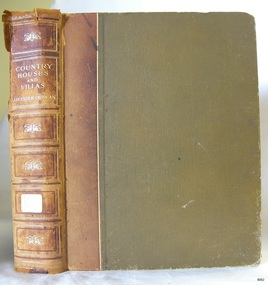
Book, Country Houses and Villas
... By 1886 the Warrnambool Mechanics’ Institute (WMI) had grown to have a Library, Museum and Fine Arts Gallery, with a collection of “… choice productions of art, and valuable specimens in almost every branch and many wonderful national curiosities are now to be seen there, including historic relics of the town and district.” It later included a School of Design. ...This item is from the ‘Pattison Collection’, a collection of books and records that was originally owned by the Warrnambool Mechanics’ Institute, which was founded in Warrnambool in 1853. By 1886 the Warrnambool Mechanics’ Institute (WMI) had grown to have a Library, Museum and Fine Arts Gallery, with a collection of “… choice productions of art, and valuable specimens in almost every branch and many wonderful national curiosities are now to be seen there, including historic relics of the town and district.” It later included a School of Design. Although it was very well patronised, the lack of financial support led the WMI in 1911 to ask the City Council to take it over. In 1935 Ralph Pattison was appointed as City Librarian to establish and organise the Warrnambool Library as it was then called. When the WMI building was pulled down in 1963 a new civic building was erected on the site and the new Warrnambool Library, on behalf of the City Council, took over all the holdings of the WMI. At this time some of the items were separated and identified as the ‘Pattison Collection’, named after Ralph Pattison. Eventually the components of the WMI were distributed from the Warrnambool Library to various places, including the Art Gallery, Historical Society and Flagstaff Hill. Later some were even distributed to other regional branches of Corangamite Regional Library and passed to and fro. It is difficult now to trace just where all of the items have ended up. The books at Flagstaff Hill Maritime Village generally display stamps and markings from Pattison as well as a variety of other institutions including the Mechanics’ Institute itself. RALPH ERIC PATTISON Ralph Eric Pattison was born in Rockhampton, Queensland, in 1891. He married Maude Swan from Warrnambool in 1920 and they set up home in Warrnambool. In 1935 Pattison accepted a position as City Librarian for the Warrnambool City Council. His huge challenge was to make a functional library within two rooms of the Mechanics’ Institute. He tirelessly cleaned, cleared and sorted a disarrayed collection of old books, jars of preserved specimens and other items reserved for exhibition in the city’s museum. He developed and updated the library with a wide variety of books for all tastes, including reference books for students; a difficult task to fulfil during the years following the Depression. He converted all of the lower area of the building into a library, reference room and reading room for members and the public. The books were sorted and stored using a cataloguing and card index system that he had developed himself. He also prepared the upper floor of the building and established the Art Gallery and later the Museum, a place to exhibit the many old relics that had been stored for years for this purpose. One of the treasures he found was a beautiful ancient clock, which he repaired, restored and enjoyed using in his office during the years of his service there. Ralph Pattison was described as “a meticulous gentleman whose punctuality, floorless courtesy and distinctive neat dress were hallmarks of his character, and ‘his’ clock controlled his daily routine, and his opening and closing of the library’s large heavy doors to the minute.” Pattison took leave during 1942 to 1945 to serve in the Royal Australian Navy, Volunteer Reserve as Lieutenant. A few years later he converted one of the Museum’s rooms into a Children’s Library, stocking it with suitable books for the younger generation. This was an instant success. In the 1950’s he had the honour of being appointed to the Victorian Library Board and received more inspiration from the monthly conferences in Melbourne. He was sadly retired in 1959 after over 23 years of service, due to the fact that he had gone over the working age of council officers. However he continued to take a very keen interest in the continual development of the Library until his death in 1969. The Pattison Collection, along with other items at Flagstaff Hill Maritime Village, was originally part of the Warrnambool Mechanics' Institute’s collection. The Warrnambool Mechanics’ Institute Collection is primarily significant in its totality, rather than for the individual objects it contains. Its contents are highly representative of the development of Mechanics' Institute libraries across Australia, particularly Victoria. A diversity of publications and themes has been amassed, and these provide clues to our understanding of the nature of and changes in the reading habits of Victorians from the 1850s to the middle of the 20th century. The collection also highlights the Warrnambool community’s commitment to the Mechanics’ Institute, reading, literacy and learning in the regions, and proves that access to knowledge was not impeded by distance. These items help to provide a more complete picture of our community’s ideals and aspirations. The Warrnambool Mechanics Institute book collection has historical and social significance for its strong association with the Mechanics Institute movement and the important role it played in the intellectual, cultural and social development of people throughout the latter part of the nineteenth century and the early twentieth century. The collection of books is a rare example of an early lending library and its significance is enhanced by the survival of an original collection of many volumes. The Warrnambool Mechanics' Institute’s publication collection is of both local and state significance. Country Houses and Villas Comprising 'Country Cottages' & 'The House Beautiful' illustrated with plans and interior decorations by well known Architects Author: J H Elder-Duncan Editorial secretary of "The Architectural Review" Publisher: Cassell & Co Date: 1908Label on spine cover with typed text PAT F 728 ELD Pastedown front endpaper has sticker from Warrnambool Mechanics Institute and Free Library Front loose endpaper has a sticker from Corangamite Regional Library Service Front loose endpaper has a stamp from Corangamite Regional Library Service warrnambool, shipwrecked-coast, flagstaff-hill, flagstaff-hill-maritime-museum, maritime-museum, shipwreck-coast, flagstaff-hill-maritime-village, shipwrecked-artefact, book, pattison collection, warrnambool library, warrnambool mechanics’ institute, ralph eric pattison, corangamite regional library service, warrnambool city librarian, mechanics’ institute library, victorian library board, warrnambool books and records, warrnambool children’s library, great ocean road, country houses and villas, j h elder-duncan, the architectural review -
 Phillip Island and District Historical Society Inc.
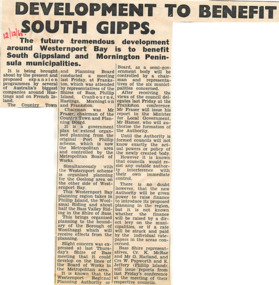
Newspaper cutting, 12/12/1968
... ...the country town and planning board...Article from a collection of newspaper cuttings from October 1968 to July 1971 phillip island westernport bay south gippsland mornington peninsula the country town and planning board mr frawer hastings french island Article about the proposed expansion programmes around Westernport Bay is to benefit South Gippsland and Mornington Peninsula municipalities. ...Article from a collection of newspaper cuttings from October 1968 to July 1971Article about the proposed expansion programmes around Westernport Bay is to benefit South Gippsland and Mornington Peninsula municipalities.phillip island, westernport bay, south gippsland, mornington peninsula, the country town and planning board, mr frawer, hastings, french island -
 Eltham District Historical Society Inc
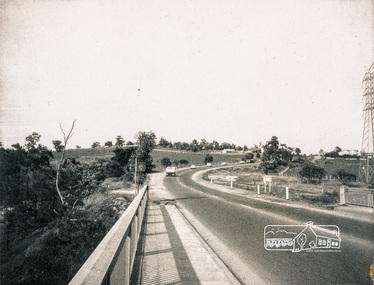
Photograph, Fitzsimons Lane Bridge over Yarra River between Eltham and Templestowe, c.1966, 1966c
... In 1955 the Country Roads Board (CRB) produced survey plans that showed proposed land acquisition for the future bridge and road approaches. ...In 1955 the Country Roads Board (CRB) produced survey plans that showed proposed land acquisition for the future bridge and road approaches. ...The bridge over the Yarra River was initially opened September 22nd, 1961. Newspaper reports at the time of opening stated it linked Bolton Street, Eltham, with Fitzsimons Lane, Templestowe. In 1955 the Country Roads Board (CRB) produced survey plans that showed proposed land acquisition for the future bridge and road approaches. The 1955 plan shows that it was proposed to connect Fitzsimons Lane with Bolton Street in Eltham by a diagonal road across the river. The road connection would then continue along Bolton Street to Main Road. Prior to construction of the bridge the CRB modified the proposal significantly so that there was a new road parallel with Bolton Street and then curving to join Main Road at what was then its intersection with Old Eltham Road. This involved significantly more land acquisition and altered the pattern of land subdivision through this corridor. Initially the new road was just a single two-way carriageway as it would have required a significant widening of the cutting on the Shire of Eltham side of the river. The road was officially un-named but was known locally as the Eltham-Templestowe Road. The 1966 Melway street directory and other 1960s editions also listed the road as the Eltham-Templestowe Road. In December 1970, Eltham Shire Council, in pursuance of the provisions of the Local Government Act, named it Templestowe Road. The road was renamed Fitzsimons Lane around 1984 in conformity with the section south of the river. In 1991 a new bridge was built to the west of the original bridge. Fitzsimons Lane was widened to four traffic lanes although on the Eltham side this was done within the limits of the existing cutting. NEW BRIDGE STARTS THEM EXPLORING Without any fanfares, Country Roads Board workmen on Friday afternoon put the finishing touches to the approaches, removed the barricades, and let the traffic roll over the new Yarra bridge linking Bolton Street, Eltham, with Fitzsimons Lane, Templestowe. Over the week-end many “bridge watchers” who were making one of their periodic inspections of the progress on the new bridge found to their surprise that they could drive over it, so that people who had gone for a run out to Eltham suddenly found themselves wandering through Templestowe and Doncaster. By Monday the word of the bridge’s opening had got around sufficiently for many regular travellers to the city from Eltham and beyond to vary the monotony by going to town via Templestowe and Kew instead of through Heidelberg. They were surprised at the distances – about 3 ½ miles from Eltham to Templestowe, 6 miles from Eltham Shire hall to the Lower Heidelberg Road-Banksia Street intersection. NEW NEIGHBOURS For people on both sides of the river, the new bridge has turned distant friends into near neighbours. A Greensborough man on Sunday took 35 minutes to reach the home of a friend in East Doncaster, but the return trip over the new bridge took only 17 minutes. It will be some time yet before most people work out the possibilities in shorter and quicker trips form the north-eastern areas to the eastern and south-eastern suburbs. The coming of the warmer months will soon teach many, though the short cuts to Peninsular beaches and eastern suburban drive-ins. And before very long it is likely there will be a Tramways bus running from Templestowe to Eltham station. NEW BRIDGE STARTS THEM EXPLORING (1961, September 27). The Diamond Valley News (News clipping held in SEA_74-1_047) The previously un-named road between Main Road and Yarra River, Eltham South, east of Bolton Street was named Templestowe Road, December 15, 1970 NAMING OF STREETS AND ROADS. (1970, December 15). The Diamond Valley News (News clipping held in SEA_74-2_022)Black and white photographManufacturer's marks: Polaroid, Batch #J62K181 (Sep 1966).infrastructure, shire of eltham infrastructure, bridge, fitzsimons lane bridge, polaroid, yarra river -
 Eltham District Historical Society Inc
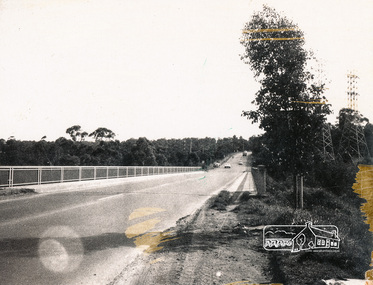
Photograph, Fitzsimons Lane Bridge over Yarra River between Eltham and Templestowe, c.1966, 1966c
... In 1955 the Country Roads Board (CRB) produced survey plans that showed proposed land acquisition for the future bridge and road approaches. ...In 1955 the Country Roads Board (CRB) produced survey plans that showed proposed land acquisition for the future bridge and road approaches. ...The bridge over the Yarra River was initially opened September 22nd, 1961. Newspaper reports at the time of opening stated it linked Bolton Street, Eltham, with Fitzsimons Lane, Templestowe. In 1955 the Country Roads Board (CRB) produced survey plans that showed proposed land acquisition for the future bridge and road approaches. The 1955 plan shows that it was proposed to connect Fitzsimons Lane with Bolton Street in Eltham by a diagonal road across the river. The road connection would then continue along Bolton Street to Main Road. Prior to construction of the bridge the CRB modified the proposal significantly so that there was a new road parallel with Bolton Street and then curving to join Main Road at what was then its intersection with Old Eltham Road. This involved significantly more land acquisition and altered the pattern of land subdivision through this corridor. Initially the new road was just a single two-way carriageway as it would have required a significant widening of the cutting on the Shire of Eltham side of the river. The road was officially un-named but was known locally as the Eltham-Templestowe Road. The 1966 Melway street directory and other 1960s editions also listed the road as the Eltham-Templestowe Road. In December 1970, Eltham Shire Council, in pursuance of the provisions of the Local Government Act, named it Templestowe Road. The road was renamed Fitzsimons Lane around 1984 in conformity with the section south of the river. In 1991 a new bridge was built to the west of the original bridge. Fitzsimons Lane was widened to four traffic lanes although on the Eltham side this was done within the limits of the existing cutting. NEW BRIDGE STARTS THEM EXPLORING Without any fanfares, Country Roads Board workmen on Friday afternoon put the finishing touches to the approaches, removed the barricades, and let the traffic roll over the new Yarra bridge linking Bolton Street, Eltham, with Fitzsimons Lane, Templestowe. Over the week-end many “bridge watchers” who were making one of their periodic inspections of the progress on the new bridge found to their surprise that they could drive over it, so that people who had gone for a run out to Eltham suddenly found themselves wandering through Templestowe and Doncaster. By Monday the word of the bridge’s opening had got around sufficiently for many regular travellers to the city from Eltham and beyond to vary the monotony by going to town via Templestowe and Kew instead of through Heidelberg. They were surprised at the distances – about 3 ½ miles from Eltham to Templestowe, 6 miles from Eltham Shire hall to the Lower Heidelberg Road-Banksia Street intersection. NEW NEIGHBOURS For people on both sides of the river, the new bridge has turned distant friends into near neighbours. A Greensborough man on Sunday took 35 minutes to reach the home of a friend in East Doncaster, but the return trip over the new bridge took only 17 minutes. It will be some time yet before most people work out the possibilities in shorter and quicker trips form the north-eastern areas to the eastern and south-eastern suburbs. The coming of the warmer months will soon teach many, though the short cuts to Peninsular beaches and eastern suburban drive-ins. And before very long it is likely there will be a Tramways bus running from Templestowe to Eltham station. NEW BRIDGE STARTS THEM EXPLORING (1961, September 27). The Diamond Valley News (News clipping held in SEA_74-1_047) The previously un-named road between Main Road and Yarra River, Eltham South, east of Bolton Street was named Templestowe Road, December 15, 1970 NAMING OF STREETS AND ROADS. (1970, December 15). The Diamond Valley News (News clipping held in SEA_74-2_022)Black and white photographManufacturer's marks: Polaroid, Batch #J62K181 (Sep 1966).infrastructure, shire of eltham infrastructure, bridge, fitzsimons lane bridge, polaroid, yarra river -
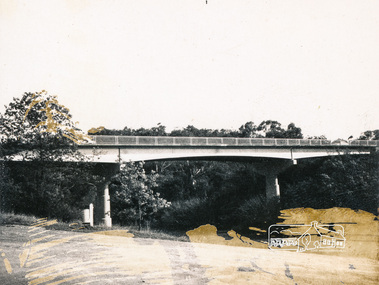 Eltham District Historical Society Inc
Photograph, Fitzsimons Lane Bridge over Yarra River between Eltham and Templestowe, c.1966, 1966c
... In 1955 the Country Roads Board (CRB) produced survey plans that showed proposed land acquisition for the future bridge and road approaches. ...In 1955 the Country Roads Board (CRB) produced survey plans that showed proposed land acquisition for the future bridge and road approaches. ...The bridge over the Yarra River was initially opened September 22nd, 1961. Newspaper reports at the time of opening stated it linked Bolton Street, Eltham, with Fitzsimons Lane, Templestowe. In 1955 the Country Roads Board (CRB) produced survey plans that showed proposed land acquisition for the future bridge and road approaches. The 1955 plan shows that it was proposed to connect Fitzsimons Lane with Bolton Street in Eltham by a diagonal road across the river. The road connection would then continue along Bolton Street to Main Road. Prior to construction of the bridge the CRB modified the proposal significantly so that there was a new road parallel with Bolton Street and then curving to join Main Road at what was then its intersection with Old Eltham Road. This involved significantly more land acquisition and altered the pattern of land subdivision through this corridor. Initially the new road was just a single two-way carriageway as it would have required a significant widening of the cutting on the Shire of Eltham side of the river. The road was officially un-named but was known locally as the Eltham-Templestowe Road. The 1966 Melway street directory and other 1960s editions also listed the road as the Eltham-Templestowe Road. In December 1970, Eltham Shire Council, in pursuance of the provisions of the Local Government Act, named it Templestowe Road. The road was renamed Fitzsimons Lane around 1984 in conformity with the section south of the river. In 1991 a new bridge was built to the west of the original bridge. Fitzsimons Lane was widened to four traffic lanes although on the Eltham side this was done within the limits of the existing cutting. NEW BRIDGE STARTS THEM EXPLORING Without any fanfares, Country Roads Board workmen on Friday afternoon put the finishing touches to the approaches, removed the barricades, and let the traffic roll over the new Yarra bridge linking Bolton Street, Eltham, with Fitzsimons Lane, Templestowe. Over the week-end many “bridge watchers” who were making one of their periodic inspections of the progress on the new bridge found to their surprise that they could drive over it, so that people who had gone for a run out to Eltham suddenly found themselves wandering through Templestowe and Doncaster. By Monday the word of the bridge’s opening had got around sufficiently for many regular travellers to the city from Eltham and beyond to vary the monotony by going to town via Templestowe and Kew instead of through Heidelberg. They were surprised at the distances – about 3 ½ miles from Eltham to Templestowe, 6 miles from Eltham Shire hall to the Lower Heidelberg Road-Banksia Street intersection. NEW NEIGHBOURS For people on both sides of the river, the new bridge has turned distant friends into near neighbours. A Greensborough man on Sunday took 35 minutes to reach the home of a friend in East Doncaster, but the return trip over the new bridge took only 17 minutes. It will be some time yet before most people work out the possibilities in shorter and quicker trips form the north-eastern areas to the eastern and south-eastern suburbs. The coming of the warmer months will soon teach many, though the short cuts to Peninsular beaches and eastern suburban drive-ins. And before very long it is likely there will be a Tramways bus running from Templestowe to Eltham station. NEW BRIDGE STARTS THEM EXPLORING (1961, September 27). The Diamond Valley News (News clipping held in SEA_74-1_047) The previously un-named road between Main Road and Yarra River, Eltham South, east of Bolton Street was named Templestowe Road, December 15, 1970 NAMING OF STREETS AND ROADS. (1970, December 15). The Diamond Valley News (News clipping held in SEA_74-2_022)Black and white photographManufacturer's marks: Polaroid, Batch #J62K181 (Sep 1966).infrastructure, shire of eltham infrastructure, bridge, fitzsimons lane bridge, polaroid, yarra river -
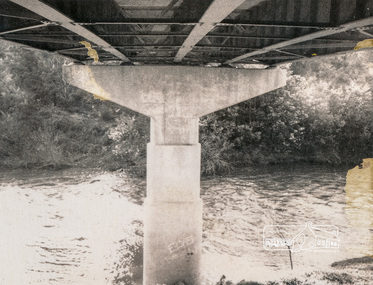 Eltham District Historical Society Inc
Photograph, Fitzsimons Lane Bridge over Yarra River between Eltham and Templestowe, c.1966, 1966c
... In 1955 the Country Roads Board (CRB) produced survey plans that showed proposed land acquisition for the future bridge and road approaches. ...In 1955 the Country Roads Board (CRB) produced survey plans that showed proposed land acquisition for the future bridge and road approaches. ...The bridge over the Yarra River was initially opened September 22nd, 1961. Newspaper reports at the time of opening stated it linked Bolton Street, Eltham, with Fitzsimons Lane, Templestowe. In 1955 the Country Roads Board (CRB) produced survey plans that showed proposed land acquisition for the future bridge and road approaches. The 1955 plan shows that it was proposed to connect Fitzsimons Lane with Bolton Street in Eltham by a diagonal road across the river. The road connection would then continue along Bolton Street to Main Road. Prior to construction of the bridge the CRB modified the proposal significantly so that there was a new road parallel with Bolton Street and then curving to join Main Road at what was then its intersection with Old Eltham Road. This involved significantly more land acquisition and altered the pattern of land subdivision through this corridor. Initially the new road was just a single two-way carriageway as it would have required a significant widening of the cutting on the Shire of Eltham side of the river. The road was officially un-named but was known locally as the Eltham-Templestowe Road. The 1966 Melway street directory and other 1960s editions also listed the road as the Eltham-Templestowe Road. In December 1970, Eltham Shire Council, in pursuance of the provisions of the Local Government Act, named it Templestowe Road. The road was renamed Fitzsimons Lane around 1984 in conformity with the section south of the river. In 1991 a new bridge was built to the west of the original bridge. Fitzsimons Lane was widened to four traffic lanes although on the Eltham side this was done within the limits of the existing cutting. NEW BRIDGE STARTS THEM EXPLORING Without any fanfares, Country Roads Board workmen on Friday afternoon put the finishing touches to the approaches, removed the barricades, and let the traffic roll over the new Yarra bridge linking Bolton Street, Eltham, with Fitzsimons Lane, Templestowe. Over the week-end many “bridge watchers” who were making one of their periodic inspections of the progress on the new bridge found to their surprise that they could drive over it, so that people who had gone for a run out to Eltham suddenly found themselves wandering through Templestowe and Doncaster. By Monday the word of the bridge’s opening had got around sufficiently for many regular travellers to the city from Eltham and beyond to vary the monotony by going to town via Templestowe and Kew instead of through Heidelberg. They were surprised at the distances – about 3 ½ miles from Eltham to Templestowe, 6 miles from Eltham Shire hall to the Lower Heidelberg Road-Banksia Street intersection. NEW NEIGHBOURS For people on both sides of the river, the new bridge has turned distant friends into near neighbours. A Greensborough man on Sunday took 35 minutes to reach the home of a friend in East Doncaster, but the return trip over the new bridge took only 17 minutes. It will be some time yet before most people work out the possibilities in shorter and quicker trips form the north-eastern areas to the eastern and south-eastern suburbs. The coming of the warmer months will soon teach many, though the short cuts to Peninsular beaches and eastern suburban drive-ins. And before very long it is likely there will be a Tramways bus running from Templestowe to Eltham station. NEW BRIDGE STARTS THEM EXPLORING (1961, September 27). The Diamond Valley News (News clipping held in SEA_74-1_047) The previously un-named road between Main Road and Yarra River, Eltham South, east of Bolton Street was named Templestowe Road, December 15, 1970 NAMING OF STREETS AND ROADS. (1970, December 15). The Diamond Valley News (News clipping held in SEA_74-2_022)Black and white photographManufacturer's marks: Polaroid, Batch #J62K181 (Sep 1966).infrastructure, shire of eltham infrastructure, bridge, fitzsimons lane bridge, polaroid, yarra river -
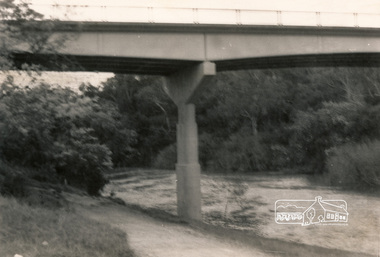 Eltham District Historical Society Inc
Photograph, Fitzsimons Lane Bridge over Yarra River between Eltham and Templestowe
... In 1955 the Country Roads Board (CRB) produced survey plans that showed proposed land acquisition for the future bridge and road approaches. ...In 1955 the Country Roads Board (CRB) produced survey plans that showed proposed land acquisition for the future bridge and road approaches. ...The bridge over the Yarra River was initially opened September 22nd, 1961. Newspaper reports at the time of opening stated it linked Bolton Street, Eltham, with Fitzsimons Lane, Templestowe. In 1955 the Country Roads Board (CRB) produced survey plans that showed proposed land acquisition for the future bridge and road approaches. The 1955 plan shows that it was proposed to connect Fitzsimons Lane with Bolton Street in Eltham by a diagonal road across the river. The road connection would then continue along Bolton Street to Main Road. Prior to construction of the bridge the CRB modified the proposal significantly so that there was a new road parallel with Bolton Street and then curving to join Main Road at what was then its intersection with Old Eltham Road. This involved significantly more land acquisition and altered the pattern of land subdivision through this corridor. Initially the new road was just a single two-way carriageway as it would have required a significant widening of the cutting on the Shire of Eltham side of the river. The road was officially un-named but was known locally as the Eltham-Templestowe Road. The 1966 Melway street directory and other 1960s editions also listed the road as the Eltham-Templestowe Road. In December 1970, Eltham Shire Council, in pursuance of the provisions of the Local Government Act, named it Templestowe Road. The road was renamed Fitzsimons Lane around 1984 in conformity with the section south of the river. In 1991 a new bridge was built to the west of the original bridge. Fitzsimons Lane was widened to four traffic lanes although on the Eltham side this was done within the limits of the existing cutting. NEW BRIDGE STARTS THEM EXPLORING Without any fanfares, Country Roads Board workmen on Friday afternoon put the finishing touches to the approaches, removed the barricades, and let the traffic roll over the new Yarra bridge linking Bolton Street, Eltham, with Fitzsimons Lane, Templestowe. Over the week-end many “bridge watchers” who were making one of their periodic inspections of the progress on the new bridge found to their surprise that they could drive over it, so that people who had gone for a run out to Eltham suddenly found themselves wandering through Templestowe and Doncaster. By Monday the word of the bridge’s opening had got around sufficiently for many regular travellers to the city from Eltham and beyond to vary the monotony by going to town via Templestowe and Kew instead of through Heidelberg. They were surprised at the distances – about 3 ½ miles from Eltham to Templestowe, 6 miles from Eltham Shire hall to the Lower Heidelberg Road-Banksia Street intersection. NEW NEIGHBOURS For people on both sides of the river, the new bridge has turned distant friends into near neighbours. A Greensborough man on Sunday took 35 minutes to reach the home of a friend in East Doncaster, but the return trip over the new bridge took only 17 minutes. It will be some time yet before most people work out the possibilities in shorter and quicker trips form the north-eastern areas to the eastern and south-eastern suburbs. The coming of the warmer months will soon teach many, though the short cuts to Peninsular beaches and eastern suburban drive-ins. And before very long it is likely there will be a Tramways bus running from Templestowe to Eltham station. NEW BRIDGE STARTS THEM EXPLORING (1961, September 27). The Diamond Valley News (News clipping held in SEA_74-1_047) The previously un-named road between Main Road and Yarra River, Eltham South, east of Bolton Street was named Templestowe Road, December 15, 1970 NAMING OF STREETS AND ROADS. (1970, December 15). The Diamond Valley News (News clipping held in SEA_74-2_022)Black and white photographinfrastructure, shire of eltham infrastructure, bridge, fitzsimons lane bridge, yarra river -
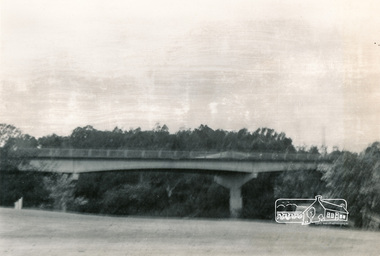 Eltham District Historical Society Inc
Photograph, Fitzsimons Lane Bridge over Yarra River between Eltham and Templestowe
... In 1955 the Country Roads Board (CRB) produced survey plans that showed proposed land acquisition for the future bridge and road approaches. ...In 1955 the Country Roads Board (CRB) produced survey plans that showed proposed land acquisition for the future bridge and road approaches. ...The bridge over the Yarra River was initially opened September 22nd, 1961. Newspaper reports at the time of opening stated it linked Bolton Street, Eltham, with Fitzsimons Lane, Templestowe. In 1955 the Country Roads Board (CRB) produced survey plans that showed proposed land acquisition for the future bridge and road approaches. The 1955 plan shows that it was proposed to connect Fitzsimons Lane with Bolton Street in Eltham by a diagonal road across the river. The road connection would then continue along Bolton Street to Main Road. Prior to construction of the bridge the CRB modified the proposal significantly so that there was a new road parallel with Bolton Street and then curving to join Main Road at what was then its intersection with Old Eltham Road. This involved significantly more land acquisition and altered the pattern of land subdivision through this corridor. Initially the new road was just a single two-way carriageway as it would have required a significant widening of the cutting on the Shire of Eltham side of the river. The road was officially un-named but was known locally as the Eltham-Templestowe Road. The 1966 Melway street directory and other 1960s editions also listed the road as the Eltham-Templestowe Road. In December 1970, Eltham Shire Council, in pursuance of the provisions of the Local Government Act, named it Templestowe Road. The road was renamed Fitzsimons Lane around 1984 in conformity with the section south of the river. In 1991 a new bridge was built to the west of the original bridge. Fitzsimons Lane was widened to four traffic lanes although on the Eltham side this was done within the limits of the existing cutting. NEW BRIDGE STARTS THEM EXPLORING Without any fanfares, Country Roads Board workmen on Friday afternoon put the finishing touches to the approaches, removed the barricades, and let the traffic roll over the new Yarra bridge linking Bolton Street, Eltham, with Fitzsimons Lane, Templestowe. Over the week-end many “bridge watchers” who were making one of their periodic inspections of the progress on the new bridge found to their surprise that they could drive over it, so that people who had gone for a run out to Eltham suddenly found themselves wandering through Templestowe and Doncaster. By Monday the word of the bridge’s opening had got around sufficiently for many regular travellers to the city from Eltham and beyond to vary the monotony by going to town via Templestowe and Kew instead of through Heidelberg. They were surprised at the distances – about 3 ½ miles from Eltham to Templestowe, 6 miles from Eltham Shire hall to the Lower Heidelberg Road-Banksia Street intersection. NEW NEIGHBOURS For people on both sides of the river, the new bridge has turned distant friends into near neighbours. A Greensborough man on Sunday took 35 minutes to reach the home of a friend in East Doncaster, but the return trip over the new bridge took only 17 minutes. It will be some time yet before most people work out the possibilities in shorter and quicker trips form the north-eastern areas to the eastern and south-eastern suburbs. The coming of the warmer months will soon teach many, though the short cuts to Peninsular beaches and eastern suburban drive-ins. And before very long it is likely there will be a Tramways bus running from Templestowe to Eltham station. NEW BRIDGE STARTS THEM EXPLORING (1961, September 27). The Diamond Valley News (News clipping held in SEA_74-1_047) The previously un-named road between Main Road and Yarra River, Eltham South, east of Bolton Street was named Templestowe Road, December 15, 1970 NAMING OF STREETS AND ROADS. (1970, December 15). The Diamond Valley News (News clipping held in SEA_74-2_022)Black and white photographinfrastructure, shire of eltham infrastructure, bridge, fitzsimons lane bridge, yarra river -
 Eltham District Historical Society Inc
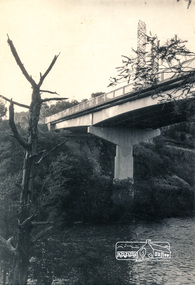
Photograph, Fitzsimons Lane Bridge over Yarra River between Eltham and Templestowe
... In 1955 the Country Roads Board (CRB) produced survey plans that showed proposed land acquisition for the future bridge and road approaches. ...In 1955 the Country Roads Board (CRB) produced survey plans that showed proposed land acquisition for the future bridge and road approaches. ...The bridge over the Yarra River was initially opened September 22nd, 1961. Newspaper reports at the time of opening stated it linked Bolton Street, Eltham, with Fitzsimons Lane, Templestowe. In 1955 the Country Roads Board (CRB) produced survey plans that showed proposed land acquisition for the future bridge and road approaches. The 1955 plan shows that it was proposed to connect Fitzsimons Lane with Bolton Street in Eltham by a diagonal road across the river. The road connection would then continue along Bolton Street to Main Road. Prior to construction of the bridge the CRB modified the proposal significantly so that there was a new road parallel with Bolton Street and then curving to join Main Road at what was then its intersection with Old Eltham Road. This involved significantly more land acquisition and altered the pattern of land subdivision through this corridor. Initially the new road was just a single two-way carriageway as it would have required a significant widening of the cutting on the Shire of Eltham side of the river. The road was officially un-named but was known locally as the Eltham-Templestowe Road. The 1966 Melway street directory and other 1960s editions also listed the road as the Eltham-Templestowe Road. In December 1970, Eltham Shire Council, in pursuance of the provisions of the Local Government Act, named it Templestowe Road. The road was renamed Fitzsimons Lane around 1984 in conformity with the section south of the river. In 1991 a new bridge was built to the west of the original bridge. Fitzsimons Lane was widened to four traffic lanes although on the Eltham side this was done within the limits of the existing cutting. NEW BRIDGE STARTS THEM EXPLORING Without any fanfares, Country Roads Board workmen on Friday afternoon put the finishing touches to the approaches, removed the barricades, and let the traffic roll over the new Yarra bridge linking Bolton Street, Eltham, with Fitzsimons Lane, Templestowe. Over the week-end many “bridge watchers” who were making one of their periodic inspections of the progress on the new bridge found to their surprise that they could drive over it, so that people who had gone for a run out to Eltham suddenly found themselves wandering through Templestowe and Doncaster. By Monday the word of the bridge’s opening had got around sufficiently for many regular travellers to the city from Eltham and beyond to vary the monotony by going to town via Templestowe and Kew instead of through Heidelberg. They were surprised at the distances – about 3 ½ miles from Eltham to Templestowe, 6 miles from Eltham Shire hall to the Lower Heidelberg Road-Banksia Street intersection. NEW NEIGHBOURS For people on both sides of the river, the new bridge has turned distant friends into near neighbours. A Greensborough man on Sunday took 35 minutes to reach the home of a friend in East Doncaster, but the return trip over the new bridge took only 17 minutes. It will be some time yet before most people work out the possibilities in shorter and quicker trips form the north-eastern areas to the eastern and south-eastern suburbs. The coming of the warmer months will soon teach many, though the short cuts to Peninsular beaches and eastern suburban drive-ins. And before very long it is likely there will be a Tramways bus running from Templestowe to Eltham station. NEW BRIDGE STARTS THEM EXPLORING (1961, September 27). The Diamond Valley News (News clipping held in SEA_74-1_047) The previously un-named road between Main Road and Yarra River, Eltham South, east of Bolton Street was named Templestowe Road, December 15, 1970 NAMING OF STREETS AND ROADS. (1970, December 15). The Diamond Valley News (News clipping held in SEA_74-2_022)Black and white photographinfrastructure, shire of eltham infrastructure, bridge, fitzsimons lane bridge, yarra river -
 Eltham District Historical Society Inc
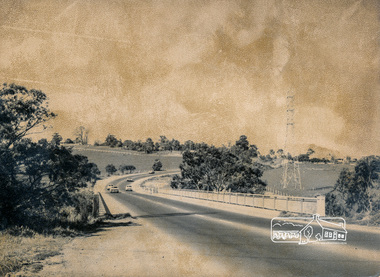
Photograph, Looking south across the Fitzsimons Lane Bridge over Yarra River between Eltham and Templestowe
... In 1955 the Country Roads Board (CRB) produced survey plans that showed proposed land acquisition for the future bridge and road approaches. ...In 1955 the Country Roads Board (CRB) produced survey plans that showed proposed land acquisition for the future bridge and road approaches. ...The bridge over the Yarra River was initially opened September 22nd, 1961. Newspaper reports at the time of opening stated it linked Bolton Street, Eltham, with Fitzsimons Lane, Templestowe. In 1955 the Country Roads Board (CRB) produced survey plans that showed proposed land acquisition for the future bridge and road approaches. The 1955 plan shows that it was proposed to connect Fitzsimons Lane with Bolton Street in Eltham by a diagonal road across the river. The road connection would then continue along Bolton Street to Main Road. Prior to construction of the bridge the CRB modified the proposal significantly so that there was a new road parallel with Bolton Street and then curving to join Main Road at what was then its intersection with Old Eltham Road. This involved significantly more land acquisition and altered the pattern of land subdivision through this corridor. Initially the new road was just a single two-way carriageway as it would have required a significant widening of the cutting on the Shire of Eltham side of the river. The road was officially un-named but was known locally as the Eltham-Templestowe Road. The 1966 Melway street directory and other 1960s editions also listed the road as the Eltham-Templestowe Road. In December 1970, Eltham Shire Council, in pursuance of the provisions of the Local Government Act, named it Templestowe Road. The road was renamed Fitzsimons Lane around 1984 in conformity with the section south of the river. In 1991 a new bridge was built to the west of the original bridge. Fitzsimons Lane was widened to four traffic lanes although on the Eltham side this was done within the limits of the existing cutting. NEW BRIDGE STARTS THEM EXPLORING Without any fanfares, Country Roads Board workmen on Friday afternoon put the finishing touches to the approaches, removed the barricades, and let the traffic roll over the new Yarra bridge linking Bolton Street, Eltham, with Fitzsimons Lane, Templestowe. Over the week-end many “bridge watchers” who were making one of their periodic inspections of the progress on the new bridge found to their surprise that they could drive over it, so that people who had gone for a run out to Eltham suddenly found themselves wandering through Templestowe and Doncaster. By Monday the word of the bridge’s opening had got around sufficiently for many regular travellers to the city from Eltham and beyond to vary the monotony by going to town via Templestowe and Kew instead of through Heidelberg. They were surprised at the distances – about 3 ½ miles from Eltham to Templestowe, 6 miles from Eltham Shire hall to the Lower Heidelberg Road-Banksia Street intersection. NEW NEIGHBOURS For people on both sides of the river, the new bridge has turned distant friends into near neighbours. A Greensborough man on Sunday took 35 minutes to reach the home of a friend in East Doncaster, but the return trip over the new bridge took only 17 minutes. It will be some time yet before most people work out the possibilities in shorter and quicker trips form the north-eastern areas to the eastern and south-eastern suburbs. The coming of the warmer months will soon teach many, though the short cuts to Peninsular beaches and eastern suburban drive-ins. And before very long it is likely there will be a Tramways bus running from Templestowe to Eltham station. NEW BRIDGE STARTS THEM EXPLORING (1961, September 27). The Diamond Valley News (News clipping held in SEA_74-1_047) The previously un-named road between Main Road and Yarra River, Eltham South, east of Bolton Street was named Templestowe Road, December 15, 1970 NAMING OF STREETS AND ROADS. (1970, December 15). The Diamond Valley News (News clipping held in SEA_74-2_022)Black and white photographinfrastructure, shire of eltham infrastructure, bridge, fitzsimons lane bridge, yarra river -
 Eltham District Historical Society Inc
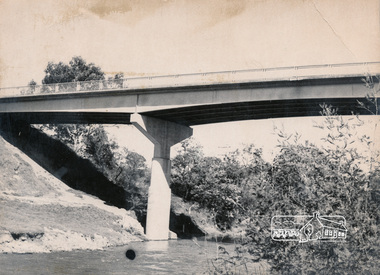
Photograph, Fitzsimons Lane Bridge over Yarra River between Eltham and Templestowe
... In 1955 the Country Roads Board (CRB) produced survey plans that showed proposed land acquisition for the future bridge and road approaches. ...In 1955 the Country Roads Board (CRB) produced survey plans that showed proposed land acquisition for the future bridge and road approaches. ...The bridge over the Yarra River was initially opened September 22nd, 1961. Newspaper reports at the time of opening stated it linked Bolton Street, Eltham, with Fitzsimons Lane, Templestowe. In 1955 the Country Roads Board (CRB) produced survey plans that showed proposed land acquisition for the future bridge and road approaches. The 1955 plan shows that it was proposed to connect Fitzsimons Lane with Bolton Street in Eltham by a diagonal road across the river. The road connection would then continue along Bolton Street to Main Road. Prior to construction of the bridge the CRB modified the proposal significantly so that there was a new road parallel with Bolton Street and then curving to join Main Road at what was then its intersection with Old Eltham Road. This involved significantly more land acquisition and altered the pattern of land subdivision through this corridor. Initially the new road was just a single two-way carriageway as it would have required a significant widening of the cutting on the Shire of Eltham side of the river. The road was officially un-named but was known locally as the Eltham-Templestowe Road. The 1966 Melway street directory and other 1960s editions also listed the road as the Eltham-Templestowe Road. In December 1970, Eltham Shire Council, in pursuance of the provisions of the Local Government Act, named it Templestowe Road. The road was renamed Fitzsimons Lane around 1984 in conformity with the section south of the river. In 1991 a new bridge was built to the west of the original bridge. Fitzsimons Lane was widened to four traffic lanes although on the Eltham side this was done within the limits of the existing cutting. NEW BRIDGE STARTS THEM EXPLORING Without any fanfares, Country Roads Board workmen on Friday afternoon put the finishing touches to the approaches, removed the barricades, and let the traffic roll over the new Yarra bridge linking Bolton Street, Eltham, with Fitzsimons Lane, Templestowe. Over the week-end many “bridge watchers” who were making one of their periodic inspections of the progress on the new bridge found to their surprise that they could drive over it, so that people who had gone for a run out to Eltham suddenly found themselves wandering through Templestowe and Doncaster. By Monday the word of the bridge’s opening had got around sufficiently for many regular travellers to the city from Eltham and beyond to vary the monotony by going to town via Templestowe and Kew instead of through Heidelberg. They were surprised at the distances – about 3 ½ miles from Eltham to Templestowe, 6 miles from Eltham Shire hall to the Lower Heidelberg Road-Banksia Street intersection. NEW NEIGHBOURS For people on both sides of the river, the new bridge has turned distant friends into near neighbours. A Greensborough man on Sunday took 35 minutes to reach the home of a friend in East Doncaster, but the return trip over the new bridge took only 17 minutes. It will be some time yet before most people work out the possibilities in shorter and quicker trips form the north-eastern areas to the eastern and south-eastern suburbs. The coming of the warmer months will soon teach many, though the short cuts to Peninsular beaches and eastern suburban drive-ins. And before very long it is likely there will be a Tramways bus running from Templestowe to Eltham station. NEW BRIDGE STARTS THEM EXPLORING (1961, September 27). The Diamond Valley News (News clipping held in SEA_74-1_047) The previously un-named road between Main Road and Yarra River, Eltham South, east of Bolton Street was named Templestowe Road, December 15, 1970 NAMING OF STREETS AND ROADS. (1970, December 15). The Diamond Valley News (News clipping held in SEA_74-2_022)Black and white photographinfrastructure, shire of eltham infrastructure, bridge, fitzsimons lane bridge, yarra river -
 Eltham District Historical Society Inc
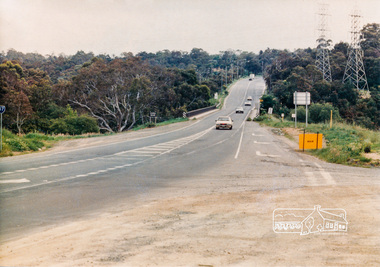
Photograph, Looking north across the Fitzsimons Lane Bridge over Yarra River between Eltham and Templestowe, c.1985, 1985c
... In 1955 the Country Roads Board (CRB) produced survey plans that showed proposed land acquisition for the future bridge and road approaches. ...In 1955 the Country Roads Board (CRB) produced survey plans that showed proposed land acquisition for the future bridge and road approaches. ...Turnoff to Candlebark Park on right. The bridge over the Yarra River was initially opened September 22nd, 1961. Newspaper reports at the time of opening stated it linked Bolton Street, Eltham, with Fitzsimons Lane, Templestowe. In 1955 the Country Roads Board (CRB) produced survey plans that showed proposed land acquisition for the future bridge and road approaches. The 1955 plan shows that it was proposed to connect Fitzsimons Lane with Bolton Street in Eltham by a diagonal road across the river. The road connection would then continue along Bolton Street to Main Road. Prior to construction of the bridge the CRB modified the proposal significantly so that there was a new road parallel with Bolton Street and then curving to join Main Road at what was then its intersection with Old Eltham Road. This involved significantly more land acquisition and altered the pattern of land subdivision through this corridor. Initially the new road was just a single two-way carriageway as it would have required a significant widening of the cutting on the Shire of Eltham side of the river. The road was officially un-named but was known locally as the Eltham-Templestowe Road. The 1966 Melway street directory and other 1960s editions also listed the road as the Eltham-Templestowe Road. In December 1970, Eltham Shire Council, in pursuance of the provisions of the Local Government Act, named it Templestowe Road. The road was renamed Fitzsimons Lane around 1984 in conformity with the section south of the river. In 1991 a new bridge was built to the west of the original bridge. Fitzsimons Lane was widened to four traffic lanes although on the Eltham side this was done within the limits of the existing cutting. NEW BRIDGE STARTS THEM EXPLORING Without any fanfares, Country Roads Board workmen on Friday afternoon put the finishing touches to the approaches, removed the barricades, and let the traffic roll over the new Yarra bridge linking Bolton Street, Eltham, with Fitzsimons Lane, Templestowe. Over the week-end many “bridge watchers” who were making one of their periodic inspections of the progress on the new bridge found to their surprise that they could drive over it, so that people who had gone for a run out to Eltham suddenly found themselves wandering through Templestowe and Doncaster. By Monday the word of the bridge’s opening had got around sufficiently for many regular travellers to the city from Eltham and beyond to vary the monotony by going to town via Templestowe and Kew instead of through Heidelberg. They were surprised at the distances – about 3 ½ miles from Eltham to Templestowe, 6 miles from Eltham Shire hall to the Lower Heidelberg Road-Banksia Street intersection. NEW NEIGHBOURS For people on both sides of the river, the new bridge has turned distant friends into near neighbours. A Greensborough man on Sunday took 35 minutes to reach the home of a friend in East Doncaster, but the return trip over the new bridge took only 17 minutes. It will be some time yet before most people work out the possibilities in shorter and quicker trips form the north-eastern areas to the eastern and south-eastern suburbs. The coming of the warmer months will soon teach many, though the short cuts to Peninsular beaches and eastern suburban drive-ins. And before very long it is likely there will be a Tramways bus running from Templestowe to Eltham station. NEW BRIDGE STARTS THEM EXPLORING (1961, September 27). The Diamond Valley News (News clipping held in SEA_74-1_047) The previously un-named road between Main Road and Yarra River, Eltham South, east of Bolton Street was named Templestowe Road, December 15, 1970 NAMING OF STREETS AND ROADS. (1970, December 15). The Diamond Valley News (News clipping held in SEA_74-2_022)Colour photographinfrastructure, shire of eltham infrastructure, bridge, fitzsimons lane bridge, yarra river, candlebark park, red nose day -
 Eltham District Historical Society Inc
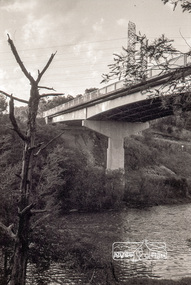
Photograph, Russell Yeoman, Fitzsimons Lane Bridge over Yarra River between Eltham and Templestowe, c.1970, 1970c
... In 1955 the Country Roads Board (CRB) produced survey plans that showed proposed land acquisition for the future bridge and road approaches. ...In 1955 the Country Roads Board (CRB) produced survey plans that showed proposed land acquisition for the future bridge and road approaches. ...The bridge over the Yarra River was initially opened September 22nd, 1961. Newspaper reports at the time of opening stated it linked Bolton Street, Eltham, with Fitzsimons Lane, Templestowe. In 1955 the Country Roads Board (CRB) produced survey plans that showed proposed land acquisition for the future bridge and road approaches. The 1955 plan shows that it was proposed to connect Fitzsimons Lane with Bolton Street in Eltham by a diagonal road across the river. The road connection would then continue along Bolton Street to Main Road. Prior to construction of the bridge the CRB modified the proposal significantly so that there was a new road parallel with Bolton Street and then curving to join Main Road at what was then its intersection with Old Eltham Road. This involved significantly more land acquisition and altered the pattern of land subdivision through this corridor. Initially the new road was just a single two-way carriageway as it would have required a significant widening of the cutting on the Shire of Eltham side of the river. The road was officially un-named but was known locally as the Eltham-Templestowe Road. The 1966 Melway street directory and other 1960s editions also listed the road as the Eltham-Templestowe Road. In December 1970, Eltham Shire Council, in pursuance of the provisions of the Local Government Act, named it Templestowe Road. The road was renamed Fitzsimons Lane around 1984 in conformity with the section south of the river. In 1991 a new bridge was built to the west of the original bridge. Fitzsimons Lane was widened to four traffic lanes although on the Eltham side this was done within the limits of the existing cutting. NEW BRIDGE STARTS THEM EXPLORING Without any fanfares, Country Roads Board workmen on Friday afternoon put the finishing touches to the approaches, removed the barricades, and let the traffic roll over the new Yarra bridge linking Bolton Street, Eltham, with Fitzsimons Lane, Templestowe. Over the week-end many “bridge watchers” who were making one of their periodic inspections of the progress on the new bridge found to their surprise that they could drive over it, so that people who had gone for a run out to Eltham suddenly found themselves wandering through Templestowe and Doncaster. By Monday the word of the bridge’s opening had got around sufficiently for many regular travellers to the city from Eltham and beyond to vary the monotony by going to town via Templestowe and Kew instead of through Heidelberg. They were surprised at the distances – about 3 ½ miles from Eltham to Templestowe, 6 miles from Eltham Shire hall to the Lower Heidelberg Road-Banksia Street intersection. NEW NEIGHBOURS For people on both sides of the river, the new bridge has turned distant friends into near neighbours. A Greensborough man on Sunday took 35 minutes to reach the home of a friend in East Doncaster, but the return trip over the new bridge took only 17 minutes. It will be some time yet before most people work out the possibilities in shorter and quicker trips form the north-eastern areas to the eastern and south-eastern suburbs. The coming of the warmer months will soon teach many, though the short cuts to Peninsular beaches and eastern suburban drive-ins. And before very long it is likely there will be a Tramways bus running from Templestowe to Eltham station. NEW BRIDGE STARTS THEM EXPLORING (1961, September 27). The Diamond Valley News (News clipping held in SEA_74-1_047) The previously un-named road between Main Road and Yarra River, Eltham South, east of Bolton Street was named Templestowe Road, December 15, 1970 NAMING OF STREETS AND ROADS. (1970, December 15). The Diamond Valley News (News clipping held in SEA_74-2_022)Roll of 35mm black and white negative film, 4 of 7 stripsIlford HP4bridge, bridges, fitzsimons lane bridge, infrastructure, shire of eltham infrastructure, yarra river -
 Eltham District Historical Society Inc
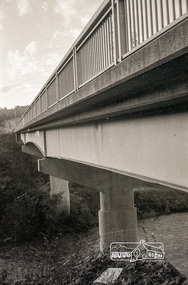
Photograph, Russell Yeoman, Fitzsimons Lane Bridge over Yarra River between Eltham and Templestowe, c.1970, 1970c
... In 1955 the Country Roads Board (CRB) produced survey plans that showed proposed land acquisition for the future bridge and road approaches. ...In 1955 the Country Roads Board (CRB) produced survey plans that showed proposed land acquisition for the future bridge and road approaches. ...The bridge over the Yarra River was initially opened September 22nd, 1961. Newspaper reports at the time of opening stated it linked Bolton Street, Eltham, with Fitzsimons Lane, Templestowe. In 1955 the Country Roads Board (CRB) produced survey plans that showed proposed land acquisition for the future bridge and road approaches. The 1955 plan shows that it was proposed to connect Fitzsimons Lane with Bolton Street in Eltham by a diagonal road across the river. The road connection would then continue along Bolton Street to Main Road. Prior to construction of the bridge the CRB modified the proposal significantly so that there was a new road parallel with Bolton Street and then curving to join Main Road at what was then its intersection with Old Eltham Road. This involved significantly more land acquisition and altered the pattern of land subdivision through this corridor. Initially the new road was just a single two-way carriageway as it would have required a significant widening of the cutting on the Shire of Eltham side of the river. The road was officially un-named but was known locally as the Eltham-Templestowe Road. The 1966 Melway street directory and other 1960s editions also listed the road as the Eltham-Templestowe Road. In December 1970, Eltham Shire Council, in pursuance of the provisions of the Local Government Act, named it Templestowe Road. The road was renamed Fitzsimons Lane around 1984 in conformity with the section south of the river. In 1991 a new bridge was built to the west of the original bridge. Fitzsimons Lane was widened to four traffic lanes although on the Eltham side this was done within the limits of the existing cutting. NEW BRIDGE STARTS THEM EXPLORING Without any fanfares, Country Roads Board workmen on Friday afternoon put the finishing touches to the approaches, removed the barricades, and let the traffic roll over the new Yarra bridge linking Bolton Street, Eltham, with Fitzsimons Lane, Templestowe. Over the week-end many “bridge watchers” who were making one of their periodic inspections of the progress on the new bridge found to their surprise that they could drive over it, so that people who had gone for a run out to Eltham suddenly found themselves wandering through Templestowe and Doncaster. By Monday the word of the bridge’s opening had got around sufficiently for many regular travellers to the city from Eltham and beyond to vary the monotony by going to town via Templestowe and Kew instead of through Heidelberg. They were surprised at the distances – about 3 ½ miles from Eltham to Templestowe, 6 miles from Eltham Shire hall to the Lower Heidelberg Road-Banksia Street intersection. NEW NEIGHBOURS For people on both sides of the river, the new bridge has turned distant friends into near neighbours. A Greensborough man on Sunday took 35 minutes to reach the home of a friend in East Doncaster, but the return trip over the new bridge took only 17 minutes. It will be some time yet before most people work out the possibilities in shorter and quicker trips form the north-eastern areas to the eastern and south-eastern suburbs. The coming of the warmer months will soon teach many, though the short cuts to Peninsular beaches and eastern suburban drive-ins. And before very long it is likely there will be a Tramways bus running from Templestowe to Eltham station. NEW BRIDGE STARTS THEM EXPLORING (1961, September 27). The Diamond Valley News (News clipping held in SEA_74-1_047) The previously un-named road between Main Road and Yarra River, Eltham South, east of Bolton Street was named Templestowe Road, December 15, 1970 NAMING OF STREETS AND ROADS. (1970, December 15). The Diamond Valley News (News clipping held in SEA_74-2_022)Roll of 35mm black and white negative film, 4 of 7 stripsIlford HP4bridge, bridges, fitzsimons lane bridge, infrastructure, shire of eltham infrastructure, yarra river -
Glen Eira Historical Society
Plan - Mount Scopus College, St. Kilda East
... Plan... Hall... Building Development... Education Department... Town and Country Planning Board...Planning Scheme Classrooms Kindergarten Playgrounds Library Multipurpose Hall Car Parking Students Teachers Staff Secondary School Primary School Synagogue Architects Syman Justin and Bialek Site Plan Hall Building Development Education Department Town and Country Planning Board Brick Zoning Traffic Property Landscape Planning Planting Fence Plan Mount Scopus College, St. ...A copy of the amended Planning brief for the development of Mount Scopus College dated 24/10/1982. It includes a covering letter listing the amendments. The planning brief describes the school’s facilities, classrooms, playground and the planned development of the school. It includes a site plan and an architect’s illustration of the proposed development.mount scopus college, st. kilda east, city of caulfield, mayfield street, talbot avenue, floyd jeff, building permits, planning act, shaw house, m.m.b.w. planning scheme, classrooms, kindergarten, playgrounds, library, multipurpose hall, car parking, students, teachers, staff, secondary school, primary school, synagogue, architects, syman justin and bialek, site plan, hall, building development, education department, town and country planning board, brick, zoning, traffic, property, landscape planning, planting, fence -
 Sunshine and District Historical Society Incorporated
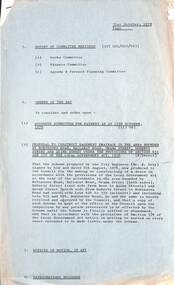
Administrative record - City of Sunshine - Commissioner Mr Alexander "Alex" George Gillon Collection 1976 - 1982 - Extraordinary Business Report of the Town Clerk 31st October 1978, City of Sunshine, 31st October 1978
... Extraordinary Business Report of the Town Clerk Errington Reserve South East Corner Ownership Dispute Report of the City Librarian Unemployment Discussion Report of the City Engineer Planning Permit Application 36 Sydney Street Advertising Signs for Child Minding Centre Planning Permit Application Take Away Food Premise Cafe Amusement Parlour Highpoint West 200 Rosamond Road Application to Country Road Board for Funds for the Year Ending 30th June 1980 Construction of Hulett Street Construction of Sydney Street Orders of the Day Accounts Submitted for Payment as at 15th October 1978 Proposal to Construct Easement Drainage in the Area Bounded by Robinsons Road, Ballarat Road, Orama Street, Doherty Street and Quinn Street...Administrative record City of Sunshine - Commissioner Mr Alexander "Alex" George Gillon Collection 1976 - 1982 - Extraordinary Business Report of the Town Clerk 31st October 1978 City of Sunshine ...Extraordinary Business Report of the Town Clerk Errington Reserve South East Corner Ownership Dispute Report of the City Librarian Unemployment Discussion Report of the City Engineer Planning Permit Application 36 Sydney Street Advertising Signs for Child Minding Centre Planning Permit Application Take Away Food Premise Cafe Amusement Parlour Highpoint West 200 Rosamond Road Application to Country Road Board for Funds for the Year Ending 30th June 1980 Construction of Hulett Street Construction of Sydney Street Orders of the Day Accounts Submitted for Payment as at 15th October 1978 Proposal to Construct Easement Drainage in the Area Bounded by Robinsons Road, Ballarat Road, Orama Street, Doherty Street and Quinn Street city of sunshine, alexander "alex" george gillon, errington reserve, main road east, st. albans, sydney street, albion, highpoint west, rosamond road, maribyrnong, hulett street, robinsons road, ballarat road, orama street, doherty street, quinn street, deer park -
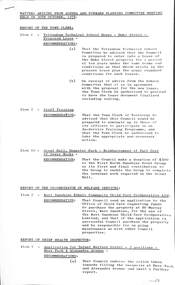 Sunshine and District Historical Society Incorporated
Administrative record - City of Sunshine - Commissioner Mr Alexander "Alex" George Gillon Collection 1976 - 1982 - Matters Arising from Agenda and Forward Planning Committee Meeting Held on 30th October 1978, City of Sunshine, 30th November 1978
... Matters Arising from Agenda and Forward Planning Committee Meeting Held on 30th October 1978 Report of Town Clerk Tottenham Technical School House Duke Street Scout Hall Dempster Park Reimbursement of Part Cost of Sewer Works Report of the Co-Ordinator of Welfare Services West Sunshine Ethnic Community Child Care Co-Operative Purchase of 90 Murray Street Sunshine West Report of the Chief By-Laws Officer Fire Hazards Removal Report of the City Librarian Sunshine - Melton Library Agreement Report of the City Engineer Planning Permit Application Glengala Road Planning Permit Application 40 Bed Nursing Home Thomson Street and Jackson Street Plan of Subdivision Chicago Street Construction of Hulett Street and Sydney Street Contract Tennis Courts Dempster Park Council Depot Amenities Building Half Cost Kerb & Channel Provision of Footpath Ballarat Road between Westmoreland Road and McIntyre Road Finalisation of Gooding Street Private Street Scheme Extraordinary Business Application to Country Road Board for Funds for the Year Ending 30th June 1980 Construction of Hulett Street Tender Construction of Sydney street Tender...Albans Matters Arising from Agenda and Forward Planning Committee Meeting Held on 30th October 1978 Report of Town Clerk Tottenham Technical School House Duke Street Scout Hall Dempster Park Reimbursement of Part Cost of Sewer Works Report of the Co-Ordinator of Welfare Services West Sunshine Ethnic Community Child Care Co-Operative Purchase of 90 Murray Street Sunshine West Report of the Chief By-Laws Officer Fire Hazards Removal Report of the City Librarian Sunshine - Melton Library Agreement Report of the City Engineer Planning Permit Application Glengala Road Planning Permit Application 40 Bed Nursing Home Thomson Street and Jackson Street Plan of Subdivision Chicago Street Construction of Hulett Street and Sydney Street Contract Tennis Courts Dempster Park Council Depot Amenities Building Half Cost Kerb & Channel Provision of Footpath Ballarat Road between Westmoreland Road and McIntyre Road Finalisation of Gooding Street Private Street Scheme Extraordinary Business Application to Country Road Board for Funds for the Year Ending 30th June 1980 Construction of Hulett Street Tender Construction of Sydney street Tender Foolscap sized document. ...Matters Arising from Agenda and Forward Planning Committee Meeting Held on 30th October 1978 Report of Town Clerk Tottenham Technical School House Duke Street Scout Hall Dempster Park Reimbursement of Part Cost of Sewer Works Report of the Co-Ordinator of Welfare Services West Sunshine Ethnic Community Child Care Co-Operative Purchase of 90 Murray Street Sunshine West Report of the Chief By-Laws Officer Fire Hazards Removal Report of the City Librarian Sunshine - Melton Library Agreement Report of the City Engineer Planning Permit Application Glengala Road Planning Permit Application 40 Bed Nursing Home Thomson Street and Jackson Street Plan of Subdivision Chicago Street Construction of Hulett Street and Sydney Street Contract Tennis Courts Dempster Park Council Depot Amenities Building Half Cost Kerb & Channel Provision of Footpath Ballarat Road between Westmoreland Road and McIntyre Road Finalisation of Gooding Street Private Street Scheme Extraordinary Business Application to Country Road Board for Funds for the Year Ending 30th June 1980 Construction of Hulett Street Tender Construction of Sydney street Tender city of sunshine, alexander "alex" george gillon, tottenham technical school, duke street, sunshine, dempster park, phoenix street, sunshine north, west sunshine ethnic community child care co-operative, murray street, sunshine west, glengala road, thomson street, jackson street, maidstone, chicago street, maribyrnong, hulett street, albion, sydney street, ballarat road, westmoreland road, mcintyre road, gooding street, st. albans -
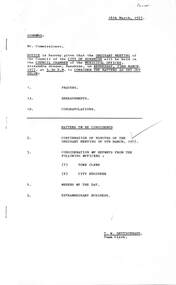 Sunshine and District Historical Society Incorporated
Administrative record - City of Sunshine - Commissioner Mr Alexander Alex George Gillon Collection 1976 - 1982 - Notice of ordinary meeting of the council of the City of Sunshine to be held on 23rd March 1977, City of Sunshine, 16th March 1977
... Report of Town Clerk Report on Submission for Finance for After School Programmes Hockey Clinics and Competition Sunshine View Estate Private Street Scheme Annual Municipal Elections Rates & Sanitary Interest Abandonments for 1976/77 Financial Reports Garbage Disposal Agreement with City of Keilor Sunshine Tip Proposed Closure of Stanley Street Transfer to Commonwealth Government Report of the Chief Health Inspector Public Toilets Hampshire Road Quarterly Return of Food Samples Removal of Dwelling Outside the Municipality Brambles McDonald Road to Violet Town Litter Control in the Western Region Clean Air & Environmental Council Annual Dinner Report of City Engineer Westerngate Estate Stage 1B Neale Road Estate Furlong Road Estate Stage 5 Contract Glengala Estate Stage 3 Private Street Scheme Land Use Permit Application Place of Worship Lot 479 Billingham Road with Comments About Place of Worship at 13 Lorna Crescent Subdivision Robinsons Road Construction of Robinsons Road Quinn Estate Deer Park Private Street Scheme St. ...Albans Football Club Coaching Boxes New Passenger Shelter Melbourne & Metropolitan Tramways Board Ballarat Road Corner of Ashley Street Strata Subdivision 27 King Edward Avenue McKay Gardens Art Display Land Use Permit Indoor Training Centre Lot 7 Mullenger Street Dickson Street Private Street Scheme Plans of Transfer and Consolidation Wright Street Land Use Permit Application Flats Lots 24 & 25 Matthews Avenue Traffic Signals Wright Street Area Melbourne & Metropolitan Tramways Board Passenger Shelters South Road Ashley Street Project Elimination of Level Crossing Country Roads Board Land Use Permit Application Proposed Car Sales Yard North West Corner Ashley Street and South Road Land Use Permit Application Extensions to Existing Factory Humes Van Ness Avenue Closure of Rogers Street & Francis Street Between Emu Street & Wattle Road Report of the Building Surveyor Building Permit Application Siting of House lot 209 Mapledene Court Sunshine West Cash in Lieu lot 17 St. ...Report of Town Clerk Report on Submission for Finance for After School Programmes Hockey Clinics and Competition Sunshine View Estate Private Street Scheme Annual Municipal Elections Rates & Sanitary Interest Abandonments for 1976/77 Financial Reports Garbage Disposal Agreement with City of Keilor Sunshine Tip Proposed Closure of Stanley Street Transfer to Commonwealth Government Report of the Chief Health Inspector Public Toilets Hampshire Road Quarterly Return of Food Samples Removal of Dwelling Outside the Municipality Brambles McDonald Road to Violet Town Litter Control in the Western Region Clean Air & Environmental Council Annual Dinner Report of City Engineer Westerngate Estate Stage 1B Neale Road Estate Furlong Road Estate Stage 5 Contract Glengala Estate Stage 3 Private Street Scheme Land Use Permit Application Place of Worship Lot 479 Billingham Road with Comments About Place of Worship at 13 Lorna Crescent Subdivision Robinsons Road Construction of Robinsons Road Quinn Estate Deer Park Private Street Scheme St. Albans Football Club Coaching Boxes New Passenger Shelter Melbourne & Metropolitan Tramways Board Ballarat Road Corner of Ashley Street Strata Subdivision 27 King Edward Avenue McKay Gardens Art Display Land Use Permit Indoor Training Centre Lot 7 Mullenger Street Dickson Street Private Street Scheme Plans of Transfer and Consolidation Wright Street Land Use Permit Application Flats Lots 24 & 25 Matthews Avenue Traffic Signals Wright Street Area Melbourne & Metropolitan Tramways Board Passenger Shelters South Road Ashley Street Project Elimination of Level Crossing Country Roads Board Land Use Permit Application Proposed Car Sales Yard North West Corner Ashley Street and South Road Land Use Permit Application Extensions to Existing Factory Humes Van Ness Avenue Closure of Rogers Street & Francis Street Between Emu Street & Wattle Road Report of the Building Surveyor Building Permit Application Siting of House lot 209 Mapledene Court Sunshine West Cash in Lieu lot 17 St. Albans Road Tenders Ainsworth Reserve Child Day Care Centre / Pavilion Undersize Allotment lot 29 Albert Street Sunshine North Rosamond Bowling Club Building Statement of Objections to Grant Permit Orders of the Day Accounts Submitted for Payment as at 28th February 1977 city of sunshine, alexander "alex" george gillon, stanley street, hampshire road, sunshine, mcdonald road, brooklyn, neale road, deer park, furlong road, st. albans, billingham road, lorna crescent, sunshine west, robinsons road, st. albans football club, ballarat roa, ashley street, braybrook, king edward avenue, albion, mullenger street, wright street, matthews avenue, south road, humes pipe works, van ness avenue, maribyrnong, rogers street, francis street, emu street, wattle road, maidstone, mapledene court, st. albans road, ainsworth reserve, vernon street, albert street, sunshine north, rosamond bowling club, robert barrett reserve, rosamond road, sunshine tip, ainsworth reserve child care centre -
 Sunshine and District Historical Society Incorporated
Administrative record - City of Sunshine - Commissioner Mr Alexander Alex George Gillon Collection 1976 - 1982 - Minutes of the ordinary meeting of council held on 23rd March 1977, City of Sunshine, 23rd March 1977
... Albans Football Club Coaching Boxes New Passenger Shelter Melbourne & Metropolitan Tramways Board Ballarat Road Corner of Ashley Street Strata Subdivision 27 King Edward Avenue McKay Gardens Art Display Land Use Permit Indoor Training Centre Lot 7 Mullenger Street Dickson Street Private Street Scheme Plans of Transfer and Consolidation Wright Street Land Use Permit Application Flats Lots 24 & 25 Matthews Avenue Traffic Signals Wright Street Area Melbourne & Metropolitan Tramways Board Passenger Shelters South Road Ashley Street Project Elimination of Level Crossing Country Roads Board Land Use Permit Application Proposed Car Sales Yard North West Corner Ashley Street and South Road Land Use Permit Application Extensions to Existing Factory Humes Van Ness Avenue Closure of Rogers Street & Francis Street Between Emu Street & Wattle Road Report of the Building Surveyor Building Permit Application Siting of House lot 209 Mapledene Court Sunshine West Cash in Lieu lot 17 St. ...Albans Football Club Coaching Boxes New Passenger Shelter Melbourne & Metropolitan Tramways Board Ballarat Road Corner of Ashley Street Strata Subdivision 27 King Edward Avenue McKay Gardens Art Display Land Use Permit Indoor Training Centre Lot 7 Mullenger Street Dickson Street Private Street Scheme Plans of Transfer and Consolidation Wright Street Land Use Permit Application Flats Lots 24 & 25 Matthews Avenue Traffic Signals Wright Street Area Melbourne & Metropolitan Tramways Board Passenger Shelters South Road Ashley Street Project Elimination of Level Crossing Country Roads Board Land Use Permit Application Proposed Car Sales Yard North West Corner Ashley Street and South Road Land Use Permit Application Extensions to Existing Factory Humes Van Ness Avenue Closure of Rogers Street & Francis Street Between Emu Street & Wattle Road Report of the Building Surveyor Building Permit Application Siting of House lot 209 Mapledene Court Sunshine West Cash in Lieu lot 17 St. ...Minutes of the ordinary meeting of council held on 23rd March 1977 Report of Town Clerk Report on Submission for Finance for After School Programmes Hockey Clinics and Competition Sunshine View Estate Private Street Scheme Annual Municipal Elections Rates & Sanitary Interest Abandonments for 1976/77 Financial Reports Garbage Disposal Agreement with City of Keilor Sunshine Tip Proposed Closure of Stanley Street Transfer to Commonwealth Government Report of the Chief Health Inspector Public Toilets Hampshire Road Quarterly Return of Food Samples Removal of Dwelling Outside the Municipality Brambles McDonald Road to Violet Town Litter Control in the Western Region Clean Air & Environmental Council Annual Dinner Report of City Engineer Westerngate Estate Stage 1B Neale Road Estate Furlong Road Estate Stage 5 Contract Glengala Estate Stage 3 Private Street Scheme Land Use Permit Application Place of Worship Lot 479 Billingham Road with Comments About Place of Worship at 13 Lorna Crescent Subdivision Robinsons Road Construction of Robinsons Road Quinn Estate Deer Park Private Street Scheme St. Albans Football Club Coaching Boxes New Passenger Shelter Melbourne & Metropolitan Tramways Board Ballarat Road Corner of Ashley Street Strata Subdivision 27 King Edward Avenue McKay Gardens Art Display Land Use Permit Indoor Training Centre Lot 7 Mullenger Street Dickson Street Private Street Scheme Plans of Transfer and Consolidation Wright Street Land Use Permit Application Flats Lots 24 & 25 Matthews Avenue Traffic Signals Wright Street Area Melbourne & Metropolitan Tramways Board Passenger Shelters South Road Ashley Street Project Elimination of Level Crossing Country Roads Board Land Use Permit Application Proposed Car Sales Yard North West Corner Ashley Street and South Road Land Use Permit Application Extensions to Existing Factory Humes Van Ness Avenue Closure of Rogers Street & Francis Street Between Emu Street & Wattle Road Report of the Building Surveyor Building Permit Application Siting of House lot 209 Mapledene Court Sunshine West Cash in Lieu lot 17 St. Albans Road Tenders Ainsworth Reserve Child Day Care Centre / Pavilion Undersize Allotment Lot 29 Albert Street Sunshine North Rosamond Bowling Club Building Statement of Objections to Grant Permit Orders of the Day Accounts Submitted for Payment as at 28th February 1977 Extraordinary Business Land Use Permit Application Place of Worship Lot 479 Billingham Road Land Use Permit Application Commonwealth Youth Support Scheme Resource Centre Main Road East city of sunshine, alexander "alex" george gillon, sunshine tip, albion, hampshire road, sunshine, mcdonald road, neale road, deer park, furlong road, st. albans, billingham road, lorna crescent, sunshine west, robinsons road, st. albans football club, ballarat road, ashley street, braybrook, king edward avenue, mullenger street, dickson street, wright street, matthews avenue, south road, humes pipe works, van ness avenue, maribyrnong, rogers street, francis street, emu street, wattle road, maidstone, mapledene court, st. albans road, ainsworth reserve, veronon street, rosamond bowling club, robert barrett reserve, rosamond road, ainsworth reserve child care centre -
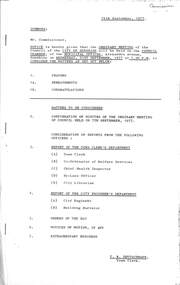 Sunshine and District Historical Society Incorporated
Administrative record - City of Sunshine - Commissioner Mr Alexander Alex George Gillon Collection 1976 - 1982 - Notice of ordinary meeting of the council of the City of Sunshine to be held on 21st September 1977, City of Sunshine, 14th September 1977
... Notice of Ordinary Meeting of the Council of the City of Sunshine to be held on 21st September 1977 Report of the Town Clerk's Department Report of the Town Clerk Estimates Schedules Proposed Agreements with Councils in Relation to New Garbage Tip Sunshine Tip City of Brunswick, City of Essendon, City of Melbourne, City of South Melbourne, City of Fitzroy, City of Richmond & City of Keilor Chaplin Reserve Proposed New Lease Additional Rent Sunshine City Soccer Club Names of Proposed Railway Station Deer Park "Crick" or "Pollard" Proposed Purchase Tip Site from Boral Resources Pty Ltd Sunshine Tip Purchase of I.C.I. ...Sassella Park Station Road Notice of Ordinary Meeting of the Council of the City of Sunshine to be held on 21st September 1977 Report of the Town Clerk's Department Report of the Town Clerk Estimates Schedules Proposed Agreements with Councils in Relation to New Garbage Tip Sunshine Tip City of Brunswick, City of Essendon, City of Melbourne, City of South Melbourne, City of Fitzroy, City of Richmond & City of Keilor Chaplin Reserve Proposed New Lease Additional Rent Sunshine City Soccer Club Names of Proposed Railway Station Deer Park "Crick" or "Pollard" Proposed Purchase Tip Site from Boral Resources Pty Ltd Sunshine Tip Purchase of I.C.I. ...Notice of Ordinary Meeting of the Council of the City of Sunshine to be held on 21st September 1977 Report of the Town Clerk's Department Report of the Town Clerk Estimates Schedules Proposed Agreements with Councils in Relation to New Garbage Tip Sunshine Tip City of Brunswick, City of Essendon, City of Melbourne, City of South Melbourne, City of Fitzroy, City of Richmond & City of Keilor Chaplin Reserve Proposed New Lease Additional Rent Sunshine City Soccer Club Names of Proposed Railway Station Deer Park "Crick" or "Pollard" Proposed Purchase Tip Site from Boral Resources Pty Ltd Sunshine Tip Purchase of I.C.I. Oval Deer Park Main Transmission Line Easement Keilor Terminal Station to Truganina Terminal Station Easement Street Construction Agreement Printing of Historical Society Book "Sunshine & District to 1901) and Secretarial Assistance Proposal for Re-Zoning of Zone 7 (Derrimut) Community School Agreements Acquisition of Lots 43 & 44 Northumberland Road Arbitration for Compensation Officers Co-Ordinating Committee Autonomy of Departments Brochure on Council Services Community Notice Boards Report of the Co-Ordinator of Welfare Services The 21st Victorian Geriatrics Conference Family and Community Services Programmes Employment and Industry Problem in the Western Region Diamond Reserve Committee of Management Diamond Reserve Kindergarten Report of the By-Laws Officer Removal of Fire Hazards Dog Act Fixing of Registration Fees Report of the City Engineer Land Use Permit Application Car Park to Serve Existing Display Home Centre lot 1171 Main Road West Land Use Permit Application Extension to Existing Shop and Storage Purposes 229 Hampshire Road Land Use Permit Application Radio Mast 552 Geelong Road Land Use Permit Application Show Room Extension to Existing Caravan and Car Sales Yard Lot 1 Geelong Road Melbourne Metropolitan Planning Scheme Amendments Land Use Permit Application Social Club Furlong Road Land Use Permit Application Extension to Existing Shop and Dwelling 82 Glengala Road Land Use Permit Application Extension to Existing Shop 67 McIntyre Road Land Use Permit Application Car Sales Yard Lots 8, 9, 10, 11, 13 & Part 12 Rosamond Road Land Use Permit Application Illuminated Sky Sign 242 Hampshire Road Land Use Permit Application Access to Main Road Geelong Road Land Use Permit Application Squash Court Centre Lots 8, 9, 10, 11, 13 & Part 12 Rosamond Road Land Use Permit Application Advertising Lots 5 & 6 Ballarat Road Land Use Permit Application Extension to Existing Shop and Addition of Caretakers Dwelling 87 Glengala Road Land Use Permit Application Bon Thomas Reserve Pre-School Centre Industrial Offensive Zoned Land Laverton North Shire of Werribee Plan of Subdivision Geelong Road & Francis Street Strata Subdivision 14 Forrest Street Outer Ring Road Study Acquisition of Road Reserve Somerville Road from Market Road to Kororoit Creek (For Future Bridge & Road Connection) Summer School of Park Management Application for Funds for 1978/79 Country Roads Board Report of Building Surveyor Flood Plain Management in Victoria Purchase of Land Adjacent Lot 63 Roussac Court Sunshine North Fencing Lot 343 Anley Place Ex G.U.D. Premises Burton Crescent Maribyrnong Ainsworth Reserve Child Care Centre / Pavilion Extraordinary Business Use of Sassella Park Removal of Fence Around Proposed Swimming Pool, Layout of Athletics Track & Hockey Pitch Orders of the Day Confirmation of Loan with the Australian Mutual Provident Society city of sunshine, alexander "alex" george gillon, sunshine tip, chaplin reserve, anderson road, sunshine, sunshine city soccer club, i.c.i. oval, ballarat road, deer park, keilor terminal station, truganina terminal station, northumberland road, sunshine north, diamond reserve committee of management, diamond reserve kindergarten, main road west, st. albans, hampshire road, geelong road, brooklyn, furlong road, glengala road, sunshine west, mcintyre road, rosamond road, maribyrnong, bon thomas reserve pre-school centre, bon thomas reserve, quinn street, francis street, forrest street, albion, somerville road, market road, roussac court, anley place, burton crescent, g.u.d., sassella park, station road -
 Sunshine and District Historical Society Incorporated
Administrative record - City of Sunshine - Commissioner Mr Alexander Alex George Gillon Collection 1976 - 1982 - Minutes of the ordinary meeting of council held on 21st September 1977, City of Sunshine, 21st September 1977
... Minutes of the Ordinary Meeting of Council held on 21st September 1977 Report of the Town Clerk's Department Report of the Town Clerk Estimates Schedules Proposed Agreements with Councils in Relation to New Garbage Tip Sunshine Tip City of Brunswick, City of Essendon, City of Melbourne, City of South Melbourne, City of Fitzroy, City of Richmond & City of Keilor Chaplin Reserve Proposed New Lease Additional Rent Sunshine City Soccer Club Names of Proposed Railway Station Deer Park "Crick" or "Pollard" Proposed Purchase Tip Site from Boral Resources Pty Ltd Sunshine Tip Purchase of I.C.I. ...Burton Crescent Ainsworth Reserve Child Care Centre Ainsworth Reserve Vernon Street Sassella Park Station Road Minutes of the Ordinary Meeting of Council held on 21st September 1977 Report of the Town Clerk's Department Report of the Town Clerk Estimates Schedules Proposed Agreements with Councils in Relation to New Garbage Tip Sunshine Tip City of Brunswick, City of Essendon, City of Melbourne, City of South Melbourne, City of Fitzroy, City of Richmond & City of Keilor Chaplin Reserve Proposed New Lease Additional Rent Sunshine City Soccer Club Names of Proposed Railway Station Deer Park "Crick" or "Pollard" Proposed Purchase Tip Site from Boral Resources Pty Ltd Sunshine Tip Purchase of I.C.I. ...Minutes of the Ordinary Meeting of Council held on 21st September 1977 Report of the Town Clerk's Department Report of the Town Clerk Estimates Schedules Proposed Agreements with Councils in Relation to New Garbage Tip Sunshine Tip City of Brunswick, City of Essendon, City of Melbourne, City of South Melbourne, City of Fitzroy, City of Richmond & City of Keilor Chaplin Reserve Proposed New Lease Additional Rent Sunshine City Soccer Club Names of Proposed Railway Station Deer Park "Crick" or "Pollard" Proposed Purchase Tip Site from Boral Resources Pty Ltd Sunshine Tip Purchase of I.C.I. Oval Deer Park Main Transmission Line Easement Keilor Terminal Station to Truganina Terminal Station Easement Street Construction Agreement Printing of Historical Society Book "Sunshine & District to 1901) and Secretarial Assistance Proposal for Re-Zoning of Zone 7 (Derrimut) Community School Agreements Acquisition of Lots 43 & 44 Northumberland Road Arbitration for Compensation Officers Co-Ordinating Committee Autonomy of Departments Brochure on Council Services Community Notice Boards Report of the Co-Ordinator of Welfare Services The 21st Victorian Geriatrics Conference Family and Community Services Programmes Employment and Industry Problem in the Western Region Diamond Reserve Committee of Management Diamond Reserve Kindergarten Report of the By-Laws Officer Removal of Fire Hazards Dog Act Fixing of Registration Fees Report of the City Engineer Land Use Permit Application Car Park to Serve Existing Display Home Centre lot 1171 Main Road West Land Use Permit Application Extension to Existing Shop and Storage Purposes 229 Hampshire Road Land Use Permit Application Radio Mast 552 Geelong Road Land Use Permit Application Show Room Extension to Existing Caravan and Car Sales Yard Lot 1 Geelong Road Melbourne Metropolitan Planning Scheme Amendments Land Use Permit Application Social Club Furlong Road Land Use Permit Application Extension to Existing Shop and Dwelling 82 Glengala Road Land Use Permit Application Extension to Existing Shop 67 McIntyre Road Land Use Permit Application Car Sales Yard Lots 8, 9, 10, 11, 13 & Part 12 Rosamond Road Land Use Permit Application Illuminated Sky Sign 242 Hampshire Road Land Use Permit Application Access to Main Road Geelong Road Land Use Permit Application Squash Court Centre Lots 8, 9, 10, 11, 13 & Part 12 Rosamond Road Land Use Permit Application Advertising Lots 5 & 6 Ballarat Road Land Use Permit Application Extension to Existing Shop and Addition of Caretakers Dwelling 87 Glengala Road Land Use Permit Application Bon Thomas Reserve Pre-School Centre Industrial Offensive Zoned Land Laverton North Shire of Werribee Plan of Subdivision Geelong Road & Francis Street Strata Subdivision 14 Forrest Street Outer Ring Road Study Acquisition of Road Reserve Somerville Road from Market Road to Kororoit Creek (For Future Bridge & Road Connection) Summer School of Park Management Application for Funds for 1978/79 Country Roads Board Report of Building Surveyor Flood Plain Management in Victoria Purchase of Land Adjacent Lot 63 Roussac Court Sunshine North Fencing Lot 343 Anley Place Ex G.U.D. Premises Burton Crescent Maribyrnong Ainsworth Reserve Child Care Centre / Pavilion Extraordinary Business Use of Sassella Park Removal of Fence Around Proposed Swimming Pool, Layout of Athletics Track & Hockey Pitch Orders of the Day Confirmation of Loan with the Australian Mutual Provident Society city of sunshine, alexander "alex" george gillon, sunshine tip, albion, chaplin reserve, anderson road, sunshine, sunshine city soccer club, boral resources, i.c.i. oval, ballarat road, deer park, keilor terminal station, truganina terminal station, northumberland road, sunshine north, diamond reserve committee of management, diamond reserve kindergarten, main road west, st. albans, hampshire road, geelong road, brooklyn, furlong road, glengala road, sunshine west, mcintyre road, rosamond road, maribyrnong, bon thomas reserve pre-school centre, bon thomas reserve, quinn street, francis street, forrest street, somerville road, market road, roussac court, g.u.d., burton crescent, ainsworth reserve child care centre, ainsworth reserve, vernon street, sassella park, station road
