
Showing 59 items matching "toxicity"
-
 National Vietnam Veterans Museum (NVVM)
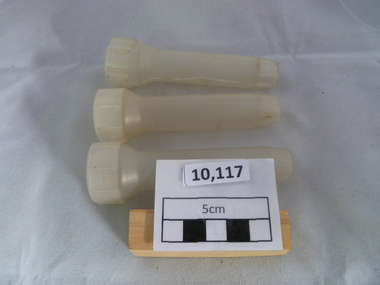
Functional Object, Blood storage containers (x3)
... Plastic with slide off top, holds 10cc of blood, disposal and non-toxic...10cc, S, disposable, non-toxic, sterile, non-pyrogenic...blood storage containers 10cc, S, disposable, non-toxic, sterile, non-pyrogenic Plastic with slide off top, holds 10cc of blood, disposal and non-toxic Blood storage containers (x3) Functional Object Functional Object ...Plastic with slide off top, holds 10cc of blood, disposal and non-toxic10cc, S, disposable, non-toxic, sterile, non-pyrogenicblood storage containers -
 Ringwood and District Historical Society
Envelope, Packet: Ringwood Area Environment Clipping and correspondence 1980s-1990s
... Conservation study - Eastlink - pollution, nature walks, toxic waste disposal....Conservation study - Eastlink - pollution, nature walks, toxic waste disposal. Packet: Ringwood Area Environment Clipping and correspondence 1980s-1990s Envelope ...Conservation study - Eastlink - pollution, nature walks, toxic waste disposal. -
 National Vietnam Veterans Museum (NVVM)
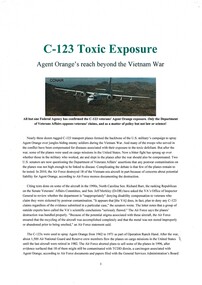
Document, A Copy of: C-123 Toxic Exposure: Agent Orange's reach beyond the Vietnam War
... A Copy of: C-123 Toxic Exposure: Agent Orange's reach beyond the Vietnam War...A Copy of: C-123 Toxic Exposure: Agent Orange's reach beyond the Vietnam War. ...See media files for more information. A Copy of: C-123 Toxic Exposure: Agent Orange's reach beyond the Vietnam War Document ...A Copy of: C-123 Toxic Exposure: Agent Orange's reach beyond the Vietnam War. See media files for more information.agent orange - toxicology, operation ranch hand, department of veterans affairs (dva), united states air force, insecticide, nui dat, dangerous chemicals, 3rd battalion, rar, 12 field regiment, 1 field hygiene company, 1st australian task force, capt john leonard mordike, 235315, royal corps of australian electrical and mechanical engineers. -
 Sunshine and District Historical Society Incorporated
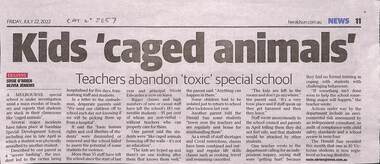
Article - Sunshine Special Development School 1A Ivory Street Sunshine West
... Sunshine Special Development School|Kids' caged animals Teachers abandon toxic special school...Sunshine Special Development School Ivory Court Sunshine West Sunshine Special Development School|Kids' caged animals Teachers abandon toxic special school Collection of documents related to the Sunshine Special Development School Article Sunshine Special Development School 1A Ivory Street Sunshine West ...Sunshine Special Development School|Kids' caged animals Teachers abandon toxic special schoolsunshine special development school, ivory court, sunshine west -
Linton and District Historical Society Inc
Scrapbook, Toxic Waste Dump Protest, 2003-2004
... Toxic Waste Dump Protest, 2003-2004 ...Large yellow "Spicers Olympic" scrapbook which contains newspaper clippings related to the Victorian Government proposal in 2003 to locate a toxic waste dump ("industrial waste containment facility") at Pittong....Toxic Waste Dump Protest, 2003-2004 Scrapbook ...In response to the proposal, the Pittong Action Group, chaired by Alice Knight, and three local municipalities (Golden Plains, Pyrenees, Corangamite) joined together to fight against it.Large yellow "Spicers Olympic" scrapbook which contains newspaper clippings related to the Victorian Government proposal in 2003 to locate a toxic waste dump ("industrial waste containment facility") at Pittong.toxic waste dump, pittong action group, community action, newspaper clippings -
University of Melbourne, Burnley Campus Archives
Album - Colour slides, Arboreal Enclosure Royal Melbourne Zoo, 1977-1981
... Includes handwritten list of dates, animals, toxic plants, other plants for particular uses, etc. ...arboreal enclosure royal melbourne zoo animals toxic plants plants Approximately 300 slides, mostly labelled. ...Approximately 300 slides, mostly labelled. Show construction of the Arboreal Enclosure at the Royal Melbourne Zoo between 1971 and 1981. Also other views of the zoo. In compartmentalised wooden box. Includes handwritten list of dates, animals, toxic plants, other plants for particular uses, etc. Not scanned.arboreal enclosure, royal melbourne zoo, animals, toxic plants, plants -
 The Beechworth Burke Museum
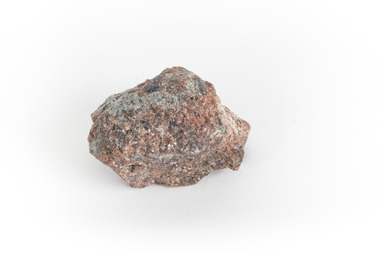
Geological specimen - Loellingite in Rhodonite
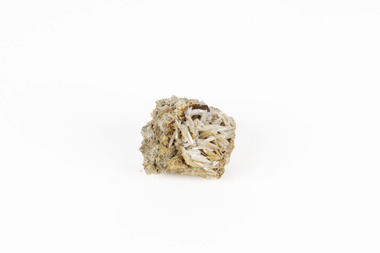
... It is mostly found in mesothermal veins (caused by immense heat) with sulfides or in limestone. It is toxic when heated or struck. ...It is mostly found in mesothermal veins (caused by immense heat) with sulfides or in limestone. It is toxic when heated or struck. Geological specimen Loellingite in Rhodonite ...Rhodonite is a reddish-pink manganese silicate material and often contains iron, magnesium and calcium. It is usually found in metamorphic rocks (rocks which have been altered by heat, pressure or chemical process). It can range in size from tiny to massive. Because of their composition they are not suitable for use in jewellery because they are hard enough. It is quite rare to find, though has been found in Australia, North America, South America and Europe.This specimen is part of a larger collection of geological and mineral specimens collected from around Australia (and some parts of the world) and donated to the Burke Museum between 1868-1880. A large percentage of these specimens were collected in Victoria as part of the Geological Survey of Victoria that begun in 1852 (in response to the Gold Rush) to study and map the geology of Victoria. Collecting geological specimens was an important part of mapping and understanding the scientific makeup of the earth. Many of these specimens were sent to research and collecting organisations across Australia, including the Burke Museum, to educate and encourage further study. This specimen is a palm shaped piece of loellingite within rhodonite. It is mostly reddish-pink coloured, with flecks of light and dark grey. Loellingite is a grey iron arsenide which often forms into crystal shapes. It is mostly found in mesothermal veins (caused by immense heat) with sulfides or in limestone. It is toxic when heated or struck. rhodonite, loellingite, burke museum, beechworth, geological survey of victoria -
 Federation University Historical Collection
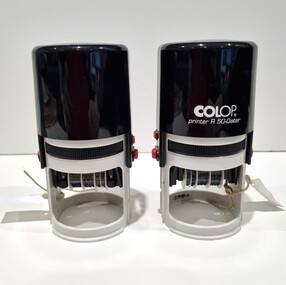
Stamp, University of Ballarat Vice Chancellors Office
... Can provide up to 10,000 impressions with out refillling ink.Not suitable for use on glossy and wax paper, and has non toxic ink. ...Can provide up to 10,000 impressions with out refillling ink.Not suitable for use on glossy and wax paper, and has non toxic ink. University of Ballarat Vice Chancellors Office Stamp ...Two University of Ballarat self inking date stamps, likely to be used by Vice Chancellor's administration staff to stamp the date on documents. Two Colop R50 Printer Round Self Inking Rubber Stamp self Inking Stamp - Ink cartridge is already integrated into the stamp. It dispenses ink to the stamp plate during each stamping procedure. Can provide up to 10,000 impressions with out refillling ink.Not suitable for use on glossy and wax paper, and has non toxic ink. University of Ballarat Vice Chancellors Officestamp, university of ballarat, stationery, office supplies, self inking stamp, administration -
 Wyndham Art Gallery (Wyndham City Council)
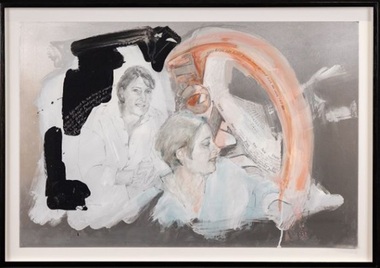
Painting, Kathy Vafiadis, Portrait of Joan Ryan, 2001
... Jo was chair person of the Toxic Dump movement. A very strong and pivotal community leader during the campaign . ...Jo was chair person of the Toxic Dump movement. A very strong and pivotal community leader during the campaign . ...Born in Melbourne in 1950, Vafiadis studied at Prahran College of Advanced Education and has been exhibiting since 1971. Solo shows include Rigoletto at Fitzroy Gallery, Melbourne in 2005 and Mary Chirnside at Wyndham Cultural Centre in 2004. She has participated in various group exhibitions. She won the Wyndham Now Acquisitive Art Prize in 2000 and her work is held in several state and local council collections.Portrait of Joanne Ryan ( MP, member for Lalor). Jo was chair person of the Toxic Dump movement. A very strong and pivotal community leader during the campaign . Hence the use of metal. australian art, painting, portrait, australian politics -
 Bendigo Historical Society Inc.
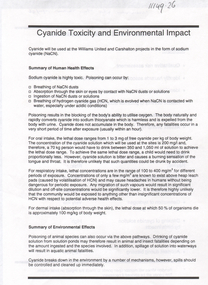
Document - Kangaroo Flat Gold Mine Collection: Cyanide Toxicity Environmental Impact, Unknown
... ...toxicity...Bendigo mining gold cyanide toxicity Woodvale Ponds One page, double sided document. ...Bendigo Mining 1993 to present In the 1980s Bendigo Mining listed on the ASX with ownership of leases along the Deborah line of reef. In 1993, the Company consolidated ownership of the entire Goldfield when it purchased WMC’s interests. A detailed account of the recent history of Bendigo Mining is outlined in the Company History. Bendigo Mining NL website: https://www.bmnl.com.au/goldfield-history/ One page, double sided document. Effects of cyanide, in the form of sodium cyanide (NaCN) used at the Williams United and Carshalton projects are examined in the paper. On back of page, a Hazard and Risk assessment details any potential impact of the cyanide on the environment ( presumably at the Woodvale Evaporation Facility, although not stated). On bottom of page: 'Bendigo Mining will monitor ponds to check the impact on local wildlife'. bendigo mining n.l., bendigo, mining, gold, cyanide, toxicity, woodvale ponds -
 Bendigo Historical Society Inc.
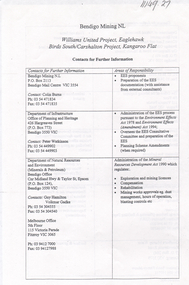
Document - Kangaroo Flat Gold Mine Collection: Williams United, Carshalton Projects, Unknown
... ...toxicity...Bendigo mining gold cyanide toxicity Woodvale Ponds 1. One page, double sided page, listing contacts for further information on Bendigo Mining N.L. ...Bendigo Mining 1993 to present In the 1980s Bendigo Mining listed on the ASX with ownership of leases along the Deborah line of reef. In 1993, the Company consolidated ownership of the entire Goldfield when it purchased WMC’s interests. A detailed account of the recent history of Bendigo Mining is outlined in the Company History. Bendigo Mining NL website: https://www.bmnl.com.au/goldfield-history/ 1. One page, double sided page, listing contacts for further information on Bendigo Mining N.L. Williams United Project, Eaglehawk and Birds South/Carshalton Project, Kangaroo Flat. 2. A4 trifold brochure ' Environmental Impact Assessment in Victoria' how to find your way around the environment effects act. Department of Planning Development, Government of Victoria.bendigo mining n.l., bendigo, mining, gold, cyanide, toxicity, woodvale ponds -
 University of Melbourne, Burnley Campus Archives
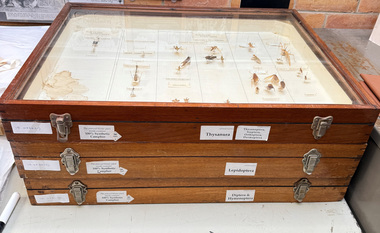
Animal specimen - Preserved Insect Collection, Educational preserved insect collection
... Printed labels on each box. Plus "toxic" warning labels. Box 1. Thysanura. Thysanoptera, Isoptera, Orthoptera, Demaptera Box 2. ...Entomology Burnley Horticultural College artifact Printed labels on each box. Plus "toxic" warning labels. Box 1. Thysanura. Thysanoptera, Isoptera, Orthoptera, Demaptera Box 2. ...Possibly part of a large collection sent to Creswick Campus or it is the full collection. Formerly kept in a laboratory classroom. Found in Curator's Cottage.6 large wooden boxes with metal clasps on 2 sides and glass top. Contain preserved insects pinned and with handwritten labels. 100% synthetic camphor within. Printed labels on each box. Plus "toxic" warning labels. Box 1. Thysanura. Thysanoptera, Isoptera, Orthoptera, Demaptera Box 2. Lepidoptera. Box 3. Diptera & Hymenoptera. Box 4. Spares. Box 5. Coleoptera. Box 6.Hemiptera.entomology, burnley horticultural college, artifact -
 Glenelg Shire Council Cultural Collection
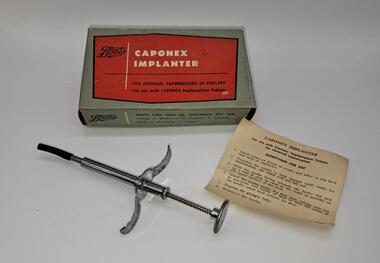
Equipment - Caponex Implanter, in original box with instruction leaflet, Unknown
... The caponisation of poultry has since been banned in Australia and UK as the chemical remained within the birds which proved to be toxic to human consumption....The caponisation of poultry has since been banned in Australia and UK as the chemical remained within the birds which proved to be toxic to human consumption. Evidence of expired practices. ...A Caponex Implanter was used to chemically castrate roosters by inserting a caponex implantation tablet into the neck of the of male chickens to make them grow faster and become more docile. The caponisation of poultry has since been banned in Australia and UK as the chemical remained within the birds which proved to be toxic to human consumption.Evidence of expired practices. 'Boots' branded box containing Caponex Implanter and instruction leaflet. Small surgical applicator. Silver in colour, resembles a syringe with a finger flange and thumb rest on the plunger. Design is for the use of insertion of a tablet rather than fluid. Long black rubber tube on the end. In 'Boots' branded box with instruction leaflet. Box is light green and red with white bold block CAPONEX IMPLANTER, all other text is black. Instruction Leaflet is small on yellowed paper with black text.On the base of the thumb rest: CAPONEX Box front: Boots Logo, CAPONEX IMPLANTER for chemical caponisation of poultry for use with CAPONEX Implantation Tablets. Box Sides: BOOTS PURE DRUG CO. (AUSTRALIA) PTY. LTD Follows with the locations in Australia of Boots. Instruction Leaflet: CAPONEX IMPLANTER for chemical caponisation of poultry for use with CAPONEX Implantation Tablets Directions for use (Directions to follow back and front)poultry, caponex, caponisation -
 Greensborough Historical Society
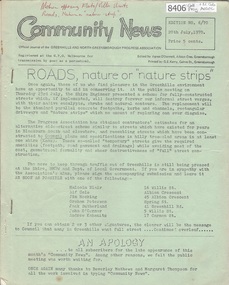
Newsletter, Greenhills and North Greensborough Progress Association, Community News: official journal of the Greenhills and North Greensborough Progress Association. 20th July 1970. Edition No. 6/70, 20/07/1970
... This edition includes a report on the Progress Association's July1970 meeting, Councillors' report, Roads, nature or "nature strips", Protecting and improving the Plenty River, Toxic insecticides - the total dangers, New park complex to be Bundoora Fields, School and Kinder news, Scout and Guide news, Letter to editor. ...This edition includes a report on the Progress Association's July1970 meeting, Councillors' report, Roads, nature or "nature strips", Protecting and improving the Plenty River, Toxic insecticides - the total dangers, New park complex to be Bundoora Fields, School and Kinder news, Scout and Guide news, Letter to editor. ...This edition includes a report on the Progress Association's July1970 meeting, Councillors' report, Roads, nature or "nature strips", Protecting and improving the Plenty River, Toxic insecticides - the total dangers, New park complex to be Bundoora Fields, School and Kinder news, Scout and Guide news, Letter to editor. A digital copy of this Newsletter is available from Greensborough Historical Society.Newsletter, 16 p., illus. greenhills and north greensborough progress association, greenhills -
 Emerald Museum & Nobelius Heritage Park
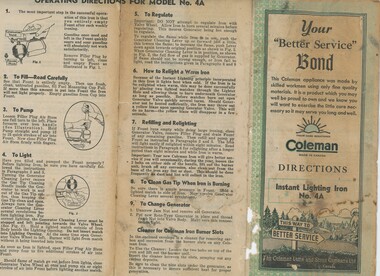
Flyer - Service Information for Petrol Iron, The Coleman Lamp and Stove Company Ltd, 1930s-1940s
... Overheating, spillage, toxic exhaust gases and (sometimes) explosions were all possibilities to be avoided through careful monitoring by the user....Overheating, spillage, toxic exhaust gases and (sometimes) explosions were all possibilities to be avoided through careful monitoring by the user. ...Coleman 4A Instant Lighting Irons were made between 1929 and 1948. This brochure with its operating directions and service instructions would assist the user to repair their Coleman iron themselves. Petrol irons were useful in areas like Emerald without reliable electricity. Overheating, spillage, toxic exhaust gases and (sometimes) explosions were all possibilities to be avoided through careful monitoring by the user.This brochure accompanied a type of iron in use in Emerald before the advent of reliable electricity. Trifold brochure with service information and operating directions for a Coleman Iron. Trifold opens out to show operating instructions and service notes in French and Spanishpetrol iron, coleman 4a, emerald -
 The Beechworth Burke Museum
Geological specimen - Arsenopyrite
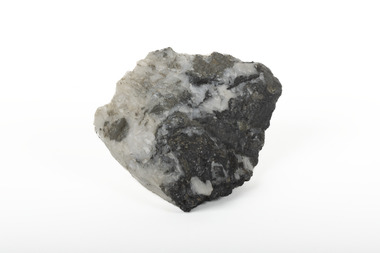
... In its purest form, it becomes toxic as a result of a 46.0% arsenic makeup. ...In its purest form, it becomes toxic as a result of a 46.0% arsenic makeup. ...Arsenopyrite is one of the most common arsenic sulfide minerals, alongside orpiment and realgar. In its purest form, it becomes toxic as a result of a 46.0% arsenic makeup. Arsenopyrite occurs naturally in sulfide-bearing mineral deposits and is commonly found alongside gold deposits. This specimen was discovered in Maldon, Victoria, in the Maldon gold field. This mine is an important gold producer which was first mined in 1857. Between this initial date and 1926, 58 tonnes of gold was produced. The town of Maldon was designated Australia's first notable town, and has maintained its 19th-century appearance since the says of the gold rush. This mineral makes up a small part of the large amounts of minerals which has been excavated from the Maldon gold mines. The Maldon Goldfield alone has produced an excess of 1.7 million ounces of Australia's highest grade gold. This mineral represents not only the richness of the area, but also the significant impacts the gold rush had on the town.A solid iron arsenic sulfide mineral with shades of white, grey and blackburke museum, mineral, arsenopyrite, victoria, maldon, maldon victoria -
 City of Ballarat
Artwork, other - Public Artwork, Home by Chris Mether, 2014
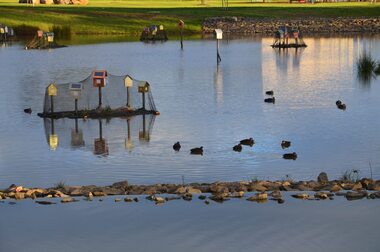
... The exposed roots draw out pollutants, such as nitrogen, phosphorous and toxic metals, which have entered the waterway through urban run-off. ...The exposed roots draw out pollutants, such as nitrogen, phosphorous and toxic metals, which have entered the waterway through urban run-off. ...Home is a collection of birdhouses on floating islands using the iconic form of the human house - a pitched roof, square walls, windows and doors. This minimal form is often drawn by children; a dolls house, a cubby house, a letter-box or a chook house. Home creates a safe refuge for birds with the plants acting as a water filtration system. The exposed roots draw out pollutants, such as nitrogen, phosphorous and toxic metals, which have entered the waterway through urban run-off. The result is a beautiful sculptural experience and a healthier water system for all to enjoy. The artwork was funded by The City of Ballarat and The Victorian State Government.The work is of aesthetic significance to the people of BallaratHome is a collection of birdhouses on floating islands home, chris mether, studio mether, public art, ballarat, delecombe, wetlands -
 Royal Australian and New Zealand College of Obstetricians & Gynaecologists (RANZCOG)
Incomplete box of 5ml Phenol ampoules, with hypodermic needle, David Bull Laboratories
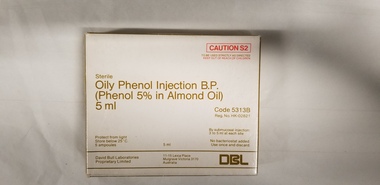
... Writing on packaging reads 'Sub-Q/REORDER NO. 5115/STERILE SINGLE USE/HYPODERMIC NEEDLE/26g 5/8 (15.9mm)/NON-TOXIC/NON-PYROGENIC'...Writing on packaging reads 'Sub-Q/REORDER NO. 5115/STERILE SINGLE USE/HYPODERMIC NEEDLE/26g 5/8 (15.9mm)/NON-TOXIC/NON-PYROGENIC' Incomplete box of 5ml Phenol ampoules, with hypodermic needle David Bull Laboratories ...Cardboard box containing 3 ampoules of phenol and a sealed, sterile hympdermic needle. Front of box is labelled 'Sterile/Oily Phenol Injection B.P./(Phenol 5% in Almond Oil)/5ml/Code 5313B/Reg. No. HK-02821'. Box is also printed with some use and storage instructions, and the name of the manufacturer. Underside of box is printed with the text 'BATCH 9015313 MFG.AUG.89/EXP.AUG.92'. Phenol ampoules are made of glass and connected together in a strip. Text printed on each ampoule reads 'CAUTION S2/PHENOL IN/ALMOND OIL/5% 5ml/DAVID BULL/EXP. DATE AUG '92'. Hypodermic needle is sealed in a sterile packet with orange backing. Writing on packaging reads 'Sub-Q/REORDER NO. 5115/STERILE SINGLE USE/HYPODERMIC NEEDLE/26g 5/8 (15.9mm)/NON-TOXIC/NON-PYROGENIC' -
 Sunshine and District Historical Society Incorporated
Photograph - Sunshine Tip Albion 1990 Photographs, Carmel Bazzano, 22nd March 1990
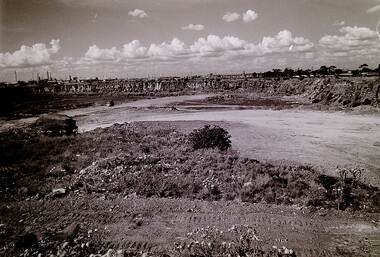
... The site now has long and documented history of toxic gas leakage and contaminated soil risks, especially where residential and community buildings were later constructed on or near uncompacted waste. ...The site now has long and documented history of toxic gas leakage and contaminated soil risks, especially where residential and community buildings were later constructed on or near uncompacted waste. ...The history of this land dates back many decades, when at first in the late 19th century, the site started as a quarry, and this continued until the late 1960's. During this time large quantities of bluestone was extracted from the site, The site was then purchased by the City of Sunshine which subsequently turned it into a tip. In the 1970’s and 1980’s, this disused quarry then became one of the main waste disposal sites for metropolitan Melbourne. The site now has long and documented history of toxic gas leakage and contaminated soil risks, especially where residential and community buildings were later constructed on or near uncompacted waste. The most authoritative, recent public reporting confirms long‑term methane and other landfill gas concerns, plus legacy contamination risks that were not consistently disclosed to buyers.These photographs show the tip in action when it was accepting waste. The photographs also provide a good indication of the depth of the quarry hole in the 1990's.Sunshine Tips 164.2sunshine tip -
 Sunshine and District Historical Society Incorporated
Archive - Sunshine Tip Hulett Street Albion Environmental Issues
... The site now has long and documented history of toxic gas leakage and contaminated soil risks, especially where residential and community buildings were later constructed on or near uncompacted waste. ...The site now has long and documented history of toxic gas leakage and contaminated soil risks, especially where residential and community buildings were later constructed on or near uncompacted waste. ...The history of this land dates back many decades, when at first in the late 19th century, the site started as a quarry, and this continued until the late 1960's. During this time large quantities of bluestone was extracted from the site, The site was then purchased by the City of Sunshine which subsequently turned it into a tip. In the 1970’s and 1980’s, this disused quarry then became one of the main waste disposal sites for metropolitan Melbourne. The site now has long and documented history of toxic gas leakage and contaminated soil risks, especially where residential and community buildings were later constructed on or near uncompacted waste. The most authoritative, recent public reporting confirms long‑term methane and other landfill gas concerns, plus legacy contamination risks that were not consistently disclosed to buyers.The City of Brimbank is now responsible for managing the legacy impacts of the closed Sunshine Tip, even though Brimbank did not operate the tip, but as it was operated by the former City of Sunshine, Brimbank inherited the consequences due to the council amalgamations of 1994. This site demonstrates how legacy contamination can create long‑term constraints and risks for later development, long after the original waste‑disposal activities have ended. Land effected by the environmental issues include but not limited to; Ballarat Road Albion Nos 570, 570A, 576, 562-568, 556-560, 528A and 528B Carrington Drive Albion Nos 19, 20 and 27 Denton Avenue St. Albans Nos 39, 41, 43, 45, 47, 49, 51, 53, 55, 57 (House Demolished), 59, 61, 63 (House Demolished), 65, 67, 69, 71, 73, 75, 77, 79, 81, 83, 85, 87, 89, 91, 93, 95, 97, 99, 101, 103, 1/105, 2/105, 107, 109, 111, 113, 115, 117, 119, 121A, 121B, 121, 123A, 123B, 123, 125, 127, 129, 131, 133, 135, 137, 137A, 139, 141 and 14 Toora Court St. Albans Nos 4, 5, 6, 7 and 8 Other land effected includes; Karen Place St. Albans City of Brimbank owned land (21.8 hectares) Hulett Street Albion (0.54 hectares) M80 Western Ring Road (7.74 hectares)Planning and Environment Act 1987 Panel Report Brimbank Planning Scheme Amendment C212brim Former Sunshine Landfills Environmental Audit Overlaysunshine tip, hulett street, albion, sunshine landfill, ballarat road, carrington drive, denton avenue, toora court, m80 western ring road, st. albans, karen place -
 Flagstaff Hill Maritime Museum and Village
Muntz Metal
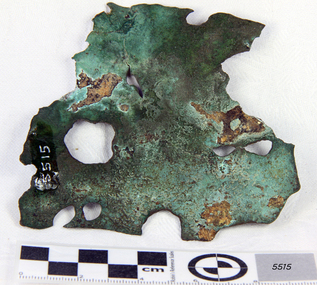
... In more recent times the ships are protected with a toxic coating. ...In more recent times the ships are protected with a toxic coating. flagstaff hill warrnambool shipwrecked-coast flagstaff-hill flagstaff-hill-maritime-museum maritime-museum shipwreck-coast flagstaff-hill-maritime-village muntz muntz metal copper sheating, copper sheathing teredo worms sea worms sea termites ship building Piece of Muntz metal, copper/zinc sheathing for protecting ship hulls. ...This sheet of copper sheathing or muntz metal has been recovered from the sea. It has been damaged by reaction of the metals to the sea, it has encrustations from the sea such as sand, and other damage has caused the edges to break away or fold over. ABOUT MUNTZ Early timber sailing ships had a problem of the timber hulls being eaten through by the marine animals called Teredo Worms, sometimes called ‘sea worms’ or ‘termites of the sea’. The worms bore holes into wood that is immersed in sea water and the bacteria inside the worms digest the wood. Shipbuilders tried to prevent this problem by applying coatings of tar, wax, lead or pitch onto the timber. In the 18th and 19th centuries the outside of their ships were sheathed in copper sheathing or a combination of 60 percent copper and 40 percent zinc (called Muntz metal). The ships would be re-metalled periodically to ensure the sheathing would remain effective. In more recent times the ships are protected with a toxic coating. Piece of Muntz metal, copper/zinc sheathing for protecting ship hulls.flagstaff hill, warrnambool, shipwrecked-coast, flagstaff-hill, flagstaff-hill-maritime-museum, maritime-museum, shipwreck-coast, flagstaff-hill-maritime-village, muntz, muntz metal, copper sheating,, copper sheathing, teredo worms, sea worms, sea termites, ship building -
 Flagstaff Hill Maritime Museum and Village
Functional object - Copper Sheathing, late 19th - early 20th centuries
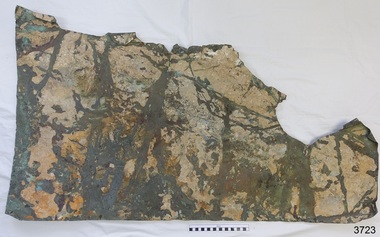
... In more recent times the ships are protected with a toxic coating....In more recent times the ships are protected with a toxic coating. This piece of Muntz sheathing is representative of building methods and materials used in late 19th and early 20th centuries for ship building. flagstaff hill warrnambool shipwrecked coast flagstaff hill maritime museum maritime museum shipwreck coast flagstaff hill maritime village great ocean road copper sheathing muntz copper sheating muntz metal teredo worms sea worms sea termites ship building late 19th century sailing ships Muntz or copper sheathing. ...This sheet of copper sheathing or Muntz metal has been recovered from the sea. It has been damaged by the reaction of the metals to the sea. It also has encrustations from the sea such as sand. Other damage, such as movement of the sea or objects in the sea, has caused the edges to break away or fold over. The hulls of early timber sailing ships had a problem of being eaten through by the marine animals called Teredo Worms, sometimes called ‘sea worms’ or ‘termites of the sea’. The worms bore holes into wood that is immersed in seawater and the bacteria inside the worms digest the wood. Shipbuilders tried to prevent this problem by applying coatings of tar, wax, lead or pitch onto the timber. In the 18th and 19th centuries, ships were built with their hulls sheathed in sheets of copper or a combination of 60 per cent copper and 40 per cent zinc (called Muntz metal). The ships would be re-metalled periodically to ensure the sheathing remained effective. In more recent times the ships are protected with a toxic coating.This piece of Muntz sheathing is representative of building methods and materials used in late 19th and early 20th centuries for ship building.Muntz or copper sheathing. Irrectangular shape, with about a fifth of the piece missing from a corner. Another corner is bent upwards. Salvaged from a shipwreck. flagstaff hill, warrnambool, shipwrecked coast, flagstaff hill maritime museum, maritime museum, shipwreck coast, flagstaff hill maritime village, great ocean road, copper sheathing, muntz, copper sheating, muntz metal, teredo worms, sea worms, sea termites, ship building, late 19th century sailing ships -
 Federation University Historical Collection
Programme - Programme - Seminar, VIOSH: Hawthorn Institute of Education; Occupational Health and Safety Seminar, 1983
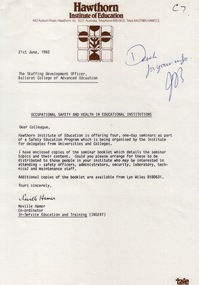
... Topics include Ergonomics in the Workplace, Accident Investigation Techniques, Emergency Preparedness, Flammability and Toxicity of Chemicals. VIOSH Australia students are safety managers, senior advisors and experienced OHS professionals. ...Topics include Ergonomics in the Workplace, Accident Investigation Techniques, Emergency Preparedness, Flammability and Toxicity of Chemicals. VIOSH Australia students are safety managers, senior advisors and experienced OHS professionals. ...Victorian Institute of Occupational Safety and Health (VIOSH) Australia is the Asia-Pacific centre for teaching and research in occupational health and safety (OHS) and is known as one of Australia's leaders on the field. VIOSH has a global reputation for its innovative approach within the field of OHS management. VIOSH had its first intake of students in 1979. At that time the Institution was known as the Ballarat College of Advanced Education. In 1990 it became known as Ballarat University College, then in 1994 as University of Ballarat. It was 2014 that it became Federation University. Hawthorn Institute of Education information on four, one-day seminars as part of a Safety Education Program. This was sent to Ballarat College of Advanced Education along with other Institutions. The Seminar centres around Occupational Safety and Health in Educational Institutions. Speakers include James Coe, Eric Wigglesworth, Derek Viner, A Giles, J Welch, G Carter and Tony Morgan. Topics include Ergonomics in the Workplace, Accident Investigation Techniques, Emergency Preparedness, Flammability and Toxicity of Chemicals. VIOSH Australia students are safety managers, senior advisors and experienced OHS professionals. They come from all over Australia and industry. Students are taught active research and enquiry; rather than textbook learning and a one-size fits all approach. VIOSH accepts people into the Graduate Diploma of Occupational Hazard Management who have no undergraduate degree - on the basis of extensive work experience and knowledge. Eleven A4 sheets of coloured paper - each colour indicates different seminar day.Hawthorn Institute of Education letterhead sign ature of Neville Hamer - co-ordinator, In-Service Education and Training Comment in blue pen. viosh, victorian institute of occupational safety and health, safety education program, one-day seminars, occupational safety and health, james coe, eric wigglesworth, derek viner, a giles, j welch, g carter, tony morgan, ergonomics in the workplace, accident investigation techniques, emergency preparedness, flammability and toxicity of chemicals -
 The Beechworth Burke Museum
Geological specimen - Cerussite, Unknown c.1890s
... The presence of lead in cerussite makes it potentially toxic. Historically, it has been an important source of lead, which has numerous industrial applications, including in batteries, construction materials, and radiation shielding. ...The presence of lead in cerussite makes it potentially toxic. Historically, it has been an important source of lead, which has numerous industrial applications, including in batteries, construction materials, and radiation shielding. ...Named in 1845 by Wilhelm Karl von Haidinger cerussite takes its name from the Latin cerussa, meaning 'white lead'. When viewed under certain lighting conditions cerussite gives of fire and rainbow-like colours (due to its high dispersion) and it is quite sought after by geological collectors for this very reason. Cerussite is usually found in the oxidised zone of lead ore deposits. It is a very common weathering product of galena and other lead ore minerals. It is a secondary mineral, meaning it forms as a result of the alteration of pre-existing minerals in the Earth’s crust. The presence of lead in cerussite makes it potentially toxic. Historically, it has been an important source of lead, which has numerous industrial applications, including in batteries, construction materials, and radiation shielding. Cerussite has a crystal structure that belongs to the orthorhombic crystal system. Its crystal structure is characterized by a three-dimensional arrangement of atoms in a repeating pattern. The crystal lattice of cerussite consists of interconnected lead (Pb) and carbonate (CO3) ions. This crystal structure is visible in the specimen. This specimen was found in Dundas (formerly Mount Dundas), a historical mining locality, mineral field and railway located on the western foothills of the West Coast Range in Western Tasmania. During the 1890s Dundas swelled in numbers however it is now lost in a temperate rainforest and its population is now 2. The present Dundas Extended mine, about 1.5 km east of Dundas is presently worked for specimen material.Faceted cerussite gems are considered rare and valuable, given the softness of the mineral. This item is not a faceted gem however its historical and scientific research potential give it significance; mined in an Australian township, this cerussite could shed light on the now lost history of Dundas and the mining that occurred there. Additionally, the uses of this mineral in historical industrial processes give it scientific significance. Such knowledge can add to understandings of the geographical and geological nature of Western Tasmania and allow for further study of Australian geological specimens. A small lead carbonite mineral with shades of cream, white and brown throughout, flaky shards of white at base. CERUSSITE / (lead carbonite) / Locality: Dundas, W. Tasmaniadundas, tasmania, cerussite, lead, orthorhombic, geology, minerals, mining -
 Flagstaff Hill Maritime Museum and Village
Functional object - Bottle Seal, circa 1843-1878
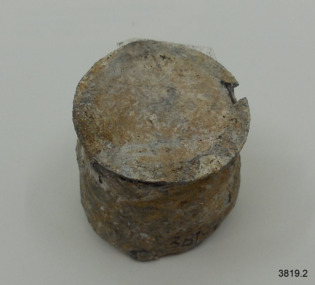
... Eventually it was found that the lead was toxic. The lead was replaced by tin, aluminium, and later plastic. ...Eventually it was found that the lead was toxic. The lead was replaced by tin, aluminium, and later plastic. ...This lead sealing capsule was recovered from the tragic wreck of the sailing ship ‘Loch Ard’. It may have once been on a bottle amongst the ship's cargo, its provisions or the passengers’ personal luggage. It is now part of the John Chance collection. Bottles in the early 19th century were handmade. They were not necessarily uniform in size or shape, so sealing was not always successful. If the bottles were stored they often became contaminated by rats and mice breaking the cork or wax seals, or by insects attracted to the contents if the seal on the bottle leaked. Lead sealing capsules were used from 1843 to overcome this problem. The lead was heated until it was malleable, then moulded by hand to fit over the sealed bottle’s mouth and neck. This was more successful if wire was also used under the capsule for added security (similar to modern champagne bottles). The capsule couldn’t be re-fitted so it was discarded after the bottle was opened. Capsule designs from about 1862 used tin-plated lead foil and often had the inscriptions and trademarks of the content makers on them. Eventually it was found that the lead was toxic. The lead was replaced by tin, aluminium, and later plastic. Today’s home brewers can buy readymade plastic capsules that fit over the bottle then twist to lock it firmly into place and can be re-used. Digs at archaeological sites often reveal lead sealing capsules. These are collected and catalogued. The information gathered from inscriptions, makers’ marks, logos and descriptions of the bottle contents has provided valuable insights into the history and the dating of other items on the sites. This lead sealing capsule was made to seal a handmade glass bottle and is historically significant for representing its invention to solve a preservation and integrity issue with bottle seals in the mid-to-late 19th century. Its design has evolved and is still in use today. This sealing capsule is representative of their historical use of capsules as a tool for dating and interpreting archaeological sites around the world. The sealing capsule is also significant as it was recovered by John Chance, a diver from the wreck of the Loch Ard in the 1960s-70s. Items that come from several wrecks along Victoria's coast have since been donated to the Flagstaff Hill Maritime Village’s museum collection by his family, illustrating this item’s level of historical value. The sealing capsule is also significant for being connected to the wreck of the Loch Ard (1873-1878), which is historically significant to both Victoria and Australia. The loss of the ship has been described as one of the ‘worst shipwreck tragedies’ and is well known in Victoria for the tragic death of 52 out of the 54 lives on board. The Loch Ard wreck's historical significance as a large international passenger and cargo clipper ship has been recognised and it is now registered on the Victorian Heritage Database, VHR S417. The wreck site is labelled as ‘one of Victoria’s most spectacular diving sites’ and the area is a popular tourist site. It is part of Victoria’s Underwater Shipwreck Discovery Trail.Bottle sealing capsule, cylindrical with thin, round top separated from thicker body (taped in place and fragile). Made from grey-white lead, uneven in thickness and shape. Remnants of a thick substance are inside the capsule.flagstaff hill, warrnambool, flagstaff hill maritime museum, maritime museum, shipwreck coast, flagstaff hill maritime village, great ocean road, john chance, loch ard, bottle seal, bottle capsule, handmade bottle, antique bottle, sealing capsule, lead capsule, bottle closure, bottle foil, bottle preservation, bottle finish -
 Sunshine and District Historical Society Incorporated
Archive - Kealba Quarry McIntyre Road Sunshine North
... 5860.01 - Kealba Quarry - EPA Fires Up Legal Action.jpg 5860.02 - Kealba Quarry - EPA Resident's Newsletter Page 1.jpg 5860.02 - Kealba Quarry - EPA Resident's Newsletter Page 2.jpg 5860.03 - Kealba Quarry - Barro Licence Cancelled.jpg 5860.04 - Kealba Quarry - Charges Dropped.jpg 5860.05 - Kealba Quarry - No Meetings Until There's New Info.jpg 5860.06 - Kealba Quarry - Landfill Not Suitable EPA.jpg 5860.07 - Kealba Quarry - Barro Group Concrete And Rock Recycling Facility Resident Survey Page 1.jpg 5860.07 - Kealba Quarry - Barro Group Concrete And Rock Recycling Facility Resident Survey Page 2.jpg 5680.08 - Kealba Quarry - EPA Failing Brimbank As Fires Still Burn.jpg 5860.09 - Kealba Quarry - EPA Failing Brimbank.jpg 5860.10 - Kealba Quarry - Barro Suspended.jpg 5860.11 - Kealba Quarry - Kealba landfill Disaster A Toxic Prison Locals Can't Escape And No End In Sight.jpg 5860.12 - Kealba Quarry - We Did It Letter Box Drop Card August 2026 Front.jpg 5860.12 - Kealba Quarry - We Did It Letter Box Drop Card August 2026 Back.jpg 5860.13 - Kealba Quarry - Landfill Closed Star Weekly 4th August 2026 Page 1.jpg 5860.14 - Kealba Quarry - Relief At Barro Decision Star Weekly 4th August 2026 Page 4.jpg...Kealba Quarry Kealba Landfill Barro Group McIntyre Road Sunshine North Kealba 5860.01 - Kealba Quarry - EPA Fires Up Legal Action.jpg 5860.02 - Kealba Quarry - EPA Resident's Newsletter Page 1.jpg 5860.02 - Kealba Quarry - EPA Resident's Newsletter Page 2.jpg 5860.03 - Kealba Quarry - Barro Licence Cancelled.jpg 5860.04 - Kealba Quarry - Charges Dropped.jpg 5860.05 - Kealba Quarry - No Meetings Until There's New Info.jpg 5860.06 - Kealba Quarry - Landfill Not Suitable EPA.jpg 5860.07 - Kealba Quarry - Barro Group Concrete And Rock Recycling Facility Resident Survey Page 1.jpg 5860.07 - Kealba Quarry - Barro Group Concrete And Rock Recycling Facility Resident Survey Page 2.jpg 5680.08 - Kealba Quarry - EPA Failing Brimbank As Fires Still Burn.jpg 5860.09 - Kealba Quarry - EPA Failing Brimbank.jpg 5860.10 - Kealba Quarry - Barro Suspended.jpg 5860.11 - Kealba Quarry - Kealba landfill Disaster A Toxic Prison Locals Can't Escape And No End In Sight.jpg 5860.12 - Kealba Quarry - We Did It Letter Box Drop Card August 2026 Front.jpg 5860.12 - Kealba Quarry - We Did It Letter Box Drop Card August 2026 Back.jpg 5860.13 - Kealba Quarry - Landfill Closed Star Weekly 4th August 2026 Page 1.jpg 5860.14 - Kealba Quarry - Relief At Barro Decision Star Weekly 4th August 2026 Page 4.jpg Collection of documents on the Kealba Quarry / Kealba Landfill Archive Kealba Quarry McIntyre Road Sunshine North ...The Kealba Quarry began as a basalt quarry on the edge of St Albans / Kealba / Sunshine North and was later converted into the Kealba (Sunshine) Landfill, operated by the Barro Group. Its modern history is dominated by long-running community conflict, legal battles, and the 2019 present underground landfill fires (“hotspots”) that have caused severe odour and environmental concerns. As of the 19 February 2026, EPA Victoria confirmed that 3 of the 4 hotspots have been extinguished, but one hotspot remains active.5860.01 - Kealba Quarry - EPA Fires Up Legal Action.jpg 5860.02 - Kealba Quarry - EPA Resident's Newsletter Page 1.jpg 5860.02 - Kealba Quarry - EPA Resident's Newsletter Page 2.jpg 5860.03 - Kealba Quarry - Barro Licence Cancelled.jpg 5860.04 - Kealba Quarry - Charges Dropped.jpg 5860.05 - Kealba Quarry - No Meetings Until There's New Info.jpg 5860.06 - Kealba Quarry - Landfill Not Suitable EPA.jpg 5860.07 - Kealba Quarry - Barro Group Concrete And Rock Recycling Facility Resident Survey Page 1.jpg 5860.07 - Kealba Quarry - Barro Group Concrete And Rock Recycling Facility Resident Survey Page 2.jpg 5680.08 - Kealba Quarry - EPA Failing Brimbank As Fires Still Burn.jpg 5860.09 - Kealba Quarry - EPA Failing Brimbank.jpg 5860.10 - Kealba Quarry - Barro Suspended.jpg 5860.11 - Kealba Quarry - Kealba landfill Disaster A Toxic Prison Locals Can't Escape And No End In Sight.jpg 5860.12 - Kealba Quarry - We Did It Letter Box Drop Card August 2026 Front.jpg 5860.12 - Kealba Quarry - We Did It Letter Box Drop Card August 2026 Back.jpg 5860.13 - Kealba Quarry - Landfill Closed Star Weekly 4th August 2026 Page 1.jpg 5860.14 - Kealba Quarry - Relief At Barro Decision Star Weekly 4th August 2026 Page 4.jpgkealba quarry, kealba landfill, barro group, mcintyre road, sunshine north, kealba -
 University of Melbourne, Burnley Campus Archives
Photograph - Black and white and colour slides, colour negative, Kodachrome, Miscellaneous Horticulture, 1947-1985
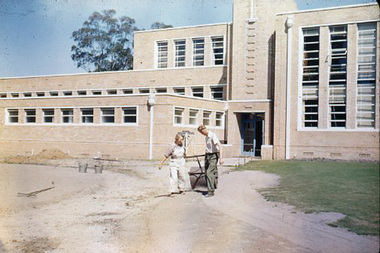
... Animals without backbones." (46) "Jassid-Vegetable 9/51." (47) "Field Day 57 (Fruit Fly-Enlarged)." (48) "Field Day 57 (Fruit Fly-Stages)." (49) Insect Life Cycle. (50) "Comatibility (sic) Chart." for Insecticides & Fungicides. (51) "Insecticides-Toxicity." (52) "Life Cycle of the Leather Jacket." (53) "Grasshopper-Head Dissected Mouth Parts." (54) "Types of Antennae." (55) "Spider Mites USA Yearbook 1952." (56) "Cultivator." (57) "Organic Phosphates." (58) Negative Isopogon anemonifolius....Animals without backbones." (46) "Jassid-Vegetable 9/51." (47) "Field Day 57 (Fruit Fly-Enlarged)." (48) "Field Day 57 (Fruit Fly-Stages)." (49) Insect Life Cycle. (50) "Comatibility (sic) Chart." for Insecticides & Fungicides. (51) "Insecticides-Toxicity." (52) "Life Cycle of the Leather Jacket." (53) "Grasshopper-Head Dissected Mouth Parts." (54) "Types of Antennae." (55) "Spider Mites USA Yearbook 1952." (56) "Cultivator." (57) "Organic Phosphates." (58) Negative Isopogon anemonifolius. ...57 slides and 1 negative. (3) Men standing around a large horticultural machine. (4) "Lawns Housing Com" Aug "66?" (5) "Flemington Racecourse." (6) "Mustard-Cover Crop. 1960." (7) Tree climbing. (8) "Grafting-scions. BHC." (11) "Mildura-Soil Probe Oct 67." (12) Virus tested stock trees & layout Flemings Apr 70." (13) "Best's Winery Mar 75." (15, 16) Best's single student and group. (17) "Ploughing-Diagram to show incomplete cover of trash? Farm Practices." (18) "Spraying Hand Equipment for Insect Control in and around Buildings USA Yearbook 1952." (19) "Pasture Harrows." (20) "Mould Board Plough-Tractor." (21) "Disc Harrows-Offset-Tractor." (22) Tyne Cultivator-for Tractor." (23) See B91.258." (24) Burnley College libary. (25) "Irrigation-Delver Tatura 12/59." (26) "Tatura 12/59 Delver Ferguson T." (27-29) "W. Prom." (30) Camp 1957 Wilson's Promontary." (34-36) Photographs of plants in book. (35) Alnus? (37) "Meterosideros excelsa." (38) "Rhipsalidopsis rosea." (39) "Protea neriifolia." (40) Banksias-Species." Insects: (41) "Lacewing larva." (42) "Mites Aug 75." (43) "Yellow Mite, Red Spider (Arachnida)." (44) "Jassid-Life Cycle 9/51." (45) "Grape Fruit Crop (Florida) Destroyed by Fruit Fly. Animals without backbones." (46) "Jassid-Vegetable 9/51." (47) "Field Day 57 (Fruit Fly-Enlarged)." (48) "Field Day 57 (Fruit Fly-Stages)." (49) Insect Life Cycle. (50) "Comatibility (sic) Chart." for Insecticides & Fungicides. (51) "Insecticides-Toxicity." (52) "Life Cycle of the Leather Jacket." (53) "Grasshopper-Head Dissected Mouth Parts." (54) "Types of Antennae." (55) "Spider Mites USA Yearbook 1952." (56) "Cultivator." (57) "Organic Phosphates." (58) Negative Isopogon anemonifolius.administration building, lawns, flemington racecourse, mustard-cover crop, tree climbing, grafting, mildura, soil probe, pests, machinery, excursions, tatura, library, wilsons promontory, plants, alnus, zygocactus, schlumbergia, feijoa, acca sellowiana, protea neriifolia, banksia, isopogon anemonifolius -
 Flagstaff Hill Maritime Museum and Village
Container - Bottle, Pre 1974
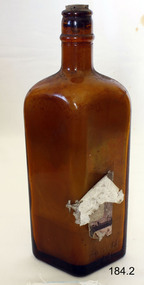
... Obviously, the one thing that sets the poison bottle apart from all other bottles is the need for prominent and immediate identification as a receptacle for toxic material, and this was achieved in a number of ways, including shape, color, embossing and labeling. ...Obviously, the one thing that sets the poison bottle apart from all other bottles is the need for prominent and immediate identification as a receptacle for toxic material, and this was achieved in a number of ways, including shape, color, embossing and labeling. ...Phenyle has been used for decades as a cleaner and disinfectant. It is well know for its use for cleaning outdoor toilets and easily identified by its strong odour. The brown glass bottle is immediately recognised as containing a poison. We've all seen them in a hundred different mystery movie scenes. The medicine cabinet opens and there, sitting on a shelf, is the incriminating object -- the ominous dark bottle with the skull and crossbones on the label. In off-screen reality, however, poison bottles have quite a different identity -- they are distinctive, varied, colorful -- and definitely collectible. Obviously, the one thing that sets the poison bottle apart from all other bottles is the need for prominent and immediate identification as a receptacle for toxic material, and this was achieved in a number of ways, including shape, color, embossing and labeling. Poisons were commonly found in the home for the purpose of controlling rodents and other pests, and were sold by grocers and druggists. For consumer protection, as far back as 1829, New York State made mandatory the marking of the bottles with the word "poison" in large letters. Then, in the middle of the 19th century, the American Pharmaceutical Association recommended legislation regarding identification of all poison bottles. In 1872 the American Medical Association also made recommendations -- namely that poison bottles be made of colored glass, and also have a rough surface on one side -- making them identifiable even in the dark -- and the word "poison" visible on the other (the skull and crossbones wasn't quite as ubiquitous as those movies led us to believe). However, passing these laws was not easy, and the manufacturers were essentially left to do as they wished. For collectors, the high point of poison bottle manufacturing was the period ranging roughly from the 1870s to the 1930s. At that time some, of the bottles were distinguished by particularly bright colors, such as cobalt blue (the most common) and emerald green. Others, particularly rare and collectible, had unusual -- and appropriate -- shapes, including skulls, leg bones and coffins. In order to better identify these lethal vessels by feel (not forgetting that there were many people in this period who could not read) when groping for them in the dark, they had such elaborate tactile patterns as quilted diamonds, lattices, hobnails and prominent vertical or horizontal ribbing, as well as spiky knobs and ridges. In addition, many had sharp points on top for the same precautionary purpose. Further efforts to distinguish poison bottles from others included uncommon multisided and triangular shapes, and unusual, hard-to-open tops, the predecessors of the modern child-proof openings. https://www.southcoasttoday.com/story/lifestyle/2001/08/19/poison-bottles-steeped-in-history/50352280007/The recognition and awareness of bottles containing poisonpous substances is extremely important for safety reasons.Bottle, brown glass, diamond shaped. "Bright Star" phenyle. Paper label attached, but peeling off and badly damaged. Corked with contents. Text moulded into glass, some with a border of stars. Poisonous contents, not to be taken. Registered Number 2140. Volume is 20 fluid ounces. Printed label "Bright Star". Text is moulded in the glass in raised lettering: "PHENYLE" outlined and decorated with star border. "POISONOUS", "NOT TO BE TAKEN" "V / DM / A" within oval, "REGD NO. 2140" (D and O are smaller and underlined) . Base is marked "F190".flagstaff hill, warrnambool, shipwrecked-coast, flagstaff-hill, flagstaff-hill-maritime-museum, maritime-museum, shipwreck-coast, flagstaff-hill-maritime-village, bright star, phenyl, cleaning and disinfecting chemical, poison, bottles -
 Flagstaff Hill Maritime Museum and Village
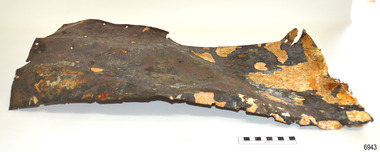
Functional object - Copper Sheathing, Ca. 1855
... In more recent times the ships are protected with a toxic coating. About the SCHOMBERG- James Blaine’s Black Ball Line had commissioned the luxury sailing ship, Schomberg, to be built for its fleet of passenger liners The three-masted wooden ship was launched in 1855, designed by the Aberdeen builders to sail faster than the quick clippers designed by North American Donald McKay. ...In more recent times the ships are protected with a toxic coating. About the SCHOMBERG- James Blaine’s Black Ball Line had commissioned the luxury sailing ship, Schomberg, to be built for its fleet of passenger liners The three-masted wooden ship was launched in 1855, designed by the Aberdeen builders to sail faster than the quick clippers designed by North American Donald McKay. ...This sheet of copper sheathing or Muntz metal has been recovered from the site of the wrecked ship Schomberg. It has been damaged by the reaction of the metals to the sea, it has encrustations from the sea such as sand, and another damage has caused the edges to break away or fold over. Early sailing ships had a problem of the timber hulls being eaten through by the marine animals called Teredo Worms, sometimes called ‘sea worms’ or ‘termites of the sea’. The worms bore holes into wood that is immersed in seawater and the bacteria inside the worms digest the wood. Early shipbuilders applied coatings of tar, was, lead or pitch onto the timber to prevent this. In the 18th and 19th centuries, the outsides of ships’ hulls were encased in either copper sheathing or Muntz metal, which is a combination of 60 per cent copper and 40 per cent zinc. The ships would be re-metalled periodically to ensure the sheathing would remain effective. In more recent times the ships are protected with a toxic coating. About the SCHOMBERG- James Blaine’s Black Ball Line had commissioned the luxury sailing ship, Schomberg, to be built for its fleet of passenger liners The three-masted wooden ship was launched in 1855, designed by the Aberdeen builders to sail faster than the quick clippers designed by North American Donald McKay. The material used for the diagonal planking was British oak with layers of Scottish larch. The Schomberg’s master Captain ‘Bully’ Forbes commanded the ship on its maiden journey between Liverpool and Melbourne, departing on 6 October 1855 with 430 passengers and 3000 tons of cargo including iron rails and equipment intended the build the Geelong Railway and a bridge over the Yarra from Melbourne to Hawthorn. After sailing for 78 days she ran aground on a sand spit at Curdies Inlet near Peterborough, Victoria, on 27 December 1835. At dawn on the next day, the ship’s Chief Officer signalled a passing steamer, SS Queen, for help and all of Schomberg’s passengers were able to disembark safely. The passengers’ baggage and some of the cargo were later collected from the Schomberg. Local merchants Manifold & Bostock bought the wreck and the remaining cargo but did not attempt to salvage the cargo that was still on board. They eventually sold it and after two of the men drowned in the salvage efforts the job was abandoned. In 1975, divers from Flagstaff Hill, including former Director, Peter Ronald, explored the Schomberg wreck site and recovered many artefacts that are now on display at the Museum.The copper sheathing is significant for its connection with the Schomberg, which is on the Victorian Heritage Register (VHR S612), has great historical significance as a rare example of a large and fast clipper ship that sailed on the England-to-Australia run, carrying emigrants at the time of the Victorian gold rush. She represents the technical advances made to break sailing records between Europe and Australia. Flagstaff Hill’s collection of artefacts from the Schomberg is significant for its association with the shipwreck. The collection is primarily significant because of the relationship between the objects, as together they can interpret the story of the ship, Schomberg. It is archaeologically significant as the remains of an international passenger Ship. It is historically significant for representing aspects of Victoria’s shipping history and for its association with the shipwreck and the ship, which was designed to be the fastest and most luxurious of its day.Copper sheathing; rectangular sheet of copper, shaped for use on a ship's hull, buckled, with fibres protruding from one edge. The object was recovered from the wreck of the SCHOMBERG.flagstaff hill, warrnambool, maritime village, maritime museum, shipwreck coast, great ocean road, schomberg, clipper ship, black ball line, 1855 shipwreck, aberdeen clipper ship, captain forbes, peterborough shipwreck, ss queen, ship construction, copper sheating, sheathing, sea worm, muntz, muntz metal, copper sheathing, teredo worms, sea worms, sea termites, shipbuilding -
 National Wool Museum
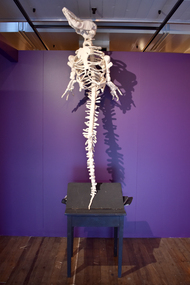
Sculpture - The Wreck of Hope, Michele Beevors, 2014
... Despite this dolphins are still at risk of swallowing plastic waste, mercury toxicity, toxoplasmosis, boat impacts and being bycatch in commercial fishing operations. ...Despite this dolphins are still at risk of swallowing plastic waste, mercury toxicity, toxoplasmosis, boat impacts and being bycatch in commercial fishing operations. ...The Wreck of Hope (Long-nosed Common Dolphin skeleton, Delphinus delphis) featured as part of the exhibition Anatomy Lessons, shown at the National Wool Museum in 2024. The exhibition featured meticulously-sculpted, life size skeletons, making visitors question their place in this web of the living and the dead. From a towering giraffe stretching 4.4 metres in height, to an army of over 50 delicately rendered frogs, this exhibition was enthralling in scale. Each sculpture is an accurate portrayal of a real animal and is carefully measured, drawn, and moulded from steel, wire, and foam. The frame is then intricately knitted over to create these thought-provoking pieces. Each sculpture tells a story, one of the collection of animals by museums and collectors, of Western safari hunters, of human encroachment, and of the often-sad role of the animals in our lives. These underlying concepts are explored and reflected by the materials used. Wool, that speaks of warmth, of comfort, of care, meets the size, grace, and sheer breathtaking beauty of the pieces, clashing with the hard and complex stories beneath. This knitted dolphin skeleton was the start of Beevor's interest in comparative anatomy. Beevors recalls viewing a dolphin, one of many skeletons alongside a mouse and a lion in the Australian Museum's collection during a school visit in the 1970s. At the time, school children watched TV reruns of 'Flipper', which portrayed dolphins as intelligent and noble animals. Elsewhere, the conservation movement was growing, and appeals to protect marine mammals were gaining momentum through the 'Save the Whales' campaign. The fascination with live dolphin shows had grown throughout the 1960s and 1970s and the ethics began to be questioned. Some believe they played an important role in raising public awareness of cetaceans and their welfare. Others argued the performances glorified the dominance of heroic trainers over the subordinate dolphin, and offered little education about the dolphins' natural characteristics nor prioritised their welfare. Many of these facilities are now closed and all dolphin species are protected by international accords aimed at conserving wild populations. Despite this dolphins are still at risk of swallowing plastic waste, mercury toxicity, toxoplasmosis, boat impacts and being bycatch in commercial fishing operations. Originally from Australia, Michele Beevors has been practicing in New Zealand for the last 20 years. She is Head of Sculpture at Dunedin School of Art, Otago Polytechnic, New Zealand’s oldest, and one of its most prestigious, art schools. Beevors has exhibited in galleries, museums, and exhibition spaces in across New Zealand, Australia and Vienna with art that is defiant, unconventional, and moving.Life sized knitted skeleton of a dolphin, with white wool and internal steel, foam and wire frame. The dolphin is mounted on a wooden base, made from a desk, with books placed under the desk lid. The books and desk are painted black.knitting, art, dolphin, conservation, sculpture, skeletons, anatomy lessons, michele beevors
