
Showing 30 items matching "training objectives"
-
 University of Melbourne, Burnley Campus Archives
Course Notes, VCAH, Competency, Unknown
... ...training objectives...Large register with columns: Tasks, Trade NGFLT, Training Objective, Associated Knowledge ...trade ngflt training objectives Large register with columns: Tasks, Trade NGFLT, Training Objective, Associated Knowledge Competency Course Notes VCAH ...trade ngflt, training objectives -
 Bendigo Military Museum
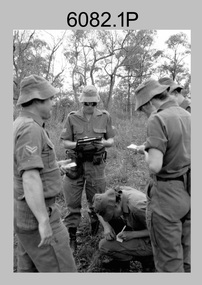
Photograph - Army Survey Regiment - Regimental Training Navigation Exercise, 1985
... This was one of the six regimental training objectives outlined in the administrative instruction – Exercise “City Soldier” accompanying these photos. ...This was one of the six regimental training objectives outlined in the administrative instruction – Exercise “City Soldier” accompanying these photos. ...This is a set of 16 photographs of Army Survey Regiment personnel undertaking a non-tactical navigation exercise, part of the field phase of regimental training in the Wellsford Forest, Bendigo 1985. This was one of the six regimental training objectives outlined in the administrative instruction – Exercise “City Soldier” accompanying these photos. The other objectives were SLR rifle and M30 grenade handling revision, and first aid at Fortuna; RATEL at Wellsford Forest and rifle shooting at Wellsford Rifle Range. Personnel from Air Survey, Cartographic, Lithographic and Headquarters Squadrons were reallocated to four training platoons for one week from 7th to 11th October 1985.This is a set of 16 photographs of Army Survey Regiment personnel undertaking a navigation exercise in the Wellford Forest, Bendigo 1985. Black & white photos .1P to .10P are printed on photographic paper and scanned at 300 dpi. Photos .11P to .16P are on 35mm negative film and scanned at 96 dpi. They are part of the Army Survey Regiment’s Collection. .1) - Photo, black & white, 1985, L to R: CPL Mick Minchin, SGT Alan Staley, CPL Megan (McBurney) Reynolds SPR Wendy (Leitinger) McCarthy. .2) - Photo, black & white, 1985, L to R: unidentified, SPR Wendy (Leitinger) McCarthy, CPL Megan (McBurney) Reynolds, unidentified, SGT Alan Staley, SPR Dave Lawler. .3) - Photo, black & white, 1985, L to R: CPL Greg Honan, CPL Grant McGuinness, SPR Leah (Hoffman) Peppler, CPL Ken Peters, SSGT Ian ‘Rock’ Thistleton, SSGT Kevin ‘Spook’ Kennedy. .4) - Photo, black & white, 1985, unidentified personnel. .5) - Photo, black & white, 1985, L to R: CPL Peter ‘Spoon’ Lefel, unidentified, CPL Mick ‘Buddha’ Ellis. .6) - Photo, black & white, 1985, L to R: SSGT Harald Mai, unidentified. .7) - Photo, black & white, 1985, unidentified personnel. .8) - Photo, black & white, 1985, unidentified personnel. .9) - Photo, black & white, 1985, WO1 Dick Manley. .10) - Photo, black & white, 1985, L to R: LT Brenton MacDonald, LT Kathie Ryan, WO1 Brian Mead. .11) - Photo, black & white, 1985, L to R: LT Carol Dunstan, unidentified, CPL John Reid. .12) - Photo, black & white, 1985, L to R: WO1 Dick Manley, unidentified, LT Carol Dunstan. .13) - Photo, black & white, 1985, L to R: unidentified (x2), WO1 Dick Manley. .14) - Photo, black & white, 1985, LT Brenton McDonald. .15) - Photo, black & white, 1985, L to R: CPL Megan (McBurney) Reynolds, SPR Wendy (Leitinger) McCarthy, CPL Mick Minchin. .16) - Photo, black & white, 1985, L to R: SPR Wendy (Leitinger) McCarthy, CPL Mick Minchin..1P to .16P – No personnel are identified.royal australian survey corps, rasvy, army survey regiment, army svy regt, fortuna, asr -
 Bendigo Military Museum
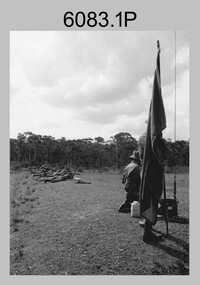
Photograph - Army Survey Regiment - Regimental Training at Wellsford Rifle Range, Bendigo, 1985
... This was the last of six regimental training objectives outlined in the administrative instruction – Exercise “City Soldier” accompanying these photos. ...This was the last of six regimental training objectives outlined in the administrative instruction – Exercise “City Soldier” accompanying these photos. ...This is a set of seven photographs of Army Survey Regiment personnel undertaking live fire SLR rifle qualification training at Wellsford Rifle Range, Bendigo 1985. This was the last of six regimental training objectives outlined in the administrative instruction – Exercise “City Soldier” accompanying these photos. The other objectives were SLR rifle and M30 grenade handling revision, and first aid at Fortuna; and navigation and RATEL at Wellsford Forest. Personnel from Air Survey, Cartographic, Lithographic and Headquarters Squadrons were reallocated to four training platoons for one week from 7th to 11th October 1985. Rifle shooting at Wellsford Rifle Range occurred for two days at the end of the week.This is a set of seven photographs of the Army Survey Regiment undertaking live fire rifle qualification training at Wellsford Rifle Range, Bendigo, 1985. Black & white photos .1P to .5P are printed on photographic paper and scanned at 300 dpi. Photos .6P to .7P are on 35mm negative film and scanned at 96 dpi. They are part of the Army Survey Regiment’s Collection. .1) - Photo, black & white, 1985, unidentified personnel. .2) - Photo, black & white, 1985, unidentified personnel. .3) - Photo, black & white, 1985, unidentified personnel. .4) - Photo, black & white, 1985, MAJ Terry Edward. .5) - Photo, black & white, 1985, unidentified US Army Exchange officer. .6) & .7) - Photo, black & white, 1985, unidentified rifle range safety officer..1P to .7P – No personnel are identifiedroyal australian survey corps, rasvy, army survey regiment, army svy regt, fortuna, asr -
 Bendigo Military Museum
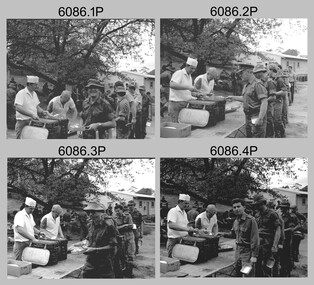
Photograph - Army Survey Regiment - Regimental Training BBQ, 1985
... There were six regimental training objectives outlined in the administrative instruction – Exercise “City Soldier” accompanying these photos. ...There were six regimental training objectives outlined in the administrative instruction – Exercise “City Soldier” accompanying these photos. ...This is a set of 14 photographs of Army Survey Regiment personnel attending a BBQ lunch during regimental training, at the basketball/tennis court area of Fortuna Villa, Bendigo, 1985. There were six regimental training objectives outlined in the administrative instruction – Exercise “City Soldier” accompanying these photos. They were SLR rifle and M30 grenade revision, and first aid at Fortuna; RATEL and navigation at Wellsford Forest; and rifle shooting at Wellsford Rifle Range. Personnel from Air Survey, Cartographic, Lithographic and Headquarters Squadrons were reallocated to four training platoons for one week from 7th to 11th October 1985. Personnel were warned in for lunch on 10th and 11th of October 1985. This is a set of 14 photographs of Army Survey Regiment personnel attending a regimental training BBQ lunch at Fortuna Villa, Bendigo, 1985. .1P to .10P are printed on photographic paper and scanned at 300 dpi. Photos .11P to .14P are on 35mm negative film and scanned at 96 dpi. They are part of the Army Survey Regiment’s Collection. The photographs were printed on photographic paper and are part of the Army Survey Regiment’s Collection. .1) - Photo, black & white, 1985, L to R: unidentified personnel, PTE Evans, LCPL Brown - cooks, CAPT Laurie Newton, WO2 Brian Partridge, CAPT Danny Galbraith. MAJ Daryl Hockings CSM, unidentified personnel. .2) - Photo, black & white, 1985, L to R: unidentified personnel, PTE Evans, LCPL Brown - cooks, MAJ Mick Byrne, CAPT Bob Williams, unidentified, LT Doug Maxwell, WO2 Brian Partridge, CAPT Danny Galbraith. .3) - Photo, black & white, 1985, L to R: unidentified personnel, PTE Evans, LCPL Brown - cooks, CAPT Bob Williams, unidentified, LT Doug Maxwell, unidentified personnel. .4) - Photo, black & white, 1985, L to R: unidentified personnel, PTE Evans, LCPL Brown - cooks, LT Doug Maxwell, unidentified, CAPT John South, unidentified personnel. .5) - Photo, black & white, 1985, L to R: unidentified personnel, MAJ Terry Edwards - background, SGT Morris – cook. .6) - Photo, black & white, 1985, L to R: unidentified, CPL Gary Tremain, unidentified, MAJ Terry Edwards, 2LT Kathie Ryan – background. .7) - Photo, black & white, 1985, L to R: SGT Charlie Creedy, SGT Wally Chilcott, LT Carol Dunstan, 2LT Kathie Ryan, LT Ossie Slade. .8) - Photo, black & white, 1985, L to R: CPL Terry ‘TJ’ Wicker, unidentified personnel, SPR Roy Hicks, SPR Dave Wright, unidentified personnel. .9) - Photo, black & white, 1985, L to R: unidentified personnel, SGT Jeff Willey, SGT Wally Chilcott, CPL Gary Tremain. .10) - Photo, black & white, 1985, L to R: foreground - CPL Megan (McBurney) Reynolds, LCPL Bob Sheppard, CPL Bob Thrower, background - CPL Peter Breukel, WO1 Doug Arman, CPL Brian Johnson. .11) - Photo, black & white, 1985, L to R: RSM WO1 Bob Mason, PTE Evans, LCPL Brown - cooks, CAPT Danny Galbraith. .12) - Photo, black & white, 1985, L to R foreground: unidentified (x2), CPL Roy Hicks, CPL Megan (McBurney) Reynolds, unidentified (x2), CPL Peter Breukel, unidentified (x2), LT Ozzy Slade. .13) - Photo, black & white, 1985, L to R: LCPL Brown – cook, WO2 Brian Partridge, unidentified, WO2 John Hook, WO1 Bill Griggs, unidentified, CAPT Danny Galbraith, unidentified. .14) - Photo, black & white, 1985, L to R foreground: MAJ Kim Weston, CAPT Bob Williams, CAPT Danny Galbraith, unidentified, unidentified US Army Exchange officer..1P to .14P No personnel are identifiedroyal australian survey corps, rasvy, army survey regiment, army svy regt, fortuna, asr -
Melbourne Tram Museum
Document, Metropolitan Transit Authority (MTA), "Programme for the five day trainer drivers course", c1985
... Document titled "Programme for the five day trainer drivers course" carried out the Hawthorn Training Centre, sets outs objectives, daily programme, record, faulty trams, and relationship with trainees....Document titled "Programme for the five day trainer drivers course" carried out the Hawthorn Training Centre, sets outs objectives, daily programme, record, faulty trams, and relationship with trainees. ...Document titled "Programme for the five day trainer drivers course" carried out the Hawthorn Training Centre, sets outs objectives, daily programme, record, faulty trams, and relationship with trainees.Yields information about the training programme to train trainer drivers c1985.Document - 5 A4 pages photocopied stapled in top left hand corner.tramways, the met, training, operations, drivers, depot trainers, mta -
 Vision Australia
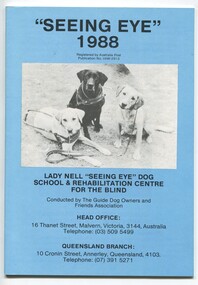
Administrative record - Text, "Seeing Eye" 1988 Lady Nell "Seeing Eye" Dog School & Rehabilitation Centre for the Blind, 1988
... President's overview of how the school started and it's relationship with Guide Dogs over the years, with references to AFB and Malvern residents, resulting in the publication of untruths about the school and how this has negatively impacted upon it's primary objective of training and supporting Seeing Eye dogs. ...President's overview of how the school started and it's relationship with Guide Dogs over the years, with references to AFB and Malvern residents, resulting in the publication of untruths about the school and how this has negatively impacted upon it's primary objective of training and supporting Seeing Eye dogs. ...President's overview of how the school started and it's relationship with Guide Dogs over the years, with references to AFB and Malvern residents, resulting in the publication of untruths about the school and how this has negatively impacted upon it's primary objective of training and supporting Seeing Eye dogs. The proposed freeway through the five acre property purchased for expansion and other challenges faced throughout the year are also mentioned.1 volume with text and illustrationsannual reports, lady nell seeing eye dog school, phyllis gration -
Federation University Historical Collection
Booklet, Country Fire Authority, Country Fire Authority Instructional Techniques, 1981
... School of Mines Ballarat is a predecessor of Federation University School of Mines Ballarat Country fire authority Instructional Techniques effective speaking systems approach to training role and needs of instructor communication and the learning process performance objectives lecture information lesson skill lesson training aids visual and training aids chalkboard equipment questions in teaching principles of learning revision techniques lesson analysis 1 Green covered booklet with Country Fire Authority emblem and black writing. ...School of Mines Ballarat is a predecessor of Federation UniversityGreen covered booklet with Country Fire Authority emblem and black writing.school of mines ballarat, country fire authority, instructional techniques, effective speaking, systems approach to training, role and needs of instructor, communication and the learning process, performance objectives, lecture, information lesson, skill lesson, training aids, visual and training aids, chalkboard equipment, questions in teaching, principles of learning, revision techniques, lesson analysis, 1 -
 Federation University Historical Collection
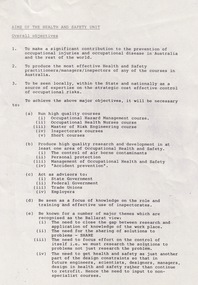
Document - Document - Information, VIOSH: Health and Safety Unit; Overall Objectives
... objectives are listed. The way each of these can be achieved it would be necessary to a. run high quality courses b. produce high quality research and development in at least one area of Occupational Health and Safety c. act as advisors to State and Federal Governments, Trade Unions and Employers d. be seen as a focus of knowledge on the role and training...objectives are listed. The way each of these can be achieved it would be necessary to a. run high quality courses b. produce high quality research and development in at least one area of Occupational Health and Safety c. act as advisors to State and Federal Governments, Trade Unions and Employers d. be seen as a focus of knowledge on the role and training and effective use of inspectorates e. be known for a number of major themes which are recognised as the Ballarat View Each of these points is expanded on. viosh victorian institute of occupational safety and health health and safety unit ballarat college of advanced education major objectives quality course research advisors governments Two A4 pages type written. ...Victorian Institute of Occupational Safety and Health (VIOSH) Australia is the Asia-Pacific centre for teaching and research in occupational health and safety (OHS) and is known as one of Australia's leaders on the field. VIOSH has a global reputation for its innovative approach within the field of OHS management. VIOSH had its first intake of students in 1979. At that time the Institution was known as the Ballarat College of Advanced Education. In 1990 it became known as Ballarat University College, then in 1994 as University of Ballarat. It was 2014 that it became Federation University. VIOSH Australia students are safety managers, senior advisors and experienced OHS professionals. They come from all over Australia and industry. Students are taught active research and enquiry; rather than textbook learning and a one-size fits all approach. VIOSH accepts people into the Graduate Diploma of Occupational Hazard Management who have no undergraduate degree - on the basis of extensive work experience and knowledge. Description of the Aims of the Health and Safety Unit (Ballarat College of Advanced Education). Three overall objectives are listed. The way each of these can be achieved it would be necessary to a. run high quality courses b. produce high quality research and development in at least one area of Occupational Health and Safety c. act as advisors to State and Federal Governments, Trade Unions and Employers d. be seen as a focus of knowledge on the role and training and effective use of inspectorates e. be known for a number of major themes which are recognised as the Ballarat View Each of these points is expanded on. Two A4 pages type written. Done in point formviosh, victorian institute of occupational safety and health, health and safety unit, ballarat college of advanced education, major objectives, quality course, research, advisors, governments -
 Federation University Historical Collection
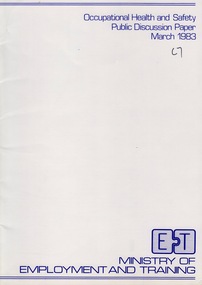
Document - Document - Course Outline, VIOSH: Ministry of Employment and Training; Occupational Health and Safety Public Discussion Paper, March 1983
... objective is to improve standards of health and safety in Victoria. The Government intends involving workers and employers directly in developing new standards and practices. Submissions to be forwarded to the Ministry of Employment and Training...objective is to improve standards of health and safety in Victoria. The Government intends involving workers and employers directly in developing new standards and practices. Submissions to be forwarded to the Ministry of Employment and Training ...Victorian Institute of Occupational Safety and Health (VIOSH) Australia is the Asia-Pacific centre for teaching and research in occupational health and safety (OHS) and is known as one of Australia's leaders on the field. VIOSH has a global reputation for its innovative approach within the field of OHS management. VIOSH had its first intake of students in 1979. At that time the Institution was known as the Ballarat College of Advanced Education. In 1990 it became known as Ballarat University College, then in 1994 as University of Ballarat. It was 2014 that it became Federation University. VIOSH Australia students are safety managers, senior advisors and experienced OHS professionals. They come from all over Australia and industry. Students are taught active research and enquiry; rather than textbook learning and a one-size fits all approach. VIOSH accepts people into the Graduate Diploma of Occupational Hazard Management who have no undergraduate degree - on the basis of extensive work experience and knowledge. The booklet sets out in detail the proposals for the implementation of Government policy on occupational health and safety. The objective is to improve standards of health and safety in Victoria. The Government intends involving workers and employers directly in developing new standards and practices. Submissions to be forwarded to the Ministry of Employment and Training by 20 May 1983. Responses from Tom Norwood of Ballarat College of Advanced Education and Mark Hennessy from Lincoln Institute of Health Sciences indicate what is already being done in courses available at Ballarat, Lincoln and Deakin. Mark Hennessy comments that "a united approach might ensure rational decisions by government, beneficial to our mutually complimentary courses." . Booklet - outlining proposals. Nine A4 pages - typedEmblem of Ministry on cover. Signature of Jim Simmonds, Minister; Mark Hennessy, Lincoln Institute of Health Sciences; Tom Norwood, Ballarat College of Advanced Education. Letterhead Ballarat BCAE and Lincoln Instituteviosh, victorian institute of occupational safety and health, ministry of employment and training, public discussion paper, tom norwood, mark hennessy, jim simmonds, workers, employers, ballarat college of advanced education, lincoln institute of health sciences, deakin university -
 Lara RSL Sub Branch
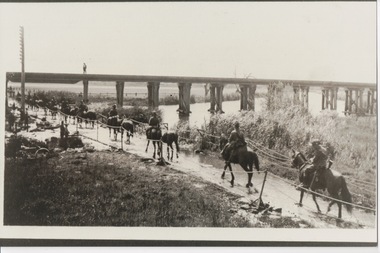
Photograph, Set 4 photographs. and others for Torquay Light Horse camp, 1940
... objective then dismounted to fight. The fall of Beersheba swung the battle tide against the Turks in Palestine; and changed the history of the Middle East. While 19 men from the Surf Coast Shire served with the 4th Light Horse over the course of WW1, only four were involved in the charge of Beersheba- John GAYLARD, Philip QUINN.(Winchelsea); Wallace FINDLAY (Anglesea); Harry TRIGG (Bambra). After the war, Light Horse units played a key role in the Australian Government’s compulsory military training...objective then dismounted to fight. The fall of Beersheba swung the battle tide against the Turks in Palestine; and changed the history of the Middle East. While 19 men from the Surf Coast Shire served with the 4th Light Horse over the course of WW1, only four were involved in the charge of Beersheba- John GAYLARD, Philip QUINN.(Winchelsea); Wallace FINDLAY (Anglesea); Harry TRIGG (Bambra). After the war, Light Horse units played a key role in the Australian Government’s compulsory military training ...These images capture for all time Light Horsemen travelling through Geelong on their way to camp at Torquay for the last Group meeting in Australia . information following - details obtained from .........https://torquayhistory.com/light-horse-brigade/ On Australia Day, 1997, Sir John Young unveiled this plaque on Point Danger, Torquay. Torquay history, Light Horse Training Camp, WW2 Plaque at Pt. Danger Note----- (See images to view plaque) The plaque identifies a significant event in Torquay’s history and the sentiments of ‘change’ for the Light Horse Brigade – from horses to machines. In 1940 the four Light Horse Regiments (4th, 8th, 13th and 20th), some 5000 Light Horse and 2000 horses camped and trained at Torquay. Three other regiments, formerly mounted on horses, were also at Torquay ‘mounted’ on privately owned trucks and cars. Division troops included Artillery, Engineers, Signals, Field Ambulance and other branches of the Army necessary to enable a Division to function. It wasn’t just the sheer numbers of men coming to this little town that made the event significant, it was also the fact that the men of the Light Horse were dramatic, almost glamorous figures and it is easy to see their exploits as some splendid adventure. Horses have played a special role in the story of Australia. They were the only means of transport across this huge country, so it was necessary for everyone to have the ability to ride a horse. When war broke out in 1899 between Britain and the Boers of South Africa (“Boer” was Dutch for “farmer”) Australia sent troops to fight. At first Britain was wary of using untried, unprofessional colonial cavalrymen but soon saw that the slouch-hatted Australian “bushmen” were a match for the fast-moving and unconventional mounted commandos of the Boers. The Australians proved themselves to be expert rough-riding horsemen and good shots. Bush life had hardened them to go for long periods with little food and water. They also showed remarkable ability to find their way in a strange country and use its features for cover, in both attack and defence. By 1914, when Australia joined the war against Germany, there were 23 Light Horse regiments of militia volunteers. Many men from these units joined the Light Horse regiments of the Australian Imperial Force (AIF). Men were given remounts (if not using their own horses) – army horses bought by Commonwealth purchasing officers from graziers and breeders. These were called “walers” because they were a New South Wales stockhorse type – strong, great-hearted animals with the strains of the thoroughbred and semi-draught to give them speed, strength and stamina. On 1st November, 1914, Australia’s First Infantry Division and the first four Light Horse regiments sailed for England in a fleet of transport ships. The first of the Light Horse arrived at Gallipoli in May without their horses. Back with their horses after Gallipoli, they were formidable combatants across the Sinai and Palestine. Some British commanders observed that the light horseman moved with a “lazy, slouching gait, like that of a sleepy tiger” but described how the promise of battle “changes that careless gait, into a live athletic swing that takes him over the ground much quicker than other troops”. They had Light Horse, Torquay, training campdeveloped a reputation as formidable infantrymen. The Turks called them “the White Ghurkas” – a reference to their deadly skill with the bayonet. The Arabs called them “The Kings of the Feathers”. The plume had originally been a battle honour of the Queensland Mounted Infantry for their work in the shearer’s strike of 1891. During WW1 it was adopted by almost all the Light Horse Regiments. It was the proud badge of the light horseman. The most famous of their battles was the attack on Beersheba- the charge of the 4th Light Horse Brigade. Mounted infantrymen and their superb walers had carried out one of the most successful cavalry charges in history – against what seemed impossible odds. They surprised the Turks by charging cavalry-style, when they would normally have ridden close to an objective then dismounted to fight. The fall of Beersheba swung the battle tide against the Turks in Palestine; and changed the history of the Middle East. While 19 men from the Surf Coast Shire served with the 4th Light Horse over the course of WW1, only four were involved in the charge of Beersheba- John GAYLARD, Philip QUINN.(Winchelsea); Wallace FINDLAY (Anglesea); Harry TRIGG (Bambra). After the war, Light Horse units played a key role in the Australian Government’s compulsory military training programme. The Citizen Military Forces (C.M.F.) thrived on the glamour of the wartime Light Horse tradition, ignoring the possibility that motor vehicles would soon replace the horses. When training was no longer compulsory, the C.M.F. regiments declined and horses became more of a luxury during the 1930s depression years of poverty and unemployment. Some regiments were motorised. Then, in 1939, Australia joined Britain in another world war. Training was increased for the militia at both home bases and regional training camps. The camp at Torquay in 1940, commanded by Major General Rankin, was at Divisional strength. By the end of the camp some felt that the Division was ready for active service. Gradually, over the next four years, the Australian Light Horse units were mounted on wheels and tracks and the horses were retired. Six men enlisted at the Torquay camp and another 57 men and women enlisted at Torquay for service in WW2. Those who served in the Militia provided valuable Officers and NCOs and men for the armed services during the war. Each infantry division of the 2nd AIF had a Light Horse regiment attached to it. But the day of the Australian mounted soldier hadn’t quite passed. During World War II, Australia’s 6th Cavalry Regiment formed a mounted unit they called “The Kelly Gang” which did valuable scouting work. In New Guinea, a mounted Light Horse Troop did patrol duty and helped carry supplies. Some fully equipped walers were flown into Borneo for reconnaissance in rugged mountain country. But by the end of the war, in 1945, the horse had disappeared from the Australian Army. References: Australian Light Horse Association www.lighthorse.org.au National Australia Archives Australian War Memorial Surf Coast Shire WW1 memorials www.togethertheyserved.com The Light horse- a Cavalry under Canvas Light Horse, Training Camp, Torquay, WW2 Late in 1939 it was decided to set up a Lighthorse training camp in Torquay to train both men and horses for the battles of the Second World War. Horses, men and equipment came on special trains from all over Victoria and NSW, and as you would expect horseman came from areas such as Omeo and Sale, the Wimmera and the Western District. They arrived at the Geelong racecourse for watering in the Barwon River and then were ridden across the ford at the breakwater and began their 11 mile trek to Torquay. Light Horse, Training Camp, Torquay, WW2 Tent city By the end of January 1940 the camp at Torquay accommodated some 5000 men and 2500 horses of the Second Cavalry Division. The rows of horses, tents and huts near Blackgate Road were quite a sight. While the cavalrymen engaged in exercises on the land and on the beaches, many of the troops took over the Torquay School for special training of men and officers. Mr Bob Pettit local farmer and Councillor for the Barrabool Shire, wrote about the Light horse in the Surf Coast Community News in 1985 saying “They used to travel about the district riding four abreast in one long convoy. To my annoyance they went through my property and shut all the gates behind them. I had certain gates open to let stock in to the water holes and it would take me three -quarters of an hour to follow the horsemen up and put all the gates right again” he continued “the men from the Light Horse were here when the fire went through in March 1940. He recalled an incident when early one morning, as some one blew the bugle, a soldier putting a white sheet on the line frightened the horses. They panicked and ran off in all directions. Six went over the cliff near Bird Rock, five were never found, and the rest were gathered up after nearly a fortnight in the bush around Addiscott and Anglesea" Light Horse, Training Camp, Torquay, WW2, Geelong Parade Geelong parade The training camp culminated in a parade through the streets of Geelong on March 12th 1940. The salute was given at the Town Hall and the troops continued on a route to the You Yang’s for a training exercise. Note-----(see media section for photograph) The Camp was abandoned in mid 1940 as it was deemed unsuitable for training during winter and the cost of a permanent camp could not be justified if it could not be used all year. Historic.......Rare,,,Interpretive.Sepia photographs.set of four ....post card size ....Horses &LighthorsemenNo 1, Lighthorsemen Regiment Geelong 1940......No 2 Light Horse at Breakwater Geelong 1938 to 1940....No 3 Light Horse at Breakwater Geelong 1938 to 1940.....No 4 Light Horse crossing Breakwater camped at Geelong Showgrounds. These markings are on reverse of photographs.light horsemengeelong 1940., world war 2 -
Federation University Historical Collection
Booklet - Handbook, Waller & Chester Printers, Your Four Years With Us: Ballarat School of Mines and Industries
... 4 x orange covered booklets with information on tertiary education, your objective in life, the importance of basic training, the importance of learning, passing examinations, how to study efficiently and your health. ...your four years with us the school of mines and industries ballarat school of mines booklet 4 x orange covered booklets with information on tertiary education, your objective in life, the importance of basic training, the importance of learning, passing examinations, how to study efficiently and your health. ...4 x orange covered booklets with information on tertiary education, your objective in life, the importance of basic training, the importance of learning, passing examinations, how to study efficiently and your health. your four years with us, the school of mines and industries, ballarat school of mines, booklet -
Federation University Historical Collection
Document - Report, Ballarat School of Mines and Industries Ballarat Limited 1995 College Plan, 01/1995
... Contents include a profile and focus of the School, Training Context, Regional Influences, training priorities, budget summary, organizational structure, corporate goals and objectives, Statement of purpose and key initiatives, Activity Profiles, Performance monitoring, Capital Works Plan. ...Contents include a profile and focus of the School, Training Context, Regional Influences, training priorities, budget summary, organizational structure, corporate goals and objectives, Statement of purpose and key initiatives, Activity Profiles, Performance monitoring, Capital Works Plan. ...Blue covered report stapled at top left corner. Contents include a profile and focus of the School, Training Context, Regional Influences, training priorities, budget summary, organizational structure, corporate goals and objectives, Statement of purpose and key initiatives, Activity Profiles, Performance monitoring, Capital Works Plan. ballarat school of mines, objectives, social and community studies, building studies, rural studies, business studies, vocational arts, hospitality studies, applied science, further education, tafe, technical and further education, ararat campus, ararat prison, langi kal kal prison, ron wild, keith boast, planning services, ross furness, human resources, john kemp, david nicholson, ann mccaggrey, brian webber, martin hill, max palmer, brian mclennan, mary molloy, david flintoff, andrew sullivan, ross holton, hoticulture, bill king, plumbing, les comley, alistair heighway, verity higgins, michael bracher, bob o'shea, derek wren, frank sordello, john ferrier, viginia fenelon, lorraine yeomans, terry o'neil, irene warfe, david manterfield, rocky hazlett, mark bevelander, kevin martin, ian harris, performance monitoring, campus plan -
 Orbost & District Historical Society
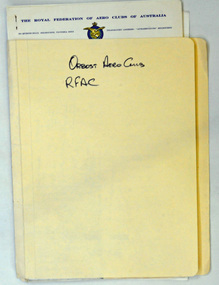
documents in folder, late 1960 - 1990's
... The prime objectives of the Federation are to foster aviation in Australia, to ensure adequate flying training is available to all pilots and to encourage national and local competitions, air races and other aviation events....The prime objectives of the Federation are to foster aviation in Australia, to ensure adequate flying training is available to all pilots and to encourage national and local competitions, air races and other aviation events. ...The Royal Federation of Aero Clubs of Australia is the national body of Aero Clubs and other aviation associations. The prime objectives of the Federation are to foster aviation in Australia, to ensure adequate flying training is available to all pilots and to encourage national and local competitions, air races and other aviation events.(ref R.F.A.C. web site) Orbost Aero Club began in 1969 with Basil Dowie as Chair, David Nixon as Secretary/Treasurer. The group went into recess from 1977-1991 closing in 1997. The mid 1960s were boom years in flying training in Australia and the number of Aero Clubs grew rapidly. The Club played a significant role in the establishment of the small airport at Marlo and in the ongoing operation and development of the airport over the years particularly for patient transfer by aerial ambulance. The Orbost Aero Club Club played a significant role in the establishment of the small airport at Marlo and in the ongoing operation and development of the airport over the years.A cream coloured folder ( NORMAN BROS) containing documents pertaining to membership of the Royal Federation of Aero Clubs of Australia. It contains membership cards, receipts, correspondence, minutes, application forms for gold, silver and bronze seals.On front - Orbost Aero Club R F A Corbost-aero-club royal-federation-aero-clubs -
 Mission to Seafarers Victoria
Book, Mission to Seafarers, Round the Island- Around the World - Mission RASI 2015, 2015
... objective is to row non-stop for 24 hours in a bid to raise S$750,000. Several corporate organisations such as Norton Rose Fulbright LLP have come on board to fund this event, with the Republic of Singapore Yacht Club providing the team with storage and training facilities. ...objective is to row non-stop for 24 hours in a bid to raise S$750,000. Several corporate organisations such as Norton Rose Fulbright LLP have come on board to fund this event, with the Republic of Singapore Yacht Club providing the team with storage and training facilities. ..."In connection with the SG50 celebrations in Singapore, Mission RASI (Row Around Singapore Island) will see a team of Singaporeans join hands with friends from overseas in a test of endurance and teamwork, to raise funds to further the Mission's work in promoting good shipping practices and a safe working environment for seafarers"--Page 4.Red cardboard hard cover book with red paper outer sleeve. 55 pages : color illustrations, color map ; 31 cmnon-fiction"In connection with the SG50 celebrations in Singapore, Mission RASI (Row Around Singapore Island) will see a team of Singaporeans join hands with friends from overseas in a test of endurance and teamwork, to raise funds to further the Mission's work in promoting good shipping practices and a safe working environment for seafarers"--Page 4.mission to seafarers, worldwide, charity, volunteers, singapore, nigel porteous, andrea fleming, london, rasi, row around singapore island, 2015, fundraising, reverend andrew wright, mts london, mts singapore, rowing -
 Bendigo Military Museum
Photograph - Army Survey Regiment - Regimental Training Military Skills Revision, 1985
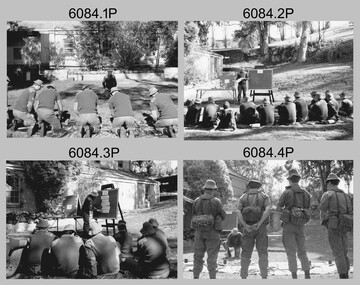
... These lessons were part of the six objectives of regimental training outlined in the administrative instruction – Exercise “City Soldier” accompanying these photos. ...These lessons were part of the six objectives of regimental training outlined in the administrative instruction – Exercise “City Soldier” accompanying these photos. ...This is a set of 35 photographs of the Army Survey Regiment personnel undertaking military skills revision, at the Army Survey Regiment, Fortuna, Bendigo, 1985. They participated in lessons on the handling of the M30 Grenade and SLR Rifle. These lessons were part of the six objectives of regimental training outlined in the administrative instruction – Exercise “City Soldier” accompanying these photos. The other objectives were first aid at Fortuna, RATEL and navigation at Wellsford Forest; and rifle shooting at Wellsford Rifle Range. Personnel from Air Survey, Cartographic, Lithographic and Headquarters Squadrons were reallocated to four training platoons for one week from 7th to 11th October 1985.This is a set of 35 photographs of the Army Survey Regiment undertaking military skills revision, part of Regimental Training at Fortuna Villa 1985. Black & white photos .1P to .17P are printed on photographic paper and scanned at 300 dpi. Photos .18P to .35P are on 35mm negative film and scanned at 96 dpi. They are part of the Army Survey Regiment’s Collection. .1) - Photo, black & white, 1985, L to R: CPL Brian Fauth, unidentified (x2), SGT Dennis Learmonth - instructor, unidentified (x2). .2) - Photo, black & white, 1985, unidentified personnel, SGT Dennis Learmonth – instructor. .3) - Photo, black & white, 1985, unidentified personnel, SGT Dennis Learmonth – instructor. .4) - Photo, black & white, 1985, unidentified personnel, SGT Dennis Learmonth - instructor. .5) - Photo, black & white, 1985, unidentified personnel. .6) - Photo, black & white, 1985, unidentified personnel. .7) - Photo, black & white, 1985, L to R: SGT Dennis Learmonth – instructor, CPL Brian Fauth, SPR Viv (Hawkins) Doherty, CPL Ken Peters, CPL Megan (McBurney) Reynolds, CPL Mick ‘Buddha’ Ellis, unidentified, SPR Wally Twidale, unidentified personnel. .8) - Photo, black & white, 1985, L to R: unidentified personnel, LT Ossie Slade. .9) - Photo, black & white, 1985, L to R: unidentified personnel, CPL Greg Honan, SGT Don Williams, LCPL Bob Sheppard, unidentified personnel. .10) - Photo, black & white, 1985, L to R: unidentified personnel, SPR Bloxham, SPR Jason Wells, unidentified personnel, CPL Gillham, CPL Peter Imeson, unidentified. .11) - Photo, black & white, 1985, L to R: SPR Terry Winzar, unidentified, WO1 Noel ‘Nesty’ Coulthard, unidentified personnel. .12) - Photo, black & white, 1985, unidentified personnel. .13) - Photo, black & white, 1985, L to R: SSGT Tony Harder – UK Exchange Instructor, unidentified personnel, CPL Bob Thrower, unidentified, SPR Jim Humphrey, LCPL Bob Sheppard. .14) - Photo, black & white, 1985, L to R: unidentified personnel, CPL Mark Casey, SSGT Tony Harder – UK Exchange Instructor. .15) - Photo, black & white, 1985, L to R: unidentified, CPL Paul Richards, SPR John Keely, CPL Peter Johnson, unidentified, SSGT Tony Harder – UK Exchange Instructor, SPR Dave Wright, unidentified personnel. .16) - Photo, black & white, 1985, L to R: unidentified, WO2 Brian Partridge – Instructor, unidentified personnel. .17) - Photo, black & white, 1985, WO2 Brian Partridge – Instructor, unidentified personnel. Unidentified. .18) - Photo, black & white, 1985, CPL Lea-anne (Smallshaw) Shirley, CPL Megan (McBurney) Reynolds, SGT Dennis Learmonth – instructor. .19) - Photo, black & white, 1985, SSGT Steve Hansen – Instructor, from background tree L to R: SPR Dave Lawler, CPL Ken Peters, CPL Steve Burke, SPR Wally Twidale, CPL Dave Murphy, SPR Jim Walker. .20) - Photo, black & white, 1985, L to R: unidentified (x3), CPL Ian Nelson, CPL Eddy Jacobs, SPR Tracy (Parker) Ash, remainder unidentified. .21) - Photo, black & white, 1985, CPL Eddy Jacobs piggybacking SPR Jason Wells, remainder unidentified. .22) - Photo, black & white, 1985, CAPT Dave McLachlan piggybacking unidentified soldier. .23) - Photo, black & white, 1985, unidentified soldiers competing in leapfrog race. .24) - Photo, black & white, 1985, SPR Leah (Hoffman) Peppler throwing dummy hand grenade, SSGT Ian ‘Rock’ Thistleton – Instructor. .25) - Photo, black & white, 1985, unidentified soldiers’ basic pouches cleared by instructor at end of hand grenade lesson. .26) - Photo, black & white, 1985, unidentified soldier throwing dummy hand grenade. .27) - Photo, black & white, 1985, unidentified personnel with dummy hand grenades, SGT Dennis Learmonth – instructor. .28) - Photo, black & white, 1985, unidentified soldier throwing dummy hand grenade. .29) - Photo, black & white, 1985, unidentified personnel with dummy hand grenades, unidentified instructor. .30) - Photo, black & white, 1985, adjusting SLR rifle gas plugs L to R: unidentified, SPR John Keely, CPL Paul Richards, unidentified, CPL Peter Johnson, remaining personnel unidentified, unidentified instructor. .31) - Photo, black & white, 1985, L to R: unidentified (x6), SPR Dave Wright, unidentified, SPR Barry Hogan, CPL Lyall Camp, SSGT Tony Harder – UK Exchange Instructor, SPR Steve Coulson, CPL Mark Lander. .32) - Photo, black & white, 1985, SLR rifle lesson L to R: unidentified, CPL Gary Drummond, SSGT Steve Hansen – Instructor in background, CPL Peter Breukel, SPR Steve Burke, CPL Brian Fauth, remaining personnel unidentified. .33) to .35) - Photo, black & white, 1985, unidentified personnel during SLR rifle lesson..1P to .35P No personnel are identifiedroyal australian survey corps, rasvy, army survey regiment, army svy regt, fortuna, asr -
 Bendigo Military Museum
Photograph - Army Survey Regiment - Regimental Training First Aid, 1985
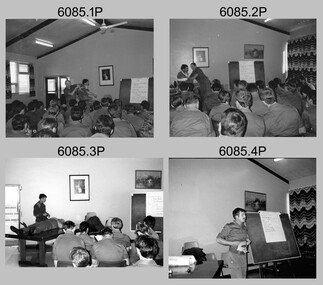
... This is a set of 14 photographs of Army Survey Regiment personnel undertaking the First Aid phase of regimental training held at Fortuna, Bendigo c1985. This was one of six objectives outlined in the administrative instruction – Exercise “City Soldier” accompanying these photos. ...This is a set of 14 photographs of Army Survey Regiment personnel undertaking the First Aid phase of regimental training held at Fortuna, Bendigo c1985. This was one of six objectives outlined in the administrative instruction – Exercise “City Soldier” accompanying these photos. ...This is a set of 14 photographs of Army Survey Regiment personnel undertaking the First Aid phase of regimental training held at Fortuna, Bendigo c1985. This was one of six objectives outlined in the administrative instruction – Exercise “City Soldier” accompanying these photos. The other objectives were weapons skills revision for SLR Rifle and M30 Grenade at Fortuna; RATEL and navigation at Wellsford Forest; and rifle shooting at Wellsford Rifle Range. Personnel from Air Survey, Cartographic, Lithographic and Headquarters Squadrons were reallocated to four training platoons for one week from 7th to 11th October 1985.This is a set of 14 photographs of the Army Survey Regiment undertaking first aid training, part of Regimental Training at Fortuna Villa, Bendigo. 1985. .1P to .8P are printed on photographic paper and scanned at 300 dpi. Photos .9P to .14P are on 35mm negative film and scanned at 96 dpi. They are part of the Army Survey Regiment’s Collection. .1) - Photo, black & white, 1985, L to R: WO1 Dick Manley – instructor, CPL Paul Davis. .2) - Photo, black & white, 1985, L to R: CPL Paul Davis, WO1 Dick Manley – instructor. .3) - Photo, black & white, 1985, L to R: WO2 Bill Kemp, – instructor, unidentified personnel. .4) - Photo, black & white, 1985, WO2 Bill Kemp, – instructor. .5) - Photo, black & white, 1985, L to R: CPL Dave Murphy, LT Carol Dunstan – instructor. .6) - Photo, black & white, 1985, L to R: SPR Wally Twidale, unidentified personnel. .7) - Photo, black & white, 1985, L to R: LT Carol Dunstan – instructor, SPR Viv (Hawkins) Doherty. .8) - Photo, black & white, 1985, unidentified WO2. .9) - Photo, black & white, 1985, L to R: WO1 Dick Manley – instructor, unidentified, LT Carol Dunstan – instructor. .10) - Photo, black & white, 1985, L to R: CPL Ken Peters, unidentified, SPR Viv (Hawkins) Doherty, unidentified (x3), LT Carol Dunstan – instructor in foreground, CPL Mick Minchin. .11) & .12) - Photo, black & white, 1985, WO2 Dave Miles with fake injured leg. .13) & .14) - Photo, black & white, 1985, unidentified officer– instructor, SPR Lorraine (Daly) Talbot-Smith..1P to .14P No personnel are identifiedroyal australian survey corps, rasvy, army survey regiment, army svy regt, fortuna, asr -
4th/19th Prince of Wales's Light Horse Regiment Unit History Room
Report: Auditor-General, The Auditor-General, Audit Report No 3, 1990-91, Department of Defence, Australia's Army Reserve, 24/8/1990 (exact)
... Training was not closely focused on the roles and objectives of the ARes and the subsequent evaluation of training activities could be improved."...Training was not closely focused on the roles and objectives of the ARes and the subsequent evaluation of training activities could be improved." ..."The report highlights significant deficiencies in achieving the major objectives for the ARes that were set out in the Defence White Paper. It also identifies inadequacies in the organisation of the ARes, shortfalls in the level of resources required to maintain its effectiveness. It indicates a need for a major review of the structure and disposition of ARes units and asset holding. The ANAO has developed estimates of the cost of the ARes and these estimates indicate that the cost of training and supporting an ARes member for each day of service are substantially higher than for a ARA soldier. The report points to difficulties in recruitment and retention and the need to examine the role of women in the ARes. Training was not closely focused on the roles and objectives of the ARes and the subsequent evaluation of training activities could be improved."ISBN 0 644 13030 X army reserve, audit reports, auditor general, australian national audit office, defence reviews -
 Bendigo Historical Society Inc.
Document - SANDHURST BOYS CENTRE COLLECTION: BUSINESS PLAN
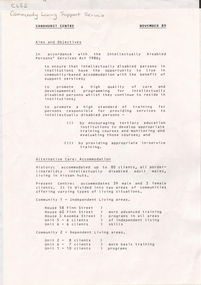
... BENDIGO Institutions sandhurst boys centre Independent Living Plan; Vocational Training; Employment; Accommodation; Sandhurst Boys Centre Business Plan 1989; Community Living Support Service Program (CLSS) November 1989. Aims & objectives ...Community Living Support Service Program (CLSS) November 1989. Aims & objectives, care alternatives, programs, co-operation with other service providers, education.bendigo, institutions, sandhurst boys centre, independent living plan; vocational training; employment; accommodation; sandhurst boys centre business plan 1989; -
 National Vietnam Veterans Museum (NVVM)
Poster - Poster, Information Board, 5 RAR 1966 - 1967 (1st Tour)
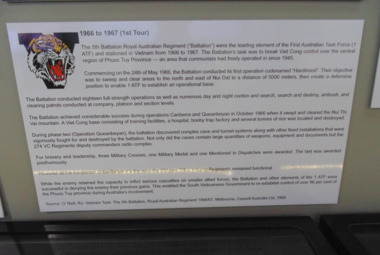
... objective was to sweep and clear areas to the north and east of Nui Dat to a distance of 5000 meters, then create a defensive position to enable 1 ATF to establish an operation base. The Battalion conducted eighteen full-lenght operations as well as numerous day and night cordon and search, search and destroy, ambush and clearing patrols conducted at company, platoon and section levels. the Battalion achieved considerable success during Operations Canberra and Queanbeyan in October 1966 when it swept and cleared the Nui Thi Vai mountain. A Viet Cong base consisting of training...objective was to sweep and clear areas to the north and east of Nui Dat to a distance of 5000 meters, then create a defensive position to enable 1 ATF to establish an operation base. The Battalion conducted eighteen full-lenght operations as well as numerous day and night cordon and search, search and destroy, ambush and clearing patrols conducted at company, platoon and section levels. the Battalion achieved considerable success during Operations Canberra and Queanbeyan in October 1966 when it swept and cleared the Nui Thi Vai mountain. A Viet Cong base consisting of training ...An Poster, Information Board of 5 RAR 1966 to 1967 (tst Tour). The 5th Battalion Royal Australian Regiment ("Battalion") were the leading element of the First Australian Task Force (1 ATF) and stationed in Vietnam from 1966 to 1967. The Battalion's task was to break Viet Cong control over the central region of Phuoc Tuy Province - an area that communists had freely operated in since 1945. Commencing of the 24th May 1966, the Battalion conducted its first operation codenamed "Hardihood". Their objective was to sweep and clear areas to the north and east of Nui Dat to a distance of 5000 meters, then create a defensive position to enable 1 ATF to establish an operation base. The Battalion conducted eighteen full-lenght operations as well as numerous day and night cordon and search, search and destroy, ambush and clearing patrols conducted at company, platoon and section levels. the Battalion achieved considerable success during Operations Canberra and Queanbeyan in October 1966 when it swept and cleared the Nui Thi Vai mountain. A Viet Cong base consisting of training facilities, a hospital, booby trap factory and several tonnes of rice was located and destroyed. during phase two (Operation Queanbeyan) the battalion discovered complex cave and tunnel systems along with other fixed installations that were vigorously fought for and destroyed by the battalion. Not only di the caves contain large quantities of weapons, equipment and documents but the 274 VC Regiments deputy commanders radio complex. For bravery and leadership, three Military Crosses, one Military Medal and one Mentioned in Dispatches were awarded. The last was awarded posthumously. However, at the completion of the battalion's first tour, the 274 and 275 Viet Cong Regiments remained functional. While the enemy retained the capacity to inflict serious casualities on smaller allied forces, the Battalion and other elements of the 1 AFt were successful in denying the enemy their previous gains. This enabled the South Vietnamese Government to re-establish control of over 96 per cent of the Phuoc Tuy Province during Australia's involvement. Source O'Neill, RJ Vietnam Task, the 5th Battalion, Royal Australian Regiment 1966/67, Melbourne. Cassell Australia Ltd, 19685 rar, 1st tour 1966 - 1967, operation hardihood, 1st atf base, poster, information board, nui dat, nui thai vai mountains, operation canberra, operation queanbeyan, viet cong, 274 vc regiments, military cross, bravery, military medal, mention in dispatches, capt robert john o'neill, 335113, royal australian infantry corps, 5th battalion, the royal australian regiment -
Moorabbin Air Museum
Album (item) - CAC Folder containing a range of documents - See Description for details
... Objectives. CAC Automatic Flight Control Systems. CAC Fishermans Bend Sector Sales Analysis Fixed 1986 Dollars CAC Active Ship Location By Major Type And Ocean Areas as April 30,1985 CAC Fishermans Bend Sales Revenue And Profit (After Tax) 1978-1986. CAC Fishermans Bend Workload Distribution 1984/5. CAC Fishermans Bend Sales Revenue Distribution 1984/85. CAC Effect Of Local Procurement On Initial Purchase Cost And Life Of Type Cost - Atar Engine. CAC Photo Composite Maintenance Trainer. CAC Product & Services Applicable to RAN New Submarine Programme. CAC Maintenance And Operational Training...Objectives. CAC Automatic Flight Control Systems. CAC Fishermans Bend Sector Sales Analysis Fixed 1986 Dollars CAC Active Ship Location By Major Type And Ocean Areas as April 30,1985 CAC Fishermans Bend Sales Revenue And Profit (After Tax) 1978-1986. CAC Fishermans Bend Workload Distribution 1984/5. CAC Fishermans Bend Sales Revenue Distribution 1984/85. CAC Effect Of Local Procurement On Initial Purchase Cost And Life Of Type Cost - Atar Engine. CAC Photo Composite Maintenance Trainer. CAC Product & Services Applicable to RAN New Submarine Programme. CAC Maintenance And Operational Training ...CAC Green Folder containing following articles, CAC Workforce 1936-1980. CAC Facility Locations. CAC Hawker De Havilland International Manufacturing Contracts. Some CAC Future Products & Contracts. CAC Typical Customer List. CAC Man Hours Lost 1978-1979 & 1980. CAC Prime Marketing Objectives. CAC Automatic Flight Control Systems. CAC Fishermans Bend Sector Sales Analysis Fixed 1986 Dollars CAC Active Ship Location By Major Type And Ocean Areas as April 30,1985 CAC Fishermans Bend Sales Revenue And Profit (After Tax) 1978-1986. CAC Fishermans Bend Workload Distribution 1984/5. CAC Fishermans Bend Sales Revenue Distribution 1984/85. CAC Effect Of Local Procurement On Initial Purchase Cost And Life Of Type Cost - Atar Engine. CAC Photo Composite Maintenance Trainer. CAC Product & Services Applicable to RAN New Submarine Programme. CAC Maintenance And Operational Training Task/Study Definition-Development-Fabrication/Manufacture Implementation/Management Infrastructure Ikara MH53E Maintenance Trainers F18A MDSLMP. CAC Torpedo Handling And Stowage System Mine Launch Handling Stowage System. CAC Airconditioning System (Environmental Control) -
 Sunshine and District Historical Society Incorporated
Archive - John Darling Flour Mill
... Allied Flour & Starch|Photocopy Newspaper Article Advocate 30 May 1990 Darling Flour Mill to Close|Photograph John Darling Mill|Photograph John Darling Mill|Photograph John Darling Building in Melbourne|Photocopy of Newspaper Article The Argus 25 Feburay 1926 Great fire near Sunshine Flour Mills Destroyed|Type written report Revision of the Flour Mill Process|Labels Goodman Fielder Mills Ltd Flour Mill|Packing Instruction 22 December 1980|Interoffice Memo 27 April 1979|Daily Delivery Sheet 21 November 1985|Notice dated 29 June 1983 to Federated Millers and Mill Employees Association Workers Compensation Benefit Payable upon incapacity of death of a worker|Certificate of Registration of a Boiler Pressure Vessel|Weighbridge Ticket 30 June|Delivery Advice|Type written Letter dated 7 July 1980|MEA Journal June 1984 Volume 32 No 2|Type written Letter Dated 2 July 1980 Reference Joe Spiteri|Type written Letter dated 30 June 1980 Don Wallis|Type written Letter dated 30 June 1980 from Don Wallis|Type written Letter dated 17 July 1980 Course Physical Distribution Management|Information Sheet NAASRA Permits|Master Specification for Raw Material Transportation Packing Branding and Quality Hazards dated 28 May 1984|Inter Office Memo Gross Truck Weights Dated 27 January 1983|Memorandum dated 15 April 1980 COD Van|Examination questions Fork lift Truck operators Training Course|Photocopy of Newspaper Article Brimbank Independent 25 November 1997 Flour mill offers breathtaking views of Melbourne and its past|Type written letter dated 5 November 1987 Dividend Share Plan|Brochure Goodman Fielder Wattie Limited Employee Share Plan|Public Weighbridges having current registration on|Flour Pack details|New Roster System 1983 Trial Basis Commencing 4 January|Demurrage Charges|Management of Distribution Objectives and Methods|John Darling Flour Mills Organisation Structure May 1980|Allied Mills Limited Personal Injury Report Pad|Newspaper Article The Advocate 24th July 1991 - John Darling & Son Flour Mill Bulding's future uncertain|Collection of docments and newspaper articles trying to save the mill from developers...John Darling Flour Mill Sydney Street Albion Allied Flour & Starch|Photocopy Newspaper Article Advocate 30 May 1990 Darling Flour Mill to Close|Photograph John Darling Mill|Photograph John Darling Mill|Photograph John Darling Building in Melbourne|Photocopy of Newspaper Article The Argus 25 Feburay 1926 Great fire near Sunshine Flour Mills Destroyed|Type written report Revision of the Flour Mill Process|Labels Goodman Fielder Mills Ltd Flour Mill|Packing Instruction 22 December 1980|Interoffice Memo 27 April 1979|Daily Delivery Sheet 21 November 1985|Notice dated 29 June 1983 to Federated Millers and Mill Employees Association Workers Compensation Benefit Payable upon incapacity of death of a worker|Certificate of Registration of a Boiler Pressure Vessel|Weighbridge Ticket 30 June|Delivery Advice|Type written Letter dated 7 July 1980|MEA Journal June 1984 Volume 32 No 2|Type written Letter Dated 2 July 1980 Reference Joe Spiteri|Type written Letter dated 30 June 1980 Don Wallis|Type written Letter dated 30 June 1980 from Don Wallis|Type written Letter dated 17 July 1980 Course Physical Distribution Management|Information Sheet NAASRA Permits|Master Specification for Raw Material Transportation Packing Branding and Quality Hazards dated 28 May 1984|Inter Office Memo Gross Truck Weights Dated 27 January 1983|Memorandum dated 15 April 1980 COD Van|Examination questions Fork lift Truck operators Training Course|Photocopy of Newspaper Article Brimbank Independent 25 November 1997 Flour mill offers breathtaking views of Melbourne and its past|Type written letter dated 5 November 1987 Dividend Share Plan|Brochure Goodman Fielder Wattie Limited Employee Share Plan|Public Weighbridges having current registration on|Flour Pack details|New Roster System 1983 Trial Basis Commencing 4 January|Demurrage Charges|Management of Distribution Objectives and Methods|John Darling Flour Mills Organisation Structure May 1980|Allied Mills Limited Personal Injury Report Pad|Newspaper Article The Advocate 24th July 1991 - John Darling & Son Flour Mill Bulding's future uncertain|Collection of docments and newspaper articles trying to save the mill from developers Vertical File containing various documents relating to Darling Flour Mill, stored in two folders 1406.1 & 1406.2 Archive John Darling Flour Mill ...Allied Flour & Starch|Photocopy Newspaper Article Advocate 30 May 1990 Darling Flour Mill to Close|Photograph John Darling Mill|Photograph John Darling Mill|Photograph John Darling Building in Melbourne|Photocopy of Newspaper Article The Argus 25 Feburay 1926 Great fire near Sunshine Flour Mills Destroyed|Type written report Revision of the Flour Mill Process|Labels Goodman Fielder Mills Ltd Flour Mill|Packing Instruction 22 December 1980|Interoffice Memo 27 April 1979|Daily Delivery Sheet 21 November 1985|Notice dated 29 June 1983 to Federated Millers and Mill Employees Association Workers Compensation Benefit Payable upon incapacity of death of a worker|Certificate of Registration of a Boiler Pressure Vessel|Weighbridge Ticket 30 June|Delivery Advice|Type written Letter dated 7 July 1980|MEA Journal June 1984 Volume 32 No 2|Type written Letter Dated 2 July 1980 Reference Joe Spiteri|Type written Letter dated 30 June 1980 Don Wallis|Type written Letter dated 30 June 1980 from Don Wallis|Type written Letter dated 17 July 1980 Course Physical Distribution Management|Information Sheet NAASRA Permits|Master Specification for Raw Material Transportation Packing Branding and Quality Hazards dated 28 May 1984|Inter Office Memo Gross Truck Weights Dated 27 January 1983|Memorandum dated 15 April 1980 COD Van|Examination questions Fork lift Truck operators Training Course|Photocopy of Newspaper Article Brimbank Independent 25 November 1997 Flour mill offers breathtaking views of Melbourne and its past|Type written letter dated 5 November 1987 Dividend Share Plan|Brochure Goodman Fielder Wattie Limited Employee Share Plan|Public Weighbridges having current registration on|Flour Pack details|New Roster System 1983 Trial Basis Commencing 4 January|Demurrage Charges|Management of Distribution Objectives and Methods|John Darling Flour Mills Organisation Structure May 1980|Allied Mills Limited Personal Injury Report Pad|Newspaper Article The Advocate 24th July 1991 - John Darling & Son Flour Mill Bulding's future uncertain|Collection of docments and newspaper articles trying to save the mill from developersjohn darling flour mill, sydney street, albion -
Villa Alba Museum
Document, Villa Alba: Interior Design Resource Centre
... training institution, and display centre for interior design, decorative materials and techniques of the 19th and 20th centuries. The completed report was a submission by the Villa Alba Preservation Committee, in conjunction with Dulux Australia, to ICI. The submission includes original photographs of the period. The major objectives ...'Villa Alba: Interior Design Resource Centre', was the outcome of a funded project designed to underpin the restoration, adaptation and use of Villa Alba, 44 Walmer Street Kew, as a repository, resource centre, training institution, and display centre for interior design, decorative materials and techniques of the 19th and 20th centuries. The completed report was a submission by the Villa Alba Preservation Committee, in conjunction with Dulux Australia, to ICI. The submission includes original photographs of the period.The major objectives of this proposal were to preserve and restore the heritage listed Villa Alba, and adapt the house for use as Australia's first resource centre of historic interior design. The 34-page report outlines the case for the house's preservation, its projected use and the costs involved. The sections of the report are: Summary, The Villa Alba, Extract from Melbourne "Argus", Objectives of project, Administration, Preliminary estimates, Proposed sources of funding, Project details, Architect's Report, Members of Villa Alba Preservation Committee, and Photographs.non-fiction'Villa Alba: Interior Design Resource Centre', was the outcome of a funded project designed to underpin the restoration, adaptation and use of Villa Alba, 44 Walmer Street Kew, as a repository, resource centre, training institution, and display centre for interior design, decorative materials and techniques of the 19th and 20th centuries. The completed report was a submission by the Villa Alba Preservation Committee, in conjunction with Dulux Australia, to ICI. The submission includes original photographs of the period. villa alba museum, vila alba preservation committee, interior design -- australia, decorative arts, vision statements, heritage proposals -
 Victorian Aboriginal Corporation for Languages
Kit, Victorian Aboriginal Legal Service et al, Aboriginal English in the courts kit : a report on Aboriginal English in the courts, 2007
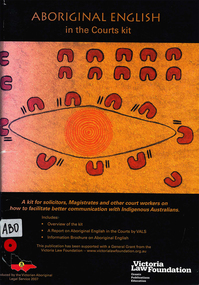
... The overall objective of this report is to collate information about Aboriginal English in order to inform future staff training and resources for people working in the courts, including solicitors and magistrates. ...Aboriginal Australians -- Criminal justice system. tables, sample legal letters, pamphlets, information card The overall objective of this report is to collate information about Aboriginal English in order to inform future staff training and resources for people working in the courts, including solicitors and magistrates. ...The overall objective of this report is to collate information about Aboriginal English in order to inform future staff training and resources for people working in the courts, including solicitors and magistrates. Features Radio National transcript from Lingua Franca program, and content by Diane Eades.tables, sample legal letters, pamphlets, information cardaustralia -- trials, litigation, etc. english language -- dialects -- australia. aboriginal australians -- social life and customs. law -- australia -- language -- handbooks, manuals, etc. aboriginal australians -- criminal justice system. -
 Vision Australia
Administrative record - Text, Association for the Blind 90th annual report 1985, 1985
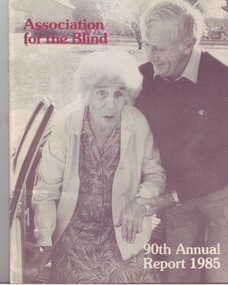
... Articles in annual report include: President's report, Philosophy, Objectives and Goals, Blind members, Finance report with Balance sheet, Auditors' report, How help is provided, Service highlights, Low Vision Clinics, Rehabilitation services, Day Centres, Domiciliary services, Recreation programmes, Nursing homes, Community education and In-service training, 3RPH, International links, Volunteer service group. ...Articles in annual report include: President's report, Philosophy, Objectives and Goals, Blind members, Finance report with Balance sheet, Auditors' report, How help is provided, Service highlights, Low Vision Clinics, Rehabilitation services, Day Centres, Domiciliary services, Recreation programmes, Nursing homes, Community education and In-service training, 3RPH, International links, Volunteer service group. association for the blind corporation records 1 printed volume with illustrations Association for the Blind 90th annual report 1985 Administrative record Text ...Articles in annual report include: President's report, Philosophy, Objectives and Goals, Blind members, Finance report with Balance sheet, Auditors' report, How help is provided, Service highlights, Low Vision Clinics, Rehabilitation services, Day Centres, Domiciliary services, Recreation programmes, Nursing homes, Community education and In-service training, 3RPH, International links, Volunteer service group. 1 printed volume with illustrationsassociation for the blind, corporation records -
 Surrey Hills Historical Society Collection
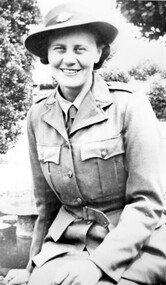
Photograph, Doris Wright, member of the Australian Women's Army Service
... Training for members of the WANS included air raid drills, first aid, basic military drills, and even shooting, signalling, and mechanics. AWAS on formed on 13 August 1941 with the objective...Training for members of the WANS included air raid drills, first aid, basic military drills, and even shooting, signalling, and mechanics. AWAS on formed on 13 August 1941 with the objective ...Doris Lilian Wright of 214 Union Road was a milliner but joined the Australian Women's Army Service (AWAS) in the early war years. The Women’s Australian National Service (WANS) was inaugurated in 1940. Training for members of the WANS included air raid drills, first aid, basic military drills, and even shooting, signalling, and mechanics. AWAS on formed on 13 August 1941 with the objective of releasing more men into forward areas. The Army was particular with its recruiting and four references were required; another stipulation was that teeth were in good condition. Doris was located at Elwood. Their training area was along the foreshore and one day to their great surprise there were crowds of American Marines – "the cream of the American Army". These were the first Americans to arrive in Australia to strengthen the defence of the country. The Americans soon went north and the AWAS went off to Balcombe on the Mornington Peninsula. At this time there were no uniforms for the girls only ‘giggle’ dresses – of a non-descript colour. They were not expected to appear in public in these and wore civilian dress. Japan had just entered the war and there were more urgent demands on restricted supplies. The formal uniforms eventually arrived.A black and white photograph of a lady in an army uniform and wearing a hat.union road, surrey hills, uniforms, clothing and dress, (miss) doris wright, australian women's army service -
 Melbourne Legacy
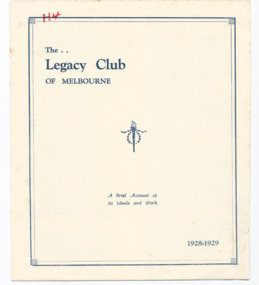
Pamphlet, The Legacy Club of Melbourne 1923-28 : A brief account of its ideals and works (H4), 1928
... Training Branch - started in 1927 and now over 120 girls were being instructed by Mrs AM Gilles (the wife of a Legatee). Lending Library of over 400 books. Vocational placements for junior legatees. Meetings were held in the Victoria Coffee Palace at 1pm on Tuesdays and included a half hour lecture. The policy and objectives...Training Branch - started in 1927 and now over 120 girls were being instructed by Mrs AM Gilles (the wife of a Legatee). Lending Library of over 400 books. Vocational placements for junior legatees. Meetings were held in the Victoria Coffee Palace at 1pm on Tuesdays and included a half hour lecture. The policy and objectives ...A brochure explaining 'A brief account of its ideals and work' in 1928. The notation H4 in red pen shows that it was part of the archive project that was trying to capture the history of Legacy. The brochure lays out the history of the young organisation, it has 146 members in 1927, and clubs had started in state capital and Geelong, Ballarat, and Bendigo. Members were all men who had served in the forces of the British Empire during the war. It shows the work of Legacy as : Junior Legacy Club - for sons (aged 9 to 21) of deceased soldiers. Members of the Legacy Club were in constant touch and acted as Big Brothers. Boys' Literary and Debating Branch - approximately 80 boys attended weekly meetings of a debating society at Anzac House. Boys' Physical Training Branch - for the boys physical welfare classes and conducted weekly by a permanent instructor (paid by Legacy). There were 161 boys attending. Also cricket, football, Lacrosse and swimming clubs, all supervised and coached. A holiday camp is held each Christmas at the seaside- 67 attended the previous year at Balnarring (led by Stan Savige). Girls' Physical Training Branch - started in 1927 and now over 120 girls were being instructed by Mrs AM Gilles (the wife of a Legatee). Lending Library of over 400 books. Vocational placements for junior legatees. Meetings were held in the Victoria Coffee Palace at 1pm on Tuesdays and included a half hour lecture. The policy and objectives were laid out including to preserve the memory of fallen comrades and to assist their dependents, particularly the children. Also to maintain a spirit of comradeship, and to safeguard the good standing and interests of ex-service men in the community and to assist the the to secure suitable employment. The brochure shows activities as: Employment Committee, Comradeship Committee, a pledge to assist the National War Memorial being established on the Domain site, and for the children the 'Deceased Soldiers' Children's Welfare Committee. A schedule of Boys' and Girls' Classes is included to show the options for the children. Also picnics, Christmas camp, cycle club, and rambles as arranged. There is help for vocational options for the children. See also 01480 for a copy from 1930.This is one of the first documents that promotes Legacy and summarises its objective and services. Brochure describing the ideal and activities of the Legacy Club in 1928.Handwritten H4 in red pen.legacy promotion, history, goals, objectives -
 Melbourne Legacy
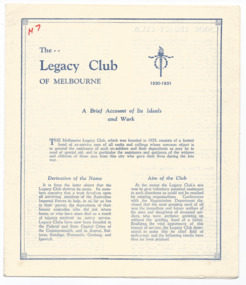
Pamphlet, The Legacy Club of Melbourne 1930-31 : A brief account of its ideals and works (H7), 1930
... Training Branch - started in 1927 and now over 200 girls were being instructed by Mrs AM Gilles (the wife of a Legatee). Lending Library of over 600 books. Vocational placements for junior legatees. Meetings were held in the Victoria Palace Hotel, Little Collins St, on Tuesdays and included an informative lecture. The policy and objectives...Training Branch - started in 1927 and now over 200 girls were being instructed by Mrs AM Gilles (the wife of a Legatee). Lending Library of over 600 books. Vocational placements for junior legatees. Meetings were held in the Victoria Palace Hotel, Little Collins St, on Tuesdays and included an informative lecture. The policy and objectives ...A brochure explaining 'A brief account of its ideals and work' in 1930. The notation H4 in red pen shows that it was part of the archive project that was trying to capture the history of Legacy. The brochure mentions clubs had started in the Federal and state capitals, and Geelong, Ararat, Ballarat, Fremantle, Ipswich and Bendigo. Members were all men who had served in the forces of the British Empire during the war. It shows the work of Legacy as : Junior Legacy Club - which had been running for 5 years, for sons (aged 9 to 21) of deceased soldiers. Members of the Legacy Club were in constant touch and acted as Big Brothers. Boys' Literary and Debating Branch - approximately 95 boys attended weekly meetings of a debating society at Anzac House. Boys' Physical Training Branch - for the boys physical welfare classes and conducted weekly by a permanent instructor (paid by Legacy). There were 270 boys attending. Also cricket, football, Lacrosse and swimming clubs, all supervised and coached. 'A permanent camp has been erected at Balnarring East, and this is occupied by the boys at the Christmas vacation under the control of Legatee Stan Savige, and the girls at Easter, with Mrs Gilles in charge. The value of these camps in enabling Junior Legatees to become better acquainted and in the development of character and the Legacy spirit cannot be overestimated'. Girls' Physical Training Branch - started in 1927 and now over 200 girls were being instructed by Mrs AM Gilles (the wife of a Legatee). Lending Library of over 600 books. Vocational placements for junior legatees. Meetings were held in the Victoria Palace Hotel, Little Collins St, on Tuesdays and included an informative lecture. The policy and objectives were laid out including to preserve the memory of fallen comrades and to assist their dependents, particularly the children. Also to maintain a spirit of comradeship, and to safeguard the good standing and interests of ex-servicemen in the community. The brochure shows activities as: Employment Committee, Comradeship Committee, a pledge to assist the National War Memorial being established on the Domain site, and for the children the 'Deceased Soldiers' Children's Welfare Committee. Also picnics, Christmas camp, cycle club, and rambles as arranged. There is help for vocational options for the children. It is mentioned during 1930 which consisted of 'a hospital ward, mess room seating 80, a kitchen and storeroom. Also tent frames and necessary offices are provided and the total value of the building and equipment owned by the Club is our £600.' See also 01478 for a copy from 1928.This is one of the first documents that promotes Legacy and summarises its objective and services. Brochure describing the ideal and activities of the Legacy Club in 1930.Handwritten H4 in red pen.legacy promotion, history, goals, objectives -
 Melbourne Legacy
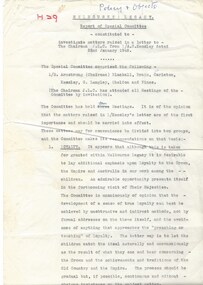
Document, Report of Special Committee (H29), 1948
... Training in good citizenship: to use the Legacy camps to impress on the juniors aspects of appropriate behaviour and attitudes. The notation H29 in red pen shows that it was part of the archive project that was trying to capture the history of Legacy. A record of Legatees making recommendations about loyalty and behaviours to instil in junior legatees. history regulations rules Handwritten H29 in red pen and 'Policy and Objectives' in blue pen. ...A special committee was convened to investigate matters raised by Legate A N Kemsley (Chairman of JLC) in a letter dated 22 January 1948. The committee comprised of Legatees Armstrong (Chairman), Blackall, Brain, Carleton, Kemsley, G Langley, Sheldon, and Vines. The matters were addressed in two groups, Loyalty and Training in Good Citizenship. Loyalty: recommendations included a framed photo of the King and Queen is displayed in all residences and rooms where classes were conducted; that a simple declaration of loyalty be recited as part of classes; that the Union Jack and Australian flag be displayed in all rooms where classes are held (flags would need to be procured as their present stock as 'small and in poor order'; that the offer to borrow items from the UK Information Office about the Royal family be accepted; that Anzac Day and the Shrine of Remembrance be discussed prior to Anzac Day at classes held in March and April; that Junior Legatees be encouraged to attend Legacy Ceremony at the Shrine on Anzac Day. Training in good citizenship: to use the Legacy camps to impress on the juniors aspects of appropriate behaviour and attitudes. The notation H29 in red pen shows that it was part of the archive project that was trying to capture the history of Legacy. A record of Legatees making recommendations about loyalty and behaviours to instil in junior legatees.White foolscap paper with black type x 4 pages about a special committee.Handwritten H29 in red pen and 'Policy and Objectives' in blue pen.history, regulations, rules -
 Melbourne Tram Museum
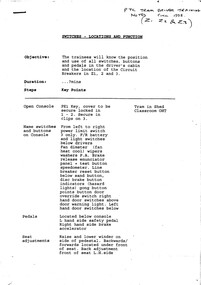
Document - Instruction, The Met, PTC tram driver training notes, c1995 for A, Z2 and Z3, Mar. 1989
... Set of instructions - 22 A4 sheets, stapled in the top left hand corner - PTC tram driver training notes, c1995 for A, Z2 and Z3 tramcars. Looks at the objectives and steps to be done for each module, eg Switches, locations and function, tram operations, fault finding, doors, insulated trams, AVM, practical tram driving, preparing tram, braking system, road rules and track infrastructure....Trams tramways Z class Training Instructions Z3 class Written in ink on first sheet top right hand corner "PTC tram driver training notes, c1995 for A, Z2 and Z3" Set of instructions - 22 A4 sheets, stapled in the top left hand corner - PTC tram driver training notes, c1995 for A, Z2 and Z3 tramcars. Looks at the objectives and steps to be done for each module, eg Switches, locations and function, tram operations, fault finding, doors, insulated trams, AVM, practical tram driving, preparing tram, braking system, road rules and track infrastructure. ...Set of instructions - 22 A4 sheets, stapled in the top left hand corner - PTC tram driver training notes, c1995 for A, Z2 and Z3 tramcars. Looks at the objectives and steps to be done for each module, eg Switches, locations and function, tram operations, fault finding, doors, insulated trams, AVM, practical tram driving, preparing tram, braking system, road rules and track infrastructure.Written in ink on first sheet top right hand corner "PTC tram driver training notes, c1995 for A, Z2 and Z3"trams, tramways, z class, training, instructions, z3 class -
 Melbourne Tram Museum
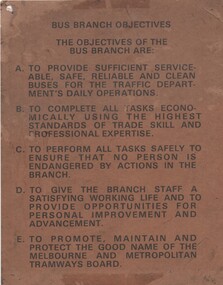
Poster, Melbourne & Metropolitan Tramways Board (MMTB), "Bus Branch Objectives", late 1970's?
... Poster printed on card titled "Bus Branch Objectives", providing a list of 5 objectives of the MMTB Bus Branch such as safety, standards, training. Undated - late 1970's?...Trams tramways Buses MMTB Workshops Safety Poster printed on card titled "Bus Branch Objectives", providing a list of 5 objectives of the MMTB Bus Branch such as safety, standards, training. Undated - late 1970's? ...Poster printed on card titled "Bus Branch Objectives", providing a list of 5 objectives of the MMTB Bus Branch such as safety, standards, training. Undated - late 1970's?trams, tramways, buses, mmtb, workshops, safety
