
Showing 9 items matching "tram 333"
-
 Melbourne Tram Museum
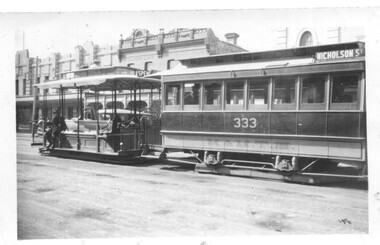
Photograph - Cable tram - Nicholson St Fitzroy, A Anderson, 1928
... ...tram 333...Photograph shows a cable car set, trailer 333, at the Nicholson St terminus North Fitzroy before returning to Spencer St. Yields information about cable trams in Nicholson St during 1928. tramcars tramways cable trams Nicholson St North Fitzroy tram 333 in ink on rear "Cable train, Fitzroy, Melbourne. ...Photograph shows a cable car set, trailer 333, at the Nicholson St terminus North Fitzroy before returning to Spencer St. Yields information about cable trams in Nicholson St during 1928.Black and white photo with source notes on the rear.in ink on rear "Cable train, Fitzroy, Melbourne. Taken 1928 (son is on dummy) when on Holidays in Victoria. Photo by A Anderson"tramcars, tramways, cable trams, nicholson st, north fitzroy, tram 333 -
 Melbourne Tram Museum
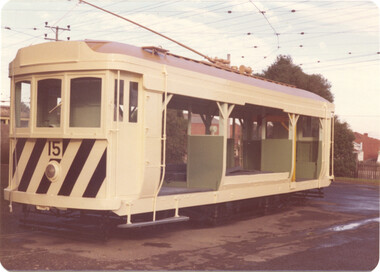
Photograph - Set of 10 - various trams Preston Workshops, Norm Cross, mid 1970s
... ...tram 333...Set of 10 colour prints by Norm Cross of trams at Preston Workshops or St George's Road. 1 - Sleeper transport 15W 2 - ditto 3 - W2 class 243 on No. 17 road, pending an 02 overhaul. 4 - W2 327 on dolly trucks at Preston Workshops 5 - W2 class tram 337 Preston Workshops 6 - W2 355 Preston Workshops 7 - W2 380 in the Yard at Hawthorn Depot 8 - W2 567 on a traverser at Preston Workshops. 9 - W2 248 Preston Workshops after a 03 overhaul or repainting 10 - W2 333 St George's Road - route 10...Set of 10 colour prints by Norm Cross of trams at Preston Workshops or St George's Road. 1 - Sleeper transport 15W 2 - ditto 3 - W2 class 243 on No. 17 road, pending an 02 overhaul. 4 - W2 327 on dolly trucks at Preston Workshops 5 - W2 class tram 337 Preston Workshops 6 - W2 355 Preston Workshops 7 - W2 380 in the Yard at Hawthorn Depot 8 - W2 567 on a traverser at Preston Workshops. 9 - W2 248 Preston Workshops after a 03 overhaul or repainting 10 - W2 333 St George's Road - route 10 Yields information about various W2 class cars at Preston Workshops, mid 1970s trams tramways tram 15W tram 243 tram 327 Preston Workshops W2 class tram 337 tram 355 tram 380 tram 567 tram 248 tram 333 Set of 10 colour prints with rounded corners. ...Set of 10 colour prints by Norm Cross of trams at Preston Workshops or St George's Road. 1 - Sleeper transport 15W 2 - ditto 3 - W2 class 243 on No. 17 road, pending an 02 overhaul. 4 - W2 327 on dolly trucks at Preston Workshops 5 - W2 class tram 337 Preston Workshops 6 - W2 355 Preston Workshops 7 - W2 380 in the Yard at Hawthorn Depot 8 - W2 567 on a traverser at Preston Workshops. 9 - W2 248 Preston Workshops after a 03 overhaul or repainting 10 - W2 333 St George's Road - route 10Yields information about various W2 class cars at Preston Workshops, mid 1970sSet of 10 colour prints with rounded corners.trams, tramways, tram 15w, tram 243, tram 327, preston workshops, w2 class, tram 337, tram 355, tram 380, tram 567, tram 248, tram 333 -
 Melbourne Tram Museum
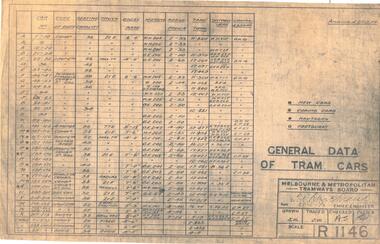
Document - Folder, Melbourne & Metropolitan Tramways Board (MMTB), "MMTB General Data of Tramcars", compiled to c2005
... R1266 – Cable Train – Dummy and 4 wheel trailer R3799 – Cable train – Dummy & 4 wheel trailer R3422 – Cable train – dummy & Bogie trailer PMTT 161 – Combination Car R3076 – Class A – Combination Car Dropped ends PMTT – 163 - Bogie car with dropped centre compartment PMTT – 700 – Bogie Car with dropped centre compartment and longitudinal rattan saloon seats R3078 – Dropped Centre bogie car – Maximum Traction R4571 – Dog Transport Car – class C converted PMTT 162 – Summer car (old type) – F class PMTT 164 – Summer car – G class R3079 – Class L R7416 – Class L PMTT 160 – Bogie Closed Car – (O class) R9787 – Class G – All night tram style R3077 – Class G – All night tram style R8999 – Class A tramcar Coburg type Original – S class R5963 - Class A tramcar Coburg type Original – S class (modified) R3093A - Class T R4382 – Class T arrangement for one-man operation Car 178 R3756A – class U R2461 – class W – W class converted to W2 R2460 – class W1 R2459 – class W2 R4646 – class SW2 R9525 – class SW2 R3071 – class W3 R3812 – class W4 R4678B – class W5 R9601 – class CW5 R5818 – class SW5 R12-052 – Class W5 – sliding door conversion R4771A – class SW6 (reversible seats) R6408A – class SW6 (Tubular Fixed Seats) R8617 – class SW6 and W6 R9529 – class W7 R10-129 – Class VR car R8332 – PCC type car R2462 – class X R1811 – types of electric cars – class X Safety car R2463 – class X1 R3080 – Class X2 R2464 – class Y R2465 – class Y1 R10-946 – All electric tram – 1041 R11-333 – class Z1 and Z2 trams R11-387 – class z outside dimensions R11-563 – Class Z tram (101-115) R11-580 - class Z3 tram R12-062 – Class A tram T4000-12 – double ended 6 axle articulated LRV – a possibly arrangement R6928 – PCC Car – double end operation R9980 – Freight car 17 – former V class passenger car See Reg Item 5639 for a similar document....R1266 – Cable Train – Dummy and 4 wheel trailer R3799 – Cable train – Dummy & 4 wheel trailer R3422 – Cable train – dummy & Bogie trailer PMTT 161 – Combination Car R3076 – Class A – Combination Car Dropped ends PMTT – 163 - Bogie car with dropped centre compartment PMTT – 700 – Bogie Car with dropped centre compartment and longitudinal rattan saloon seats R3078 – Dropped Centre bogie car – Maximum Traction R4571 – Dog Transport Car – class C converted PMTT 162 – Summer car (old type) – F class PMTT 164 – Summer car – G class R3079 – Class L R7416 – Class L PMTT 160 – Bogie Closed Car – (O class) R9787 – Class G – All night tram style R3077 – Class G – All night tram style R8999 – Class A tramcar Coburg type Original – S class R5963 - Class A tramcar Coburg type Original – S class (modified) R3093A - Class T R4382 – Class T arrangement for one-man operation Car 178 R3756A – class U R2461 – class W – W class converted to W2 R2460 – class W1 R2459 – class W2 R4646 – class SW2 R9525 – class SW2 R3071 – class W3 R3812 – class W4 R4678B – class W5 R9601 – class CW5 R5818 – class SW5 R12-052 – Class W5 – sliding door conversion R4771A – class SW6 (reversible seats) R6408A – class SW6 (Tubular Fixed Seats) R8617 – class SW6 and W6 R9529 – class W7 R10-129 – Class VR car R8332 – PCC type car R2462 – class X R1811 – types of electric cars – class X Safety car R2463 – class X1 R3080 – Class X2 R2464 – class Y R2465 – class Y1 R10-946 – All electric tram – 1041 R11-333 – class Z1 and Z2 trams R11-387 – class z outside dimensions R11-563 – Class Z tram (101-115) R11-580 - class Z3 tram R12-062 – Class A tram T4000-12 – double ended 6 axle articulated LRV – a possibly arrangement R6928 – PCC Car – double end operation R9980 – Freight car 17 – former V class passenger car See Reg Item 5639 for a similar document. ...Set of 60 A3 sheets, comprising a folder of GA Drawings – from Keith Kings, held with black plastic semi elastic black clip or retaining strip. All drawings have been scanned (about 50% were already scanned, e.g. the first sheet) and placed on the Depot Tramcar Mechanical component listing. Order of drawings as received has been retained and listed as follows. R1146 – General Data of Tramcars – 24-9-1924 R11-927 – SW6 and W6 – Advertising Panel Location R11-928 – W7 Advertising Panel Location R9529 – Class W7 GA List of Tramcar GA Arrangement Drawings dated 13/12/1974 Cover sheet – “Melbourne and Metropolitan Tramways Board – Electric Tramcars Index - lists Class, numbers and Drawing Nos. R1266 – Cable Train – Dummy and 4 wheel trailer R3799 – Cable train – Dummy & 4 wheel trailer R3422 – Cable train – dummy & Bogie trailer PMTT 161 – Combination Car R3076 – Class A – Combination Car Dropped ends PMTT – 163 - Bogie car with dropped centre compartment PMTT – 700 – Bogie Car with dropped centre compartment and longitudinal rattan saloon seats R3078 – Dropped Centre bogie car – Maximum Traction R4571 – Dog Transport Car – class C converted PMTT 162 – Summer car (old type) – F class PMTT 164 – Summer car – G class R3079 – Class L R7416 – Class L PMTT 160 – Bogie Closed Car – (O class) R9787 – Class G – All night tram style R3077 – Class G – All night tram style R8999 – Class A tramcar Coburg type Original – S class R5963 - Class A tramcar Coburg type Original – S class (modified) R3093A - Class T R4382 – Class T arrangement for one-man operation Car 178 R3756A – class U R2461 – class W – W class converted to W2 R2460 – class W1 R2459 – class W2 R4646 – class SW2 R9525 – class SW2 R3071 – class W3 R3812 – class W4 R4678B – class W5 R9601 – class CW5 R5818 – class SW5 R12-052 – Class W5 – sliding door conversion R4771A – class SW6 (reversible seats) R6408A – class SW6 (Tubular Fixed Seats) R8617 – class SW6 and W6 R9529 – class W7 R10-129 – Class VR car R8332 – PCC type car R2462 – class X R1811 – types of electric cars – class X Safety car R2463 – class X1 R3080 – Class X2 R2464 – class Y R2465 – class Y1 R10-946 – All electric tram – 1041 R11-333 – class Z1 and Z2 trams R11-387 – class z outside dimensions R11-563 – Class Z tram (101-115) R11-580 - class Z3 tram R12-062 – Class A tram T4000-12 – double ended 6 axle articulated LRV – a possibly arrangement R6928 – PCC Car – double end operation R9980 – Freight car 17 – former V class passenger car See Reg Item 5639 for a similar document.trams, tramways, drawings, tramcars, cable trams, tramcar design, preston workshops, mmtb -
 City of Melbourne Libraries
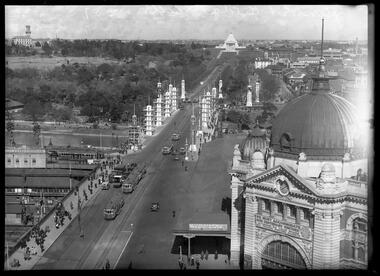
Photograph, Bull, Hugh Jones, 1897-1993, Princes Bridge Centenary pylons under construction
... The trams visible are Glen Iris (Route No. 6; tram no. 448), Toorak (Route No. 8, tram no. 333), ? (No. 7), ? (No. 1), and ? (No. 2A). ...The trams visible are Glen Iris (Route No. 6; tram no. 448), Toorak (Route No. 8, tram no. 333), ? (No. 7), ? (No. 1), and ? (No. 2A). ...Princes Bridge Centenary pylons under construction Possibly taken from Young and Jacksons Hotel (formerly Princes Bridge Hotel) on the corner of Flinders and Swanston streets, Flinders Street Station’s clocks and main entrance dominate, along with its distinctive copper dome and decorative façade. The time on the main clock is 1.40pm, and the sign underneath, reflecting Melbourne’s upcoming Centenary reads, “We must accommodate our Centenary visitors! Citizens! Do your share by taking paying guests.” At left is the original Princes Bridge Station, today the site of Federation Square. The riverside tram terminus advertises a Café/Tobacconist/Refreshment Room selling cigars & cigarettes, fountain drinks & confectionery, and in smaller text: “Leave your boot repairs here”. Nearly everyone is dressed in dark suits, coats and hats. The footpaths are wide and there are no traffic lights. The roadway stretches towards the Shrine of Remembrance, not yet dedicated but very dominant on the skyline. Government House is clearly visible across the wide parkland that would come to be known as Kings Domain and that is an area of deep importance to the people of the Eastern Kulin. Originally, Birrarung was part of a network of swamps and lagoons linked to the course of the river. From 1896, Public Works Department engineer Carlo Catani, oversaw a new channel to straighten the river and the swamps and lagoons were filled with spoil from the channel works. From the same vantage point today, only the top of the tower of Government House would be visible. The photo captures the pylons along Princes Bridge, mid-construction and being installed to mark Melbourne’s Centenary. The pylons were not without controversy. Both The Argus and The Age bemoaned them for being “made almost entirely of imported softwood timber”, denying work to native hardwood timber workers and sawmillers, and leading visitors to think Australia did not have its own exceptional native hardwoods. The pylons were also variously described in their incomplete state, as unimaginative and resembling an oilfield. Published: The Age 5 September 1934 Featured in "Newsworthy: Melbourne in photographs 1933-1936" exhibition at East Melbourne Library, October to December 2023. Exhibition caption by project volunteer, Louise McKenzie Photographer notations on slide: "Pylons + St Kilda Rd C57" Published: Age (Melbourne, Vic. : 1854 - 1954), Wednesday 5 September 1934, page 11 Published title: DECORATIONS -- THEN AND NOW. Published caption: "Although not completed yet, some impression of the effect of the decorations on Princes-bridge may be obtained from the first picture which shows the majestic sweep of St Kilda road with the Shrine of Remembrance and Government House dominating the horizon. The area to the left of St. Kilda-road and in front of Government House is portion of the area which it is proposed to call the King's Domain, which extends to Domain-road and Anderson-street..." Description: East-facing, elevated view of Flinders Street Station and Princes Bridge, featuring partially completed pylons erected for Melbourne's Centenary celebrations. The Shrine of Remembrance and Government House can be seen in the distance. In the foreground are trams, cars and trucks, pedestrians, Batman Avenue tram terminus and refreshment rooms. Signage on Flinders Street Station encourages citizens to accommodate Centenary visitors. The Melbourne Centenary was held 1934-35 in celebration John Batman's proclamation that Melbourne "the place for a village". Centenary events included a visit by Prince Henry, Duke of Gloucester. A Centenary Cake measuring 50 feet in height and ten tons in weight was cut into 250,000 pieces and sold at 1 shilling per piece for charity. Spectacular floodlighting of city landmarks, the creation of the Pioneer Women's Memorial Garden, and the MacRobertson Air Race from London, were other notable activities. Research by project volunteer, Louise McKenzie: The photo in The Age collage of 5 September 1934 has a slightly cropped foreground. The original photo has been taken from an elevated vantage point, most probably the roof of the Nicholas Building on the corner of Flinders and Swanston streets. The right foreground is dominated by the main “clocks” entrance to Flinders Street Station, showing its distinctive copper dome and decorative façade. The time on the main clock is 1.40 pm. The main sign on the front of the Station reads, "We Must Accommodate our Centenary Visitors! Citizens! Do your share by taking paying guests. Write to The Official Centenary Accommodation Bureau, 436 Collins St. City. Tel M 4671”. Another sign at eye level at the main entrance says: “Cheap Trips on Sundays”. The sign on the end of the roof along the eastern side of the station reads, “The Babies Need Your Help! Support Broadmeadows Foundling Hospital Appeal. July and August”. Run by the Sisters of St Joseph of the Sacred Heart, St Joseph’s Foundling Hospital was a purpose built infants’ home for up to 300 babies, plus accommodation for expectant mothers, mainly single women. In the early 1930s, the department (Victorian Children’s Welfare Department) contracted St Joseph’s Foundling Hospital to care for an additional 60 infant state wards, and up to 175 non wards at any given time. In 1931 it also operated a mothercraft training school. The centre foreground shows the commencement of Princes Bridge. Beneath the left side of the bridge was the site of the original Princes Bridge Station, by this time incorporated into Flinders Street Station, and today the area is the site of Federation Square. It was linked to Flinders Street station by the railway tracks that ran underneath the northern approach to the bridge. This photo shows a tram terminus which has a Café/Tobacconist/Refreshment Room, selling cigars & cigarettes, fountain drinks & confectionary, and a sign: Leave your boot repairs here. In the foreground is a wide roadway running south/north, comprising two vehicle lanes each heading north/south, and a central section containing two sets of tram tracks. There are cars, buses and delivery vans on the roadway. The trams visible are Glen Iris (Route No. 6; tram no. 448), Toorak (Route No. 8, tram no. 333), ? (No. 7), ? (No. 1), and ? (No. 2A). The footpaths are extremely wide. There is a square newspaper/magazine stand on the eastern side footpath. And also a “Ferry” sign. There are no traffic lights, but a policeman is visible on the roadway. There are pedestrians – men, women, children, a porter with trolley, women with prams. Clothing comprises dark suits, coats and hats for nearly everyone. There are double headed “Collins Street” lights along the side of the roadway, and along the northern riverbank. The roadway in the foreground is an extension of Swanston Street, which becomes Princes Bridge, then St Kilda Road, stretching towards the Shrine of Remembrance, and diverting past it. The Shrine had not yet been officially dedicated, and looks very white and dominant on the skyline. On the LHS of St Kilda Road, Government House is clearly visible across the wide parkland to be known as Kings Domain. The Kings Domain area is important to the people of the Eastern Kulin nation, and also has historical importance for its association with the early settlement of Melbourne and the foundation of British colonial administration in Victoria. On the southern side of the Yarra River (Birrarung) an historic rowing boathouse is visible, located adjacent to the Alexandra Gardens. Originally Birrarung was part of a network of swamps and lagoons linked to the course of the river. From 1896, under the guidance of engineer Carlo Catani* a new channel to straighten the river was created and the swamps and lagoons were filled with spoil from the channel works. The gardens were then created and completed in time for a Royal visit by the Duke of York in May 1901. The gardens are named after Alexandra of Denmark, the wife of King Edward VII. Both these areas, plus the Royal Botanic Gardens Victoria, Shrine of Remembrance Reserve, Sidney Myer Music Bowl, Government House, and the Queen Victoria Gardens together form the Domain Parklands. The extent of the subsequent plantings is evident today, where from the same vantage point only the top of the tower of Government House would be visible. *Catani was born in Florence in 1852, but after arriving in Melbourne worked as a civil engineer for the Victorian Government. His last major project was the reclamation of the foreshore of St Kilda, envisaged in the style of a European resort, complete with a split level esplanade, bathing pavilions, dance halls, amusements and a French-Italian style of landscape complete with palms. The gardens at the end of Fitzroy Street, St Kilda, now bear his name. The historic boathouse visible across the Yarra is another glimpse into Melbourne’s past. “Boathouse Row” comprises 7 amateur rowing clubs, the first established in 1859 (Melbourne University Boat Club). Other Clubs were Richmond, Melbourne, Banks, Melbourne Grammar School, Yarra Yarra and Mercantile. South of the river and west of the bridge is an area today developed into the Melbourne arts precinct of Hamer Hall and the Arts Centre. But at this time it was the home of Wirths Olympia Circus, which comprised Wirths Pleasure Park (an amusement park), a 5,000 seat auditorium – Hippodrome, a roller skating rink, a glaciarium, a cinema, and the Green Mill Dance Hall. Dog shows were also held at Olympia. The Green Mill Dance Hall closed in 1950, and the remainder of the Wirth buildings on site were destroyed by fire in December 1953. The feature of the photo is the pylons erected along Princes Bridge to mark Melbourne’s Centenary in 1934. The sixteen plastered pylons were designed by Roy Prentice, the second person to qualify as an architect at The University of Melbourne’s Bachelor of Architecture degree, in 1933, aged 27. Simon Reeves in his article marking the 100th birthday of Roy Prentice on 20 June 2006 reports that the State Electricity Commission sponsored this work, and the Argus reported that “… the pylons were “illuminated from within to give the effect of soft radiance”. Australia Home Beautiful 1 Oct 1934 reports in a very detailed and comprehensive article: The 10 taller pylons, including flagpole, were 48 ft, with a base of 8 ft. Timber-framed and faced with fibrous plaster and galvanised sheet iron, each structure was securely bolted to a concrete foundation three feet in depth. Panels of glass let into the shaft of each pylon were indirectly lit by 40, 100 watt lamps, and the upper bank of internal lamps were dyed so as to flood the panels with a deep red light. The decorative painted shields and flagpoles/pennants were illuminated by three 200 watt projectors concealed in the roof of each pylon, and were part of an electric night light decoration scheme involving 28 miles of wire to supply more than 20,000 lights. An article in the Argus on 18 October 1934 provided minute detail of the lighting erected in Melbourne for the Centenary, converting it “… into a coloured fairyland by night.” The estimated cost of 10 pounds per hour the lights were on. The display included 800 standard light poles 30 feet high which were tiered with electric bulbs concealed in inverted cones, 138 specially designed “Venetian poles” draped in flags trophies and streamers. The streets included in the electric night light decoration scheme were Bourke Street from Spring to William, the entire length of Collins Street, Flinders Street from Elizabeth to Spring, Lonsdale Street from Elizabeth to Swanston, Swanston and Elizabeth Streets from Flinders to Lonsdale, and parts of Springs and Spencer Streets. Together with the Princes Bridge pylons, approximately 28 miles of wire was required to supply power to the more than 20,000 lights. And that is just in the city of Melbourne. It was estimated the same amount of lighting was duplicated among other local councils. The pylons were not without controversy. The Argus on 28 August 1934 in an article headed “Imported Timber in Pylons” reported that the Princes Bridge pylons are “made almost entirely of imported softwood timber”, and have therefore denied work to native hardwood timber workers and sawmillers. The same day the Melbourne Age ran a similar story, bemoaning the fact that foreign oregon had been used which may lead tourists to think Australia did not have its own exceptional native hardwoods. A Camberwell City Councillor described the pylons as unimaginative, and the Herald reported that skeletons of pylons for the Centenary decorations in their present form led the area to resemble an oilfield! The Yarra River and Princes Bridge have long been a focal point of Melbourne life. In the early days of European settlement in Melbourne a rope-hauled punt carried people across the Yarra River. A surge in population and increased shipping traffic created a need for a bridge. There was difficulty in agreeing on a suitable site for the bridge (options were crossing at Elizabeth, Swanston, Queen or Market Streets), but the NSW Government favoured Swanston Street and the Melbourne Town Council decided on a temporary bridge across the Yarra spanning from the foot of Swanston Street. This first bridge was a single span timber toll bridge designed by Scottish born bridge designer David Lennox, and completed in 1845. It was 120 feet long, had a roadway of 17 feet wide, and a footpath on one side of 4 feet. It was leased to the Melbourne Bridge Company in the name of Robert A Balbirnie. The tollhouse was on the north side of the river and the toll keeper, Patrick Doherty, was credited with saving nine lives during the four years he was in charge of the toll station. The second bridge was stone (completed 1850), and named Prince’s Bridge after the HRH Prince of Wales, later Edward VII. It was designed with an elliptical single arc and an exceedingly small rise in proportion to the span. However, this design created an obstacle for flood waters, and together with Melbourne’s increasing population it was quickly apparent that a new bridge was required. At its opening on 15 November 1850 coincided with the imminent declaration of Victoria as a separate colony, it provided a moment of great celebration for Melbournians and “The opening ceremony was described as the grandest processional display witnessed in the colony.” (ToMelbourne.com.au) Princes Bridge in its present form, as depicted in this photograph, was designed by Jenkins, D’Ebro and Grainger, and constructed in 1886-88 by David Munro. John Grainger (father of Australian composer Percy Grainger) did the majority of the design work for the bridge. The structure was to have three arches each 96 feet wide measured across the river, and the banks on both sides were raised to allow more space for floodwater to flow. St Kilda Road was originally many feet below the current level. The bridge is of architectural significance for its substantial size, giant half columns, extensive use of wrought and cast iron, decorative elements (cast-iron lamps) and the skilled stonemasonry in the construction of the abutments and piers. Its main design features are similar to those of Blackfriars Bridge in London (1870). The bluestones were quarried from Footscray, the Malmsbury stones were from quarries at Kyneton, and the granite from Harcourt. The cost was met by the State of Victoria, City of Melbourne, and six out of seven of its municipalities, and their coats of arms feature on the bridge. The building of the bridge reflected the boom period of Melbourne, including the Victorian gold rush 1851- late 1860s, and its contractor, David Munro, was also responsible for the construction of Queens Bridge and Sandridge Railway Bridge. The Centenary pylons are no longer in place, but today this intersection still plays a major part in Melbourne’s daily life: people still meet “under the clocks” at Flinders Street station, and the route in and out of the city along St Kilda Road is often a feature of parades such as Moomba, the Grand Final Parade, and of course the Anzac Day Parade which commences at the Princes Bridge intersection and finishes at the Shrine of Remembrance. There are many tram routes, which cross the Bridge, and it directs pedestrians towards the Arts Precinct, the various components of Domain Park, plus the Southbank restaurant and rowing precincts. Even though this is a street scene, it feels very intimate; the viewer is instantly immersed in the activity of a Melbourne afternoon, looking down St Kilda Road from a viewpoint near today’s Federation Square. References: DECORATIONS -- THEN AND NOW. (1934, September 5). The Age (Melbourne, Vic. : 1854 - 1954), p. 11. Retrieved September 21, 2023, from http://nla.gov.au/nla.news-article205880269 'Flinders Street railway station', Wikipedia, https://en.wikipedia.org/wiki/Flinders_Street_railway_station 'St Joseph’s Foundling Hospital (1901-75)', Finding Records, Department of Health and Human Services, State of Victoria, https://www.findingrecords.dhhs.vic.gov.au/collectionresultspage/St-JosephsFoundling-Hospital-Babies-Home#departmental-administration 'Alexandra Gardens', City of Melbourne, https://www.melbourne.vic.gov.au/community/parks-open-spaces/major-parks-gardens/Pages/alexandra-gardens.aspx 'Wirths Circus', Wikipedia, https://en.wikipedia.org/wiki/Wirth's_Circus 'Roy Prentice: Centenary Architect', Built Heritage Pty Ltd, Simon Reeves, https://www.builtheritage.com.au/downloads/prentice.pdf 'Princes Bridge', Heritage Council Victoria, https://vhd.heritagecouncil.vic.gov.au/places/817 PORT PHILLIP. (1846, April 1). The Sydney Morning Herald (NSW : 1842 - 1954), p. 3. Retrieved September 21, 2023, from http://nla.gov.au/nla.news-article12886251 'Edward VII', Wikipedia, https://en.wikipedia.org/wiki/Edward_VII 'Princes Bridge', ToMelbourne.com, https://tomelbourne.com.au/princes-bridge/ 'Princes Bridge', eMelbourne, https://www.emelbourne.net.au/biogs/EM01189b.htm 'Princes Bridge', Australia for everyone, http://australiaforeveryone.com.au/files/melbourne/princes-bridge.html 'Victorian gold rush', Wikipedia, https://en.wikipedia.org/wiki/Victorian_gold_rush IMPORTED TIMBER IN PYLONS (1934, August 28). The Argus (Melbourne, Vic. : 1848 - 1957), p. 9. Retrieved September 21, 2023, from http://nla.gov.au/nla.news-article10952507 Princes-Bridge Pylons. (1934, August 28). The Age (Melbourne, Vic. : 1854 - 1954), p. 7. Retrieved September 21, 2023, from http://nla.gov.au/nla.news-article205532235 Pylons Appear Near Princes Bridge (1934, August 18). The Herald (Melbourne, Vic. : 1861 - 1954), p. 1. Retrieved September 21, 2023, from http://nla.gov.au/nla.news-article243104375 PRINCES-BRIDGE PYLONS. (1934, September 20). The Age (Melbourne, Vic. : 1854 - 1954), p. 10. Retrieved September 21, 2023, from http://nla.gov.au/nla.news-article205873535 28 Miles of Wire (1934, October 18). The Argus (Melbourne, Vic. : 1848 - 1957), p. 1 (The Junior Argus). Retrieved September 21, 2023, from http://nla.gov.au/nla.news-article10977836 'Historical references for Boathouse Row, Melbourne', http://boathouserowmelbourne.com.au/history/ 'ITALIAN DELEGATION TO HONOUR CARLO CATANI, DESIGNER OF THE ST KILDA FORESHORE, St Kilda Historical Society, 2001, https://web.archive.org/web/20070928061938/http://www.skhs.org.au/~SKHSarticles/articles/Carlo_Catani.html# HISTORY IN LIGHTS (1934, July 12). The Herald (Melbourne, Vic. : 1861 - 1954), p. 16. Retrieved September 21, 2023, from http://nla.gov.au/nla.news-article243172436 'Dressing Melbourne for the Duke', The Australian home beautiful: a journal for the home builder. Vol 12 No. 10 (1 October 1934), page 21, 58. Retrieved September 14, 2023, from http://nla.gov.au/nla.obj-2950922209Photographer notations on slide: "Pylons + St Kilda Rd C57".centenaries, bridges, lighting, flinders street railway station -
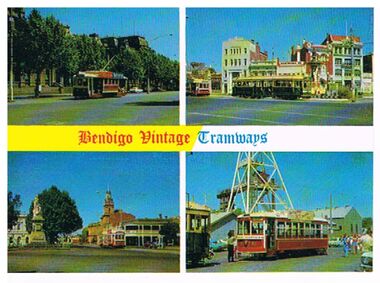 Bendigo Historical Society Inc.
Postcard - BENDIGO TRAMS - BENDIGO VINTAGE TRAMWAYS
... Tram Service. No. 30 at the Central Deborah Mine, this Birney is probably the oldest of its type to come to Australia. Built USA.' ' The Bendigo Trust, PO, Box 333...Tram Service. No. 30 at the Central Deborah Mine, this Birney is probably the oldest of its type to come to Australia. Built USA.' ' The Bendigo Trust, PO, Box 333, Bendigo, Australia, 3550' Postcard BENDIGO TRAMS - BENDIGO VINTAGE TRAMWAYS ...coloured postcard. 4 separate images showing views of trams in Bendigo streets, Pall Mall, Charing Cross, Alexandra Fountain, Deborah Mine. On back of card 'Post Card, The Rose Series Deluxe. No. 19, in front of Post Office and Civic Buildings, Built Duncan & Fraser, Adelaide, 1920, came to Bendigo 1935. No. 5 at Alexandra Fountain - built 1913 Adelaide. No. 25 at the Gold Monument, one of the first trams to start the Bendigo Tourist Tram Service. No. 30 at the Central Deborah Mine, this Birney is probably the oldest of its type to come to Australia. Built USA.' ' The Bendigo Trust, PO, Box 333, Bendigo, Australia, 3550'Rose Seriesbendigo, tramways, trams in street views, bendigo, alexandra fountain, charing cross, central deborah, post office, duncan and fraser, birney, tourism -
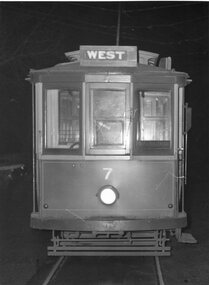 Ballarat Tramway Museum
Photograph - Black & White Photograph/s - set of 3, W.C. Meyer and Photographer, 1955
... Set of three photographs of Geelong single trams, one of the same type of tram (No. 7) prior to fitting with marker lights and No. 4 after fitting with marker lights, one during daylight and one at night. Three photographs taken by W.C. Meyer, Photographer, 333...333 Myers St. East Geelong, Phone 3289" and on rear of photos in dark blue ink, handwriting, 1872.1 - Night - with 'flash' photo. 1872.2 - Daylight 1872.3 - Night - with 'flash' photo. This tram...trams tramways Geelong Dash Canopy Lights Lights Mirrors tram 7 tram 4 All stamped with black ink stamp " W.C. Meyer, Photographer, 333 Myers St. ...Set of three photographs of Geelong single trams, one of the same type of tram (No. 7) prior to fitting with marker lights and No. 4 after fitting with marker lights, one during daylight and one at night. Three photographs taken by W.C. Meyer, Photographer, 333 Myers St. East Geelong, Phone 3289. Photo of one end of the tram only. Note top marker lights, not repeated on any other cars shown in photographs in Destination Eaglehawk. Shows as well, arrangements for tow bars, mirror and handrails. 1872.1 - Before fitting with additional lights, at night with 'flash' - showing destination 'West' - tram No. 7 1872.2 - after fitting with lights and stripes, during daylight - showing destination 'CITY' - tram No. 4 1872.3 - ditto at night, showing destination of 'CITY'. - tram No. 4 1872i4 - close up of the mirror and light on the roof - right hand side of i2. Note all lights illuminated in the night photo. Destination Eaglehawk, page 44, notes tram 4 as being fitted with dash canopy lighting and zebra stripes in 1955. No mention of No. 7 being so fitted. For date of photograph, assumed early 1955 at this time (14/11/2001) See Destination EaglehawkAll stamped with black ink stamp " W.C. Meyer, Photographer, 333 Myers St. East Geelong, Phone 3289" and on rear of photos in dark blue ink, handwriting, 1872.1 - Night - with 'flash' photo. 1872.2 - Daylight 1872.3 - Night - with 'flash' photo. This tram has supplementary lights trams, tramways, geelong, dash canopy lights, lights, mirrors, tram 7, tram 4 -
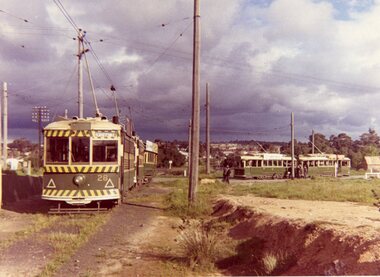 Ballarat Tramway Museum
Photograph - Colour Photograph/s, B. Groves?, 7/12/1962 12:00:00 AM
... On rear "Tram Tour Bendigo / Mr. B. Groves / 333 Pascoe Vale Road / Essendon W5 / Vict." ...Birney Bendigo North Bendigo tram 28 On rear "Tram Tour Bendigo / Mr. B. Groves / 333 Pascoe Vale Road / Essendon W5 / Vict." ...Colour print of five SECV Bendigo trams at the North Bendigo tram terminus during a 1962 tour. Tram 28 (Birney), another Birney and then three single truckers at the terminus. All have their poles turned to return to the City. Photo shows the nature of the location of the terminus; open paddocks. All trams have been fitted with dash canopy lights. Taken on AGFA paper. On rear is a stamped date "- 7.12.62", looks like a machine imprint.On rear "Tram Tour Bendigo / Mr. B. Groves / 333 Pascoe Vale Road / Essendon W5 / Vict." In top right hand corner is the number "1175" In the stamp appears " 110B / Photo / The? / -7.12.62"birney, bendigo, north bendigo, tram 28 -
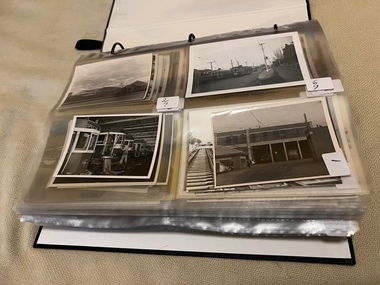 Melbourne Tram Museum
Album - Charles Craig - part 1 of 2, 1950s to 1970s
... CC14 W2 630 being washed at a depot – The Argus photo CC15 Royal Park line at Flemington Road – W2 355 and W5 786 CC16 Nicholson St track construction from a tram cab CC17 T181 on tour at Gordon St CC18 T181 on Maribyrnong Bridge CC19 Ditto at River St just off bridge CC20 As for CC18 CC21 At Raleigh Rd CC22 T181 at Footscray depot CC23 Track construction, Nicholson, just north of Gertrude CC24 Commissioning overhead Bourke St tram 988 CC25 Queens Parade – 997 and 994 CC26 Swapping trolley wheel to skid – commissioning CC27 Track construction in Gertrude St CC28 985 in Queens Parade running special CC29 997 in Queens Parade CC30 1033 at North Fitzroy – AETA Special CC31 Bourke St at Elizabeth St – has passengers on board CC32 W6 985, 996 Queens Parade, Mk 3 bus 333 CC33 As above CC34 Showing construction at Nicholson & Gertrude – Bourke St CC35 W2 223 on Burnley temporary bridge – VR track expansion CC36 W5 823 – ditto CC37 Tram on old bridge prior to removal CC38 W2 433 on temporary bridge with new bridge beams and old track CC39 Looking down showing temporary single track – Swan St CC40 Tait train passing under tram bridge CC41 SW6 on single line – off loading CC42 W2 547 at City Road Junction CC43 City Road Jtn – 1969 – 596 and 771 CC44 City Road Jtn – 1969 – 596 and 771 (same as CC45 438 in Flinders St CC46 355 somewhere CC47 552 somewhere CC47A 364 at Preston Workshops? ...CC14 W2 630 being washed at a depot – The Argus photo CC15 Royal Park line at Flemington Road – W2 355 and W5 786 CC16 Nicholson St track construction from a tram cab CC17 T181 on tour at Gordon St CC18 T181 on Maribyrnong Bridge CC19 Ditto at River St just off bridge CC20 As for CC18 CC21 At Raleigh Rd CC22 T181 at Footscray depot CC23 Track construction, Nicholson, just north of Gertrude CC24 Commissioning overhead Bourke St tram 988 CC25 Queens Parade – 997 and 994 CC26 Swapping trolley wheel to skid – commissioning CC27 Track construction in Gertrude St CC28 985 in Queens Parade running special CC29 997 in Queens Parade CC30 1033 at North Fitzroy – AETA Special CC31 Bourke St at Elizabeth St – has passengers on board CC32 W6 985, 996 Queens Parade, Mk 3 bus 333 CC33 As above CC34 Showing construction at Nicholson & Gertrude – Bourke St CC35 W2 223 on Burnley temporary bridge – VR track expansion CC36 W5 823 – ditto CC37 Tram on old bridge prior to removal CC38 W2 433 on temporary bridge with new bridge beams and old track CC39 Looking down showing temporary single track – Swan St CC40 Tait train passing under tram bridge CC41 SW6 on single line – off loading CC42 W2 547 at City Road Junction CC43 City Road Jtn – 1969 – 596 and 771 CC44 City Road Jtn – 1969 – 596 and 771 (same as CC45 438 in Flinders St CC46 355 somewhere CC47 552 somewhere CC47A 364 at Preston Workshops? ...Photo - see pdf file for further information. Number Brief Description CC1 S178 at Elsternwick level crossing track works CC2 Building East Preston Depot 1955 CC3 Camberwell depot – post WW2 – lots of trams and a black cat CC4 W2 584 and SW6 958 northbound – Chapel St and Brighton Road CC5 W2 357 – southbound, Chapel St Brighton Road CC6 Pascoe Vale Road, Raceday working – note the signal CC7 The Preston Workshops - The Argus, post WW2, 223, 647 et al CC8 923 or is it 922 being built at Preston – The Argus photo - CC8A 832 being positioned onto trucks at Preston after an overhaul – Argus Photo – see also CC306 CC9 Footscray depot` CC10 W5 797 in St Kilda Road during track works – 1950s CC11 W2 457 at Kew Post Office CC12 Wellington Parade – W2 432, 492 and 337 – special event CC13 Swan St line up of trams – football? Or other special event – Sinclair’s bus on the right side. CC14 W2 630 being washed at a depot – The Argus photo CC15 Royal Park line at Flemington Road – W2 355 and W5 786 CC16 Nicholson St track construction from a tram cab CC17 T181 on tour at Gordon St CC18 T181 on Maribyrnong Bridge CC19 Ditto at River St just off bridge CC20 As for CC18 CC21 At Raleigh Rd CC22 T181 at Footscray depot CC23 Track construction, Nicholson, just north of Gertrude CC24 Commissioning overhead Bourke St tram 988 CC25 Queens Parade – 997 and 994 CC26 Swapping trolley wheel to skid – commissioning CC27 Track construction in Gertrude St CC28 985 in Queens Parade running special CC29 997 in Queens Parade CC30 1033 at North Fitzroy – AETA Special CC31 Bourke St at Elizabeth St – has passengers on board CC32 W6 985, 996 Queens Parade, Mk 3 bus 333 CC33 As above CC34 Showing construction at Nicholson & Gertrude – Bourke St CC35 W2 223 on Burnley temporary bridge – VR track expansion CC36 W5 823 – ditto CC37 Tram on old bridge prior to removal CC38 W2 433 on temporary bridge with new bridge beams and old track CC39 Looking down showing temporary single track – Swan St CC40 Tait train passing under tram bridge CC41 SW6 on single line – off loading CC42 W2 547 at City Road Junction CC43 City Road Jtn – 1969 – 596 and 771 CC44 City Road Jtn – 1969 – 596 and 771 (same as CC45 438 in Flinders St CC46 355 somewhere CC47 552 somewhere CC47A 364 at Preston Workshops? CC48 W2 334 on Traverser – Preston Workshops CC49 Wellington pade – large line up of trams, c1950 925, and 611 CC50 W2 493 Franklin st – advertising for Savings Certificates CC51 Possibly 551 with advertising for fund raising for Blind institute CC52 249 at Hawthorn – Riversdale Junction – with a Tally Ho and Village Fair Aux. board CC53 MMTB Postcard of 511 CC54 Wattle Park terminus with Single line warning sign CC55 Wattle Park Duplication CC56 36 at Domain Junction – 833 CC57 36 at Domain Junction CC58 36 at Domain Junction with 810 and 833 CC59 36 in Swanston by Flinders St Station CC60 36 in Spencer St at A’Beckett CC61 36 crossing Collins St CC62 36 crossing Collins St CC63 36 northbound in St Kilda Road with Shrine in background CC64 36 northbound in Swanston St at Flinders St CC65 Postcard – Ballarat 36 in Domain Road CC66 Postcard - Stampshow – Hawthorn Horse tram CC67 Postcard - Stampshow – Peace cable tram CC68 Postcard - 1041 and cable car set 1 at Preston CC69 Postcard - Colins & Elizabeth – greetings from old Melbourne CC70 Postcard - Cable car set at Preston CC71 Postcard - Twentyman’s cable cars CC72 Postcard - Nu-color-vue – horse tram 256 CC73 Cable car set – Market & Flinders CC74 Cable trams at Twentymans’ in their shed CC75 Cable tram track at Bourke & Spencer prior to removal CC76 Cable tram bogie at Preston Workshops – used as a dolly CC77 Cable trams at Twentymans’ CC78 Postcard - Valentines – Bourke looking west from Swanston CC79 Postcard - Rose 3938 – Bourke at Swanston – the Leviathan building CC80 Postcard - Valentines – Elizabeth St looking south from Collins – No. 19 CC81 Postcard - Rose P4765 – Bourke St Melbourne CC82 Postcard - Rose 4090 – cable tram passing Parliament house CC83 Postcard - Valentines – GPO Elizabeth St CC84 Interior of cable trailer with clothing on a set CC85 Elizabeth St looking north CC86 Cigarette card - Collins St No. 41- WD HO Wills CC87 Postcard - Rialto building with cable set CC88 Postcard - Valentines - Swanston at Flinders looking north CC89 CC90 Q 150 Hanna St – dated on rear CC91 176 turning – photo ex Alan Jungworth CC92 161 on Princes Bridge – minimum fare 4d sign and Inspector CC93 459 at Point Ormond CC94 158 at Gordon St – side on view CC95 X 217 in Swanston St CC96 X 217 in Swanston St with an East Brighton destination CC97 T177 CC98 T177 Peel St – no destination roll – being transferred? CC99 X1 462 in Glenhuntly Road to Point Ormond CC100 X1 462 in Glenhuntly Road to Elsternwick Rly Station CC101 X1 462 in Glenhuntly Road to Point Ormond CC102 Q 150 Hanna St CC103 190 at Camberwell Depot CC104 T182 at Footscray CC105 X1 466 and W2 at Footscray CC106 190 at Camberwell Depot CC107 X1 467 Barkly St Footscray CC108 X2 679 turning into William St from La Trobe St CC109 X2 677 Glenhuntly Road with Point Ormond Destination CC110 Postcard T180 CC111 Postcard format – X1 467 on a truck – see also CC178 CC112 Postcard format – X1 467 at Wantirna South CC113 Q200 and SW6 896 at Thornbury – has labels on rear CC114 T177, Ballarat Road – has labels on rear CC115 T178 at Point Ormond CC116 Postcard X1 465 and 466 CC117 Postcard – X2 676 CC118 Postcard – TMSV X2 217 CC119 810 on temporary bridging – 24-12-67 CC120 W2 575 – Queens Parade junction in, still temporary bridging, substation under construction CC121 Forming Queens Parade Junction base slab CC122 W2 596 prior to tramway works – all tracks still in position CC123 It’s a mass of reinforcing – bridging being formed CC124 Looking north with substation being built CC125 Looking east with some rather tight curves, Wellington St still in use CC126 SW6 958 ex Wellington St with all tracks and signal box and buildings. CC127 Victoria Pde at Gisborne looking east – at least 4 cars CC128 SW6 893? With dash canopy lights and SW6 862 and a man with a newspaper CC129 SW6 894 on the S curves, with tram in Wellington St CC130 Similar photo CC131 W2 564 turning into Wellington St – the concrete tracks are not that old CC132 W2 552 running out of Wellington St CC133 W5 732 from Fitzroy St into St Kilda Road with next iteration in position – very wonky CC134 W5 764 turning into Fitzroy St CC135 SW6 947 turning from Wellington St CC136 W2 586 running out of High St CC137 W2 500 turning into Wellington St CC138 W2 543 in Wellington St inbound CC139 L103 with St Kilda Junction destination, and a tower truck on right CC140 Workmen – new track in Queensway in use CC141 Ditto CC142 L103 in Queensway, and another car in bound CC143 Looking east along Wellington St which has been taken out of use. Also a MMTB Roller CC144 W5 824 and a W2 and all types of wobbly temporary track CC145 W2 354 to High St CC146 Sw6 947 on the S bends CC147 W2 500 looking north – tram on the S bends CC148 SW6 896 leaving the S bend CC149 W2 357 and a MMTB City bus with trees/gardens on the side CC150 W5 817 Elliot Ave – see also CC302 CC151 W2 552 – note the large trolley bridge CC152 W2 550 at depot or workshops CC153 1B truck CC154 SW2 432 CC155 W2 155 at Glenhuntly CC156 SW6 937 on AETA tour? CC157 X2 677 on Footscray service – Ballarat Rd? CC158 W2 641 – High St Kew? CC159 SW6 847 – Power St Hawthorn CC160 Simpson St – big line up CC161 W2 546 truck No. 1? CC162 W2s at Glenhuntly depot CC163 No. 15 truck under 899 CC164 206 and other junk at Preston Workshops CC165 W in Swanston St Melbourne – Rose series card CC166 Y1 613 Batman Ave?? or William St at Collins CC167 Tram plans CC168 X 217 Swanston St – see also 95 and 96 CC169 217 in Swanston St – same as 95 CC169A 192 in St Kilda Road at Princes bridge CC170 192 in St Kilda Road at Princes bridge CC171 Bendigo 3 arriving Malvern depot – being unloaded CC172 Ditto CC173 T180 at a depot CC174 X1 463 wheel set CC175 C30 – dog car side view – close up CC176 C30 dog car CC177 206 and 30 at Preston Workshops CC178 X1 467 on a truck – see CC111 also CC179 42 CC180 42 at a depot, no destination box CC181 W2 556 1A type truck CC182 Flinders St Station – Rose Series CC183 W7 1035 Spring – Nicholson St CC184 W7 1022 MMTB Post Card CC185 Adelaide 178 – has on rear – R. Lilburn 4/82 CC186 Adelaide 175 – has on rear – R. Lilburn 4/82 CC187 Y1 610 on AETA tour CC188 Y1 610 on AETA tour with large group – Point Ormond CC189 AETA display – has GH55-32 in pencil on rear CC190 AETA display – has GH55-29 in pencil on rear CC191 Y1 610 on AETA tour with large group – Point Ormond CC192 VR 53 at Footscray CC193 VR cars 40 and 34 at Elwood wash dock CC194 W7 1024 as the 1970 Christmas tram CC195 Geelong – loading a set of 22E trucks CC196 Geelong 10 and 23 running an AETA special CC197 Geelong – AETA special CC198 Geelong 7 at Junction CC199 Geelong 10, in the city CC200 Geelong 33 with Belmont destination CC201 Geelong 15 Eastern Park destination 29-3-1948 CC202 Geelong 23 at Railway Station – 29-3-1948 CC203 Geelong 23 at Railway Station – 29-3-1948 CC204 Geelong – loading a bogie tram CC205 Geelong – loading a bogie tram CC206 Geelong 40 – loaded on truck CC207 Geelong 40 – on jacks CC208 Geelong 40 on jacks – 19 behind CC209 Geelong 38 with two workers on either side CC210 – 214 Australian Historic Tramways stamp folder and set CC215 Bendigo 17 at depot – has dup JBS on rear CC216 Bendigo 20, 29 bogie and straight sill car at Charing Cross CC217 Bendigo one man bogie Pall Mall CC218 Bendigo – Bogie 23, other cars and welding truck at depot CC219 Bendigo 7 with Quarry Hill destination CC220 Bendigo 21 with Lake Weerona destination CC221 ESCo 18 Ballarat CC222 Ballarat bogie 22 on AETA special CC223 Ditto CC224 Ballarat 34 at Stones Corner – R Lilburn CC225 Ballarat 15 in Bridge St – R Lilburn CC226 Ballarat 40 at Gardens – R Lilburn CC227 Ballarat 37 running out of depot – R Lilburn CC228 Postcard – Valentines – Sturt St with loaded horse tram trailer CC229 AETA Geelong tram tour ticket – 29-3-1948 CC230 Postcard – Geelong – Valentine 2114 – T&G building CC231 Postcard – PMTT ! – High St Malvern CC232 Postcard – Empire – Glenferrie Road, Malvern at Wattletree Rd CC233 Postcard Y469, MMTB CC234 Postcard Z2 Spring St CC235 Postcard – Z1 MMTB CC236 Postcard – Stamp Show W1 431 CC237 Postcard – Stamp show B2005 CC238 Postcard – Stamp show W6 982 CC239 Postcard – Valentines 1264 – Johnstone Park with tram in distance CC240 Postcard – Rose 10711 – Swanston and Lonsdale – Hospital and W232 CC241 Postcard – Rose 4827 – Fitzroy St St Kilda W2 362 and 548 CC242 Postcard – Valentines – 939 – St Kilda War Memorial, W and a R? CC243 Postcard – Valentines – 572 – St Kilda War Memorial, W 413 and 140? CC244 Postcard – Valentines – 938 – Uper and Lower Esplanade – L 104 CC245 Postcard – St Kilda Rd at Princes Bridge Y1 and W CC246 Postcard – Biscay BG82 – W5 814 - CC247 Postcard – Biscay 796112 – Bourke St looking west CC248 Postcard – Biscay 796109 – Bourke St looking east CC249 Postcard – Biscay 2AUS58 – Z5 Bourke St CC250 Postcard – Biscay BG 249 – Swanston St CC251 Postcard – National View – St Kilda Rd – shrine and Prince Henrys W2 405 CC252 Postcard – Nu color vue – 11 ML 156 – St Kilda Rd CC253 Postcard – Nu color vue – 11 ML 153 – Swanston St CC254 Postcard – Nu Color vue – Collins St 442 CC255 Postcard – Pitt card – Adelaide – H 364 at Victoria St CC256 Postcard – SPER L/P 154 CC257 Postcard – BTMS – 550 CC258 Postcard – SPER – Brisbane 295 CC259 Adelaide 131 at Burnside – has R Lilburn on card, c1911 CC260 Adelaide 194 CC261 Adelaide 235, with two crew, The News photo CC262 Rockhampton, outside post office – has source of photo details CC263 Sydney – 2086 and 2062 arriving Circular Quay CC264 Sydney – P class – Pitt St? CC265 Sydney – 1610 at Circular Quay CC266 Brisbane 99 and 468 CC267 Sydney with bridge behind CC268 Steam tram Paramatta Park – 103 CC269 Sydney – Museum Station =- Elizabeth St CC270 Sydney – weed burner 137S at a loop Demonstrates the work of Charles Craig in photography and collection of prints.Assembled album in a black presentation folder of 270 photographs from the Charles Craig Collection - 86 sleeves - part 1 of 2. All photographs have been scanned and placed on the Museum's G drive. A list of all photographs with details where possible has been compiled. Victorian Provincial, Launceston, Hobart and Sydney tram photos have been transferred to other Museums, image files retained.melbourne, tramways, tramcars, trams, charles craig, st kilda junction, trackworks -
 Melbourne Tram Museum
Album - Folder, Public Transport Corporation (PTC), "MMTB Electric Tramways", c2000
... Providing GA drawings of the following: R1146 – General Data of Tramcars – 24-9-1924 PMTT 160 - PMTT Bogie closed car (O class) PMTT 161 - PMTT Combination car PMTT 162 – Summer car (old type) – F class PMTT 163 - PMTT Bogie car PMTT 164 – Summer car – G class PMTT – 700 – Bogie Car with dropped centre compartment and longitudinal rattan saloon seats R2461 – class W – W class converted to W2 R2460 – class W1 R2459 – class W2 R2462 – class X R2464 – class Y R2463 – class X1 R2465 - class Y1 R3071 - class W3 R3076 - class A R3077 - class G R8617 - class Sw6 and W6 R3078 - Class C R3080 – Class X2 R3093A - Class T R3812 - class W4 R4382 - class T - arrangement for one man operation R4646 - class Sw2 R4678B - class W5 R4771A - Class SW6 R5818 - class SW5 R5963 - class A - One man Coburg type R6928 - PCC Car - double end operation (based on a USA drawing) R7416 - class L R8332 - PCC Type car (980) R8999 - Class A tramcar Coburg type original R9601 - class CW5 R9529 - class W7 R9622 - Proposed SW6 car with front entrance R9980 - Freight car 17 R10-129 - class VR R11-333 - Class Z1 and Z2 trams R11-387 - class Z 0 outside dimensions R11-580 - class Z3 tram R12-052 - class W5 sliding door conversion R12-062 - class A tram Articulated tram - class B2...Providing GA drawings of the following: R1146 – General Data of Tramcars – 24-9-1924 PMTT 160 - PMTT Bogie closed car (O class) PMTT 161 - PMTT Combination car PMTT 162 – Summer car (old type) – F class PMTT 163 - PMTT Bogie car PMTT 164 – Summer car – G class PMTT – 700 – Bogie Car with dropped centre compartment and longitudinal rattan saloon seats R2461 – class W – W class converted to W2 R2460 – class W1 R2459 – class W2 R2462 – class X R2464 – class Y R2463 – class X1 R2465 - class Y1 R3071 - class W3 R3076 - class A R3077 - class G R8617 - class Sw6 and W6 R3078 - Class C R3080 – Class X2 R3093A - Class T R3812 - class W4 R4382 - class T - arrangement for one man operation R4646 - class Sw2 R4678B - class W5 R4771A - Class SW6 R5818 - class SW5 R5963 - class A - One man Coburg type R6928 - PCC Car - double end operation (based on a USA drawing) R7416 - class L R8332 - PCC Type car (980) R8999 - Class A tramcar Coburg type original R9601 - class CW5 R9529 - class W7 R9622 - Proposed SW6 car with front entrance R9980 - Freight car 17 R10-129 - class VR R11-333 - Class Z1 and Z2 trams R11-387 - class Z 0 outside dimensions R11-580 - class Z3 tram R12-052 - class W5 sliding door conversion R12-062 - class A tram Articulated tram - class B2 Yields information about the MMTB fleet including scrapped trams and their General Arrangement. ...Providing GA drawings of the following: R1146 – General Data of Tramcars – 24-9-1924 PMTT 160 - PMTT Bogie closed car (O class) PMTT 161 - PMTT Combination car PMTT 162 – Summer car (old type) – F class PMTT 163 - PMTT Bogie car PMTT 164 – Summer car – G class PMTT – 700 – Bogie Car with dropped centre compartment and longitudinal rattan saloon seats R2461 – class W – W class converted to W2 R2460 – class W1 R2459 – class W2 R2462 – class X R2464 – class Y R2463 – class X1 R2465 - class Y1 R3071 - class W3 R3076 - class A R3077 - class G R8617 - class Sw6 and W6 R3078 - Class C R3080 – Class X2 R3093A - Class T R3812 - class W4 R4382 - class T - arrangement for one man operation R4646 - class Sw2 R4678B - class W5 R4771A - Class SW6 R5818 - class SW5 R5963 - class A - One man Coburg type R6928 - PCC Car - double end operation (based on a USA drawing) R7416 - class L R8332 - PCC Type car (980) R8999 - Class A tramcar Coburg type original R9601 - class CW5 R9529 - class W7 R9622 - Proposed SW6 car with front entrance R9980 - Freight car 17 R10-129 - class VR R11-333 - Class Z1 and Z2 trams R11-387 - class Z 0 outside dimensions R11-580 - class Z3 tram R12-052 - class W5 sliding door conversion R12-062 - class A tram Articulated tram - class B2Yields information about the MMTB fleet including scrapped trams and their General Arrangement.Album or Set of 41 A4 sheets, photocopied with the title "MMTB Electric Tramways". See also item 5639 and 4714 for other similar sets of drawings.trams, tramways, drawings, tramcars, tramcar design, preston workshops, mmtb
