
Showing 10 items matching "transport lanterns"
-
 Orbost & District Historical Society
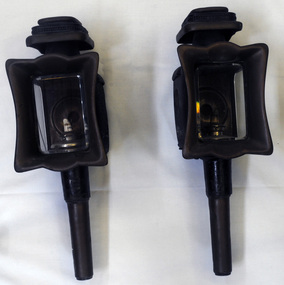
buggy lamps, 1880's -1910
... lighting kerosene-lights buggy-lamps transport lanterns...Lamps are placed at different places on the carriage sides: 1 lamp on each side placed close to box seat These lanterns are examples of lighting devices used in the time of horse and carriage transport. lighting kerosene-lights buggy-lamps transport lanterns On ceramic wick holder - B in the middle of BARTONS B Underneath is TRADE MARK Two kerosene lanterns - buggy lamps.They are rectangular in shape and have a chimney on top. ...In the beginning of the19th century, the main mode of transportation was the horse and carriage. Even after the advent of the railway, remote areas still relied on the horse for local transport.Until Australian coachbuilders began making buggies from the 1860s, most were made in America Buggies with four wheels were light but comfortable. Many had hoods to keep the sun and rain off passengers. They were generally owned by doctors, ‘squatters’ and business people. Some had small turn-out seats at the back for children. Lamps are placed at different places on the carriage sides: 1 lamp on each side placed close to box seatThese lanterns are examples of lighting devices used in the time of horse and carriage transport.Two kerosene lanterns - buggy lamps.They are rectangular in shape and have a chimney on top. Both have carrying handles.There are 3 glass windows having two clear white lights and one small red round light on the back. The ceramic burner is made by Barton's.On ceramic wick holder - B in the middle of BARTONS B Underneath is TRADE MARK lighting kerosene-lights buggy-lamps transport lanterns -
 Emerald Museum & Nobelius Heritage Park
Functional object - Buggy Lamps, circa 1880
... ...transport lanterns...Buggies were generally owned by doctors, business people and wealthier people. buggy lamps transport lanterns No discernible markings Pair of buggy lamps made of black sheet metal - almost square-shaped with carrying handles and chimneys on top of the lamps. ...Buggy lanterns are examples of lighting devices used in the horse and carriage era of transport. More remote areas like Emerald would have continued to use them after the advent of the railway. Buggies were generally owned by doctors, business people and wealthier people.Pair of buggy lamps made of black sheet metal - almost square-shaped with carrying handles and chimneys on top of the lamps. Glass window in the front of the lamps and small, red round light in back. No apparent inscriptions. Donated by local collector, Bill Black.No discernible markingsbuggy lamps, transport lanterns -
 Parks Victoria - Point Hicks Lightstation
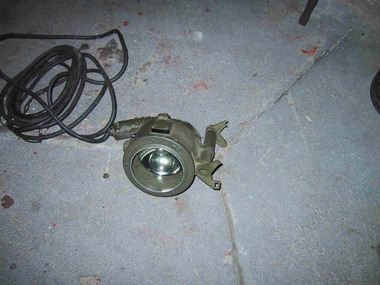
Lamp, Aldis
... PHLS0007.1 "D^D / LANTERN PORTABLE SIGNALLING / ADMIRALITY No 5110D / SERIAL No 5482 YEAR 943 / AMALGAMATED WIRELESS / A ASA LTD / 9792-100" •PHLS0007.2 "20 K4 transporting lantern / admirality pattern no 91108"... PORTABLE SIGNALLING / ADMIRALITY No 5110D / SERIAL No 5482 YEAR 943 / AMALGAMATED WIRELESS / A ASA LTD / 9792-100" •PHLS0007.2 "20 K4 transporting lantern / admirality pattern no 91108" PHLS0007.1 Hand held signal light. ...This portable, hand held visual signalling lamp was used for optical communication via Morse code. It comprises the metal encased Aldis lamp with electrical cord and its associated green-painted, hinged wooden carrying case, which has a metal clasp and leather hand grip. Larger versions of these lamps are fixed on ships or pedestals and have shutters on the front that are opened and closed to transmit signals. Smaller hand held versions like the Point Hicks example have a concave mirror that is tilted to focus the light into pulse signals via a trigger. The lamps were pioneered by the British navy in the late nineteenth century and continue to be used to the present day.317 Details on the Point Hicks lamp include a serial number and other information. Another Aldis lamp and case remaining at Cape Nelson Lightstation dates to 1960 and has the initials of the Department of Transport, which at that time incorporated the Commonwealth Lighthouse Service. Wilsons Promontory also has an Aldis lamp and case that dates from around the same year. A lamp formerly at Cape Schanck has disappeared. The Aldis lamp and associated case at Point Hicks has first level contributory significance for its historic values and provenance to the lightstation. PHLS0007.1 Hand held signal light. Painted metal trigger with attached black electrical leads with battery terminals at end. Inscriptions on metal of lantern. PHLS0007.2 Hinged lid, wooden box painted army green to house signal light. Metal plate with inscription on front of box.PHLS0007.1 "D^D / LANTERN PORTABLE SIGNALLING / ADMIRALITY No 5110D / SERIAL No 5482 YEAR 943 / AMALGAMATED WIRELESS / A ASA LTD / 9792-100" •PHLS0007.2 "20 K4 transporting lantern / admirality pattern no 91108" -
 Parks Victoria - Wilsons Promontory Lightstation
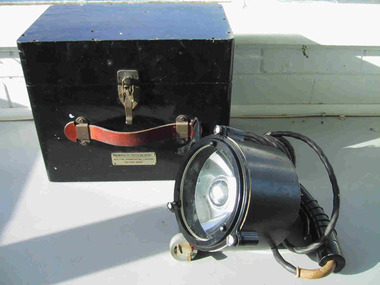
Lamp, Aldis
... Black painted wooden box for transporting lantern. brass catch, leather handle. ...ADMIRALTY PATTERN 16409 / BOX FOR TRANSPORTING LANTERN / PATTERN 16409" Inside box on side of metal insert attached to inside of box;"EXTRA LOW VOLTAGE TRANSFORMER / MADE BY / M.Brodribb, Melbourne/ cat & APP / No v/QR / 1811A / 50 / 60 va / CONT. 55 c / RATIO 240, 12 V TAPS " Top of metal box on sticker;"C of A / D.O.T 143076 / 12 V 5A" On Bakelite plug on metal box;"EXTRA LOW VOLTAGE"...Black painted wooden box for transporting lantern. brass catch, leather handle. ...The lamps were pioneered by the British Navy in the late nineteenth century and introduced by the Royal Australian Navy after 1918, and continue to be used to the present day. Manufactured in 1960, the Wilsons Promontory lamp was provided to the lighthouse by the Department of Shipping for signalling ships but was also used for communicating with Cliffy Island, 18 nautical miles away. This type of lamp was renowned for its brilliant light, and lightkeepers from the two lightstations ‘used to practice their signalling with each other, as its effective use was reliant on precise positioning of the scope which is located on top of the lamp’. The inside of the case is imprinted with ‘RAN (Royal Australian Navy), and details on the lamp include a serial number, the date of 1960 and the initials of the Department of Transport, which at that time incorporated the Commonwealth Lighthouse Service. Another Aldis lamp and case with a date of 1960 is held at Cape Nelson and third lamp and case is at Point Hicks; (date unconfirmed but possibly 1943). A fourth lamp and case formerly at Cape Schanck disappeared from the collection sometime between 1995 and 2003.Aldis lamp and case (WPLS 0003.2; likely provenance) The lamps are not rare in museum collections however the Wilsons Promontory example has a confirmed provenance to the lightation and has first level contributory significance as a fine example of the Aldis lamps that were distributed to lightstations throughout Victoria and Australia.1. Handheld black signaling lantern with trigger mechanism. Glass front with inner reflective disc. Black electrical cord is attached with a two pronged plug at the end. 2. Black painted wooden box for transporting lantern. brass catch, leather handle. Grey electrical cord inside plus transformer. Hinged lid. The Aldis lamp is portable, hand held visual signalling lamp with trigger mechanism and inner reflective disk used for optical communication via Morse code. The concave mirror is tilted to focus the light into pulse signals. Larger versions of the lamp are fixed on ships or pedestals and have shutters in front of the device that are opened and closed to transmit signals. Wilsons Promontory’s black metal Aldis lamp and attached electrical cord has a black painted wooden carrying case with metal clasp and leather hand grip.1. On trigger;"AP16413" Around V shaped protrusion attached to lamp "AP197873 / AEI .LTD 59" Beneath screw on face;"AD16415" Inside lamp, under glass;"ADMIRALTY PATTERN 16409 / 5 INCH HAND SIGNALING LANTERN SERIAL No. 212 Year 1960 / AEI PTY LTD SYDNEY" •2. Box. On brass plate below handle."ADMIRALTY PATTERN 16409 / BOX FOR TRANSPORTING LANTERN / PATTERN 16409" Inside box on side of metal insert attached to inside of box;"EXTRA LOW VOLTAGE TRANSFORMER / MADE BY / M.Brodribb, Melbourne/ cat & APP / No v/QR / 1811A / 50 / 60 va / CONT. 55 c / RATIO 240, 12 V TAPS " Top of metal box on sticker;"C of A / D.O.T 143076 / 12 V 5A" On Bakelite plug on metal box;"EXTRA LOW VOLTAGE" -
 The Beechworth Burke Museum
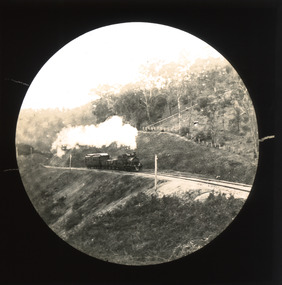
Photograph - Lantern Slide, c1900
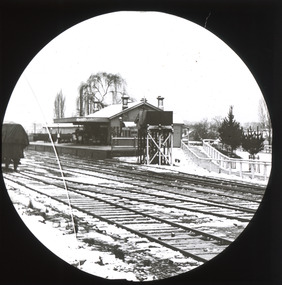
... Lantern Slide...Slide...Glass Slide...Plate...Burke Museum Collection...Photograph...Monochrome...indigo shire...north-east victoria...rail trail...beechworth rail trail...beechworth station...everton...wangaratta...wodonga...albury...rail transport...transporting nearly 12,000 passengers and around 6,500 tons of cargo in 1900. It closed in 1976 and is today used as a cycling trail used by locals and promoted as a feature of the area to tourists. Lantern...Lantern slides and magic lantern technologies are seen as foundational precursors to the development of modern photography and film-making techniques. This glass slide is significant because it provides insight into Beechworth's social amenities and transport infrastructure in the late Nineteenth Century. ...This slide shows a train proceeding along the Beechworth rail trail in approximately 1900. The rail line to Beechworth was the subject of significant lobbying by local officials such as John Orr and G.B. Kerferd in the 1860s, as it was recognised that the poor quality of roads to Melbourne and Albury hindered trade and formed a barrier to the social development of the town. The subsequent positioning of Beechworth on a branch rather than a main line was not considered ideal to achieve these aims, but the Everton-to-Beechworth and Beechworth-to-Yackandandah components of the line cost an average of £7,277 per mile and State Government officials felt the need in the area did not justify the cost of a direct line. The Beechworth Railway Station was officially opened on the 29th of September 1876 and ran services twice daily to Melbourne, transporting nearly 12,000 passengers and around 6,500 tons of cargo in 1900. It closed in 1976 and is today used as a cycling trail used by locals and promoted as a feature of the area to tourists. Lantern slides, sometimes called 'magic lantern' slides, are glass plates on which an image has been secured for the purpose of projection. Glass slides were etched or hand-painted for this purpose from the Eighteenth Century but the process became more popular and accessible to the public with the development of photographic-emulsion slides used with a 'Magic Lantern' device in the mid-Nineteenth Century. Photographic lantern slides comprise a double-negative emulsion layer (forming a positive image) between thin glass plates that are bound together. A number of processes existed to form and bind the emulsion layer to the base plate, including the albumen, wet plate collodion, gelatine dry plate and Woodburytype techniques. Lantern slides and magic lantern technologies are seen as foundational precursors to the development of modern photography and film-making techniques.This glass slide is significant because it provides insight into Beechworth's social amenities and transport infrastructure in the late Nineteenth Century. It is also an example of an early photographic and film-making technology in use in regional Victoria in the time period.Thin translucent sheet of glass with a circular image printed on the front and framed in a black backing. It is held together by metal strips to secure the edges of the slide.burke museum, beechworth, lantern slide, slide, glass slide, plate, burke museum collection, photograph, monochrome, indigo shire, north-east victoria, rail trail, beechworth rail trail, beechworth station, everton, wangaratta, wodonga, albury, rail transport, cargo transport, g.b. kerferd, john orr, murray to mountains rail trail, cycling, biking, railway -
 The Beechworth Burke Museum
Photograph - Lantern Slide, c1900
... Lantern Slide...Slide...Glass Slide...Plate...Burke Museum Collection...Photograph...Monochrome...Beechworth Railway Station...Railway Station...transport...Burke Museum Beechworth Lantern Slide Slide Glass Slide Plate Burke Museum Collection Photograph Monochrome Beechworth Railway Station Railway Station transport railway history railway Thin translucent sheet of glass with a circular image printed on the front and framed in a black backing. ...This slide shows an image taken in c.1900 of the Beechworth Railway Station. The Beechworth Railway Station was officially opened on the 29 of September 1876, to allow for quicker and easier transportation of goods and supplies from Beechworth to Melbourne via Everton and Wangaratta. The railway station was heavily used for transportation running two trains a day and was a vital link to Melbourne from it's opening until it's closure in 1976. Lantern slides, sometimes called 'magic lantern' slides, are glass plates on which an image has been secured for the purpose of projection. Glass slides were etched or hand-painted for this purpose from the Eighteenth Century but the process became more popular and accessible to the public with the development of photographic-emulsion slides used with a 'Magic Lantern' device in the mid-Nineteenth Century. Photographic lantern slides comprise a double-negative emulsion layer (forming a positive image) between thin glass plates that are bound together. A number of processes existed to form and bind the emulsion layer to the base plate, including the albumen, wet plate collodion, gelatine dry plate and Woodburytype techniques. Lantern slides and magic lantern technologies are seen as foundational precursors to the development of modern photography and film-making techniquesThis glass slide is significant because it provides insight into Beechworth's social amenities and religious infrastructure in the late Nineteenth Century. It is also an example of an early photographic and film-making technology in use in regional Victoria in the time period.Thin translucent sheet of glass with a circular image printed on the front and framed in a black backing. It is held together by metals strips to secure the edges of the slide.burke museum, beechworth, lantern slide, slide, glass slide, plate, burke museum collection, photograph, monochrome, beechworth railway station, railway station, transport, railway history, railway -
 The Beechworth Burke Museum
Photograph - Lantern Slide, c1900
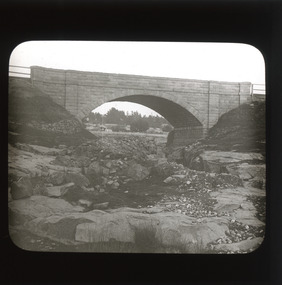
... Lantern Slide...Slide...Glass Slide...Plate...Burke Museum Collection...Photograph...Monochrome...Newtown Bridge...masonry...transport...Burke Museum Beechworth Lantern Slide Slide Glass Slide Plate Burke Museum Collection Photograph Monochrome Newtown Bridge masonry transport bridge granite Thin translucent sheet of glass with a square image printed on the front and framed in a black backing. ...Taken in c.1900 this image shows Newtown Bridge in Beechworth. Newtown Bridge is constructed with granite from the surrounding area and is a great example of the masonry work used in the construction of the town. This bridge has been listed by the National Trust as a significant object to the transportation history of Australia. Lantern slides, sometimes called 'magic lantern' slides, are glass plates on which an image has been secured for the purpose of projection. Glass slides were etched or hand-painted for this purpose from the Eighteenth Century but the process became more popular and accessible to the public with the development of photographic-emulsion slides used with a 'Magic Lantern' device in the mid-Nineteenth Century. Photographic lantern slides comprise a double-negative emulsion layer (forming a positive image) between thin glass plates that are bound together. A number of processes existed to form and bind the emulsion layer to the base plate, including the albumen, wet plate collodion, gelatine dry plate and Woodburytype techniques. Lantern slides and magic lantern technologies are seen as foundational precursors to the development of modern photography and film-making techniquesThis glass slide is significant because it provides insight into Beechworth's social amenities and religious infrastructure in the late Nineteenth Century. It is also an example of an early photographic and film-making technology in use in regional Victoria in the time period.Thin translucent sheet of glass with a square image printed on the front and framed in a black backing. It is held together by metals strips to secure the edges of the slide.burke museum, beechworth, lantern slide, slide, glass slide, plate, burke museum collection, photograph, monochrome, newtown bridge, masonry, transport, bridge, granite -
 Glen Eira Historical Society
Document - PRAHRAN AND MALVERN TRAMWAYS TRUST
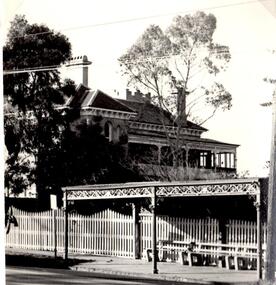
... Prahran and Malvern Tramways Trust P+MTT Tram companies Land transport Public transport Substation Tram shelter Powerhouse Parapet Brick Stuccoed Roof lanterns Historic Buildings register National Estate register National Trust Register Rusden Street Balaclava Road Orrong Road Hawthorn Road Dandenong Road Glen Huntly Road Grange Road Elsternwick Elsternwick Railway Station Caulfield Caulfield North Caulfield Railway Station Point Ormond Grimwade House Breydon Graeme Tramcar Edwardian Transport Trams Tram Depot Document PRAHRAN AND MALVERN TRAMWAYS TRUST ...This file has 3 items. 1/Photocopy of Caulfield Conservation Study Report by Andrew Ward dated January 1995 of 6-8 Rusden Street, Elsternwick being former Prahran and Malvern Tramways Trust substation. Report includes image, existing registrations, description of substation building and condition. 2/Original photograph (black and white) of tram shelter at corner of Balaclava Road and Orrong Road, Caulfield North, outside Grimwade House (school), description written on back of photo. 3/Original copy of magazine of the Tramway Museum Society of Victoria Ltd. ‘Running Journal’ Vol 7 No. 3 dated June 1970. Article (pages 3-7) entitled ‘Feeding & Filling, The Story of the Prahran & Malvern Tramways Trust’ written by Graeme Breydon. Article written for the 60th anniversary of the trust which opened for business on 30/05/1910 and describes the establishment and development of Tramways between suburbs of Malvern & Prahran including Elsternwick, Caulfield & Glen Huntly. Article includes 4 images plus map and diagram. Included: Photograph 3: Opening ceremony of tramway extension from Balaclava junction to Elsternwick railway station on Glen Huntly Road dated 13/11/1913. Diagram of various tramway routes including Prahran & Malvern Tramways Trust routes.prahran and malvern tramways trust, p+mtt, tram companies, land transport, public transport, substation, tram shelter, powerhouse, parapet, brick, stuccoed, roof lanterns, historic buildings register, national estate register, national trust register, rusden street, balaclava road, orrong road, hawthorn road, dandenong road, glen huntly road, grange road, elsternwick, elsternwick railway station, caulfield, caulfield north, caulfield railway station, point ormond, grimwade house, breydon graeme, tramcar, edwardian, transport, trams, tram depot -
 Surrey Hills Historical Society Collection
Photograph, Surrey Hills railway station on Empire Day in 1909
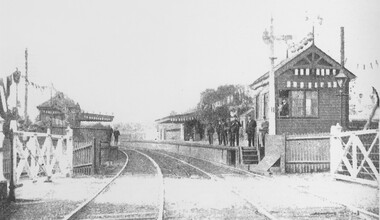
... Published in book 'Surrey Hills in Celebration of its Centenary: 1883-1983', compiled by the History Nook and edited by William Chandler. transport empire day railways surrey hills station mr tom keating mr j rasmussan Black and white photo of Surrey Hills railway station on Empire Day in 1909. Signal box and station are decorated with bunting and lanterns ...Man in the signal box is believed to be Mr J Rasmussan and the assistant stationmaster, Mr Tom Keating. Published in book 'Surrey Hills in Celebration of its Centenary: 1883-1983', compiled by the History Nook and edited by William Chandler.Black and white photo of Surrey Hills railway station on Empire Day in 1909. Signal box and station are decorated with bunting and lanterns. Gates are closed and there is a man in the signal box. There are approximately 9 men on the platforms including the stationmaster, assistant stationmaster, Mr Tom Keating and other railway officials.transport, empire day, railways, surrey hills station, mr tom keating, mr j rasmussan -
Emerald Museum & Nobelius Heritage Park
Functional object - Buggy Lantern
... Cousin to Jim & Peter Madigan Emerald Victoria Australia transport Patrick Madigan Jim Madigan Peter Madigan Blackhill Road British Made Small, black buggy lantern kerosene operated with wick red reflector glass Functional object Buggy Lantern ...discovered on Patrick Madigan's farm in Blackhill Road, Menzies Creek. Cousin to Jim & Peter MadiganSmall, black buggy lantern kerosene operated with wick red reflector glassBritish Madeemerald, victoria, australia, transport, patrick madigan, jim madigan, peter madigan, blackhill road
