
Showing 12 items matching "transport of sick and wounded"
-
 Orbost & District Historical Society
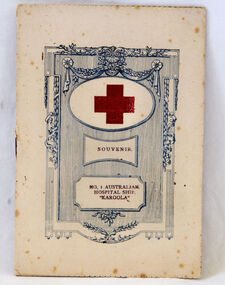
souvenir card, 1916
... It spent 3 years transporting the sick and wounded between England and Australia....It spent 3 years transporting the sick and wounded between England and Australia. souvenir Karoola World-War-One Drew-James hospital-ship Inside cover -"Trooper James Drew 2563" White card with blue decoration and red cross on front. ...His Majesty's Australian Hospital ship Karoola was converted in England to a fully equipped Hospital ship with beds for 463 patients. It spent 3 years transporting the sick and wounded between England and Australia.White card with blue decoration and red cross on front. A souvenir booklet for soldiers who returned home on the No.1 Australian Hospital Ship "Karoola".Inside cover -"Trooper James Drew 2563"souvenir karoola world-war-one drew-james hospital-ship -
 National Vietnam Veterans Museum (NVVM)
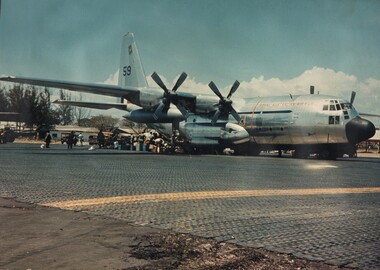
Photograph, Gibbons, Denis, C130 Hercules
... Probably the most important task of the aircraft was the medivac transport of wounded and sick Diggers back to Australia....Probably the most important task of the aircraft was the medivac transport of wounded and sick Diggers back to Australia. ...Denis Gibbons (1937 – 2011) Trained with the Australian Army, before travelling to Vietnam in January 1966, Denis stayed with the 1st Australian Task Force in Nui Dat working as a photographer. For almost five years Gibbons toured with nine Australian infantry battalions, posting compelling war images from within many combat zones before being flown out in late November 1970 after sustaining injuries. The images held within the National Vietnam Veterans Museum make up the Gibbons Collection. A colour photograph of RAAF C130 Hercules transport, operating between Australia and Vietnam and carrying passengers and supplies. Probably the most important task of the aircraft was the medivac transport of wounded and sick Diggers back to Australia.photograph, raaf, c-130 hercules, medivac, gibbons collection catalogue, wounded serviceman, denis gibbons, photographer, vietnam war, diggers -
 Returned Nurses RSL Sub-branch
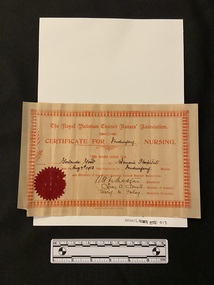
Certificate - Nursing Certificate, The Royal Victorian Trained Nurses' Association, August 7 1913
... Enlisting in 1914, she is primarily known for her dedicated service on hospital ships and sea transport sections bringing sick and wounded Australian troops home'. - Australian War Memorial website...Enlisting in 1914, she is primarily known for her dedicated service on hospital ships and sea transport sections bringing sick and wounded Australian troops home'. - Australian War Memorial website Gertrude Good Royal Victorian Trained Nurses Association Certificates nurse training 1913 Australian Army Nursing Serive 'Midwifery' [Handwritten in black ink on the second line] 'Gertrude Good' and 'Women's Hospital' [Handwritten in black ink on the fourth line] 'Aug 7th 1913' and 'midwifery' [Handwritten in black ink on the fifth line] '?' ...Certificate of Midwifery Nursing for Gertrude Good of the Women's Hospital on August 7th 1913. 'Gertrude Good was an Australian Army Nursing Service (AANS) Matron and Sister who served extensively during World War I. Enlisting in 1914, she is primarily known for her dedicated service on hospital ships and sea transport sections bringing sick and wounded Australian troops home'. - Australian War Memorial websiteCertificate stamped in red ink on pale brown paper, details are handwritten in black ink. There is a burgundy sticker seal in the lower left corner.'Midwifery' [Handwritten in black ink on the second line] 'Gertrude Good' and 'Women's Hospital' [Handwritten in black ink on the fourth line] 'Aug 7th 1913' and 'midwifery' [Handwritten in black ink on the fifth line] '?' [Illegible signature in lighter black ink next to the word 'President'] '? A. Jones' [Signed in lighter black ink next to the words 'Member of Council'] 'Mary M. Finlay' [Signed in lighter vlack ink next to 'Honorary Secretary']gertrude good, royal victorian trained nurses association, certificates, nurse training, 1913, australian army nursing serive -
 Wangaratta RSL Sub Branch
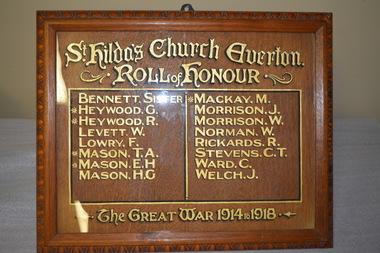
Honour Board - Framed Roll of Honour, St. Hilda's Church, Everton
... The following year she was appointed Matron of the hospital ship "Herefordshire" which transported sick and wounded soldiers from the mouth of the Tigris River to Bombay. ...The following year she was appointed Matron of the hospital ship "Herefordshire" which transported sick and wounded soldiers from the mouth of the Tigris River to Bombay. ...St Hilda's Church Everton, WW1 Roll of Honour - contains 16 names of members of the Everton Community in Victoria who served during the First World War including Nursing Sister Alma Louisa BENNETT (1890-1922) who trained at Melbourne General Hospital. She moved to Western Australia and continued nursing until the advent of World War 1. She immediately sought to enlist but was not granted her request until 1916 and was eventually sent for nursing duties in India. Her arrival coincided with the first convey of wounded after the fall of Kut in Mesopotamia. She was immediately given charge of a ward at Victoria Hospital. The following year she was appointed Matron of the hospital ship "Herefordshire" which transported sick and wounded soldiers from the mouth of the Tigris River to Bombay. Her next appointment was to the 34th Welsh Hospital at Deolali 150 miles from Bombay. The hospital was huge and she took charge as Matron. After 17 months at Deolali BENNETT was awarded the Royal Red Cross Medal First Class one of the highest distinctions in the British Nursing Service. When peace was declared she travelled to England where she continued to nurse in an Army Hospital. During her stay she was invited to Buckingham Palace where she was presented with Red Cross Medal by King George V. BENNETT returned to Victoria and was invited to join the nursing staff at Melbourne's Epworth Hospital with prospects of becoming Matron. Ill health intervened and she died in September 1922. Item said to be made by the family of Gilbert and Richard Heywood both KIA and listed on honour roll.St Hilda's Church Everton Honour Roll contains 16 names of members including Nurse BENNETT, from the Everton Community in Victoria who served in WW1 Carved timber frame and mounting with 16 names in gold coloured paint listed in two columns."St Hilda's Church Everton' "Roll of Honour" "The Great War 1914 to 1918" Sister Bennett/Heywood G/Heywood R/Levett W/Lowry F/Mason T.A/Mason E.H/Mason H.G/MacKay M/Morrison J/Morrison W/Norman W/Rickards R/Steens C.T/Ward C/Welch J.everton, 1914-1918, roll of honour -
 Montmorency–Eltham RSL Sub Branch
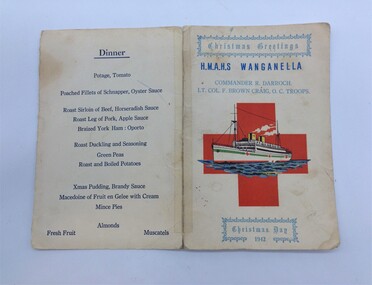
Functional object - Christmas Day Menu H.M.A.H.S. Wanganella
... Between 19 May 1941 and 1946, AHS Wanganella carried wounded and sick evacuees from the Middle East, New Guinea, Solomon Islands, Borneo and the South Pacific, travelling over 251,011 nautical miles (464,872 km) and transporting 13,385 wounded. ...Between 19 May 1941 and 1946, AHS Wanganella carried wounded and sick evacuees from the Middle East, New Guinea, Solomon Islands, Borneo and the South Pacific, travelling over 251,011 nautical miles (464,872 km) and transporting 13,385 wounded. ...During World War II, Wanganella was converted to serve as an Australian Hospital Ship (AHS). Between 19 May 1941 and 1946, AHS Wanganella carried wounded and sick evacuees from the Middle East, New Guinea, Solomon Islands, Borneo and the South Pacific, travelling over 251,011 nautical miles (464,872 km) and transporting 13,385 wounded. A.H.S Wanganella 2/2nd Australian Hospital ship. Ref: "Hospital Ships" Rupert Goodman SLV LT 359.8364 0994 G62H Trip 8 Depart 12th Nov 1942 Melbourne Fremantle Aden 10th - 11th Dec 1942 Port Tewfik, Egypt 21st - 22nd Dec 1942 Colombo, Sri Lanka 01 Jan 1943 Fremantle Adelaide Melbourne Sydney Arrived 13th Jan 1943 Brisbane Wanganella left Colombo 22nd December 1942 for Fremantle, with patients who boarded at Port Tewfik in Egypt arriving on New Year's day 1943. The menu is printed on fawn cardboard. The menu has been torn along the spine and rearranged at some time to put on display. There is evidence of glue or tape damage at the back of each corner of the card. Some grease and finger marks are evident on the front and back of the card. The printing is very legible. The heading 'Christmas Greetings' is at the top of the front page and 'Christmas Day 1942' at the bottom of the page. Originally the menu was assembled as a leaflet with the menu on the inside of the second sheet. Since this time, the menu has been torn along the middle fold and the second page sheet taped to the first page. There is a red cross on the front page with a printed illustration of the Wanganella superimposed over the top. H.M.A.H.S. Wanganella and the dinner menu are printed in dark blue ink. The Christmas greetings and the names of the commander and officer in command of the troops are printed in light blue ink. h.m.a.h.s. wanganella, w.w.ii hospital ship -
 Bendigo Historical Society Inc.
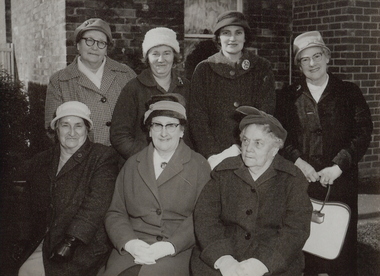
Photograph - Kangaroo Flat Red Cross Collection. Photo of seven Ladies Members 1961
... This expanded to the Voluntary Aid Detachments' (VAD) who cared for sick and wounded soldiers in hospitals or on transport ships. In 1929 the Red Cross Blood transfusion Service began. ...This expanded to the Voluntary Aid Detachments' (VAD) who cared for sick and wounded soldiers in hospitals or on transport ships. In 1929 the Red Cross Blood transfusion Service began. ...On 13/8/1914 Red Cross was set up in Victoria as a branch of the British Red Cross. This coincided with the outbreak of WW1. Its initial remit was to supply comforts packages for soldiers. This expanded to the Voluntary Aid Detachments' (VAD) who cared for sick and wounded soldiers in hospitals or on transport ships. In 1929 the Red Cross Blood transfusion Service began. After WW11 it continued to expand into all domestic and overseas humanitarian operations. The Kangaroo Flat group was first mentioned in the newspapers in August 1915.Black and white rectangle photograph. Edges have been hand cut. Back has description written in blue pen and copyright stamp. Ladies Red Cross Kangaroo Flat 1961, Sitting - Mrs Browning, Mrs Mitchell Sec + Tres, Mrs E Lanyon 90 years of age, 47 years continuous service to Red Cross. Standing - Mrs V Ryan, Mrs Freestone, Mrs Barber, Mrs Dower. Written on back - names of the seven ladies in the photo. Stamp on back - Copyright Not for Reproduction Herald Sun Photography. Grey lead inscription and sticker, location to be changed Folder 20 to Box 949 1125kangaroo flat, red cross, 1960s -
 Wangaratta RSL Sub Branch
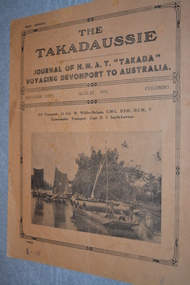
Booklet, The Takadaussie, August 1919
... sick and wounded soldiers. On the signing of the Armistice she made three trips carrying repatriated prisoners of war before transporting Australian troops home....sick and wounded soldiers. On the signing of the Armistice she made three trips carrying repatriated prisoners of war before transporting Australian troops home. ...The Takadaussie - Journal of H.M.A.T "Takada" voyaging Devonpart to Australia - Souvenir Copy August 1919 Colombo Built in 1914 by the British India Steam Navigation Company originally for the Indian-chinese trade. The Takada was used as a hospital ship making numerous trips with sick and wounded soldiers. On the signing of the Armistice she made three trips carrying repatriated prisoners of war before transporting Australian troops home.Beige and black booklet with photograph of three primitive barges surrounded by ornate borderhmat takada, the takadaussie, troopship, ww1 -
 Melton City Libraries
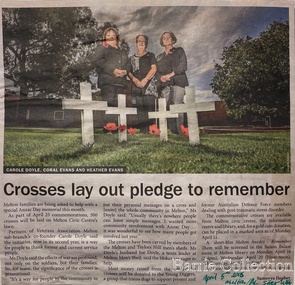
Newspaper, Crosses lay out pledge to remember, 2015
... sick and wounded soldiers. A depot was established in Melton to collect clothing and other ‘comfort’ items for the soldiers – including reading material, tobacco, linen, canned foods and soap – and to coordinate the branch’s work and activities. Local cab driver Percival Stubbs volunteered to transport...sick and wounded soldiers. A depot was established in Melton to collect clothing and other ‘comfort’ items for the soldiers – including reading material, tobacco, linen, canned foods and soap – and to coordinate the branch’s work and activities. Local cab driver Percival Stubbs volunteered to transport ..."The outbreak of World War I in August 1914 had an immediate impact on communities across Australia, and it was no different in Melton. Young men began enlisting immediately, and Australia’s initial offer of 20,000 troops was soon exceeded by Victorian enlistments alone. Over the four years of the war, approximately 114,000 Victorians enlisted and around 91,000 servicemen and women were sent overseas. They came not just from Melbourne, but from all over the state; from farms, small towns and suburban areas. They included locals, newly arrived migrants and Indigenous people. The Australian home front was a hive of activity throughout the war, and the Melton community played its part. Following the announcement that Australia was joining the war with Great Britain and its allies on 5 August 1914, the Melton community lost no time in launching into action. A meeting ‘to assist the Red Cross fund’ was held in the Melton Mechanics’ Institute hall on 18 August – just days after the outbreak of the war. Collectors were appointed for each corner of the shire and individual donations were made. A Melton branch of the Australian Red Cross Society was formed in June 1915 and focused its energies on raising funds to purchase material that was used to make clothes for sick and wounded soldiers. A depot was established in Melton to collect clothing and other ‘comfort’ items for the soldiers – including reading material, tobacco, linen, canned foods and soap – and to coordinate the branch’s work and activities. Local cab driver Percival Stubbs volunteered to transport all the packages to the Melton railway station, until he enlisted and departed for the front in 1916. Such were the numbers of people getting involved that branches were also established in Toolern Vale and Rockbank. Regular community events were held to farewell soldiers who were leaving on active service and to welcome those who returned home. Gunner Robert (Bob) Wynne, whose uncle’s family ran the general store in Toolern Vale, was presented with a pair of field glasses (binoculars), a gold watch, inscribed locket and autographed letter by the Toolern Vale community before he set sail for the front in 1916. His mother noted that he ‘sailed away in good spirits with a smile till out of sight’. From June 1915 to June 1919, the Melton Red Cross branch donated 2,156 pairs of socks, 1,357 shirts, 425 kit bags, 251 pillowslips, 224 towels and 121 pairs of pajamas. Countless fundraising events were held, including jumble fairs, concerts and gift evenings. Local schools also encouraged students to contribute through fund-raising and making and collecting comforts for the soldiers. People across the country engaged in similar activities, but Victoria’s rural communities found unique ways of contributing. In Melton, people were encouraged to send rabbits and hares ‘in good condition’ to an exporter in Spencer Street, for export to Belgium ‘for the relief of those suffering". Special Anzac Memorial article featured in the Star Weeklylocal identities, war -
 8th/13th Victorian Mounted Rifles Regimental Collection
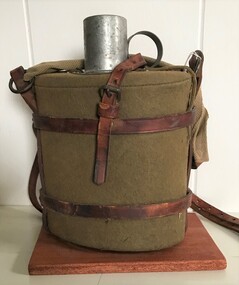
Functional object - water bottle
... It use stretchers or carts to retrieve the wounded and transport them to the Dressing Station. ...It use stretchers or carts to retrieve the wounded and transport them to the Dressing Station. ...This water bottle was carried by stretcher bearers in the Light Horse Field Ambulance. The cup/cap was used to give a drink to a wounded soldier who could not hold a water bottle to his lips. A light horse field ambulance was an Australian World War I military unit whose purpose was to provide medical transport and aid to the wounded and sick soldiers of an Australian Light Horse brigade. Typically a Lieutenant Colonel commanded each ambulance. All officers of the ambulance were medical doctors or surgeons. Dental units were often attached to the ambulance as well. A Field Ambulance consisted of two sections, the Mobile and the Immobile. The Mobile Section travel with its brigade into combat, where it would establish a Dressing Station. It use stretchers or carts to retrieve the wounded and transport them to the Dressing Station. The Immobile Section established and operated a Receiving Station, which received the wounded the Dressing Station sent on. The ambulance's surgeons would operate on the wounded at the Receiving Station. From the Receiving Station, the sick and wounded would go first to the Casualty Clearing Station and ultimately to a Base Hospital. Representative of a water bottle which differed from the regular water bottle and was used for a specific purpose.Water bottle, felt coated, with small metal cup over spout, all held in leather carrier. Strapped to a wooden stand.military, water, medical, light horse, ambulance, stretcher bearer -
 Royal District Nursing Service (now known as Bolton Clarke)
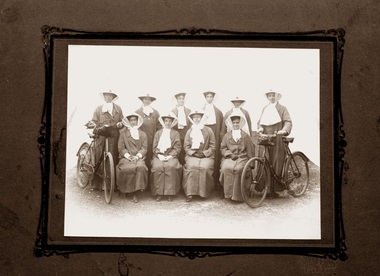
Photograph - Photograph, sepia, 1916
... transport used by MDNS at that time.. Nurses - Back - L-R - O'Sullivan, Deans, Warren, Amess, Pat Lee and Jane with bicycle Front - L-R - Blanche Wilson, Matron Janie Freeman, Peake and Brown. In February 1885, 50 years after Melbourne was founded, it was recognized that nursing care was needed for the sick poor in inner Melbourne. ...Matron Freeman and the MDNS Trained Nurses are wearing long grey coats and white pith helmets, which display a red Maltese cross.The Pith helmets are held on with a white veil. The two Bicycles with nursing bags attached to handlebars show the transport used by MDNS at that time.. Nurses - Back - L-R - O'Sullivan, Deans, Warren, Amess, Pat Lee and Jane with bicycle Front - L-R - Blanche Wilson, Matron Janie Freeman, Peake and Brown. In February 1885, 50 years after Melbourne was founded, it was recognized that nursing care was needed for the sick poor in inner Melbourne. The Melbourne District Nursing Society (MDNS) was founded with one Trained nurse (Nurse), and a second employed six months later. This was the first such service in Australia. They worked in the now CBD, ie from Spencer Street to Spring Street and from Victoria Parade to Flinders Street. From its inception the Society was at the forefront of health care. They provided high quality nursing care; educated their patients in the curing and prevention of disease; teaching the importance of cleanliness and good nutrition, both by verbal instruction and demonstration, even supplying soup and milk when needed. At that time they walked the streets and lane ways amid the slums of inner Melbourne carrying their nursing bag containing lotion ointments, powders, liniment, bandages, dressings, a case of spirits, and the Nurse's own clean apron. They loaned equipment, such as earthenware hot water bottles, splints, urinals, bed pans, bed cradles, feeding mugs, and air-cushions as well as providing clean bed linen and nightdresses as necessary. Trained Midwives began home births in August 1893 taking midwifery bundles and providing clothes for the babe as needed. This was arduous work, particularly in the heat of summer. Permission to use bicycles was given to the Nurses in 1898 and the Society decided to purchase their own in 1903. A business man offered ‘new free wheel’ bicycles at £13 each which included maintenance for one year. Bells and wooden frames were added, at a cost of £5 per frame, so the Nurses could carry extra equipment. Nurses’ bags were strapped to the handlebars. Soup was made for those in need 2-3 times a week and if patients could not arrange to have it collected the soup was delivered by the Nurses on their bicycles. The use of bicycles caused a change in uniform, with white pith helmets, and veils covering them and tied under their chin, now being used. In 1913 a Nurse had her Board and residence, uniforms, bicycles and laundry expensive provided and was paid £50 a year for her first six months. At the end of a year her salary is increased by £5, and later she earned £60 a year. Over the years the Nurses complained their veils became wet in the rain and asked for a change of uniform but this did not occur until 1921. Bicycles continued to be used in inner areas until 1945. From its inception the Society was at the forefront of health care and liaised with Doctors. They provided high quality nursing care to a range of people, often in destitute situations, some lying on rags on the floor as they had no bed, others with just a bed and maybe a thin blanket, a chair and nothing else. Their ages ranged from babes, children, adults to the elderly. The Nurses gave medications as ordered, dressed wounds e.g. to the injured, and surgical cases, and to those with leg ulcers; attended to patients with ‘surgical ailments’ such as ‘hip disease’; gave care to those with acute illnesses such as bronchitis, pleurisy, pneumonia, measles, and scarlet fever, as well as those with chronic illnesses such as consumption (tuberculosis), heart disease, arthritis, cancer, debility, neuritis and paralysis. They educated their patients, and their Carers, in the curing and prevention of disease; teaching the importance of hygiene, cleanliness, ventilation and good nutrition. They taught them, by verbal instruction and demonstration, how to make poultices, to make and apply bandages, apply medical appliances such as splints.Sepia photograph on brown card mount with 'Kirk Studio' on bottom right of the card. The photograph shows Matron Freeman and nine Melbourne District Nursing Society (MDNS) Trained nurses, (Nurses), with bicycles. The back row of six Nurses are standing and the Nurses either end are holding bicycles which have leather oblong nursing bags attached to the handlebars with two straps. The front row are seated. All are wearing the MDNS uniform of long dark coats and white helmets, with white scarves covering them and tied under their chins. A Maltese cross can be seen in the centre of the helmets. Both bicycles have two large wire spoked wheels at either end of the black V shape bicycle frame; a rubber tyre runs around the outside of each wheel. The metal handlebars are a horizontal configuration and are attached with a central column into a black vertical column at the front of the V shape bicycle frame which has 'fork shaped' thin metal pierces running down either side of the wheel attaching the frame to the central hub of the wheel. The rear wheel is attached the same way to a central column at the rear of the frame which runs up to V shape solid seat. At the bottom of the V of the frame a pedal is attached with a rotating arm on either side of the bicycle and on the right side the rotating arm is attached to a sprocket which has a chain running around it back to a smaller sprocket on the hub of the back wheel. The chain has a thin metal guard over it. There are narrow thin metal mud guards running a short distance above the top of each wheel.Photographer's embossed stampmdns, melbourne district nursing society, mdns uniforms, mdns transport, mdns matron, rdns, royal district nursing service, nurse blanche wilson, nurse pat lee, nurse deans, nurse o'sullivan, nurse warren, nurse amess, nurse peak, nurse brown, matron janie freeman -
 Royal District Nursing Service (now known as Bolton Clarke)
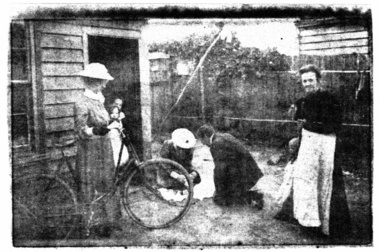
Photograph - Photograph, black and white, c.1905
... transport purchased by MDNS in 1903. The Nurse's bag is seen strapped to the handles of the bicycle. In February 1885, 50 years after Melbourne was founded, it was recognized that nursing care was needed for the sick poor in inner Melbourne. ...This photograph shows Melbourne District Nursing Society (MDNS) Trained Nurses (known as 'Nurse' in those days) attending to a family in the early 1900s. It also shows their uniform which had a red Maltese cross in the centre of the pith helmet. The bicycle seen is the first mode of transport purchased by MDNS in 1903. The Nurse's bag is seen strapped to the handles of the bicycle. In February 1885, 50 years after Melbourne was founded, it was recognized that nursing care was needed for the sick poor in inner Melbourne. The Melbourne District Nursing Society (MDNS), the first District Nursing Society in Australia, was founded and the decision was made to only employ fully qualified nurses who had trained in a Hospital. In those days they were known as 'Nurse'. One Trained nurse, was employed in March, and a second employed six months later. They worked in the now CBD, ie from Spencer Street to Spring Street and from Victoria Parade to Flinders Street. From its inception the Society was at the forefront of health care and only attended patients seen by a Doctor. They provided high quality nursing care; educated their patients in the curing and prevention of disease; teaching the importance of cleanliness, ventilation and good nutrition, both by verbal instruction and demonstration, even supplying soup and milk when needed. At that time they walked the streets and lane ways amid the slums of inner Melbourne carrying their nursing bag containing lotion, ointments, powders, liniment, bandages, dressings, a case of spirits, and the Nurse's own clean apron, soap and small towel. They supplied equipment on loan, such as earthenware hot water bottles, splints, urinals, bed pans, bed cradles, feeding mugs, and air-cushions as well as providing blankets and clean bed linen, and nightdresses as necessary. Trained midwives began home births in late 1893 taking midwifery bundles and providing clothes for the babe and mother as needed. This was arduous work, particularly in the heat of summer. Permission to use bicycles was given to the Nurses in 1898 and the Society decided to purchase their own in 1903. A business man offered ‘new free wheel’ bicycles at £13 each which included maintenance for one year. Bells and wooden frames were added, at a cost of £5 per frame, so the Nurses could carry extra equipment. Nurses’ bags were strapped to the handlebars. Soup was made for those in need 2-3 times a week and if patients could not arrange to have it collected the soup was delivered by the Nurses on their bicycles. The use of bicycles caused a change in uniform, with white pith helmets, and veils covering them and tied under their chin, now being used. Over the years the Nurses complained their veils became wet in the rain and asked for a change of uniform but this did not occur until 1921. Bicycles continued to be used in inner areas until 1945. The Nurses provided high quality nursing care to a range of people often in destitute situations, some lying on rags on the floor as they had no bed, others with just a bed and maybe a thin blanket, a chair and nothing else. Their ages ranged from babes, children, adults to the elderly. The Nurses gave medications as ordered by a Doctor, dressed wounds e.g. to the injured, and surgical cases, and to those with leg ulcers; attended to patients with ‘surgical ailments’ such as ‘hip disease’; gave care to those with acute illnesses such as bronchitis, pleurisy, pneumonia, measles, and scarlet fever, as well as those with chronic illnesses such as consumption (tuberculosis), heart disease, arthritis, cancer, debility, neuritis and paralysis. The Nurses liaised with the person's Doctor. They educated their patients, and their Carers, in the curing and prevention of disease; teaching the importance of hygiene, cleanliness, ventilation and good nutrition. They taught them, by verbal instruction and demonstration, how to make poultices, to make and apply bandages, apply medical appliances such as splints; and the Nurses supplied milk, beef tea and cooked soup when needed. As the work increased a third Nurse was employed but this was arduous work, particularly in the heat of summer and many Nurses only remained with the Society for several months. Black and white photograph of two Melbourne District Nursing Society (MDNS) Trained nurses, 'Nurse', wearing their full length grey uniforms, with white collar, cuffs and belt, and white pith helmets with a Maltese cross applied. One Nurse is standing and holding her bicycle, while the other is kneeling and holding a small child. They are in the garden behind a horizontal weatherboard house. A man dressed in dark clothes is also kneeling beside the child. There is a child, dressed in white, in the doorway of the home, and a lady, dressed in a full length black dress and a white apron, is standing in front of the wooden fence in the garden. The bicycle has two large wire spoked wheels at either end of the black V shape bicycle frame; a rubber tyre runs around the outside of each wheel. The metal handlebars are a horizontal configuration and are attached with a central column into a black vertical column at the front of the V shape bicycle frame which has ‘fork shaped’ thin metal pierces running down either side of the wheel attaching the frame to the central hub of the wheel. The rear wheel is attached the same way to a central column at the rear of the frame which runs up to V shape solid seat. At the bottom of the V of the frame a pedal is attached with a rotating arm on either side of the bicycle and on the right side the rotating arm is attached to a sprocket which has a chain running around it back to a smaller sprocket on the hub of the back wheel. The chain has a thin metal guard over it. There are narrow thin metal mud guards running a short distance above the top of each wheel.melbourne district nursing society, mdns, mdns uniforms, mdns transport, rdns, royal district nursing service -
 Returned Nurses RSL Sub-branch
Book - Hardcover book, Big Sky publishing, Shadows on the track: Australia's medical war in Papua 1942-1943: Kokoda - Milne Bay - The Beachhead Battles, 2019
... ...transport of sick and wounded...2/6 Australian Army Field Ambulance Australian Army medical care transport of sick and wounded medical aspects of war PapuaNew Guinea World War 1939-1945 WWII WW2 Kokoda Milne Bay Beachhead The Australian Army was woefully unprepared to fight a medical war in Papua and the soldiers paid the price. ...The Australian Army was woefully unprepared to fight a medical war in Papua and the soldiers paid the price. Almost 30,000 soldiers suffered from illness and tropical diseases, and an estimated 6000 were killed or wounded during the six-month campaign. These statistics have traditionally been represented as unavoidable consequences of fighting a war in a place such as Papua. This book disputes that narrative. Death and disease were inevitable outcomes, but the scale of the suffering was not. The medical challenges presented in Papua were extreme - they were not insurmountable. Shadows on the Track considers a wide range of issues that impacted on the health of the Australian soldiers before, during and after the Papuan campaign was fought and won. The strengths, successes, shortcomings and failures of the medical campaign are identified, analysed and evaluated. The focus on the front-line medical personnel - the men of the field ambulance units - brings a new perspective to the battles of the Kokoda Track, Milne Bay and the Beachheads. [taken from Trove record]Hardcover with dark purple dust jacket. Title printed in white along the spine and a white spine label sticker at the base. The front cover shows an image of three men carrying another man on a stretcher through thick mud. The lower half of the cover shows the title details in large white print.non-fiction The Australian Army was woefully unprepared to fight a medical war in Papua and the soldiers paid the price. Almost 30,000 soldiers suffered from illness and tropical diseases, and an estimated 6000 were killed or wounded during the six-month campaign. These statistics have traditionally been represented as unavoidable consequences of fighting a war in a place such as Papua. This book disputes that narrative. Death and disease were inevitable outcomes, but the scale of the suffering was not. The medical challenges presented in Papua were extreme - they were not insurmountable. Shadows on the Track considers a wide range of issues that impacted on the health of the Australian soldiers before, during and after the Papuan campaign was fought and won. The strengths, successes, shortcomings and failures of the medical campaign are identified, analysed and evaluated. The focus on the front-line medical personnel - the men of the field ambulance units - brings a new perspective to the battles of the Kokoda Track, Milne Bay and the Beachheads. [taken from Trove record]2/6 australian army field ambulance, australian army medical care, transport of sick and wounded, medical aspects of war, papuanew guinea, world war 1939-1945, wwii, ww2, kokoda, milne bay, beachhead
