
Showing 17 items matching "transportation to england"
-
 Whitehorse Historical Society Inc.
Newsletter - Whitehorse Historical Society Newsletters 1983, 1983
... ...Transportation to England...Railways Christmas in the Bush Ash Wednesday 1983 Bushfires Coach & Mail Routes Transportation to England Mitcham Railway Station Newsletters published in 1983. ...Newsletters published in 1983. Featuring articles on: 100 years of railways in the Eastern suburbs Christmas in the Bush Ash Wednesday 1983, bushfires Planned Tesselated Tile history Farming, drought Coach & Mail Routes, Melbourne to Lilydale, 1862-1976 Transportation to England, 1900-1975 Three Weeks at Port Arthur Post Box, Mitcham Railway StationTyped newsletters non-fiction Newsletters published in 1983. Featuring articles on: 100 years of railways in the Eastern suburbs Christmas in the Bush Ash Wednesday 1983, bushfires Planned Tesselated Tile history Farming, drought Coach & Mail Routes, Melbourne to Lilydale, 1862-1976 Transportation to England, 1900-1975 Three Weeks at Port Arthur Post Box, Mitcham Railway Station railways, christmas in the bush, ash wednesday 1983, bushfires, coach & mail routes, transportation to england, mitcham railway station -
 Flagstaff Hill Maritime Museum and Village
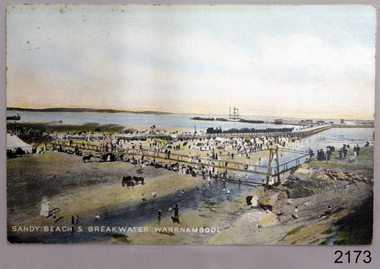
Postcard - Coastal Scene, Joseph Jordan, Sandy beach & breakwater Warrnambool, 1910
... England and is one of the Jordan Series produced by Joseph Jordan, a renowned photographer in Victoria's Western District. The postcard is locally significant as a record of the early footbridge over the Merri River, and the Viaduct before the space between the pylons was filled it. It shows the use of horses as a means of transportation ...The coloured postcard depicts the Port of Warrnambool in the early 1900s. It shows the Breakwater, completed in 1890, the Viaduct, and the Merri River footbridge. There are many people on the sandy river banks, beach and bridge, and some are on the rocks of Middle Island. The printed postcard was made in England and is one of the Jordan Series produced by Joseph Jordan, a renowned photographer in Victoria's Western District. The postcard is locally significant as a record of the early footbridge over the Merri River, and the Viaduct before the space between the pylons was filled it. It shows the use of horses as a means of transportation. The photograph is also associated with Joseph Jordan, a renowned Victoria's Western District photographer. Postcard, coloured, showing the Port of Warrnambool. People are gathered on the sandy beach beside the river and near the river mouth. They are on and below the footbridge, along with several horses. Some are on the rocky Middle Island. There is a white ship in port. There is a jetty on the left, and buildings at the start of the breakwater. An inscription is printed at the bottom of the picture. The picture is one of the Jordan Series. It was printed in England in 1910. "SANDY BEACH & BREAKWATER AT WARRNAMBOOL" "JORDAN SERIES" "PRINTED IN ENGLAND" "1910" warrnambool, shipwreck coast, flagstaff hill, flagstaff hill maritime museum, flagstaff hill maritime village, postcard, merri river, footbridge, warrnambool breakwater, breakwater, viaduct, middle island, port of warrnambool, jordan series, printed in england, 1910, joseph jordan, jordan photography -
 The Beechworth Burke Museum
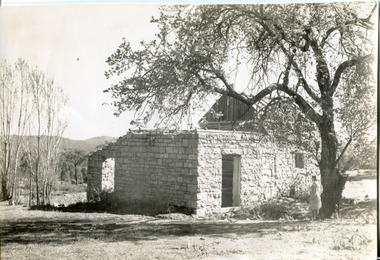
Photograph, Approximately 1930
... England in 1832. After coming to Australia in 1849, Brewer worked in various forms of livestock transportation. ...England in 1832. After coming to Australia in 1849, Brewer worked in various forms of livestock transportation. ...Taken in approximately 1930, this photograph depicts the ruins of Rosehill Dairy. A woman stands beside the ruins, observing them solemnly. The owner of this once prominent dairy, John Brewer, was born in Cornwall, England in 1832. After coming to Australia in 1849, Brewer worked in various forms of livestock transportation. Upon hearing of the vast discovery of gold in Victoria's north-east, he engaged in mining in the Ovens Goldfield district before starting his own dairy on Wooragee road (now Old Wooragee road). The Wooragee Valley, approximately five kilometres north of Beechworth, was used extensively during the nineteenth century to build farming practices in the area, possessing eighteen farms by 1860. Brewer enjoyed a prosperous career in the dairy industry, personally delivering milk to the residents of Beechworth. He died on the thirteenth of August 1915, a few weeks shy of his eighty-third birthday. As this photograph is dated approximately fifteen years later, it can be assumed that the dairy fell into neglect following his death. This photograph is historically significant as it provides insight the development of the dairy industry in Beechworth in the second half of the nineteenth century. Black and white square photograph printed on matte photographic paper Reverse: 1997.2912 / John Brewers / Rosehill / Dairy / top of the 'rising sun' / john brewer, 1930 beechworth, rosehill dairy, dairy industry beechworh, dairy factories beechworth, dairying, dairy farm beechworth, wooragee road, wooragee valley, old wooragee road, dairy farm ruins -
 Flagstaff Hill Maritime Museum and Village
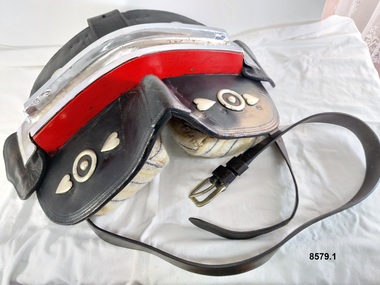
Equipment - Show Harness, R. Mitchell, Saddler, Early to mid-20th century
... transportation. Flagstaff Hill Maritime Museum and Village Warrnambool Great Ocean Road Shipwreck Coast harness horse harness show harness Clydesdale horses Andy Bourke horse drawn cart housen bridle hames breeching straps dropper bit Liverpool bit backband harness ornamentation bellyband back saddle fly terret Saddle - "R.MITCHELL / SADDLER" Hames - "MADE IN ENGLAND / WARRANTED / STEEL" "MADE IN ENGLAND / WARRANTED / unclear" Breeching Straps - "R. ...The early settlers of Victoria depended on horse drawn vehicles to farm, make roads and railways, deliver produce and transport people. Horse harnesses were an important requisite for all drivers and could be found wherever there were working horses. Horse Harnesses have played an essential role in different cultures throughout history. Simple, utilitarian horse harnesses made of leather straps and iron rings were being used in early China before AD 500 as well as ancient Greece and Rome, allowing horses to pull chariots and ploughs. The Greeks and Romans were the first to use a "horse collar" which distributed the weight of the harness evenly across the horse's chest rather than relying on a "throat harness" that could damage a horse's throat or choke them. During the medieval period, European horse harnesses became more elaborate and decorative. Variations of different horse harnesses were also found in Native American and Middle Eastern cultures. Horse Harnesses usually have four basic components which include - 1. Communication - the bridle, bit and reins allows the driver to communicate instructions and commands to the horse, guiding its movement and direction. 2. Draft - the collar, hame straps, hames, traces and chains enables the horse to draw and pull the load efficiently by distributing the weight and transferring the pulling force to the vehicle. 3. Stopping - the breeching band, pole straps and breast strap helps to control or stabilise the horse and vehicle when moving downhill or stopping. 4. Support - the back pad, backband, belly band and back saddle keep the harness in the correct position and proper alignment. This show harness was used by Mr. Andy Bourke when showing his Clydesdales at shows or demonstrations. Although a more modern example with decorative embellishments, it still has many essential components traditionally found in an everyday working horse harness. The original purpose of the "housen" for example, was to run rain or drizzle off the horse's neck when they had to work in wet conditions - it was laid flat for this purpose on the top of the collar. Nowadays it is purely for show and is often used to advertise a business or stud. Horse brasses and fly terrets were fastened to various parts of a horse's harness. In the early days they probably began as amulets to ward off evil and to bring good luck and continued to be used as a festive decoration. The heyday of horse brasses was between the years 1851 and 1900. Horse brasses are fastened to various parts of the harness with many of their designs being symbolic. The ornamentation on this harness (although not authentic horse brasses) are based on the horse brasses that were popular in the 19th century. This horse harness is a significant example of the equipment that was needed wherever heavy horses were being used - particularly in the early years of Victoria's settlement by white settlers. Harnesses such as this example were used with stage coaches, drays, farming equipment, delivery carts and personal transportation. A leather and metal horse harness used when showing a Clydesdale (or other breed of heavy horse). It is made up of a number of components. 1. Decorative leather cart saddle with two large cloth pads underneath (which have a scalloped leather and stud border), a raised leather pommel and a silver and red coloured metal back strap holder across the top. It has two symmetrical sets of ornamentation (silver hearts and circles) in the front and a wide strap or girth (with a maker's stamp reading "R. Mitchell Saddler") and buckle which attaches the saddle to the horse. 2. Pair of steel hames which are gently curved (to fit on a horse collar) and are topped with steel knobs. They have several steel rings and lugs (to hold straps and chains) and a "Made in England Warranted Steel" stamp. 3. Breeching harness which consists of a number of leather straps, chains and metal rings including a wide padded leather strap with a scalloped edge that sits on the back of the horse and a thick leather strap that goes around the hind quarters of a horse which is joined to the back strap with four shorter vertical straps and buckles. These straps feature silver and red patent leather trim and silver heart shaped ornamentation. The strap also features the maker's stamp of "R. Mitchell". 4. Decorative leather bridle with blinkers featuring the same silver and red patent leather trim on the cheek piece, brow band and throatlatch. It has a stainless steel "Liverpool Driving Bit" with a curb chain, a variety of decorative silver ornaments (rosettes, diamonds plus a heart and two circles) on each end of the forehead band, dropper and strap as well as a silver metal bell (sometimes known as a "fly terret" or "swinger") that sits on the headpiece of the bridle. 5. Leather "violin shaped" dropper (or hanger) with two silver rosette shaped ornaments and a stainless steel clip on the top 6. Stainless steel "Liverpool Driving Bit" with a straight mouthpiece which is ribbed on one side. It has three rein spots (spaces) and a curb chain. 7. Leather arch shaped "Housen" covered in black and red patent leather and decorated with silver studs (some spelling out F H) and bordered with a red fringe. It has a leather strap at the back and two leather loops on the front. 8. Leather padded backband (Australian style "Stallion Draught Roller") decorated with two groups of nine metal "horse brasses" or harness ornaments displaying horseshoe, starburst and horse head designs on blue, red and white striped webbing. The backband has three notched straps at each end, a buckle near the centre and the initial B stamped in two places underneath. 9. Bellyband made of leather and red, white and blue striped webbing. It has a set of three buckles at each end (which correspond with the notched straps of the backband). 10. Wide, thick leather strap which has a buckle and notches at each end. It also has the maker's stamp of "R. Mitchell Saddler". 11.One pair of long leather traces - each with a buckle and notched loop at one end, decorated with a small silver diamond shaped harness ornament. 12. Length of stainless steel heavy duty chain with two swivel connectors. Saddle - "R.MITCHELL / SADDLER" Hames - "MADE IN ENGLAND / WARRANTED / STEEL" "MADE IN ENGLAND / WARRANTED / unclear" Breeching Straps - "R. MITCHELL / MAKER / R. MITCHELL MAKER" Housen - "F H" Backband "B / B' Wide leather strap - "R. MITCHELL / SADDLER" flagstaff hill maritime museum and village, warrnambool, great ocean road, shipwreck coast, harness, horse harness, show harness, clydesdale horses, andy bourke, horse drawn cart, housen, bridle, hames, breeching straps, dropper, bit, liverpool bit, backband, harness ornamentation, bellyband, back saddle, fly terret -
 City of Moorabbin Historical Society (Operating the Box Cottage Museum)
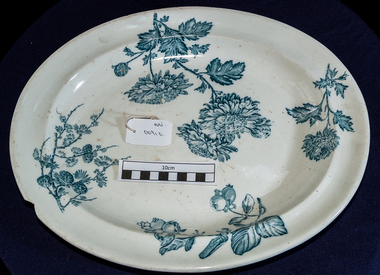
Kitchen Equipment, china meat platter, c1900
... transportation costs and the demanding journey from the Far East meant that the supply of chinaware could not keep up with increasingly high demand. In 1812 Wedgwood produced their own bone china which, though not a commercial success at first eventually became an important part of an extremely profitable business. china pottery crockery england moorabbin bentleigh cheltenham kitchenware wedgwood josiah On base ; CHRYSANTHEMUM / i / W / 7 / WEDGWOOD An oval white china platter with blue flowers and fruit. ...Wedgwood was founded on 1 May 1759 by Josiah Wedgwood and in 1987 merged with Waterford Crystal to create Waterford Wedgwood, an Ireland-based luxury brands group. After the 2009 purchase by KPS Capital, Wedgwood became part of a group of companies known as WWRD Holdings Ltd, an acronym for "Waterford Wedgwood Royal Doulton." In 1765, Josiah Wedgwood created a new earthenware form which impressed the then British Queen consort Charlotte of Mecklenburg-Strelitz who gave permission to call it "Queen's Ware"; this new form sold extremely well across Europe. Wedgwood developed a number of further industrial innovations for his company, notably a way of measuring kiln temperatures accurately and new ware types Black Basalt and Jasper Ware. Wedgwood's most famous ware is jasperware. It was created to look like ancient cameo glass. It was inspired by the Portland Vase, a Roman vessel. Wedgwood had increasing success with hard paste porcelain which attempted to imitate the whiteness of tea-ware imported from China. High transportation costs and the demanding journey from the Far East meant that the supply of chinaware could not keep up with increasingly high demand. In 1812 Wedgwood produced their own bone china which, though not a commercial success at first eventually became an important part of an extremely profitable business. An oval white china platter with blue flowers and fruit. Back is marked WEDGWOOD CHRYSANTHEMUM On base ; CHRYSANTHEMUM / i / W / 7 / WEDGWOOD china, pottery, crockery, england, moorabbin, bentleigh, cheltenham, kitchenware, wedgwood josiah -
 Kiewa Valley Historical Society
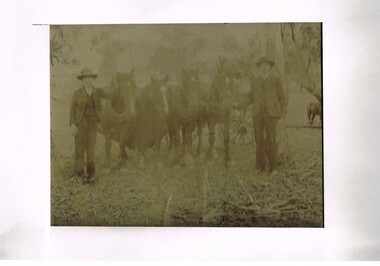
Photograph (Digital) Harnessing Horses, Harnessing Working Horses early 1900, early 1900s
... transportation routes where dirt roads with potholes. The significance of a local pioneer "family" encapsulated by this photograph cannot be reproduced as effectively in any other form. "orange grove " property early tawonga life style john cooper paddy cullen harnessing working horses on the reverse side hand written(in pencil) "John Cooper & Paddy Cullen (itinerant worker) on grandfathers place (opposite Nesta Drews place) (orange Grove). "Grandfather emigrated from England ...This copy of an original photograph created in the early 1900s details the "horse and cart" era when the normal transportation of the day was, in this rural setting, exclusively by horse and cart. The importance of this particular photograph to the subjects can be seen by the formal suits worn by both subjects.The natural bush and grassed backdrop have not been "touched up". The dray behind the horses is barely visible (fog like aperture). The lad , John Cooper was 14 years old when this photograph was taken. Both were in the process of harnessing four horses to "hook up" on the dray behind them. From their attire it looks like a trip to town or "the church". This photograph of life on a rural property in the early 1900 shows the rough and hard (physically) life in rural areas before great mechanical revolution/evolution post World War II. This was a time in the Kiewa Valley when most transportation was by horse drawn carriages and transportation routes where dirt roads with potholes. The significance of a local pioneer "family" encapsulated by this photograph cannot be reproduced as effectively in any other form. This digitised scanned copy of an original photograph of four work horses is on 200gms Fujicolor (Fujifilm) Crystal Archive paper has a silver side on which the image has been printed and a matt reverse side.The darker slightly "blurred" image has had a white frame placed over it at the time of encapsulation to provide the finished photo with a frame. This method highlights and focuses the view into the photograph. It is a clever way to permit the eyes to focus into the image to give it a greater third dimensional aspect. on the reverse side hand written(in pencil) "John Cooper & Paddy Cullen (itinerant worker) on grandfathers place (opposite Nesta Drews place) (orange Grove). "Grandfather emigrated from England with Ryders" "orange grove " property, early tawonga life style, john cooper, paddy cullen, harnessing working horses -
 Kiewa Valley Historical Society
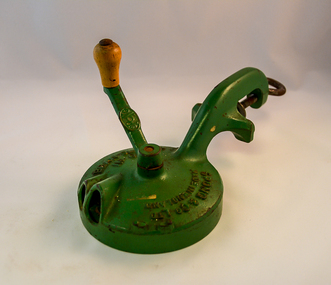
Slicer Bean, early 1900's
... This large bean slicer was first manufactured in the late 1800's in England and exported to Australia. Due to the transportation costs it was not used in many Domestic kitchens. ...This large bean slicer was first manufactured in the late 1800's in England and exported to Australia. Due to the transportation costs it was not used in many Domestic kitchens. ...This large bean slicer was first manufactured in the late 1800's in England and exported to Australia. Due to the transportation costs it was not used in many Domestic kitchens. This slicer would have been in a kitchen of a higher socio/economic family within the Kiewa Valley. In the 1930's the manufacturer traded this slicer as "domestic labour-saving slicers". This was the beginning of new generation of the kitchen "gadget". The introduction of the Asian "gadget" manufacturer from the late 1950's saw English export diminish by the cheaper Asian products. This item has great significance because it demonstrates that even "remote rural" locations, such as the Kiewa Valley in the early 1900s still were able to optain "state of the art" labour saving "kitchen" appliances. It was these English and European goods that were made "to last" which brought the mind set "British is best" This mindset was only altered by periods of Australian economic down turns and the cheap Asian product availability This bean slicer is made from cast iron with a round body housing three rotating blades screwed into a riveted spinning base plate. The whole body of this slicer is green with a "natural coloured" handle. A "G" clamp is part of the main frame to fasten the slicer onto a table/counter top (when in use). On the side of the handle and along the top plate "SPONG & Co Ltd" and opposite "BEAN SLICER" below this "No 633" domestic kitchen time savers, food processors, bean slicers -
 Royal Australian and New Zealand College of Obstetricians & Gynaecologists (RANZCOG)
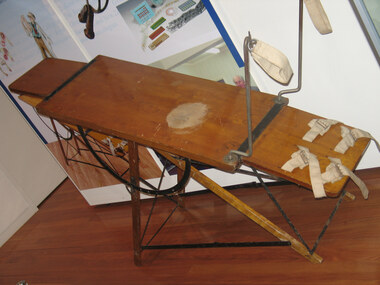
Portable operating table used by Sir Victor Bonney, Allen & Hanburys, England, c. 1900
... transportation and re-assembly. Portable operating table used by Sir Victor Bonney Allen & Hanburys, England ...This operating table belonged to the famous gynaecological surgeon Dr Victor Bonney and was given to Dr Frank Forster in 1953 by his widow Mrs Annie Bonnie, a distant relative of Forster's. Dr Victor Bonney (1872 - 1953) followed his father into medicine and trained at St Bartholomew's and the Middlesex Hospitals. Writing his obituary in 1953, FW Roques said of Bonney that he "'made three great gifts to surgery. First, he was the pioneer of myomectomy; second, with Berkeley, he extended and perfected Wertheim's operation for carcinoma of the cervix; and third, he devised a fine surgical technique emulated by so many of his pupils. To theatre sisters, labour-ward sisters and young house-surgeons he will always be remembered as the discoverer of 'Bonney's Blue' [antiseptic solution].'" Bonney's utilitarian, portable operating table has a round, worn scrubbed patch showing traces of his famous blue solution. This portable operating table was owned and used by pioneering gynaecological surgeon Sir Victor Bonney in London, U.K. c 1900. Dr Bonney employed two theatre sisters and had two sets of instruments and portable operating tables. This made it possible for Dr Bonney to 'complete three or more operations a day by rotating staff and equipment with a chauffeur driven Lanchester or Rolls Royce', delivering them from one house to the next. The donor of the operating table, the late Dr Frank Forster, was a distant relative of Sir Victor Bonney's widow, Annie Appleyard, formerly of Tasmania. When he visited her in the UK after Bonney's death, she offered the operating table to Dr Forster for the RANZCOG Museum. It was still in a canvas bag in the boot of one of Bonney's cars. Sir Victor Bonney was the pioneer of myomectomy, the surgical procedure for removing uterine fibroids. In collaboration with Berkeley, he extended and perfected Wertheim's operation for carcinoma of the cervix. Bonney was an influential teacher, developing and promoting conservatism of surgical technique (minimal intervention) that has had a lasting influence in modern surgical practice. To theatre-sisters, labour-ward sisters and young house-surgeons he will always be remembered as the discoverer of Bonney's Blue an antiseptic that was characteristically blue. Portable, laminated operating table. Plywood rectangular table with two laminated plywood extensions, a head board, and a foot board. At the foot board are insets of canvas straps to support a patient's ankles. Two detachable stirrup poles, each with a canvas strap attached, fit into two holes at the lower end of the table. The table is supported by two timber trellis cross braces with metal bars, and supported at the centre by a metal rod that allows the table to pivot up and down. Two metal arcs with a locking mechanism fix the table at the desired elevation, allowing a Trendelenburg tilt ( a 45 degree tilt, with the patient's head downwards.) The operating table is demountable for transportation and re-assembly. obstetric delivery -
 National Wool Museum
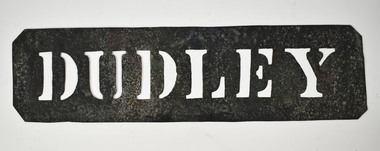
Stencil - DUDLEY
... transportation of wool bales. Dudley is a large industrialised market town and administrative centre in England. ...transportation of wool bales. Dudley is a large industrialised market town and administrative centre in England. ...This stencil was used as a location stamp for the transportation of wool bales. Dudley is a large industrialised market town and administrative centre in England. Wool bales marked DUDLEY would have been transported to Dudley by sea. Wool bale export stencil - DUDLEY DUDLEY wool sales, wool transportation, wool export -
 National Wool Museum
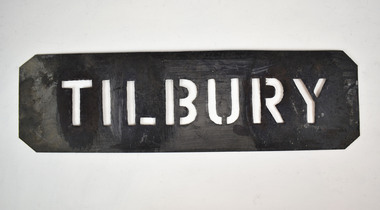
Stencil - TILBURY
... transportation of wool bales. Tilbury is a port located on the River Thames at Tilbury in Essex, England. ...transportation of wool bales. Tilbury is a port located on the River Thames at Tilbury in Essex, England. ...This stencil was used as a location stamp for the transportation of wool bales. Tilbury is a port located on the River Thames at Tilbury in Essex, England. Wool bales marked TILBURY would have been transported to England by sea. Wool bale export stencil - TILBURY TILBURY wool - transportation, wool sales, wool class, wool classers -
 National Wool Museum
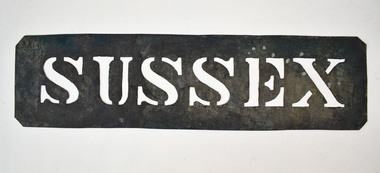
Stencil - SUSSEX
... This stencil was used as a location stamp for the transportation of wool bales. Sussex is a historic county in South East England. ...This stencil was used as a location stamp for the transportation of wool bales. Sussex is a historic county in South East England. ...This stencil was used as a location stamp for the transportation of wool bales. Sussex is a historic county in South East England. Wool bales marked SUSSEX would have been transported to England by sea. Wool bale export stencil - SUSSEX SUSSEX wool - transportation, wool sales, wool class, wool classers -
 National Wool Museum
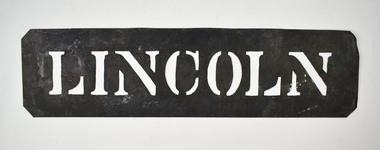
Stencil - LINCOLN
... transportation of wool bales. Lincoln is a city in the English East Midlands. Wool bales marked LINCOLN would have been transported to England by sea....transportation of wool bales. Lincoln is a city in the English East Midlands. Wool bales marked LINCOLN would have been transported to England by sea. wool - transportation wool sales wool class wool classers LINCOLN Wool bale export stencil - LINCOLN Stencil - LINCOLN ...This stencil was used as a location stamp for the transportation of wool bales. Lincoln is a city in the English East Midlands. Wool bales marked LINCOLN would have been transported to England by sea. Wool bale export stencil - LINCOLN LINCOLN wool - transportation, wool sales, wool class, wool classers -
 National Wool Museum
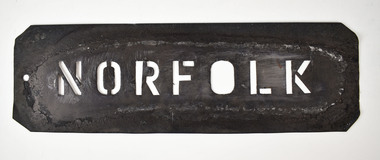
Stencil - NORFOLK
... This stencil was used as a location stamp for the transportation of wool bales. Norfolk is a county in East Anglia in England. Wool bales marked NORFOLK would have been transported to England by sea....This stencil was used as a location stamp for the transportation of wool bales. Norfolk is a county in East Anglia in England. Wool bales marked NORFOLK would have been transported to England by sea. wool - transportation wool sales wool class wool classers NORFOLK Wool bale export stencil - NORFOLK Stencil - NORFOLK ...This stencil was used as a location stamp for the transportation of wool bales. Norfolk is a county in East Anglia in England. Wool bales marked NORFOLK would have been transported to England by sea. Wool bale export stencil - NORFOLK NORFOLK wool - transportation, wool sales, wool class, wool classers -
 National Wool Museum
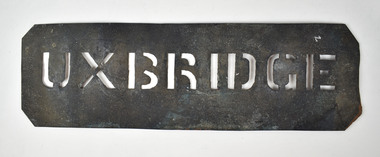
Stencil - UXBRIDGE
... This stencil was used as a location stamp for the transportation of wool bales. Uxbridge is a town in England. Wool bales marked UXBRIDGE would have been transported to England by sea....This stencil was used as a location stamp for the transportation of wool bales. Uxbridge is a town in England. Wool bales marked UXBRIDGE would have been transported to England by sea. wool - transportation wool sales wool class wool classers UXBRIDGE Wool bale export stencil - UXBRIDGE Stencil - UXBRIDGE ...This stencil was used as a location stamp for the transportation of wool bales. Uxbridge is a town in England. Wool bales marked UXBRIDGE would have been transported to England by sea. Wool bale export stencil - UXBRIDGE UXBRIDGE wool - transportation, wool sales, wool class, wool classers -
 Surrey Hills Historical Society Collection
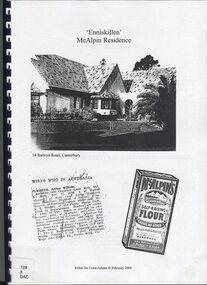
Book, Robin Da Costa-Adams, Enniskillen McAlpin Residence, Feb-09
... Robin da Costa-Adams has researched and written many publications including 'Blackburn a picturesque history, 1978'; 'Land of Gold: Gwlad yr Aur: James Tipping and a Mining Heritage'; 'Address (with signatories) from the women of Ballarat & Ballarat East to the women of England 1864 : against transportation of convicts', compiled and indexed by Robin; and 'Connie's Story : commemorating the Life of Mrs Edward (Plorn) Dickens'. ...Robin da Costa-Adams has researched and written many publications including 'Blackburn a picturesque history, 1978'; 'Land of Gold: Gwlad yr Aur: James Tipping and a Mining Heritage'; 'Address (with signatories) from the women of Ballarat & Ballarat East to the women of England 1864 : against transportation of convicts', compiled and indexed by Robin; and 'Connie's Story : commemorating the Life of Mrs Edward (Plorn) Dickens'. ...This report was prepared by historian Robin da Costa-Adams to assess the cultural heritage significance of "Enniskillen" at 14 Balwyn Road, Canterbury. It includes some family history on a number of prominent families - the McAlpin family, the Hindson family and the architect, Arthur William Plaisted who designed 'Enniskillen' for the McAlpin family. McAlpin's was a major Victorian flour company in the nineteenth and early twentieth centuries. Owned and operated by J. McAlpin and Sons, the company sold its flour products across Australia and overseas. McAlpin's developed a successful marketing campaign which was pitched directly at housewives. One innovation was the publishing of a free cookbook which had recipes in it that used McAlpin's products. These free cookbooks were published successively from the 1930s through to the 1960s in Australia. Arthur Plaisted also designed the Surrey Hills Medical Centre in Union Road c1911. Some of his work is featured on the State Library of Victoria Collection. Robin da Costa-Adams has researched and written many publications including 'Blackburn a picturesque history, 1978'; 'Land of Gold: Gwlad yr Aur: James Tipping and a Mining Heritage'; 'Address (with signatories) from the women of Ballarat & Ballarat East to the women of England 1864 : against transportation of convicts', compiled and indexed by Robin; and 'Connie's Story : commemorating the Life of Mrs Edward (Plorn) Dickens'. Robin has been a tireless campaigner for heritage protection in Canterbury. This document on 'Enniskillen' was included with Robin's submission for 2 VCAT hearings regarding possible development of the property. Both resulted in a judgement against the proposed developments. In the recent (2021) hearing the document was specifically mentioned in the judgement. A report prepared by Robin da Costa-Adams in 2009 to assess the cultural heritage significance of "Enniskillen" at 14 Balwyn Road, Canterbury. It includes some family history on the McAlpin family, the Hindson family and the architect Arthur WIlliam Plaisted family. (mr) arthur plaisted, (mr) walter plaisted, enniskillen, shrublands, house names, (mr) francis henty, (mrs) mary henty, (mr) ernest carter, heathfield, (mr) john hindson, (mrs) alice hindson, (mr) william hindson, (mrs) annie west mcalpin, (mr) john mcalpin, mcalpin bakery, (mr) keith matthies, dental surgeon, (mr) william wolf, architects, (miss) mary beacon, robin ca costa-adams -
 Wodonga & District Historical Society Inc
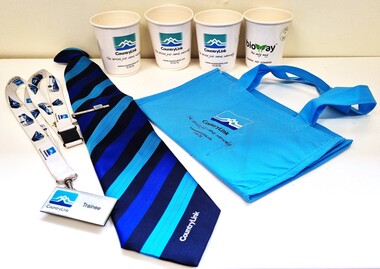
Memorabilia - CountryLink Collection
... transportation system in eastern Australia. CountryLInk Australian Railways CountryLink uniforms Tag on tie: Stylecore Corporate Wear Australia/ Polyester/ Made in England On all items: CountryLink A collection of uniform items and memorabilia from the CountryLink rail service. ...For residents of Northeast Victoria, railway services have provided a critical link between the area and state capital cities. CountryLink was established in January 1989 under the Transport Administration Act 1988. It was a passenger rail and road service brand that operated in regional areas of New South Wales, and to and from Canberra, Brisbane and Melbourne. CountryLink operated rail services a fleet of XPT and locomotive-hauled passenger trains. The Southern region of the Country Link network covered New South Wales districts of Illawarra, South Coast, Snowy Mountains, South West Slopes, Southern Tablelands, Riverina and Sunraysia regions plus the Australian Capital Territory and parts of Victoria. The Government of Victoria contributed to the provision of these services. Services ran along the Main South line from Sydney Central station to Albury before continuing on the North East line to Southern Cross station in Melbourne. The Sydney/Melbourne Express ceased in November 1993 and was replaced by an XPT in November 1993 In December 1994, a daylight service to Melbourne resumed by extending the Riverina XPT from Albury. In July 2013, CountryLink was merged with the intercity services of CityRail to form NSW TrainLink. These items are connected to a major transportation system in eastern Australia. A collection of uniform items and memorabilia from the CountryLink rail service. They include a tie and tiepin, staff badge and lanyard, cups and a bag with CountryLink logo. Tag on tie: Stylecore Corporate Wear Australia/ Polyester/ Made in England On all items: CountryLink countrylink, australian railways, countrylink uniforms -
Friends of Ballarat Botanical Gardens History Group
Work on paper - Differing Styles of Wardian Cases, The Transportation of Plants to Ballarat and Other Parts of the World, 27/2/2009
... John Garner Doctor John Garner Ballarat Botanical Gardens Friends of Ballarat Botanical Gardens Wardian Cases Styles of Wardian Cases Thomas Rooney George Longley Mr Duthie Robert Fortune Doctor Nathaniel Bagshaw Ward Joseph Dalton Hooker Kelway and Son Somerset England John Garner Collection Gardens Ballarat None p.1 is headed "A Wardian Case" and is a little over 1/2 a page. p 2. is headed File: Wardian Cases and has pictures of 4 styles of wardian cases. p3. is entitled Wardian case and has a small picture on the lefthand side of a wardian case. p.4. has 1/2 a page of print and another small picture of a wardian case on the lefthand side of the page with References at the bottom of the page. The Transportation ...Wardian cases made it possible for plants and seeds to be transported long distances and to be in good condition on arrival. Without Wardian cases, it would have been impossible to plan and implement the Ballarat Botanical Gardens in the Gardenesque style that we see today. p.1 is headed "A Wardian Case" and is a little over 1/2 a page. p 2. is headed File: Wardian Cases and has pictures of 4 styles of wardian cases. p3. is entitled Wardian case and has a small picture on the lefthand side of a wardian case. p.4. has 1/2 a page of print and another small picture of a wardian case on the lefthand side of the page with References at the bottom of the page. None john garner, doctor john garner, ballarat botanical gardens, friends of ballarat botanical gardens, wardian cases, styles of wardian cases, thomas rooney, george longley, mr duthie, robert fortune, doctor nathaniel bagshaw ward, joseph dalton hooker, kelway and son somerset england, john garner collection, gardens, ballarat
