
Showing 7 items matching "tree huggers"
-
 Heidelberg Golf Club
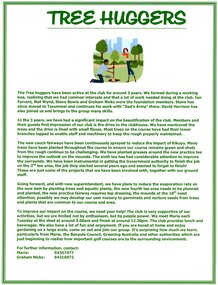
Document - Notes, Heidelberg Golf Club, Tree Huggers 2005-2007, 2005-2007
... Tree Huggers 2005-2007...Tree Huggers...The Heidelberg Golf Club Tree Huggers commenced in 2005 with the aim of improving the appearance of the course through planting and maintenance of the course surrounds. ...An enthusiastic group of members have met each Thursday. this collection of notes, minutes and agendas is from 2005-2007. Tree Huggers Course maintenance Gardens at HGC Neil Wynd A collection of minutes and other notes from a group within HGC Tree Huggers 2005-2007 Document Notes Heidelberg Golf Club ...The Heidelberg Golf Club Tree Huggers commenced in 2005 with the aim of improving the appearance of the course through planting and maintenance of the course surrounds. An enthusiastic group of members have met each Thursday. this collection of notes, minutes and agendas is from 2005-2007.A collection of minutes and other notes from a group within HGCtree huggers, course maintenance, gardens at hgc, neil wynd -
 Tatura Irrigation & Wartime Camps Museum
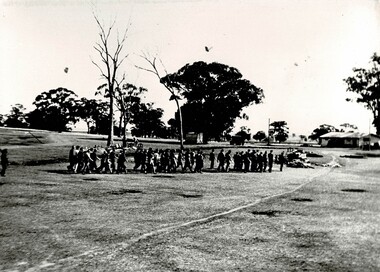
Photograph, Japanese Officers
... Guard on the left, trees in background and hug to the back right....Guard on the left, trees in background and hug to the back right. Japanese Officers Photograph Photograph ...Group of Japanese POW officer's being transferred to POW Camp 13 in August 1944 after the suicidal breakout from Cowra POW Camp.Black and white photograph stuck on coreflu backing depicting a group of men walking through a camp. Guard on the left, trees in background and hug to the back right.camp 13, murchison camp, cowra camp, japanese internees, cowra breakout. -
 Bendigo Military Museum
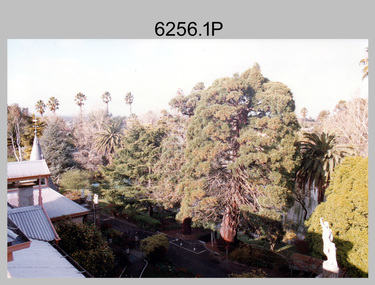
Photograph - Removal of Sequoia Californian Redwood Tree - Army Survey Regiment, Fortuna, Bendigo, 1994
... The photographs were scanned at 300 dpi. .1) - Photo, colour, 1994, Felling of sequoia Californian redwood tree. .2) - Photo, colour, 1994, Felling of sequoia Californian redwood tree. Neil Morgan (ground maintenance) is hugging the tree. .3) - Photo, colour, 1994, Felling of sequoia Californian redwood tree. .4) to .8) - Photo, colour, 1994, Felling of sequoia Californian redwood tree. .9) - Photo, colour, 1994, background on left - WO2 Bob Garritty, foreground L to R: Geoff (ground maintenance), unidentified, Neil Morgan (ground maintenance)....The photographs were scanned at 300 dpi. .1) - Photo, colour, 1994, Felling of sequoia Californian redwood tree. .2) - Photo, colour, 1994, Felling of sequoia Californian redwood tree. Neil Morgan (ground maintenance) is hugging the tree. .3) - Photo, colour, 1994, Felling of sequoia Californian redwood tree. .4) to .8) - Photo, colour, 1994, Felling of sequoia Californian redwood tree. .9) - Photo, colour, 1994, background on left - WO2 Bob Garritty, foreground L to R: Geoff (ground maintenance), unidentified, Neil Morgan (ground maintenance). ...These nine photographs of contractors felling a sequoia Californian redwood tree was taken at the Army Survey Regiment, Fortuna, Bendigo on the 16th of September 1994. Although 23 photos were taken at the time, 14 were not scanned due to their similarity to the nine featured photos. Two sequoia Californian redwood trees were planted at the front entrance of Fortuna Villa in the early days of gold mining magnate George Lansell’s occupation in the 1870’s. They were of immense proportion and much admired during the Lansell era and RA Svy’s occupation from 1942 to 1996. In these early days of Army occupation, the trees were lopped due to concerns of their size and proximity to the Villa. The felling of the tree in 1994 was considered unsafe due to perceptions of disease. These perceptions were upsetting to staff, as some believed that although there were a few dead branches, the tree was OK. As the tree had a noticeable lean, measurements were taken indicating the tree was stable. A sequoia sapling was eventually planted as a replacement to the diseased tree. It was decided to mill and store the timber of the felled tree on-site due to its historical significance. Although future uses were not determined at the time, the timber was eventually used to construct display cabinets and souvenir pens. When Defence decided to relocate geospatial production to a new facility in Junortoun an outer suburb of Bendigo in 2008, the sequoia timber was used as a beautiful feature in the front foyer as well as several feature walls within the building, providing a historical connection Fortuna Villa.This is a set of nine photographs of contractors felling a Sequoia (Californian redwood) tree at the Army Survey Regiment, Fortuna, Bendigo on the 16th of September 1994. The colour photographs were printed on photographic paper and are part of the Army Survey Regiment’s Collection. The photographs were scanned at 300 dpi. .1) - Photo, colour, 1994, Felling of sequoia Californian redwood tree. .2) - Photo, colour, 1994, Felling of sequoia Californian redwood tree. Neil Morgan (ground maintenance) is hugging the tree. .3) - Photo, colour, 1994, Felling of sequoia Californian redwood tree. .4) to .8) - Photo, colour, 1994, Felling of sequoia Californian redwood tree. .9) - Photo, colour, 1994, background on left - WO2 Bob Garritty, foreground L to R: Geoff (ground maintenance), unidentified, Neil Morgan (ground maintenance)..1P to .9P – No personnel are identified.royal australian survey corps, rasvy, army survey regiment, army svy regt, fortuna, asr -
 Federation University Historical Collection
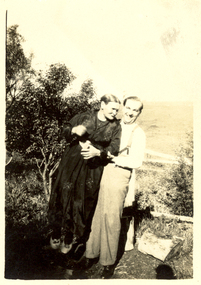
Photograph - Black and White, Scott's, Sarah and Alex? Wright (at Sewell's?), circa 1930
... Black and white photograph of a man in shirt, trousers and braces hugging a woman in a dark frock. They are standing in front of a fence with trees and a paddock in the background. ...The Frank Wright Medal at the Royal South Street competition is awarded to an individual recognized as making an outstanding contribution to brass music in Australia. sarah wright alex wright frank wright navarre smeaton ballarat Printed on back - Printed at Scott's, Velox Black and white photograph of a man in shirt, trousers and braces hugging a woman in a dark frock. They are standing in front of a fence with trees and a paddock in the background. ...Alex Wright travelled to England in 1930 and was known as the Prince of Mimic although his stage name was Navarre. He died in an air raid in the Hippodrome Birmingham in 1940. Alex was the brother of Frank Wright who was a renown resident of Smeaton, where he was born. He lived at Laura Villa, and attended Smeaton State School. His father William was a gold miner and his mother's name was Sarah. Their family won many singing and instrumental awards. Frank was tutored by Percy Code and was awarded a gold medal for the highest marks in the ALCM examinations in the British Colonies at the age of seventeen years. He became the Australian Open Cornet Champion by the age of eighteen. A year later, Frank conducted the City of Ballarat Band, and later the Ballarat Soldiers’ Memorial Band. He formed the Frank Wright Frisco Band and Frank Wright and his Coliseum Orchestra. These bands won many South Street awards, and Frank as conductor won many awards in the Australian Band Championship contest. In 1933 Frank Wright sailed to England to conduct the famous St Hilda’s Band and was later appointed Musical Director of the London County Council, where he organized many amazing concerts in parks, in and around the London district. He was made Professor of Brass and Military Band Scoring and conducted at the Guildhall of Music and Drama. Frank was often invited to adjudicate Brass Band Championships around Europe, in Australia, including South Street and in New Zealand. The Frank Wright Medal at the Royal South Street competition is awarded to an individual recognized as making an outstanding contribution to brass music in Australia.Black and white photograph of a man in shirt, trousers and braces hugging a woman in a dark frock. They are standing in front of a fence with trees and a paddock in the background. They are Sarah Wright and her son Alex?.Printed on back - Printed at Scott's, Veloxsarah wright, alex wright, frank wright, navarre, smeaton, ballarat -
 Otway Districts Historical Society
Photograph, Victorian Railways, Between Devitt Bros. Siding & Ditchley, 1901, 1901
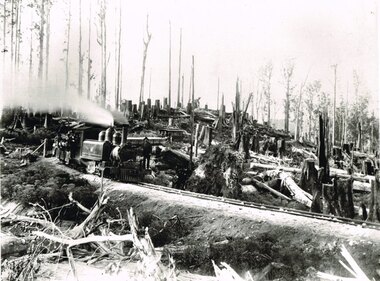
... hugging the side of a forty degree slope emerging on top of the ridge at Beech Forest. This photograph was taken 28 miles (45 kilometres) from Colac between Devitt Bros. Siding and Ditchley, just out of Beech Forest. Two 2-6-2 Tank engines of the narrow-gauge A class built by Victorian Railway's Newport workshop, were commonly dubbed 'Coffee Pots'. As well as pulling a load of NQR wagons a NBB saloon car ended the train. The devastation to the standing timber was deliberate: the Engineer-in-Chief of VR ruled that all trees...hugging the side of a forty degree slope emerging on top of the ridge at Beech Forest. This photograph was taken 28 miles (45 kilometres) from Colac between Devitt Bros. Siding and Ditchley, just out of Beech Forest. Two 2-6-2 Tank engines of the narrow-gauge A class built by Victorian Railway's Newport workshop, were commonly dubbed 'Coffee Pots'. As well as pulling a load of NQR wagons a NBB saloon car ended the train. The devastation to the standing timber was deliberate: the Engineer-in-Chief of VR ruled that all trees ...Construction of the Colac-Beech Forest railway line began in 1900 with about 100 men engaged in laying and ballasting the track, as well as others forming the earthworks and building culverts and bridges. The result of this labour saw the railway advance from Colac until it climbed a spur hugging the side of a forty degree slope emerging on top of the ridge at Beech Forest. This photograph was taken 28 miles (45 kilometres) from Colac between Devitt Bros. Siding and Ditchley, just out of Beech Forest. Two 2-6-2 Tank engines of the narrow-gauge A class built by Victorian Railway's Newport workshop, were commonly dubbed 'Coffee Pots'. As well as pulling a load of NQR wagons a NBB saloon car ended the train. The devastation to the standing timber was deliberate: the Engineer-in-Chief of VR ruled that all trees within a certain distance of the railway line were to be cut down. This certainly saved the line from destruction several times in the future.B/W. An NA class locomotive, NQR wagons and an NBB saloon car, all with workmen, going around a bend between Devitt Brother's Siding and Ditchley on the Beech Forest line in 1901.beech forest; ditchley; devitt bros siding, railways; -
 Nillumbik Shire Council
Photograph: Charlie SUBLET, Tree Hugger
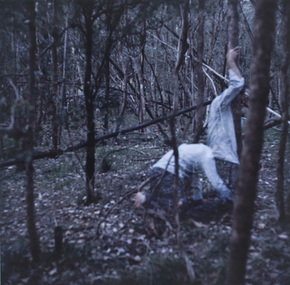
... Tree Hugger Photograph: Charlie SUBLET ... -
 Broadmeadows Historical Society & Museum
Photograph - Portrait Photograph, A Hug Between Friends, 1990
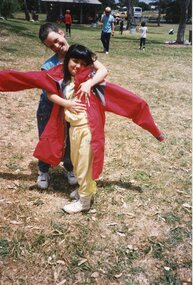
... The image shows two individuals sharing a hug in a grassy outdoor setting, surrounded by trees, a picnic shelter, and other people enjoying the day. ...The image shows two individuals sharing a hug in a grassy outdoor setting, surrounded by trees, a picnic shelter, and other people enjoying the day. ...This photograph, taken during Jacana Primary School’s 1990 Christmas picnic, captures a relaxed and heartfelt moment believed to have occurred at Greenvale Reservoir, a popular recreational destination in Melbourne’s northern suburbs. The image shows two individuals sharing a hug in a grassy outdoor setting, surrounded by trees, a picnic shelter, and other people enjoying the day. Such moments reflect the informal and inclusive nature of school-organised events, which were a hallmark of Australian public education. These gatherings provided opportunities for students, staff, and families to connect, celebrate the end of the school year, and create lasting memories in natural surroundings. As part of Jacana Primary School’s visual archive, this photograph offers insight into the social and cultural fabric of suburban Melbourne in the late 20th century, highlighting the importance of friendship, community, and shared experience in shaping school life.This 1990 photograph, taken during Jacana Primary School’s Christmas picnic—believed to have been held at Greenvale Reservoir—holds cultural and social significance as a representation of the informal, community-focused traditions of Australian public education. The image captures a tender moment between two individuals sharing a hug, subtly reflecting friendship, warmth, and connection in a relaxed outdoor setting. Such scenes exemplify the inclusive and nurturing environment fostered by Jacana Primary School, which operated from 1959 until its closure in the early 2000s. The picnic setting, with its natural backdrop and festive atmosphere, highlights the importance of school-organised events in building relationships and creating shared memories among students, staff, and families. As part of the school’s visual archive, this photograph contributes to a broader understanding of how public education supported social cohesion, celebrated diversity, and left a lasting legacy in the lives of children and their communities.Colour photograph on glossy paper of children in a park.PH18289 (crossed out) PH-4209 (crossed out) PH-4868jacana, jacana primary school, christmas picnic, 1990, children
