
Showing 11 items matching "trench foot"
-
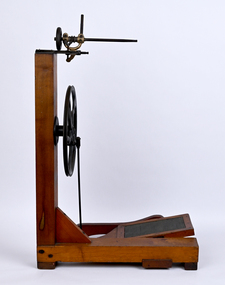 National Wool Museum
Machine - Strickland Silent Spinner, Sir Gerald Strickland, c.1916
... ...Trench Foot...Wool growers donated greasy wool, which was spun and knitted into socks for soldiers in the trenches, helping to prevent trench foot. This Silent Spinner was purchased online by the donor in 2011, and is just missing the flyer, a U-shaped rotating assembly that twists drafted wool fibres into yarn and guides that yarn evenly onto the storage bobbin....Sir Gerald Strickland Lady Edeline Mary Strickland Strickland Silent Spinner Red Cross World War I Spinning Wheel Socks Trench Foot Metal plaque [embossed]: THE / STRICKLAND / SILENT / SPINNER / SOLD / ONLY BY / THE RED CROSS SOCIETY / MADE IN AUSTRALIA / BEBAFALDS LTD / OPP. ...The Strickland Silent Spinner is an upright, single-treadle spinning wheel invented around 1916 by Sir Gerald Strickland, then Governor of New South Wales, to support the Australian Red Cross during World War I. Drawing on the spinning expertise of his wife, Lady Edeline, and daughter, Mary, he built an early prototype using repurposed scraps of iron, gas pipes, and ball bearings. Unlike traditional wooden wheels of the era, the inclusion of ball bearings significantly reduced friction and noise, earning it the “Silent Spinner” name, while allowing spinners to work at high speeds and spin directly from raw fleece. Approximately 70 Strickland Silent Spinners were manufactured and sold through the Australian Red Cross for the war effort, while Lady Edeline and Mary Strickland gave public spinning demonstrations to encourage women across Australia to spin at home. Wool growers donated greasy wool, which was spun and knitted into socks for soldiers in the trenches, helping to prevent trench foot. This Silent Spinner was purchased online by the donor in 2011, and is just missing the flyer, a U-shaped rotating assembly that twists drafted wool fibres into yarn and guides that yarn evenly onto the storage bobbin. Wood and metal spinning wheel with foot pedal and small metal brass plaque on top. Metal plaque [embossed]: THE / STRICKLAND / SILENT / SPINNER / SOLD / ONLY BY / THE RED CROSS SOCIETY / MADE IN AUSTRALIA / BEBAFALDS LTD / OPP. TOWN HALL, SYDNEY / PATENT APPLIED FOR / TO SPIN-TURN WHEEL FROM LEFT TO RIGHT / TO TWIST-TURN WHEEL FROM RIGHT TO LEFT sir gerald strickland, lady edeline, mary strickland, strickland silent spinner, red cross, world war i, spinning wheel, socks, trench foot -
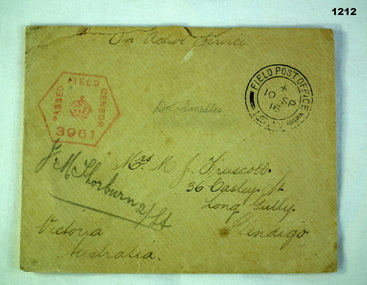 Bendigo Military Museum
Accessory - ENVELOPE, est 1916
... Embarked for Egypt on 29.12.1915, transfers to the 60th Batt 26.2.1916, promoted to Sgt 25.3.1916, hospital 30.4.1916 with Influenza, embark for France 19.6.1916, hospital 29.11.1916 with Trench Foot, Died of Disease (DOD) 9.12.1916 listed Trench Foot and Septic Pnuemonia at 7.15am in the morning. ...Embarked for Egypt on 29.12.1915, transfers to the 60th Batt 26.2.1916, promoted to Sgt 25.3.1916, hospital 30.4.1916 with Influenza, embark for France 19.6.1916, hospital 29.11.1916 with Trench Foot, Died of Disease (DOD) 9.12.1916 listed Trench Foot and Septic Pnuemonia at 7.15am in the morning. documents-envelopes military history Truscott "From: Victor Truscott" Handwritten: "On Active Service/Mrs MJ Truscott/36 Castey St/Long Gully/Bendigo/Victoria/Australia" Black post office stamp Red censor stamp. ...Victor Joseph Truscott No 3629 enlisted in the AIF on 21.7.1915 with 8th reinforcements 21st Batt age 21 years 6 months. Embarked for Egypt on 29.12.1915, transfers to the 60th Batt 26.2.1916, promoted to Sgt 25.3.1916, hospital 30.4.1916 with Influenza, embark for France 19.6.1916, hospital 29.11.1916 with Trench Foot, Died of Disease (DOD) 9.12.1916 listed Trench Foot and Septic Pnuemonia at 7.15am in the morning. Beige paper envelope, no letter inside. Handwritten in black addressed to Mrs MJ Truscott. Also has pencil notes on envelope. "From: Victor Truscott" Handwritten: "On Active Service/Mrs MJ Truscott/36 Castey St/Long Gully/Bendigo/Victoria/Australia" Black post office stamp Red censor stamp. documents-envelopes, military history, truscott -
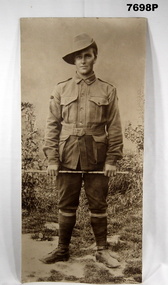 Bendigo Military Museum
Photograph - PHOTOGRAPH, PORTRAIT
... Hospitalised 8 Nov 1916 for trench foot and rejoined unit 11 Feb 1917. WIA 27 Feb 1917 GSW left forearm and rejoined 30 July 1917. ...Hospitalised 8 Nov 1916 for trench foot and rejoined unit 11 Feb 1917. WIA 27 Feb 1917 GSW left forearm and rejoined 30 July 1917. ...Lance Corporal "Alfred Alexander Priest" No. 5162. Enlisted 31/12/15 into 6th Battalion, 16th Reinforcements. Embarked 1 April 1916 for England the 29 Aug 1916 to France. Hospitalised 8 Nov 1916 for trench foot and rejoined unit 11 Feb 1917. WIA 27 Feb 1917 GSW left forearm and rejoined 30 July 1917. WIA 4 Oct 1917 GSW left finger and rejoined 1 Jan 1918. WIA 16 May 1918 multiple gunshot wounds - died 27 May 1918. Buried at Boulogne Eastern Cemetery. Ful length portrait of Alfred Alexander Priest in full uniform of WW1 ANZAC Soldier, in sepia. Man standing in an outside setting, holding a cane. Front bottom right hand corner written "KALMA BENDIGO". Back top right corner written "Len's Uncle, Alfred Priest". ww1, 6th battalion, alfred alexander priest -
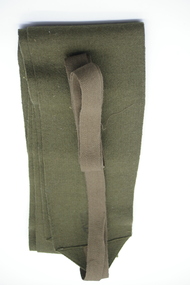 Lara RSL Sub Branch
Service Gear, Puttee
... Many Australian soldiers developed a painful medical condition during their service on the Western Front called trench foot. The primary causes were wet feet and unsanitary conditions but puttees were also partly to blame as they limited circulation to the lower leg and foot. ...Many Australian soldiers developed a painful medical condition during their service on the Western Front called trench foot. The primary causes were wet feet and unsanitary conditions but puttees were also partly to blame as they limited circulation to the lower leg and foot. ...A puttee is a cloth band that was wound round a soldier’s leg from their ankle to their knee. They were designed to provide support when walking and protect against harsh weather conditions. Many Australian soldiers developed a painful medical condition during their service on the Western Front called trench foot. The primary causes were wet feet and unsanitary conditions but puttees were also partly to blame as they limited circulation to the lower leg and foot. These puttees are a collectors item, they are the real thing, used in WW1 and made a short return in WW2 and were used as ceremonial dress in Malaysia in the 1960s, these ones are WW2 issue. Used as military dress in world war one, briefly in world war II and ceremonial dress in Malaysia in the 1960's Olive green wrapping wool mix wrapping 106cm long and q2cm wide with tape 103 cm long 1.5 cm wide Nil puttee, leggings world ww1 1 ww2 malaysia cloth bans -
 Bendigo Military Museum
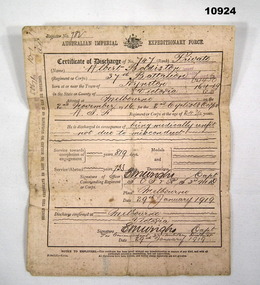
Certificate - DISCHARGE CERTIFICATE WW1, Aust Army, 1919
... Date of Entry: 2/11/16, Age 24 - Unit ANZAC Cyclist BA Embark for England: 16/12/16, Transfer to 8 Batt: 7/3/17, Embark for France: 14/6/17, Transfer to 37 Bn: 1/7/17, Hospital - sprained ankle: 5/7/17, Rejoin Unit: 7/9/17, Hospital - Trench foot: 18/11/17, Rejoin Unit: 5/6/18, WIA - GSW left wrist: 10/8/18, RTA Wounded: 20/10/18, Medically unfit due to wounded wrist joint: 29/1/19. ...Date of Entry: 2/11/16, Age 24 - Unit ANZAC Cyclist BA Embark for England: 16/12/16, Transfer to 8 Batt: 7/3/17, Embark for France: 14/6/17, Transfer to 37 Bn: 1/7/17, Hospital - sprained ankle: 5/7/17, Rejoin Unit: 7/9/17, Hospital - Trench foot: 18/11/17, Rejoin Unit: 5/6/18, WIA - GSW left wrist: 10/8/18, RTA Wounded: 20/10/18, Medically unfit due to wounded wrist joint: 29/1/19. ...Refers to the service of: - Albert Boldiston Cat 747. Place of birth: Kyneton, Vic. Date of Entry: 2/11/16, Age 24 - Unit ANZAC Cyclist BA Embark for England: 16/12/16, Transfer to 8 Batt: 7/3/17, Embark for France: 14/6/17, Transfer to 37 Bn: 1/7/17, Hospital - sprained ankle: 5/7/17, Rejoin Unit: 7/9/17, Hospital - Trench foot: 18/11/17, Rejoin Unit: 5/6/18, WIA - GSW left wrist: 10/8/18, RTA Wounded: 20/10/18, Medically unfit due to wounded wrist joint: 29/1/19. His discharge certificate and Vic BDM's show POB as Kyneton. His application to enlist shows Colbinabbin. Certificate is a heavy duty paper document. Printed in black ink and printed on both sides. Titled "Australian Imperial Expeditionary Force", "Certificate of Discharge". There is printing up the left hand side and a stamp showing silver badge No.50671 dated 10/1/19. Rear side is stamped V/B No. 30043. 41324. Description of soldier. certificate of discharge, ww1, albert boldiston -
 Wodonga & District Historical Society Inc
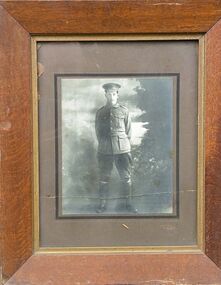
Photograph - Sydney William Phefley
... During that year he was also hospitalised for a minor case of mumps in Cairo in March and then for a case of trench foot in England in December. In February 1918, Sergeant Phefley was accepted into the Officer Cadet Battalion which included the completion of an Officers Training Course at Oxford. ...During that year he was also hospitalised for a minor case of mumps in Cairo in March and then for a case of trench foot in England in December. In February 1918, Sergeant Phefley was accepted into the Officer Cadet Battalion which included the completion of an Officers Training Course at Oxford. ...Sydney William Phefley was born in Wodonga, Victoria on 5th November 1896 to Christian Phefley and Martha nee Schultz. He was their third son and eighth child in a family of 17 children. Sydney enlisted in Melbourne on 4th August 1915 and was allocated to 29th Battalion Machine Gun Section. On 10th November 1915 he embarked from Melbourne on the HMAT Ascanius and saw service in Egypt and on the Western Front. In March 1916 Sydney was promoted to Sergeant. During that year he was also hospitalised for a minor case of mumps in Cairo in March and then for a case of trench foot in England in December. In February 1918, Sergeant Phefley was accepted into the Officer Cadet Battalion which included the completion of an Officers Training Course at Oxford. In October 1918 he was transferred to the 32nd Battalion and was promoted to the rank of Lieutenant in December 1918. Lieutenant Phefley returned to Australia on 15th May 1919 and was discharged on 22nd August 1919. Sydney was later employed by the Victorian Railways as an Engine Driver. He married Mary Johanna Hogan on 15th October 1924. Sydney William Phefley died in Moe, Victoria on 16th January 1973. This image is significant because it portrays a member of a prominent Wodonga family who served Australia during World War I. A framed black and white image of Sydney William Phefley in Uniform. private sydney william phefley, phefley family wodonga, world war 1 servicemen -
 Bendigo Military Museum
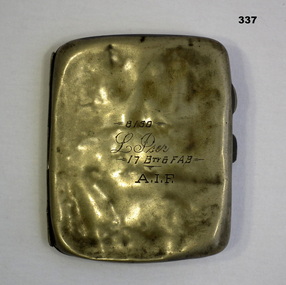
Memorabilia - TRENCH ART, CIGARETTE CASE, C. 1914 - 18
... foot required immediate amputation and then done again. The left leg became septic and he suffered from Jaundice. He was promoted to Lieut on 1.8.1917 and placed on the supernumerary list. Embarked for Australia 9.10.1917 and his appointment in the AIF was terminated on 4.1.1918. Refer 339.2, 1971, 2049P. Cigarette cases accesory engraving "8150 / L. Iser / 17 BTY 6 FAB / AIF" Metal case, hinged with two elastic straps inside to hold cigarettes. Inscribed on lid. Memorabilia TRENCH ...Case belonged to Les Iser. He had pre War service 3 years Cadets and 2 years L.Horse. Leslie Iser No 8150 (born Bendigo, enlisted Melbourne) in the 17th Battery 6th F.A.Brigade AIF on 18.6.1915. Promoted to Sgt 9.10.1915. Embarked for Eygpt 22.11.1915. Promoted 2nd Lieut 12.3.1916. Embarked for France 17.3.1916. WIA severe at Bois Greiner 26.6.1916, GSW's to right foot, left leg and forearm. The right foot required immediate amputation and then done again. The left leg became septic and he suffered from Jaundice. He was promoted to Lieut on 1.8.1917 and placed on the supernumerary list. Embarked for Australia 9.10.1917 and his appointment in the AIF was terminated on 4.1.1918. Refer 339.2, 1971, 2049P. Metal case, hinged with two elastic straps inside to hold cigarettes. Inscribed on lid. "8150 / L. Iser / 17 BTY 6 FAB / AIF" cigarette cases, accesory, engraving -
 Eltham District Historical Society Inc
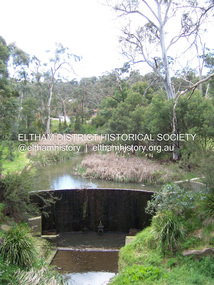
Photograph - Digital Photograph, Marguerite Marshall, Smith Dam, Karingal Drive, Eltham, 19 September 2006
... trench was dug with a single furrow plough drawn by an old draught horse. Living in rough conditions did not deter the Smiths, who made the pump-house their home, where they still lived when their first child was born in 1944. They later built their home at the top of their property overlooking Eltham, with magnificent views to Kinglake, the Dandenong Ranges and Melbourne. From 1946 it took them almost 20 years to complete the 36-square house with its 12-foot...trench was dug with a single furrow plough drawn by an old draught horse. Living in rough conditions did not deter the Smiths, who made the pump-house their home, where they still lived when their first child was born in 1944. They later built their home at the top of their property overlooking Eltham, with magnificent views to Kinglake, the Dandenong Ranges and Melbourne. From 1946 it took them almost 20 years to complete the 36-square house with its 12-foot ...The dam at the entrance to the Nerreman Gateway in Eltham was built according to an internationally acclaimed theory developed by the builder's father. In 1920, Victorian engineer B.A. Smith was awarded the American Society of Civil Engineers J. James R. Cross Gold Medal for his Technical Paper titled 'Arched Dams'. It was the first time this medal had been awarded outside the United States. The concrete arched dam across the Eltham West Drain was built in 1940 by B.A. Smith's son and engineer, D. B. (Bernie) Smith to water the 24 acre (9.75 ha) hobby farm owned by himself and new wife, Isa Smith. Upon completion of the dam a pump-house was constructed beside the creek but before the water could be pumped up the hill they had to dig a trench and lay 500m of 100mm water main to an elevated holding tank. The Smiths made the pump-house their home for several years until they constructed their home at the top of the hill overlooking Eltham and views extending to Kinglake. Following Bernie's death in 1983, Nerreman Park was subdivided between 1993 and 1995. Gordon Ford designed the landscaping and the pump-house was demolished. Covered under Heritage Overlay, Nillumbik Planning Scheme. Published: Nillumbik Now and Then / Marguerite Marshall 2008; photographs Alan King with Marguerite Marshall.; p137 The dam at the entrance to the Nerreman Gateway in Eltham, was built according to an internationally acclaimed theory developed by the builder’s father. In 1920, Victorian engineer B A Smith was awarded the American Society of Civil Engineers J. James R. Croes Gold Medal, for his Technical Paper titled Arched Dams. It was the first time this medal had been awarded outside America. An international example of the application of Smith’s work can be found in the design of the Hoover Dam on the Colorado River, Nevada, USA. Built between 1930 and 1936, it is recognised by the ASCE as one of ‘America’s Seven Modern Civil Engineering Wonders’.1 The concrete arched dam across the Eltham West Drain was built by B A Smith’s son and engineer, D B (Bernie) Smith. Bernie’s dam followed his father’s theory, having a curvature that takes maximum advantage of concrete’s great strength in compression. The water load is carried into the abutments because of this curvature, which permits a wall thickness of only 225 millimetres thick at its crest, despite the dam’s capacity of more than 4.5 megalitres. The Eltham dam was designed to water the 24 acre (9.75 ha) hobby farm belonging to newly married couple Bernie and Isa Smith. Bernie, from Armadale, and Isa, from a farm at Tyntynder near Swan Hill, were attracted to the hilly topography and the creek running through the property. It extended from Ryans Road, Eltham, to Karingal Drive, Montmorency and was adjacent to Meruka Park. The Smiths named it Nerreman Park using the Aboriginal word Nerreman meaning ‘River Bend’ as their creek had a pronounced bend.2 In 1940 the first thing Bernie did was to build a dam, and with Isa’s help, a pump-house, to secure a water supply for their cattle, pigs, chickens, orchard and vegetable gardens. It was also available for the fire-plugs, which they placed all over the property in case of bushfire. The couple built the pump-house beside the creek and installed a Tange three-plunger pump, which had originally supplied the City of Wodonga with water. But before the Smiths could pump water up the hill from the dam they had to dig a trench and lay about 550 yards (500m) of a four-inch (100mm) water main up to an elevated holding tank. The trench was dug with a single furrow plough drawn by an old draught horse. Living in rough conditions did not deter the Smiths, who made the pump-house their home, where they still lived when their first child was born in 1944. They later built their home at the top of their property overlooking Eltham, with magnificent views to Kinglake, the Dandenong Ranges and Melbourne. From 1946 it took them almost 20 years to complete the 36-square house with its 12-foot (3.6m) high ceilings. Material for the concrete roof and walls faced with sandstone, was ripped out of the ground on their property by plough pulled by tandem Clydesdale horses. Isa was a strong woman – two days before their second child was born – she set three huge sandstone boulders in place in the bottom wall of the garage. She also mixed all the cement for the house. A collapsed kitchen wall did not discourage her from rebuilding it in a week, while her husband was away working in the country. She later recalled: ‘We stood back to admire this beautiful wall we’d built and while we were looking at it, it came tumbling down’.3 Following Bernie’s death in 1983, Nerreman Park was subdivided, between 1993 and 1995. Local Gordon Ford designed the landscaping and the pump-house was pulled down. But the dam remains as a reminder of exceptional engineering4 – and of a remarkable couple. This collection of almost 130 photos about places and people within the Shire of Nillumbik, an urban and rural municipality in Melbourne's north, contributes to an understanding of the history of the Shire. Published in 2008 immediately prior to the Black Saturday bushfires of February 7, 2009, it documents sites that were impacted, and in some cases destroyed by the fires. It includes photographs taken especially for the publication, creating a unique time capsule representing the Shire in the early 21st century. It remains the most recent comprehenesive publication devoted to the Shire's history connecting local residents to the past. nillumbik now and then (marshall-king) collection, eltham, karingal drive, smiths dam, bernie smith, gordon ford, isa smith, nerreman gateway, nerreman park estate, dams -
 Bendigo Historical Society Inc.
Photograph - CASTLEMAINE GAS COMPANY COLLECTION: PHOTO PEOPLE
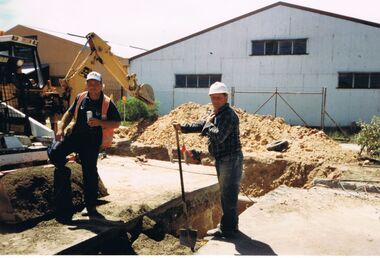
... 2 workers and an excavator digging trenches, man on left has his foot on the bucket of a bobcat, background shows 2 large buildings, one cream? ...PERSON Group males Kodak 2 workers and an excavator digging trenches, man on left has his foot on the bucket of a bobcat, background shows 2 large buildings, one cream? ...2 workers and an excavator digging trenches, man on left has his foot on the bucket of a bobcat, background shows 2 large buildings, one cream? The other larger silver, double gate entrance to the larger building, old tyre on heap of rubble. Kodak person, group, males -
 Bendigo Historical Society Inc.
Document - GOLD SALE NOTES FOR NICHOLAS BOLLE, 1868 - 1887
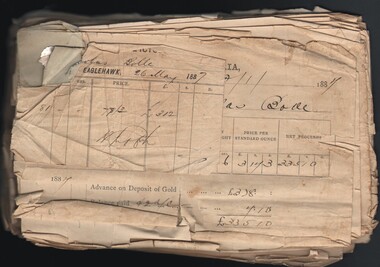
... foot diameter puddling machine. The central mound retains its wooden post and fragments of timber side-boarding are still present in the puddling trench. ...foot diameter puddling machine. The central mound retains its wooden post and fragments of timber side-boarding are still present in the puddling trench. ...Nicholas John Bolle was born in Dorstadt, Germany in 1836 to parents Heinrich (Johannes Heinrich Wilhelm) and Friederike Hartmann (Anne Marie Friedericke). Around the age of 20 he immigrated to Australia and made his way, most likely on foot, 150km in a northerly direction to the Bendigo goldfields. In March 1863 Nicholas registered his first mining claim, naming it Bolle’s Reef. Having worked this reef until it no longer paid, he went on a prospecting tour of the area and found another gold reef towards Elysian Flat, staked a claim and registered it under the name of his beloved wife ‘Rosanna’. Sadly, as was often the case, the cost of hiring men to get the gold out of the ground, and removing it from the clay and quartz, outweighed the amount of profit he was making from his discoveries. In November 1863 while living and working at Old Tom Gully, Nicholas appeared in the Government Gazette as insolvent. Nicholas continued to struggle on, scoping out the surrounding area in the Whipstick Forest, and having some little success and by 1869 he was given a government reward of 25 pounds for discovering a new area of gold in the Whipstick. The Government Gazette records this reward – 'for the discovery of the Whipstick, 25 pounds' (Government Gazette 1869) By 1872 Nicholas had established a quartz crushing plant at his mine in Old Tom Gully, (the Old Tom mine) a remote place in the middle of the Whipstick. Mining was a dangerous business, and in 1875 Nicholas was called as a witness in a coroner’s inquest into the death of a John Bashton who was accidentally killed in a mining accident at nearby Easter Claim in December. In 1881, he was again called to give evidence when one of his employees Mr Thomas Garrett was killed while working at his claim at Old Tom Reef. So we are fortunate to have Nicholas describing his day’s work in his own words. Reference: Michelle Dennis Family History http://www.michelledennis.com.au/?page_id=1067) The Old Tom Mine site is situated between Old Tom Road, Scotsman Road, Eaglehawk-Neilborough Road and an unnamed road, Whipstick VIC 3556. The Marong Heritage Study, Mining Sites ( City of Greater Bendigo) describes the former mine site as follows: '40 metre-long mullock heap with one dumping line running north from a filled shaft. The heap has been partially quarried. 20 metres south is a scatter of red hand-made bricks and rough concrete rubble. Further south there are smaller mullock dumps and a line of shallow reef workings Surface workings 30 metres west of the mullock dump, running north, is a line of small mullock paddocks, terminating in a shallow open cut. On the same line to the south, in an area north and west of the most southerly section of reef workings there is an area of hydraulic sluicing. West of the cyanide works and along Scotchman Gully there are patches of shallow alluvial workings. Battery site On the eastern side of the open-cut is a small mullock paddock, below which is a spread of hand-made red bricks and fire bricks. Near this rubble is a dry dam, with traces of battery sand nearby. Puddling machine site 10 metres north of the water race is the outline of a 20 foot diameter puddling machine. The central mound retains its wooden post and fragments of timber side-boarding are still present in the puddling trench. Water was fed to the puddling machine from the race by a pipe, now largely buried. The dumps are weathered and partially quarried, but the puddling machine is in good con 40 metre-long mullock heap with one dumping line running north from a filled shaft. The heap has been partially quarried. 20 metres south is a scatter of red hand-made bricks and rough concrete rubble. Further south there are smaller mullock dumps and a line of shallow reef workings Surface workings 30 metres west of the mullock dump, running north, is a line of small mullock paddocks, terminating in a shallow open cut. On the same line to the south, in an area north and west of the most southerly section of reef workings there is an area of hydraulic sluicing. West of the cyanide works and along Scotchman Gully there are patches of shallow alluvial workings'. Reference: https://www.goldfieldsguide.com.au/explore-location/553/old-tom-mine/ Document. Gold Sale notes for Nicholas Bolle. Papers pinned together covering the years 1868 - 1887 being statement of gold melted and assayed for Nicholas Bolle from the Eaglehawk branch of the Bank of Victoria. A few of the papers are from the Bank of New South Wales - Eaglehawk Branch, Bank of Australasia, Bank of Australasia Gold Office. The earliest statement dated 3 Jul 1868 is for Messrs Harrison & Bashton. Other early ones are for Derbyshire Reef. The Bank of Victoria cards mention R. H. Andrews, Agent on the back. The Bank of Australasia Gold Office statement contains an ink picture of the building on the back. gold sale notes for nicholas bolle, bank of victoria - eaglehawk branch, bank of new south wales, bank of australasia, bank of australasia gold office, messrs harrison & bashton, derbyshire reef, r. h. andrews -
 The Beechworth Burke Museum
Photograph
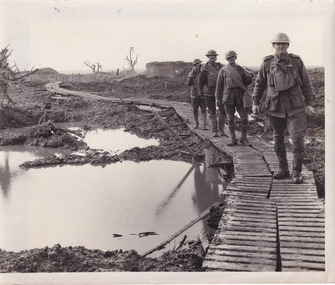
... These conditions caused some soldiers to develop medical problems such as trench foot. There were many lines of German trenches on one side and many lines of Allied trenches on the other. ...Taken during World War I on the Western Front, this photograph depicts four soldiers dressed in full uniform and kit walking through muddy trenches on wooden duckboards. On the Western Front, the war was fought by soldiers in trenches. Trenches were long, narrow ditches dug into the ground where soldiers lived. They were very muddy, uncomfortable and the toilets overflowed. These conditions caused some soldiers to develop medical problems such as trench foot. There were many lines of German trenches on one side and many lines of Allied trenches on the other. In the middle was no man's land, which soldiers crossed to attack the other side. 'Duckboards' (or 'trench gratings') were first used at Ploegsteert Wood, Ypres in December 1914. They were used throughout the First World War being usually placed at the bottom of the trenches to cover the sump-pits, the drainage holes which were made at intervals along one side of the trench. This made it easier to pump out the pits when necessary. The raised edges of the boards in theory helped protect men's feet from accumulated water; walking along them (especially at night and in the wet) was something of an art as it was easy to lose one's footing and slip or trip on the fequently misaligned sections. Sepia rectangular reproduced photograph on matte photographic paper Reverse: 6528/ (A copyright and reproduction notice from the Australian War Museum, printed in blue ink)/ burke museum, military album, trench warfare, duckboards, soldiers, ww1, wwi, world war 1, world war i, western front
