Showing 4 items matching "trinity college (dublin, ireland) library"
-
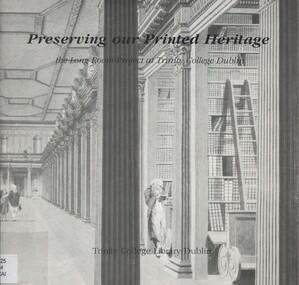
Surrey Hills Historical Society CollectionBook, Preserving our printed heritage: the Long Room Project at Trinity College Dublin, c1988
... trinity college (dublin, ireland) library...Trinity College's foundation in 1592. The staff faced the problems of space, access, and above all preservation. This booklet describes their journey. trinity college (dublin, ireland) library books- ireland - conservation and restoration Preserving our printed heritage: the Long Room Project at Trinity College Dublin. ...The Long Room was built between 1712 and 1732 to house the collections of books and manuscripts which had been growing since Trinity College's foundation in 1592. The staff faced the problems of space, access, and above all preservation. This booklet describes their journey.trinity college (dublin, ireland) library, books- ireland - conservation and restoration -

Supreme Court of Victoria LibraryPortrait, Sir Robert Molesworth
... Library 210 William Street Melbourne melbourne The portrait was commissioned in 1884, near the end of Molesworth's term of office. The portrait was commissioned at the same time as those of Redmond Barry and Chief Justice Stawell. Robert Molesworth, like his contemporaries, Stawell and Barry, went to Trinity College, Dublin, and practiced at the Irish ...The portrait was commissioned in 1884, near the end of Molesworth's term of office. The portrait was commissioned at the same time as those of Redmond Barry and Chief Justice Stawell. Robert Molesworth, like his contemporaries, Stawell and Barry, went to Trinity College, Dublin, and practiced at the Irish Bar before migrating to Australia in 1852. Molesworth quickly gained a large practice at the Bar. In 1853 he was acting Chief Justice and he later served as Solicitor-General in the early Victorian colonial administrations. Molesworth was appointed to the bench in 1856. He primarily worked in the Equity area, but his main contribution to Colonial administration was as the Chief Judge of the Court of Mines, establishing the basis of mining law in Australia.The portrait of Molesworth is significant because of whom it portrays and is the only known portrait of Molesworth.Full length portrait in oils of Sir Robert Molesworth. He is seated at a desk and dressed in Judicial robes. The frame is of 20th century originSigned with monogram and dated 1885 lower left. Plaque identifies sitter as The Hon. Sir Robert Molesworth Judge of the Supreme Court. 1856-1886courts, molesworth robert, a beckett edward -
St Patrick's Old Collegians Association (SPOCA)Photograph - SPOCA, Tour of Ireland
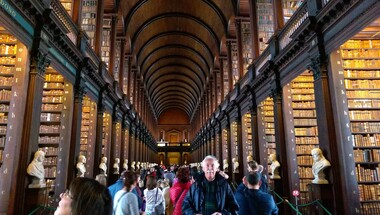
... St Patrick's Old Collegians Association (SPOCA) Formerly Cnr of Cathedral Place & Lansdowne Street East Melbourne melbourne Long Room of the Library at Trinity College Dublin - home of King Brian Barough's Harp of Erin and of the Book of Kells Photograph SPOCA, Tour of Ireland ... -
Bacchus Marsh & District Historical SocietyDiary, [Digital file].1840-1841. Charles Griffith
... Bacchus Marsh & District Historical Society Lerderderg Library Main Street Bacchus Marsh Charles Griffith was born in Kildare, Ireland in 1808. He studied at Trinity College, Dublin acquiring a B.A. in 1829 and an M.A. in 1832 before being admitted to practice as barister. ...Charles Griffith was born in Kildare, Ireland in 1808. He studied at Trinity College, Dublin acquiring a B.A. in 1829 and an M.A. in 1832 before being admitted to practice as barister. In 1840 he emigrated to Australia arriving in the Port Phillip District in November 1840. Soon after arriving he and his friend James Moore formed a business partnership and acquired land in the Parwan Valley near Bacchus Marsh. This land had been in the possession of a Mr. McKenzie who agreed to sell his land and sheep to Griffith and Moore. The property they acquired came to be known as Glenmore. The partnership with James Moore lasted until 1848. In 1846, whilst in Ireland, Griffith married Miss Jane Catherine Magee, then returned to Glenmore and later took his nephew, Molesworth Richard Greene, into partnership, which arrangement proved to be long and prosperous. In 1857, they bought runs at Mount Hope and Mount Pyramid, which they kept until the days of free selection. Griffith led an active and successful public life. He was a member of the new Victorian Legislative Council in 1851, and was later an elected representative of the Legislative Assembly 1853-1859. He occupied many important public positions, including that of magistrate for Bacchus Marsh. Griffith was a devout Anglican and hosted Bishop Charles Perry at his station near Bacchus Marsh in 1849. He died in 1863 at his home in South Yarra. The diary is a detailed account of Griffith's voyage from Ireland to Australia and of his early months in Melbourne. After this it covers his early months establishing himself on his property, Glenmore, near Bacchus Marsh. The timeline of the diary stretches across 1840 and 1841. Griffith was an educated gentleman who made detailed observations about the environment he found himself in. The diary is particularly notable for Griffith's commentary about his interactions with people from first nations, and reveals some of his thinking about Colonial policies directed at first nations people. The diary also includes some sketches of individual first nations people along with some sketches of flora and fauna. The final part of the diary includes a glossary of Aboriginal words Griffith was familiar with. Digital file. PDF format. Digitised by State Library Victoria from photocopied pages of a hand-written transcription of the original diaries written by Charles J. (James) Griffith in 1840 and 1841.charles james griffith 1808-1863, diaries bacchus marsh, glenmore station, wadawurrung people, aboriginal australians bacchus marsh region history