
Showing 39 items matching "tripod mounting"
-
 Geelong RSL Sub Branch
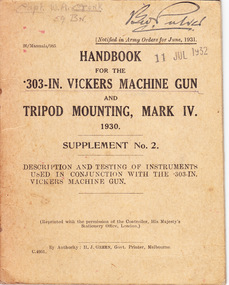
Book, Handbook for .303-IN Vickers Machine Gun and Tripod Mounting, Mark IV 1930 Supplement No 2, Early 20th Century
... Handbook for .303-IN Vickers Machine Gun and Tripod Mounting, Mark IV 1930 Supplement No 2......Tripod Mounting...Handbook for the .303-IN Vickers Machine Gun and Tripod Mounting, Mark IV 1930 Supplement 2....Handbook for the .303-IN Vickers Machine Gun and Tripod Mounting, Mark IV 1930 Supplement 2. Handbook used by Military Personnel in relation to the .303-IN Vickers Machine Gun and Tripod Mounting, Mark IV. ...Handbook for the .303-IN Vickers Machine Gun and Tripod Mounting, Mark IV 1930 Supplement 2.Handbook used by Military Personnel in relation to the .303-IN Vickers Machine Gun and Tripod Mounting, Mark IV.A small oblong book buff in colour cardboard outer cover.On the front cover in pencil Capt W.A. Cronk 59 Bn. On the front cover in ink B.W. Pulver.machine gun, tripod mounting, mounting -
 National Vietnam Veterans Museum (NVVM)
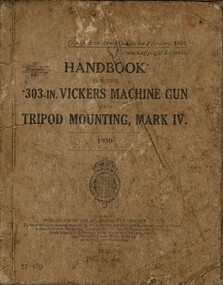
Booklet, British Army, Handbook: 303 in. Vickers Machine Gun and Tripod Mounting, Mark IV. 1930, 1930
... Vickers Machine Gun and Tripod Mounting, Mark IV. 1930......Tripod Mounting Mark IV...Vickers Machine Gun and Tripod Mounting, Mark IV. 1930 Booklet British Army ...A brown colouerd cardboard cover with black information on the front. Above the insignia (unit not known) are the details of the handbook. There are two metal staples holdong the handbook together on the inside of the cover.hanbook, british army, military books, .303in vickers machine gun, tripod, tripod mounting mark iv -
 National Vietnam Veterans Museum (NVVM)
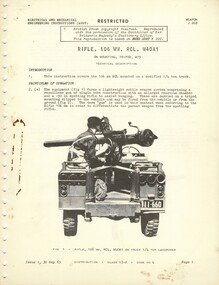
Booklet, Australian Army, Australian Army: Rifle, 106mm, RCL, M40A1 on Mounting, Tripod, M79
... Australian Army: Rifle, 106mm, RCL, M40A1 on Mounting, Tripod, M79...Australian Army: Rifle, 106mm, RCL, M40A1 on Mounting, Tripod, M79 Booklet Australian Army ...Pages one toeleven of the Electrical and Mechanical Engineering Instructions (Aust). There are several punch holes down the left hand side. This is stored in a plastic bag.electrical and mechanical engineering instructions, 106mm recoilless rifle, m40a1 and mount m79 -
 Bendigo Military Museum
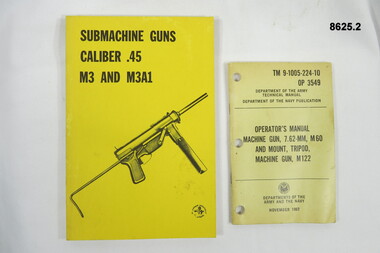
Manual - MACHINE & SUB MACHINE GUNS, Department of the Army and the Navy, 1967, 1975
... This manual contains instructions for the operation and maintenance of the 7.62 Machine Gun, M60 and Machine Gun Tripod Mount....This manual contains instructions for the operation and maintenance of the 7.62 Machine Gun, M60 and Machine Gun Tripod Mount. Manual MACHINE & SUB MACHINE GUNS Department of the Army and the Navy. ...1. The manual is a guide for unit Commanders in training their men in the use of the Sub-Machine Guns, Caliber .45, M3 and M3A1. 2. This manual contains instructions for the operation and maintenance of the 7.62 Machine Gun, M60 and Machine Gun Tripod Mount.passchendaele barracks trust, pbt 23 24, manuals, machine guns -
 Department of Energy, Environment and Climate Action
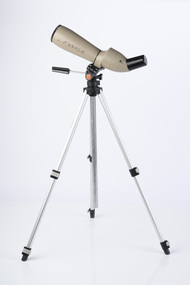
Spotting telescope
... Telescope mounted on tripod...Forests Commission Victoria (FCV) Communications Surveying L McKenzie Telescope mounted on tripod Spotting telescope ...Telescope mounted on tripodL McKenzieforests commission victoria (fcv), communications, surveying -
 Montmorency–Eltham RSL Sub Branch
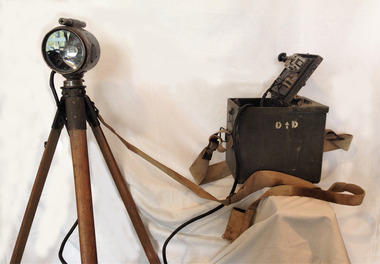
Equipment - Tripod Mount, Lamp, Signalling Daylight, Short Range, MK II, PMG 1942
... Tripod Mount, Lamp, Signalling Daylight, Short Range, MK II, PMG 1942...Wooden tripod mount for lamp, signalling daylight, short range, MK II. ...tripod helio lamp daylight STAND LAMP OR HELIO A MK II Wooden tripod mount for lamp, signalling daylight, short range, MK II. ...Wooden tripod mount for lamp, signalling daylight, short range, MK II. The legs are shaped to a point at the bottom and shaped to form a circle when closed. Each leg has a metal fitting attached by metal screws at the top, which supports a circular metal collar fitting for the mounting of the lamp. A khaki coloured stiched canvas webbing with brass buckles is attached at one end to the metal fitting at the top of one leg. The other end has a circular sleeve for using to keep the wooden tripos mount legs closed for storage. One leg has a small brass ring mounted at the top. A metal hook is mounted under the lamp mounting collar.STAND LAMP OR HELIO A MK IItripod, helio, lamp, daylight -
 Flagstaff Hill Maritime Museum and Village
Instrument - Telescope, Mid-18th Century
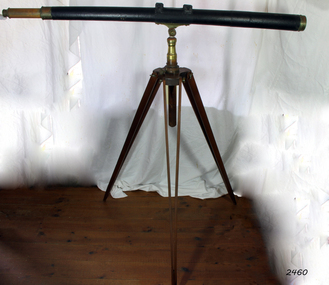
... Telescope is mounted on wooden tripod stand that has folding legs. ...Telescope is mounted on wooden tripod stand that has folding legs. ...This Day or Night telescope, made by John Dollond, was designed for use in a range of lighting conditions, as its name suggests. Telescopes are optical instruments that make distant objects appear larger and closer, thereby extending the range of what the human eye can observe. The development of the telescope was gradual, shaped by a series of important advances in optical science. In 1608, the Dutch spectacle-maker Hans Lippershey discovered that when two lenses were held apart in a particular way, distant objects appeared closer. He applied for a patent for this invention, creating the first documented telescope. In 1668, Isaac Newton produced the first successful reflecting telescope, using a two-inch concave spherical mirror. This marked a major step forward, demonstrating that mirrors could overcome some of the limitations of lenses and greatly improve magnification. Further progress followed in the eighteenth century. In 1729, Chester Moor Hall developed the achromatic lens by combining two types of glass with different refractive properties. This reduced colour distortion and produced a sharper image, although some edge distortion remained. That same year, the Scottish instrument maker James Short developed parabolic and elliptical mirrors that were better suited to reflecting telescopes because they reduced optical distortion. Building on these advances, John Dollond improved the achromatic objective lens by placing a concave flint-glass lens between two convex crown-glass lenses, considerably enhancing image quality. Maker’s information. John Dollond (1707–1761), of London, was a maker of optical, scientific and astronomical instruments best known for developing the achromatic refracting telescope. He also introduced a practical heliometer, a telescope fitted with a divided lens that could be used to measure the Sun’s diameter and the angular distance between celestial bodies. The son of Huguenot refugees, Dollond first learned the family trade of silk weaving before turning his attention to optics and astronomy, in which he became highly skilled. In 1753, Dollond patented his improved lenses, the same year he had introduced the heliometer. In 1761, John Dollond was appointed as optician to George III and the Duke of York. He was also elected a Fellow of the Royal Society in May 1761, but died suddenly later that year in November. His share of the patent then passed to his eldest son, Peter. In later disputes between Peter Dollond and rival London opticians who challenged the patent, Peter consistently argued that, whatever earlier precedents may have existed, his father had independently developed a practical method for producing achromatic lenses through his command of Newtonian optics. By successfully defending the patent, the Dollond firm became one of the leading manufacturers of optical instruments. During the eighteenth and nineteenth centuries, the name ‘Dollond’ was at times used almost generically to mean ‘telescope,’ reflecting the firm’s reputation. Genuine Dollond telescopes were regarded as among the finest available. Peter Dollond (1731–1820) was the driving force behind the family business. He had founded a small optical business in 1750 on Vine Street, Halton Garden, with his father's guidance. The success of the business led to his father joining him in partnership in 1752. In 1959, J Dollond and Son opened a shop on The Strand, London. Dollonds appear to have produced both reflecting and refracting telescopes, and they possessed the technical skill to manufacture significant numbers of lenses largely free from chromatic aberration. In 1766, Peter went into partnership with his younger brother, John, and they traded under the name P and J Dollond. They supplied optical instruments for Captain Cook and George Hadley, an English lawyer and Meteorologist. In 1769, Captain Cook travelled with a Dollond telescope on the voyage to observe the Transit of Venus. Other notable customers included Thomas Jefferson and Admiral Lord Nelson. In 1781, Peter Dollond made bifocal spectacles. In 1804, young John Dollond passed away. The following year, Peter Dollond went into partnership with his nephew, George Huggins, and Huggins legally changed his surname to Dollond, and the firm remained P and J Dollond. In the early 20th century, the company sold film cameras. The firm remained in the hands of Dollond family members until 1927, when Dollond & Co. merged with James Aitchison & Co. to form Dollond & Aitchison, the well-known high street chain of opticians, which continued making and selling prescription spectacles. Now fully part of Boots Opticians, the company no longer manufactures instruments and operates exclusively as a retail business. The telescope in the collection is an excellent example of one of Dollond’s early library telescopes. Its association with one of eighteenth-century England’s leading innovators in optical development gives it considerable historical significance and makes it an important object within the collection. John Dollond’s experiments in optics advanced the understanding of the divergent properties of lenses and made a lasting contribution to the development of practical optical science. His work helped lay the foundation for major improvements in the design and performance of optical instruments. In his own time, Dollond was celebrated as the “Father of practical optics” and received widespread recognition for his achievements in the field. Dollond telescopes were associated with the renowned mariners, Captain James Cook and Admiral Lord Nelson Telescope: Dollond's Telescope, Day or Night model navigational instrument. Telescope is mounted on wooden tripod stand that has folding legs. Brass telescope with leather sheath over barrel, adjustable angle fitting with brass wing nuts that join the legs to the top frame, which is then joined to the telescope pole by an adjustable screw fitting. Manufactured by Dollond, London. Inscription reads "Dollond London, Day or Night" and "DOLLOND LONDON"flagstaff hill maritime museum and village, maritime museum, maritime village, great ocean road, warrnambool, optical instrument, achromatic telescope, heliometer, light refraction, instrument maker, lens, transit of venus, astronomical telescope, concave lens, scientific instrument, navigation, navigational instrument, astronomy, dollond, dollond london, john dollond, peter dollond, dollond telescope, day or night telescope, floor-standing telescope, library telescope, hans lippershey, isaac newton, chester moor hall, james short, captain cook, thomas jefferson, admiral lord nelson, dollond & co, aitchison & co, dollond & aitchison, boots opticians, george iii, duke of york, george huggins, george dollond, p and j dollond, j dollond and son, spectacles, cameras -
 Federation University Historical Collection
Instrument - Scientific Instrument, Bellingham & Stanley Ltd, Polarimeter, c early 1900s
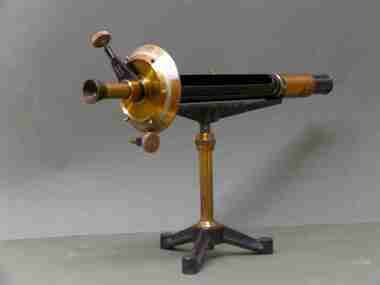
... An optical device with horizontal axis, mounted on a tripod. The polarimeter is used for determining the polarising properties of solutions. ...ballarat school of mines scientific equipment scientific instruments scientific objects polarimeter polarising liquids An optical device with horizontal axis, mounted on a tripod. The polarimeter is used for determining the polarising properties of solutions. ...An optical device with horizontal axis, mounted on a tripod. The polarimeter is used for determining the polarising properties of solutions. ballarat school of mines, scientific equipment, scientific instruments, scientific objects, polarimeter, polarising liquids -
 Federation University Historical Collection
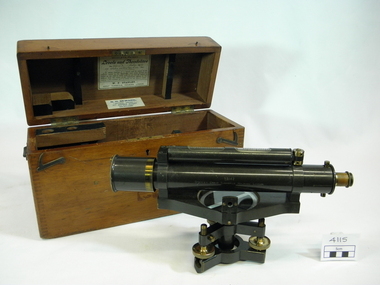
Instrument, W. H. Stanley, Surveying level, July 1899
... mounting provided). dust shield for object. Features glass lens x 2. Timber carry case features dovetailed joints, separate lid attached to body of case with two brass piano hinges along back side. Case has a metal carry handle screwed to each end. Matches tripod...mounting provided). dust shield for object. Features glass lens x 2. Timber carry case features dovetailed joints, separate lid attached to body of case with two brass piano hinges along back side. Case has a metal carry handle screwed to each end. Matches tripod ...Used by students attending surveying classes at the School of Mines & Industries, Ballarat.Surveyor's level caste in metal with brass trimmings. Features external focus, twin inclined vertical crosshairs with stadia wires. With ray-shade clinomenter. Three levelling screws. Without transverse level (mounting provided). dust shield for object. Features glass lens x 2. Timber carry case features dovetailed joints, separate lid attached to body of case with two brass piano hinges along back side. Case has a metal carry handle screwed to each end. Matches tripod Item 4116 Item's serial number: 99142*The timber lid of the carry case has 'L3' painted on it in white paint. *The paper label glued to reverse side lid of inside carry box reads: STANLEY'S PATENT LEVELS AND THEODOLITES No.99142 July 1899 STADIA POINTS SET=1 : 100. In taking readings of a distant staff by means of the subtense points in the diaphragm, read every 1/100 foot (or metre) on the staff as being equal to one foot (or metre) of distance from the centre of the instrument adding to the reading of plus constant of 18 3/4 inchess from any distance shown. W.F. Stanley, Great Turnstile, Holborn, London. *The paper label glued to lower edge inside lid of carry box reads: N. H. SEWARD, "Optical House" 457 BOURKE STREET (Near Queen Street) MELBOURNE *Engraving on brass plate encompassing the catch on front edge of the timber carry case reads: H&C L (inside an engraved heart on LSH) EUCHRE LEVER (engraved on RHS of brass plate) *Maker's mark is engraved along the length of the telescope barrel: 99142 Stanley. Great Turnstile Holborn, London. level, theodolite, surveying instrument, surveying, scientific instruments -
 Federation University Historical Collection
Equipment - Camera, Thornton-Pickard, Thornton Pickard Triple Imperial Extension Camera, c1901
... The camera has leather bellows, and was originally mounted on a tripod....The camera has leather bellows, and was originally mounted on a tripod. Thornton Pickard Triple Imperial Extension Camera, c1901 Equipment Camera Thornton-Pickard ...Thornton-Pickard was a famous British camera manufacturer established in 1888. The company was based in Altrincham, near Manchester, and was an early pioneer in the development of the camera industry.Thornton Pickard Triple Imperial Extension half plate camera nos 529946 and 529947. The camera has leather bellows, and was originally mounted on a tripod.camera, extension camera, photographic equipment -
Federation University Historical Collection
Tool - Scientific Instrument, Theodolite: Serial No. 25353; Also known as "Transit" in the USA, c1939
... A surveying instrument mounted on a wood base with Slotted ends Instrument to be mounted on a tripod - Item No 7459...theodolite transit united states of america berger & sons magnetic compass compass dial surveying instrument On magnetic compass dial: "C.L.BERGER & SONS" "BOSTON USA" 25353 A surveying instrument mounted on a wood base with Slotted ends Instrument to be mounted on a tripod - Item No 7459 Theodolite: Serial No. 25353; Also known as "Transit" in the USA Tool Scientific Instrument C.L. ...A surveying instrument mounted on a wood base with Slotted ends Instrument to be mounted on a tripod - Item No 7459On magnetic compass dial: "C.L.BERGER & SONS" "BOSTON USA" 25353theodolite, transit, united states of america, berger & sons, magnetic compass, compass dial, surveying instrument -
 Federation University Historical Collection
Instrument - Scientific Instrument, W.&L.E. Gurley, Plane Table
... A spherical mount on the underside, designed to match the receptacle on top of the tripod - Item 04129....tripod location chains Manufacturer's stamp underneath. A wooden platform used in surveying equipped with a 2.7 cm diameter dowel at each end that would hold the charts/papers in position. A spherical mount ...Used at the Ballarat School of Mines in Surveying classes. It was used in conjunction with Item 04129 - Collapsible leg surveying instrument, tripod, and at times with Item 4127 - Tripod location chains.A wooden platform used in surveying equipped with a 2.7 cm diameter dowel at each end that would hold the charts/papers in position. A spherical mount on the underside, designed to match the receptacle on top of the tripod - Item 04129.Manufacturer's stamp underneath.plane table, surveying, w. & l.e. gurley, scientific instrument, ballarat school of mines, tripod, location chains -
 Federation University Historical Collection
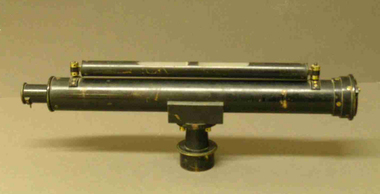
Equipment - Scientific Instruments, Level
... Instrument to be mounted on a tripod with 3.5 cm male thread. Matches Tripod Catalogue Number 4111....Instrument to be mounted on a tripod with 3.5 cm male thread. Matches Tripod Catalogue Number 4111. ...A sensitive optical levelling instrument in a polished timber carry case. Instrument to be mounted on a tripod with 3.5 cm male thread. Matches Tripod Catalogue Number 4111.scientific instruments, level, contractors level, ballarat school of mines, surveying, mining -
 Federation University Historical Collection
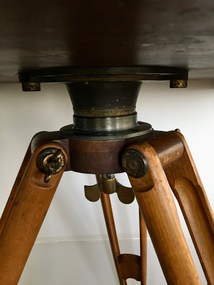
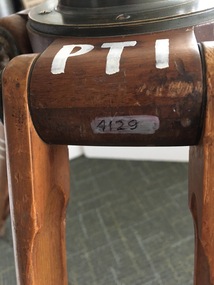
Instrument - Scientific Instruments, W.& L.E. Gurley, Collapsible Leg Surveying Instrument: Tripod
... A large tripod of timber construction. Concave top mount flange to receive matching spherical spigot. ...GURLEY A large tripod of timber construction. Concave top mount flange to receive matching spherical spigot. ...Used with the Plane Table - Item 4130, in surveying classes at Ballarat School of Mines. Item 4127, Tripod Location Chains, may also have been used.A large tripod of timber construction. Concave top mount flange to receive matching spherical spigot. Spacer block halfway up each twin-strut leg.In white paint on the top "PTI" Manufacturer's stamp on each leg - circular. "W.& L.E. GURLEYtripod, surveying, scientific instrument, ballarat school of mines, plane table, location chains, w & l e gurley -
Federation University Historical Collection
Instrument, Tripod
... Top fitting painted light green.8.5cm make screw thread for mounting theodolite no 04084. Tripod Instrument ...Tripos with polished dark brown timber legs. Top fitting painted light green.8.5cm make screw thread for mounting theodolite no 04084.tripid, scientific instrument, surveying, precision -
 Bendigo Military Museum
Photograph - Army Survey Regiment – Corps Day Parade Set 2, Fortuna Villa, Bendigo, 1991
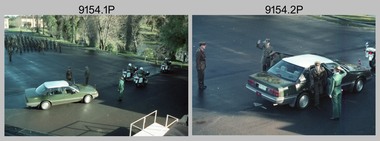
... SPR Peter Smyth stands on the corner of the parade ground behind an MRA-7 Tellurometer mounted on a tripod. .15) & .16) - Photo, colour, 1991. ...SPR Peter Smyth stands on the corner of the parade ground behind an MRA-7 Tellurometer mounted on a tripod. .15) & .16) - Photo, colour, 1991. ...This set of 37 photographs was taken at the Corps Day Parade held at the Army Survey Regiment, Bendigo on the 26th of June 1991.The Corps Day Parade was held to commemorate the 76th anniversary of the formation of the Royal Australian Survey Corps. The Reviewing officer was the Commander of the 3rd Military District BRIG P. Davies AM ADC and the Parade Host was D-SVY COL Simon Lemon. Refer to items 9152.31P for more photographs taken during the parade; and 9155.27P for photographs taken afterwards during the tour of the unit and the family BBQ.This is a set of 37 photographs of the Corps Day Parade held at the Army Survey Regiment, Fortuna, Bendigo on the 26th of June 1991. The colour photographs are on 35mm negative film and scanned at 2400 dpi. They are part of the Army Survey Regiment’s Collection. .1) - Photo, colour, 1991. Arrival of COMD 3MD. L to R: D-SVY - COL Simon Lemon, unidentified personnel, unidentified Aide-de-camp. .2) to .4) - Photo, colour, 1991. Arrival of COMD 3MD. L to R: D-SVY - COL Simon Lemon, COMD 3MD - BRIG P. Davies AM ADC, unidentified Aide-de-camp, unidentified personnel. .5) - Photo, colour, 1991. Cartographic Squadron stands at attention, under command of OC MAJ Graeme Wastell. .6) - Photo, colour, 1991. Headquarters Squadron stands at attention, under command of OC MAJ Peter Jensen. 2IC MAJ Ray Redman at left. .7) - Photo, colour, 1991. Air Survey Squadron stands at attention. L to R: LT Simon Buckpitt, WO1 Brett ‘Dutchy’ Van Leeuwen, unidentified (x2), CPL Perry Burt, SGT Sandy Craig, SGT Graeme Reany, SPR Stuart Bowd, LT Michelle Breen in foreground, unidentified, SGT Wolfgang Thun, SSGT Bruce Hammond, unidentified, SGT Paul Hopes, WO1 Russell ‘Rusty’ Williams. .8) - Photo, colour, 1991. Air Survey Squadron at attention under command of OC MAJ Peter Clark - at far left during the inspection. L to R: LT Simon Buckpitt, CO LTCOL Rene van den Tol, unidentified Aide-de-camp, LT Michelle Breen in foreground. At her right L to R: COMD 3MD - BRIG P. Davies AM ADC, SGT Graeme Reany, SPR Stuart Bowd, unidentified, SGT Wolfgang Thun, SSGT Bruce Hammond, unidentified, SGT Paul Hopes, WO1 Russell ‘Rusty’ Williams. .9) - Photo, colour, 1991. Air Survey Squadron inspection. L to R: D-SVY - COL Simon Lemon, COMD 3MD - BRIG P. Davies AM ADC, SPR Steve Linane, SPR Derek Percival. .10) & .11) - Photo, colour, 1991. Air Survey Squadron inspection. SSGT Graham Johnston at far left. L to R: CO LTCOL Rene van den Tol, unidentified Aide-de-camp, D-SVY - COL Simon Lemon, COMD 3MD - BRIG P. Davies AM ADC, SPR John ‘Docc’ Commons, unidentified (x4), SPR Jo (Innes) Thun, SGT Peter Tuddenham, SSGT Bob Garritty, SGT Martin Evans. .12) - Photo, colour, 1991. Air Survey Squadron inspection. L to R: CO LTCOL Rene van den Tol, unidentified Aide-de-camp, D-SVY - COL Simon Lemon, COMD 3MD - BRIG P. Davies AM ADC, SPR John ‘Docc’ Commons, unidentified (x4), SPR Jo (Innes) Thun, SGT Peter Tuddenham, SSGT Bob Garritty, SGT Martin Evans. Unidentified WO2 in right background. .13) & .14) - Photo, colour, 1991. SPR Peter Smyth stands on the corner of the parade ground behind an MRA-7 Tellurometer mounted on a tripod. .15) & .16) - Photo, colour, 1991. SPR Damian Nolan stands on the corner of the parade ground behind a Plane Table Board with an alidade mounted 3MD Band stands at attention during the inspection. L to R: unidentified Aide-de-camp, unidentified 3MD Band Master, D-SVY - COL Simon Lemon, COMD 3MD - BRIG P. Davies AM ADC, unidentified members of 3MD Band.on a tripod. .17) - Photo, colour, 1991. The unidentified 3MD Band Master salutes COMD 3MD - BRIG P. Davies AM ADC before the 3MD Band inspection. .18) - Photo, colour, 1991. 3MD Band stands at attention during the inspection. L to R: unidentified Aide-de-camp, unidentified 3MD Band Master, D-SVY - COL Simon Lemon, COMD 3MD - BRIG P. Davies AM ADC, unidentified members of 3MD Band. .19) - Photo, colour, 1991. Army Survey Regiment at ‘Shoulder Arms’ position in readiness for the Present Arms’ salute. CO LTCOL Rene van den Tol at front. .20) - Photo, colour, 1991. Cartographic and Air Survey Squadrons at ‘Shoulder Arms’ position in readiness for the Present Arms’ salute. CO LTCOL Rene van den Tol at front. .21) - Photo, colour, 1991. Headquarters Squadron at ‘Shoulder Arms’ position in readiness for the Present Arms’ salute. L to R: 2IC MAJ Ray Redman, MAJ Bob Williams, OC MAJ Peter Jensen. CAPT Colin Cuskelly. .22) & .23) - Photo, colour, 1991. Army Survey Regiment under CO LTCOL Rene van den Tol’s command salutes the COMD 3MD with ‘Present Arms’. .24) - Photo, colour, 1991. L to R: COMD 3MD - BRIG P. Davies AM ADC, D-SVY - COL Simon Lemon, unidentified Aide-de-camp. .25) - Photo, colour, 1991. The squadrons remove their hats in readiness for ‘Three cheers for Her Majesty the Queen’. .26) & .27) - Photo, colour, 1991. The squadrons cheer in unison to the command ‘Three cheers for Her Majesty the Queen’. .28) - Photo, colour, 1991. The unidentified padre addresses the Parade. .29) - Photo, colour, 1991. COMD 3MD - BRIG P. Davies AM ADC, addresses the Parade. .30) - Photo, colour, 1991. D-SVY - COL Simon Lemon addresses the Parade. .31) & .32) - Photo, colour, 1991. COMD 3MD - BRIG P. Davies AM ADC presents the Defence Force Service Medal with clasp to WO1 Brett ‘Dutchy’ Van Leeuwen for 20 years of efficient remunerated service. .33) - Photo, colour, 1991. The 3MD Band marches towards the front steps of Fortuna Villa. .34) - Photo, colour, 1991. The 3MD Band salutes as it marches past the official guests on the front steps of Fortuna Villa. .35) - Photo, colour, 1991. Lithographic Squadron led by OC MAJ Bob Coote marches towards the front steps of Fortuna Villa. .36) - Photo, colour, 1991. Lithographic Squadron led by OC MAJ Bob Coote salutes as it marches past the official guests on the front steps of Fortuna Villa. .37) - Photo, colour, 1991. COMD 3MD - BRIG P. Davies AM ADC salutes the passing troops. L to R: D-SVY - COL Simon Lemon, unidentified UK Liaison Officer, BRIG P. Davies AM ADC, unidentified Aide-de-camp.There are no personnel identified. ‘Corps Day 26 Jun 1991’ annotated on negative sleeves.royal australian survey corps, rasvy, army survey regiment, army svy regt, fortuna -
 Bendigo Military Museum
Administrative record - FOLDER AND RECORDS
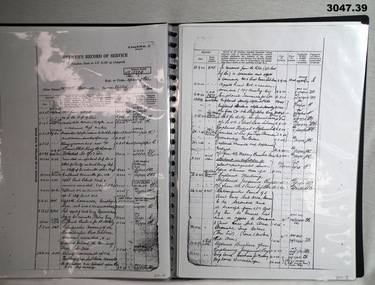
... Written on a note pad with British Aluminium stamped on it. .28) Typed sheet showing a brief (biography) story of the life of Herbert Trangmar ALLAN (Blue). .29) Colour top view photo on A4 paper showing a huge pair of Japanese binoculars mounted on a tripod. .30) Colour R side view photo on A4 paper of Japanese binoculars. .31) Colour rear view photo of huge Japanese binoculars. .32) Colour front view photo on A4 paper of huge Japanese binoculars mounted on a tripod. .33) Colour L side view photo of huge Japanese binoculars. .34) Colour photo of tripod with timber legs & brace to suit binoculars above. .35) Black & white photo of a manufacturers plate featuring Japanese writing & numbers. .36) Colour photo on A4 paper showing manufacturers plate on rear of support brace on the tripod head. .37) Copy of WM Collection photo number 058101 showing an Australian soldier looking into the binoculars, Finschafen New Guinea .38) Menu card. ...Written on a note pad with British Aluminium stamped on it. .28) Typed sheet showing a brief (biography) story of the life of Herbert Trangmar ALLAN (Blue). .29) Colour top view photo on A4 paper showing a huge pair of Japanese binoculars mounted on a tripod. .30) Colour R side view photo on A4 paper of Japanese binoculars. .31) Colour rear view photo of huge Japanese binoculars. .32) Colour front view photo on A4 paper of huge Japanese binoculars mounted on a tripod. .33) Colour L side view photo of huge Japanese binoculars. .34) Colour photo of tripod with timber legs & brace to suit binoculars above. .35) Black & white photo of a manufacturers plate featuring Japanese writing & numbers. .36) Colour photo on A4 paper showing manufacturers plate on rear of support brace on the tripod head. .37) Copy of WM Collection photo number 058101 showing an Australian soldier looking into the binoculars, Finschafen New Guinea .38) Menu card. ...For historical information refer to notes attached to Cat No 2755.4 See attached sheets for the remainder of pages.Black plastic folder, ring binding with 20 clear plastic sleeves. .1) Photocopy of cover for personnel documents for Herbert Trangmar ALLAN, MC, NX12229, N60005, Captain 2nd Garrison Battalion. A4 page size. .2) Photocopy of WWII attestation form dated 2.5.1940 for NX12229, Herbert Trangmar ALLAN. .3) Photocopy of Medical Exam Section. .4) Photocopy of Medical Exam Section with black & white ID photo. .5) Enlarged photocopy of ID photos of Herbert Trangmar ALLAN. .6) Photocopy of Mobilization attestation form dated 6.10.39 for Herbert Trangmar ALLAN. .7) Photocopy of Termination of Officer's Appointment dated 2.4.1946 for Herbert Trangmar ALLAN, OBE, NX12229. .8) Photocopy of Officers Record of Service for Herbert Trangmar ALLAN. Address at time was Wali, New Guinea .9) Photocopy of Officers Record of Suc for Herbert Trangmar ALLAN OBE MC ED NX12229. Address at time was Wali, New Guinea. First entry: 16.6.1914. Last entry: 1.11.1945. .10) Photocopy of Officers Record of Service, dated 29.8.1950. For NX12229 Herbert Trangmar ALLAN MC OBE ED. Last address Watsons Bay NSW. .11) Photocopy of Determination of Demobilization Priority for NX12229 Herbert Trangmar ALLAN. Dated 5.10.1945. .12) Photocopy of sheet showing service early WWII for Herbert Trangmar ALLAN. .13) Photocopy of sheet showing early WWII service of N60005, Herbert Trangmar ALLAN. .14) Photocopy of Officer's Record of Service sheet for Herbert Trangmar ALLAN OBE MC NX12229. First entry: 17/2/1943. Last entry: 24.8.1944. .15) Photocopy of Record of Service sheet. First entry: 28.9.1944. Last entry: 25.5.1945. .16) Photocopy of Officer's Record of Service for Herbert Trangmar ALLAN OBE MC NX12229. First entry: 1.6.1945. Last entry: 14.3.1946. .17) Photocopy of Record of Service sheet. Mentions MID in SWPA & rank changes. First entry: 21.3.1946. Last entry: 30.9.1950. .18) Photocopy of Officer's Record of Service sheet for NX12229 Herbert Trangmar ALLAN 2nd Garrison Battalion. First entry: 6.9.1944. Last entry: 7.5.1946 .19) Photocopy of Recommendation for an OBE for NX12229 Herbert Trangmar ALLAN MC Major. Tobruk period April / October 1941. .20) Photocopy of a sheet showing medals & awards for N60005 NX12229 Herbert Trangmar ALLAN OBE MC ED MID. .21) Photocopy of a letter to Deputy Commissioner - Repatriation on AIF letterhead. Re: Captain ALLAN H T 17 Battalion. .22) Photocopy of an AIF letterhead Canberra dated 1.5.1950. To Secretary HQ Repat Commission. Re: Capt ALLAN H T 17 Battalion. .23) Photocopy of a sheet showing telephone note re awards, dated 2.7.1955. Re: ALLAN H T. Address Mullaway, Woolgoolga, NSW. .24) Photocopy of ranks & dates for ALLAN H T NX12229. DOB 5.1.1895. Served in 14-18 Yes. First entry: 16.6.1914. Last entry: 29.1.1944. .25) Photocopy of ranks & dates for above. First entry: 13.2.1942. Last entry: 1.4.1945. .26) Photocopy of ranks & dates for ALLAN H T NX12229. DOB 5.1.1895. OBE MC. First entry: 23.7.1945. Last entry: 15.8.1951. .27) Photocopy of a note showing Colonel H T ALLAN, address Mullaway, Woolgoolga, NSW. Written on a note pad with British Aluminium stamped on it. .28) Typed sheet showing a brief (biography) story of the life of Herbert Trangmar ALLAN (Blue). .29) Colour top view photo on A4 paper showing a huge pair of Japanese binoculars mounted on a tripod. .30) Colour R side view photo on A4 paper of Japanese binoculars. .31) Colour rear view photo of huge Japanese binoculars. .32) Colour front view photo on A4 paper of huge Japanese binoculars mounted on a tripod. .33) Colour L side view photo of huge Japanese binoculars. .34) Colour photo of tripod with timber legs & brace to suit binoculars above. .35) Black & white photo of a manufacturers plate featuring Japanese writing & numbers. .36) Colour photo on A4 paper showing manufacturers plate on rear of support brace on the tripod head. .37) Copy of WM Collection photo number 058101 showing an Australian soldier looking into the binoculars, Finschafen New Guinea .38) Menu card. TobrukDay Dinner 2/17th Sgts Mess. Dated Wed 19.11.1941. .39) Christmas card with red ribbon in its fold. Shows a signpost Syria - Australia - & a Rising Sun, a kangaroo with smoke & fire, a laughing kookaburra on a sign post. Stamp. HQ 20 Aust Inf Bde AIF. .38) On rear: Two autographs. .39) Inside: “Best wishes for year 1942-1943 from Brig W (T) V Windeyer and staff”recorrds, certificcats, folders -
 Bendigo Military Museum
Equipment - TRAINING STAND FOR .303 IN LEE ENFIELD RIFLE, 21 Bn. AIF, c1915-1918
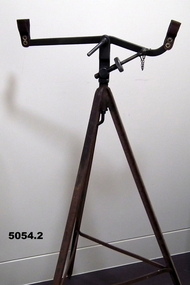
... This top section is mounted on a tripod, it can be removed. 2. This is a steel tripod made out of 'T' section steel. ...This top section is mounted on a tripod, it can be removed. 2. This is a steel tripod made out of 'T' section steel. ...This is a WW1 stand for mounting a .303 rifle, to train soldiers in shooting.This device consists of two parts; 1. Top part has an adjustable 'arm' . At the end of each arm is a leather covered 'U' section. Under the arm is a large threaded rod and knurled knob, this is to adjust elevation. At the center of the arm is a pivot that can lock into position. This top section is mounted on a tripod, it can be removed. 2. This is a steel tripod made out of 'T' section steel. There are fixed cross braces about 40 cm fom bottom. The top has a tube section within which the upper arm mounts.Marked on one leg is "XXI". Believed to be from 21st Bn. AIF. on the top of that leg is a very small arrow head.ww1, training, .303 rifles -
 Bendigo Military Museum
Instrument - Duplex Heliograph Mk V - 1940 with Tripod, LUCO Art Metal Coy Ltd, London, 1940
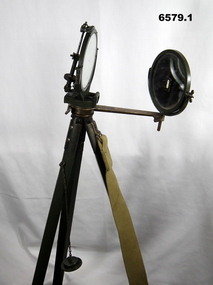
... The device typically included a 5 - inch mirror and was often mounted on a tripod for stability. Initially the instrument was used to communicate between survey stations using Morse code to coordinate their activities. ...The Instrument is mounted on a three-legged tripod of brass and mahogany with spiked feet, approximately 1.2 metres high. ...The Instrument is mounted on a three-legged tripod of brass and mahogany with spiked feet, approximately 1.2 metres high. ...The Heliograph MkV is a fascinating piece of historical surveying and communications equipment. It was primarily used for visual signaling by reflecting sunlight with a mirror to send coded messages over long distances. This method was primarily useful in remote areas where other forms of communication were not available. The MkV model, specifically, was widely used by the British Army and other military forces from around 1906 until the mid 1960s. It remained in use with the Australian Army Survey Corps until the mid 1980s. The device typically included a 5 - inch mirror and was often mounted on a tripod for stability. Initially the instrument was used to communicate between survey stations using Morse code to coordinate their activities. Later when better forms of communication were available, they were used for precise angle alignment where the sunlight reflection from the mirror was targeted between the survey stations to give very accurate results. The MkV was relatively light weight and portable, making it ideal for use in the field. It could be setup and adjusted quickly. The heliograph had an adjustable mirror that could be tilted to reflect sunlight towards a distant receiver. Surveyors could align the mirror using a sighting device. Whilst it was primarily used by the Military it was also used in civil surveying particularly in the remote areas of Australia. The British Army Mark V version uses a flat round mirror with a small unsilvered spot in the centre. The sender aligned the heliograph to the target by looking at the reflected target in the mirror and moving their head until the target was hidden by the unsilvered spot. Keeping their head still, they then adjusted the aiming rod so its cross wires bisected the target, they then turned up the sighting vane, which covered the cross wires with a diagram of a cross, and aligned the mirror with the tangent and elevation screws, so the small shadow that was a reflection of the unsilvered spot hole was on the cross target. This indicated that the sunbeam was pointing at the target. If the sun was in front of the sender, its rays were reflected directly from this mirror to the receiving station. If the sun was behind the sender, the sighting rod was replaced by a second mirror, to capture the sunlight and direct it onto the main mirror to reflect it to the receiving station.. 1 Brish Army "Mance" Mk V A253 Heliograph has two 125mm diameter mirrors on a brass arm with targeting attachments. The Instrument is mounted on a three-legged tripod of brass and mahogany with spiked feet, approximately 1.2 metres high. The instrument was made by LUCO Art Metal Co Ltd, London in 1940. .2 A military green metal carrying safety storage case with khaki shoulder strap.A253 stamped on instrumentroyal australian survey corps, rasvy, fortuna, army survey regiment, army svy regt, asr -
 Bendigo Military Museum
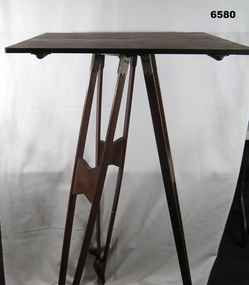
Instrument - Survey Plane Table with Tripod, Circa 1910
... A Plane Table consists of a smooth wooden table surface (with metal strengthening supports) mounted on a sturdy base. The base, a three-legged Tripod, is designed to support the table over a specific point on land. ...A Plane Table consists of a smooth wooden table surface (with metal strengthening supports) mounted on a sturdy base. The base, a three-legged Tripod, is designed to support the table over a specific point on land. ...A Plane Table consists of a smooth wooden table surface (with metal strengthening supports) mounted on a sturdy base. The base, a three-legged Tripod, is designed to support the table over a specific point on land. The connection between the tabletop and the adjustable Tripod legs permits the user to level the table precisely, using bubble levels in a horizontal plane regardless of the roughness of the terrain. The Plane Table is a surveying device used in surveying and mapping to provide a level surface on which to make drawings, charts or maps. An alidade, with or without a telescope located on the tabletop is used to sight features and draw angles to that feature. Using these lines to the same feature from different setup locations it is possible to locate that feature on the map. Plane Tabeling was widely used by the early members of the Australian Survey Corps and in both World Wars. It remains a simple and effective tool to teach the fundamentals of mapping and surveying. It was simple to use and was reasonably robust and portable. See also item 6489.2 for the Plane Table Alidade.A wooden Plane Table with alloy fittings to strengthen and support the table top. The table is fixed to a three-legged wooden Tripod with cast alloy fittings and metal pointed tips.royal australian survey corps, rasvy, fortuna, army survey regiment, army svy regt, asr, 4 fd svy sqn, school of military survey -
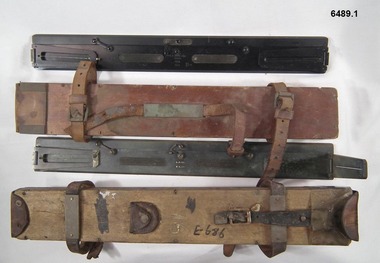 Bendigo Military Museum
Instrument - Plane Table Surveying - Simple Alidade, ER Watts and Son, London, 1938
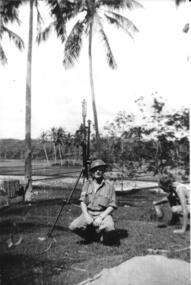
... A Plane Table Board mounted on a tripod is levelled and the Alidade is placed on the table with the vanes perpendicular to the it. ...A Plane Table Board mounted on a tripod is levelled and the Alidade is placed on the table with the vanes perpendicular to the it. ...The Plane Table Alidade was used as the sighting Instrument in the production of historical manual hand drawn maps. A Plane Table Board mounted on a tripod is levelled and the Alidade is placed on the table with the vanes perpendicular to the it. Each sighting vane has a central thread lined up on the target and the angle to that target point is then drawn on the map sheet using the beveled fiducial edge. Plane Table Surveying is used as a quick method where less accuracy is required or needed. Plane table Surveying is a relatively portable and inexpensive method and was used extensively before the advent of sophisticated surveying instruments. The photo at 6489.2 is an Australian Army Survey Corps Party using a Plane Table Alidade in Syria during WWII. See also item 6580 which is the Plane Table with tripod legs that was used with the Alidade.Two Plane Table sighting instruments (Alidade) used for historical manual map making housed in wooden transit boxes. A brass instrument with folding sights at each end and a beveled fiducial edge in one edge. The front sight is the object vane and the rear sight is the sight vane. There is a sliding arm attached to the base to draw parallel lines to the fiducial edge. Very slight differences in model between these two instruments.First Instrument, "ER Watts and Son, London, 1938, MkII, Box Label 423. Second Instrument - R. E-Co, Mk.II, stamped E686, Box Label 686.royal australian survey corps, rasvy, fortuna, army survey regiment, army svy regt, asr -
4th/19th Prince of Wales's Light Horse Regiment Unit History Room
Tripod, Bren Light Machine Gun
... However being a mounted unit, Bren LMG were either carried as personal weapons of the unit's assault troopers or mounted on Mk1 Ferret Scout Cars or Saracen Armoured Personnel Carriers. As far as is known, this tripod was not on issue. weapons mounts bren gun tripod Tripod, Bren Light Machine Gun ...Used for setting up in defensive position for firing on fixed linesThe 4/19 PWLH Regiment was previously equipped with Bren guns. However being a mounted unit, Bren LMG were either carried as personal weapons of the unit's assault troopers or mounted on Mk1 Ferret Scout Cars or Saracen Armoured Personnel Carriers. As far as is known, this tripod was not on issue.weapons, mounts, bren gun, tripod -
4th/19th Prince of Wales's Light Horse Regiment Unit History Room
Booklet (2 copies), US Government Printing Office, Operational and Organizational maintenance Cal .50 Spotting Rifle M8C 106mm Rifles M40A1 & M40A1C & Mounts T173, M79 and Tripod T26, March 1959
... 106RCL TM9-1000-205-12 A soft covered manual covering operational and organisational maintenance for the subject equipment Operational and Organizational maintenance Cal .50 Spotting Rifle M8C 106mm Rifles M40A1 & M40A1C & Mounts T173, M79 and Tripod T26 Booklet (2 copies) US Government Printing Office ...A soft covered manual covering operational and organisational maintenance for the subject equipmentTM9-1000-205-12106rcl -
Frankston RSL Sub Branch
Stand, Tripod, Puddefoot Bowers & Simonett Limited, ca 1940
... A portable, three legged stand in the form of a tripod, used by Australian and British Commonwealth military forces for mounting the standard issue signaling lamp and heliograph. ...military tripod ww2 world war 2 signalling heliograph stand The brass collar and mount is stamped : "STAND LAMP OR HELIO A MKlll" and has the manufacturer "PUDDEFOOT, BOWERS & SIMONETT LTD, LONDON, 1940". ...A portable, three legged stand in the form of a tripod, used by Australian and British Commonwealth military forces for mounting the standard issue signaling lamp and heliograph. The three collapsible, metal tipped, wooden legs are joined by hinge fittings to a brass collar with a threaded mount at one end (the head). The mounting thread is approximately 38mm diameter and fitted with a protective cap which can be removed for use, the cap being retained by a length of light chain. The stand is complete with a leather and webbing carrying strap attached to the head fitting of the stand with a leather sleeve at the other end which fits over the free end of the legs when folded.The brass collar and mount is stamped : "STAND LAMP OR HELIO A MKlll" and has the manufacturer "PUDDEFOOT, BOWERS & SIMONETT LTD, LONDON, 1940". Serial number 47064. Each of the wooden legs are stamped with the Australian Department of Defence "DɅD" symbol.military, tripod, ww2, world war 2, signalling, heliograph, stand -
 Frankston RSL Sub Branch
Photograph
... Photographs of a Bren gun mounted on a tripod for anti aircraft use. The location is unknown. ...Photographs of a Bren gun mounted on a tripod for anti aircraft use. The location is unknown. ...Photographs of a Bren gun mounted on a tripod for anti aircraft use. The location is unknown. The first photograph shows an Australian Army Sergeant standing beside the Bren gun. The second photograph shows a group of seven Australian Army soldiers beside the Bren gun. -
Frankston RSL Sub Branch
Stand, Tripod, Puddefoot Bowers & Simonett Limited, ca 1940
... A portable, three legged stand in the form of a tripod, used by Australian and British Commonwealth military forces for mounting the standard issue signaling lamp and heliograph. ...military tripod ww2 world war 2 signalling heliograph stand The brass collar and mount is stamped: "STAND LAMP OR HELIO A MKlll" the manufacturer "P.M.G. ...A portable, three legged stand in the form of a tripod, used by Australian and British Commonwealth military forces for mounting the standard issue signaling lamp and heliograph. The three collapsible, metal tipped, wooden legs are joined by hinge fittings to a brass collar with a threaded mount at one end (the head). The mounting thread is approximately 38mm diameter and fitted with a protective cap which can be removed for use, the cap being retained by a length of light chain. The stand is complete with a leather and webbing carrying strap attached to the head fitting of the stand with a leather sleeve at the other end which fits over the free end of the legs when folded.The brass collar and mount is stamped: "STAND LAMP OR HELIO A MKlll" the manufacturer "P.M.G. VIC" and "1941"military, tripod, ww2, world war 2, signalling, heliograph, stand -
 Bendigo Historical Society Inc.
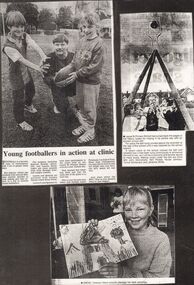
Newspaper - GOLDEN SQUARE P.S. LAUREL ST. 1189 COLLECTION: NEWSPAPER CUTTINGS
... The second photo John McCorkelle, Ben Rodda, Nicole Johnson, Tonya McNamara and Johanna White with an old school bell mounted on a tripod. The third photo is Chelsea Hilson displaying her bark painting....The second photo John McCorkelle, Ben Rodda, Nicole Johnson, Tonya McNamara and Johanna White with an old school bell mounted on a tripod. The third photo is Chelsea Hilson displaying her bark painting. ...Black laminated card with three photos. The first is two young footballers, Quinton Bentley and Lauren Reidy who got some pointers from Golden Square coach Brian Walsh. The second photo John McCorkelle, Ben Rodda, Nicole Johnson, Tonya McNamara and Johanna White with an old school bell mounted on a tripod. The third photo is Chelsea Hilson displaying her bark painting.education, primary, golden square laurel st p.s., golden square primary school 1189 collection - newspaper cuttings, quinton bentley, lauren reidy, bendigo football league, brian walsh, tony shaw, john mccorkelle, ben rodda, nicole johnson, tonya mcnamara, johanna white, chelsea hilson -
 Bendigo Historical Society Inc.
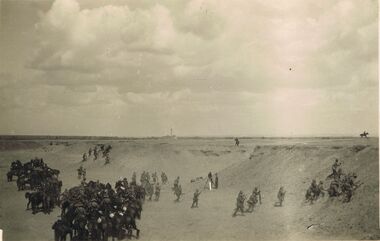
Postcard - ACC LOCK COLLECTION: B&W PHOTO OF SOLDIERS AND HORSES BETWEEN SANDHILLS, POSTCARD, 1914-1918
... Postcard, WW1, B&W photo of dismounted soldiers clambouring up sandhills and a group of mounted soldiers standing in foreground. Camera on a tripod with a figure in the centre. ...POSTCARD Postcard WW1 Light Horse Zeitoun Egypt Cinema film series Postcard, WW1, B&W photo of dismounted soldiers clambouring up sandhills and a group of mounted soldiers standing in foreground. Camera on a tripod with a figure in the centre. ...Postcard, WW1, B&W photo of dismounted soldiers clambouring up sandhills and a group of mounted soldiers standing in foreground. Camera on a tripod with a figure in the centre. Factory chimney in far distance. Handwritten in ink on the back Cinema Film Series LH dismounting & taking up position on crest Zeitoun Feby '16postcard, postcard, ww1, light horse, zeitoun, egypt, cinema film series -
The Ed Muirhead Physics Museum
Instrument - Artillery director (No 6 Mk II with tripod), c1924
... Green painted brass director mounted on a grey metal base plate. Secured to a wooden tripod with coated copper wire cord linking tripod legs....Related to object 463.2 artillery instruments WWII artillery No 6 director mk ii optical equipment cooke troughton & simms Theodolite body engraved with: the broad arrow on top, and on side with 'DIRECTOR No 6 MK II / COOKE TROUGHTON & SIMMS LTD / 1924 / No 1126' Green painted brass director mounted on a grey metal base plate. Secured to a wooden tripod with coated copper wire cord linking tripod legs. ...Possibly related to the range-finding equipment sent from England for dismantling during the 1940s so University of Melbourne Physics staff could develop their own equipment. Related to object 463.2Green painted brass director mounted on a grey metal base plate. Secured to a wooden tripod with coated copper wire cord linking tripod legs.Theodolite body engraved with: the broad arrow on top, and on side with 'DIRECTOR No 6 MK II / COOKE TROUGHTON & SIMMS LTD / 1924 / No 1126'artillery instruments, wwii artillery, no 6 director mk ii, optical equipment, cooke troughton & simms -
 National Vietnam Veterans Museum (NVVM)
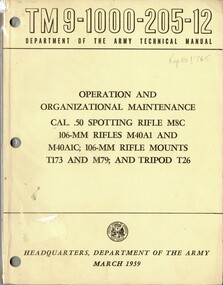
Manual, United States Army, Operation And Organisational Maintenance CAL. 50 Spotting Rifle M8C: 106-mm Rifles M40A1 & M40A1C; 106-mm Rifle Mounts T173 and M79; And Tripod T26
... Operation And Organisational Maintenance CAL. 50 Spotting Rifle M8C: 106-mm Rifles M40A1 & M40A1C; 106-mm Rifle Mounts T173 and M79; And Tripod T26. Manual United States Army ...A cream coloured cardboard cover with black information of the front. At the top of the cover reads TM9-1000-205-12 and under this reads Department of the Army Technical Manual. There are three punch holes down the left hand side and the manual is in a clear plastic over for protection.united states - armed forces - service manuals, operation and organizational maintenance, 106mm recoilless rifle
