
Showing 11 items matching "twelve decades"
-
 Otway Districts Historical Society
Book, Twelve Decades. J.K. Loney. E.W. Morris, c 1975
... Twelve Decades. J.K. Loney. E.W. Morris....Twelve Decades; J.K.Loney; E.W.Morris; Apollo Bay; History; Geology; Shipping; Names; War Service;...Twelve decades. A short history of Apollo Bay. J.K.Loney. ...Twelve Decades; J.K.Loney; E.W.Morris; Apollo Bay; History; Geology; Shipping; Names; War Service; Twelve decades. ...Twelve decades. A short history of Apollo Bay. J.K.Loney. E.W.Morris. 1st ed. J.K.Loney; Apollo Bay (Vic.); c 1975. 64 p.; illus. Soft cover.twelve decades; j.k.loney; e.w.morris; apollo bay; history; geology; shipping; names; war service; -
 Otway Districts Historical Society
Book, Marine History Publication, The Otway, 1979
... twelve decades; otway memories; pioneering days; j.k. loney; e.w. morris; apollo bay; history; reminiscences; anecdotes;...Compilation of three works: Twelve Decades, a short history of Apollo Bay, 1850-1969; Otway Memories; Pioneering Days, a collection of short articles prepared by Loney during his days at Apollo Bay....Compilation of three works: Twelve Decades, a short history of Apollo Bay, 1850-1969; Otway Memories; Pioneering Days, a collection of short articles prepared by Loney during his days at Apollo Bay. twelve decades; otway memories; pioneering days; j.k. loney; e.w. morris; apollo bay; history; reminiscences; anecdotes; The Otway. ...Compilation of three works: Twelve Decades, a short history of Apollo Bay, 1850-1969; Otway Memories; Pioneering Days, a collection of short articles prepared by Loney during his days at Apollo Bay.The Otway. J.K. Loney. 1st ed. np; J.K.Loney; 1979. 142 p.; illus, map. Soft cover. ISBN 0 9092442 1 9 twelve decades; otway memories; pioneering days; j.k. loney; e.w. morris; apollo bay; history; reminiscences; anecdotes; -
 Federation University Historical Collection
Article - Article - Women, Ballarat Girls' Technical School: Women of Note; Joan Kirner (1938 - 2015)
... Joan Kirner's career in politics has two distinctive phases: twelve years in the Victorian Parliament (1982-1994), the remaining decades in community politics. ...Joan Kirner's career in politics has two distinctive phases: twelve years in the Victorian Parliament (1982-1994), the remaining decades in community politics. ...Joan Kirner was born on the 20th June, 1938, the only child of John Keith Hood and Beryl Edith Cole, whose belief that girls could do anything holds importance in explaining Joan's commitment to improving the status of girls and women Joan graduated from Melbourne University in 1958, and was sent to Ballarat where she taught at the Ballarat Girls' Technical College. Like all women at the time, her marriage to her husband, Ron, a teacher at the Ballarat Junior Technical School in 1960, meant that she was precluded from permanency in the service, an injustice which fueled much of her activism as an education lobbyist and later, as Minister for Education. The birth of three children, and the move back to Melbourne, marked the beginning of Joan's career as a community activist. Joan Kirner's career in politics has two distinctive phases: twelve years in the Victorian Parliament (1982-1994), the remaining decades in community politics. In the Victorian parliament, Joan held the positions of Minister for Conservation, 1985, Minister for Education, 1988, Deputy Premier, 1989, and Victoria's first woman Premier, 1990 to 1992. She retired from parliament in May, 1994. She was a Co-founder of Emily's List which supports women wishing to enter Parliament. Joan Kirner introduced the Victorian Certificate of Education. Awarded Companion of the Order of Australia in 2012 and Centenary Medal in 2001.women of note, joan kirner, joan hood, melbourne university, ballarat girls' technical school, ballarat junior technical school, education lobbyist, minister for education, community activist, victorian parliament, 1982-1994, minister for conservation, deputy premier, first woman premier, emily's list, victorian certificate of education, companion of the order of australia, centenary medal -
Glen Eira Historical Society
Book - St. Mary’s Church, Caulfield
... decade from 1908 to 1918. It also has a list of organisations and office bearers. Manila book has all photos omitted. There are twelve...decade from 1908 to 1918. It also has a list of organisations and office bearers. Manila book has all photos omitted. There are twelve ...Two copies of St. Mary’s Anglican Church, Glen Eira Road, Caulfield. Souvenir of 50 years 1858-1908. Includes history of the church, home and foreign missions, list of memorials and gifts in the church. Also photos of parishioners the church and interior, the vestry and Rev. A.J.H. Priest and Mrs. Priest, and Rev. H.B. Macartney and Mrs. Macartney. Two copies of St. Mary’s Anglican Church, Glen Eira Road Caulfield. Souvenir record of 60 years 1858-1918. Includes history of the wooden church, names of the early parishioners, the first, third and fourth incumbencies, the jubilee school, Sunday school, choir and organ, daughter churches and St. Mary’s a mission parish, and the last decade from 1908 to 1918. It also has a list of organisations and office bearers. Manila book has all photos omitted. There are twelve photos including St. Mary’s choir, a group of St. Mary’s Sunday school teachers, missionaries, curate, organist and verger, Rev. H.T. Langley and Mrs. Langley. Three leaflets from St. Mary’s Church, the first 100 years of the church building 1871-1971. Leaflets detail the centenary services and functions. It has a list of office bearers and vicars, named windows, the honour roll and some other notable areas in the church and furniture.watts thomas, caulfield, glen huntly road, balaclava, hawthorn road, the black chapel, st. mary’s, park street, porter mrs., pennington mr., pennington mrs., stephen wilberforce, stephen mrs., hart mrs., cox peter, bunton barbara -
 Warrnambool and District Historical Society Inc.
Folding Postcard, Murray Studios, Warrnambool, c.1960
... decades. Tourism in Warrnambool History of Warrnambool Warrnambool This is a postcard with a cover photograph in colour and twelve other colour photographs folding up in concertina fashion. ...This is a Warrnambool folding post card sold to tourists and locals in the mid 20th century. The card contains photographs of Warrnambool scenes – the Hopkins River mouth, the Botanic Gardens, Liebig Street, Fletcher Jones gardens etc. Warrnambool has been promoted as a tourist town since the late 1800s and attracts visitors in both the summer months (beaches, coastal scenery etc) and the winter months (visit of Southern Right whales and major sporting events). This card is an example of a local tourist souvenir sold in places such as Warrnambool in the mid 20th century and ensuing decades.This is a postcard with a cover photograph in colour and twelve other colour photographs folding up in concertina fashion. One page has space for a stamp and an address.Warrnambooltourism in warrnambool, history of warrnambool -
 National Wool Museum
Archive - Advertisement, Onkaparinga Woollen Mill Company, 1954
... decades representing the styles and fashions of their time and includes dated advertisements which help determine the eras the blankets are from." Blanket Blanket Fever Wool Onkaparinga Advertisement Australian Women's Weekly Onkaparinga/100% Pure Wool Blankets/Truly Fine Blankets of Surpassing Beauty/Buy Well-Buy Wool/Guaranteed for Twelve Years 'Truly Fine Blankets of Surpassing Beauty' (range of blankets both fanned out and folded) Archive Advertisement Australia South Australia Lobethal Onkaparinga Woollen Mill Company ...Note from collector- "For more than 100 years blankets were made all over Australia in over 100 woollen mills. My aim, is to preserve 100 examples of these wonderful pieces of history. Ten years ago I started collecting the iconic Onkaparinga travel rugs, so that on movie nights at home there would be plenty to go around. Everyone had their favourite; even the cat had his own – a small red tartan one. Keeping an eye out for those travel rugs at op-shops and markets, collectable stores and bazaars, led to noticing vintage blankets. I'd never really thought about them before or paid much attention though of course I had grown up with them at my grandmother's. When I discovered my first Laconia cream blanket with blue stripes, my eyes just went gaga. Well that was it, I was hooked and since then over 500 blankets have passed through my hands. These common, everyday items, found in all households for so many decades, were traditional engagement gifts. Pairs were prized wedding presents turning into family heirlooms. They were fashionable dressers of beds, givers of warmth, bestowers of security and reliability. The comfort found in these objects resonates with almost all of us; we grew up with them ourselves or fondly recall them in a grandparent’s home. There is no modern replacement with the integrity of these old blankets, many of them now older than most of us. They are romantic, sensible, special, familiar, nostalgic and nothing else feels so appropriate in so many situations. No offense to the great Aussie doona, but from hippie to hipster, at a music festival, picnic, campsite or couch, a vintage blanket is something coveted by all. This industry that employed tens of thousands and must have been such a huge contributor to the economy is almost completely lost now. Blanket Fever is an ode to everything that came before: the land, the sheep, the shearers, the hands, the mills, the weavers, the designers, the distributors, the department stores. To the grandparents that gave them, the people that received them, the families that kept them; thank you. I’m passionate about my collection of Australian blankets manufactured in mostly Victoria, South Australia and Tasmania from the 1930s to the end of the 1960s. The collection has blankets from each of these four decades representing the styles and fashions of their time and includes dated advertisements which help determine the eras the blankets are from." 'Truly Fine Blankets of Surpassing Beauty' (range of blankets both fanned out and folded) Onkaparinga/100% Pure Wool Blankets/Truly Fine Blankets of Surpassing Beauty/Buy Well-Buy Wool/Guaranteed for Twelve Years blanket, blanket fever, wool, onkaparinga, advertisement, australian women's weekly -
 National Wool Museum
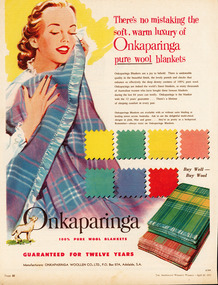
Archive - Advertisement, Onkaparinga Woollen Mill Company, 1955
... decades representing the styles and fashions of their time and includes dated advertisements which help determine the eras the blankets are from." Blanket Blanket Fever wool Onkaparinga Advertisement Australian Women's Weekly There's no mistaking the soft, warm luxury of Onkaparinga pure wool blankets/Buy Well-Buy Wool/Onkaparinga 100% Pure Wool Blankets/Guaranteed for Twelve Years 'There's no mistaking the soft, warm luxury' (range of blankets and colours) Archive Advertisement Australia South Australia Lobethal Onkaparinga Woollen Mill Company ...Note from collector- "For more than 100 years blankets were made all over Australia in over 100 woollen mills. My aim, is to preserve 100 examples of these wonderful pieces of history. Ten years ago I started collecting the iconic Onkaparinga travel rugs, so that on movie nights at home there would be plenty to go around. Everyone had their favourite; even the cat had his own – a small red tartan one. Keeping an eye out for those travel rugs at op-shops and markets, collectable stores and bazaars, led to noticing vintage blankets. I'd never really thought about them before or paid much attention though of course I had grown up with them at my grandmother's. When I discovered my first Laconia cream blanket with blue stripes, my eyes just went gaga. Well that was it, I was hooked and since then over 500 blankets have passed through my hands. These common, everyday items, found in all households for so many decades, were traditional engagement gifts. Pairs were prized wedding presents turning into family heirlooms. They were fashionable dressers of beds, givers of warmth, bestowers of security and reliability. The comfort found in these objects resonates with almost all of us; we grew up with them ourselves or fondly recall them in a grandparent’s home. There is no modern replacement with the integrity of these old blankets, many of them now older than most of us. They are romantic, sensible, special, familiar, nostalgic and nothing else feels so appropriate in so many situations. No offense to the great Aussie doona, but from hippie to hipster, at a music festival, picnic, campsite or couch, a vintage blanket is something coveted by all. This industry that employed tens of thousands and must have been such a huge contributor to the economy is almost completely lost now. Blanket Fever is an ode to everything that came before: the land, the sheep, the shearers, the hands, the mills, the weavers, the designers, the distributors, the department stores. To the grandparents that gave them, the people that received them, the families that kept them; thank you. I’m passionate about my collection of Australian blankets manufactured in mostly Victoria, South Australia and Tasmania from the 1930s to the end of the 1960s. The collection has blankets from each of these four decades representing the styles and fashions of their time and includes dated advertisements which help determine the eras the blankets are from." 'There's no mistaking the soft, warm luxury' (range of blankets and colours)There's no mistaking the soft, warm luxury of Onkaparinga pure wool blankets/Buy Well-Buy Wool/Onkaparinga 100% Pure Wool Blankets/Guaranteed for Twelve Yearsblanket, blanket fever, wool, onkaparinga, advertisement, australian women's weekly -
 Flagstaff Hill Maritime Museum and Village
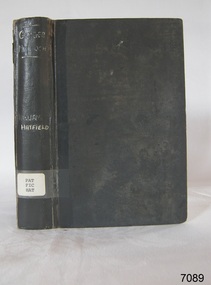
Book - A Fictional Story, William Hatfield, Ginger Murdoch, 1932
... He wrote for over a decade before publishing anything for twelve years he accumulated rejection slips until his novel Sheepmates (1931), written while unemployed in Sydney, succeeded. ...He wrote for over a decade before publishing anything for twelve years he accumulated rejection slips until his novel Sheepmates (1931), written while unemployed in Sydney, succeeded. ...Ginger Murdoch is a novel built around a recurring bush character of Hatfield's, which had already been running as a series of short stories in The Sydney Mail from 1931 onward. It's about a hard-drinking bushman named Ginger Murdoch. The stories (titles like 'Ginger Murdoch: Horse Dealer', 'Ginger Murdoch, Publican', 'Ginger Murdoch–Outlaw', 'Ginger Murdoch: Squatter') cast him as a knockabout outback figure a horse-dealer, publican, 'knight errant', squatter moving through the kind of droving, station and bush-town life Hatfield knew first-hand. The 1932 Angus & Robertson first edition ran to 268 pages, and the dust-jacket art shows Ginger Murdoch on horseback, exploring the countryside consistent with a picaresque, episodic outback adventure rather than a tightly plotted single narrative.Hard cover book. Ginger Murdoch Author: William Hatfield Publisher: Angus & Robertson Date: 1932 Further Information: Dark Blue plain cloth hardcover with lettering and patterning to spine in white. The spine has a Library label with an inscription.fictionGinger Murdoch is a novel built around a recurring bush character of Hatfield's, which had already been running as a series of short stories in The Sydney Mail from 1931 onward. It's about a hard-drinking bushman named Ginger Murdoch. The stories (titles like 'Ginger Murdoch: Horse Dealer', 'Ginger Murdoch, Publican', 'Ginger Murdoch–Outlaw', 'Ginger Murdoch: Squatter') cast him as a knockabout outback figure a horse-dealer, publican, 'knight errant', squatter moving through the kind of droving, station and bush-town life Hatfield knew first-hand. The 1932 Angus & Robertson first edition ran to 268 pages, and the dust-jacket art shows Ginger Murdoch on horseback, exploring the countryside consistent with a picaresque, episodic outback adventure rather than a tightly plotted single narrative.warrnambool, shipwrecked-coast, flagstaff-hill, flagstaff-hill-maritime-museum, maritime-museum, shipwreck-coast, flagstaff-hill-maritime-village, shipwrecked-artefact, book, ginger murdoch, william hatfield -
Emerald Museum & Nobelius Heritage Park
Photograph - Budding at Gembrook Nurseries, Unknown photographer, 1910s
... The photograph of a postcard or newspaper clipping depicts twelve men in clothes associated with the first decades of the Twentieth Century undertaking planting or other field work under the gaze of a man in a suit and top hat. ...In 1981 the final twelve acres were purchased by the Shire of Sherbrooke in recognition to be used as a heritage landmark in recognition of the site's significance. The photograph is significant because it depicts work processes at the Gembrook Nurseries during the early decades of the Twentieth Century; a period in which the nurseries were the leading Southern-hemisphere supplier of plants and trees to public gardens around the world. ...Carl Axel Nobelius established the Gembrook Nurseries in 1886 on sixty-three acres purchased from an original selector after the area's gold rush started to diminish. It was called the Gembrook Nurseries as it was located in the Parish of Gembrook, but it was commonly referred to as the Nobelius nurseries after its founder; especially as control of the remaining portions of the nurseries remained with the Nobelius family until 1955. The Nobelius Nurseries had a substantial impact on the development of the township of Emerald, as local farmers were able to earn funds during the winter by working at the nursery which gave them financial resources while waiting for their own farms to become productive. The need to transport plants and trees to port quickly also contributed to the development of rail infrastructure in the region; C.A. Nobelius was one of thirteen witnesses to the Parliamentary Standing Committee on Railways in 1898 debating a rail connection between Gembrook and Ferntree Gully, which became today's Puffing Billy tourist service. The nurseries occupied 280 acres at their peak in 1905, with more than one million trees available for sale at that time. The nursery focused on exotic fruit and ornamental species which were supplied to public parks and gardens all over the world. In several cases the nurseries were the first suppliers of the trees in Australia. Sales records show that trees were supplied to clients in Europe, Asia, the United States, Africa and New Zealand, as well as to many Councils and Government organisations around Australia, such as Melbourne's Fitzroy Gardens and Royal Botanic Gardens. Portions of the Gembrook Nurseries were sold at different times throughout the Twentieth Century, with the Emerald Country Club and Emerald Lake Park both occupying portions of the original land. In 1981 the final twelve acres were purchased by the Shire of Sherbrooke in recognition to be used as a heritage landmark in recognition of the site's significance.The photograph is significant because it depicts work processes at the Gembrook Nurseries during the early decades of the Twentieth Century; a period in which the nurseries were the leading Southern-hemisphere supplier of plants and trees to public gardens around the world. The photograph may also depict Carl Axel Nobelius overseeing his workers, which gives insights into work practices and social dynamics of the time.Black and white rectangular photograph printed on photographic paper. The photograph of a postcard or newspaper clipping depicts twelve men in clothes associated with the first decades of the Twentieth Century undertaking planting or other field work under the gaze of a man in a suit and top hat. The item is captioned 'Budding at Gembrook Nurseries.'Obverse: BUDDING AT GEMBROOK NURSERIES. /1910s, 1900s, 1890s, 1880s, 1886, 1905, carl axel nobelius, nobelius nursery, gembrook nurseries, emerald country club, emerald lake park, fruit growing, trees, farming -
Emerald Museum & Nobelius Heritage Park
Photograph - Gembrook Nurseries, 1908-1912, Unknown photographer, 1908-1912
... In 1981 the final twelve acres were purchased by the Shire of Sherbrooke in recognition to be used as a heritage landmark in recognition of the site's significance. The photograph is significant because it demonstrates the extent of stock cultivation at the Gembrook Nurseries during the early decades of the Twentieth Century; a period in which the nurseries were the leading Southern-hemisphere supplier of plants and trees to public gardens around the world. ...Carl Axel Nobelius established the Gembrook Nurseries in 1886 on sixty-three acres purchased from an original selector after the area's gold rush started to diminish. It was called the Gembrook Nurseries as it was located in the Parish of Gembrook, but it was commonly referred to as the Nobelius nurseries after its founder; especially as control of the remaining portions of the nurseries remained with the Nobelius family until 1955. The Nobelius Nurseries had a substantial impact on the development of the township of Emerald, as local farmers were able to earn funds during the winter by working at the nursery which gave them financial resources while waiting for their own farms to become productive. The need to transport plants and trees to port quickly also contributed to the development of rail infrastructure in the region; C.A. Nobelius was one of thirteen witnesses to the Parliamentary Standing Committee on Railways in 1898 debating a rail connection between Gembrook and Ferntree Gully, which became today's Puffing Billy tourist service. The nurseries occupied 280 acres at their peak in 1905, with more than one million trees available for sale at that time. The nursery focused on exotic fruit and ornamental species which were supplied to public parks and gardens all over the world. In several cases the nurseries were the first suppliers of the trees in Australia. Sales records show that trees were supplied to clients in Europe, Asia, the United States, Africa and New Zealand, as well as to many Councils and Government organisations around Australia, such as Melbourne's Fitzroy Gardens and Royal Botanic Gardens. Portions of the Gembrook Nurseries were sold at different times throughout the Twentieth Century, with the Emerald Country Club and Emerald Lake Park both occupying portions of the original land. In 1981 the final twelve acres were purchased by the Shire of Sherbrooke in recognition to be used as a heritage landmark in recognition of the site's significance.The photograph is significant because it demonstrates the extent of stock cultivation at the Gembrook Nurseries during the early decades of the Twentieth Century; a period in which the nurseries were the leading Southern-hemisphere supplier of plants and trees to public gardens around the world. Museum acquisition records indicate this photograph was taken in the period 1908-1912.Black and white rectangular photograph printed on photographic paper. The photograph depicts a central view of cultivated fields and trees along the skyline at the Gembrook Nurseries in approximately 1908-1912.Obverse: Gembrook Nurseries - Central View /1900s, 1910s, farming, agriculture, trees, gembrook nurseries, carl axel nobelius, emerald park lake, emerald country club, parish of gembrook, fitzroy gardens, royal botanic gardens, melbourne, shire of sherbrooke -
Emerald Museum & Nobelius Heritage Park
Photograph - Nursery below 'Carramar', Unknown photographer, 1910s
... In 1981 the final twelve acres were purchased by the Shire of Sherbrooke in recognition to be used as a heritage landmark in recognition of the site's significance. The photograph is significant because it depicts the built environment and stock cultivation at the Gembrook Nurseries during the early decades of the Twentieth Century; a period in which the nurseries were the leading Southern-hemisphere supplier of plants and trees to public gardens around the world. ...Carl Axel Nobelius established the Gembrook Nurseries in 1886 on sixty-three acres purchased from an original selector after the area's gold rush started to diminish. It was called the Gembrook Nurseries as it was located in the Parish of Gembrook, but it was commonly referred to as the Nobelius nurseries after its founder; especially as control of the remaining portions of the nurseries remained with the Nobelius family until 1955. The Nobelius Nurseries had a substantial impact on the development of the township of Emerald, as local farmers were able to earn funds during the winter by working at the nursery which gave them financial resources while waiting for their own farms to become productive. The need to transport plants and trees to port quickly also contributed to the development of rail infrastructure in the region; C.A. Nobelius was one of thirteen witnesses to the Parliamentary Standing Committee on Railways in 1898 debating a rail connection between Gembrook and Ferntree Gully, which became today's Puffing Billy tourist service. The nurseries occupied 280 acres at their peak in 1905, with more than one million trees available for sale at that time. The nursery focused on exotic fruit and ornamental species which were supplied to public parks and gardens all over the world. In several cases the nurseries were the first suppliers of the trees in Australia. Sales records show that trees were supplied to clients in Europe, Asia, the United States, Africa and New Zealand, as well as to many Councils and Government organisations around Australia, such as Melbourne's Fitzroy Gardens and Royal Botanic Gardens. Emerald Museum records indicate that this photograph of the Gembrook Nursery was taken in the vicinity of Carramar, the family home built by Carl Axel Nobelius. The sixteen-room mansion was one of the premier estates in the region and was visited by guests including Dame Nellie Melba and the Governor of Victoria, Sir Reginald Talbot. The building still stands amongst gardens that feature original Gembrook Nurseries plantings. Portions of the Gembrook Nurseries (and the Carramar estate) were sold at different times throughout the Twentieth Century, with the Emerald Country Club and Emerald Lake Park both occupying portions of the original land. In 1981 the final twelve acres were purchased by the Shire of Sherbrooke in recognition to be used as a heritage landmark in recognition of the site's significance.The photograph is significant because it depicts the built environment and stock cultivation at the Gembrook Nurseries during the early decades of the Twentieth Century; a period in which the nurseries were the leading Southern-hemisphere supplier of plants and trees to public gardens around the world. Museum acquisition records indicate this photograph was taken in the vicinity of the 'Carramar' estate, the home of the Nobelius family.Black and white rectangular photograph printed on photographic paper. The photograph depicts cultivated fields, roads, fencing and buildings at the Gembrook Nurseries; in the vicinity of the 'Carramar' estate.Obverse: 70 / (?) nt /1910s, 1890s, 1900s, carl axel nobelius, gembrook nurseries, nobelius nursery, carramar, farming, buildings, agriculture, dame nellie melba, reginald talbot, emerald country club, emerald lake park, shire of sherbrooke
