
Showing 25 items matching "two up pennies"
-
 Waverley RSL Sub Branch
Two up pennies & kip
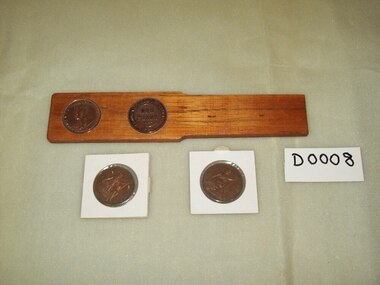
... Two up pennies & kip...Two up has been played by Australians since 1850's. It was popular during WWI, during which time the soldiers referred to the game as SWY (which came from the German Zwei which is the word for two.) It's popularity continued through WWII and the BCOF constantly ran "SWY" schools. The game is now only legal to be played on Anzac day in Victoria, but in other states also on remembrance day. Pennies... must be from before 1938 as "Kangaroo" pennies are not acceptable. kip pennies swy two up SWY School A formed piece of light timber with inserts for 2 pennies Two up pennies & kip ...Two up has been played by Australians since 1850's. It was popular during WWI, during which time the soldiers referred to the game as SWY (which came from the German Zwei which is the word for two.) It's popularity continued through WWII and the BCOF constantly ran "SWY" schools. The game is now only legal to be played on Anzac day in Victoria, but in other states also on remembrance day. Pennies must be from before 1938 as "Kangaroo" pennies are not acceptable.A formed piece of light timber with inserts for 2 pennieskip, pennies, swy, two up, swy school -
 Wangaratta RSL Sub Branch
Coin - Engraved Box and Pennies
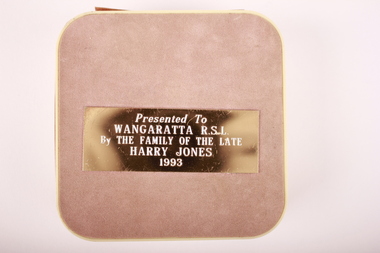
... two up pennies...pennies belonged to Private Henry JONES VX48340 who enlisted at Wangaratta on 25th July 1940 and served with the 2/23rd Battalion 2nd A.I.F. He was twice wounded and after being wounded at Tobruk spent time in hospital in Alexandria. (refer item 69) He was discharged from the army on 26th of September 1945.The game of two up... is played by throwing two pennies in the air and betting on which way they face up on landing. two up pennies private henry jones ww2 Presented to WANGARATTA R.S.L. by THE FAMILY OF THE LATE HARRY JONES 1993 Light pink velvet and plastic box with engraved inscription containing 6 penny coins each marked with a red cross. ...These pennies belonged to Private Henry JONES VX48340 who enlisted at Wangaratta on 25th July 1940 and served with the 2/23rd Battalion 2nd A.I.F. He was twice wounded and after being wounded at Tobruk spent time in hospital in Alexandria. (refer item 69) He was discharged from the army on 26th of September 1945.The game of two up is played by throwing two pennies in the air and betting on which way they face up on landing.Light pink velvet and plastic box with engraved inscription containing 6 penny coins each marked with a red cross.Presented to WANGARATTA R.S.L. by THE FAMILY OF THE LATE HARRY JONES 1993two up pennies, private henry jones, ww2 -
 Kyneton RSL Sub Branch
Two -Up
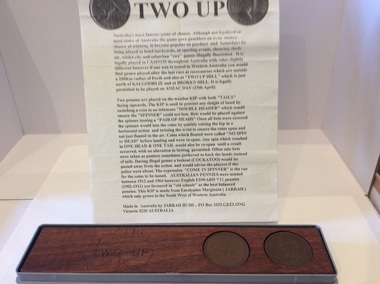
... two indentations to sit two pennies in side by side. Decoration at one end includes a map of Australia. The board is accompanied by a description of how to play TWO-UP. ...The board is accompanied by a description of how to play TWO-UP. Two pennies sit in position. Two -Up ...The game of TWO-UP was a popular gambling game played by soldiers during WW1.Piece of timber with two indentations to sit two pennies in side by side. Decoration at one end includes a map of Australia. The board is accompanied by a description of how to play TWO-UP. Two pennies sit in position.two-up -
 Ringwood RSL Sub-Branch
Souvenir, 1994
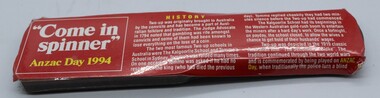
... Two up kip and commemorative pennies..."Come in Spinner" Anzac Day 1944 Two up kip and commemorative pennies Souvenir ...Two up kip and commemorative pennies"Come in Spinner" Anzac Day 1944 -
 Frankston RSL Sub Branch
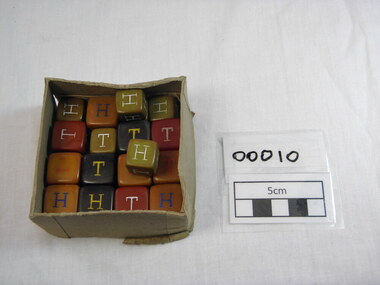
Set, Heads 'n Tails
... These heads and tails dice were used by the troops to gamble in World War 1 and World War 11 and were the pre-cursur to the two-up game which was a popular form of gambling in Australia post World War 11. Later versions of two-up were played with two pennies on a board. ...These heads and tails dice were used by the troops to gamble in World War 1 and World War 11 and were the pre-cursur to the two-up game which was a popular form of gambling in Australia post World War 11. Later versions of two-up were played with two pennies on a board. world war 1 world war 2 dice game two up gambling heads tails heads and tails Each dice has H and T A hand made cardboard box containing 18 cubed shaped dice of various colours and sizes. ...These heads and tails dice were used by the troops to gamble in World War 1 and World War 11 and were the pre-cursur to the two-up game which was a popular form of gambling in Australia post World War 11. Later versions of two-up were played with two pennies on a board. A hand made cardboard box containing 18 cubed shaped dice of various colours and sizes. Three red with white lettering, three dark grey with yellow lettering, six orange/brown with blue and red lettering, and six brown with white lettering. Each dice is marked with the three letters H and three letters T.Each dice has H and Tworld war 1, world war 2, dice, game, two up, gambling, heads tails, heads and tails -
 Flagstaff Hill Maritime Museum and Village
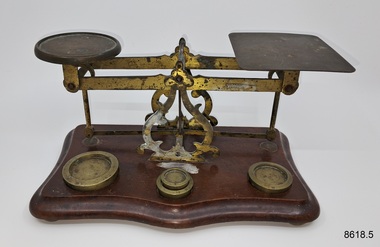
Equipment - Postal Scales, Unknown
... penny if prepaid, or two pence if paid on delivery. These postal scales belonged to Dr.William Roy Angus, Surgeon and Oculist. They were donated to Flagstaff Hill Maritime Village by his daughter, Bernice McDade. They are part of the “W.R. Angus Collection” that includes historical medical equipment, surgical instruments and material once belonging to Dr Edward Ryan and Dr Thomas Francis Ryan, (both of Nhill, Victoria) as well as Dr Angus’ own belongings. The Collection’s history spans the medical practices of the two Doctors Ryan, from 1885-1926 plus that of Dr Angus, up...penny if prepaid, or two pence if paid on delivery. These postal scales belonged to Dr.William Roy Angus, Surgeon and Oculist. They were donated to Flagstaff Hill Maritime Village by his daughter, Bernice McDade. They are part of the “W.R. Angus Collection” that includes historical medical equipment, surgical instruments and material once belonging to Dr Edward Ryan and Dr Thomas Francis Ryan, (both of Nhill, Victoria) as well as Dr Angus’ own belongings. The Collection’s history spans the medical practices of the two Doctors Ryan, from 1885-1926 plus that of Dr Angus, up ...Before 1851, letters sent through the mail were charged by the number of sheets it contained and the distance it travelled. For example, a letter consisting of one sheet of paper was charged the single rate; a double letter, that is two sheets, was charged double the single rate, a treble letter, was charged three times the single rate, and so on. In other words, each additional sheet of paper increased the charge by one rate. In Great Britain. Sealing a letter in an envelope effectively put an end to postal clerks' ability to count the number of sheets in a letter and an alternative method of determining the postage had to be found. Overweight mailings had previously required the items to be weighed but with the introduction of the Uniform Penny Postage act of 1839, the public could mail a letter not exceeding a half-ounce in weight within the United Kingdom for one penny if prepaid, or two pence if paid on delivery. These postal scales belonged to Dr.William Roy Angus, Surgeon and Oculist. They were donated to Flagstaff Hill Maritime Village by his daughter, Bernice McDade. They are part of the “W.R. Angus Collection” that includes historical medical equipment, surgical instruments and material once belonging to Dr Edward Ryan and Dr Thomas Francis Ryan, (both of Nhill, Victoria) as well as Dr Angus’ own belongings. The Collection’s history spans the medical practices of the two Doctors Ryan, from 1885-1926 plus that of Dr Angus, up until 1969. ABOUT THE “W.R.ANGUS COLLECTION” Doctor William Roy Angus M.B., B.S., Adel., 1923, F.R.C.S. Edin.,1928 (also known as Dr Roy Angus) was born in Murrumbeena, Victoria in 1901 and lived until 1970. He qualified as a doctor in 1923 at University of Adelaide, was Resident Medical Officer at the Royal Adelaide Hospital in 1924 and for a period was house surgeon to Sir (then Mr.) Henry Simpson Newland. Dr Angus was briefly an Assistant to Dr Riddell of Kapunda, then commenced private practice at Curramulka, Yorke Peninsula, SA, where he was physician, surgeon and chemist. In 1926, he was appointed as new Medical Assistant to Dr Thomas Francis Ryan (T.F. Ryan, or Tom), in Nhill, Victoria, where his experiences included radiology and pharmacy. In 1927 he was Acting House Surgeon in Dr Tom Ryan’s absence. Dr Angus had become engaged to Gladys Forsyth and they decided he further his studies overseas in the UK in 1927. He studied at London University College Hospital and at Edinburgh Royal Infirmary and in 1928, was awarded FRCS (Fellow from the Royal College of Surgeons), Edinburgh. He worked his passage back to Australia as a Ship’s Surgeon on the on the Australian Commonwealth Line’s T.S.S. Largs Bay. Dr Angus married Gladys in 1929, in Ballarat. (They went on to have one son (Graham 1932, born in SA) and two daughters (Helen (died 12/07/1996) and Berenice (Berry), both born at Mira, Nhill ) According to Berry, her mother Gladys made a lot of their clothes. She was very talented and did some lovely embroidery including lingerie for her trousseau and beautifully handmade baby clothes. Dr Angus was a ‘flying doctor’ for the A.I.M. (Australian Inland Ministry) Aerial Medical Service in 1928 . Its first station was in the remote town of Oodnadatta, where Dr Angus was stationed. He was locum tenens there on North-South Railway at 21 Mile Camp. He took up this ‘flying doctor’ position in response to a call from Dr John Flynn; the organisation was later known as the Flying Doctor Service, then the Royal Flying Doctor Service. A lot of his work during this time involved dental surgery also. Between 1928-1932 he was surgeon at the Curramulka Hospital, Yorke Peninsula, South Australia. In 1933 Dr Angus returned to Nhill and purchased a share of the Nelson Street practice and Mira hospital (a 2 bed ward at the Nelson Street Practice) from Dr Les Middleton one of the Middleton Brothers, the current owners of what previously once Dr Tom Ryan’s practice. Dr Tom and his brother had worked as surgeons included eye surgery. Dr Tom Ryan performed many of his operations in the Mira private hospital on his premises. He had been House Surgeon at the Nhill Hospital 1902-1926. Dr Tom Ryan had one of the only two pieces of radiology equipment in Victoria during his practicing years – The Royal Melbourne Hospital had the other one. Over the years Dr Tom Ryan had gradually set up what was effectively a training school for country general-practitioner-surgeons. Each patient was carefully examined, including using the X-ray machine, and any surgery was discussed and planned with Dr Ryan’s assistants several days in advance. Dr Angus gained experience in using the X-ray machine there during his time as assistant to Dr Ryan. When Dr Angus bought into the Nelson Street premises in Nhill he was also appointed as the Nhill Hospital’s Honorary House Surgeon 1933-1938. His practitioner’s plate from his Nhill surgery is now mounted on the doorway to the Port Medical Office at Flagstaff Hill Maritime Village, Warrnambool. When Dr Angus took up practice in the Dr Edward and Dr Tom Ryan’s old premises he obtained their extensive collection of historical medical equipment and materials spanning 1884-1926. A large part of this collection is now on display at the Port Medical Office at Flagstaff Hill Maritime Village in Warrnambool. In 1939 Dr Angus and his family moved to Warrnambool where he purchased “Birchwood,” the 1852 home and medical practice of Dr John Hunter Henderson, at 214 Koroit Street. (This property was sold in1965 to the State Government and is now the site of the Warrnambool Police Station. and an ALDI sore is on the land that was once their tennis court). The Angus family was able to afford gardeners, cooks and maids; their home was a popular place for visiting dignitaries to stay whilst visiting Warrnambool. Dr Angus had his own silk worm farm at home in a Mulberry tree. His young daughter used his centrifuge for spinning the silk. Dr Angus was appointed on a part-time basis as Port Medical Officer (Health Officer) in Warrnambool and held this position until the 1940’s when the government no longer required the service of a Port Medical Officer in Warrnambool; he was thus Warrnambool’s last serving Port Medical Officer. (Masters of immigrant ships arriving in port reported incidents of diseases, illness and death and the Port Medical Officer made a decision on whether the ship required Quarantine and for how long, in this way preventing contagious illness from spreading from new immigrants to the residents already in the colony.) Dr Angus was a member of the Australian Medical Association, for 35 years and surgeon at the Warrnambool Base Hospital 1939-1942, He served as a Surgeon Captain during WWII1942-45, in Ballarat, Victoria, and in Bonegilla, N.S.W., completing his service just before the end of the war due to suffering from a heart attack. During his convalescence he carved an intricate and ‘most artistic’ chess set from the material that dentures were made from. He then studied ophthalmology at the Royal Melbourne Eye and Ear Hospital and created cosmetically superior artificial eyes by pioneering using the intrascleral cartilage. Angus received accolades from the Ophthalmological Society of Australasia for this work. He returned to Warrnambool to commence practice as an ophthalmologist, pioneering in artificial eye improvements. He was Honorary Consultant Ophthalmologist to Warrnambool Base Hospital for 31 years. He made monthly visits to Portland as a visiting surgeon, to perform eye surgery. He represented the Victorian South-West subdivision of the Australian Medical Association as its secretary between 1949 and 1956 and as chairman from 1956 to 1958. In 1968 Dr Angus was elected member of Spain’s Barraquer Institute of Barcelona after his research work in Intrasclearal cartilage grafting, becoming one of the few Australian ophthalmologists to receive this honour, and in the following year presented his final paper on Living Intrasclearal Cartilage Implants at the Inaugural Meeting of the Australian College of Ophthalmologists in Melbourne In his personal life Dr Angus was a Presbyterian and treated Sunday as a Sabbath, a day of rest. He would visit 3 or 4 country patients on a Sunday, taking his children along ‘for the ride’ and to visit with him. Sunday evenings he would play the pianola and sing Scottish songs to his family. One of Dr Angus’ patients was Margaret MacKenzie, author of a book on local shipwrecks that she’d seen as an eye witness from the late 1880’s in Peterborough, Victoria. In the early 1950’s Dr Angus, painted a picture of a shipwreck for the cover jacket of Margaret’s book, Shipwrecks and More Shipwrecks. She was blind in later life and her daughter wrote the actual book for her. Dr Angus and his wife Gladys were very involved in Warrnambool’s society with a strong interest in civic affairs. He had an interest in people and the community They were both involved in the creation of Flagstaff Hill, including the layout of the gardens. After his death (28th March 1970) his family requested his practitioner’s plate, medical instruments and some personal belongings be displayed in the Port Medical Office surgery at Flagstaff Hill Maritime Village, and be called the “W. R. Angus Collection”. At about the same time that the adhesive postage stamps and envelopes made their appearance, postal administrations began to experiment with strategically placed street letter boxes, known as pillar boxes because of their round, pillar-like shape, that permitted the public to mail letters from a place other than from a post office. For all these reasons, the use of postal scales became the nucleus of every post office. Scales had been in use since ancient Egyptian times so their use for everyday commerce was not unusual in the 1800s. What was new in 1840 was their ubiquitous use throughout the postal system. No post office could function effectively without one. Although the earliest scales used in post offices did not differ markedly from the ones in general use as time went on they were adapted specifically for postal use. For example, a paper sleeve, also known as a weight sticker, was attached that showed the applicable rate of postage for any given weight. This innovation was quite a time saver as postal clerks no longer needed to weigh the item first and then refer to a separate chart to determine the required postage for that particular weight.The W.R. Angus Collection is significant for still being located at the site it is connected with, Doctor Angus being the last Port Medical Officer in Warrnambool. The collection of medical instruments and other items and equipment is culturally significant, being an historical example of medicine from late 19th to mid-20th century. Dr Angus assisted Dr Tom Ryan, a pioneer in the use of X-rays and in ocular surgery.Postal scales with weights,. Balance scale has brass fittings and is mounted on a rectangular wooden stand, with depressions for brass weights. Weights measure 1oz, 2oz, 4oz and 8oz.'Warranteed Accurate'flagstaff hill maritime museum and village, great ocean road, shipwreck coast, scales, post -
 Flagstaff Hill Maritime Museum and Village
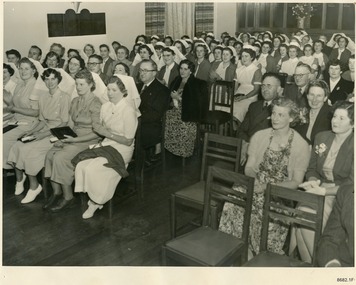
Work on paper - Photograph with envelope, Dr. W. R. Angus Warrnambool & District Base Hospital, c1951
... two Doctors Ryan, from 1885-1926 plus that of Dr Angus, up until 1969. This sepia photograph is from circa 1950s and came in an envelope with a postage mark commemorating the Australian Jubilee of 1901 and a 2-penny stamp with King George VI. ...two Doctors Ryan, from 1885-1926 plus that of Dr Angus, up until 1969. This sepia photograph is from circa 1950s and came in an envelope with a postage mark commemorating the Australian Jubilee of 1901 and a 2-penny stamp with King George VI. ...This photograph is part of the “W.R. Angus Collection” that includes historical medical equipment, surgical instruments and material once belonging to Dr Edward Ryan and Dr Thomas Francis Ryan, (both of Nhill, Victoria) as well as Dr Angus’ own belongings. The Collection’s history spans the medical practices of the two Doctors Ryan, from 1885-1926 plus that of Dr Angus, up until 1969. This sepia photograph is from circa 1950s and came in an envelope with a postage mark commemorating the Australian Jubilee of 1901 and a 2-penny stamp with King George VI. The photo includes Dr. Angus in the second row wearing glasses, his wife Mrs. Angus seated behind in the third row. John Lindsay, Committee Member WDBH, is possibly in the third row on the right. It is probably Sister June H. Stewart, Matron, wearing glasses is seated behind Mrs. Angus. Mr. J. Taylor was Hon. Treasurer. All these names are inscribed on the back of the photograph. The envelope that the photo came is has a note “NURSES GRADUATION WARRNAMBOOL HOSPITAL ?1951/PHOTOGRAPH OF GRADS. The 1951 Report of the Warrnambool and District Base Hospital cites McMillian as a Committee Member, Mr. Taylor as Honorary Treasurer and Dr. Angus was Medical Officer to Diseases of the Eye, Ear, Nose and Throat. It is wondered if this building is the one used by the hospital and removed to 54 Banyan Street, Warrnambool for the use of Legacy? The W.R. Angus Collection is significant for still being located at the site it is connected with, Doctor Angus being the last Port Medical Officer in Warrnambool. The collection of medical instruments and other equipment is culturally significant, being an historical example of medicine from late 19th to mid-20th century. Dr Angus assisted Dr Tom Ryan, a pioneer in the use of X-rays and in ocular surgery.Sepia photograph of nurses and guests seated in rows at an official function. MR McMILLAN/MR J NED TAYLOR/MRS J TAYLOR/ SISTER STEWART/ DR W R ANGUS/MRS ANGUS/Ralph Illidge WARRNAMBOOL on the back of the photograph.flagstaff hill, warrnambool, maritime village, maritime museum, flagstaff hill maritime museum and village, shipwreck coast, great ocean road, dr. w.r. angus, dr. roy angus, warrnambool & district base hospital, nurses graduation, ralph illidge, 1951 warrnambool, jubilee year australia, 1901-1951, ophthalmology -
 Bendigo Military Museum
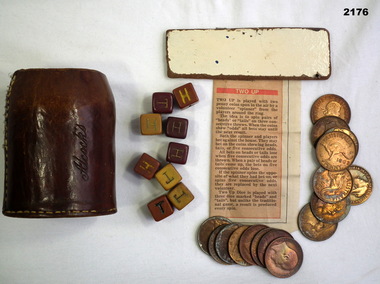
Leisure object - TWO UP SET, c.unknown
... Two Up Set containing cylindrical leather holder, 1 kip, 16 copper pennies (10 English, 6 Australian), 9 die (3 sides marked H, 3 sides marked T), newspaper clipping with rules of Two Up....recreactions - games military history Two up “Alcocks”, stamped on side of leather holder. Two Up Set containing cylindrical leather holder, 1 kip, 16 copper pennies (10 English, 6 Australian), 9 die (3 sides marked H, 3 sides marked T), newspaper clipping with rules of Two Up. ...Two Up Set containing cylindrical leather holder, 1 kip, 16 copper pennies (10 English, 6 Australian), 9 die (3 sides marked H, 3 sides marked T), newspaper clipping with rules of Two Up.“Alcocks”, stamped on side of leather holder.recreactions - games, military history, two up -
 Bendigo Military Museum
Currency - COINS PENNY, 1912, 1927
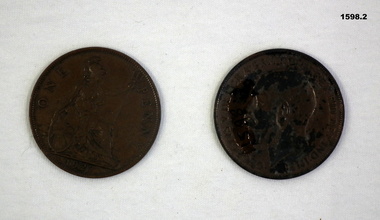
... Penny...two up...Two Up" in the islands WW11. They belonged to Billy Bird No VX113169 2/14 Batt AIF. Refer Cat No 1601. coins, monetary, gambling. Penny ...The coins were used to play "Two Up" in the islands WW11. They belonged to Billy Bird No VX113169 2/14 Batt AIF. Refer Cat No 1601.Pair of Australian Pennies, with King George on one side and Brittania the other. .1) Dated "1912" .2) Dated "1927"coins, monetary, gambling., penny, two up -
 Bendigo Military Museum
Leisure object - TWO-UP SET, 1) 1942; .2) 1908; .3) 1909; .4) 1910
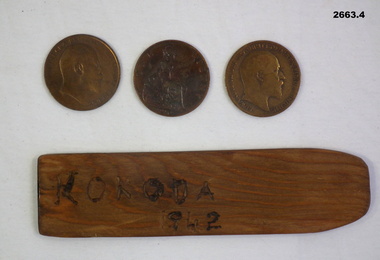
... military history - recreation - gambling trades -carpentery Passchendaele barracks trust .1) Hard etched with black ink: “KOKODA 1942” .1) Kip - the tossing implement, timber rectangular shape, hand made with hard etched letters & numbers on one side. .2) - .4) All pennies have an image of King Edward VII on one side & Britannia on the other side with dates - .1) 1908; .2) 1909; .3) 1910. Leisure object TWO-UP ....1) Kip - the tossing implement, timber rectangular shape, hand made with hard etched letters & numbers on one side. .2) - .4) All pennies have an image of King Edward VII on one side & Britannia on the other side with dates - .1) 1908; .2) 1909; .3) 1910..1) Hard etched with black ink: “KOKODA 1942”military history - recreation - gambling, trades -carpentery, passchendaele barracks trust -
 Bendigo Military Museum
Photograph - PHOTOGRAPHS, RAAF WW2, C. March 1944
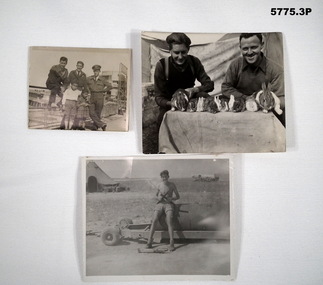
... Penny, Goodall, Snowy, Taffy, Snowy the second, un named, Charlie & the old man Elna, taken March 44". Self & Myself relate to Allan Goodall. .1) Photograph sepia tone showing three Airmen with two local children in the Middle East. .2) Photo showing two Airmen with 10 rabbits lined up on a table. .3) Photo showing Allan Goodall sitting astride a large bomb, tent in back ground. ...Items in collection re Allan Frederick Goodall DFC, RAAF, refer Cat No 543.2 for his service history..1) Photograph sepia tone showing three Airmen with two local children in the Middle East. .2) Photo showing two Airmen with 10 rabbits lined up on a table. .3) Photo showing Allan Goodall sitting astride a large bomb, tent in back ground..1) On rear in pen, "Bob, self, Johnny". .2) On rear in pencil, "Myself, Wilma, Shifty, Ginger, Penny, Goodall, Snowy, Taffy, Snowy the second, un named, Charlie & the old man Elna, taken March 44". Self & Myself relate to Allan Goodall. photographs, rabbits, middle east, dfc -
 Bendigo Historical Society Inc.
Programme - Programme for German Masque Ball, 1905
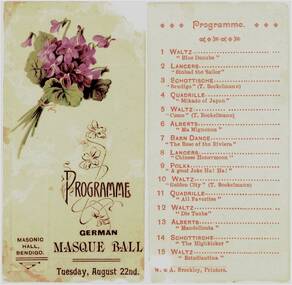
... penny school Two cardboard parts to a printed programme. On one is a posy of violets and the printing: "Programme German Masque Ball, Tuesday 22nd. The second lists 15 dances. Printed by A. Brookley, Printers. Also are the following two articles from Trove: From the Bendigo Advertiser and the Bendigo Independant, Wed 23 Aug 1905: GERMAN MASQUE BALL. The pleasant plan of fancy masque ball, which for nearly 20 years now has been an annual fixture at this season, is always looked forward to with delight. It is got up ...Two cardboard parts to a printed programme. On one is a posy of violets and the printing: "Programme German Masque Ball, Tuesday 22nd. The second lists 15 dances. Printed by A. Brookley, Printers. Also are the following two articles from Trove: From the Bendigo Advertiser and the Bendigo Independant, Wed 23 Aug 1905: GERMAN MASQUE BALL. The pleasant plan of fancy masque ball, which for nearly 20 years now has been an annual fixture at this season, is always looked forward to with delight. It is got up by the Bendigo Deutcher Verein, in aid of their free library. The function took place last night in the Masonic Hall and was most enjoyable, and all who took part in it were delighted. The hall was tastefully decorated with flags, flowers and ferns. Bockelmann's Band occupied the stage and discoured sweet music. Many of the items on a long programme were of Mr. Bockelmann's own composition, notably the schottische "Bendigo," the waltz 'Como, 'and the waltz "Golden City." By 9 o'clock there were about 80 couples on the floor. Amongst the merry troupe of dancers were youths and maidens in all sorts and descriptions of gay costumes, including flower girls, Japanese lady, German peasant, lily of the valley, Mercia, Geisha girl, French Vivandiere, red dominos, black dominos, "The Last Rose of Summer," rose, sailor girls, gondolier, Pierot, Charles II., Tipperary boy. Toreador, Romeo, Prince Le Var, huntsman, Indian prince, fireman, barristers. jockeys, cricketers, etc. Many of the Iadies were in evening dress, but wore the masque. The arrangements were admirably carried out by the secretarv. Mr. J. D. Khaland, while it would be difficult to find a better M.C. than Mr. J. Armstrong. The dancing was witnessed by a large number of the public, who were accommodated on a temporary gallery at one end of the hall. A small charge was made for their admission, which helped to swell thelibrary funds. An excellent supper, served in Mr. W. C. Dick's best style, was much enjoyed. Dancing was kept up till about three o'clock, everybody pronouncing the gathering a highly enjoyable one. bendigo history, sandhurst, lutheran german church, penny school -
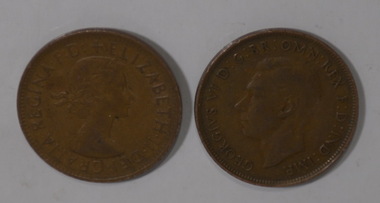 Running Rabbits Military Museum operated by the Upwey Belgrave RSL Sub Branch
Coins
... 2 Pennies for two-up...Ephemera 2 Pennies for two-up Coins ...2 Pennies for two-upephemera -
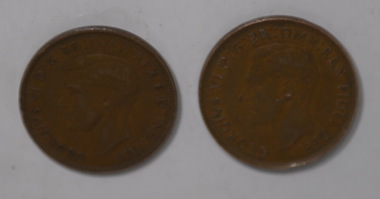 Running Rabbits Military Museum operated by the Upwey Belgrave RSL Sub Branch
Coins
... 2 Pennies for two-up...Ephemera 2 Pennies for two-up Coins ...2 Pennies for two-upephemera -
 Bendigo Historical Society Inc.
Document - MALONE COLLECTION: GREETING CARDS, 5/2/1910
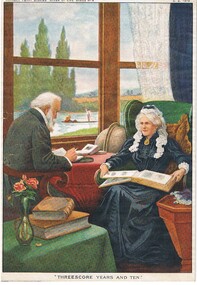
... two people in it. One man is standing up and using a pole to guide the boat. At the top is printed 'Horner's Penny Stories 'River of Life' Series No 4. 5. 2. 1920. ...two people in it. One man is standing up and using a pole to guide the boat. At the top is printed 'Horner's Penny Stories 'River of Life' Series No 4. 5. 2. 1920. ...Coloured picture of an elderly man & lady. The man is wearing a grey suit. He has grey hair and beard. He is sitting at a table with a red cloth on it. He is reading a book and has some others on the table. The lady is wearing a black dress and a gold medallion necklace. She is wearing a lace cap which extends past the medallion. She has an open photo album on her lap. She is sitting in a green armchair with a brown cushion. Beside her is a brown table and in front of her is a small table with a green cloth. It has two large books and a tall green vase of pink roses on it. The view outside the window is of a stream with two people in it. One man is standing up and using a pole to guide the boat. At the top is printed 'Horner's Penny Stories 'River of Life' Series No 4. 5. 2. 1920. The picture is titled 'Threescore Years and Ten'. On the back is written 'MP277.MP277personal effects, greeting cards, malone collection, malone collection, greeting cards, horner's penny stories 'river of life' series no 4 -
 Bendigo Historical Society Inc.
Postcard - GLADYS DEAN COLLECTION: POSTCARD, 1906 - 1908
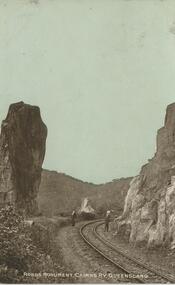
... two men standing either side of the railway line looking up at a rocky monolith. Image is sepia with a pale blue sky.The words Robbs Munument Cairns Ry Queensland are printed in white along the bottom of the image.The reverse is addressed to Miss Dean Post Office Golden Square Victoria. A one penny...two men standing either side of the railway line looking up at a rocky monolith. Image is sepia with a pale blue sky.The words Robbs Munument Cairns Ry Queensland are printed in white along the bottom of the image.The reverse is addressed to Miss Dean Post Office Golden Square Victoria. A one penny ...Photographic postcard of Robbs Monument CAirns Railwya Queensland. Image of railway line curving around a hill with two men standing either side of the railway line looking up at a rocky monolith. Image is sepia with a pale blue sky.The words Robbs Munument Cairns Ry Queensland are printed in white along the bottom of the image.The reverse is addressed to Miss Dean Post Office Golden Square Victoria. A one penny Australian stamp postmarked Rockhampton Queensland is affixed to the top right hand corner.postcard -
 Ballarat Tramway Museum
Postcard, "Shoppee and Alexandra Squares Ballarat Vic.", c1904
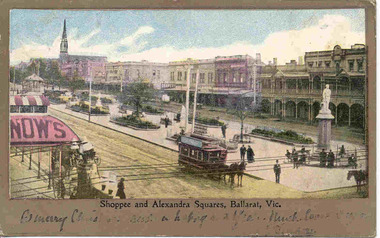
... up to Lydiard St. on the south side of Sturt St. Has the buildings on north side of Sturt St. in the view, including the central median reserve before the trees had grown. Titled "Shoppee and Alexandra Squares, Ballarat Vic." along the bottom edge. On the bottom of the postcard is a one line hand written message, ink fading, very hard to read. On rear of postcard is the address to a Mr Frank Tucker, Glencairn, Park Avenue, Harrogate, England. Has two Victorian stamps, half penny...up to Lydiard St. on the south side of Sturt St. Has the buildings on north side of Sturt St. in the view, including the central median reserve before the trees had grown. Titled "Shoppee and Alexandra Squares, Ballarat Vic." along the bottom edge. On the bottom of the postcard is a one line hand written message, ink fading, very hard to read. On rear of postcard is the address to a Mr Frank Tucker, Glencairn, Park Avenue, Harrogate, England. Has two Victorian stamps, half penny ...Printed colour postcard from top of the Town Hall, looking northwest with Snows building in the foreground looking west. Has a horse tram travelling up to Lydiard St. on the south side of Sturt St. Has the buildings on north side of Sturt St. in the view, including the central median reserve before the trees had grown. Titled "Shoppee and Alexandra Squares, Ballarat Vic." along the bottom edge. On the bottom of the postcard is a one line hand written message, ink fading, very hard to read. On rear of postcard is the address to a Mr Frank Tucker, Glencairn, Park Avenue, Harrogate, England. Has two Victorian stamps, half penny (green) and one penny (red) stamps. Has been postmarked, "Ballarat East 16.11.04". See images .1 and .2. Two copies held - on the second copy, the address details have been crossed out and the stamp removed. Yields information about central Ballarat in the horse tram days.Postcard - printed colour, divided back, used.trams, tramways, horse trams, sturt st, postcards, snows, tram 3 -
 Ballarat Tramway Museum
Postcard, Sturt St. from top of the Nicholl and Allan Building, c1904
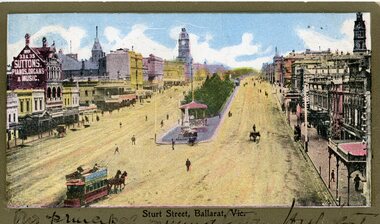
... penny stamp. See images .1 and .2 2437.2 - On the bottom of the postcard is a single line hand written message. On the rear of postcard is the address to a Mr Frank Tucker, Glencairn, Park Avenue, Harrogate, England. Has two Victorian stamps, half penny (green) and one penny (red) stamps. Has been postmarked twice with the same stamp, "Ballarat East 16.01.04" or 16.11.04?? See images .3 and .4 See Reg Item 5103 for a black and photograph close up...penny stamp. See images .1 and .2 2437.2 - On the bottom of the postcard is a single line hand written message. On the rear of postcard is the address to a Mr Frank Tucker, Glencairn, Park Avenue, Harrogate, England. Has two Victorian stamps, half penny (green) and one penny (red) stamps. Has been postmarked twice with the same stamp, "Ballarat East 16.01.04" or 16.11.04?? See images .3 and .4 See Reg Item 5103 for a black and photograph close up ...2437 - Printed colour postcard of the east end of Sturt St. from top of the Nicholl and Allan Building in Grenville St looking west. Has a horse tram leaving the Grenville St. terminus travelling up to Lydiard St. on the north side of Sturt St. Has the buildings on either side of Sturt St. in the view, including Suttons Music store. Titled "Sturt St Ballarat Vic" along the bottom edge. 2437.1 - On the bottom of the postcard is a two line hand written message. On rear of postcard is the address to a Miss C. Haurley of 4 Mortuary Road, South Shields England and two Victorian stamps - half penny (green) and one penny (red) stamps. Has been postmarked "North Melbourne Vic. Feb? 23 05" and over stamped "289" over the penny stamp. See images .1 and .2 2437.2 - On the bottom of the postcard is a single line hand written message. On the rear of postcard is the address to a Mr Frank Tucker, Glencairn, Park Avenue, Harrogate, England. Has two Victorian stamps, half penny (green) and one penny (red) stamps. Has been postmarked twice with the same stamp, "Ballarat East 16.01.04" or 16.11.04?? See images .3 and .4 See Reg Item 5103 for a black and photograph close up of the horse tram in the photo. trams, tramways, horse trams, sturt st, postcards, grenville st -
 Wangaratta RSL Sub Branch
Coin - Two-up Game, Unknown
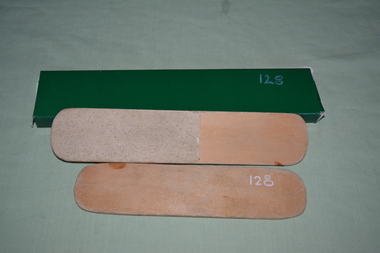
... Two up is a traditional Australian gambling game involving a designated "spinner" throwing two coins or pennies into the air. ...Two up is a traditional Australian gambling game involving a designated "spinner" throwing two coins or pennies into the air. ...Two up is a traditional Australian gambling game involving a designated "spinner" throwing two coins or pennies into the air. Players bet on whether the coins will fall with both heads up both tails up or with one coin head and one a tail. It is traditionally played on Anzac day in pubs and clubs throughout Australia in part to mark a shared experience with diggers through the ages.A game traditionally played on Anzac DayGreen cardboard package containing two coins and three timber paddles.1955 and 1984 pennies in a wooden board made in the Perth Mint Logo of Perth Mint embossed on board. Perth Mint EST 1899 together with Bird two up, anzac day -
 Wodonga & District Historical Society Inc
Photograph - Samuel Skelton Parker's Butchery and Bakery, Barnawartha, Victoria
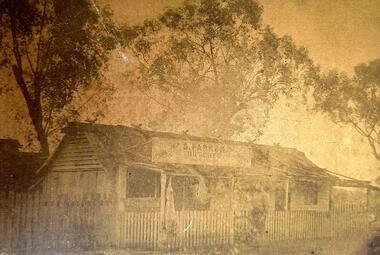
... Bread was sold for five loaves for one shilling, meat was two pennies per pound. In 1890 Skelton decided to give up butchering and baking and moved to Wodonga. ...Bread was sold for five loaves for one shilling, meat was two pennies per pound. In 1890 Skelton decided to give up butchering and baking and moved to Wodonga. ...Samuel Skelton Parker was a native of Ballymena in the County of Antrim, Ireland and came to Melbourne, Australia in 1854. He was engaged for two years as a storeman. After mining in the Ovens district for five years he next became overseer on a station in New South Wales. He was married to Bridget Cusack in 1865 and they had a family of 4 sons and a daughter. After returning to Victoria Samuel Skelton Parker started a butchering business at Barnawartha and in 1881 he combined it with a bakery. This was the first business established in Barnawartha. Samuel had several properties in the township as well as his business premises and private residence. His horse drawn butchers cart made a run to Wodonga three days a week supplying the wayside pubs and Railway Gate House owners. Bread was sold for five loaves for one shilling, meat was two pennies per pound. In 1890 Skelton decided to give up butchering and baking and moved to Wodonga. He bought a 'Bush Block' of 150 acres on Fergusons Lane, now Parkers Road. Skelton called the property 'Park Hall' after his home in Ireland. On this new property Skelton raised sheep and he also sold chaff around the district. When Skelton died on 14 October 1897 the farm was split up with two sons Sam and Jack continuing the running of the farm, whilst the other two sons William and James joined the Victorian railways. Samuel and Jack continued to successfully manage the farm until 1974 when the Albury Wodonga Development Corporation acquired the land for the planned development of the region. In 2026 this is the location of Park Hall Retirement Village and the Wodonga Golf Club are situated on Parkers Road.This image is significant because it records one of the earliest businesses established in Barnawartha, Victoria.Two black and white images of Samuel Parker's business in Barnawartha, Northeast Victoria.parker family wodonga, early wodonga settlers, barnawartha, samuel skelton parker -
 Wangaratta High School
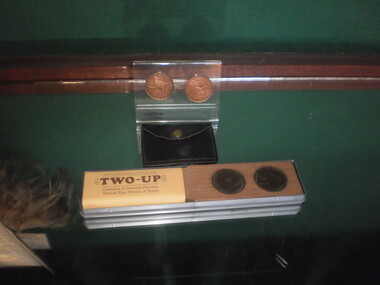
WWII replica Two-up Sets
... Two-up was a betting game played by soldiers in WWI and is played on Anzac days to commemorate the sacrifices made by Australian soldiers in the war effort. Two sets of two pennies ...Two-up was a betting game played by soldiers in WWI and is played on Anzac days to commemorate the sacrifices made by Australian soldiers in the war effort.Two sets of two pennies. One set has a black leather case for the coins and the other has a brown wooden kip and rules sheet -
 Ringwood RSL Sub-Branch
Souvenir - two up kip
... wooden kip two Edward V11 British pennies circa 1906 Souvenir two up kip ...wooden kip two Edward V11 British pennies circa 1906 -
 Melbourne Tram Museum
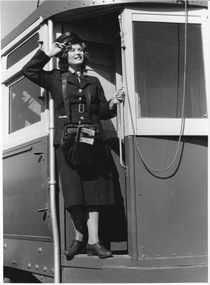
Photograph - Actor Megan Williams as conductress Alice Sullivan, GTV 9 - Channel 9, David Kemp, late 1970s
... up shoes. Alice also wears a conductor's coin bag with ticket wallet and two blocks of 4 penny tickets strategically located for the camera. ...up shoes. Alice also wears a conductor's coin bag with ticket wallet and two blocks of 4 penny tickets strategically located for the camera. ...Photograph shows actor Megan Williams dressed as conductress Alice Sullivan posing at the right side driver's doorway of what may be an L class car, suggested by the metal downpipe from the roof to the undercarriage and the saloon windows. The photograph is closely cropped but also appears to show a male in jacket or coat inside the saloon behind the driver's compartment. The Sullivans was a successful period drama series screened on Channel 9 between 1976 and 1983. It traced the lives of a Melbourne family during the 1939-45 war and its aftermath. As women were 'finally' employed by the tramways from 1941 because of man-power shortages, Alice Sullivan's new job helped highlight the changing societal views of the 1940s. The series was know for its attention to historical details, so Alice is dressed in the conductress uniform of the 1940s - brown tunic with brass buttons and belt, collar and tie, a cap (which may not exactly match that of the day), brown skirt below the knees, stockings and flat brown lace-up shoes. Alice also wears a conductor's coin bag with ticket wallet and two blocks of 4 penny tickets strategically located for the camera. One error in the historical detail is that the coin bag is hung solely around her neck, which was never done because of the weight of the coins and tickets. A more elaborate harness was soon provided for conductresses to share the weight across both shoulders. Another error is the placement of the ticket blocks facing outward at the front of her bag. These would have easily been knocked or become loose and lost, resulting in a large deduction for the conductress's wage.Yields information about 1940s conductresses and their representation in popular drama Black and white print with note on rearIn pencil: "Channel 9 Sullivans"megan williams, alice sullivan, conductress, l class, the sullivans, conductress uniform, coin bag -
 City of Melbourne Libraries
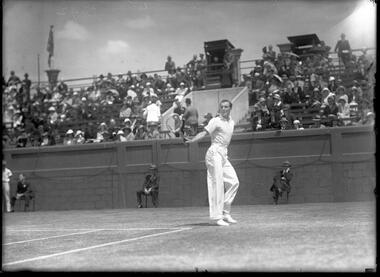
Photograph, Bull, Hugh Jones, 1897-1993, Tennis player Fred Perry, Kooyong
... up to the son of a Labour M.P. inside the manicured grounds of Wimbledon,” he said. Fred married four times, firstly to Texan actress Helen Vinson. His final marriage to Barbara Riese in 1952 lasted until his death. They had two children, Penny...up to the son of a Labour M.P. inside the manicured grounds of Wimbledon,” he said. Fred married four times, firstly to Texan actress Helen Vinson. His final marriage to Barbara Riese in 1952 lasted until his death. They had two children, Penny ...Tennis champion Fred Perry backhands the ball at Kooyong, 1934 “I didn’t aspire to be a good sport, “champion” was good enough for me.” Fred Perry (1909-1995) was an English tennis champion who won eight Grand Slam titles including Wimbledon in 1934, 1935, 1936 and the Australian Open in 1934. Australian sports journalist Alan Trengove remarked, “When Perry walked out to play in his crisp white flannels and matching white blazer, thousands of female hearts missed a beat!” In 1935, Fred and Dorothy defeated Harry and Nell Hopman in the Wimbledon mixed doubles, and in 1936 they won against America. Fred started a successful sportswear brand in 1952, which continues today. Fred initially wanted a smoking pipe as the emblem as he was an enthusiastic smoker, but was talked out of it because it wouldn’t appeal to women. The familiar laurel was used instead. Featured in "Newsworthy: Melbourne in photographs 1933-1936" exhibition at East Melbourne Library, October to December 2023. Exhibition caption by project volunteer Fiona Collyer. Photographer notations on slide: "F. Perry 1934 Action B42" Photograph taken at Kooyong, Melbourne, but used in article about Wimbledon 1934. Published: The Age 7 July 1934 p 13 Published title: "THE FINAL STAGE." Published caption: F. J. Perry (England) Trove article identifier: http://nla.gov.au/nla.news-article205525840 Research by project volunteer Fiona Collyer: Frederick John Perry, 18 May 1909 to 2 Feb 1995 Fred Perry was an English tennis and table-tennis champion. He won eight Grand Slam titles – Wimbledon Gentlemen’s Singles, US Open three times, Australian Open and French Open once each. Fred had natural hand-to eye co-ordination, solid strokes and a devastating forehand that he used soon after the ball bounced. His fierce competitiveness and unabashed confidence gave him the winning edge. Fred was born in Stockport, Cheshire in 1909. His father, Samuel, a committed socialist, was a cotton spinner who became Secretary of the Co-Operative Party and later a Labour and Co-Operative Party M.P. When Fred was nine years old the family moved to Ealing, London. In 1929, at the age of 19, Fred became the World Champion at table-tennis – a new international sport at the time. He then decided to switch from table-tennis to tennis after his father told him to stop spending so much time in the smoke-filled halls that held table-tennis events. “You look like death warmed up.” he said. In the tennis world, Fred was regarded as an upstart intruder, and was the victim of snobbery and prejudice for his working class background. Fred trained with Arsenal Football Club in defiance of the LTA (Lawn Tennis Association) which had a dim view of extra-curricular exercise. His sarcastic toff-baiting call of “very clevah” when an opponent played a good shot and his habit of vaulting over the net whenever he won a match made Fred compelling to watch. Fred’s prize for winning Wimbledon was a £25 shopping voucher and a replica trophy. There was no on-court presentation; instead it was the custom to offer congratulations in the dressing rooms. One of the defining moments of Fred’s career came on the day he won Wimbledon for the first time in 1934. He was in the bathtub after the match when he over-heard former tennis player Brame Hillyard, a committee member of the All-England Club talking to Australian runner-up Jack Crawford. “This was the one day when the best man didn’t win.” Hillyard had brought a bottle of champagne and an All-England neck-tie, which was official recognition of Fred now being a member of one of the sporting world’s most elite clubs. Instead of a formal presentation to Fred, Hillyard draped the tie unceremoniously over his seat in the dressing room, handed Jack the bottle of champagne, and left. “Instead of Fred Perry the Champ, I felt like J. Fred Muggs the Chimp!” he said. When Fred finally went professional, an official at LTA told him he would never wear the club sweater again. Fred said “I made sure he wouldn’t have to worry about that, I sent a sleeve to him as a present!” In 1935, RKO offered Fred a contract for two movies at $50,000 each, but he had to turn down the offer as it would be in breach of LTA rules and he would lose his amateur status. In 1935, Fred married American film actress Helen Vinson in Harrison, New York, waking up a registrar at five minutes to midnight to avoid being married on Friday the thirteenth – “To be on the safe side” they said. In 1936, having been world number one tennis player for three years, Fred quit amateur tennis and moved to America. He joined tennis players Ellsworth Vines and Don Budge on a professional tennis circuit, travelling around US cities and receiving a share of the gate receipts. The All-England Club removed his honorary membership and the tie that went with it – “After all the trouble they’d gone to presenting it to me.” he quipped acidly. Despite being a three-time Wimbledon champion, Fred was barred from playing on LTA affiliated courts, so when he held his pro-tour through the UK in 1937, the matches had to be played on a portable wooden court, transported around by truck to football grounds. Fred was co-owner of the Beverley Hills Tennis Club. The exclusive membership consisted of Hollywood actors, directors, writers and studio heads. At the launch of the re-branded club in 1937, Fred played a doubles match with Charlie Chaplin, Groucho Marx and Ellsworth Vines, which he won with Charlie. Watching on was a Who’s Who of Hollywood actors including Barbara Stanwyck, Joan Crawford, the Marx Brothers, Errol Flynn, and Ronald Coleman to name a few. Fred was romantically linked to Hollywood actresses Marlene Dietrich, Jean Harlow, and Bette Davis, and was engaged to British actress Mary Lawson. In 1939, he became a US citizen and in 1942 enlisted in the US Air Force. Fred wore medical gauze around his right wrist while playing to stop sweat from flowing onto the handle of his racket and to wipe sweat from his brow. He paired up with former footballer Austrian Tibby Wegner to develop an anti-perspirant device. The prototype towelling sweatbands were given free to players at tournaments and proved popular. In 1952, Fred Perry Sportswear began and the trademark slimfit white polo shirt with embroidered laurel wreath on the left breast was born. The laurel wreath was inspired by Wimbledon’s original emblem and is the ancient symbol for triumph and victory. Fred was an enthusiastic pipe smoker and wanted a pipe to be the logo, however he was persuaded that it wouldn’t appeal to women. Years after the brand started, French tennis champion and sportswear designer Rene Lacoste and Fred were interviewed together for TV. Lacoste said ”I made the shirt and you made me a great compliment doing the same thing.” Fred responded “You made the back of it longer than the front – so between us we revolutionised it, didn’t we?” After Fred retired from competition tennis in 1956, he worked as a BBC tennis commentator for TV and radio and wrote columns for British newspapers. He also coached at Beca Raton Club in Florida and was director of golf at Runaway Bay in Jamaica. In 1984, 50 years after his first title, Wimbledon erected a statue of Fred. “I never thought I’d live to see the day when a statue was put up to the son of a Labour M.P. inside the manicured grounds of Wimbledon,” he said. Fred married four times, firstly to Texan actress Helen Vinson. His final marriage to Barbara Riese in 1952 lasted until his death. They had two children, Penny and David. Fred died in the Epworth Hospital, Richmond, Melbourne after falling in his hotel bathroom while visiting for the Australian Open. His ashes are in an urn near his statue at Wimbledon. - In 1975, Fred was inducted into the International Tennis Hall of Fame. - In 2002, the Fred Perry 23 km walking route was opened in Stockport. - An English Heritage blue plaque was attached to his Ealing house where he lived in from 1919-1935. A letter to The Times… In 1932, Dr Daniel Prenn and Gottfried Von Cramm of Germany beat the formally dominant Great Britain team of Fred Perry and Bunny Austin in the Davis Cup. Prenn was not selected for the 1933 Davis Cup Team after Chancellor Adolf Hitler announced his “Aryan only” agenda for Germany’s sporting bodies. Dr Prenn, a Jew, was born in Vilnius (then part of Russia), and in 1920 his family fled to Berlin as refugees after the pogroms. On 15 April 1933, Fred Perry and Bunny Austin (a member at the Oxford Group, a Christian anti-war movement), wrote a letter of protest to the London Times: "Sir, We have read with considerable dismay the official statement which has appeared in the Press that Dr D.D. Prenn is not to represent Germany in the Davis Cup on the grounds that he is of Jewish origin. We cannot but recall the scene when, less than twelve months ago, Dr Prenn before a large crowd at Berlin won for Germany against Great Britain the semi-final round of the European Zone of the Davis Cup, and was carried from the arena amidst spontaneous and tremendous enthusiasm. We have always valued our participation in international sport, because we believed it to be a great opportunity for the promotion of better international understanding and because it was a human activity that countenanced no distinction of race, class or creed. For this reason, if for none other, we view with great misgivings any action which may well undermine all that is most valuable in international competitions. Yours faithfully, H.W. Austin, Fred Perry.” Daniel Prenn emigrated to Britain in 1935. References: Fred Perry: British tennis legend, Kevin Jefferys, Pitch Publishing, 2017 'Fred Perry: The hero from the wrong side of the tramlines', Paul Newman, tennis correspondent, The Independent, 21 November 2015 https://www.independent.co.uk/sport/tennis/fred-perry-the-hero-from-the-wrong-side-of-the-tramlines-a6743721.html. 'Fred Perry: the radical of Wimbledon', Bob Holman, Socialist Worker, 26 June 2009 https://socialistworker.co.uk/comment/fred-perry-the-radical-of-wimbledon/ 'Daniel Prenn (1904-1991) – A little-known Jewish German tennis player', newmark401, Tennis Warehouse forums, 12 May 2011 http://tt.tennis-warehouse.com/index.php?threads/daniel-prenn-1904-1991-–-a-little-known-jewish-german-tennis-player.379780/Photographer notations on slide: "F. Perry 1934 Action B42".tennis, 1930-1939 -
 Bendigo Historical Society Inc.
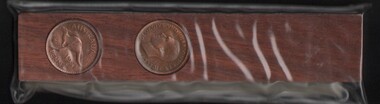
Ephemera - Two-Up betting game
... Two-Up betting game set with two pennies rules and Australian Jarrah Kip (board). ...Australian Two-Up games set Betting game Two-Up betting game set with two pennies rules and Australian Jarrah Kip (board). ...Two-Up betting game set with two pennies rules and Australian Jarrah Kip (board). Set is unopened, and costs $10.50 as new.australian two-up games set, betting game
