
Showing 35 items matching "two-up game"
-
 Wangaratta RSL Sub Branch
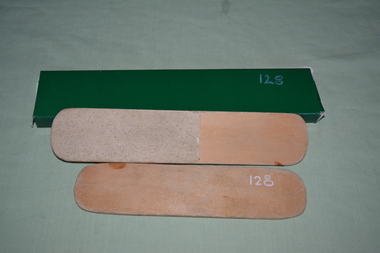
Coin - Two-up Game, Unknown
... Two-up Game...Two up is a traditional Australian gambling game involving a designated "spinner" throwing two coins or pennies into the air. ... up Anzac Day 1955 and 1984 pennies in a wooden board made in the Perth Mint Logo of Perth Mint embossed on board. Perth Mint EST 1899 together with Bird Green cardboard package containing two coins and three timber paddles. Coin Two-up Game ...Two up is a traditional Australian gambling game involving a designated "spinner" throwing two coins or pennies into the air. Players bet on whether the coins will fall with both heads up both tails up or with one coin head and one a tail. It is traditionally played on Anzac day in pubs and clubs throughout Australia in part to mark a shared experience with diggers through the ages.A game traditionally played on Anzac DayGreen cardboard package containing two coins and three timber paddles.1955 and 1984 pennies in a wooden board made in the Perth Mint Logo of Perth Mint embossed on board. Perth Mint EST 1899 together with Bird two up, anzac day -
 Bendigo Historical Society Inc.
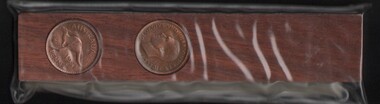
Ephemera - Two-Up betting game
... Two-Up betting game...Australian Two-Up games set...Betting game...Two-Up betting game set with two pennies rules and Australian Jarrah Kip (board). ...Australian Two-Up games set Betting game Two-Up betting game set with two pennies rules and Australian Jarrah Kip (board). ...Two-Up betting game set with two pennies rules and Australian Jarrah Kip (board). Set is unopened, and costs $10.50 as new.australian two-up games set, betting game -
 Eltham District Historical Society Inc
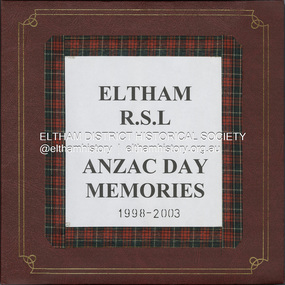
Album - Photo Album, Lynne Reid, Eltham R.S.L. ANZAC Day Memories 1998-2003
... ...Two-up game...Terry Beaton Jock Read Lofty Lofty (horse) Joe Mason Navy Catalogue HMAS Cerberus Warren Whatman Dave Maslen Mick Fowler Bert McKinnell Max Lowerson Stella Lowerson Watsonia Signals Mick Hingston Russell Erickson Two-up game Richie Soma Lynne Reid Les Stillman Julie Stillman Suzy Read Sue Johnson Catalogue Watson School of Signals Briar Hill Salvation Army Band Photo album 34.5 x 34.5 x 5 cm; 34 leaves (68 pages each capable of storing six 10 x 15 cm prints). 233 colour photo prints of various sizes, 10 x 15 cm, 10 x 18 cm and 10 x 30 cm. ...A collection of photographs of Anzac Day services around the Eltham Obelisk situated at the Eltham RSL Sub-branch on Main Road, Eltham and the parade along Main Roadanzac day parade, eltham obelisk, eltham rsl sub-branch, main road eltham, clive jenkins, cliff gardman, john cohen, bev haines, wayne phillips m.p., harold watts, margaret watts, maurie kruegal, eugene snopkowski, joe mason (ww2 veteran), manny ryles, robert marshall, warren watman, john haines, nacy ferguson, ridie soma, henry bradford, jim murphy, vic abbacamenco, eddie shanahan, graham o'shannesy, kniale harris, les meredith, greg gibbs, lauirie kavangh, john beavis, keith lear, neville o'connor, les stiman, ian mc?, terry beaton, jock read, lofty, lofty (horse), joe mason, navy catalogue, hmas cerberus, warren whatman, dave maslen, mick fowler, bert mckinnell, max lowerson, stella lowerson, watsonia signals, mick hingston, russell erickson, two-up game, richie soma, lynne reid, les stillman, julie stillman, suzy read, sue johnson, catalogue, watson school of signals, briar hill salvation army band -
 Frankston RSL Sub Branch
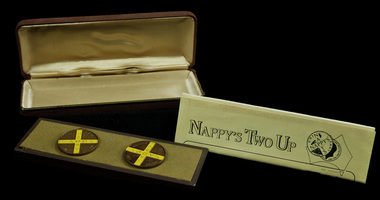
Game, Two Up, Nappy's Two Up
... Game, Two Up...up two nappy s up two nappy s Embossed "Nappy's Two Up" fading Nappy's Two Up set comprising satin lined box measuring 155mm by 55mm with throw board, 2 coins embrossed "Nappys", and instruction sheet Nappy's Two Up Game, Two Up Nappy's ...Nappy's Two Up set comprising satin lined box measuring 155mm by 55mm with throw board, 2 coins embrossed "Nappys", and instruction sheetEmbossed "Nappy's Two Up" fadingup, two, nappy s, up, two, nappy s -
 Frankston RSL Sub Branch
Game, Two Up
... Game, Two Up...two-up set. This commemorative two-up set features an engraved kip made of Gallipoli Lone Pine timber, a velvet pouch, and two copper coins bearing the AWM logo and a First World War soldier. The kip is made from a branch that fell from the Lone Pine Tree during a storm in 2008. This tree was grown from a seed sent back from Gallipoli in 1915. Game ...Gallipoli Lone Pine: two-up set. This commemorative two-up set features an engraved kip made of Gallipoli Lone Pine timber, a velvet pouch, and two copper coins bearing the AWM logo and a First World War soldier. The kip is made from a branch that fell from the Lone Pine Tree during a storm in 2008. This tree was grown from a seed sent back from Gallipoli in 1915. -
 Frankston RSL Sub Branch
Set, Heads 'n Tails
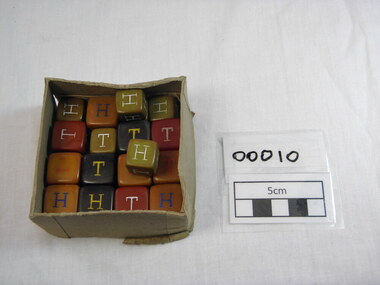
... game...two up...These heads and tails dice were used by the troops to gamble in World War 1 and World War 11 and were the pre-cursur to the two-up game which was a popular form of gambling in Australia post World War 11. ...These heads and tails dice were used by the troops to gamble in World War 1 and World War 11 and were the pre-cursur to the two-up game which was a popular form of gambling in Australia post World War 11. ...These heads and tails dice were used by the troops to gamble in World War 1 and World War 11 and were the pre-cursur to the two-up game which was a popular form of gambling in Australia post World War 11. Later versions of two-up were played with two pennies on a board. A hand made cardboard box containing 18 cubed shaped dice of various colours and sizes. Three red with white lettering, three dark grey with yellow lettering, six orange/brown with blue and red lettering, and six brown with white lettering. Each dice is marked with the three letters H and three letters T.Each dice has H and Tworld war 1, world war 2, dice, game, two up, gambling, heads tails, heads and tails -
 Wangaratta High School
WWII replica Two-up Sets
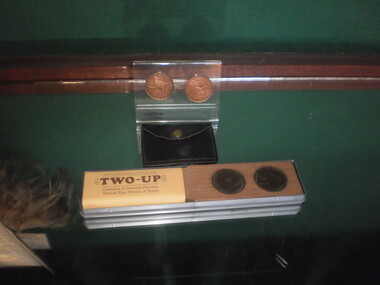
... Two-up was a betting game played by soldiers in WWI and is played on Anzac days to commemorate the sacrifices made by Australian soldiers in the war effort....Two-up was a betting game played by soldiers in WWI and is played on Anzac days to commemorate the sacrifices made by Australian soldiers in the war effort. ...Two-up was a betting game played by soldiers in WWI and is played on Anzac days to commemorate the sacrifices made by Australian soldiers in the war effort.Two sets of two pennies. One set has a black leather case for the coins and the other has a brown wooden kip and rules sheet -
 Sunshine and District Historical Society Incorporated
Archive - Two-Up Gambling Schools
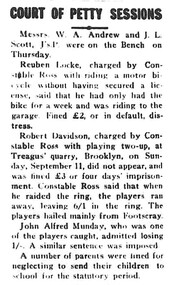
... Two-up became famous among Australian soldiers in World War I, especially at Gallipoli and on the Western Front. It was simple, portable, and boosted morale. After the war, it became a symbol of mateship and remembrance. Two-up isn’t just a game...5347.01 - Court Of Petty Sessions - Sunshine Advocate 1st October 1927 Page 5.pdf 5347.02 - Two-Up, Beer-Up And Betting School - Sunshine Advocate 14th February 1936 Page 2.pdf 5347.03 - Two-Up At Ding Sunshine Station Reserve - Sunshine Advocate 15th November 1935 Page 3.pdf 5347.04 - Young Bloods Playing Two-Up - Sunshine Advocate 24th October 1941 Page 1.pdf 5347.05 - Played Two-Up - Sunshine Advocate 1st May 1942 Page 1.pdf 5347.06 - Two-Up Players Fined - Sunshine Advocate 19th June 1942 Page 1.pdf 5347.07 - Alleged Two-Up School - Sunshine Advocate 15th October 1943 Page 1.pdf 5347.08 - Alleged Two-Up School Case Against Occupier Dismissed - Sunshine Advocate 3rd December 1943 Page 3.pdf 5347.09 - Two-Up Players Fined - Sunshine Advocate 19th May 1944 Page 1.pdf 5347.10 - The Police Infiltrated Two Uppers Landed Cold - Sunshine Advocate 22nd September 1944 Page 1.pdf 5347.11 - Hard Swearing In Two-Up Cases - Sunshine Advocate 15th June 1945 Page 1.pdf 5347.12 - Gambols In Paddock To Escape Gambling Police Raid - Sunshine Advocate 24th January 1947 Page 3.pdf 5347.13 - Obstructing Of Police Brings Fine - Sunshine Advocate 14th February 1947 Page 1.pdf 5347.14 - Charge Of Gambling Fails - Sunshine Advocate 21st February 1947 Page 1.pdf 5347.15 - Police Raid House For 'Swy' Game Occupier And Players Fined - Sunshine Advocate 3rd September 1948 Page 1.pdf 5347.16 - Caught Red Handed At Two-Up - Sunshine Advocate 21st October 1949 Page 1.pdf 5347.17 - Two-Up Players Fined - Sunshine Advocate 25th November 1949 Page 1.pdf 5347.18 - Two-up Players Caught - Sunshine Advocate 20th January 1950 Page 4.pdf 5347.19 - Gave Wrong Name To Police Two-Up Player Fined - Sunshine Advocate 17th March 1950 Page 4.pdf 5347.20 - Youth Won't Work - Sunshine Advocate 27th October 1950 Page 1.pdf 5347.21 - Bing Crosby Caught Playing Two-Up - Sunshine Advocate 13th April 1951 Page 1.pdf 5347.22 - Jotting From the Court Two-Up Player Fined - Sunshine Advocate 23rd November 1951 Page 4.pdf 5347.23 - No Claim Expected For This Money - Sunshine Advocate 11th January 1952 Page 1.pdf 5347.24 - Police Distrurb Two-Up Players In House - Sunshine Advocate 2nd July 1954 Page 1.pdf 5347.25 - The History Of Two-Up Schools In Melbourne West - The Westsider 26th April 2026 Page 15.pdf ...Two-up became famous among Australian soldiers in World War I, especially at Gallipoli and on the Western Front. It was simple, portable, and boosted morale. After the war, it became a symbol of mateship and remembrance. Two-up isn’t just a game ...Two-up is a traditional Australian gambling game played with two coins tossed in the air, and players bet on whether they will land two heads, two tails, or odds (one of each). It’s one of the most iconic pieces of Australian cultural history. Two-up became famous among Australian soldiers in World War I, especially at Gallipoli and on the Western Front. It was simple, portable, and boosted morale. After the war, it became a symbol of mateship and remembrance. Two-up isn’t just a game, it’s a ritual of Mateship, Luck and Chance, Remembering diggers and Community gatherings. Because of this, Two-up is legally allowed to be played in most Australian states on ANZAC Day, even where gambling laws would normally prohibit it.Two‑up has a surprisingly rich little history in Sunshine, Victoria, because of the suburb’s strong links to WWI and WWII service, the RSL, and the old industrial workforce culture where the game stayed alive long after it faded elsewhere. Two-up was played in lunchrooms at the large factories throughout the district, such as at H.V. McKay’s Sunshine Harvester Factory, ICI & Wunderlich. It was played at private gatherings in back sheds, houses, paddocks, behind buildings and hotels around Albion, Braybrook, Matthews Hill, Sunshine & Sunshine North, and informally at the early Sunshine RSL. As the game was illegal, there are many reports in the local papers of places being raided by the police and fines being imposed by the courts on players that were caught playing the game. Many of the local two-up locations are listed in these newspaper's reports.5347.01 - Court Of Petty Sessions - Sunshine Advocate 1st October 1927 Page 5.pdf 5347.02 - Two-Up, Beer-Up And Betting School - Sunshine Advocate 14th February 1936 Page 2.pdf 5347.03 - Two-Up At Ding Sunshine Station Reserve - Sunshine Advocate 15th November 1935 Page 3.pdf 5347.04 - Young Bloods Playing Two-Up - Sunshine Advocate 24th October 1941 Page 1.pdf 5347.05 - Played Two-Up - Sunshine Advocate 1st May 1942 Page 1.pdf 5347.06 - Two-Up Players Fined - Sunshine Advocate 19th June 1942 Page 1.pdf 5347.07 - Alleged Two-Up School - Sunshine Advocate 15th October 1943 Page 1.pdf 5347.08 - Alleged Two-Up School Case Against Occupier Dismissed - Sunshine Advocate 3rd December 1943 Page 3.pdf 5347.09 - Two-Up Players Fined - Sunshine Advocate 19th May 1944 Page 1.pdf 5347.10 - The Police Infiltrated Two Uppers Landed Cold - Sunshine Advocate 22nd September 1944 Page 1.pdf 5347.11 - Hard Swearing In Two-Up Cases - Sunshine Advocate 15th June 1945 Page 1.pdf 5347.12 - Gambols In Paddock To Escape Gambling Police Raid - Sunshine Advocate 24th January 1947 Page 3.pdf 5347.13 - Obstructing Of Police Brings Fine - Sunshine Advocate 14th February 1947 Page 1.pdf 5347.14 - Charge Of Gambling Fails - Sunshine Advocate 21st February 1947 Page 1.pdf 5347.15 - Police Raid House For 'Swy' Game Occupier And Players Fined - Sunshine Advocate 3rd September 1948 Page 1.pdf 5347.16 - Caught Red Handed At Two-Up - Sunshine Advocate 21st October 1949 Page 1.pdf 5347.17 - Two-Up Players Fined - Sunshine Advocate 25th November 1949 Page 1.pdf 5347.18 - Two-up Players Caught - Sunshine Advocate 20th January 1950 Page 4.pdf 5347.19 - Gave Wrong Name To Police Two-Up Player Fined - Sunshine Advocate 17th March 1950 Page 4.pdf 5347.20 - Youth Won't Work - Sunshine Advocate 27th October 1950 Page 1.pdf 5347.21 - Bing Crosby Caught Playing Two-Up - Sunshine Advocate 13th April 1951 Page 1.pdf 5347.22 - Jotting From the Court Two-Up Player Fined - Sunshine Advocate 23rd November 1951 Page 4.pdf 5347.23 - No Claim Expected For This Money - Sunshine Advocate 11th January 1952 Page 1.pdf 5347.24 - Police Distrurb Two-Up Players In House - Sunshine Advocate 2nd July 1954 Page 1.pdf 5347.25 - The History Of Two-Up Schools In Melbourne West - The Westsider 26th April 2026 Page 15.pdf two-up, two up -
 Ballarat Clarendon College
Trophy, Junior tennis champion
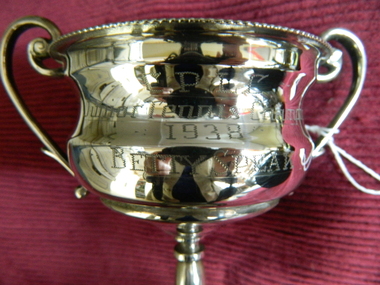
... two daughters. In 1967 Betty returned to work at the Coleraine Post Office and worked for 17 years, moving to the Hamilton PO after the Coleraine PO closed around 1980. She continued to play tennis throughout her adult years. Daughter Gwenda Steff, who donated the trophy to the school in 2016, says 'Mum was passionate about her tennis. She had a formidable backhand shot that few could return. She played Saturday afternoon competition tennis up until her late 40's and she instilled her love of the game...two daughters. In 1967 Betty returned to work at the Coleraine Post Office and worked for 17 years, moving to the Hamilton PO after the Coleraine PO closed around 1980. She continued to play tennis throughout her adult years. Daughter Gwenda Steff, who donated the trophy to the school in 2016, says 'Mum was passionate about her tennis. She had a formidable backhand shot that few could return. She played Saturday afternoon competition tennis up until her late 40's and she instilled her love of the game ...Elizabeth (Betty) Ann Speak attended Clarendon Presbyterian Ladies College 1937 - 1938. She won the Junior Tennis Champion in 1938. Betty worked as a telephonist at Coleraine Post Office after leaving CPLC in 1938. In 1949, she married Leslie James Steff from Konongwootong. They had two daughters. In 1967 Betty returned to work at the Coleraine Post Office and worked for 17 years, moving to the Hamilton PO after the Coleraine PO closed around 1980. She continued to play tennis throughout her adult years. Daughter Gwenda Steff, who donated the trophy to the school in 2016, says 'Mum was passionate about her tennis. She had a formidable backhand shot that few could return. She played Saturday afternoon competition tennis up until her late 40's and she instilled her love of the game into both my sister Margaret and myself. Mum was always too humble to acknowledge her amazing abilities - both on and off the tennis court. But this is an early public acknowledgement of her skills.'Medium silver cup with double handles and silver base and stem on melamine standEngraved on face of cup: C P L C / Junior Tennis Champion / 1938 / BETTY SPEAKbetty-speak, sports, tennis, trophy, 1930s -
 Orbost & District Historical Society
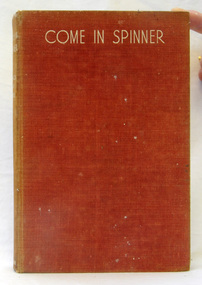
book, Come in Spinner, 1951
... The title refers to a phrase used in the Australian Gambling game of two-up. "Come in spinner" is the call given by the game manager when all bets have been placed and the coins are ready to be tossed....The title refers to a phrase used in the Australian Gambling game of two-up. "Come in spinner" is the call given by the game manager when all bets have been placed and the coins are ready to be tossed. ...The title refers to a phrase used in the Australian Gambling game of two-up. "Come in spinner" is the call given by the game manager when all bets have been placed and the coins are ready to be tossed.This novel, set in Sydney, Australia at the end of the second World War was an outstanding best seller in its time and was an honest portrayal of society at that time. It is regarded as one of the best Australian novels ever written.A hardback novel with a red cloth cover. The title is printed in gold at the top of the front cover. Written by Dymphna Cusack and Florence James. Published by William Heinemann Ltd. Melbourne.literature come-in-spinner cusack-dymphna james-florence sydney-1950's -
 Eltham District Historical Society Inc
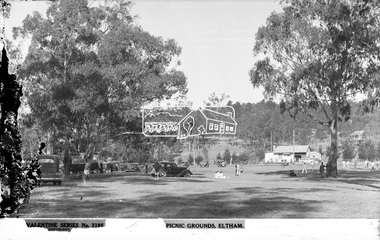
Photograph, The Rose Stereograph Company, Picnic Grounds. Eltham, Vic, c.1939
... up in their cars and are enjoying a game of cricket being played on the oval. This glass plate negative was used to manufacture postcards (1:1 printing) for commercial sale by the Rose Stereograph Company and its subsidiaries. George Rose founded the Rose Stereograph Company in 1880 and was joined by Herbert (Bert) Cutts in the early 20th Century. The pair formed a lifetime working partnership and strong personal friendship. Assisted by George’s two...up in their cars and are enjoying a game of cricket being played on the oval. This glass plate negative was used to manufacture postcards (1:1 printing) for commercial sale by the Rose Stereograph Company and its subsidiaries. George Rose founded the Rose Stereograph Company in 1880 and was joined by Herbert (Bert) Cutts in the early 20th Century. The pair formed a lifetime working partnership and strong personal friendship. Assisted by George’s two ...View looking north parallel to present-day Hohnes Road in Eltham Park (Eltham Lower Park) towards the intersection of Old Eltham Road and Main Road. In those days Eltham Park consisted of a single oval with a cricket pitch running north south in much the same position as today’s oval closest to Main Road. An unsealed track ran around the perimeter of park, essentially bisecting today’ rear oval and horse paddock. Picnickers have pulled up in their cars and are enjoying a game of cricket being played on the oval. This glass plate negative was used to manufacture postcards (1:1 printing) for commercial sale by the Rose Stereograph Company and its subsidiaries. George Rose founded the Rose Stereograph Company in 1880 and was joined by Herbert (Bert) Cutts in the early 20th Century. The pair formed a lifetime working partnership and strong personal friendship. Assisted by George’s two sons, Herbert George and Walter, and later by Neil Cutts, the Rose Stereograph Company continued its operations for more than 140 years. The company was initially built on stereographs, but as cinema took over and stereographs fell out of fashion, the Rose Stereograph Company developed Australia’s first commercially viable photographic postcard business. Specialising in postcards of iconic historical moments and significant landmarks, The Rose Stereograph Company became a staple of the Australian travel industry.This remarkable collection of glass plate negatives, transparencies, and postcards – arguably Australia’s most significant photography collection outside of public hands – has been passed down through the generations, surviving war, relocation, and the harsh Victorian climate. The historic Rose Stereograph collection is the culmination of George Rose’s dream of capturing and preserving precious moments in time and remains the legacy of the Rose and Cutts families. It is with great sadness that the Cutts family says goodbye to a collection that spans five generations and 140 years. The Cutts family understands that for these historically important pieces to rest with one family is to deny others the pleasure of their custodianship.Glass Plate Negative Size: 9.2 x 13.9 cmPicnic Grounds, Eltham, Valentine Series No. 3195, Copyrighteltham lower park, cricket, cars, buildings, electricity lines, lower plenty, eltham, postcard, travel, picnic ground, rose stereograph company, valentine series postcard, glass plate negative, peter and elizabeth pidgeon collection -
 Eltham District Historical Society Inc
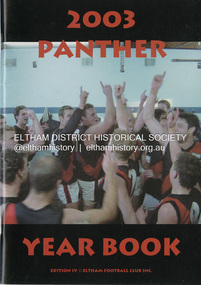
Document - Folder, Eltham Football Club
... News clippings (2000s) • Bailing out water hogs; A plan to pull the plug on muddy sports ovals and lift residents’ game; Diamond Valley Leader, Wednesday, July 20, 2005, p1 • Clubs pleased about plan to upgrade ovals; Diamond Valley Leader, Wednesday, July 20, 2005, p3 • Panthers pounce on the flag; Diamond Valley Leader, Wednesday, September 21, 2005 • Eltham Junior Football Club (photo); Diamond Valley Leader, Wednesday, June 21, 2006 • DVFL reforms to go to vote; Diamond Valley Leader, May 2, 2007, p33 • Panthers end Dogs’ great start; League awards Round 2 games; Diamond Valley Leader, May 30, 2007, p31 • Veteran umpires match up at game; Diamond Valley Leader, August, 2007 • Max Kirwan Mazda Congratulates Eltham Junior Football Club On Another Successful Season in 2007; Two more Division 1 Premierships for the mighty Panthers! ...News clippings (2000s) • Bailing out water hogs; A plan to pull the plug on muddy sports ovals and lift residents’ game; Diamond Valley Leader, Wednesday, July 20, 2005, p1 • Clubs pleased about plan to upgrade ovals; Diamond Valley Leader, Wednesday, July 20, 2005, p3 • Panthers pounce on the flag; Diamond Valley Leader, Wednesday, September 21, 2005 • Eltham Junior Football Club (photo); Diamond Valley Leader, Wednesday, June 21, 2006 • DVFL reforms to go to vote; Diamond Valley Leader, May 2, 2007, p33 • Panthers end Dogs’ great start; League awards Round 2 games; Diamond Valley Leader, May 30, 2007, p31 • Veteran umpires match up at game; Diamond Valley Leader, August, 2007 • Max Kirwan Mazda Congratulates Eltham Junior Football Club On Another Successful Season in 2007; Two more Division 1 Premierships for the mighty Panthers! ...Contents: 1. Diamond Valley Football League Grand Final Souvenir Record; 20 Sep 1969 (colour photocopy) 2. Panther Yearbook 2000 3. Panther Yearbook 2001 4. Panther Yearbook 2003 5. Program: Eltham Football Club Third Annual Ball - 1968; Eltham Football Club “The Panthers” 6. Program: Eltham Football Club Third Annual Ball - 1969; Eltham Football Club “The Panthers” 7. Flyer: Match Of The Year, Eltham, Coach – Hugh Mitchell Ex Essendon versus Diamond Creek, Coach – Keith Burns Ex. Collingwood, Saturday, 19th July, 1969, Central Park Eltham 8. Eltham Football Club Letterhead Stationery (two copies), circa 1970 9. News clippings (1930s) • Football; Diamond Valley Association; Advertiser, Friday, September 9, 1932 10. News clippings (1980s) • Hats off to a veteran; Diamond Valley News, Tuesday, August 8, 1986, p5 [Bernhard Rayner] • Footy Brawl: 4 suspended; Diamond Valley News, Tuesday, August 26, 1986, p1 • DVFL Pennant to Heidelberg; Diamond Valley News, Tuesday, September 23, 1986, p77 11. News clippings (1990s) • Sunday best!; Advertiser, Tuesday, May 30, 1995, p1 • Photo: DVFL football was plagued by mud-bound grounds at the weekend as shown by this Diamond Creek – Reservoir-Lakeside clash. A full report starts on Page 20; Advertiser, Tuesday, July 4, 1995 • It’s Eltham! Panthers claim Division Two flag in historic win over Preston; Advertiser, Tuesday, September 19, 1995, p1 • Boom Time For Sport; Advertiser, Tuesday, September 19, 1995, p3 • DVFL provisional Div. 1 fixture; Advertiser, Tuesday, November 14, 1995, p18 • Panton Hill F.C. joins Diamond Valley; Advertiser, Tuesday, October 29, 1996, p21 12. News clippings (2000s) • Bailing out water hogs; A plan to pull the plug on muddy sports ovals and lift residents’ game; Diamond Valley Leader, Wednesday, July 20, 2005, p1 • Clubs pleased about plan to upgrade ovals; Diamond Valley Leader, Wednesday, July 20, 2005, p3 • Panthers pounce on the flag; Diamond Valley Leader, Wednesday, September 21, 2005 • Eltham Junior Football Club (photo); Diamond Valley Leader, Wednesday, June 21, 2006 • DVFL reforms to go to vote; Diamond Valley Leader, May 2, 2007, p33 • Panthers end Dogs’ great start; League awards Round 2 games; Diamond Valley Leader, May 30, 2007, p31 • Veteran umpires match up at game; Diamond Valley Leader, August, 2007 • Max Kirwan Mazda Congratulates Eltham Junior Football Club On Another Successful Season in 2007; Two more Division 1 Premierships for the mighty Panthers! ; Diamond Valley Leader, August 29, 2007, p60 [Photo] • Max Kirwan Mazda Congratulates Eltham Junior Football Club On Another Successful Season in 2008; Two more NFL Premierships for the mighty Panthers!; Diamond Valley Leader, August 27, 2008, p56 [Photo] • It’s V for victory for talented; Diamond Valley Leader, October 8, 2008 [Photo] • Max Kirwan Mazda Congratulates Eltham Junior Football Club On Another Successful Season in 2009; Three more NFL Premierships for the mighty Panthers!; Diamond Valley Leader, September 23, 2009, p56 [Photo] 13. News clippings (2010s) • Footy fund-raiser for Maddison; Heidelberg & Diamond Valley Weekly, February 23, 2010 • Kicking goals against cancer; Diamond Valley Leader, July 10, 2010 • Max Kirwan Mazda Congratulates Eltham Junior Football Club On Another Successful Season in 2010; Three more First Division NFL Premierships for the mighty Panthers!; Diamond Valley Leader, September 22, 2010, p56 [Photo] • Keen Colm giant killer; Diamond Valley Leader, Wednesday, July 10, 2013 • Heartfelt thanks; Heroes, saviours honoured; Herald Sun, Saturday, December 13, 2014, p2 • Footy: Eltham v. Greensborough; The Weekly Review, March 23, 2016 • Flyer: Girls’ Skills Session; Eltham Football Club; 2017 • Perfect plan delivers a flag; Diamond Valley Leader, Wednesday, September 11, 2019, p33 • Panther Cubs Take High Marks by Mal Harrop, Eltham Town Community News, n.d. p13 eltham panthers, eltham football club, diamond valley football league -
 Bendigo Military Museum
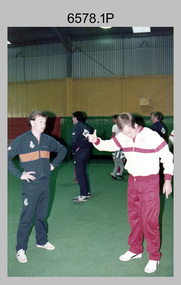
Photograph - Continuous Indoor Cricket World Record Attempt, Seymour, Victoria, 1986
... two eight-man teams, from Army School of Transport and Army Survey Regiment, broke the 120 hour record set by Corrimal High School, NSW earlier this year. Organiser of the event, Capt Marty Alsford of AST told ARMY the teams had played 107 games, scoring 15,000 runs in their chase for the record. "The rules allowed a five-minute rest break every hour which could be accrued, so we played for 64 hours straight then had a five hour sleep. "When everybody got up and went straight back into the game...two eight-man teams, from Army School of Transport and Army Survey Regiment, broke the 120 hour record set by Corrimal High School, NSW earlier this year. Organiser of the event, Capt Marty Alsford of AST told ARMY the teams had played 107 games, scoring 15,000 runs in their chase for the record. "The rules allowed a five-minute rest break every hour which could be accrued, so we played for 64 hours straight then had a five hour sleep. "When everybody got up and went straight back into the game ...This is a set of 12 photographs of Army teams from the Army Survey Regiment, Bendigo and the Army School of Transport, Puckapunyal attempting a world record playing indoor cricket, at Seymour Victoria from the 31st of January to the 5th of February 1986. The following article appeared on the back page of the ARMY Newspaper on Thursday 6th of March 1986. 'INDOOR CRICKET RECORD SMASHED. ARMY TEAMS from Puckapunyal and Bendigo recently played indoor cricket for 124 hours to set a new world record. The two eight-man teams, from Army School of Transport and Army Survey Regiment, broke the 120 hour record set by Corrimal High School, NSW earlier this year. Organiser of the event, Capt Marty Alsford of AST told ARMY the teams had played 107 games, scoring 15,000 runs in their chase for the record. "The rules allowed a five-minute rest break every hour which could be accrued, so we played for 64 hours straight then had a five hour sleep. "When everybody got up and went straight back into the game with no grumbling, I knew we had the record," Capt Alsford said. The event was held at the Seymour Indoor Cricket Centre, an iron-roofed building with no air-conditioning, and all players had to battle the effect of the stifling heat in addition to fatigue. One player dropped out through exhaustion, but this did not prejudice the record attempt as the rules permitted each team to lose a player who cannot return to the game nor be replaced. The Army teams' effort are now awaiting recognition by the Guinness Book of Records. During the marathon event, the soldiers raised money for Legacy, through sponsorships and a raffle. At the time ARMY went to press, the final figure was not available.’ Army Survey Regiment Routine Orders Part 1 Issue No 16/86 Notices on Page 7 stated: ‘World Record Indoor Cricket. 1. Congratulations to the following members for their successful attempt on the Guinness Book of Records, Record for continuous playing of indoor cricket: John Whaling, Peter Ball, Brenton McDonald, Per Andersen, John Anderson, Brian Fauth, Brett McAllister and Daryl South. 2. Our team, playing a team from Army School of Transport at Seymour played continuous Indoor Cricket for 124 hours, beating the existing record by 4 hours. During that time the two teams amassed a total in excess of 16,000 runs. 3. Congratulations also to Peter Ball for picking up the Trophy for the most outstanding player during the record attempt.’This is a set of 12 photographs of Army teams from Bendigo and Puckapunyal attempting a world record playing indoor cricket, at Seymour Victoria in February 1986. The photographs were printed on photographic paper and are part of the Army Survey Regiment’s Collection. The colour photographs were scanned at 300 dpi. .1) - Photo, colour, 1986, L to R: John ‘Junior’ Whaling, Marty Alsford. Background L to R: Peter Ball, unidentified, John ‘Flash’ Anderson. .2) - Photo, colour, 1986, L to R: John ‘Junior’ Whaling, unidentified, Peter Ball. .3) to .7) - Photo, colour, 1986, unidentified participants. .8) - Photo, colour, 1986, L to R: unidentified, Peter Ball, Brett McAllister, John ‘Junior’ Whaling. .9) - Photo, colour, 1986, L to R: unidentified, John ‘Flash’ Anderson, Brian Fauth, unidentified, Peter Ball, unidentified (x2). .10) - Photo, colour, 1986, Army School of Transport (red & white uniform) - back row L to R: unidentified (x4), front row L to R: unidentified (x3), Marty Alsford. Army Survey Regiment (dark green uniform) - back row L to R: Brett McAllister, John ‘Flash’ Anderson, Brian Fauth, Per Andersen, front row L to R: John ‘Junior’ Whaling, Daryl South, Brenton McDonald, Peter Ball. .11) & .12) - Photo, colour, 1986, Army Survey Regiment (dark green uniform) - back row L to R: Peter Ball, Per Andersen, Brett McAllister, Brian Fauth, front row L to R: Brenton McDonald, John ‘Flash’ Anderson, Daryl South, John ‘Junior’ Whaling..1P to .12P –No personnel are identified. ‘Attempt at World Record for Indoor Cricket 31 Jan - 5 Feb 1986’ annotated on cover sleeve.royal australian survey corps, rasvy, army survey regiment, army svy regt, fortuna -
 Waverley RSL Sub Branch
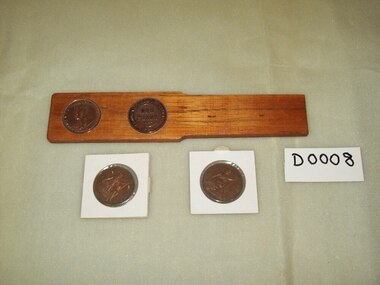
Two up pennies & kip
... Two up has been played by Australians since 1850's. It was popular during WWI, during which time the soldiers referred to the game as SWY (which came from the German Zwei which is the word for two.) ...Two up has been played by Australians since 1850's. It was popular during WWI, during which time the soldiers referred to the game as SWY (which came from the German Zwei which is the word for two.) ...Two up has been played by Australians since 1850's. It was popular during WWI, during which time the soldiers referred to the game as SWY (which came from the German Zwei which is the word for two.) It's popularity continued through WWII and the BCOF constantly ran "SWY" schools. The game is now only legal to be played on Anzac day in Victoria, but in other states also on remembrance day. Pennies must be from before 1938 as "Kangaroo" pennies are not acceptable.A formed piece of light timber with inserts for 2 pennieskip, pennies, swy, two up, swy school -
 Kiewa Valley Historical Society
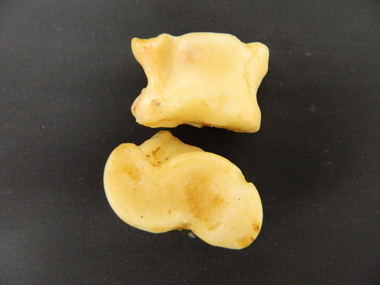
Knuckle Bones
... game called 'knucklebones' was played by primary school girls. At least 2 people were required to play sitting opposite each other and going through the 'moves' (throwing the bones up from the back of your hand, picking up a bone from the floor and catching the others), using 5 knucklebones, as listed on written instruction that came with a coloured plastic version mass produced and with instructions. During the 1950's games were played that required natural substances but increasingly extending to commercial equivalents. knucklebones. children's games. primary school. 1950's Two ...During the 1950's a childhood game called 'knucklebones' was played by primary school girls. At least 2 people were required to play sitting opposite each other and going through the 'moves' (throwing the bones up from the back of your hand, picking up a bone from the floor and catching the others), using 5 knucklebones, as listed on written instruction that came with a coloured plastic version mass produced and with instructions.During the 1950's games were played that required natural substances but increasingly extending to commercial equivalents. Two white knuckle bones from a sheep, used to play the game 'knuckle bones'knucklebones. children's games. primary school. 1950's -
 Bendigo Historical Society Inc.
Ephemera - BENDIGO HOTEL COLLECTION: BELMONT HOTEL GAME CARDS
... up game card. On the cover ''With the compliments of A. Jackson's Belmont Hotel, Kennington, Bendigo'' Inside on the left column for the name of eight players on the right a blank square. How to play: each player selects a number, apply heat to back of square marked, result and winning number will appear. (two...up game card. On the cover ''With the compliments of A. Jackson's Belmont Hotel, Kennington, Bendigo'' Inside on the left column for the name of eight players on the right a blank square. How to play: each player selects a number, apply heat to back of square marked, result and winning number will appear. (two ...Fold up game card. On the cover ''With the compliments of A. Jackson's Belmont Hotel, Kennington, Bendigo'' Inside on the left column for the name of eight players on the right a blank square. How to play: each player selects a number, apply heat to back of square marked, result and winning number will appear. (two copies of the card)bendigo, hotel, belmont hotel -
 Kyneton RSL Sub Branch
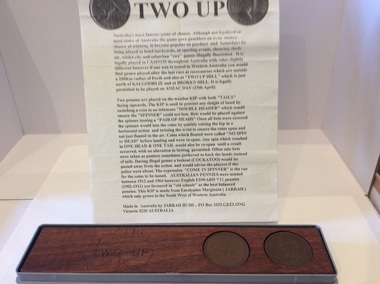
Two -Up
... The game of TWO-UP was a popular gambling game played by soldiers during WW1....The game of TWO-UP was a popular gambling game played by soldiers during WW1. two-up Piece of timber with two indentations to sit two pennies in side by side. ...The game of TWO-UP was a popular gambling game played by soldiers during WW1.Piece of timber with two indentations to sit two pennies in side by side. Decoration at one end includes a map of Australia. The board is accompanied by a description of how to play TWO-UP. Two pennies sit in position.two-up -
 Port Melbourne Historical & Preservation Society
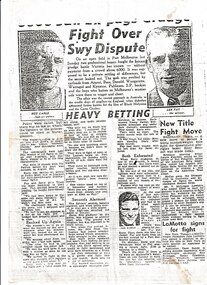
Document, Truth Newspaper, 6000 saw Ex-Pugs Grudge Fight over Swy Dispute, 1950
... The fight between Roy EARLE & Len FAY was over a disputed bet whilst playing the illegal game of two-up known as Swy. After two fights when EARLE needed stitches on both sides of his jaw, he challenged FAY to 15 two minute rounds. ...The fight between Roy EARLE & Len FAY was over a disputed bet whilst playing the illegal game of two-up known as Swy. After two fights when EARLE needed stitches on both sides of his jaw, he challenged FAY to 15 two minute rounds. ...The fight between Roy EARLE & Len FAY was over a disputed bet whilst playing the illegal game of two-up known as Swy. After two fights when EARLE needed stitches on both sides of his jaw, he challenged FAY to 15 two minute rounds. Although supposed to be a private affair a crowd of 6,000 gathered on rough ground behind the Fire Station. The local crowd was swelled by carloads from Victorian country towns. Bets at times up to three hundred pounds were placed allegedly 'always between friends'. By the end of 15 rounds both fighters had collapsed and had to be lifted apart by their seconds. Although FAY was declared the winner on points, EARLE wanted a return fight. Single sheet of A4 paper copied from a 1950 edition of the Truth Newspaper. Missing the first five words of the headline, is - Fight over Swy Dispute. Photographs of the two combatant's, Roy (Ox) EARL and Len FAY , are on either side of the heading. sport - boxing, roy (ox) earl, len fay, young jocker, jack kirkham, arts and entertainment - gambling -
Port Melbourne Historical & Preservation Society
Document, Remembering life in Port Melbourne in the good old days, 21 Apr 1988
... Recollections of Jack CHUMBLEY of life in Port Melbourne include two-up games, training horses on Sandridge Beach and the introduction of buses to replace the cable trams. Jack CHUMBLEY In pencil on top left - Jack knows where the trotting track & 2 up game would be on the map (Terry's dad) A4 copy of newspaper article from the Emerald Hill, Sandridge & St Kilda Times Remembering life in Port Melbourne in the good old days Document ...Recollections of Jack CHUMBLEY of life in Port Melbourne include two-up games, training horses on Sandridge Beach and the introduction of buses to replace the cable trams. A4 copy of newspaper article from the Emerald Hill, Sandridge & St Kilda Times In pencil on top left - Jack knows where the trotting track & 2 up game would be on the map (Terry's dad)jack chumbley -
Tatura Irrigation & Wartime Camps Museum
Photograph - original, A Game of Two Up, 1925
... A Game of Two Up...Sepia photograph of local Tatura men playing a game of two up, possible at Tatura Racecourse. c 1925....on back: a game of two up c 1925...Tatura Racecourse on back: a game of two up c 1925 Sepia photograph of local Tatura men playing a game of two up, possible at Tatura Racecourse. c 1925. ...Original photograph presented to Museum by Noreen Lenehan (nee Bradley). Sepia photograph of local Tatura men playing a game of two up, possible at Tatura Racecourse. c 1925.on back: a game of two up c 1925tatura racecourse -
 Wangaratta RSL Sub Branch
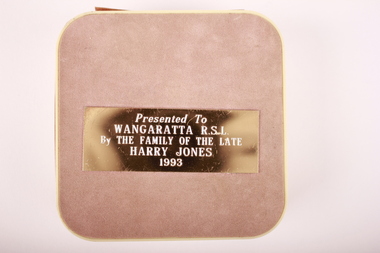
Coin - Engraved Box and Pennies
... (refer item 69) He was discharged from the army on 26th of September 1945.The game of two up is played by throwing two pennies in the air and betting on which way they face up on landing....(refer item 69) He was discharged from the army on 26th of September 1945.The game of two up is played by throwing two pennies in the air and betting on which way they face up on landing. two up pennies private henry jones ww2 Presented to WANGARATTA R.S.L. by THE FAMILY OF THE LATE HARRY JONES 1993 Light pink velvet and plastic box with engraved inscription containing 6 penny coins each marked with a red cross. ...These pennies belonged to Private Henry JONES VX48340 who enlisted at Wangaratta on 25th July 1940 and served with the 2/23rd Battalion 2nd A.I.F. He was twice wounded and after being wounded at Tobruk spent time in hospital in Alexandria. (refer item 69) He was discharged from the army on 26th of September 1945.The game of two up is played by throwing two pennies in the air and betting on which way they face up on landing.Light pink velvet and plastic box with engraved inscription containing 6 penny coins each marked with a red cross.Presented to WANGARATTA R.S.L. by THE FAMILY OF THE LATE HARRY JONES 1993two up pennies, private henry jones, ww2 -
 Sunbury Family History and Heritage Society Inc.
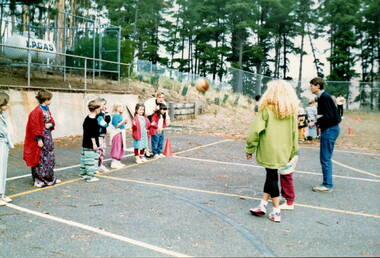
Photograph, Bulla Primary School - Dress-up Day, C1993
... Bulla Primary School Dress-up DAy Barbara Springfield Ball games A coloured photograph showing eight children standing on the boundary of a netball court with two adults, who are playing a ball game with the children. ...The children in photograph are not wearing their school uniform as it was taken on a Bulla Primary School dress-up day. Although they didn't wear their uniforms, classes carried on as normal. This young group are practising ball handling skills needed for netball. The teacher with her back to the camera is Barbara Springfield. A coloured photograph showing eight children standing on the boundary of a netball court with two adults, who are playing a ball game with the children.bulla primary school dress-up day, barbara springfield, ball games -
 Sunbury Family History and Heritage Society Inc.
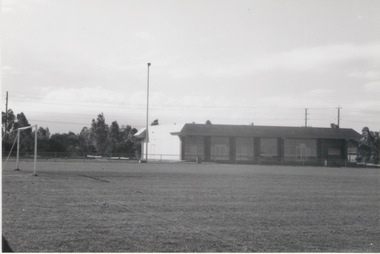
Photograph, Lamgama Park - Soccer Pitch, C 1970s
... game they grew up with. Their first games were played on the recreation reserve in Evans Street on the ground designed for AFL football. (Now the site of a shopping complex). In August 1975, Sunbury United moved to its present home on seven and a half acres of sporting ground at Langama Park in Mitchells Lane . Over the years that area has developed and there are now three senior, and two...game they grew up with. Their first games were played on the recreation reserve in Evans Street on the ground designed for AFL football. (Now the site of a shopping complex). In August 1975, Sunbury United moved to its present home on seven and a half acres of sporting ground at Langama Park in Mitchells Lane . Over the years that area has developed and there are now three senior, and two ...Sunbury United Soccer Club was established in 1973 by a group of expatriate Europeans who wanted to play the game they grew up with. Their first games were played on the recreation reserve in Evans Street on the ground designed for AFL football. (Now the site of a shopping complex). In August 1975, Sunbury United moved to its present home on seven and a half acres of sporting ground at Langama Park in Mitchells Lane . Over the years that area has developed and there are now three senior, and two junior soccer pitches with two cricket pitches and practice nets. Although there is still room for improvement to the floodlighting on the main pitch, the night games have proven successful. The Sunbury United Soccer Club has played an important roll in district competition and is one of the many sporting clubs in Sunbury.A non-digital black and white photograph of a soccer ground showing a set of goal posts with the clubrooms and change rooms in the background.soccer, sunbury united soccer club, football, langama park, mitchells lane -
 Carlton Football Club
Scrap Book, 1995 Grand Final Scrap Book, 1995
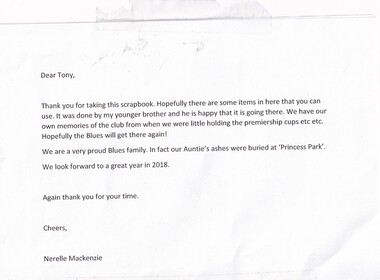
... game being the tightest as the young Bears gave their all. If anything, the 1995 Finals campaign was a testament to Stephen Silvagni who would give up only 1 goal in the 3 games, keeping Darryl White (Brisbane), Wayne Carey (Kangaroos) and Gary Ablett (Geelong) well held. On the day itself, the Blues were supreme as they pounded the Cats into submission. Greg Williams would win the Norm Smith Medal for his 32 possessions and 5 goals, to add to his two ...A Scrap Book dedicated to Carlton's 1995 GF Triumph defeating Geelong A almost complete record of Newspaper Articles dedicated to Carlton's GF win over Geelong in 1995. It was Carlton's 16th Premiership after 16 wins in a row and became known as "sweet sixteen" In 1995 the AFL would admit the 16th team to the competion, the Fremantle Dockers. This would continue the expansion of the traditional VFL, after the West Coast Eagles and Brisbane Bears had been admitted in 1987 and the Adelaide Crows had been admitted in 1991. Carlton won their 16th Premiership in 1995 by defeating Geelong by 61 points in front of over 90,000 fans at the MCG. Over the season, the Blues would set a new benchmark for dominance in a single season with only 2 losses relatively early in the season, to lowly placed St Kilda and Sydney, with a string of 16 successive wins to take their 16th premiership. The season itself was just brilliant to watch as a fan, with stars in defence (Silvagni, Dean, Sexton), midfield (Williams, Bradley, Ratten) and attack (Kernahan, Pearce and Spalding), and all led by Captain Stephen Kernahan. There was a great blend of seasoned veterans (Silvagni, Kernahan and Williams) to young up & comers, including the brilliant Anthony Koutoufides who would have a breakout year at the start of a stellar career. By season's end, Carlton would be 4 games clear of the next best team, Geelong, demonstrating how far above the rest of the competition we were. Throughout the year, our only losses were to Bottom 8 teams, St Kilda and Sydney, and we did not drop a game to any team that played in the finals. In the finals, we defeated Brisbane, the Kangaroos and Geelong, with the Brisbane game being the tightest as the young Bears gave their all. If anything, the 1995 Finals campaign was a testament to Stephen Silvagni who would give up only 1 goal in the 3 games, keeping Darryl White (Brisbane), Wayne Carey (Kangaroos) and Gary Ablett (Geelong) well held. On the day itself, the Blues were supreme as they pounded the Cats into submission. Greg Williams would win the Norm Smith Medal for his 32 possessions and 5 goals, to add to his two Brownlow medals and now Premiership Medal. It was a fantastic year to be a Carlton fan. Come season's end, Coach David Parkin went on record to say that to maintain our success changes would be required. Troy Bond, Ben Harrison and James Cook, each having played games in 1995 but not making it for the Grand Final, would be traded (plus some draft picks) in return for Adrian Hickmott, Justin Murphy, Craig Devonport and Ben Sexton. A4 Scrap Book -
 Carlton Football Club
Pewter Mug, TOM ALVIN PERPETUAL TROPHY Presented Latrobe Valley Hyundai, 1997
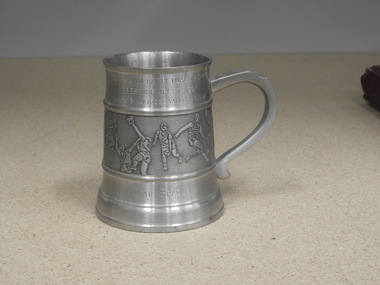
... game as he was at the start. He won two more Carlton Best and Fairest awards in 1988 and 1993, and by the end of his superb career had been an All Australian six times. Aged 32, he picked up ...Yarra Valley Hyundai presentation to Carlton B&F winner 1997A perpetual Trophy presented by a major sponsor Hyundai in the guise of "TOM ALVIN PERPETUAL TROPHY". In 1997 it was presented to Craig Bradley Carlton Best & Fairest winner 1997. Career : 1986 - 2002 Debut : Round 1, 1986 vs Hawthorn, aged 22 years, 159 days Carlton Player No. 931 Games : 375 Goals : 247 Last Game : Round 19, 2002 vs Port Adelaide, aged 38 years, 291 days Guernsey No. 21 Height : 182 cm (5 ft. 11 in.) Weight : 81 kg (12 stone, 11 lbs.) DOB : 23 October, 1963 Premiership Player 1987, 1995 Carlton Legend Carlton Hall of Fame (1995) Best and Fairest 1986, 1988, 1993 All Australian 1986, 1993, 1994, 1995, 1997 Captain 1998-2002 Team of the Century: Wing International Rules Series vs Ireland : 2000, 2001 (captain), 2002 Off the field, Craig Bradley was a somewhat quiet, unassuming character who never hungered for the spotlight. But when the umpire’s whistle blew for a game of Australian football, he became a consummate professional whose outstanding ball-winning ability, accurate disposal, punishing non-stop running and longevity in the game made him one of the all-time greats. “Braddles” captained the Blues for three years, won two AFL Premierships, and picked up almost every possible honour in a stellar career that spanned 17 seasons and a record 375 games for the Carlton Football Club. He began his football journey at Pooraka in outer-suburban Adelaide, where his father was coach of the Under-19 team. Craig was a stand-out junior footballer, and in 1981 he was recruited by SANFL club Port Adelaide. At the same time, Essendon also made a big pitch for his signature. The Bombers were very intent on getting him to Windy Hill, but Bradley wasn’t then ready to make the big move interstate. Essendon redoubled their efforts after Bradley’s sensational debut year for Port Adelaide, which culminated in the Magpies’ 51-point demolition of Glenelg in the Grand Final. Playing on a wing, but roaming the length of the ground, 17 year-old Bradley was one of his team’s best. He followed up by winning Port’s Best and Fairest in 1982, before departing for England later that year, as a member of the Australian Under-19 cricket team. Cricket was Braddles’ other great sporting passion, and he would eventually play two Sheffield Shield games each for South Australia and Victoria, before giving the game away to further his football ambitions. Because of his cricketing commitments, Bradley missed most of the 1983 pre-season with Port, but it made little difference, because he had another dominant season for the Magpies and was named All Australian for the first time. Two more Port Adelaide Best and Fairests followed in 1984 and '85 – with the latter complemented by All Australian honours again. In that year of 1985, four South Australians were named as All Australians; Bradley, Stephen Kernahan, Peter Motley and John Platten – and to the chagrin and envy of every other VFL club (especially Essendon) the first three all signed to play with Carlton. In the following year that trio of stars took to VFL football like they were born to it, and a time of bubbling confidence began for the Old Dark Navy Blues. Braddles wasted little time in announcing his arrival into the upper echelons of our national game by playing in the 1986 Grand Final in his debut season at Princes Park; the same year he won his first Carlton Best and Fairest award in a tie with Wayne Johnston. The Blues lost heavily to Hawthorn on Grand Final day, but twelve months later bounced back to snatch the 1987 flag from the Hawks in Bradley’s 47th senior match. By then, he was already a budding champion whose amazing stamina was too much for almost every opponent. He simply ran his taggers into the ground, and he was as effective in the last minutes of a game as he was at the start. He won two more Carlton Best and Fairest awards in 1988 and 1993, and by the end of his superb career had been an All Australian six times. Aged 32, he picked up his second Premiership winner’s medallion in 1995 when the unstoppable Kernahan-led Blues demolished Geelong in a one-sided Grand Final, but those who thought he might retire after that triumph were right off the mark. He still had his zip, his footy smarts and his brilliant foot skills, and he had transformed himself from a purely attacking weapon into an equally-effective sweeper across half-back. And to cap off a memorable season, he became one of only a handful of players to be inducted into the Carlton Hall of Fame while still playing out their career. In 1997, at the age of 34, Bradley won the Sunday Age Footballer of the Year award. ”It’s not the end of the world when you reach 30,” he said in a blunt response to those who kept asking how long he intended going on – to his considerable annoyance. After being named All Australian yet again that year, he answered all those sorts of questions when he was appointed captain of his beloved Blues in 1998 – after the retirement of his great mate ‘Sticks’ Kernahan. Braddles led the Blues into another Grand Final in 1999, but the Wayne Carey-inspired Kangaroos proved just too good. Further indication of Craig Bradley’s enduring ability was his record in the often controversial and passionately-contested International Rules Series against Ireland. He first played for his country in 1984, and was recalled again in 2000. He was appointed captain of Australia in 2001, and played a fourth round of matches in 2002 at the age of 38 – a truly amazing achievement. In the millennium year of 2000, the honours kept rolling in for Braddles when he was included in both Carlton and Port Adelaide’s Team of the Century. In turn this raised the usual debate over why he had never won the game’s most prestigious individual award, the Brownlow Medal. The answer was apparently found when former field umpire Peter Cameron was interviewed, and he revealed that during most games, Bradley regularly back-chatted the men with the whistle. “He’s in the umpire’s ear all the time,’ said Cameron. By circumstance, Braddles wore his iconic number 21 guernsey for the last time against Port Adelaide at Princes Park in round 19, 2002. Carlton lost the match by 9 points, and Bradley suffered broken ribs and a punctured lung in a heavy collision. Even so, he was an almost unanimous choice as Best on Ground and was given three Brownlow Medal votes by the umpires. A few weeks later, Bradley’s farewell was typical of his nature. There was no big press conference, no stage-managed extravaganza. Instead, he issued a written statement through the AFL that caught everyone – including the Carlton Football Club by complete surprise. It read (in part); I have many people to thank and will do so in the coming weeks. I would however like to thank the Carlton Football Club and the Port Adelaide Football Club for many wonderful times and for their influence in helping to shape my life. To leave the game with a bit left in the tank and in good personal form makes me feel good. Since the foundation of the VFL in 1897, only three men (Michael Tuck, Kevin Bartlett and Simon Madden) have played more senior games than Craig Edwin Bradley of Carlton. A true Blue champion, he is one of only ten official Carlton Legends, and in 2006 was Carlton’s 17th inductee into the AFL Hall of Fame. In October 2006, it was announced that Bradley would return to the club for season 2007 as an assistant to senior coach Brett Ratten – a role he filled with the same intensity as he showed on the field. Bradley holds the club record for most career disposals, kicks, handballs, & Brownlow votes with totals of 8776, 5876, 2900 & 144 respectively.Pewter MugTOM ALVIN PERPETUAL TROPHY Presented Latrobe Valley Hyundai Best & Donated 1997 Craig Bradley -
 Carlton Football Club
Black & White Photos x 2, John O'Connell
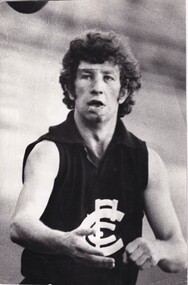
... O’Connell went on to play in two more finals campaigns in 1975 and ’76 but was denied the joy of another September victory. He brought up game number 100 at Princes Park in June 1976, when Carlton ended a five-game losing sequence to beat Essendon, before calling time on his VFL career after the Blues suffered a heart-breaking 1-point loss to North Melbourne in that season’s Preliminary Final. ...Two Pictures of 1972 Premiership Player John O'ConnellCareer : 1970 - 1976 Debut : Round 3, 1970 vs Richmond, aged 18 years, 361 days Carlton Player No. 818 Games : 111 Goals : 0 Guernsey Nos. 50 (1970-71) and No. 19 (1972-76) Last Game : Preliminary Final, 1976 vs North Melbourne, aged 25 years, 149 days Height : 183 cm (6 ft. 0 in.) Weight : 82 kg (12 stone, 13 lbs.) DOB : April 22, 1951 Premiership Player 1972 After starting his career at Carlton as a centreman or ruck-rover at Under-19 and Reserves level, John Michael “Jack” O’Connell found his niche in defence for the Blues and was a creative back pocket in Carlton’s record-breaking 1972 Grand Final victory over Richmond. A dasher who loved to take off on bouncing runs, Jack spent much of his career alongside champion full-back Geoff Southby, with either Vin Waite or David McKay in the opposite pocket. Together, they created a full-back line regarded as among the best in club history. O’Connell’s journey to Premiership glory began during his school days at St Mark’s in Melbourne’s outer north, then at Glenroy YCW and Fawkner. In 1967, aged 17, he joined Carlton’s Under-19s, and by midway through 1969 he was playing Reserves football in guernsey number 50. Early in the following year, a couple of strong showings saw him banging on the door of senior selection, and he was duly rewarded by being named on the bench for his senior debut against Richmond at the MCG in round 3, 1970. For the Blues and their supporters, the game was a forgettable one, because Carlton surrendered a big half-time lead to be beaten by 13 points, and O’Connell wasn’t called on until the dying minutes. Sent back to the Reserves after that one brief taste if the big time, Jack honed his skills and bided his time - for more than a year – while Carlton went on to win the 1970 Premiership. Eventually, he earned a recall midway through 1971, but with a bevy of stars standing in his way, he was a regular reserve until late in the year, when coach John Nicholls – aware that incumbent Ian Collins intended to retire – offered O’Connell a chance in the back pocket. Jack grasped his opportunity with both hands. At 183 cm and 82 kg he was bigger than the average specialist back-pocket of that era, but he gave nothing away in agility. An excellent mark and an accurate kick off either foot, he had settled in beside Southby by the end of that season, playing the last ten games straight. As season 1972 dawned and Collins retired, O'Connell inherited the Blues’ number 19 guernsey and began marking his mark in the Carlton defence. Inspired by Southby’s creativity and Waite’s aggression, Jack was soon a headache for every opposition club. An ankle injury sustained in round 5, 1972 against Collingwood cost him five matches, but he was back to top form by finals time, when Carlton finished the regular season on top of the ladder. In their first final together – the Second Semi Final - O’Connell, Southby and Waite were resolute in a thrilling draw. Richmond won the replay, then Carlton conquered St Kilda in the Preliminary Final to earn another crack at the Tigers in the Grand Final. Opting for a strategy of all-out attack in the flag decider, the Blues blasted off the blocks to kick 8 goals in the first quarter, 10 in the second and 7 in the third to put the game right out of Richmond’s grasp with a full quarter remaining. After coasting to the final siren, the Blues collected their eleventh VFL Premiership by 27 points. Waite was missing from the match, having been injured in the Preliminary Final, but David McKay was a more than adequate replacement, and all three defenders on the last line completed an excellent final series. On the way to another consistent season in 1973, O’Connell strained a thigh in Carlton’s surprise loss to Fitzroy at the Junction Oval in round 16, and wasn’t recalled to the senior side until the Grand Final, when Carlton and Richmond met once more in the 48th match of Jack’s career. A few days beforehand, Barry Armstrong had been ruled out when he was hit by appendicitis, so O’Connell took over Armstrong’s assigned role of negating the Tigers’ star centreman Ian Stewart. Jack stuck to his task all match, but neither he nor his team could hold back a ferocious Richmond side that crashed and bashed its way to victory. O’Connell went on to play in two more finals campaigns in 1975 and ’76 but was denied the joy of another September victory. He brought up game number 100 at Princes Park in June 1976, when Carlton ended a five-game losing sequence to beat Essendon, before calling time on his VFL career after the Blues suffered a heart-breaking 1-point loss to North Melbourne in that season’s Preliminary Final. In 1977 O'Connell was cleared to WAFL club Subiaco. Later he came back to Victoria and coached Diamond Creek to a Premiership in the Diamond Valley League. Then in 1987, the football world was rocked by the news that Jack had been diagnosed with a virulent form of cancer. He fought hard for 18 months, but tragically passed away on the 5th November, 1989 aged just 38. Career Highlights 1971 - 3rd Reserves Best & Fairest 1971 - Reserves Most Improved Player 1972 - Premiership Player Milestones 50 Games : Round 2, 1974 vs Geelong 100 Games :Round 13, 1976 vs Essendon Footnotes Off the field, O’Connell was a quiet, reserved character who, by 1973 had struck a warm friendship with another man of few words in his champion team-mate Bruce Doull. The pair could often be seen together sharing a beer after Sunday morning recovery sessions, and club folklore has it that the only regular conversation to be heard between them was, “it’s your shout.” In 1997, John's son Luke O'Connell joined Carlton, playing eight Reserves games and kicking three goals.2 x Black & White PhotosThe Sun Articles pasted on back of each photo -
 Carlton Football Club
Dinner Program & Menu, Carlton Football Club November 21st 1957 to Mr H R Clover, 1957
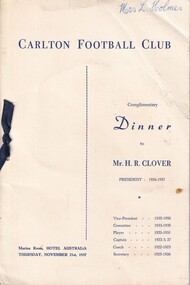
... two aspects of the game, yet none have equalled Clover in the three branches. His nearest rival as an all-round kick, though not quite as certain in his efforts, was Frank Caine, of Carlton, who, like Clover, also hailed from the country." 1933 Coming Football Champion Melbourne, Saturday A special warning was issued to the Victorian Football League delegates last night by Mr. D. H. Crone, a Carlton delegate, not to angle for a certain "coming" champion that the Carlton Club had signed up...two aspects of the game, yet none have equalled Clover in the three branches. His nearest rival as an all-round kick, though not quite as certain in his efforts, was Frank Caine, of Carlton, who, like Clover, also hailed from the country." 1933 Coming Football Champion Melbourne, Saturday A special warning was issued to the Victorian Football League delegates last night by Mr. D. H. Crone, a Carlton delegate, not to angle for a certain "coming" champion that the Carlton Club had signed up ...Dinner to Mr H R Clover player Career : 1920-24, 1926-31 Debut : Round 2, 1920 vs. Richmond, aged 25 years, 46 days Carlton Player No. 346 Games : 147 Goals : 396 Guernsey No. 1 Last Game : Semi Final, 1931 vs. Collingwood, aged 36 years, 180 days Height : 185 cm (6 ft. 1 in.) Weight : 86.5 kg (13 stone, 9 lbs.) DOB : 20 March, 1895 League Leading Goalkicker: 1922 Leading Goalkicker: 1920, 1921, 1922, 1923, 1926, 1928 Best and Fairest: 1929 Captain Coach: 1922-1924, 1927 Champion of the Colony: 1921 VFL AFL Hall of Fame Carlton Hall of Fame Team of the Century President: 1956-57 Vice President: 1932, 1935-54 Club Secretary: 1925-26 Horace “Horrie” Clover was Carlton’s star centre half-forward of the 1920’s; a high flying, long-kicking champion who enjoyed a stellar career with the Old Dark Navy Blues, then went on to be one of our longest-serving administrators. But even before he took the field for Carlton, Clover had to conquer the odds on the battlefields of France in World War 1. From Maryborough in central Victoria, Horrie enlisted in the 1st AIF in September 1915. After basic training, he embarked for France with reinforcements for the 7th Battalion in January of 1916. Soon pitched into the horrors of trench warfare, he fought and survived until September of that year, when he was transferred to a machine gun company and promoted to the rank of Corporal. On Christmas day, 1916, Horrie was struck down with acute appendicitis. He was evacuated to a field hospital for emergency surgery, where the doctors discovered that his appendix was gangrenous and that his life was in danger. He was immediately transferred to London for specialist treatment, and months of recuperation. Pronounced unfit for further front-line service, he was repatriated back to Australia in August 1917, and honourably discharged in May of the following year – six months before the Armistice. Having recovered, and keen to have a crack at senior football, Clover trained with Richmond and Melbourne before Carlton gave him an opportunity at VFL level. And how he delivered! In his first match in 1920 – ironically, against Richmond - he kicked four goals from centre half-forward, and hit the post three times! By the end of his first season at Princes Park, Clover was one of Carlton’s drawcards. Former Australian Prime Minister Sir Robert Menzies was just one of the many Carlton fans who were captivated; “he was the most artistic of high marks, unforgettable at half-forward,” said Menzies. Horrie could kick a football, too. A balanced, deceptively quick mover, he was a glorious running drop-kick for goal. Playing against Richmond again at Princes Park in July, 1921, he let fly with a monster kick that was later measured at 86.26 metres – that’s 94 yards, 2 feet in imperial terms! And there are numerous other instances where he roosted the ball more than 70 metres. In round 12 of 1921, he slotted 13 goals in a game against St Kilda; a club record which still stands today. The Blues made the finals in third place in 1921 and battled through to meet Richmond for the Premiership. Then the heavens above the MCG opened up on the day before the decider, turning the ground into a quagmire. In what was to be Clover’s only Grand Final appearance, Richmond won a slogging, mauling contest by four points. While Premiership glory eluded him, Horrie was Carlton’s top goalkicker in three of his first four seasons, including 1922, where his total of 58 was the competition’s best. He was appointed captain of the Blues that same year, and in 1923 took on the dual role of captain-coach. Over 1924 / 1925, he suffered more debilitating illness that prevented him from playing all season. Unable to pull on his football boots, he took on the job of Club Secretary, and continued in that position even after returning to the field in 1926. When he did eventually resume, he formed a new, powerful Carlton forward set-up with a young Harry “Soapy” Vallence at full-forward. Twice more – in 1926 and 1928, Clover’s brilliance and accuracy in front of goal saw him at the top of Carlton’s goal-kicking, and in 1929 – aged 34, he was honoured with the captaincy of Victoria against WA in his ninth and final game in the Big Vee. show_image.php?id=205 Horrie Clover retired as a player in 1931 after 147 games. His total of 396 goals is still ranked fifth best in Carlton’s proud history (only displaced for fourth when Brendan Fevola broke through in 2007/2008) – and it should be remembered that all but a handful of his games were played at centre half-forward, not in the goal square. In 1932 he was elected Vice-President of the Carlton Football Club, but retired after one year. In February 1935 on learning of Terry Ogden's the serious illness, Clover and Newton Chandler offered their services for a blood transfusion for the club's wing man. After a blood test Chandler's blood was accepted. However, Ogden passed away the next month. Clover stood again in 1935, was elected – and spent twenty unbroken years serving his beloved Blues. He even took on the Presidency in 1956, aged 60, and was as vigorous and determined as ever in his two years in the job. Carlton Football Club mourned deeply when Horrie Clover passed away on the first day of January, 1984. Three years later, he was among the first to be inducted into the Carlton Hall of Fame. Testament to his stature in the game as a whole, he was elected to the AFL Hall of Fame in 1996; and May 2000 saw him named as one of four emergencies in Carlton’s Team of the Century. A champion in every sense of the word, he spent 37 years of his remarkable life at Princes Park. Footnote The Argus published an article on Maryborough, April 12 1930, it said; "Clover has been the leading half-forward in League ranks for some time. It takes a specialist to fill the position capably, and the Carisbrook man does this admirably. Like good wine he has improved with age, and besides being one of the greatest half forwards that has ever appeared on a football field, he is about the best all round kicker that has ever played the game. He excells in punting, drop, and place kicking. He is a great marksman and a splendid exponent, one of the greatest the district has produced, besides being a fair cricketer also." When Clover returned to football in 1926, The Argus mentioned that they thought it was the first time a member of the Permit and Umpire Committee had played in a League game. 13 GOAL AWARD Round 12, 1921 At the Carlton AGM held on Monday 27 February 1922, Horrie Clover "was presented with ball used on the occasion, the St.Kilda club having generously donated it to the Carlton officials, who had it mounted for the purpose." (Age February 22 1922) 1922 The Art Of Forward Play Horrie wrote an article for the Sporting Globe August 30 p7 To read click here> http://nla.gov.au/nla.news-article184798404 1928 Idol of Carlton Crowds - Australia's Best Centre Half Forward The Sporting Globe's football writer W. S. "Jumbo" Sharland writes about Horrie Clover To read click here> http://nla.gov.au/nla.news-article183958222 Footballer Who Gambles With Death. Daily Pictorial (Sydney) article about Horrie. http://nla.gov.au/nla.news-article246129350 1932 Jack Worrall on Clover Writing for the Australasian September 03 p7; "Take Horrie Clover as an example, a real specialist, one of the best forwards the game has seen, and the best all-round kick that has ever come under my purview. For that reason he deserves a line to himself. He played the game like a sportsman, was a glorious high mark, and could cover a great distance by either drop, punt, or place kick - a remarkable accomplishment. Many players have been notable kicks in two aspects of the game, yet none have equalled Clover in the three branches. His nearest rival as an all-round kick, though not quite as certain in his efforts, was Frank Caine, of Carlton, who, like Clover, also hailed from the country." 1933 Coming Football Champion Melbourne, Saturday A special warning was issued to the Victorian Football League delegates last night by Mr. D. H. Crone, a Carlton delegate, not to angle for a certain "coming" champion that the Carlton Club had signed up that day. At first delegates were a little puzzled at the statement, but when it was explained that Horrie Clover, former champion half-forward, had that day become the father of of a son they burst into sustained laughter. It was only by persistent ringing of the bell by the chairman that order was restored. (News (Adelaide) May 20 1933 p3) 1933 - The Place Kick A letter to The Argus via the Huon Times about the lack of place kicking expertise in the VFL. The writer mentions that he got Horrie to play football in Maryborough after he saw the then 15 y.o. place kick a ball 63 yards, and later with Carlton, Clover place kicked 8 goals in one match. To read click here> http://nla.gov.au/nla.news-article137253000 Milestones 50 Games: Round 1, 1923 vs Fitzroy 100 Games: Round 18, 1927 vs St Kilda 100 Goals: Round 18, 1921 vs Collingwood 200 Goals: Round 3, 1924 vs St Kilda 300 Goals: Round 11, 1928 vs Geelong Links Articles: The Magical 'Three Goal Average' | A Letter From Horrie | Our Flagless Greats Blueseum: Stat Shot for Horrie Clover | Career Breakdown | Clover's big goals hauls | Clover's Blueseum Image Gallery A dinner to celebrate career Horrie Clover in 1957Four Page Program & Menu 1927 -
 Carlton Football Club
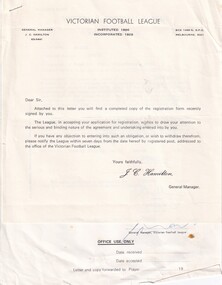
Letter from Victorian Football League 1981, VFL Registration Form 5A, 1981
... One of the hallmarks of the Carlton teams coached by Barassi was their versatility, so as his career progressed, McKay started spending time up forward or in the ruck. From then on, when a game was in the balance and a goal or two was sorely needed, he was the man the Blues often looked for. ...A now defunct Form 5A registration of playerA now defunct Form 5A registration of player of four time premiership player David McKay Career : 1969 - 1981 Debut : Round 3, 1969 vs Footscray, aged 19 years, 165 days Carlton Player No. 809 Games : 263 Goals : 277 Last Game : Grand Final, 1981 vs Collingwood, aged 31 years, 325 days Guernsey No. 43 Height : 191 cm (6 ft. 3 in.) Weight : 92 kg (15 stone, 0 lbs.) DOB : November 5, 1949 Premiership Player 1970, 1972, 1979, 1981 Carlton Hall of Fame (1996) One of the most spectacular high marks of his era, David Robert James “Swan” McKay was a Carlton star for twelve seasons, and a key member of four Premiership teams. Recruited from Newlyn, near Ballarat in central Victoria, McKay arrived at Princes Park in 1968 as a raw-boned 19 year-old. Coach Ron Barassi liked what he saw, and quickly realised that the laconic, easy-going country kid had the makings of something special after only a handful of games in the Blues’ number 43 guernsey. At 191cm and 95 kg he was robust enough to play in the ruck, while his exceptional aerial skills allowed him to hold down a key position. The problem was that he had joined the reigning premiers, so he wasn’t able to claim a regular place in the side until after the Blues were beaten by Richmond in the ’69 Grand Final. Early in the following season, McKay was given a chance at centre half-back, and took to it “like a swan to water.” Quick for his size and blessed with wonderful judgement, “Swan” soon became a crowd favourite. From that season on and throughout his career, it was only on rare occasions when the weekly televised football highlights package did not include footage of him drifting across the front of the pack to pluck the ball from the hands of an opponent, or leaping high over three or four sets of shoulders to take another soaring high mark. By 1970, McKay was embedded in the Carlton defence and hadn’t missed a game all season. After the Blues wound up second on the ladder, David experienced the thrill of a VFL final for the first time in his 29th senior match, when almost 113,000 fans packed into the MCG to see Collingwood beat Carlton by 10 points in a high-scoring Semi Final. Swan took 10 marks amid his 16 possessions that afternoon, and although his side was beaten, he revelled in the occasion. A fortnight later, after destroying St Kilda in a one-sided Preliminary Final, Carlton met Collingwood again in the Grand Final in front of an even bigger crowd. McKay was in trouble early against his taller, equally athletic opponent Len Thompson, but rallied after half time to get right on top as the Blues came from 44 points down to shatter Collingwood in the greatest of all Grand Final comebacks. Swan took nine telling marks and collected 18 possessions to be hailed as Best on Ground, before collecting the first of his four Premiership medals. One of the hallmarks of the Carlton teams coached by Barassi was their versatility, so as his career progressed, McKay started spending time up forward or in the ruck. From then on, when a game was in the balance and a goal or two was sorely needed, he was the man the Blues often looked for. He worked hard on his shooting for goal and became a reliable forward option. The 1972 final series must rank as one of Carlton’s finest hours, as the Blues fought their way through three hard, cut-throat games to meet the raging favourites Richmond in the Grand Final. In that remarkable encounter on a fine, cool day at the MCG, Swan lined up in a back pocket to cover the Tigers’ resting ruckmen and for once, lowered his colours to Richmond’s Neil Balme, who kicked 5 goals – but the Blues still won by 27 points and McKay picked up his second medal. In August 1973, Swan brought up game number 100 against Footscray at the Western Oval. Carlton won by nine points – thanks to McKay’s 13 marks in great game at centre half-back. A month later, the Blues and the Tigers met again on Grand Final day, and – still smarting from their surprise defeat the previous year – Richmond went head-hunting in a spiteful match. Swan was shifted forward early and kicked two majors, but neither he nor his team could match Richmond’s ferocity and the Tigers won the flag by 30 points. Midway through the following season, in round 14, 1975 - McKay was embroiled in another infamous encounter at Essendon’s Windy Hill – a game that saw eight players (himself included) reported. On a wet and miserable day dominated by a howling wind, Swan’s 22 disposals, 14 marks and eight goals won the game for Carlton, and making that victory even sweeter, he later escaped suspension for striking. By the time Carlton was knocked out of the finals in 1976 by straight-sets defeats at the hands of Hawthorn and North Melbourne, McKay was 27 and had racked up 172 games. But he felt he needed relief from the pressure-cooker life of a VFL footballer, so he agreed in principle to join WAFL club Subiaco. When he requested a clearance from Carlton however, the Blues steadfastly refused. Both sides dug in their heels, and some unfortunate headlines resulted before Swan relented and resumed training some weeks into 1977. In round 13 of that season, on a freezing cold and wet Saturday afternoon at the Junction Oval, bottom side Fitzroy caused a huge upset by beating Carlton by 7 points. In his 181st game, McKay took 9 marks, and his second goal of the game was the 200th of his career. McKay’s fourth Grand Final came in 1979 against Collingwood. By then one of only five survivors from the ’73 team, Swan was approaching his 30th birthday. yet still playing valuable, consistent football. In a close, absorbing match on a wet and slippery MCG that day, Carlton again won a nail-biter by just 5 points, thanks to Wayne Harmes’ famous swipe at the ball from a forward pocket in the last minutes of the game. The ball ended at the feet of Ken Sheldon, whose goal clinched Carlton’s twelfth Premiership, and McKay’s third. Throughout the majority of his career, Swan was a durable type who rarely suffered serious injury. That all changed in 1980 however, when he rolled an ankle, played on, and compounded the injury which hampered him for the rest of his career. Carlton made the finals again, but dropped out after successive losses. That was a bitter blow for the Blues, who promptly sacked coach Peter Jones and reinstated David Parkin. Because of his ankle, Swan missed a number of games early in 1981, but was back to near his best for the finals. Carlton destroyed Geelong by 40 points in the second Semi Final and marched into the Grand Final as hot favourites against Collingwood. In a typically fierce and physical decider, Collingwood led by 21 points late in the third quarter, before the confident Blues overwhelmed them in the last term - winning Premiership number four for Swan McKay, and flag number thirteen for Carlton. One of the goals in that vital last quarter came from the big number 43. It was his second major of the game, and his last kick in league football. Amid the jubilation of victory in the rooms after the game, Swan announced his retirement after 263 games and 277 career goals. He was a few weeks short of his thirty-second birthday and it was an appropriate way to end the playing career of one of the club’s favourite sons. Following his retirement, McKay stayed involved at Princes Park in a number of off-field roles. He was inducted into the Carlton Hall of Fame in 1996, and later became a high-profile critic of Carlton’s President John Elliott. When Elliott was voted out of office in 2002, McKay was appointed a director of the club under new President Ian Collins. During 1999 and 2000, David's son James McKay played eight Reserves games and kicked two goals for Carlton. Milestones 100 Games : Round 21, 1973 vs Footscray 150 Games : Round 2, 1976 vs Essendon 200 Games : Round 10, 1978 vs Footscray 250 Games : Round 9, 1981 vs South Melbourne 100 Goals : Round 13, 1974 vs Geelong 200 Goals : Round 13, 1977 vs FitzroyLetters & copy of form from VFL -
 Bacchus Marsh & District Historical Society
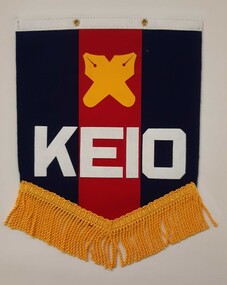
Banner, KEIO Hawks Football Club Pennant
... The Keio University Hawks were one of the first two Aussie rules teams in Japan, along with the Waseda University Bombers. Those teams were formed to play a warm-up game at Yokohama baseball stadium before an exhibition match between VFL teams Essendon and Hawthorn. ...The Keio University Hawks were one of the first two Aussie rules teams in Japan, along with the Waseda University Bombers. Those teams were formed to play a warm-up game at Yokohama baseball stadium before an exhibition match between VFL teams Essendon and Hawthorn. ...The Keio University Hawks were one of the first two Aussie rules teams in Japan, along with the Waseda University Bombers. Those teams were formed to play a warm-up game at Yokohama baseball stadium before an exhibition match between VFL teams Essendon and Hawthorn. The first visit by the Keio Hawks to Australia was in September 1988, About 20 students from Keio and two or three from other universities made the trip. Their visit included training sessions at the Hawthorn and North Melbourne clubs. They then played Japan's first international match against the Sunbury Football Club's under-19 team.The following year they returned to Australia and during this visit played a match in Bacchus Marsh in September 1989. The Keio Hawks returned to Australia over subsequent years in the 1990s included some visits to Bacchus Marsh. During one of these visit a Keio Hawks pennant was presented to the Shire of Bacchus Marsh.Football club banner. Three vertical felt stripes in red and blue with the team name KEIO written in white felt block letters across the width of the banner. Along the top of the banner, a narrow strip of white felt with two metal eyelets to allow for display. Gold coloured textile fringe along the V-shaped bottom of the banner. In a whimsical reference to the university origin of the club, there are two gold felt crossed pen-nibs on the central red section. KEIOkeio university australian rules football club, australian rules football teams japan, australian rules football bacchus marsh -
 Musculoskeletal Health Australia (now held by the Glen Eira Historical Society)
Photograph - Group photo, XX/04/1989
... A net was set up and posters on a display board promoted the game of tennis. arthritis foundation of victoria afv outreach come and try tennis training net practice net geelong shopping centre 1989 [Handwritten in blue ink] Geelong Shopping Centre - Come & Try Tennis April 1989. B&W photo of two ...In April 1989, the Arthritis Foundation of Victoria (AFV) held a "Come & Try Tennis" day at Geelong Shopping Centre. The event was held as part of an outreach visit to Geelong and Corio. A net was set up and posters on a display board promoted the game of tennis.B&W photo of two people, each holding a tennis racket, practising serving tennis balls into a small framed net. Behind the net is a display board with a poster of a woman playing tennis. To the left of the frame, there is another display board advertising Prince tennis products. In the background, there are two people walking past shops with neon signage. One of them is pushing a pram. They are both looking towards the tennis players.[Handwritten in blue ink] Geelong Shopping Centre - Come & Try Tennis April 1989.arthritis foundation of victoria, afv, outreach, come and try, tennis, training net, practice net, geelong shopping centre, 1989
