
Showing 32 items matching "united australia party"
-
 Unions Ballarat
So we take comfort (Don Woodward Collection), Lyons, Enid, 1965
... ...United Australia Party...JA Lyons was Australian Prime Minister (United Australia Party) from 1933 to 1939. ...JA Lyons was Australian Prime Minister (United Australia Party) from 1933 to 1939. Biographical and political interest. ...First-hand story of Dame Enid Lyons' marriage to JA Lyons. JA Lyons was Australian Prime Minister (United Australia Party) from 1933 to 1939. Biographical and political interest.Book; 283 pages. Dustjacket: purple background; pink and white lettering; author's name and title. Cover: green background; gold lettering; author's name and title on the spine.In blue pen, "To Margaret. Graduation Day 5-5-66. John [surname illegible].btlc, ballarat trades hall, ballarat trades and labour council, lyons, dame enid, lyons, ja, prime ministers - ja lyons, united australia party, politics and government, biography/autobiography -
Unions Ballarat
Australian labour leader : the story of W.A. Holman and the labour movement, Evatt, HV, 1942
... ...united australia party...He had a subsequent career in federal politics under the Nationalist and United Australia Parties; during this time he did not distinguish himself....He had a subsequent career in federal politics under the Nationalist and United Australia Parties; during this time he did not distinguish himself. ...Story of WA Holman who was a NSW union organiser; he entered politics and ultimately become Premier of NSW. His pro-conscription stance led to his being expelled from the Labor Party. He had a subsequent career in federal politics under the Nationalist and United Australia Parties; during this time he did not distinguish himself.Relevant to Labor and Australian political history. References to conscription. The author, HV Evatt, was most notably known as Leader of the Australian Labor Party (and Leader of the Opposition) from 1951 to 1960.Paper; book. btlc, ballarat trades hall, ballarat trades and labour council, holman, wa, unions, politics, premier - nsw, conscription, parliament, government, nationalist party, united australia party, alp, australian labor party, union organisers -
Unions Ballarat
Billy Hughes (Don Woodward Collection), Horne, Donald, 2000
... Australia - Billy Hughes...Trolley, Draymen and Carters Union...waterside workers' federation...ALP...australian labor party...National Labor Party...Nationalist Party...Politicians - independent...Biography...Politics and government...Australian party...United...Australia from 1915-1923. He represented the following parties at different times: Labor (to 1916) National Labor (1916–17) Nationalist (1917–29) Independent (1929) Australian (1929–31) United Australia (1931–44) Independent (1944–45) Liberal (from 1945) He was expelled from three parties. ...BTLC Ballarat Trades and Labour Council Ballarat Trades Hall Prime ministers - Australia - Billy Hughes Trolley, Draymen and Carters Union waterside workers' federation ALP australian labor party National Labor Party Nationalist Party Politicians - independent Biography Politics and government Australian party United Australia Party Liberal Party Australia LPA Book; 196 pages. ...Billy Hughes was Prime Minister of Australia from 1915-1923. He represented the following parties at different times: Labor (to 1916) National Labor (1916–17) Nationalist (1917–29) Independent (1929) Australian (1929–31) United Australia (1931–44) Independent (1944–45) Liberal (from 1945) He was expelled from three parties. Before going into politics, Hughes was involved in the trade union movement - particularly the Wharf Labourer's Union, founder of the Trolley, Draymen and Carters; Union and the Waterside Workers Federation of Australia.Politics - Australian. Trade unionism.Book; 196 pages. Cover: white background; picture (black and white) of Billy Hughes; blue and black lettering; author's name and title.btlc, ballarat trades and labour council, ballarat trades hall, prime ministers - australia - billy hughes, trolley, draymen and carters union, waterside workers' federation, alp, australian labor party, national labor party, nationalist party, politicians - independent, biography, politics and government, australian party, united australia party, liberal party australia, lpa -
Unions Ballarat
In search of Billy Hughes, Horne, Donald, 1979
... ...united australia party...Australia. He also served as an organiser for the Amalgamated Shearers' Union prior to embarking upon his political career. He belonged to five different political parties over his parliamentary career: Labor, National Labor, Nationalist, Australian, United Australia, to Liberal....Pertinent to biography of Billy Hughes. btlc ballarat trades hall ballarat trades and labour council w. hughes hughes, billy prime minister unions amalgamated shearers' union union organisers politics australian labor party alp national labor party nationalist party australian party united australia party liberal party australia history biography Front cover: title and author's name. ...Biography of Billy Hughes from his early career to gaining the office of Prime Minister of Australia. He also served as an organiser for the Amalgamated Shearers' Union prior to embarking upon his political career. He belonged to five different political parties over his parliamentary career: Labor, National Labor, Nationalist, Australian, United Australia, to Liberal.Relevance to Australian political history. Pertinent to biography of Billy Hughes.Paper; book. Front cover: painting of Billy Hughes; blue lettering.Front cover: title and author's name.btlc, ballarat trades hall, ballarat trades and labour council, w. hughes, hughes, billy, prime minister, unions, amalgamated shearers' union, union organisers, politics, australian labor party, alp, national labor party, nationalist party, australian party, united australia party, liberal party australia, history, biography -
Canterbury History Group
Document - Going on to war, Daynes, Neville, 22/02/2013 12:00:00 AM
... ... United Australia Party...G(Sir) Canterbury Bowling Club Australian Women's League Canterbury Primary School United Australia Party Emulation Hall A copy of the talk given by Neville Daynes to the Canterbury History Group, 22 February 2013 describing life in Canterbury leading up top to and during World War 2. ...A copy of the talk given by Neville Daynes to the Canterbury History Group, 22 February 2013 describing life in Canterbury leading up top to and during World War 2.canterbury, canterbury memorial hall, menzies> r. g(sir), canterbury bowling club, australian women's league, canterbury primary school, united australia party, emulation hall -
Unions Ballarat
They called me Artie (Don Woodward Collection), Fadden, Arthur, 1969
... Party Australia...National Party Australia...United...BTLC Ballarat Trades Hall Ballarat Trades and Labour Council Fadden, Sir Arthur Country Party Australia National Party Australia United Australia Party Liberal Party Australia politics and government Cabinet Ministers - Treasurer house of representatives - australia Autobiography Prime Minister - Menzies world war ii coalition government politics and government Black ink, "To whomsoever may wish it. ...Arthur Fadden was a member of the House of Representatives for 22 years, representing the Country Party. In 1941, he became Prime Minister for 40 days. He served as Treasurer on two occasions. These memoirs are the story of his boyhood as well as his political career.Political and autobiographical.Book; 196 pages. Dustjacket: green background; artistic impression of Sir Arthur Fadden smoking a pipe; white and black lettering; author's name and title. Cover: green background; gold lettering; author's name and title on the spine.Black ink, "To whomsoever may wish it. [Name illegible.] 1969."btlc, ballarat trades hall, ballarat trades and labour council, fadden, sir arthur, country party australia, national party australia, united australia party, liberal party australia, politics and government, cabinet ministers - treasurer, house of representatives - australia, autobiography, prime minister - menzies, world war ii, coalition government, politics and government -
Unions Ballarat
The measure of the years, Menzies, Robert Gordon, 1970
... ...liberal party australia...united...Party Australia in 1945. Relevance to the history of Australian politics - especially, the Liberal Party Australia and the United Australia Party. btlc ballarat trades hall ballarat trades and labour council menzies, sir robert menzies, rg menzies, bob prime minister deputy premier - victoria liberal party australia united australia party cricket - anecdotes politics politicians memoir autobiography Dark coloured paperback with photo of Sir Robert Menzies on the cover. ...Memoir of former Liberal Party prime minister, Robert Gordon Menzies. Menzies also served as Deputy Premier of Victoria. He launched the Liberal Party Australia in 1945.Relevance to the history of Australian politics - especially, the Liberal Party Australia and the United Australia Party.Dark coloured paperback with photo of Sir Robert Menzies on the cover. Name of author and title on front cover. Back cover is green with white print, including author's name and a precis of the content. Includes a brief statement of praise from the Daily Telegraph. Prices are at the bottom of the back cover.btlc, ballarat trades hall, ballarat trades and labour council, menzies, sir robert, menzies, rg, menzies, bob, prime minister, deputy premier - victoria, liberal party australia, united australia party, cricket - anecdotes, politics, politicians, memoir, autobiography -
 Wodonga & District Historical Society Inc
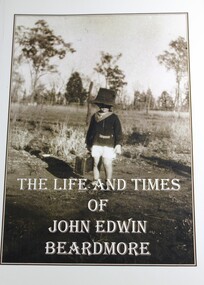
Book - The Life and Times of John Edwin Beardmore, John Edwin Beardmore, 2010
... He continuously represented the Benambra electorate as a Nationalist and United Australia Party member for more than 15 years until his death in 0632 ...He continuously represented the Benambra electorate as a Nationalist and United Australia Party member for more than 15 years until his death in 0632 beardmore family pioneers australia This family history details the background of the Beardmore family in Australia and focuses on the life, adventures and achievements of the author, John Edwin Beardmore. ...This family history details the background of the Beardmore family in Australia and focuses on the life, adventures and achievements of the author, John Edwin Beardmore. It tells of his childhood experiences as well as his many travels around parts of Australia and especially Queensland. A biographical study of the life of Edwin James Beardmore as told by his son John. Edwin James Beardmore was a successful pastoralist and served as a Member of the Queensland Legislative Assembly from 3 August 1957 until his retirement on 17 May 1969. He was awarded an MBE for services to State and Local Government. Born in Victoria in 1891, he moved to Queensland in 1914 as a stock-dealer at St George and lived the remainder of his life in that area of the State. He served on the Balonne Shire Council for 15 years and was its Deputy Chairman for eight years. He died in Brisbane, Queensland on 8 April 1985. Politics and the desire to help others were part of Eddie Beardmore's heritage and when he entered Parliament it was a case of like father, like son. His father, Mr Henry Beardmore, was a member of the Victorian Legislative Assembly many years earlier after serving on the Wodonga Council for 20 years, including five terms as President. Henry then won the seat of Benambra in the Victorian Legislative Assembly at a by-election on 20th April 1917. Henry Beardmore died in Wodonga on 29 August 1932non-fictionThis family history details the background of the Beardmore family in Australia and focuses on the life, adventures and achievements of the author, John Edwin Beardmore. It tells of his childhood experiences as well as his many travels around parts of Australia and especially Queensland. A biographical study of the life of Edwin James Beardmore as told by his son John. Edwin James Beardmore was a successful pastoralist and served as a Member of the Queensland Legislative Assembly from 3 August 1957 until his retirement on 17 May 1969. He was awarded an MBE for services to State and Local Government. Born in Victoria in 1891, he moved to Queensland in 1914 as a stock-dealer at St George and lived the remainder of his life in that area of the State. He served on the Balonne Shire Council for 15 years and was its Deputy Chairman for eight years. He died in Brisbane, Queensland on 8 April 1985. Politics and the desire to help others were part of Eddie Beardmore's heritage and when he entered Parliament it was a case of like father, like son. His father, Mr Henry Beardmore, was a member of the Victorian Legislative Assembly many years earlier after serving on the Wodonga Council for 20 years, including five terms as President. Henry then won the seat of Benambra in the Victorian Legislative Assembly at a by-election on 20th April 1917. Henry Beardmore died in Wodonga on 29 August 1932beardmore family, pioneers australia -
 Wodonga & District Historical Society Inc
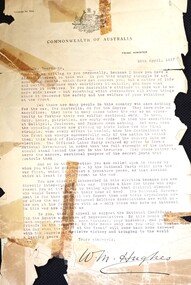
Letter - To Henry Beardmore from William Hughes, Prime Minister, 1917
... He continuously represented the Benambra electorate as a Nationalist and United Australia Party Member for more than 15 years being returned unopposed on four occasions. ...He continuously represented the Benambra electorate as a Nationalist and United Australia Party Member for more than 15 years being returned unopposed on four occasions. ...Henry Beardmore represented the Green Hills Riding on Wodonga Shire Council from 1898 to 1922, including terms as President from 1900-01, 1903-4, 1908-10, 1911-12, 1914-17. He won the seat of Benambra in the Victorian Legislative Assembly at a by-election on 20th April 1917. After a few years serving simultaneously at both local and State government levels, in 1922 Mr Beardmore retired from the Wodonga Council due to his increased workload in State politics. He continuously represented the Benambra electorate as a Nationalist and United Australia Party Member for more than 15 years being returned unopposed on four occasions. Mr Beardmore was a strong advocate for country development and decentralisation. He was an Honorary Minister in 1924 and for a short time in 1929, Minister of Railways, Minister in-charge of Electrical Undertakings and Minister of Labour. He was a leading supporter of Kiewa Hydro-Electric Project and opponent of Yallourn coalfield. He remained as the Member for Benambra until his death in Wodonga on 1st August 1932. At the time this letter was written, William Hughes had been expelled from the ALP over his stance on conscription. He formed the National Labor Party which later merged with the Liberal Party to become the Nationalist Party. Henry Beardmore was a newly-elected Member of the Victorian Parliament and became a member of the Nationalist Party. Two of Henry Beardmore’s sons were on Active Service at the time and were later joined by another of their brothers. The letter aimed to gain support for Hughes at the Federal Election to be held on 5th May 1917 which his new party won with a large majority. However the Second Referendum held on conscription on 20th December 1917 at William Hughes’ instigation was defeated.This letter is significant because it was sent to an important Wodonga politician by the Prime Minister at a critical time in Australia's history.A typed letter sent to Mr Henry Beardmore by W. M. Hughes, Prime Minister 25th April 1917. It is printed on the Commonwealth of Australia letterhead. The letter has been damaged over time and has been repaired. Commonwealth of Australia letterhead Signed W. M. Hughesw. m. hughes, henry beardmore, conscription debate 1917 -
 Melbourne Tram Museum
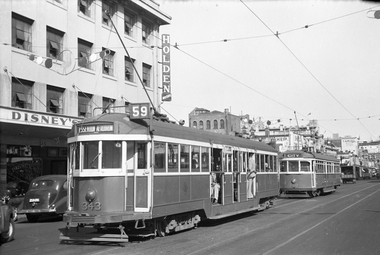
Negative - W2 343 (Essendon Aerodrome Route 59) and SW6 860 (City Route 19) southbound in Elizabeth St, Wal Jack, 10/03/1954
... He was elected to the Victorian Legislative Council in 1940 as a United Australia Party member, representing Higginbotham Province; at this time his father still represented Melbourne West for the Labor Party. ...He was elected to the Victorian Legislative Council in 1940 as a United Australia Party member, representing Higginbotham Province; at this time his father still represented Melbourne West for the Labor Party. ...Black and white negative, by Wal Jack, of W2 343 (Essendon Aerodrome Route 59) and SW6 860 (City Route 19) southbound in Elizabeth St, c1955 near to Franklin St Note the Moomba decorations in the overhead. In the background is Disney's (at 416 Elizabeth St a Holden dealer) with flags under the verandah) Rod Atkins advised 7/9/2020: "He was born in Ballarat to Arthur Disney and Isabella Christina Hill. During World War I he served with the Australian Flying Corps and was at Gallipoli. He then became a motor dealer, running his own company. In June 1924 he married Ruby Chapman. From 1935 to 1952 he served on Melbourne City Council. He was elected to the Victorian Legislative Council in 1940 as a United Australia Party member, representing Higginbotham Province; at this time his father still represented Melbourne West for the Labor Party. Disney was a supporter of Ian MacFarlane, and served in his brief ministry in October–November 1945 as Minister of Transport and Mines. He consequently lost Liberal endorsement in 1946 and was defeated. In 1948 he was elected Lord Mayor of Melbourne, serving until 1951; during this period he was closely involved with securing the 1956 Olympic Games for Melbourne. Knighted in 1951, Disney died in 1952 at Auburn.[1] The ones at Swanston street are taken on different days. Yes there is one of those under powered Jaguars parked across the road .... Did you notice the tram signal on the pole? An interesting thing I did not know looking at all three photos is that the flag pole holder on the route number box is on the inside. So when did it move to the outside of the box? On the photo of the RAAF tram, there is one employee wearing a cap but appears to be wearing overalls? I wonder what that is all about? "trams, tramways, sw6 class, w2 class, route 59, route 19, elizabeth st, moomba, tram 343, tram 860 -
 Wodonga & District Historical Society Inc
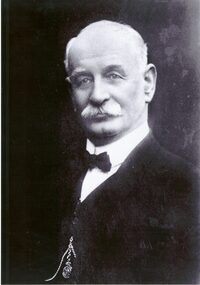
Photograph - Henry Beardmore - Wodonga Shire Councillor and Member for Benambra
... He continuously represented the Benambra electorate as a Nationalist and United Australia Party member for more than 15 years. ...He continuously represented the Benambra electorate as a Nationalist and United Australia Party member for more than 15 years. ...Henry Beardmore was a significant contributor to Wodonga and the state of Victoria. He was born in Melton on 7th February 1863 to Edwin James Beardmore and Flora McDonald. He grew up in Benalla and became a butcher at Glenrowan before taking up land at Leneva near Wodonga, Victoria. On 15 July 1885 Henry married his first wife, Agnes Annie Lee and they had two sons and two daughters. Agnes died in 1892. In 23 August 1893, Henry married Jessie Muirhead and they had six sons and four daughters. Henry represented the Green Hills riding on Wodonga Shire Council from 1898 to 1922, including terms as President from 1900-01, 1903-4, 1908-10, 1911-12, 1914-17. In 1922 Mr. Beardmore retired from the Wodonga Council due to his increased workload in State politics. Henry Beardmore was a Freemason including Master of the Wodonga Lodge from 1906 to 1907, and was an active member up until his death. From 1905-1915, Henry Beardmore leased “De Kerilleau” homestead with the exception of 1907, when Mr W. Huon was in residence, and after he died there in 1907, the Beardmore family returned. Henry Beardmore won the seat of Benambra in the Victorian Legislative Assembly at a by-election on 20th April 1917. He continuously represented the Benambra electorate as a Nationalist and United Australia Party member for more than 15 years. He was a strong advocate for country development and decentralisation, but he declined to join the Country Party. He held the seat of Benambra, up to the date of his death, and was returned unopposed on four occasions. He was an Honorary Minister in 1924 and for a short time in 1929, Minister of Railways, Minister in-charge of Electrical Undertakings and Minister of Labour. He was a leading supporter of Kiewa Hydro-Electric Project and opponent of Yallourn coalfield. Henry Beardmore died in Wodonga on 29 August 1932. His last residence was on the corner Elm Street and Beechworth Road.This photo is significant because it depicts an important local and State politician and member of the Wodonga Community.A black and white formal portrait of Henry Beardmore.henry beardmore, wodonga council, benambra - victorian politics -
 City of Melbourne Libraries
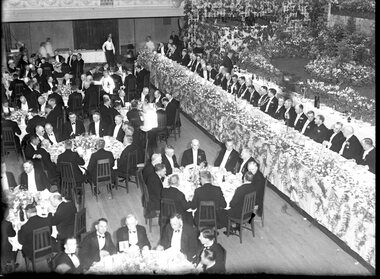
Photograph, Bull, Hugh Jones, 1897-1993, Lord Mayor's Dinner, Melbourne Town Hall
... In 1936 he was elected to the Legislative Council with United Australia Party support, but later resigned over possible State government contract tender irregularities. ...In 1936 he was elected to the Legislative Council with United Australia Party support, but later resigned over possible State government contract tender irregularities. ...Photographer notations on slide: "General View Of Lord Mayor's Dinner At Town Hall Nov 1936 B112" Published: The Age, Tuesday 10 November 1936, page 13 Published title: LORD MAYOR'S BANQUET Published caption: The brilliant scene inside the Melbourne Town Hall last night during the Lord Mayor’s banquet. Trove article identifier: http://nla.gov.au/nla.news-article205939431 Description: 700 guests (all men) are seated around numerous tables in the Melbourne Town Hall for the Lord Mayor's dinner in November 1936. Before the stage is a top table of 35 men, all dressed smartly in black dinner suits, with either a black or white bow tie. Many are wearing their medals. The Lord Mayor has on his Mayoral chains, and to his right is the Governor of Victoria, Lord Huntingfield. The stage is heavily decorated with fresh flowers. Research by project volunteer, Louise McKenzie: This image takes up one quarter of the photographic space on page 13 of The Age on 10 November 1936, reflecting the importance of the event and also the sheer dramatics of the image: 700 guests (all men), a top table of 35, and all dressed smartly in black dinner suits, with either a black or white bow tie. Many are wearing their medals. The Lord Mayor has on his Mayoral chains, and to his right is the Governor of Victoria, Lord Huntingfield. Further to his right is a man with an impressive sash across his chest. It is a very animated, and rather informal, moment. Banks of fresh flowers smother the stage, which is decorated in the manner of a terrace at an English stately home. Tables are laden with food, drink and decorations, and the wait staff (men and women) are also formally dressed, in the manner of Downton Abbey. It is spectacular, dramatic, and luxurious, and perpetuates the proud descriptor of “Marvellous Melbourne” as conferred by London Journalist George Augustus Sala when he visited the city in 1885. During its 1880s boom, Melbourne was the second-largest city in the British Empire, after London, and reputedly the richest city in the world. At times the expression was used with some irony, but "...in Victoria’s centenary year, 1934, with the city mired in another depression, a publisher bravely entitled a book of souvenir photographs Marvellous Melbourne, claiming that the subject ‘still finds apt expression in the happy one-time sobriquet’.” This photo seems to reflect an ongoing pride in Melbourne and a desire for it to live up to its descriptor and celebrate its post-centenary era in style. So it is no surprise to find that on page 11 of The Age on the same day, a second photo is to be found – a cropped view of one table – along with a very detailed description of the night, its purpose, and a surprise announcement. But, who was the Lord Mayor in whose honour the dinner was held? In 1934, the Lord Mayor of Melbourne was Cr. Alexander George Wales, (born Richmond, 11 October 1885, died Elsterwick, 31 May 1962). His father was a contractor and quarry-owner, but was blinded in an industrial accident in 1899. Consequently Alexander, then aged 14, left Brunswick State School to become a railway labourer working at a quarry, and in 1903 joined the Commonwealth public service as a clerk and began studying at night school, determined to improve himself. In 1907 he was appointed secretary of the Albion Quarrying Co. (in which the family had an interest), then its managing director and chairman. As the Australian Dictionary of Biography notes, he was instrumental in expanding the company’s interests, "...becoming director of the Hardware Co. of Australia Pty Ltd, the Twentieth Century Building and Investment Society, the Albion Sand Co. and the Geelong Brick Co.”. His public career began in 1914 when he was elected to the Brunswick council. He was mayor 1917-18, and in 1925 progressed to the Melbourne City Council where he remained for 29 years, being a member of most council committees. He served three successive terms as lord mayor (1934-37), was Chairman of the council’s decorations committee for Melbourne’s centenary, president of the Metropolitan Fire Brigades Board (1936), and Chairman of the Public Works Committee (1937-39). In 1936 he was elected to the Legislative Council with United Australia Party support, but later resigned over possible State government contract tender irregularities. Wales received "the customary reward” of a knighthood and was invested at Buckingham Palace by King George VI whose coronation he attended in 1937. He was an early director of what is now Ampol, and helped the development of the petroleum industry in Australia after visiting the USA in 1943 and 1946. He was impressed by that country’s wartime shipbuilding efforts and supported closer ties with the USA. “While president (1947-48) of the Melbourne Chamber of Commerce, Wales was a vocal critic of the Federal Labor Government, ...a staunch anti-socialist ... and a focus for conservative opposition to the Curtin and Chifley governments...” He is described as “a natural leader in business and civic politics,... a powerful force in the Melbourne City Council... opposing democratic reforms such as the creation of a Greater Melbourne Council and the abolition of plural voting, but advocat[ing] the redevelopment of city-owned property like the Eastern and Western markets...” So, this Lord Mayor’s dinner marks the third successive term in office for Governor Cr. A G Wales. The room is filled with powerful and influential men, and provided a platform for the Premier of Victoria, Albert Dunstan (1882-1950, United Country party) to announce that if the City Council would bear half the cost the State Government would build a bridge at Punt Road “at once”. He announced that the Government proposed to have the bridge built by the Country Roads Board, and allow the City Council to pay its share on convenient terms, and further, it would investigate the shared provision of more Yarra bridges. The proposal for the Punt Road Bridge was met with applause as the Yarra River constituted a serious traffic barrier. On 12 November 1936, two days after the Lord Mayor’s dinner, The Age published an article, “Building without a Plan”. It questions the appropriateness of the next Yarra bridge being the one at Punt Road, and encourages a “proper procedure” to look at the provision of additional Yarra bridges as a whole. But in fact this topic had been canvassed back in August when Melbourne City Council’s public works committee had recommended the replacement of the footbridge at Punt Road with a bridge, and if the Country Roads Board would declare this portion of Punt Road, including the river crossing, a State Highway, this could give the Board authority to construct the bridge and allocate the cost. Hence the reference at the dinner to a shared expense. Still an integral part of traffic management today, the Hoddle Bridge carries Punt Road over the Yarra River between Richmond and South Yarra in Melbourne. It is a five-lane road bridge with narrow footpaths on either side. It is of continuous reinforced concrete T-beam construction with five segmental arched spans, supported on transverse piers, and linked by concrete cross-beams. “The piers terminate in a series of tapered concrete pillars with Art Deco-styled steamlined decoration. Each pillar supports a Victorian-style lamp. The infill railings are geometric-patterned painted metal. Construction began in late 1937, and it was opened by Premier Albert Dunstan on 22 December 1938. It replaced an earlier footbridge, which in turn had replaced a punt service. The bridge (originally referred to as Punt Road Bridge) was named after Robert Hoddle, who planned central Melbourne’s Hoddle Grid, the grid of streets which form Melbourne’s central business district. Hoddle arrived in Australia from the UK in 1823 and went on to carry out surveys in NSW and Queensland before arriving in Melbourne in 1837. He designed layouts for both Melbourne and Williamstown, and later Geelong and other Victorian country areas. He was keen that major streets be at least 30 metres wide. ”With remarkable foresight he provided for wide boulevards from the city to the suburbs, but the subdivisions of early speculators in inner suburbs created the bottle-necks of today. After the separation of the colony in 1851, he became Victoria’s first surveyor-general... and advocated the provision of three-chain (60 m) roads and the widening of all existing main roads from one (20 m) to three chains." However, he was met with constant opposition and in 1853, was eased out of office. As a small and interesting aside: Hoddle was appointed auctioneer for the first sale of crown land in Melbourne on 1 June 1837. His commission was 57 pounds 12s 7d. and he bought two allotments for himself at a cost of 54 pounds. After he died his second wife married Richard Buckhurst Buxton, a member of the family which in 1860s Melbourne established the Australian property dynasty of Buxton Real Estate, Becton, MAB Corporation etc. Returning to the dinner and The Age article of 10 November 1836: Another topic of the after-dinner speeches was a reference to the upcoming Armistice Day. “The Minister of Customs (Mr White) said the proximity of Armistice day reminded us that eighteen years ago we had high hopes of prolonged peace.” The term “Armistice Day” was coined after WWI: “At 11 am on 11 November 1918, the guns on the Western Front fell silent after more than four years of continuous warfare. The Germans called for an armistice (suspension of fighting) in order to secure a peace settlement. They accepted the allied terms on unconditional surrender. Therefore on the 11th hour of the 11th day of the 11th month, a minute’s silence is observed and dedicated to those soldiers who died fighting to protect the nation. Originally known as Armistice Day, it was renamed Remembrance Day after World War Two to commemorate those who were killed in both World Wars. Today it refers to the loss of Australian lives from all wars and conflicts, accompanied by the words, "We will remember them, Lest we forget"." There was comment at the dinner about the need to remain firm in supporting the “democratic government in the British Empire to avoid a “plunge into savagery”. There was a grave responsibility on the British people to keep democracy alive, and that could not be done without adequate defence forces... Many weak governments in non-British countries had been swept aside by strong-fisted dictators, who now were the real threat to peace”. With the benefit of hindsight these were very pertinent comments and tragically prophetic. The Melbourne Shrine of Remembrance had only been dedicated two years earlier, at a ceremony attended by the Duke of Gloucester, son of King George V. Over 300,000 citizens attended: one third of the population of Melbourne. It became the location for the Anzac Day Dawn Service. Originally the march travelled from the Shrine into the city, however, in 1936, this was reversed, and the Shrine became the termination point for Anzac Day Marches. Also significant in 1936, was the installation of a statue in the west forecourt of the Shrine: “The Man with the Donkey” (aka 'Private John Simpson and his Little Donkey'). The work is said to represent the “valour and compassion of the Australian soldier”. Its full citation, according to the City of Melbourne City Collection is: West Side of Base: "The / Man with his Donkey / Gallipoli, April 25 to May 19 / in Commemoration / of the valour and compassion / of the Australian Soldier" AFTER LANDING AT GALLIPOLI, SIMPSON, WITH HIS LITTLE DONKEY, WORKED ALONE, DAY AND NIGHT TAKING WATER TO THE FRONT LINE AND CARRYING THE WOUNDED BACK TO THE DRESSING STATIONS. HE AND HIS DONKEY WERE KILLED BY A SHRAPNEL SHELL ON THE 19TH MAY, 1915. SIMPSON WAS MENTIONED IN DISPATCHES BY SIR IAN HAMILTON, COMMANDER-IN-CHIEF OF THE MEDITERRANEAN EXPEDITIONARY FORCE. / Erected by Public Subscription under auspices of the / Red Cross Society. East Side of Base: Private John Simpson." Their summary in background states: "A bronze figure of Simpson and his donkey with a wounded man on the donkey's back on a granite pedestal. Private John Simpson Kirkpatrick’s intrepid and short-lived exploits during the Gallipoli campaign have made him a popular figure of World War One. He has been mythologised to represent the lauded values of the digger, and he symbolises all those who went into battle unarmed. Born in England in 1892, he came to Australia in 1910. He enlisted to make his way back to England, but as a member of the 3rd Field Ambulance AIA was sent to Gallipoli. After just three weeks of bearing wounded soldiers across Shrapnel Gully on the back of his donkey, Simpson was killed by shrapnel fire. Simpson’s story became a powerful propaganda tool for enlistment in Australia, but following the war he was quickly forgotten. With the Shrine of Remembrance nearing completion in 1933, the memory of Simpson was rekindled to commemorate all who gave their lives to help others during the war. One plaque reads: ‘The / Man with his donkey / Gallipoli … / In commemoration / of the valour and compassion / of the Australian soldier’. In 1935, Wallace Anderson’s design for the memorial was selected though a competition organised by the Australian Red Cross. Anderson had served during the war and worked at the Australian War Memorial after his return. His Man with the Donkey was cast in Italy, and after some debate was sited near the shrine. Unveiled 20th June, 1936." The sculptor, Victorian-born William Wallace Anderson (1888-1975), served in France during WWI and afterwards produced a number of bronze war memorials and memorial portraits, predominantly in Victoria. “His most famous work is that of Simpson and his Donkey (1935), which he completed after winning a competition conducted by the Victorian Division of the Australian Red Cross. Anderson’s fee was 350 pounds; the cast, made by the Chiurazzi Foundry, Naples, Italy, cost 40 pounds. The work... has become well known as a symbol of the Anzac tradition.” A debate as to the siting of the statue arose from a strong view expressed by General Sir John Monash that no representation of individual members of the Australian Defence Force be located on the Shrine itself. Hence its location off to the northwest of the forecourt, in a garden of rosemary. And finally we return to the photo of the grand Lord Mayor’s dinner! An article in The Argus of 4 November 1936 refers to “Brilliant Scene at Lord Mayor’s Ball – Hall Becomes a Garden”. So now it becomes clear why the Town Hall, location of the Lord Mayor’s Dinner on 10 November 1934, only 6 days later, is so lavishly decorated. The floral decorations from the Ball are still in place - an early example of “recycling”, which is gratifying to note at a time of Depression. The reporter has captured the scene with enthusiasm: “Hundreds of tiny rose lights, hidden among pink roses, transformed the Melbourne Town Hall into a magical garden last night, when the Lord Mayor and Lady Mayoress (Councillor A. C. Wales, M.L.C., and Mrs. Wales) entertained about 3,500 guests at a ball. His Excellency the Governor (Lord Huntingfield) and Lady Huntingfield were present, while Rear-Admiral and Mrs. Lane Poole and officers from the visiting squadron were among the special guests. The balconies all round the hall were hidden by a white trellis, covered with pink blossoms and greenery. Rosy flowers were issued up every pillar, and great golden lamps, hanging from the door, were seated in greenery and trails of sweet peas. The organ gallery was converted into a terrace garden with stone steps leading to banks of pink azaleas, pink pelargoniums, masses of calceolarias, and the lovely deep mauve and blue of cinerarias. Slender Japanese maples and poplar trees grew from the higher slopes amid thickets of hostas, while a fascinating illusion was created by the lofty conservatory windows, which formed the background, and which were tinted cerulean blue to simulate the sky seen through glass. Large fern baskets hung from the conservatory roof, and the whole scene was enclosed in trellises of blossom. In the entrance palm green shrubs stood like sentinels round the passed floor, and flowers bloomed in misty golds. The long corridor upstairs leading to the council chamber was lined with an avenue of poplar trees in tubs. In the Lower Town Hall great banks of calceolarias and azaleas decked the upper dais, and each supper table was adorned with a different coloured flower with sprays of roses and Japanese maple laid on the snowy cloths. The adjoining supper-rooms were fragrant with the scent of huge bowls of stock in mauve, purple, and pink, while the white walls were covered with palm leaves and flowers. The roof garden below the clock tower was enclosed as a buffet with rose wreathed walls, and flowers were arranged attractively in the Lady Mayoress's rooms." References: LORD MAYOR'S BANQUET. CENTURY MAKERS AT THE M.C.G. BEFORE THE CHANGE. (1936, November 10). The Age (Melbourne, Vic. : 1854 - 1954), p. 13. Retrieved September 4, 2024, from http://nla.gov.au/nla.news-article205939431 'Portrait of Sir George Wales (Lord Mayor 1934-1937)', City Collection, City of Melbourne, https://citycollection.melbourne.vic.gov.au/portrait-of-sir-george-wales-lord-mayor-1934-37/ Graeme Davison, 'Marvellous Melbourne', eMelbourne, https://www.emelbourne.net.au/biogs/EM00906b.htm THE LORD MAYOR'S BANQUET. (1936, November 10). The Age (Melbourne, Vic. : 1854 - 1954), p. 11. Retrieved September 26, 2024, from http://nla.gov.au/nla.news-article205939643 BRILLIANT SCENE AT LORD MAYOR'S BALL Hall Becomes a Garden (1936, November 4). The Argus (Melbourne, Vic. : 1848 - 1957), p. 14. Retrieved September 26, 2024, from http://nla.gov.au/nla.news-article11932746 'Hoddle Bridge', Wikipedia, https://en.wikipedia.org/wiki/Hoddle_Bridge 'Hoddle Bridge', Victorian Heritage Database Report, Victorian Heritage Council, https://vhd.heritagecouncil.vic.gov.au/places/195689/download-report David Dunstan, 'Wales, Sir Alexander George (1885–1962)', Australian Dictionary of Biography, National Centre of Biography, Australian National University, https://adb.anu.edu.au/biography/wales-sir-alexander-george-8951/text15737, published first in hardcopy 1990, accessed online 26 September 2024. Marjorie J. Tipping, 'Hoddle, Robert (1794–1881)', Australian Dictionary of Biography, National Centre of Biography, Australian National University, https://adb.anu.edu.au/biography/hoddle-robert-2190/text2823, published first in hardcopy 1966, accessed online 26 September 2024. BUILDING WITHOUT A PLAN. (1936, November 12). The Age (Melbourne, Vic. : 1854 - 1954), p. 8. Retrieved September 26, 2024, from http://nla.gov.au/nla.news-article205949762 NEW BRIDGE AT PUNT ROAD (1936, August 12). The Argus (Melbourne, Vic. : 1848 - 1957), p. 10. Retrieved September 26, 2024, from http://nla.gov.au/nla.news-article11902131 'The Shrine of Remembrance', Beaconsfield’s Soldiers: https://beaconsfield.org.au/digitalmemorial/shrine-introduction/ 'Shrine of Remembrance', Wikipedia, https://en.wikipedia.org/wiki/Shrine_of_Remembrance Ken Scarlett, 'Anderson, William Wallace (1888–1975)', Australian Dictionary of Biography, National Centre of Biography, Australian National University, https://adb.anu.edu.au/biography/anderson-william-wallace-9362/text16441, published first in hardcopy 1993, accessed online 26 September 2024. 'Man with the Donkey', City Collection, City of Melbourne, https://citycollection.melbourne.vic.gov.au/man-with-the-donkey-aka-private-john-simpson-and-his-little-donkey/ 'Remembrance Day', Australian Army, https://www.army.gov.au/about-us/history-and-research/traditions/remembrance-day Photographer notations on slide: "General View Of Lord Mayor's Dinner At Town Hall Nov 1936 B112".melbourne town hall, mayors, lord mayors, centenaries, bridges, dinners, clothing and dress, festive decorations, dances and balls, eating and drinking, shrine of remembrance, governors, monuments and memorials, 1930-1939, plants -
 Kiewa Valley Historical Society
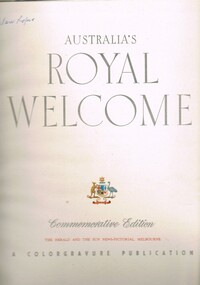
Book - Non Fiction History, Australia's Royal Welcome 1954, circa 1954
... party at Buckingham Palace representing the local CWA. She has purchased this book and therefore giving this a close historical significance connection, it has good provenance and interpretive capacity. 1954 royal tour queen elizabeth ii monarchy british empire in the 1900s god save the queen. Third page has free hand penned signature "Clare Roper" This hard(blue coloured) covered book contains thirty six double sided pages. Both the first and last pages (inside cover included) has the royal crest of Australia (kangaroo and emu) balancing the individual six states crests ,united ...This publication covers the mid 1900s and relates to a period where the majority of the Australian population was engrossed with the Queen of Australia, even though her Highness did not reside on this continent. The period covered was before the great immigration insurgence from Europe.The Labour Party's "White Australian" policy was a hinderance and a barrier towards the Asian and African prospective immigrants. The motto Queen and Country was still very ingrained in the rural population. This period in Australian domestic self reliance, brought about the growing strength and very active trade union movement and their staunch support for the Tariff protection against a growing swell of imported goods. This self reliance psyche was essentially a by product of World War II, and the isolation felt by the Australian People. The Queen (royalty) was the binding force holding the British Empire together which was emphasised with her popularity when touring Australia Queen Elizabeth's visited the MCG twice in 1954 1. to attend an assembly of ex-servicemen and women's organisations 2. to attend a Children's Display. She also visited Government House and visited Country Victoria on the Royal train from 24th Feb - 9th March.The Kiewa Valley and all the rural areas in the region were still very much tied to the "mother land" and trade between Britain and Australia was very strong. Trade with Asian manufacturers was minimal and needed the late 1900s to see both the trade and immigration barriers fall. This book was produced during a time when the majority of Australians looked more to England for trade and companionship. The agricultural trade with England and Europe was very high and the motto of the time was "Australia grows on the sheep's back". Late 1900's saw the motto "Australia grows on the miner's back" The Queen was still very popular then which was emphasised by the large crowds which greeted her on tour. Residents of Mt Beauty including Cubs, Brownies, Scouts and Guides travelled to Benalla to see the Queen. Clare Roper was a founding member of the KVHS and attended a garden party at Buckingham Palace representing the local CWA. She has purchased this book and therefore giving this a close historical significance connection, it has good provenance and interpretive capacity. This hard(blue coloured) covered book contains thirty six double sided pages. Both the first and last pages (inside cover included) has the royal crest of Australia (kangaroo and emu) balancing the individual six states crests ,united under the royal crown. The first six double pages, each portraying a coloured free hand sketches of various Australian scenery enclosing the Queen's day by day and State by State itinerary. There are 115 black and white photographs and 25 coloured photographs contained in this book.Third page has free hand penned signature "Clare Roper"1954 royal tour, queen elizabeth ii monarchy, british empire in the 1900s, god save the queen. -
 Bendigo Military Museum
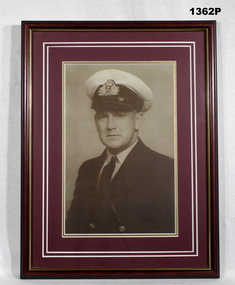
Photograph - PHOTOGRAPH, FRAMED
... Party” as a Sub Lieut. Embarcation dates are not listed but it appears he was in New Guinea in 1944 - 45. He was awarded the DSC for “Bravery and Enterprise in Recconnaisance Operations” on 16.2.1945. Appointment terminated in the RANVR on 8.1.1946. (SWPA) South West Pacific Area. (RANVR) Royal Australian Navy Volunteer Reserve. (DSC) Distinguished Service Cross. Refer Book 46. photography - photographs frame accessories military history - navy united ...Kenneth William Tweeddale BRIDGE DSC. Pre WW2 Kenneth worked in New Guinea from 1929 to 1941 as a Patrol Officer and then Assistant District Officer. He enlisted in the 2nd AIF No VX7794 on 10.3.1942 age 34 years 5 months. Initially posted too 3rd F.A Regt he was appointed A/Lieut on 26.5.1942 in “Z Special Unit”. Embarked for service in Aust mandated territory (NG) 31.8.1942, alloted to “M” Special Unit SWPA 7.5.1943, returned from special duties 11.9.1943, transferred to the retired list 8.10.1943. He was awarded by the U.S the “Legion of Merit” (Degree of Legionairre) for his work between Nov 1942 - July 1943 in the Sambare River and Salamaua area. He then joined the RANVR on 9.10.1943 in Intelligence and allotted to “Ferdinand Party” as a Sub Lieut. Embarcation dates are not listed but it appears he was in New Guinea in 1944 - 45. He was awarded the DSC for “Bravery and Enterprise in Recconnaisance Operations” on 16.2.1945. Appointment terminated in the RANVR on 8.1.1946. (SWPA) South West Pacific Area. (RANVR) Royal Australian Navy Volunteer Reserve. (DSC) Distinguished Service Cross. Refer Book 46.Brown plastic frame, gold trim, glass front, brown paper backing. Sepia photo, head & shoulders, peaked cap with white top, mounted with maroon border.On back: Sub Lieutenant KENNETH W T BRIDGE DSC, Legion of Merit (US) RANVR - Coastwatcher, photography - photographs, frame accessories, military history - navy, united states -
 Bendigo Historical Society Inc.
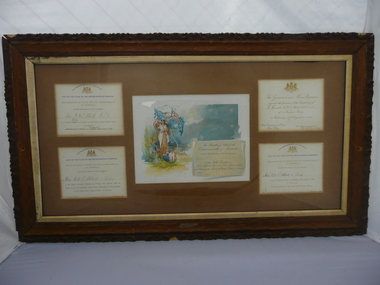
Document - R.H.ABBOTT. INVITATIONS. 1908, 1908
... Australia request the pleasure of the company of R.H.S. Abbott at the public reception of Rear Admiral Sperry and the officers, sailors, & marines of the fleet of the united states of America. Sydney. August 1908. 2. Invitations to a theatre parties...Australia request the pleasure of the company of R.H.S. Abbott at the public reception of Rear Admiral Sperry and the officers, sailors, & marines of the fleet of the united states of America. Sydney. August 1908. 2. Invitations to a theatre parties ...5 Invitation cards in a display. 1. The ministers of state for the commonwealth of Australia request the pleasure of the company of R.H.S. Abbott at the public reception of Rear Admiral Sperry and the officers, sailors, & marines of the fleet of the united states of America. Sydney. August 1908. 2. Invitations to a theatre parties. Tuesday 25th August 1908. 3. Invitation to Public Reception. Friday 21st August. 1908. 4. Invitation to garden party. State government house. Rose Bay. Wednesday. 26th August 1980 at 3pm. 5. Invitation to Naval & Military review. Monday 24th August 1908 at centennial park. Deframed 2022document, invitations, receptions -
 National Vietnam Veterans Museum (NVVM)
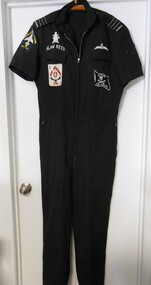
Uniform - Uniform, RAAF, Party Suit
... United States Distinguished Flying Cross with oak leaf cluster. His final rank with the Air Force was Air Vice Marshal and his last posting was with Headquarters, Australian Force Vietnam (RAAF Element) Alan Reed United States Air Force Air pilots Royal Australian Air Force Squadron Leader Air Vice Marshall Allan Reed Squadron Leader Alan Reed Pilot Headquarters Australian Force Vietnam RAAF Element 12th Tactical Reconnaissance Squadron Officer of the Order of Australia AO United States Distinguished Flying Cross 052363 White embroidered RAAF Brevet on left breast."Phan" A black one piece Dining Suit (party ...Squadron Leader Alan Reed from the Royal Australian Air Force 052363 served in Vietnam from 26 May 1968 until 20 November 1968. He spent most of his tour detached to the 12th Tactical Reconnaissance Squadron, US Air Force. He was made an Officer of the Order of Australia (AO) in June 1989 for his service to the RAAF as Air Officer Commanding, Support Command. For his service with the USAF, Alan Reed was awarded the United States Distinguished Flying Cross with oak leaf cluster. His final rank with the Air Force was Air Vice Marshal and his last posting was with Headquarters, Australian Force Vietnam (RAAF Element) A black one piece Dining Suit (party suit) similar in style to a short sleeve Flying Suit, with zippered front and pockets, bearing Squadron Leader epaulettes worn by the then Squadron Leader Alan Reed whilst serving in Vietnam in 1968. It has a white embroidered RAAF brevet on the left chest, with a "Phamous Phantom Spook" (82 Wing RAAF F4E) caricature above the embroidered name ALAN REED on the right chest. Three additional embroidered patches are attached to the suit (RF-4C, 100 Missions Vietnam and Aussie Air Pirate) two on the chest and one on the left sleeve.White embroidered RAAF Brevet on left breast."Phan"alan reed, united states air force, air pilots, royal australian air force, squadron leader, air vice marshall allan reed, squadron leader alan reed, pilot, headquarters, australian force vietnam, raaf element, 12th tactical reconnaissance squadron, officer of the order of australia, ao, united states distinguished flying cross, 052363 -
 Narre Warren and District Family History Group
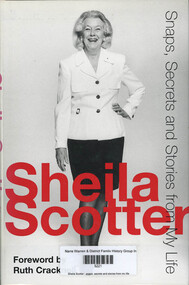
Book, Sheila Scotter, Sheila Scotter : snaps, secrets and stories from my life, 1998
... Australia's doyennes of style. For Sheila Scotter's seventeenth birthday her parents put on a 'coming out ball' in the United Services Club in Calcutta, where they lived at the time. The teenager wore a pale turquoise silk taffeta ball gown. Sheila no longer remembers what happened to that dress, but she does know that it is responsible for the black-and-white wardrobe that has been her hallmark ever since, with the exception of one occasion and one occasion only. For her seventieth birthday party ...There is no other store like David Jones... and there is no other consultant like Sheila Scotter! Known variously as the Kangaroo editor (by Diana Vreeland), the black and white lady from Albert Park, and the Silver Duchess, this is the autobiography, scrapbook-style, of one of Australia's doyennes of style. For Sheila Scotter's seventeenth birthday her parents put on a 'coming out ball' in the United Services Club in Calcutta, where they lived at the time. The teenager wore a pale turquoise silk taffeta ball gown. Sheila no longer remembers what happened to that dress, but she does know that it is responsible for the black-and-white wardrobe that has been her hallmark ever since, with the exception of one occasion and one occasion only. For her seventieth birthday party, close friend John Truscott conned her into wearing red, insisting that the theme for the event was all red. And what did the guests all wear? Black and white! This anecdote lite, stylish, idiosyncratic is typical of the many that make up Sheila Scotter's autobiographical assortment. Most Australian women know Sheila Scotter through her Women's Weekly column 'Sheila Scotter Suggests' which ran between 1975 and 1980 and totalled some 235 instalments. The fact that this column is still vividly remembered 17 years later attests to the sacred place it held in every Australian household. A feminist before the word was invented, Sheila has had a formidable career. Two chapters are devoted to her career in fashion, including her time as the editor-in-chief of Vogue and founding editor of Vogue Living. The art of fundraising is also treated in some depth. In snippets, we hear of her love of cricket (which she once played); we find out how she came to live in Australia in the first place and why she has made Melbourne her home. Not surprisingly, the book reflects the personal contradictoriness of its author/subject on the one hand an aristocrat, on the other a rogue who does not respect rank; blithely mixing innate feminism with blatant coquettishness; outrageous yet scrupulously stylish; in the know yet discrete; courting notoriety while at the same time needing solitude a Like all celebrity autobiographers Sheila reserves her right to privacy while basking in the limelight. But she has used this book to set the record straight on a number of issues, including why she left Vogue, her many romantic involvements, her much-publicised spat with socialite Lillian Frank, and what was wrong with David Jones, to whom she consulted during 1994-95. The book contains the expected wining, dining and partying, as well as the inside story on some recent scandals. Sheila Scotter is glamorous and alluring, a forthright mover and shaker who inspires fear in some, awe and respect in others, and admiration and loyalty in most. No matter what you think of her, you simply cannot ignore her. Friends and enemies alike are awaiting this book with bated breath for one reason: when Sheila Scotter speaks, people listen. Contents Foreword (by Ruth Cracknell, a personal friend) Before I Begin a (explaining the rationale for the book) 1 Thursday's Child (birthdays) 2 Christmases to Remember 3 In Fashion (career in fashion) 4 A Matter of Style (Vogue Living and its influence) 5 Marriage and Other Liaisons 6 A Mixed Salad of Letters (letters, personal and business, from prominent people) 7 Fundraising: Are Committees Really Necessary? 8 Loved Ones Departed (or Why I Envy the Angels) 9 Disappointments and Other Disasters (scandals and inside stories) 10 London, Paris, Sydney, Melbourne (the places she has lived) 11 Not the Last Instalment (a look ahead) Postscript (a tribute to some special men read between the lines) Source: Publisher253 p.; 25 cmnon-fictionThere is no other store like David Jones... and there is no other consultant like Sheila Scotter! Known variously as the Kangaroo editor (by Diana Vreeland), the black and white lady from Albert Park, and the Silver Duchess, this is the autobiography, scrapbook-style, of one of Australia's doyennes of style. For Sheila Scotter's seventeenth birthday her parents put on a 'coming out ball' in the United Services Club in Calcutta, where they lived at the time. The teenager wore a pale turquoise silk taffeta ball gown. Sheila no longer remembers what happened to that dress, but she does know that it is responsible for the black-and-white wardrobe that has been her hallmark ever since, with the exception of one occasion and one occasion only. For her seventieth birthday party, close friend John Truscott conned her into wearing red, insisting that the theme for the event was all red. And what did the guests all wear? Black and white! This anecdote lite, stylish, idiosyncratic is typical of the many that make up Sheila Scotter's autobiographical assortment. Most Australian women know Sheila Scotter through her Women's Weekly column 'Sheila Scotter Suggests' which ran between 1975 and 1980 and totalled some 235 instalments. The fact that this column is still vividly remembered 17 years later attests to the sacred place it held in every Australian household. A feminist before the word was invented, Sheila has had a formidable career. Two chapters are devoted to her career in fashion, including her time as the editor-in-chief of Vogue and founding editor of Vogue Living. The art of fundraising is also treated in some depth. In snippets, we hear of her love of cricket (which she once played); we find out how she came to live in Australia in the first place and why she has made Melbourne her home. Not surprisingly, the book reflects the personal contradictoriness of its author/subject on the one hand an aristocrat, on the other a rogue who does not respect rank; blithely mixing innate feminism with blatant coquettishness; outrageous yet scrupulously stylish; in the know yet discrete; courting notoriety while at the same time needing solitude a Like all celebrity autobiographers Sheila reserves her right to privacy while basking in the limelight. But she has used this book to set the record straight on a number of issues, including why she left Vogue, her many romantic involvements, her much-publicised spat with socialite Lillian Frank, and what was wrong with David Jones, to whom she consulted during 1994-95. The book contains the expected wining, dining and partying, as well as the inside story on some recent scandals. Sheila Scotter is glamorous and alluring, a forthright mover and shaker who inspires fear in some, awe and respect in others, and admiration and loyalty in most. No matter what you think of her, you simply cannot ignore her. Friends and enemies alike are awaiting this book with bated breath for one reason: when Sheila Scotter speaks, people listen. Contents Foreword (by Ruth Cracknell, a personal friend) Before I Begin a (explaining the rationale for the book) 1 Thursday's Child (birthdays) 2 Christmases to Remember 3 In Fashion (career in fashion) 4 A Matter of Style (Vogue Living and its influence) 5 Marriage and Other Liaisons 6 A Mixed Salad of Letters (letters, personal and business, from prominent people) 7 Fundraising: Are Committees Really Necessary? 8 Loved Ones Departed (or Why I Envy the Angels) 9 Disappointments and Other Disasters (scandals and inside stories) 10 London, Paris, Sydney, Melbourne (the places she has lived) 11 Not the Last Instalment (a look ahead) Postscript (a tribute to some special men read between the lines) Source: Publishersheila scotter, fashion -
Glen Eira Historical Society
Article - Attwood Family
... Horse Troughs Horse Drawn Vehicle Taxis Board Roy Buick Cars Charleston’s Bakery Carnegie Rosstown Hotel Corum’s Dairy Kangaroo Road Reids Dairy Dalny Road Reid Shaver Racehorses Cove’s Dairy Wilson Street Police Murrumbeena Police Station Dunoon Street Murrumbeena Park Footballers Gangs Liberal Party Labour Party United Australian Party UAP Woodland Alec Liquor Shops Johnson Suzanne Singers Taylor Squizzy Boyd Family Artists Criminals Skase Christopher Skase Charles Sunaria Competition Herald and Weekly Times Ralph J.W. ...Two items about the Attwood Family: A seventeen page computer typed copy of the memories of John Attwood, compiled by Colin Smith in January 2002. Includes memories of his childhood, contact and impressions of local identities including Merric Boyd and others; the retailers and business owners in the Murrumbeena area, the trains and railway stations, picture theatres and other businesses. A photocopy of an article taken from the Herald Sun newspaper 06/11/2007. Myra Attwood, wife of John, local business person in Murrumbeena Newsagency; includes brief local history of family and Myra’s personal hobbies, till the time of her death. Also a newspaper clipping of her death notice, unknown source and date.emily street, murrumbeena, elsternwick, railway stations, signal boxes, beena avenue, murrumbeena state school, primary schools, attwood john, attwood myra, attwood rhonda, attwood colin, attwood warren, attwood murray, attwood janine, attwood susan, attwood michael, attwood greg, attwood gerard, black bridge, outer circle railway, murrumbeena newsagency, newsagents, murrumbeena railway station, railway stations, book binders, stevens alf, sykes harold, attwood motors, neerim road, boyd merric, boyd mrs., timber houses, outbuildings, artists, trains, car parks, christie’s woodyard, ferguson cam, railway accidents, ardyne street, north road, dalny road, brett street, barnes family, newspapers, roads and streets, soils, flower growing, market gardens, world war 1939-1945, land subdivisions, air raid precautions, bicycles, drawing, springthorpe park, mass media, murrumbeena shopping centre, butcher shops, grocer shops, green grocers, shoe shops, confectionary shops, barber shops, beck george, bowyer ralph, rennie bill, bookmakers, presbyterian church, methodist church, hanna’s milk bar, sunday school, woodland bill, ssw grocery chain, drays, woodland alec, lee ron, jewellers, bakeries, fish shops, dressmakers, delicatessens, east bentleigh, selkrigs family, pottery, heads’ garage, head lindsay, head doug, head clarry, head ron, murrumbeena road, car retailers, petrol pumps, motor vehicle repair shops, billy one motors, bird mr., real estate agents, w.b. tonks and company, sparrow mr., pidgeon mr., hardware stores, florist shops, murrumbeena post office, tile shops, gardens, murrumbeena chamber of commerce, kiosks, gardeners, carnegie citizens band, spurway nursing home, argosy theatre, cinemas, dance halls, the capri, theatre groups, caulfield council, the blowfly train service, billiard rooms, printers, hammond olsen and company, l.j. miles and company, moody’s real estate agency, paddocks, flats, es&a bank murrumbeena, esanda bank murrumbeena, state savings bank murrumbeena, commonwealth bank murrumbeena, fuel merchants, hobart road, golden fleece service station, quince’s buses, bus services, ardyne street, timber yard, gow mr., railway parade, shell service station, pharmecies, house miss, bicycle shops, barnhill les mr., fliner mr., boot makers, widdop peter, moran and cato’s, grocers, pizza shop, car yards, classic caravan, o’brien kevin, wrought iron work, williams mr., candle making factory, lights, power tom, gates, fences, whitelaw monier tiles, whitelaw bill, hanna rex, dandenong road, cumloden grammar school, independent schools, emmaus rest house, oakdene, house names, taranto bob, hanson cab service, billy one motors, grey mr., horse troughs, horse drawn vehicle, taxis, board roy, buick cars, charleston’s bakery, carnegie, rosstown hotel, corum’s dairy, kangaroo road, reids dairy, dalny road, reid shaver, racehorses, cove’s dairy, wilson street, police, murrumbeena police station, dunoon street, murrumbeena park, footballers, gangs, liberal party, labour party, united australian party, uap, woodland alec, liquor shops, johnson suzanne, singers, taylor squizzy, boyd family, artists, criminals, skase christopher, skase charles, sunaria competition, herald and weekly times, ralph j.w., j.h. ralph butchers, butcher shops, pennington gardens, home units, flats, schrape frank, builder, smith colin, mansions, death registers, hockley myra, esperanto, book keepers, accountants, solicitors -
 Sunshine and District Historical Society Incorporated
Film - City of Sunshine Mayor Cr. George Parnis Video, John Willaton, 1994
... Australian Citizenship Ceremony and Supper gathering. Council Function 4th November. Recognition to members of the Sunshine Ladies Benevolent Association after its disbandment in 1993. Sunshine Private Nursing Home tour 19th November 1993. Mytle's 100th Year Birthday party. Sunshine Festival Street Parade 20th November 1993. Sunshine City Band, Sunshine and District Historical Society, 1st Sunshine Scout Group, Pilipino Cultural Group. Carols By Candlelight Christmas celebrations 19th December 1993 R. T. Pollard Gardens Corio Street. Selwyn Park 24th December 1993 Sunshine United ...George Zachary Parnis migrated to Melbourne from Malta in 1964, arriving with his brother Manny. George was 19 years old at the time. The family later became well-established in Melbourne’s western suburbs. George Zachary Parnis became a councillor of the former City of Sunshine (Victoria), active in local government before the council’s amalgamation in 1995. He was the Mayor of City of Sunshine for one term 1993 - 1994. This video records Mayor Cr. George Parnis term of being the Mayor of the City of Sunshine. The video also captures the role of the City of Sunshine Town Clerk Mr. John Willaton performing his public civic duties.This video provides a rare recording of City of Sunshine Mayor Cr. George Zachery's term in office. The video also contains rare scenes of Sunshine's Hampshire Road, Devonshire Road and including many images of Sunshine residents. Swearing in of the 1993 City of Sunshine Councillors. Election of 1993 - 1994 Mayor Cr. George Parnis. Mayor Cr. George Parnis maiden speech, after party gathering, speeches and toast. Gift given to former Cr. Marion Marton for her term as mayor 1992 - 1993. Council Meeting 31st August 1993. Gifts to retired Councillors Marion Martin and Charles Sidmore. Mayoral office scene. Council Meeting 22nd September 1993. Swearing in the new Councillors, Australian Citizenship Ceremony and Supper gathering. Council Function 4th November. Recognition to members of the Sunshine Ladies Benevolent Association after its disbandment in 1993. Sunshine Private Nursing Home tour 19th November 1993. Mytle's 100th Year Birthday party. Sunshine Festival Street Parade 20th November 1993. Sunshine City Band, Sunshine and District Historical Society, 1st Sunshine Scout Group, Pilipino Cultural Group. Carols By Candlelight Christmas celebrations 19th December 1993 R. T. Pollard Gardens Corio Street. Selwyn Park 24th December 1993 Sunshine United Cricket Club Christmas Party. Mayoral presentation 23rd January 1994 to Rick and Eva Cramere of the Friends of the Kororoit Creek for the establishment of Buckingham Reserve. Australian Citizenship Ceremony 28th January 1994, one held in a shopping centre and one in the Council Chambers. Maribyrnong and Maidstone RSL 17th April 1994 ANZAC Service. Robert Bruce Reserve Sports Albanvale Football Club and Albion Cricket Club Rooms 16th July 1994 opening function.Sunshine District Historical Society Mayor 1993 - 94 Cr. G. Parnis This video has been digitised.city of sunshine, maribyrnong maidstone rsl, marion martin, john willaton, george zachary parnis, charles sidmore, sunshine ladies benevolent association, gwen goedecke, sunshine private nursing home, sunshine city band, sunshine salvation army, selwyn park, friends of the kororoit creek, buckingham reserve, eva cramere, rick cramere, albanvale football club, john hyett, albion cricket club -
 Uniting Church Archives - Synod of Victoria
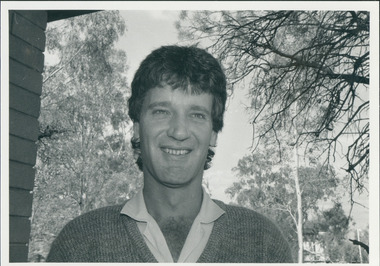
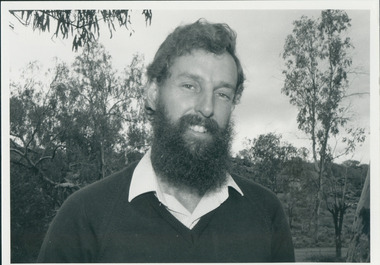
Photograph, St Philip's College Alice Springs - Principal Chris Tudor & Deputy Principal Chris Eldridge, 09/1986
... Australian Inland Mission, lobbied the United Church in the Northern Territory to build and expand on this important start. Together the Presbyterian, Methodist and Congregational churches embarked on a missionary venture to develop St Philip's College - a new, larger residential hostel which would one day become a full boarding school. An ideal site - 22 acres of bush at the junction of the Charles and Todd Rivers and backing on to the Telegraph Station National Park - was secured and after six years of planning, construction began in 1964. Fred McKay led the legendary work parties...Australian Inland Mission, lobbied the United Church in the Northern Territory to build and expand on this important start. Together the Presbyterian, Methodist and Congregational churches embarked on a missionary venture to develop St Philip's College - a new, larger residential hostel which would one day become a full boarding school. An ideal site - 22 acres of bush at the junction of the Charles and Todd Rivers and backing on to the Telegraph Station National Park - was secured and after six years of planning, construction began in 1964. Fred McKay led the legendary work parties ...In 1945 the Reverend Harry Griffiths, who worked for the Methodist Inland Mission in Alice Springs, saw the need for a boarding facility for children of families living in remote areas in Central Australia who needed access to schools. He and his wife established Griffiths House, on a site in the town centre, and for many years it became home for students from all over the Outback, including many young Aboriginal people. In the late 1950's the Rev Fred McKay, successor to the Rev John Flynn as Superintendent of the Australian Inland Mission, lobbied the United Church in the Northern Territory to build and expand on this important start. Together the Presbyterian, Methodist and Congregational churches embarked on a missionary venture to develop St Philip's College - a new, larger residential hostel which would one day become a full boarding school. An ideal site - 22 acres of bush at the junction of the Charles and Todd Rivers and backing on to the Telegraph Station National Park - was secured and after six years of planning, construction began in 1964. Fred McKay led the legendary work parties comprised of volunteers from all over Australia who travelled to Alice Springs, paying their own way and volunteering their expertise, time and labour, to turn a dream into a reality. This fantastic tradition continues today, with work parties arriving each mid-year holiday. On 13 February 1965 the first boarders moved in to St Philip's College. For the first 24 years, therefore, St Philip's College operated as a residential hostel only. The College’s ninth Headmaster, Mr Christopher Tudor, arrived in 1986. He and the Council Chairman, Mrs Jan Heaslip, judged that the time was right to complete the original plan to turn St Philip’s College into a fully fledged independent boarding/day school, serving not only “bush” families, but also the growing population of Alice Springs. The then College Council embraced the idea and three years of frantic, determined preparation and planning commenced, culminating in an extensive $2 million building program in 1988. To this day there continues to be further development with the new landscaping underway near The Minnamurra Hall, Reception and Rivergum Cafe, plus the recent completion of the Science & Food Technology building and the new Rivergum Cafe.Head & Shoulders of Chris Eldridgest. philip's college, tudor, chris, eldridge, chris -
 Uniting Church Archives - Synod of Victoria
Photograph, St Philip's College Alice Springs - Principal Chris Tudor & Deputy Principal Chris Eldridge, 09/1986
... Australian Inland Mission, lobbied the United Church in the Northern Territory to build and expand on this important start. Together the Presbyterian, Methodist and Congregational churches embarked on a missionary venture to develop St Philip's College - a new, larger residential hostel which would one day become a full boarding school. An ideal site - 22 acres of bush at the junction of the Charles and Todd Rivers and backing on to the Telegraph Station National Park - was secured and after six years of planning, construction began in 1964. Fred McKay led the legendary work parties...Australian Inland Mission, lobbied the United Church in the Northern Territory to build and expand on this important start. Together the Presbyterian, Methodist and Congregational churches embarked on a missionary venture to develop St Philip's College - a new, larger residential hostel which would one day become a full boarding school. An ideal site - 22 acres of bush at the junction of the Charles and Todd Rivers and backing on to the Telegraph Station National Park - was secured and after six years of planning, construction began in 1964. Fred McKay led the legendary work parties ...In 1945 the Reverend Harry Griffiths, who worked for the Methodist Inland Mission in Alice Springs, saw the need for a boarding facility for children of families living in remote areas in Central Australia who needed access to schools. He and his wife established Griffiths House, on a site in the town centre, and for many years it became home for students from all over the Outback, including many young Aboriginal people. In the late 1950's the Rev Fred McKay, successor to the Rev John Flynn as Superintendent of the Australian Inland Mission, lobbied the United Church in the Northern Territory to build and expand on this important start. Together the Presbyterian, Methodist and Congregational churches embarked on a missionary venture to develop St Philip's College - a new, larger residential hostel which would one day become a full boarding school. An ideal site - 22 acres of bush at the junction of the Charles and Todd Rivers and backing on to the Telegraph Station National Park - was secured and after six years of planning, construction began in 1964. Fred McKay led the legendary work parties comprised of volunteers from all over Australia who travelled to Alice Springs, paying their own way and volunteering their expertise, time and labour, to turn a dream into a reality. This fantastic tradition continues today, with work parties arriving each mid-year holiday. On 13 February 1965 the first boarders moved in to St Philip's College. For the first 24 years, therefore, St Philip's College operated as a residential hostel only. The College’s ninth Headmaster, Mr Christopher Tudor, arrived in 1986. He and the Council Chairman, Mrs Jan Heaslip, judged that the time was right to complete the original plan to turn St Philip’s College into a fully fledged independent boarding/day school, serving not only “bush” families, but also the growing population of Alice Springs. The then College Council embraced the idea and three years of frantic, determined preparation and planning commenced, culminating in an extensive $2 million building program in 1988. To this day there continues to be further development with the new landscaping underway near The Minnamurra Hall, Reception and Rivergum Cafe, plus the recent completion of the Science & Food Technology building and the new Rivergum Cafe.Head & Shoulders of Chris Tudor.st. philip's college, tudor, chris, eldridge, chris -
 Uniting Church Archives - Synod of Victoria
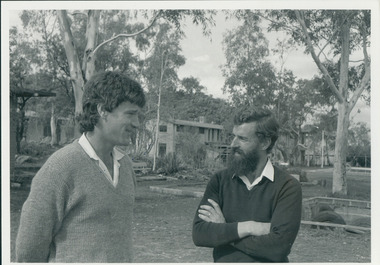
Photograph, St Philip's College Alice Springs - Principal Chris Tudor & Deputy Principal Chris Eldridge, 09/1986
... Australian Inland Mission, lobbied the United Church in the Northern Territory to build and expand on this important start. Together the Presbyterian, Methodist and Congregational churches embarked on a missionary venture to develop St Philip's College - a new, larger residential hostel which would one day become a full boarding school. An ideal site - 22 acres of bush at the junction of the Charles and Todd Rivers and backing on to the Telegraph Station National Park - was secured and after six years of planning, construction began in 1964. Fred McKay led the legendary work parties...Australian Inland Mission, lobbied the United Church in the Northern Territory to build and expand on this important start. Together the Presbyterian, Methodist and Congregational churches embarked on a missionary venture to develop St Philip's College - a new, larger residential hostel which would one day become a full boarding school. An ideal site - 22 acres of bush at the junction of the Charles and Todd Rivers and backing on to the Telegraph Station National Park - was secured and after six years of planning, construction began in 1964. Fred McKay led the legendary work parties ...In 1945 the Reverend Harry Griffiths, who worked for the Methodist Inland Mission in Alice Springs, saw the need for a boarding facility for children of families living in remote areas in Central Australia who needed access to schools. He and his wife established Griffiths House, on a site in the town centre, and for many years it became home for students from all over the Outback, including many young Aboriginal people. In the late 1950's the Rev Fred McKay, successor to the Rev John Flynn as Superintendent of the Australian Inland Mission, lobbied the United Church in the Northern Territory to build and expand on this important start. Together the Presbyterian, Methodist and Congregational churches embarked on a missionary venture to develop St Philip's College - a new, larger residential hostel which would one day become a full boarding school. An ideal site - 22 acres of bush at the junction of the Charles and Todd Rivers and backing on to the Telegraph Station National Park - was secured and after six years of planning, construction began in 1964. Fred McKay led the legendary work parties comprised of volunteers from all over Australia who travelled to Alice Springs, paying their own way and volunteering their expertise, time and labour, to turn a dream into a reality. This fantastic tradition continues today, with work parties arriving each mid-year holiday. On 13 February 1965 the first boarders moved in to St Philip's College. For the first 24 years, therefore, St Philip's College operated as a residential hostel only. The College’s ninth Headmaster, Mr Christopher Tudor, arrived in 1986. He and the Council Chairman, Mrs Jan Heaslip, judged that the time was right to complete the original plan to turn St Philip’s College into a fully fledged independent boarding/day school, serving not only “bush” families, but also the growing population of Alice Springs. The then College Council embraced the idea and three years of frantic, determined preparation and planning commenced, culminating in an extensive $2 million building program in 1988. To this day there continues to be further development with the new landscaping underway near The Minnamurra Hall, Reception and Rivergum Cafe, plus the recent completion of the Science & Food Technology building and the new Rivergum Cafe.Tudor and Eldridge in conversation with the College in the background.st. philip's college, tudor, chris, eldridge, chris -
 Uniting Church Archives - Synod of Victoria
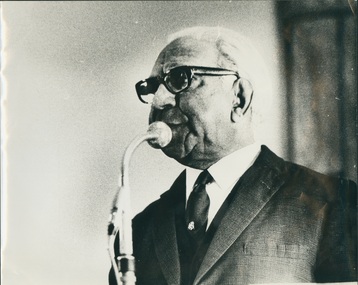
B&W photo of another photo or newspaper photograph of Pastor Sir Douglas Nicholls, Undated
... Party of Australia. This association attracted the attention of the Australian Security Intelligence Organization, which in 1957 began to keep a file on Nicholls. In May 1957 Nicholls formed the Victorian Aborigines Advancement League with Doris Blackburn and Gordon Bryant, a Federal parliamentarian. As its paid field officer and spokesman, Nicholls contested assimilation policies and used film to raise awareness of issues. When the Welfare Board attempted to close Lake Tyers reserve, Gippsland, he resigned in disgust and led a protest march on parliament in May 1963. The AAL also petitioned the United...Party of Australia. This association attracted the attention of the Australian Security Intelligence Organization, which in 1957 began to keep a file on Nicholls. In May 1957 Nicholls formed the Victorian Aborigines Advancement League with Doris Blackburn and Gordon Bryant, a Federal parliamentarian. As its paid field officer and spokesman, Nicholls contested assimilation policies and used film to raise awareness of issues. When the Welfare Board attempted to close Lake Tyers reserve, Gippsland, he resigned in disgust and led a protest march on parliament in May 1963. The AAL also petitioned the United ...Sir Douglas Ralph Nicholls (1906-1988), footballer, pastor, activist and governor, was born on 9 December 1906 at Cummeragunja Aboriginal mission, New South Wales, fifth child of Herbert Nicholls, seasonal worker, and his wife Florence, née Atkinson. Doug grew up at Cummeragunja, on the Murray River near Barmah, in its golden years of Aboriginal autonomy. Thomas Shadrach James gave him and other Yorta Yorta children a sound primary education, reinforcing the pride and self-assurance gained from their parents. As Doug grew, so too did the powers of the State’s Aboriginal Protection Board. Doug’s elder sister Hilda was removed about 1915. When Doug reached 14, he was moved off under the Aborigines Protection Act (1909) to find work. He took a job with dredging teams constructing levees on the Murray. Like other youths in the region Nicholls played Australian rules football, emulating kinsmen who had won local premierships since the 1890s. Doug and his brother Herbert (‘Dowie’) played with Tongala in the mid-1920s. Melbourne football beckoned, Doug trying out unsuccessfully for Carlton in 1927. He signed with the Northcote Victorian Football Association team, despite his nervousness about his Aboriginality, and was given a job with Northcote City Council. ‘Dowie’ joined him for a season. Doug was short at 5 ft 2 ins (158 cm), but muscular and lightning fast. He competed regularly during a boom in professional running, winning many heat and place prizes. In 1929 he won the Nyah and Warracknabeal gifts, earning a sash and £100 in each, together with a case of cutlery in the latter. Using his speed on the wing for Northcote, he produced great spring and agility from his compact body. The Sporting Globe reported in 1929 that ‘he flashes through packs of big men, whisks around small men . . . and attempts marks at the back of any six-footer’. In front-on clashes he was flattened only to rise again. The sole Aborigine in the VFA, he was known affectionately as the ‘flying Abo’ but called worse by his opponents’ barrackers. He competed for five seasons, being named ‘best and fairest’ twice, appearing in three association grand finals and winning in 1929. Keen to earn more than a seasonal wage, in 1931 Nicholls accepted a three-year contract with Jimmy Sharman’s travelling boxing show. The bouts matched opposites, local against tent boxer, white against black, and sometimes men of different sizes. He faced stiff competition from those who wanted to best the noted Melbourne black footballer, the crowd adding racial abuse. A far better footballer than boxer, he copped some punishment. Fighting in the Melbourne Stadium in December 1931, he was described by Truth as ‘slow and awkward’, but packing a ‘good wallop’. In 1932 Sharman, who treated his boxers fairly, released Nicholls to join the Fitzroy Victorian Football League team, which agreed to employ him as its groundsman. He played fifty-four games for Fitzroy over six seasons until knee trouble forced him out in 1937. Winning cups in 1934 and 1935, he played alongside Haydn Bunton and Wilfred (‘Chicken’) Smallhorn. Grand finals eluded him but he represented Victoria twice. Following his mother’s death, Nicholls revisited the Church of Christ chapel in Northcote, where they had worshipped together. On 17 July 1932 he experienced a conversion. He was soon baptised and witnessed openly, leading his fellow footballers to occasional church parades. Nicholls exhibited leadership qualities. William Cooper, founder of the Australian Aborigines’ League and Nicholls’ Yorta Yorta kinsman and fellow Christian, encouraged the young footballer. In February 1935 Cooper, Nicholls and others lobbied Thomas Paterson, the Commonwealth minister for the interior, over the need for Federal control of Aboriginal affairs. Nicholls attended the Day of Mourning protest for Aborigines held in Sydney on 26 January 1938, declaring: ‘after 150 years our people are still influenced and bossed by white people. I know we can proudly hold our own with others if given the chance’. When Cooper retired in November 1940 Nicholls became secretary of the AAL. On 2 June 1941 Nicholls enlisted in the Citizen Military Forces. He trained at Seymour and Bonegilla before being posted to the 29th Battalion. As Major Frank Corr’s batman, he was popular with other soldiers who tolerated his preaching and Bible reading. His army service was brief, however, and he was discharged in Melbourne on compassionate grounds on 22 January 1942. His biographer claimed that the Fitzroy police requested his return to mediate in the racial tensions developing between servicemen and the mostly respectable Aboriginal families living in crowded and dilapidated Fitzroy housing; Aboriginal people maintain that they requested his release. Nicholls began welfare work and religious services from an Aboriginal home in Gertrude Street, Fitzroy. In April 1942, ‘Dowie’ died of road accident trauma, leaving his wife, Gladys, née Bux, and three children. On 26 December 1942 at Moama Methodist Church, New South Wales, Nicholls married her, a caring gesture which developed into a loving partnership. In January 1943 he initiated ‘Aboriginal Sunday’, featuring a gum leaf orchestra and choir. By 1955 this service had moved to July and later evolved into National Aborigines and Islanders Day Observance Committee (NAIDOC) week. Ordained a Churches of Christ pastor in 1945, Nicholls conducted a vigorous ministry from a chapel in Gore Street, Fitzroy. His work survived on donations, a small honorarium, and his employment as team coach (1947) and curator at the Northcote Football Ground. In the 1950s Gladys established grocery and opportunity shops to earn income and provide services. Their house soon overflowed with people in need or visitors to Melbourne. Nicholls also hosted inspiring African American visitors such as the pianist Winifred Attwell and the singer Harry Belafonte. His ministry extended to Aboriginal country communities. Gladys taught Sunday school, undertook endless fund-raising and welfare work beside her husband, and became his greatest supporter and financial manager. They formed an Aboriginal Girls’ Hostel in 1956, for which they acted as house parents, and bought holiday units for Aborigines at Queenscliff. Persistently advocating Aboriginal rights, Nicholls protested about the impact of the Woomera rocket range on the people of the Warburton Ranges, co-ordinated the production of a concert, Out of the Dark, scripted by Jean Campbell, to rectify the omission of Aborigines from Victoria’s Commonwealth jubilee celebrations, and criticised the Victorian Aboriginal Protection Board. In 1957 when the board was transformed into the Aborigines’ Welfare Board, he and Harold Blair were appointed as Aboriginal representatives. Maintaining the stance of a political moderate, he did not bear grudges and sought to build bridges between black and white. He co-operated with any group that aided the cause, including the Council of Aboriginal Rights, whose executive were members of the Communist Party of Australia. This association attracted the attention of the Australian Security Intelligence Organization, which in 1957 began to keep a file on Nicholls. In May 1957 Nicholls formed the Victorian Aborigines Advancement League with Doris Blackburn and Gordon Bryant, a Federal parliamentarian. As its paid field officer and spokesman, Nicholls contested assimilation policies and used film to raise awareness of issues. When the Welfare Board attempted to close Lake Tyers reserve, Gippsland, he resigned in disgust and led a protest march on parliament in May 1963. The AAL also petitioned the United Nations on land rights in June, perhaps the first indigenous body to do so. He argued for new premises at 58 Cunningham Street, Northcote, opened in 1966 as the ‘Doug Nicholls Centre’. In 1958 Nicholls was a foundation member of the Federal Council for Aboriginal Advancement (Federal Council for the Advancement of Aboriginal and Torres Strait Islanders after 1964), which he served as national field officer (1961) and Victorian secretary (1962-63). While an innovator in tactics, he was alarmed by the influence of confrontational ‘black power’ politics in the AAL and resigned as a director amid turmoil on this issue in 1969, claiming the concept was a ‘bitter word’, not needed in Australia. Similar tensions in FCAATSI led him to join with Kath Walker (Oodgeroo Noonuccal) in establishing the short-lived National Tribal Council as an alternative forum. As the AAL leadership moderated their stance, he returned as president (1969-74) of the new all-Aboriginal organisation. He was also a keen patron of the National Aboriginal Sports Foundation, founded in 1969. Many honours were conferred on Nicholls: he was appointed MBE (1957) and OBE (1968) and knighted (1972). In 1962 he was named Victorian ‘Father of the Year’ and the State’s second Aboriginal justice of the peace. Crowned Melbourne’s 1973 King of Moomba, he was declared Bapu Mamus (a Torres Strait term for ‘headman’) by the NTC. On 1 December 1976 Sir Douglas was appointed Governor of South Australia, but his health deteriorated within weeks, making it difficult for him to perform his official duties. In March 1977 he hosted Queen Elizabeth during her royal tour and was appointed KCVO. He relinquished his governorship on 30 April 1977 following a stroke. Ill health continued to dog him during retirement, but he played his Nelson Eddy records, enjoyed his expanding family, and when able, ministered to the Aboriginal Church at the League’s premises. Sir Douglas Nicholls died on 4 June 1988 at Mooroopna, predeceased (1981) by his wife and survived by his five children. He was given a state funeral and buried in tribal ground at Cummeragunja cemetery. Among the many tributes to him are an oval at Northcote, handed to the AAL in 1982, a Canberra suburb gazetted in 1991, and a fellowship for Indigenous leadership established in 2003, all in his name, and a statue of Sir Doug and Lady Nicholls by Louis Laumen, unveiled in 2007 in Parliament Gardens, Melbourne. Sir Douglas Nicholls is shown speaking at a microphone; head and shoulders; dressed in a suit.Pastor Douglas Nicholls -
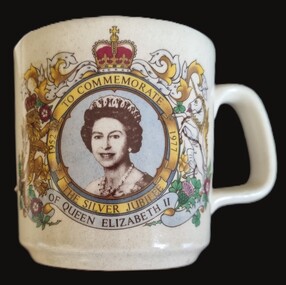 Wodonga & District Historical Society Inc
Souvenir - Mug Silver Jubilee of Queen Elizabeth II
... United Kingdom and the other Commonwealth realms on June 2nd 1953 at Westminster Abbey. Her Silver Jubilee was celebrated with large-scale parties and parades throughout the United Kingdom and the Commonwealth throughout 1977, culminating in June with the official "Jubilee Days", held to coincide with the Queen's Official Birthday. In addition Queen Elizabeth and Prince Philip embarked on a tour of Commonwealth nations including Australia...United Kingdom and the other Commonwealth realms on June 2nd 1953 at Westminster Abbey. Her Silver Jubilee was celebrated with large-scale parties and parades throughout the United Kingdom and the Commonwealth throughout 1977, culminating in June with the official "Jubilee Days", held to coincide with the Queen's Official Birthday. In addition Queen Elizabeth and Prince Philip embarked on a tour of Commonwealth nations including Australia ...Queen Elizabeth II ascended the throne, at the age of 25, on the death of her father King George VI on the 6th February 1952. Elizabeth was crowned as the Queen of the United Kingdom and the other Commonwealth realms on June 2nd 1953 at Westminster Abbey. Her Silver Jubilee was celebrated with large-scale parties and parades throughout the United Kingdom and the Commonwealth throughout 1977, culminating in June with the official "Jubilee Days", held to coincide with the Queen's Official Birthday. In addition Queen Elizabeth and Prince Philip embarked on a tour of Commonwealth nations including Australia. In March 1977, a Silver Jubilee Parade was held in front of Parliament House, Canberra. The Royal Australian Mint released a commemorative Silver Jubilee 50c coin, which featured twenty-five representations of St Edward's Crown. Two commemoratives stamps were released by Australia Post to celebrate the Jubilee. Australian artist Paul Fitzgerald was commissioned to complete the only official portrait of the Queen during the Silver Jubilee year. The Silver Jubilee celebrations culminated in December 1977 with 35,000 serving personnel taking part in parades across Australia.This item is significant because it records an important event in the British Royal Family, a vital part of the hereditary of many Wodonga residents. This item is a vintage ceramic commemorative mug produced to celebrate the 1977 Silver Jubilee of Queen Elizabeth II. It features a portrait of the Queen surrounded by royal iconography, including the crown, crests, and the text "To Commemorate The Silver Jubilee of Queen Elizabeth II". The reverse bears a decorative transfer. The centre features the British Royal Crown. Surrounding the crown are floral emblems representing the United Kingdom: the Tudor Rose (England), the Thistle (Scotland), and Shamrock (Ireland). TO COMMEMORATE THE SILVER JUBILLEE OF QUEEN ELIZABETH II 1952 1977queen elizabeth ii, royal memorabilia -
Unions Ballarat
The Colt from Kooyong: Andrew Peacock, a Political Biography (Don Woodward Collection), Schneider, Russell, 1981
... After leaving politics, Peacock became Australian Ambassador to the United States. Biographical and political (Liberal Party Australia). btlc ballarat trades hall ballarat trades and labour council leader of the opposition liberal party australia biography politics and government Book; 144 pages. ...Andrew Peacock was the member for Kooyong and at various times served as Leader of the (Liberal) Opposition. He served as a cabinet minister including the portfolio of Minister for Foreign Affairs. After leaving politics, Peacock became Australian Ambassador to the United States.Biographical and political (Liberal Party Australia).Book; 144 pages. Front cover: brown background with colour photograph of Andrew Peacock; yellow lettering; author's name and title.btlc, ballarat trades hall, ballarat trades and labour council, leader of the opposition, liberal party australia, biography, politics and government -
Unions Ballarat
Hockey: not your average Joe (Don Woodward Collection), King, Madonna, 2014
... Australia to the United States. The book also contains personal biographical detail. Material is drawn from interviews with Hockey and others. Political and biographical interest. btlc ballarat trades hall ballarat trades and labour council hockey, joe biography treasurers - federal politics and government cabinet ministers ambassadors and diplomats liberal party australia national party australia Book; 328 pages. ...Joe Hockey was Treasurer in the Abbott (Liberal Coalition) ministry. He also served in the Howard (Liberal Coalition) ministry. The book was written when he was still an MP and speculated upon whether he would ever become Prime Minister of Australia. However he is no longer in parliament and went on to become the Ambassador of Australia to the United States. The book also contains personal biographical detail. Material is drawn from interviews with Hockey and others.Political and biographical interest.Book; 328 pages. Front cover: blue background; colour photograph of Joe Hockey; white lettering; author's name and title.btlc, ballarat trades hall, ballarat trades and labour council, hockey, joe, biography, treasurers - federal, politics and government, cabinet ministers, ambassadors and diplomats, liberal party australia, national party australia -
Unions Ballarat
The Right Hon W.E. Gladstone (Don Woodward Collection), Reid, Stuart J, 1923
... Party Prime Minister in Britain from 1868 and ending in 1894. He introduced many pivotal changes including the secret ballot, equality of opportunity, free trade, and laissez-faire economics. Political, historical and biographical interest - Victorian England. btlc ballarat trades and labour council ballarat trades hall gladstone, we prime ministers - united kingdom politics and government biography history - united kingdom Inside: stamp "Gilbert N Cassidy, 42 Minchinbury Tce, Marion, South Australia, 5043". ...WE Gladstone was a Liberal Party Prime Minister in Britain from 1868 and ending in 1894. He introduced many pivotal changes including the secret ballot, equality of opportunity, free trade, and laissez-faire economics.Political, historical and biographical interest - Victorian England.Book; 289 pages. Cover: red background; gold lettering; author's name and title.Inside: stamp "Gilbert N Cassidy, 42 Minchinbury Tce, Marion, South Australia, 5043". Inside: typewritten pasted note - "If thou art borrowed by a friend, Right welcome shall be to read, to study not to lend, but to return to me. Not that imparted knowledge doth dimish learning's store, but books I find when once they're lent, return to me no more."btlc, ballarat trades and labour council, ballarat trades hall, gladstone, we, prime ministers - united kingdom, politics and government, biography, history - united kingdom -
Unions Ballarat
Afternoon light: Some memories of men and events (Don Woodward Collection), Menzies, Robert, 1967
... Party Australia...LPA...politics and government...politics and government - international...Monarchy - united...Australia Policy, Suez Canal, the monarchy, cricket, governance and more. Politics and government - world. Sport. BTLC Ballarat Trades Hall ballarat trades and labour council prime ministers - Menzies, Robert Liberal Party Australia LPA politics and government politics and government - international Monarchy - united kingdom white australia policy Suez Canal international relations Inside pages: Don Woodward's name inscribed in blue ink. ...Reflections by Sir Robert Menzies (former Australian Prime Minister) upon past USA and UK prime ministers, White Australia Policy, Suez Canal, the monarchy, cricket, governance and more.Politics and government - world. Sport.Book; 384 pages. Cover: green background; gold lettering; author's name and title on the spine.Inside pages: Don Woodward's name inscribed in blue ink.btlc, ballarat trades hall, ballarat trades and labour council, prime ministers - menzies, robert, liberal party australia, lpa, politics and government, politics and government - international, monarchy - united kingdom, white australia policy, suez canal, international relations -
Unions Ballarat
Common ground: Issues that should bind and not divide us (Don Woodward Collection), Fraser, Malcolm, 2002
... Party Prime Minister from 1975-1983. Chapter titles: 1. A Liberal's Approach 2. High Noon for Globalisation 3. Australia in the World 4. Sovereignty, International Law and Global Cooperation 5. The United...Party Prime Minister from 1975-1983. Chapter titles: 1. A Liberal's Approach 2. High Noon for Globalisation 3. Australia in the World 4. Sovereignty, International Law and Global Cooperation 5. The United ...Written by Malcolm Fraser who was a Liberal Party Prime Minister from 1975-1983. Chapter titles: 1. A Liberal's Approach 2. High Noon for Globalisation 3. Australia in the World 4. Sovereignty, International Law and Global Cooperation 5. The United Nations: Between Sovereignty and Global Governance 6. Human Rights and Responsibilities: Do We Live in a Humane World 7. Reconciliation: The Past We Need to Understand 8. Multiculturism Global and local politics and social issues.Book; 267 pages. Dustjacket: blue background; colour photograph of Malcolm Fraser; white and black lettering; author's name and title.btlc, ballarat trades hall, ballarat trades and labour council, politics and government, globalisation, humanitarian interventions, united nations, multiculturism, reconciliation -
Unions Ballarat
Book - Changing Employment Relations in Australia (D.J. Spiers Collection), Kitay, Jim (ed), 1997
... Approaches current (1997) employment relations in Australia comparative to other countries (especially the United States and European nations). Note: this book was published one year after the Coalition (National and Liberal parties) returned to government in Australia and is therefore written before the enactment of the WorkChoices legislation and the subsequent Fair Work Act. ...Approaches current (1997) employment relations in Australia comparative to other countries (especially the United States and European nations). Note: this book was published one year after the Coalition (National and Liberal parties) returned to government in Australia and is therefore written before the enactment of the WorkChoices legislation and the subsequent Fair Work Act. ...Approaches current (1997) employment relations in Australia comparative to other countries (especially the United States and European nations). Note: this book was published one year after the Coalition (National and Liberal parties) returned to government in Australia and is therefore written before the enactment of the WorkChoices legislation and the subsequent Fair Work Act. Includes commentary about the likely future of industrial relations. The authors provide analysis around the following industries: automative; banking; information technology; Australian steel; and telecommunications.Industrial relations in the 1990s. Book; paperback.Front cover: editors' names and title. Title page: in black ink, "D.J. Spiers, University of Ballarat, April 1997".btlc, ballarat trades and labour council, industrial relations, workplace relations act, automative industry, banking, information technology, steel, telecommunications
