
Showing 29 items matching "universe"
-
 Tarnagulla History Archive
Book: Laanecoorie - Hub Of The Universe, Laanecoorie - Hub Of The Universe, 1990
... Laanecoorie - Hub Of The Universe...Book with title 'Laanecoorie - Hub Of The Universe' by Jennifer E. Cain....Donald Clark Collection. laanecoorie local history Book with title 'Laanecoorie - Hub Of The Universe' by Jennifer E. Cain. Laanecoorie - Hub Of The Universe Book: Laanecoorie - Hub Of The Universe ...Donald Clark Collection. Book with title 'Laanecoorie - Hub Of The Universe' by Jennifer E. Cain.laanecoorie, local history -
Federation University Historical Collection
Book, Richard A. Proctor, The Universe and the Coming Transits, 1874, 1874
... The Universe and the Coming Transits, 1874...Includes start streams, star-sprays, nebulae, A New Theory of The Universe, Nebular Regions, Star-guaging, Transit of Venus. ...Includes images. The Universe and the Coming Transits, 1874 Book Book Richard A. ...Blue hard covered book of 298 pages. Includes start streams, star-sprays, nebulae, A New Theory of The Universe, Nebular Regions, Star-guaging, Transit of Venus. Includes images. non-fictionrichard a. proctor, stars, astronomy, a. felton -
 Ballarat Clarendon College
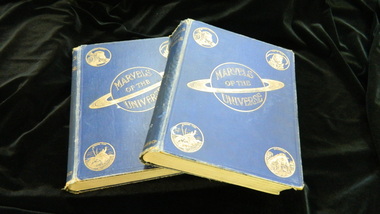
Book, Marvels of the universe: a popular work on the marvels of the heavens, the earth, plant life, animal life, the mighty deep, c1913
... Marvels of the universe: a popular work on the marvels of the heavens, the earth, plant life, animal life, the mighty deep...Dark Blue cloth with gilt titles and beautiful gilt cover decorations, Fair copies with wear and soiling, edgewear at all edges, endpapers a bit age-toned, previous owner's inscribed on flyleaf of both volumes Marvels of the universe: a popular work on the marvels of the heavens, the earth, plant life, animal life, the mighty deep Book Hutchinsons and Co ...Both volumes were gifted to the Clarendon Presbyterian Ladies College library by the family of former student Helena Cowan who entered the school in 1882. Volumes presumably from her personal collectionLondon: Hutchinson & Co, c1913, 2 volumes, volume one 602pp, volume two pp 602 to 1162 plus Index; over 1500 illustrations and 64 colored plates. Dark Blue cloth with gilt titles and beautiful gilt cover decorations, Fair copies with wear and soiling, edgewear at all edges, endpapers a bit age-toned, previous owner's inscribed on flyleaf of both volumesInscribed on flyleaf of both volumes: H M Cowan Library stamps throughout volumes Call number on spine: 500 MARhelena-cowan, clarendon-presbyterian-ladies-college, 1913, 1882, -
 Robin Boyd Foundation
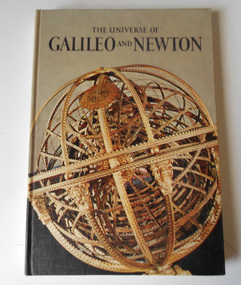
Book, William Bixby, The Universe of Galileo & Newton, 1964
... The Universe of Galileo & Newton...Galileo Galilei Isaac Newton modern science Walsh St library 2 Notes on the text - handwritten by a student between pages 116-117 Hardcover The Universe of Galileo & Newton Book William Bixby American Heritage Publishing ...Hardcover2 Notes on the text - handwritten by a student between pages 116-117galileo galilei, isaac newton, modern science, walsh st library -
 Robin Boyd Foundation
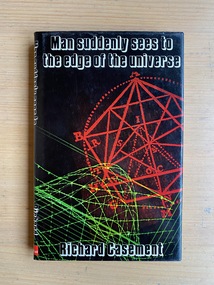
Book, Richard Casement, Man Suddenly Sees to the Edge of the Universe, 1984
... Man Suddenly Sees to the Edge of the Universe...Walsh St library Hardcover w/ Dust Jacket Man Suddenly Sees to the Edge of the Universe Book Richard Casement The Economist ...Hardcover w/ Dust Jacketwalsh st library -
 Robin Boyd Foundation
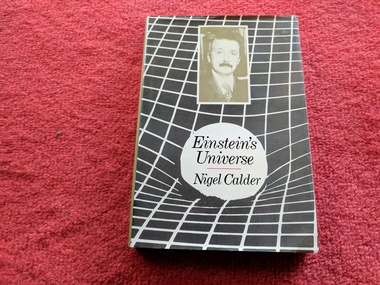
Book, Nigel Calder, Einstein's Universe, 1979
... Einstein's Universe...Walsh St library Hardcover w/ Dust Jacket Einstein's Universe Book Nigel Calder British Broadcasting Corporation ...Hardcover w/ Dust Jacketwalsh st library -
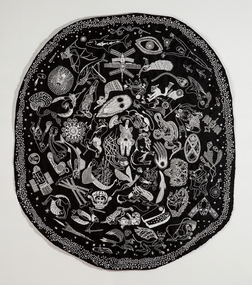 Ararat Gallery TAMA
Textile, Lucas Grogan, The Universe Quilt, 2013
... The Universe Quilt...The Universe Quilt Textile Lucas Grogan ... -
Moorabbin Air Museum
Book - THE ATLAS OF THE UNIVERSE, Patrick Moore, 1970
... THE ATLAS OF THE UNIVERSE...THE ATLAS OF THE UNIVERSE Book THE ATLAS OF THE UNIVERSE Patrick Moore Mitchell Beazley Ltd with George Philip & Son Ltd ... -
 Melbourne Royal
Memorabilia - Showbag, Showbag Factory, Zooper Dooper Showbag, c. 2009
... The Coolest Taste in the Universe produced by The Showbag Factory, Wangaratta....[both sides] Showbag Factory / Zooper Dooper / The coolest taste / in the universe! / Novelties in this bag may not be suitable for children under 7 years of age / products of National Foods Beverages group limited A. ...The Coolest Taste in the Universe produced by The Showbag Factory, Wangaratta. ...The Coolest Taste in the Universe produced by The Showbag Factory, Wangaratta.Zooper Dooper Showbag, no content: black plastic bag with image of three cartoon astronauts surrounding the product logo[both sides] Showbag Factory / Zooper Dooper / The coolest taste / in the universe! / Novelties in this bag may not be suitable for children under 7 years of age / products of National Foods Beverages group limited A. C. N. 051 195 272, 253 Woodpark Rd, Smithfield NSW 2164 Australian Registered trademark of Sunburst Foods Limited / Packed & marketed by: the Showbag Factory, 8 Barry Crt, Wangaratta, Ph. (03) 5721 4968showbag factory, showbag, zooper dooper, commercial, confectionary -
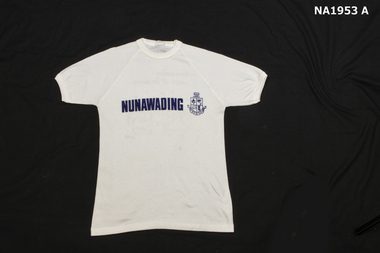 Whitehorse Historical Society Inc.
Memorabilia - Shirt, 1985
... Leunig cartoon of 'Nunawading - centre of the universe' on back....Leunig cartoon of 'Nunawading - centre of the universe' on back. Memorabilia Shirt ...T shirt made as a result of a Leunig cartoon in 'The Age' in response to the historic by - election in the Nunawading Province. Leunig is a famous Australian cartoonist. Donor, Miss Shirley Ramsay was a Social Worker and late in charge of welfare matters in the City Of Nunawading for many years.White cotton T shirt with 'Nunawading' and City of Nunawading logo on front. Leunig cartoon of 'Nunawading - centre of the universe' on back.As abovecostume, children's -
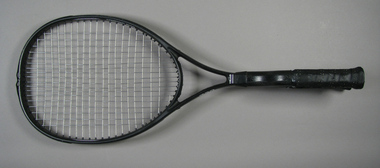 Tennis Australia
Racquet, Circa 1993
... An Head 'Universe 720' demonstration composite tennis racquet, featuring: oversized head; split shaft; and, a unique double handle, wrapped with Wilson 'Cushion-Aire' handle grips. ...Tennis An Head 'Universe 720' demonstration composite tennis racquet, featuring: oversized head; split shaft; and, a unique double handle, wrapped with Wilson 'Cushion-Aire' handle grips. ...An Head 'Universe 720' demonstration composite tennis racquet, featuring: oversized head; split shaft; and, a unique double handle, wrapped with Wilson 'Cushion-Aire' handle grips. Materials: Composite Materials, Nylon, Synthetic material, Plastic, Adhesive tape, Ink, Painttennis -
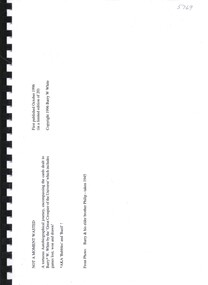 Bendigo Historical Society Inc.
Book - NOT A MOMENT WASTED
... 'Not a Moment Wasted', a tortuous Autobiographical journey, encompassing the cards dealt to Barry W White by the Great Croupier of the Universe which includes games lost, won and drawn. 263 pages of reminiscences by Barry White of his life and times in Bendigo.Spiral bound with clear plastic cover....BOOK Bendigo bendigo history & its people Bendigo-History-White family Barry W White 'Not a Moment Wasted', a tortuous Autobiographical journey, encompassing the cards dealt to Barry W White by the Great Croupier of the Universe which includes games lost, won and drawn. 263 pages of reminiscences by Barry White of his life and times in Bendigo.Spiral bound with clear plastic cover. ...'Not a Moment Wasted', a tortuous Autobiographical journey, encompassing the cards dealt to Barry W White by the Great Croupier of the Universe which includes games lost, won and drawn. 263 pages of reminiscences by Barry White of his life and times in Bendigo.Spiral bound with clear plastic cover.Barry W Whitebook, bendigo, bendigo history & its people, bendigo-history-white family -
 Ararat Gallery TAMA
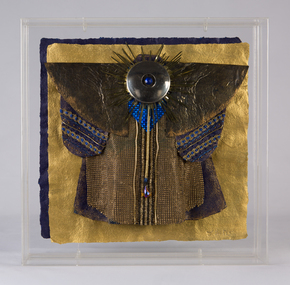
Mixed media, Inga Hunter, Irusaq Void Sayer's Robe, 1986-1989
... On one level the triangle symbolises Man, and on another, the whole material universe. The Void, symbolised by the circle, is both within and without Man and the material universe. ...On one level the triangle symbolises Man, and on another, the whole material universe. The Void, symbolised by the circle, is both within and without Man and the material universe. ...“The lIrusaqi are monotheistic Void worshippers. The Void is an extremely complex concept, and seems to include multiple interpretations of the two great signs, the triangle and the circle. On one level the triangle symbolises Man, and on another, the whole material universe. The Void, symbolised by the circle, is both within and without Man and the material universe. So, we find many variations of the circle and triangle imagery permeating the whole of lrusaqi society, i.e. villages are laid out in pyramid form, with a circular well at the centre, towns are built on a series of triangles, intersected by highways and the Court of the Imperium itself is based on a central circle within a triangle, with delegates to the Court in the three corners, while the positions of the three Heads of State and the one Head Speaker, repeat the pattern. The Void itself is always portrayed as an expanding and contracting circle, (not unlike the aperture of a camera). This Robe is worn by the High Priest’s acolyte and spokesman. The Voidsayer interprets the prophesies and sayings of the Priest, in words readily understood by the common people. The disc on the back of the Robe is the Void, and the gold lines symbolise the words of the Priest, coming from the source of life. The Robe is covered in gold chain mail, a sign that the Robe-wearer will defend his master with his life, if necessary.” -Inga Hunter -
Federation University Historical Collection
Book - Astronomy, Richard A. Proctor, Other Worlds Than Ours: The Plurality of Worlds Studied under the Light of Recent Scientific Researches, 1878
... Influenced by Darwin, Proctor had a teleological view of the universe and believed that eventually the cosmos would be filled with living things. ...Influenced by Darwin, Proctor had a teleological view of the universe and believed that eventually the cosmos would be filled with living things. ...Richard Anthony Proctor (23 March 1837 – 12 September 1888) was an English astronomer who produced one of the earliest maps of Mars in 1867 from 27 drawings by the English observer William Rutter Dawes. He used old drawings of Mars dating back to 1666 to try to determine the sidereal day of Mars. His final estimate, in 1873, was 24h 37m 22.713s, very close to the modern value of 24h 37m 22.663s. Proctor was already a well-known populariser of science when he published this book, joining a ferocious debate about the possibility of life on other planets. The crater Proctor on Mars is named after him.Red hard covered book of 318 pages. Includes early images of planets as seen through a J. Browning Telescope. Proctor discusses Victorian discoveries about the solar system and describes what was then known about each of the planets. He evaluates the habitability of Mars, Jupiter, Mercury, Venus and Saturn in the light of his belief in the possibility of extraterrestrial life. The text includes many illustrations of the planets, a spectacular map of Mars, and theoretical views of the Milky Way. Influenced by Darwin, Proctor had a teleological view of the universe and believed that eventually the cosmos would be filled with living things. non-fictionRichard Anthony Proctor (23 March 1837 – 12 September 1888) was an English astronomer who produced one of the earliest maps of Mars in 1867 from 27 drawings by the English observer William Rutter Dawes. He used old drawings of Mars dating back to 1666 to try to determine the sidereal day of Mars. His final estimate, in 1873, was 24h 37m 22.713s, very close to the modern value of 24h 37m 22.663s. Proctor was already a well-known populariser of science when he published this book, joining a ferocious debate about the possibility of life on other planets. The crater Proctor on Mars is named after him.astronomy, planets, telescope, earth, sun, jupitar, saturn, uranus, neptune, moon, meteors, comets, solar system, nebulae, galaxies, milky way -
 Federation University Historical Collection
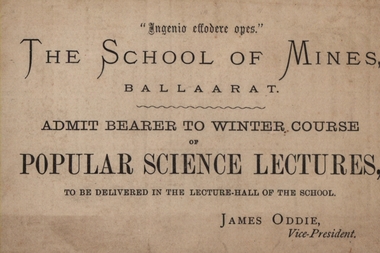
Advertising card, School of Mines: Popular Science Lectures, 1882, 1882
... G Foord (Royal Mint) - Alchemy; Rev Ick (Sandhurst) - The Wonders of Coral Life; R Ellery (Government Astronomer) - The Sun's Distances and the Transits of Venus; J Thomas (Geelong) - The Stellar Universe; J Usher (Doctor) - Physiology, Body and Bones; Baron Von Mueller (Government Botanist) - General observations on the Flora of Australia; Professor Mica Smith - Gold; Professor F Kraush - Volcanic rocks of the Ballarat District. ...G Foord (Royal Mint) - Alchemy; Rev Ick (Sandhurst) - The Wonders of Coral Life; R Ellery (Government Astronomer) - The Sun's Distances and the Transits of Venus; J Thomas (Geelong) - The Stellar Universe; J Usher (Doctor) - Physiology, Body and Bones; Baron Von Mueller (Government Botanist) - General observations on the Flora of Australia; Professor Mica Smith - Gold; Professor F Kraush - Volcanic rocks of the Ballarat District. ...The card enabled a person to attend the 'Popular Science Lectures' which were held in the lecture hall of the school. These were the Winter course of 1882. The Lectures were from 8p.m. They ran from June 9 through to October 11. The subjects were varied and a guest speaker was responsible for each session. G Foord (Royal Mint) - Alchemy; Rev Ick (Sandhurst) - The Wonders of Coral Life; R Ellery (Government Astronomer) - The Sun's Distances and the Transits of Venus; J Thomas (Geelong) - The Stellar Universe; J Usher (Doctor) - Physiology, Body and Bones; Baron Von Mueller (Government Botanist) - General observations on the Flora of Australia; Professor Mica Smith - Gold; Professor F Kraush - Volcanic rocks of the Ballarat District. This was organised by the School Councilwhen James Oddie was Vice-President.Beige coloured card written on both sidespopular science lectures, winter course 1882, guest speakers, g foord, royal mint, alchemy, reverend ick, sandhurst, coral life, r ellery, government astronomer, sun's distances, transits of venus, j thomas, stellar universe, baron von mueller, flora of australia, government botanist, mica smith, gold, f m kraush, volcanic rocks -
 City of Stonnington
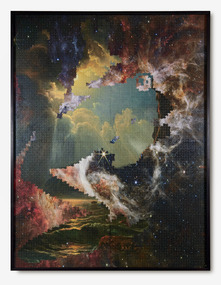
Zac Langdon-Pole, Frog B, 2023
... ...Universe...Stonnington contemporary art collection Zac Langdon-Pole Tarantula Nebula NASA James Webb space telescope jigsaw puzzle Assemblage Johann Nepomuk Schödlberger Rocky Coast in Moonlight Science Universe Deep space Romanticism Frog B Zac Langdon-Pole ...In Frog B, Zac Langdon-Pole deconstructs and reweaves history by blending two vastly separate images into a single, cohesive collage. This intricate work merges a 2022 NASA James Webb Space Telescope photograph of the Tarantula Nebula with Johann Nepomuk Schödlberger’s 1830 Romantic landscape painting, Rocky Coast in Moonlight. Using the the common interlocking structure of jigsaw puzzles, Langdon-Pole splices deep space imagery with 19th-century European romanticism. The result is a pixelated, hybrid tapestry where disparate eras and scales collide. The composition operates like a "Mooney image"- a cognitive science tool using stark dark and light tones to test how human perception fills in gaps based on prior knowledge. Through this assemblage, Frog B challenges our impulse to find absolute order, forcing us to confront how historical, scientific, and colonial frameworks shape our understanding of the universe.stonnington contemporary art collection, zac langdon-pole, tarantula nebula, nasa, james webb space telescope, jigsaw puzzle, assemblage, johann nepomuk schödlberger, rocky coast in moonlight, science, universe, deep space, romanticism -
 Federation University Art Collection
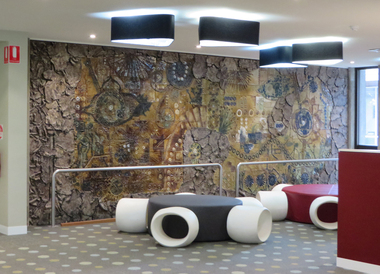
Artwork, other - Ceramic mural, John Gilbert, 'Enigmatic Land' by John Gilbert, 1973, 1973
... The theme relates to the development of the Universe through basic symbols such as plant forms, fish, birds and to mans development through symbols of science and engineering. ...The theme relates to the development of the Universe through basic symbols such as plant forms, fish, birds and to mans development through symbols of science and engineering. ...ENIMATIC LAND OF BIRDS THAT SING FLOWERS FROMS SEEDS THAT SPRING OF REPTILES AND FISHES CREATURES FROM THE BEGINNING SUN AND MAN AND SCIENCE THE SYMBOLS THAT SILENTLY BUILD AND CHANGE IN COOL AND WARM YOU ARE THERE AND HERE OF YESTERDAY NOW THE SPLITTING EARTH MURAL BY JOHN GILBERT 1973John GILBERT (1935- ) Born Albury, New South Wales John Gilbert worked as a teacher while completing a Certificate of Art at the Technical College in Marlborough, before moving to Ballarat in 1958. He studied at the Ballarat Technical Art School, a division of the Ballarat School of Mines (1960-1961) receiving a Diploma of Art; and Croydon College of Art, London. Gilbert was a Senior Lecturer at the Ballarat Institute of Advanced Education (now Federation University) Art Department until his retirement in the late 1970s. In John Gilbert's Mount Helen studio he produced work marked with an incised 'Gilbert'. He had acquired a concern for form and an interest in sculpture from his teacher Neville Bunning, and from the British potter Hans Coper, whom he visited in 1968. He established two potteries in Ballarat , the Edinburgh Pottery (1972-2005) located within the Sovereign Hill precinct, and the Old Ballarat Pottery (1973-1994) located in the Old Ballarat Village opposite Sovereign Hill. This item is part of the Federation University Art Collection. The Art Collection features over 2000 works and was listed as a 'Ballarat Treasure' in 2007.A large ceramic mural by John Gilbert commissioned for the wall of the E.J. Barker Library. The mural features brown and green glaze with features of indigo. The work has no particular pictorial representation. It is an arrangement of colour and form, designed for enjoyment rather than to analyse. The theme relates to the development of the Universe through basic symbols such as plant forms, fish, birds and to mans development through symbols of science and engineering. The outer edge is symbolic of earths crust being peeled away to reveal science and nature. The mural depicts the changing of seasons from Winter to Summer (left to right). The mural was completed at John Gilbert's Slate Gallery studio, Mount Helen, and took eight months to make.gilbert, artwork, john gilbert, art, ballarat school of mines, mural, ballarat institute of advanced education, ballarat pottery, ceramics, old ballarat pottery, edinburgh pottery -
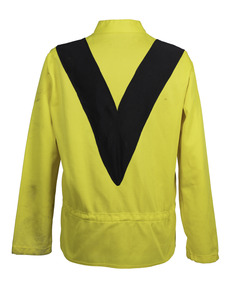 Victorian Harness Racing Heritage Collection at Lord's Raceway Bendigo
Clothing - Race Colours, Bob Conroy
... Dullard Cup, Lincoln Star's win in the 1978 Bendigo Pacing Cup and 1978 Italian Cup, and the Lightfoot Laurels on four occasions (Lucy Lastic 1997, Miss Universe 1999 and 2001 and False Gem on 2008). ...Dullard Cup, Lincoln Star's win in the 1978 Bendigo Pacing Cup and 1978 Italian Cup, and the Lightfoot Laurels on four occasions (Lucy Lastic 1997, Miss Universe 1999 and 2001 and False Gem on 2008). ...Bob Conroy died on Tuesday, December 12, 2017 at age 88. The Daylesford trainer and brilliant horseman enjoyed a life dedicated to harness racing, which he shared with his wife Pat and their five children, including Glenn, Anne-Maree and Peter, who themselves have combined to drive more than 800 winners. Renowned as an outstanding trainer of trotters, Conroy spent a life training from Daylesford, having been raised in nearby Korweinguboora before occupying the former Daylesford Trotting Club track, from where he would often venture into neighbouring Hepburn Regional Park to educate his horses. A trots trainer, driver and breeder, Mr Conroy’s training successes include Mary Beverley’s win in the 1973 V. L. Dullard Cup, Lincoln Star's win in the 1978 Bendigo Pacing Cup and 1978 Italian Cup, and the Lightfoot Laurels on four occasions (Lucy Lastic 1997, Miss Universe 1999 and 2001 and False Gem on 2008). His greatest stakes win came when Amazon captured the $30,000 Australasian Trotters Championship final in 1984 and then the same year the E B Cochran Memorial Trotters Cup, while notable triumphs also include Mister Everest in the 1990 Chris E Howe Trotters Cup, two Central Victorian Trotting Championships in 1991 (Omaorio) and 2005 (Sutters Glory), the 1996 Coulter Crown with Lucy Lastic, First Signal's win in the 1999 Cranbourne Trotters Cup and then the R C Freestone Trotters Cup with Miss Universe. Other notable performers he trained throughout his distinguished career included multiple metropolitan winners King’s Pride, Eden’s Return, Magic Madge, Minnesota Fats, Hot And Dry, Kyvalley Duke, Speeding Fine, Baltic Prince and Looks Like Me. Bob Conroy’s trotters Bootleg Bert and Margaret Ruth delivered his last trotting wins. Yellow with black Vrb conroy, lincoln star, amazon, bendigo harness racing club, bhrc, bendigo, horses, racing colours, trotting, pacing, harness racing, bob conroy, r conroy -
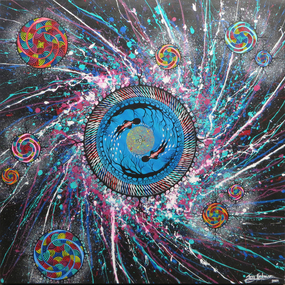 Federation University Art Collection
Painting - Artwork, Troy Firebrace, 'A Galaxy Swirl' by Troy Firebrace, 2015
... Artist's statement: "‘Stories are being told and shared like particles in the universe, a constant swirl of words filled with emotions creating a pattern — explosions — smashing into each other creating a layering effect — creating worlds, planets — well nourished and suited to sustain life, and from this life new stories will emerge, to be told, to be shared — a continuous galaxy swirl. ...Troy seeks to find and demonstrate a connection between humanity and the environment, exploring the idea of harmonious co-existence. victorian indigenous art awards troy firebrace artwork artist indigenous aboriginal painting indigenous artist Artist's statement: "‘Stories are being told and shared like particles in the universe, a constant swirl of words filled with emotions creating a pattern — explosions — smashing into each other creating a layering effect — creating worlds, planets — well nourished and suited to sustain life, and from this life new stories will emerge, to be told, to be shared — a continuous galaxy swirl. ...Troy FIREBRACE (c1994-) Country/Language: Yorta Yorta Troy is a Shepparton born Yorta Yorta man, whose career is on the rise after winning the prestigious Federation University Acquisitive Award for Work by a Victorian Regional Artist at the 10th Victorian Indigenous Art Awards. He completed Year Twelve at Shepparton Secondary College in 2010, and in 2015 Troy was studying Creative Arts at La Trobe University, Bendigo where he has pursued his interest in his Aboriginal identity and art. He is largely influenced by the art of his Uncle Chris Firebrace and he enjoys the design aspects of creating a painting. Usually Troyʼs works contain a narrative, or at least hint of a meaning that he would like to convey to people. Influenced by the imagery of his Aboriginal cultural background he works at bringing together references of landscape, environmental processes and concerns, looking at the way in which we as humans relate to the natural world. Troy seeks to find and demonstrate a connection between humanity and the environment, exploring the idea of harmonious co-existence. Artist's statement: "‘Stories are being told and shared like particles in the universe, a constant swirl of words filled with emotions creating a pattern — explosions — smashing into each other creating a layering effect — creating worlds, planets — well nourished and suited to sustain life, and from this life new stories will emerge, to be told, to be shared — a continuous galaxy swirl. I like the idea that we are a part of something bigger — yes, the earth is massive, but we are just a speck of something far beyond the Milky Way itself.” The work was inspired by the work of abstract expressionist painter Jackson Pollock, science and space. This work won the 2015 Victorian Indigenous Art Awards Federation University Acquisitive Award for work by a Victorian regional artist. His canvas 'A Galaxy Swirl' was described by judges as ‘‘a vibrant and dynamic painting that, as the artist explains, epitomises a bringing together of modernism and Aboriginal arts’’.victorian indigenous art awards, troy firebrace, artwork, artist, indigenous, aboriginal, painting, indigenous artist -
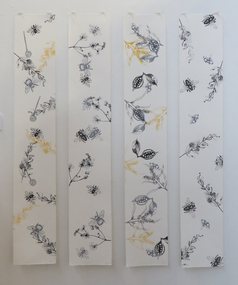 Federation University Art Collection
Work on paper - Artwork - Printmaking, Jessica Price, 'Garden #1, #2, #3 and #4' by Jessica Price, 10/2017
... I find that bringing this concept and theme thorughout my work using a botanical like approach not only expresses a part of who I am, but connects me with the creator of the universe. My hope is that by making these works I can create a similar experience for my viewers, as well as celebrate the master craftsmanship of the creator. ...I find that bringing this concept and theme thorughout my work using a botanical like approach not only expresses a part of who I am, but connects me with the creator of the universe. My hope is that by making these works I can create a similar experience for my viewers, as well as celebrate the master craftsmanship of the creator. ...Jessica PRICE (1996- ) Born Busselton, Western Australia In 2017 Jessica Price completed a Bachelor of Arts (Fine Arts) Printmaking at the Federation University Arts Academy. A general theme in her work is nature to reveal the beauty of God in nature. This item is part of the Federation University Art Collection. The Art Collection features over 2000 works and was listed as a 'Ballarat Treasure' in 2007.Four limited edition screenprints with fineliner printed on Somerset Satin White paper. Artist's Statement: I am a practising printmaking artist and enjoy experimenting with various forms of print including chine colle, screenprinting and monoprint. I also enjoy drawing and painting, and hope to expand my practise to incorporate all these methods to create a unique style of artwork for myself. I am constantly in awe of the delicacy and grandeur of creation. I find that bringing this concept and theme thorughout my work using a botanical like approach not only expresses a part of who I am, but connects me with the creator of the universe. My hope is that by making these works I can create a similar experience for my viewers, as well as celebrate the master craftsmanship of the creator. This item is part of the Federation University Art Collection. The Art Collection features over 2000 works and was listed as a 'Ballarat Treasure' in 2007.1/1jessica price, screenprint, printmaking, flora, alumni, bee, australian nature -
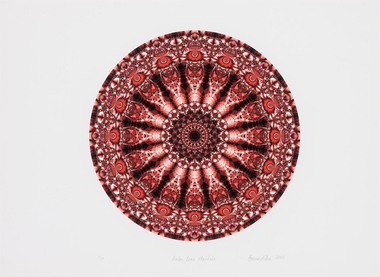 Footscray Community Arts
Amber Bead Mandala, Rosemary De Dear, (exact); 2002
... The Mandalas geometric designs are symbolic of the universe and used in Hinduism and Buddhism as an aid to meditation. ...The Mandalas geometric designs are symbolic of the universe and used in Hinduism and Buddhism as an aid to meditation. ...MEDIUM: Digital print. DESCRIPTION: A fractal exploration on 192 gsm archival matt. Image ranges from yellow, orange, and red to darker tones. Gold outer frame with a glass front. The Mandalas geometric designs are symbolic of the universe and used in Hinduism and Buddhism as an aid to meditation. The creative possibilities that exist in these sacred circles, are often based on a step-and-repeat principle, centre, and symmetry. Here we see this put into practise. The mandala has an iris quality about it with 16 pillars pulling centrally to what looks like a pupil, the centre of the mandala. This then has more points around it and then more once again. This fractal approach gives the work a textural depth. The use of blurring and merging in a kaleidoscopic fashion creates movement, the circular flow repetitive and calming. The use of reds throughout mandata art represent the glowing sun and of fire, red generally taken to be the color of life, love, joy and rage, the polar values of the color. Orange the colour of cheerfulness and gaiety, a colour mixed from red and yellow, it stands for kind-heartedness and warm-heartedness. Signed, titled, dated and editioned on image across bottom.de, print, digital, dear, amber, bead, mandala, fractal, expolration -
 Bendigo Historical Society Inc.
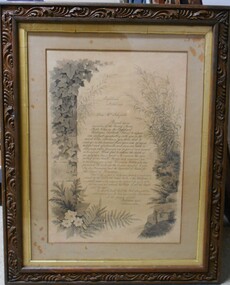
Letter - Framed letter to Mrs Schofield, 1895
... That a life so full of hope and promise of usefulness should by the Will of the Great Ruler of the Universe be so quickly ended is an enigma too difficult for us to solve but we may rest-assured the Judge of all the Earth will do right. ...That a life so full of hope and promise of usefulness should by the Will of the Great Ruler of the Universe be so quickly ended is an enigma too difficult for us to solve but we may rest-assured the Judge of all the Earth will do right. ...A Trove search records a fatal mining accident that occurred in Eaglehawk on 27th January 1895 concerning 23-year-old William Schofield who was the support of a widowed mother, and it can be assumed this is the son of the Mrs. Schofield mentioned in the letter. 28 Jan 1895 - FATAL MINING ACCIDENT. - Trove (nla.gov.au) The Age Newspaper p.6The item is a condolence letter behind glass in an carved and embellished timber frame. The letter is addressed to Mrs. Schofield from members of the Young Men's Bible Class at the Eaglehawk Wesleyan Sabbath School. The letter is handwritten in a copperplate style and surrounded by a black and white floral watercolour painting by the artist C.G. Darvatt. The frame consists of a gold painted inner timber frame with a decorative outer wooden frame. The wording in the letter to Mrs Schofield states: 'Eaglehawk. 14th February 1895. Dear Mrs Schofield, Permit us as members of the Young Bible Class in the Eaglehawk Wesleyan Sabbath School to express our deepest sympathy with you in the recent bitter experience you have had to undergo in the removal from your side of one so helpful and affectionate, and from our circle a classmate whose presence was so genial and counsel so beneficial. Words fail to express the depth of our grief at a loss so great or to measure the sympathy of our hearts. We can only commend you to the loving care of our Heavenly Father who has promised "To bind up the broken-hearted, to give joy for Mourning and the Garment of Praise for the Spirit of Heaviness". That a life so full of hope and promise of usefulness should by the Will of the Great Ruler of the Universe be so quickly ended is an enigma too difficult for us to solve but we may rest-assured the Judge of all the Earth will do right. In simple trust that the God of consolation will reconcile you to His ever-ruling Providence is the prayer of his Teachers and Classmates.'william schofield, mining accident, 1895 -
 Royal Brighton Yacht Club
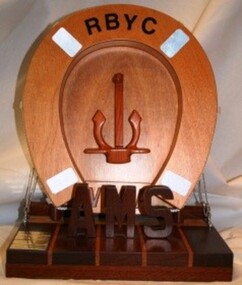
Life Ring, Vega Trophy (Mounted Wooden Life Ring)
... As a side note Vega is the name of the brightest star in the universe. Furthermore, throughout the occupation, despite German law that demanded confiscation of all radio sets, punishable by long prison terms or deportation to Germany, there were still many sets being listened to. ...As a side note Vega is the name of the brightest star in the universe. Furthermore, throughout the occupation, despite German law that demanded confiscation of all radio sets, punishable by long prison terms or deportation to Germany, there were still many sets being listened to. ...Vega Trophy (Mounted Wooden Life Ring) Donor: Graham Noel During World War II when the Germans occupied the Channel Islands the local people went through very severe food rationing and were on the verge of starvation. Near the end of the war, the Swedish ship Vega was allowed by the Germans to deliver several shipments of food to the civilian population, easing the critical shortages of food on the islands. Further background detail can be found below. Graham Noel was born on the Islands and lived there during this harsh period. The trophy is awarded to the winner of the Combined Division AMS Aggregate Series. First Winner: Under Capricorn, P. Bedlington 2005/06 Vega – Further historical background Early in the Second World War Jersey was declared “unarmed” and the German military took over, taking quite a few lives in the process, through strafing the main harbour and a few other places which they needlessly considered threatening. A considerable number of locals evacuated to England before the Germans arrived, but more than 60% of the population remained and endured 5 years of very strict and difficult conditions. Not only was the population unable to contact relatives in the UK or elsewhere, but very quickly they found themselves subject to harsh curfews, strictly rationed foodstuffs, no fuel for vehicles, radios confiscated, and homes and hotels commandeered by the military. The military demanded first pick of all foodstuffs and kept meticulous records of all livestock forcing farmers even to show newborn calves and piglets to them, then claiming the new arrivals for their dinner tables. However there are many stories of farmers outwitting their masters when twin calves or suchlike arrived! Lawbreakers were quickly dealt with, mostly with lengthy prison terms in Jersey, but the more serious crimes were punished by being sent to some horrible French prisons, or even some of the notorious German concentration camps. All local Jews were dispatched to concentration camps, and even English born families were similarly shipped through France and on to Germany. Sadly, a considerable number of those deported did not make it back safely to Jersey. In June 1944 the locals were delighted to hear that the Allies had invaded Normandy and very soon they could hear the battles as the Allies worked their way along the French coast. Little did they know they would still have to wait another 11 months for freedom, having to put up with a very demanding German occupation force which was still determined to obey Hitler’s order to “Defend the Channel Islands to the death”. Now that France was in Allied Hands the local military commanders were unable to supplement their food supplies from France and even harsher demands were made on the local population to ensure that all branches of their still very substantial military force were reasonably well fed. As well as the military, Jersey farmers had to provide food for the Allied POWs and the many “forced labourers”, mainly of Russian, Polish and Italian backgrounds who had been directed to the island to build all the concrete bunkers. This included an underground hospital, all this complying with Hitler’s orders to ensure that the Channel Islands would never again be part of Britain. Many requests by the Jersey authorities for Red Cross assistance were rejected, but finally in December 1944 they agreed and on 30th December the Red Cross vessel “Vega” (Swedish Registry) arrived and delivered parcels to the civilian population. These parcels contained a variety of foodstuffs supplied mainly by Canadian authorities, desperately needed medical supplies, flour, oils and soaps, as well as tobacco from New Zealand. Vega made a further 3 or 4 trips and most certainly eased the desperate situation being faced by the locals. In fact, it resulted in the locals having slightly better food supplies than the military and many local farmers tell stories of having to protect their stock from marauding soldiers. Understandably Churchill was reluctant to send in an invading force to retake the Channel Islands, but by May 1945 it was clear that the Third Reich was finished and on May 9th the German Military surrendered, without a fight, to a large British landing force. On a slightly lighter note … in January 1945 Jersey stonemasons were seen in the main town square repairing flagstones … the Germans had never noticed that the name “Vega” had been formed in those flagstones! As a side note Vega is the name of the brightest star in the universe. Furthermore, throughout the occupation, despite German law that demanded confiscation of all radio sets, punishable by long prison terms or deportation to Germany, there were still many sets being listened to. The locals had a well refined news system for the dissemination of news of what was happening in the outside world. vega, graham noel, ams, combined division, aggregate -
 Victorian Aboriginal Corporation for Languages
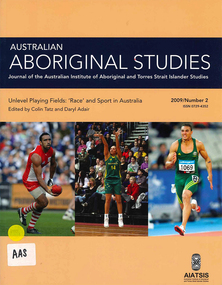
Periodical, Australian Institute of Aboriginal and Torres Strait Islander Studies, Australian Aboriginal studies : journal of the Australian Institute of Aboriginal and Torres Strait Islander Studies, 2009
... the wonderful and chaotic universe of clashing colors, temperaments and emotions, of brave deeds against odds seemingly insuperable?...the wonderful and chaotic universe of clashing colors, temperaments and emotions, of brave deeds against odds seemingly insuperable? ...Darkness and a little light: ?Race? and sport in Australia Colin Tatz (AIATSIS & Australian National University) and Daryl Adair (University of Technology Sydney) Despite ?the wonderful and chaotic universe of clashing colors, temperaments and emotions, of brave deeds against odds seemingly insuperable?, sport is mixed with ?mean and shameful acts of pure skullduggery?, villainy, cowardice, depravity, rapaciousness and malice. Thus wrote celebrated American novelist Paul Gallico on the eve of the Second World War (Gallico 1938 [1988]:9-10). An acute enough observation about society in general, his farewell to sports writing also captures the ?clashing colors? in Australian sport. In this ?land of the fair go?, we look at the malice of racism in the arenas where, as custom might have it, one would least want or expect to find it. The history of the connection between sport, race and society - the long past, the recent past and the social present - is commonly dark and ugly but some light and decency are just becoming visible. Coming to terms: ?Race?, ethnicity, identity and Aboriginality in sport Colin Tatz (AIATSIS & Australian National University) Notions of genetic superiority have led to some of the world?s greatest human calamities. Just as social scientists thought that racial anthropology and biology had ended with the cataclysm of the Second World War, so some influential researchers and sports commentators have rekindled the pre-war debate about the muscular merits of ?races? in a new discipline that Nyborg (1994) calls the ?science of physicology?. The more recent realm of racial ?athletic genes?, especially within socially constructed black athletic communities, may intend no malice but this search for the keys to their success may well revive the old, discredited discourses. This critical commentary shows what can happen when some population geneticists and sports writers ignore history and when medical, biological and sporting doctrines deriving from ?race? are dislocated from any historical, geographic, cultural and social contexts. Understanding discourses about race, racism, ethnicity, otherness, identity and Aboriginality are essential if sense, or nonsense, is to be made of genetic/racial ?explanations? of sporting excellence. Between the two major wars boxing was, disproportionately, a Jewish sport; Kenyans and Ethiopians now ?own? middle- and long-distance running and Jamaicans the shorter events; South Koreans dominate women?s professional golf. This essay explores the various explanations put forward for such ?statistical domination?: genes, biochemistry, biomechanics, history, culture, social dynamics, the search for identity, alienation, need, chance, circumstances, and personal bent or aptitude. Traditional games of a timeless land: Play cultures in Aboriginal and Torres Strait Islander communities Ken Edwards (University of Southern Queensland) Sports history in Australia has focused almost entirely on modern, Eurocentric sports and has therefore largely ignored the multitude of unique pre- European games that are, or once were, played. The area of traditional games, especially those of Aboriginal and Torres Strait Islander peoples, is an important aspect of the cultural, social and historical experiences of Indigenous communities. These activities include customs of play that are normally not associated with European notions of competitive sport. Overall, this paper surveys research undertaken into traditional games among Indigenous Australians, as well as proposals for much needed further study in this area. Culture, ?race? and discrimination in the 1868 Aboriginal cricket tour of England David Sampson As a consequence of John Mulvaney?s important historical research, the Aboriginal cricket and performance tour of Britain in 1868 has in recent decades become established as perhaps the most famous of all public events in contact history involving Aborigines, white settlers and the British metropolis. Although recognition of its importance is welcome and significant, public commemorations of the tour have enveloped the tour in mythologies of cricket and nation. Such mythologies have obscured fundamental aspects of the tour that were inescapable racial and colonial realities of the Victorian era. This reappraisal of the tour explores the centrality of racial ideology, racial science and racial power imbalances that enabled, created and shaped the tour. By exploring beyond cricketing mythology, it restores the central importance of the spectacular performances of Aboriginal skills without which the tour would have been impossible. Such a reappraisal seeks to fully recognise the often trivialised non-cricketing expertise of all of the Aboriginal performers in 1868 for their achievement of pioneering their unique culture, skills and technologies to a mass international audience. Football, ?race? and resistance: The Darwin Football League, 1926?29 Matthew Stephen (Northern Territory Archive Service) Darwin was a diverse but deeply divided society in the early twentieth century. The Commonwealth Government introduced the Aboriginals Ordinance 1911 in the Northern Territory, instituting state surveillance, control and a racially segregated hierarchy of whites foremost, then Asians, ?Coloureds? (Aborigines and others of mixed descent) and, lastly, the so-called ?full-blood? Aborigines. Sport was important in scaffolding this stratification. Whites believed that sport was their private domain and strictly controlled non-white participation. Australian Rules football, established in Darwin from 1916, was the first sport in which ?Coloured? sportsmen challenged this domination. Football became a battleground for recognition, rights and identity for all groups. The ?Coloured? community embraced its team, Vesteys, which dominated the Northern Territory Football League (NTFL) in the 1920s. In 1926, amidst growing racial tension, the white-administered NTFL changed its constitution to exclude non-white players. In reaction, ?Coloured? and Chinese footballers formed their own competition - the Darwin Football League (DFL). The saga of that colour bar is an important chapter in Australia?s football history, yet it has faded from Darwin?s social memory and is almost unknown among historians. That picture - Nicky Winmar and the history of an image Matthew Klugman (Victoria University) and Gary Osmond (The University of Queensland) In April 1993 Australian Rules footballer Nicky Winmar responded to on-field racist abuse by lifting his jersey and pointing to his chest. The photographic image of that event is now famous as a response to racial abuse and has come to be seen as starting a movement against racism in football. The racial connotations in the image might seem a foregone conclusion: the power, appeal and dominant meaning of the photograph might appear to be self-evident. But neither the fame of the image nor its racial connotation was automatic. Through interviews with the photographers and analysis of the use of the image in the media, we explore how that picture came to be of such symbolic importance, and how it has remained something to be re-shown and emulated. Rather than analyse the image as a photograph or work of art, we uncover some of its early history and explore the debates that continue to swirl around its purpose and meaning. We also draw attention to the way the careful study of photographs might enhance the study of sport, race and racism. ?She?s not one of us?: Cathy Freeman and the place of Aboriginal people in Australian national culture Toni Bruce (University of Waikato) and Emma Wensing (Independent scholar) The Sydney 2000 Olympic Games generated a national media celebration of Aboriginal 400 metre runner Cathy Freeman. The construction of Freeman as the symbol of national reconciliation was evident in print and on television, the Internet and radio. In contrast to this celebration of Freeman, the letters to the editor sections of 11 major newspapers became sites for competing claims over what constitutes Australian identity and the place of Aboriginal people in national culture. We analyse this under-explored medium of opinion and discuss how the deep feelings evident in these letters, and the often vitriolic responses to them, illustrate some of the enduring racial tensions in Australian society. Sport, physical activity and urban Indigenous young people Alison Nelson (The University of Queensland) This paper challenges some of the commonly held assumptions and ?knowledges? about Indigenous young people and their engagement in physical activity. These include their ?natural? ability, and the use of sport as a panacea for health, education and behavioural issues. Data is presented from qualitative research undertaken with a group of 14 urban Indigenous young people with a view to ?speaking back? to these commentaries. This research draws on Critical Race Theory in order to make visible the taken-for-granted assumptions about Indigenous Australians made by the dominant white, Western culture. Multiple, shifting and complex identities were expressed in the young people?s articulation of the place and meaning of sport and physical activity in their lives. They both engaged in, and resisted, dominant Western discourses regarding representations of Indigenous people in sport. The paper gives voice to these young people in an attempt to disrupt and subvert hegemonic discourses. An unwanted corroboree: The politics of the New South Wales Aboriginal Rugby League Knockout Heidi Norman (University of Technology Sydney) The annual New South Wales Aboriginal Rugby League Knockout is so much more than a sporting event. Involving a high level of organisation, it is both a social and cultural coming together of diverse communities for a social and cultural experience considered ?bigger than Christmas?. As if the planning and logistics were not difficult enough, the rotating-venue Knockout has been beset, especially since the late 1980s and 1990s, by layers of opposition and open hostility based on ?race?: from country town newspapers, local town and shire councils, local business houses and, inevitably, the local police. A few towns have welcomed the event, seeing economic advantage and community good will for all. Commonly, the Aboriginal ?influx? of visitors and players - people perceived as ?strangers?, ?outsiders?, ?non-taxpayers? - provoked public fear about crime waves, violence and physical safety, requiring heavy policing. Without exception, these racist expectations were shown to be totally unfounded. Research report: Recent advances in digital audio recorder technology provide considerable advantages in terms of cost and portability for language workers.b&w photographs, colour photographs, tablessport and race, racism, cathy freeman, nicky winmar, rugby league, afl, athletics, cricket, digital audio recorders -
 Great Stupa of Universal Compassion
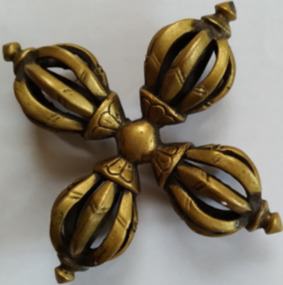
Ceremonial object - Double dorje
... The Double Dorje is often associated with stability and protection, symbolizing the indestructible nature of the universe. tibetan buddhism holy objects worship devices This double dorje is a cross of two dorjes, which look like a small scepter with multiple prongs at each end. ...In Tibetan Buddhism a "dorje" (also known as "vajra" in Sanskrit) symbolizes the indestructible nature of reality, spiritual power, and enlightenment, often depicted as a thunderbolt or diamond scepter, representing the ability to cut through illusion and achieve ultimate wisdom; it is a key ritual object in the Vajrayana school of Tibetan Buddhism, signifying the union of compassion and wisdom through its male principle association when used with a bell (female principle). The Double Dorje (Vishvavajra), is a powerful Buddhist symbol. It consists of two crossed vajras (dorjes) and represents the foundation of the physical world. The Double Dorje is often associated with stability and protection, symbolizing the indestructible nature of the universe. This double dorje is a cross of two dorjes, which look like a small scepter with multiple prongs at each end.tibetan buddhism, holy objects, worship devices -
 Great Stupa of Universal Compassion
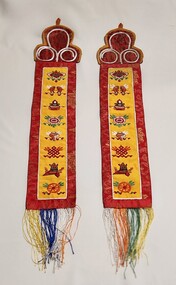
Artwork, other - Auspicious symbols hangings
... They symbolise the totality of the Buddha’s teachings and the harmony of the universe. Holy objects worship devices Two identical hangings feature the eight auspicious symbols of Buddhist iconography: the precious parasol, white conch shell, two golden fish, eternal knot, treasure vase, victory banner, lotus flower and dharma wheel. ...These types of wall hangings are commonly used in homes, temples and meditation spaces to bring blessings, good fortune and to remind practitioners of the Buddhist teachings.The eight auspicious symbols represent blessings, spiritual qualities and the path to enlightenment. They symbolise the totality of the Buddha’s teachings and the harmony of the universe.Two identical hangings feature the eight auspicious symbols of Buddhist iconography: the precious parasol, white conch shell, two golden fish, eternal knot, treasure vase, victory banner, lotus flower and dharma wheel.holy objects, worship devices -
Koorie Heritage Trust
Book, Roberts, Ainslie, The First Sunrise : Australian Aboriginal myths, 1971
... . | Australian The profound mystery of the creation of the Universe has occupied the beliefs of people from the simplest cultures to those of the present day. ...The profound mystery of the creation of the Universe has occupied the beliefs of people from the simplest cultures to those of the present day. Almost without exception, except perhaps in some aspects of modern life, these veliefs have played a major part in mould79p. : ill.(part col.) ; 24cm.The profound mystery of the creation of the Universe has occupied the beliefs of people from the simplest cultures to those of the present day. Almost without exception, except perhaps in some aspects of modern life, these veliefs have played a major part in mouldroberts, ainslie, 1911- | aboriginal australians -- folklore. | legends -- australia. | aboriginal tales & legends. australia. texts. | australian paintings. roberts, ainslie. | australian -
 Mrs Aeneas Gunn Memorial Library
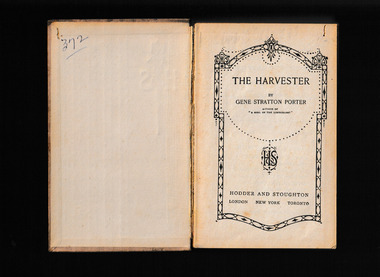
Book, Gene Stratton Porter, The harvester, 1911
... If it opens his eyes to one beauty in nature he never saw for himself and leads him one step toward the God of the Universe, it is a beneficial book..." p.564. ...A Gripping Romance in a Natural Setting "To my way of thinking and working, the greatest service a piece of fiction can do any reader is to leave him with a higher ideal of life than he had when he began. If in one small degree it shows him where he can be...gentler, saner, cleaner, kindlier...it is a wonder-working book. If it opens his eyes to one beauty in nature he never saw for himself and leads him one step toward the God of the Universe, it is a beneficial book..."p.564.fictionA Gripping Romance in a Natural Setting "To my way of thinking and working, the greatest service a piece of fiction can do any reader is to leave him with a higher ideal of life than he had when he began. If in one small degree it shows him where he can be...gentler, saner, cleaner, kindlier...it is a wonder-working book. If it opens his eyes to one beauty in nature he never saw for himself and leads him one step toward the God of the Universe, it is a beneficial book..."america - fiction, romantic fiction -
 Flagstaff Hill Maritime Museum and Village
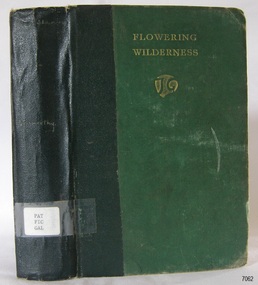
Book - A Fictional Story, John Galsworthy, Flowering Wilderness, 1932
... It's part of Galsworthy's broader fictional universe that includes the famous Forsyte Saga, although this particular trilogy follows a different but related family branch. ...Flowering Wilderness (1932) is a novel by John Galsworthy, and it's the second book in his 'End of the Chapter' trilogy it's a sequel to 'Maid in Waiting', continuing the story of the Cherrell family. It centres on Dinny Cherrell (niece of the Forsyth-adjacent Cherrell clan) and her love affair with Wilfred Desert, a poet who under threat of death while a captive in the Middle East had renounced Christianity and converted to Islam. The novel explores the social scandal and moral judgement that follows him back to England, and Dinny's loyalty to him in the face of society's condemnation. It's part of Galsworthy's broader fictional universe that includes the famous Forsyte Saga, although this particular trilogy follows a different but related family branch.Hard cover book. Flowering Wilderness Author: John Galsworthy Publisher: William Heinemann Ltd Date: 1932 Further Information: Green cloth boards, gilt/black spine with gilt lettering. William Heinemann publisher's device on the title page, and rebound spine in black cloth. fictionFlowering Wilderness (1932) is a novel by John Galsworthy, and it's the second book in his 'End of the Chapter' trilogy it's a sequel to 'Maid in Waiting', continuing the story of the Cherrell family. It centres on Dinny Cherrell (niece of the Forsyth-adjacent Cherrell clan) and her love affair with Wilfred Desert, a poet who under threat of death while a captive in the Middle East had renounced Christianity and converted to Islam. The novel explores the social scandal and moral judgement that follows him back to England, and Dinny's loyalty to him in the face of society's condemnation. It's part of Galsworthy's broader fictional universe that includes the famous Forsyte Saga, although this particular trilogy follows a different but related family branch.shipwrecked-coast, flagstaff-hill, flagstaff-hill-maritime-museum, warrnambool, maritime-museum, shipwreck-coast, flagstaff-hill-maritime-village, shipwrecked-artefact, book, pattison collection, warrnambool library, warrnambool mechanics’ institute, ralph eric pattison, corangamite regional library service, warrnambool city librarian, mechanics’ institute library, victorian library board, warrnambool books and records, warrnambool children’s library, flowering wilderness, john galsworthy
