
Showing 7 items matching "university of sheffield"
-
 University of Melbourne, Burnley Campus Archives
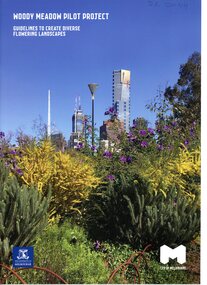
Booklet, The University of Melbourne et al, Woody Meadows Pilot Project, April 2020
... ...university of sheffield...Collaboration between The Univdersity of Melbourne, the University of Sheffield, City of Melbourne and the Royal Botanic Gardens Victoria 2015-2018....The University of Melbourne...University of Sheffield...woody meadows landscape gardening city of melbourne university of sheffield the university of melbourne royal botanic gardens melbourne Booklet with light cardboard covers. ...woody meadows, landscape gardening, city of melbourne, university of sheffield, the university of melbourne, royal botanic gardens melbourne -
 University of Melbourne, Burnley Campus Archives
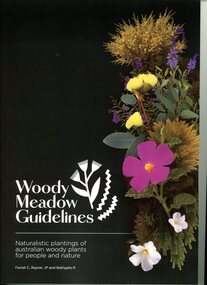
Booklet, Claire Farrell et al, Woody Meadow Guidelines, 2025
... ...university of sheffield...Developed as part of the Woody Meadow Project, a collaborative research partnership between The University of Melbourne, the University of Sheffield and urban green practitioners across Australia....The University of Melbourne...University of Sheffield...Bathgate The University of Melbourne University of Sheffield ...woody meadows, naturalistic plantings, australian woody plants, university of sheffield -
 Flagstaff Hill Maritime Museum and Village
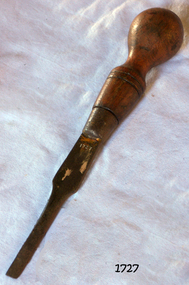
Tool - Screw Driver, A Ridge and Son, 1950s Item is in company catalogue in 1951
... In 2004, Footprint cooperated with the University of Sheffield in a study of modern manufacturing techniques. ...In 2004, Footprint cooperated with the University of Sheffield in a study of modern manufacturing techniques. ...Footprint Tools is a hand tool manufacturer based in Sheffield, England. In 2014 most of their hand tools are still made in Sheffield at the Footprint factory. Footprint Tools can trace its manufacturing history as far back as the 1760s when Alfrid Ridge & Sons was established as a manufacturer of wood working tools. Ridge was bought by the current owning family in 1932. The Footprint brand originates from 1875 when Thomas R Ellin, a member of a cutlery manufacturing family, started a tool manufacturing business under the brand “Footprint”. This subsequently became known as Thomas R Ellin (Footprint Works). This company was bought by the current owning family in 1948 and began to manufacture a range of tools under the Footprint, Domino, Climax, John Bull and Clinker brands. During World War 2 the divisions of the business were engaged in manufacturing hand tools for British and Commonwealth forces. After the war Footprint continued to grow, manufacture and expand its range hand tools for the professional tradesman. In 2004, Footprint cooperated with the University of Sheffield in a study of modern manufacturing techniques. In 2008 Footprint moved to a larger factory and invested in new forging equipment, but this process was interrupted by a global recession, and Footprint was unable to generate enough business to cover the cost of the upgrades. In early 2009 the company was forced to liquidate and lay off its staff in order to pay creditors. The Jewitt family retained the brand and intellectual property, and later that year revived the company under the name Footprint Sheffield, and began producing a smaller range of products at first. With the same family of owner managers, now run by the fourth generation, in 2015 Footprint continues to manufacture most products in Sheffield, England and exports worldwide.A tool that was made by a UK company in the 1950s that has a long history of tool manufacture and after many changes in company ownership is still producing tools today in Sheffield England.Screw driver wooden handle turned and steel blade. Made in Sheffield by Alfrid Ridge and Son. London patternNoneflagstaff hill, warrnambool, shipwrecked-coast, flagstaff-hill, flagstaff-hill-maritime-museum, maritime-museum, shipwreck-coast, flagstaff-hill-maritime-village, screw driver, alfrid ridge & son, footprint tools, tools -
 Orbost & District Historical Society
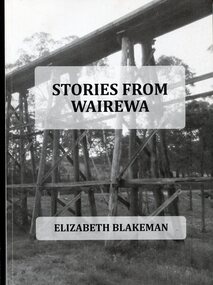
Book, Stories From Wairewa, 2017
... The book was partly the result of two song writing courses, one run on-line for six weeksby Sheffield University, U.K., and another year-long course at U3A in Lakes Entrance, East Gippsland. ...The book was partly the result of two song writing courses, one run on-line for six weeksby Sheffield University, U.K., and another year-long course at U3A in Lakes Entrance, East Gippsland. ...This book is a social history collected orally and from the private records of residents of the Wairewa Valley, Victoria, Australia. It includes a brief history of the old primary school. Appended is a performance piece 'Waltz for Wairewa", a dialogue with poems and songs. It was sponsored by the Hospital Creek Bush Band and Dance Group. The book was partly the result of two song writing courses, one run on-line for six weeksby Sheffield University, U.K., and another year-long course at U3A in Lakes Entrance, East Gippsland. The bridge pictured on the front cover is O'Grady's railway bridge which was severely damaged in the bushfires of January 2020.This item is a useful reference on the history of the Wairewa Valley, East Gippsland.A soft covered book, titled "Stories From Wairewa". On the front cover is a tall wooden rail bridge. the book contains stories, photographs, scanned documents, shet music, drawings and poetry. book-wairewa blakeman-elizabeth school-wairewa -
 Alfred Hospital Nurses League - Nursing History Collection
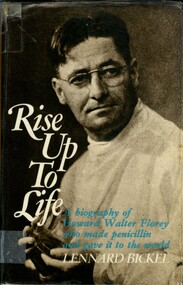
Book - Illustrated book, Lennard Bickel 1913-2002, Rise up to life: a biography of Howard Walter Florey who made penicillin and gave it to the world, 1972
... Howard Florey Penicillin history of medicine-biography "Rise Up to Life" follows Howard Florey’s career from his university days in Adelaide, through the period of his greatest research projects at Oxford, Cambridge and Sheffield which culminated in his success with penicillin, to the final years of his life when he was the first Australian to be elected President of the Royal Society. ..."Rise Up to Life" follows Howard Florey’s career from his university days in Adelaide, through the period of his greatest research projects at Oxford, Cambridge and Sheffield which culminated in his success with penicillin, to the final years of his life when he was the first Australian to be elected President of the Royal Society. But this biography goes beyond exploring with insight and sympathy the life of a great scientist to give the reader a vivid and dramatic picture of the scientific processes that led up to a new discovery and a new era in medicine.Illustrated book with dustjacket. Book is bound in brown cloth with abbreviated title, author's name and printer's mark embossed in gilt on spine. Dustjacket has title printed in white and green and author's name in white print on a black and white photograph of a man with dark hair, wearing glasses and a white coat (Walter Florey), Abbreviated title (in white) author's name (in green) and printer's mark (in black) are printed on a brown background on the spine. The back of the dust jacket has a black and white photo of Penicillin notatum growing in a petri dish."Rise Up to Life" follows Howard Florey’s career from his university days in Adelaide, through the period of his greatest research projects at Oxford, Cambridge and Sheffield which culminated in his success with penicillin, to the final years of his life when he was the first Australian to be elected President of the Royal Society. But this biography goes beyond exploring with insight and sympathy the life of a great scientist to give the reader a vivid and dramatic picture of the scientific processes that led up to a new discovery and a new era in medicine.howard florey, penicillin, history of medicine-biography -
 Chiltern Athenaeum Trust
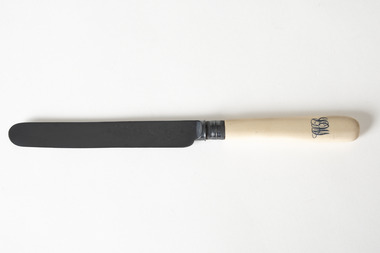
Domestic object - Knife, T. Turner & Co, 1907
... Sheffield, United Kingdom. The trademark is ascribed to goods produced in approximately 1907. The handle of the knife displays the initials 'WB', potentially indicating it was made to order. Wilfred Clarence Busse was born in Chiltern in 1898. He went to school at Wesley College in Melbourne, studied law at the University...Sheffield, United Kingdom. The trademark is ascribed to goods produced in approximately 1907. The handle of the knife displays the initials 'WB', potentially indicating it was made to order. Wilfred Clarence Busse was born in Chiltern in 1898. He went to school at Wesley College in Melbourne, studied law at the University ...This knife is believed to belong to the household of Chiltern writer and historian, W.C. Busse. It displays a level of tarnish indicating it may be comprised of silver or silver plate. The blade contains the mark 'EP' which may indicate silverplate over steel. The blade also contains the maker's mark 'Wingfield', which was the trademark of T. Turner & Co but could also refer to the company Wingfield Rowbotham. Both factories are located in Sheffield, United Kingdom. The trademark is ascribed to goods produced in approximately 1907. The handle of the knife displays the initials 'WB', potentially indicating it was made to order. Wilfred Clarence Busse was born in Chiltern in 1898. He went to school at Wesley College in Melbourne, studied law at the University of Melbourne and became a barrister. Additionally, after spending time on a Victorian station in his early twenties, he wrote two historical novels about bush life. His first novel was 'The Blue Beyond: a Romance of the Early Days in South Eastern Australia', written in 1928 and published in 1930. Busse's second novel was titled 'The Golden Plague: A Romance of the Early Fifties'. The judges of the Henry Lawson Society's T.E. Rofe competition to advance Australian literature unanimously awarded it the Gold Medal in 1931 for the best historical novel of 1930. Newspaper articles about the award mention the writer's meticulous documentary and oral history research regarding life on the Gold Fields in the 1850s. It became a best-seller. Busse also wrote a series of articles about local history for "The Federal Standard" newspaper in Chiltern. He was a member of the Chiltern Athenaeum. He died in 1960.This knife is significant for the detail it conveys of ordinary domestic life in the household of a significant Victorian writer with special reference to Chiltern and the surrounding region. Knife with tarnished patina and cream-coloured handle with owner's initials engraved or stamped.WBw.c. busse, chiltern, gold fields, gold mining, gold rush, north-east victoria, indigo shire, wingfield, t.turner & co, wingfield rowbotham, silver, silverplate, knife, cutlery, silverware, tableware, barrister, wesley college, melbourne, historical fiction, golden plague, blue beyond, henry lawson society, t.e. rofe, 1930s, 1850s -
 Chiltern Athenaeum Trust
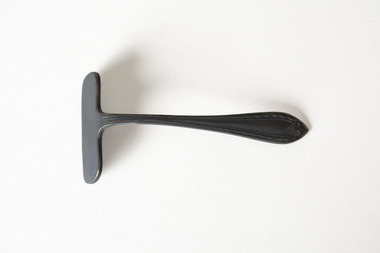
Domestic object - Child's food pusher, J. Biggin & Co, Unknown
... Sheffield, United Kingdom. Pushers such as these were a common utensil in Victorian and early twentieth-century households. They were used to help children too young to use knives learn to eat politely at the table - the blunt blade was used to push food onto the fork. Pushers could also be used to pull food from a serving platter onto an individual plate. Wilfred Clarence Busse was born in Chiltern in 1898. He went to school at Wesley College in Melbourne, studied law at the University...Sheffield, United Kingdom. Pushers such as these were a common utensil in Victorian and early twentieth-century households. They were used to help children too young to use knives learn to eat politely at the table - the blunt blade was used to push food onto the fork. Pushers could also be used to pull food from a serving platter onto an individual plate. Wilfred Clarence Busse was born in Chiltern in 1898. He went to school at Wesley College in Melbourne, studied law at the University ...This children's eating utensil is believed to belong to the household of Chiltern writer and historian, W.C. Busse. The level of tarnish and the mark 'EPNS' may indicate it is electroplated. The blade also contains the maker's mark 'APEX', which was used by John Biggin & Co, Sheffield, United Kingdom. Pushers such as these were a common utensil in Victorian and early twentieth-century households. They were used to help children too young to use knives learn to eat politely at the table - the blunt blade was used to push food onto the fork. Pushers could also be used to pull food from a serving platter onto an individual plate. Wilfred Clarence Busse was born in Chiltern in 1898. He went to school at Wesley College in Melbourne, studied law at the University of Melbourne and became a barrister. Additionally, after spending time on a Victorian station in his early twenties, he wrote two historical novels about bush life. His first novel was 'The Blue Beyond: a Romance of the Early Days in South Eastern Australia', written in 1928 and published in 1930. Busse's second novel was titled 'The Golden Plague: A Romance of the Early Fifties'. The judges of the Henry Lawson Society's T.E. Rofe competition to advance Australian literature unanimously awarded it the Gold Medal in 1931 for the best historical novel of 1930. Newspaper articles about the award mention the writer's meticulous documentary and oral history research regarding life on the Gold Fields in the 1850s. It became a best-seller. Busse also wrote a series of articles about local history for "The Federal Standard" newspaper in Chiltern. He was a member of the Chiltern Athenaeum. He died in 1960.This child's eating utensil is significant for the detail it conveys of ordinary domestic life in the household of a significant Victorian writer with special reference to Chiltern and the surrounding region. It may also be significant in understanding the customs and practices of English-speaking nations in the early Twentieth Century. The object is a metal food pusher, a child's eating utensil with a blunt lozenge at right angles to the handle. The metal is tarnished, indicating that it may be silver or silverplated. APEX EPNS AI w.c. busse, wilfred clarence busse, chiltern, indigo shire, north-east victoria, gold fields, gold mining, gold rush, table manners, etiquette, children, childhood, john biggin & co, sheffield, golden plague, blue beyond, historical fiction, 1930s, 1850s, t.e. rofe, henry lawson society, electroplate, tableware, cutlery
