
Showing 4 items matching "unknown location (bendigo region)"
-
 Bendigo Historical Society Inc.
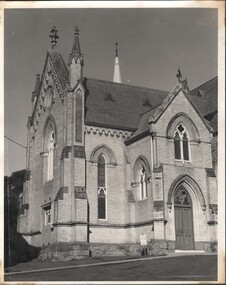
Photograph - National Trust Collection: Cream brick Church - unknown location, 23/06/2025
... ...unknown location (Bendigo region)...National Trust Collection: Church - unknown location (Bendigo region). B&W photograph shows side access/entry to the church. ...historic building bluestyone church unknown location (Bendigo region) National Trust Collection: Church - unknown location (Bendigo region). ...historic buildingNational Trust Collection: Church - unknown location (Bendigo region). B&W photograph shows side access/entry to the church. A cream brick church with decorative brickwork, built on bluestone foundationsbluestyone church, unknown location (bendigo region) -
 Bendigo Military Museum
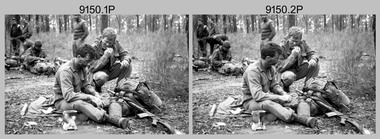
Photograph - Army Survey Regiment - Regimental Training Field Phase, 1998
... This is a set of 43 photographs of Army Survey Regiment personnel undertaking regimental training in an unknown location in the Bendigo region, from the 4th to the 9th of October 1988. ...This is a set of 43 photographs of the Army Survey Regiment undertaking regimental training in in an unknown location in the Bendigo region in 1988. The black and white photographs are on 35mm negative film and scanned at 2400 dpi. ...This is a set of 43 photographs of Army Survey Regiment personnel undertaking regimental training in an unknown location in the Bendigo region, from the 4th to the 9th of October 1988. ...This is a set of 43 photographs of Army Survey Regiment personnel undertaking regimental training in an unknown location in the Bendigo region, from the 4th to the 9th of October 1988. The aim of the training was to provide personnel a practical knowledge of infantry and minor tactics at the section level, navigation and map reading, RATEL and survival in the field. Most of the photos in this set were taken during a water crossing activity.This is a set of 43 photographs of the Army Survey Regiment undertaking regimental training in in an unknown location in the Bendigo region in 1988. The black and white photographs are on 35mm negative film and scanned at 2400 dpi. They are part of the Army Survey Regiment’s Collection. .1) to .2) - Photo, black & white, 1988. L to R: unidentified soldier, WO2 Phil Meagher. In centre background: SPR Brett McAllister. .3) - Photo, black & white, 1988. L to R: unidentified soldier, Phuc ‘Charlie’ Tran. .4) - Photo, black & white, 1988. Unidentified soldiers. .5) - Photo, black & white, 1988, Unidentified soldier. .6) - Photo, black & white, 1988, SPR Ian Brown. .7) - Photo, black & white, 1988, CPL Barry Hogan. .8) - Photo, black & white, 1988, SPR Jann (Caithness) Lambton-Young. .9) - Photo, black & white, 1988. L to R: unidentified (x2), SGT Steve Gloster. .10) - Photo, black & white, 1988. L to R: SGT Lyn Johnson, unidentified (x2), SGT Steve Gloster, unidentified, SGT Greg Anderson, unidentified. .11) & .12) - Photo, black & white, 1988. SPR Brett McAllister. .13) & .14) - Photo, black & white, 1988. Unidentified soldiers. .15) - Photo, black & white, 1988. L to R: SPR Colin Campbell, SPR Rob Jones, unidentified, SGT Paul ‘Hutch’ Hunter. .16) - Photo, black & white, 1988. L to R: unidentified SPR Craig Ferguson, SGT Dale Hudson. .17) to .21) - Photo, black & white, 1988. Unidentified soldiers. .22) - Photo, black & white, 1988. L to R: SGT Brian Collings on the shoulders of an unidentified soldier. .23) to .32) - Photo, black & white, 1988. Unidentified soldiers. .33) - Photo, black & white, 1988. SGT Gary Kerr, unidentified soldiers. .34) - Photo, black & white, 1988. SGT Peter Imeson. .26) to .37) - Photo, black & white, 1988. Unidentified soldiers. .38) - Photo, black & white, 1988. CPL Peter Swandale. .39) - Photo, black & white, 1988. CPL Janet Murray. .40) to .43) - Photo, black & white, 1988. Unidentified soldiers..1P to .43P - no personnel are identified. ‘Regt Training 4-9 Oct 88’ is annotated on negative sleeve.royal australian survey corps, rasvy, army survey regiment, army svy regt, fortuna -
 Bendigo Historical Society Inc.
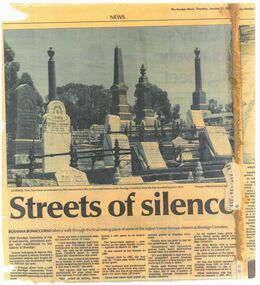
Newspaper - The Bendigo Miner 17 January 2008 - Streets of Silence
... Bendigo Miner, Thursday January 17, 2008. Date of photocopy unknown. Location of original paper unknown. The article was spread across two pages and has been cut from the larger paper. The article is torn, discoloured and folded. "Streets of Silence" is an article where "Rosanna Bonaccurso takes a walk through the final resting place of some of the region's...Bendigo Miner, Thursday January 17, 2008. Date of photocopy unknown. Location of original paper unknown. The article was spread across two pages and has been cut from the larger paper. The article is torn, discoloured and folded. "Streets of Silence" is an article where "Rosanna Bonaccurso takes a walk through the final resting place of some of the region's ...The article references several of Bendigo's famous names including: Anne Caudle, founder of the Anne Caudle Centre (previously the Benevolent Asylum) which was established in March 1860. Sir John Quick, politician known as the Father of the Federation. James Northcott, musician who received a silver cornet. William and Richard Francis, who founded the Beehive Store. Peter Hoey Finn, who carved the bowl of the Alexandra fountain. Elizabeth Watson, the only woman to have died in a mining accident in 1863.A3 colour photocopies of newspaper articles from the Bendigo Miner, Thursday January 17, 2008. Date of photocopy unknown. Location of original paper unknown. The article was spread across two pages and has been cut from the larger paper. The article is torn, discoloured and folded. "Streets of Silence" is an article where "Rosanna Bonaccurso takes a walk through the final resting place of some of the region's most famous citizens at Bendigo Cemetery." newspaper, bendigo cemetery, anne caudle, sir john quick, james northcott, william francis, richard francis, peter hoey finn, elizabeth watson, bendigo, the bendigo miner -
 Northern District School of Nursing. Managed by Bendigo Historical Society Inc.
Administrative record - Northern District School of Nursing List of Students in Preliminary Training Schools (3-44), 1950-59
... location or region of their training. Training sessions are grouped by date, with each session listing all attendees. Covers training sessions from July 1950 through at least late 1959.Sessions are sequentially numbered and dated, showing the progression of training cohorts. The document is structured in tabular format, making it easy to reference individual students and their details. Students come from a wide range of towns and regions, including Bendigo, Mildura, Swan Hill, Castlemaine, Echuca, St. Arnaud, Kyneton, and others. Some addresses are listed as unknown...location or region of their training. Training sessions are grouped by date, with each session listing all attendees. Covers training sessions from July 1950 through at least late 1959.Sessions are sequentially numbered and dated, showing the progression of training cohorts. The document is structured in tabular format, making it easy to reference individual students and their details. Students come from a wide range of towns and regions, including Bendigo, Mildura, Swan Hill, Castlemaine, Echuca, St. Arnaud, Kyneton, and others. Some addresses are listed as unknown ...Managed by a committee including hospital administrators, medical professionals, and nursing leaders from several regional hospitals. Associated with major hospitals in the Northern District, including Bendigo Base, Mildura Base, Castlemaine, Echuca, Swan Hill, St. Arnaud, and Kyneton District Hospitals. Provide high-quality theoretical and practical nursing training. Raise the standard of nursing education in the region. Maintain the highest principles of nursing practice. Applicants must be at least 17 years old and hold a Proficiency Certificate or higher educational qualification. Application involves submitting forms, certificates, an interview, an aptitude test, and a medical examination. A three-month probationary period follows initial acceptance. Preliminary Training School: Four-week introductory course covering basic nursing, anatomy, hygiene, and practical skills. Practical experience in various hospital departments, guided by senior staff. Study Block Plan: Includes several blocks of theoretical and practical instruction throughout the three-year program. Regular school exams and two state exams (First Professional and Final State) are required for progression and graduation. Nurses work a 40-hour week with at least one or two days off per week and three weeks of annual leave. Accommodation is provided in comfortable hostels with good facilities. Uniforms are supplied free; nurses provide their own shoes and stockings. Salaries and allowances are regulated, with deductions for board and free medical care. Additional Information Post-Graduate Opportunities. Senior positions require further experience and additional certificates (e.g., Midwifery, Infant Welfare).Diploma courses available in administration, teaching, and specialized nursing fields. Bursaries are available for advanced study.Career Prospects: Graduates can pursue roles in administration, teaching, ward and departmental leadership, district and visiting nursing, industrial and school nursing, and more. Opportunities exist both within hospitals and in community or specialized settings.FAQs and Practical Details. Minimal training costs (mainly exam fees and personal items).Living out allowances and travel expenses are covered. Four training intakes per year; waiting periods are short if qualifications are met.Northern District School of Nursing List of Students in Preliminary Training Schools (3-44) - 17 pages This item contains the following document: 3791.6a This document is a comprehensive record of students' attendance at Preliminary Training Schools from 1950 to 1959. It lists the names, addresses, and training dates for each student, organized by training session. The document serves as an attendance and registration log for students attending Preliminary Training Schools over several years. Each entry typically includes the student's full name, home address, and the location or region of their training. Training sessions are grouped by date, with each session listing all attendees. Covers training sessions from July 1950 through at least late 1959.Sessions are sequentially numbered and dated, showing the progression of training cohorts. The document is structured in tabular format, making it easy to reference individual students and their details. Students come from a wide range of towns and regions, including Bendigo, Mildura, Swan Hill, Castlemaine, Echuca, St. Arnaud, Kyneton, and others. Some addresses are listed as unknown or only partially available, indicating incomplete records for a few students. Some students have updated names (e.g., married names) or additional notes about their address or status. The document reflects the mobility and diversity of students entering training during this period.nurse training, lister house, list of students
