
Showing 14 items matching "vanity fair"
-
 Whitehorse Historical Society Inc.
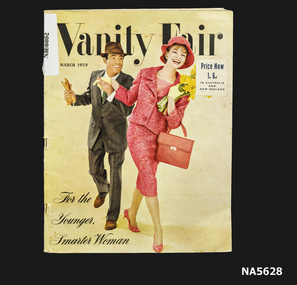
Magazine - Vanity Fair
... Vanity Fair......Vanity Fair magazine...Vanity Fair Fashion Magazine - March 1959 Dress, shoes, make-up advertisements Fashion career advertisements...Vanity Fair Fashion Magazine March 1959 Price 1s. 6d. ...Vanity Fair Fashion Magazine - March 1959 Dress, shoes, make-up advertisements Fashion career advertisements 1959 Fashion for Women Vanity Fair magazine For the younger, smarter Women Vanity Fair Fashion Magazine March 1959 Price 1s. 6d. ...Vanity Fair Fashion Magazine - March 1959 Dress, shoes, make-up advertisements Fashion career advertisementsVanity Fair Fashion Magazine March 1959 Price 1s. 6d. Australian & New Zealand Published by The National Magazine Co. Ltd in London.For the younger, smarter Women1959 fashion for women, vanity fair magazine -
 Flagstaff Hill Maritime Museum and Village
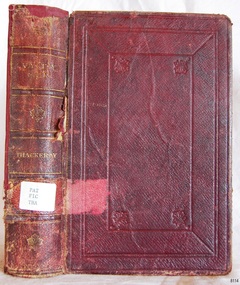
Book, Vanity Fair
... Vanity Fair......vanity fair...Vanity Fair A Novel without a Hero Author: W M Thackeray Edited by George Saintsbury Publisher: Henry Frowde, Oxford University Press Date: 1864...The Warrnambool Mechanics' Institute’s publication collection is of both local and state significance. warrnambool shipwrecked-coast flagstaff-hill flagstaff-hill-maritime-museum maritime-museum shipwreck-coast flagstaff-hill-maritime-village shipwrecked-artefact book pattison collection warrnambool library warrnambool mechanics’ institute ralph eric pattison corangamite regional library service warrnambool city librarian mechanics’ institute library victorian library board warrnambool books and records warrnambool children’s library great ocean road vanity fair w m thackeray george saintsbury Label on spine cover with typed text PAT FIC THA Pastedown front endpaper has sticker from Warrnambool Mechanics Institute and Free Library Pastedown front endpaper has sticker from Corangamite Regional Library Service Vanity Fair A Novel without a Hero Author: W M Thackeray Edited by George Saintsbury Publisher: Henry Frowde, Oxford University Press Date: 1864 Vanity Fair Book ...This item is from the ‘Pattison Collection’, a collection of books and records that was originally owned by the Warrnambool Mechanics’ Institute, which was founded in Warrnambool in 1853. By 1886 the Warrnambool Mechanics’ Institute (WMI) had grown to have a Library, Museum and Fine Arts Gallery, with a collection of “… choice productions of art, and valuable specimens in almost every branch and many wonderful national curiosities are now to be seen there, including historic relics of the town and district.” It later included a School of Design. Although it was very well patronised, the lack of financial support led the WMI in 1911 to ask the City Council to take it over. In 1935 Ralph Pattison was appointed as City Librarian to establish and organise the Warrnambool Library as it was then called. When the WMI building was pulled down in 1963 a new civic building was erected on the site and the new Warrnambool Library, on behalf of the City Council, took over all the holdings of the WMI. At this time some of the items were separated and identified as the ‘Pattison Collection’, named after Ralph Pattison. Eventually the components of the WMI were distributed from the Warrnambool Library to various places, including the Art Gallery, Historical Society and Flagstaff Hill. Later some were even distributed to other regional branches of Corangamite Regional Library and passed to and fro. It is difficult now to trace just where all of the items have ended up. The books at Flagstaff Hill Maritime Village generally display stamps and markings from Pattison as well as a variety of other institutions including the Mechanics’ Institute itself. RALPH ERIC PATTISON Ralph Eric Pattison was born in Rockhampton, Queensland, in 1891. He married Maude Swan from Warrnambool in 1920 and they set up home in Warrnambool. In 1935 Pattison accepted a position as City Librarian for the Warrnambool City Council. His huge challenge was to make a functional library within two rooms of the Mechanics’ Institute. He tirelessly cleaned, cleared and sorted a disarrayed collection of old books, jars of preserved specimens and other items reserved for exhibition in the city’s museum. He developed and updated the library with a wide variety of books for all tastes, including reference books for students; a difficult task to fulfil during the years following the Depression. He converted all of the lower area of the building into a library, reference room and reading room for members and the public. The books were sorted and stored using a cataloguing and card index system that he had developed himself. He also prepared the upper floor of the building and established the Art Gallery and later the Museum, a place to exhibit the many old relics that had been stored for years for this purpose. One of the treasures he found was a beautiful ancient clock, which he repaired, restored and enjoyed using in his office during the years of his service there. Ralph Pattison was described as “a meticulous gentleman whose punctuality, floorless courtesy and distinctive neat dress were hallmarks of his character, and ‘his’ clock controlled his daily routine, and his opening and closing of the library’s large heavy doors to the minute.” Pattison took leave during 1942 to 1945 to serve in the Royal Australian Navy, Volunteer Reserve as Lieutenant. A few years later he converted one of the Museum’s rooms into a Children’s Library, stocking it with suitable books for the younger generation. This was an instant success. In the 1950’s he had the honour of being appointed to the Victorian Library Board and received more inspiration from the monthly conferences in Melbourne. He was sadly retired in 1959 after over 23 years of service, due to the fact that he had gone over the working age of council officers. However he continued to take a very keen interest in the continual development of the Library until his death in 1969. WARRNAMBOOL'S MECHANICS' INSTITUTE Warrnambool's Mechanics' Institute (or Institution as it was sometimes called) was one of the earliest in Victoria. On 17th October 1853 a meeting was held where it was resolved to request the Lieutenant Governor of the Colony to grant land for the erection of a Mechanics' Institutes building. A committee was formed at the meeting and Richard Osburne chaired the first meeting of this committee. The land on the North West corner of Banyan and Merri Streets was granted but there were no funds to erect the building. The Formal Rights of the Warrnambool Mechanics' Institute's encompassed its aims and these were officially adopted in1859; "This Institution has for its object the diffusion of literary, scientific, and other useful knowledge amongst its members, excluding all controversial subjects, religious or political. These objects are sought to be obtained by means of a circulating library, a reading room, the establishment of classes, debates, and the occasional delivery of lectures on natural and experimental philosophy, mechanics, astronomy, chemistry, natural history, literature, and the useful and ornamental arts, particularly those which have a more immediate reference to the colony." The Warrnambool Mechanics' Institute opened its first reading room in November1884 in the National School building at the corner of Banyan and Timor Streets. The Institute was funded by member subscription, payable on a quarterly, half yearly or yearly basis. Samuel Hannaford, the Manager of the Warrnambool Bank of Australasia, was the first Honorary Secretary of the Mechanics' Institutes, and an early President and Vice-President. He also gave several of the early lectures in the Reading Room. Another early Secretary, Librarian and lecturer was Marmaduke Fisher, the teacher at the National School. Lecture topics included The Poets and Poetry of Ireland', 'The Birth and Development of the Earth', 'The Vertebrae - with Remarks on the pleasures resulting from the study of Natural History' and 'Architecture'. In 1856 the Reading Room was moved to James Hider's shop in Timor Street, and by 1864 it was located in the bookshop of Davies and Read. In the 1860's the Mechanics' Institute struggled as membership waned but in 1866, after a series of fund raising efforts, the committee was able to purchase land in Liebig Street, on a site then called Market Square, between the weighbridge and the fire station. A Mechanics' Institute building was opened at this site in August 1871. The following year four more rooms were added to the main Reading Room and in 1873 the Artisan School of Design was incorporated into the Institute. The same year Joseph Archibald established a Museum; however it deteriorated when he was transferred to Bendigo in 1877. In 1880, with Archibald's return to Warrnambool, the Museum was re-established, and in 1885 a new building was built at the back of the Institute to accommodate the re-created School of Design, the Art Gallery and the Museum. In 1887 the Museum section was moved to the former court house in Timor Street (for some time the walls of the building formed part of the TAFE cafeteria but all is now demolished)). In 1911 the Museum was transferred back to the original building and the management of the Mechanics' Institute was handed over to the Warrnambool City Council. The Museum and Art Gallery became one and housed many fine works of art, and the Library continued to grow. The building was well patronised, with records showing that at the beginning of the 20th century there were between 500 and 800 visitors. During World War One the monthly figures were in the thousands, with 3,400 people visiting in January 1915. The Museum was a much loved Institution in Warrnambool until the contents of the Museum and Art Gallery were removed to make room for the Warrnambool City Council Engineers' Department. The contents were stored but many of the items were scattered or lost. When the original building was demolished the site became occupied by the Civic Centre, which included the new City Library. (The library was temporarily located in the old Palais building in Koroit Street.) In the process of reorganisation the Collection was distributed amongst the community groups: -The new City Library took some of the historic books and some important documents, historic photographs and newspapers. -The Art Gallery kept the 19th Century art collection and some of the artefacts from the museum. -The Historic Society has some items -The State Museum has some items -Some items were destroyed -Flagstaff Hill Maritime Village has old newspapers, Government Gazettes, most of the Mechanics' Institute Library, ledgers and documents connected to the Mechanics' Institute Library, some framed and unframed art works and some photographs. The Warrnambool Mechanics' Institute Library book collection is deemed to be of great importance because it is one of the few collections in an almost intact state, and many of the books are now very rare and of great value. The Pattison Collection, along with other items at Flagstaff Hill Maritime Village, was originally part of the Warrnambool Mechanics' Institute’s collection. The Warrnambool Mechanics’ Institute Collection is primarily significant in its totality, rather than for the individual objects it contains. Its contents are highly representative of the development of Mechanics' Institute libraries across Australia, particularly Victoria. A diversity of publications and themes has been amassed, and these provide clues to our understanding of the nature of and changes in the reading habits of Victorians from the 1850s to the middle of the 20th century. The collection also highlights the Warrnambool community’s commitment to the Mechanics’ Institute, reading, literacy and learning in the regions, and proves that access to knowledge was not impeded by distance. These items help to provide a more complete picture of our community’s ideals and aspirations. The Warrnambool Mechanics Institute book collection has historical and social significance for its strong association with the Mechanics Institute movement and the important role it played in the intellectual, cultural and social development of people throughout the latter part of the nineteenth century and the early twentieth century. The collection of books is a rare example of an early lending library and its significance is enhanced by the survival of an original collection of many volumes. The Warrnambool Mechanics' Institute’s publication collection is of both local and state significance. Vanity Fair A Novel without a Hero Author: W M Thackeray Edited by George Saintsbury Publisher: Henry Frowde, Oxford University Press Date: 1864Label on spine cover with typed text PAT FIC THA Pastedown front endpaper has sticker from Warrnambool Mechanics Institute and Free Library Pastedown front endpaper has sticker from Corangamite Regional Library Servicewarrnambool, shipwrecked-coast, flagstaff-hill, flagstaff-hill-maritime-museum, maritime-museum, shipwreck-coast, flagstaff-hill-maritime-village, shipwrecked-artefact, book, pattison collection, warrnambool library, warrnambool mechanics’ institute, ralph eric pattison, corangamite regional library service, warrnambool city librarian, mechanics’ institute library, victorian library board, warrnambool books and records, warrnambool children’s library, great ocean road, vanity fair, w m thackeray, george saintsbury -
 Sunshine and District Historical Society Incorporated
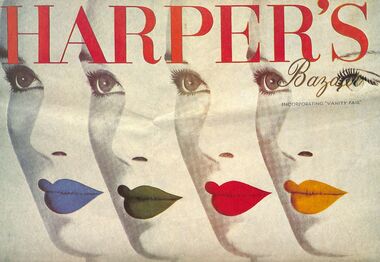
Poster - Haper's Incorporating Vanity Fair Poster, 15097
... Haper's Incorporating Vanity Fair Poster...Haper's Incorporating Vanity Fair Poster May 19441 Summer Fashions Two Shillings & Sixpence...This is typical newspaper advertising supplement during WW2 Haper's Incorporating Vanity Fair Poster May 19441 Summer Fashions Two Shillings & Sixpence A color advertising poster newspaper supplement Poster Haper's Incorporating Vanity Fair Poster ...This is typical newspaper advertising supplement during WW2Haper's Incorporating Vanity Fair Poster May 19441 Summer Fashions Two Shillings & Sixpence -
 Phillip Island and District Historical Society Inc.
Book, THACKERAY, William Makepeace, Vanity Fair, 1848?
... Vanity Fair...Not to be removed', 'Cowes Free Public Library'. Vanity Fair Book THACKERAY, William Makepeace Odhams ...Labelled: Cowes Free Public Library. Labelled: Phillip Island Historical Society, Cleeland Bequest. Stamped 'P.I. Municipal Library. Not to be removed', 'Cowes Free Public Library'. -
 Mrs Aeneas Gunn Memorial Library
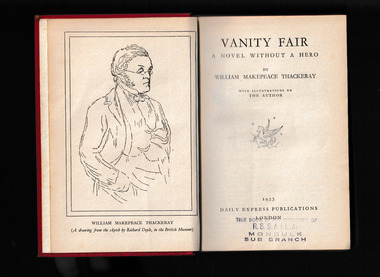
Book, William Makepeace Thackeray, Vanity Fair, 1933
... Vanity Fair...Social battles are waged against the backdrop of the Napoleonic Wars, and when the smoke finally clears, there's no telling who will come out victorious. Ill, p.623. Vanity Fair Book William Makepeace Thackeray Daily Express Publications ...This classic story of two nineteenth-century social climbers is the basis for countless films and TV series, and one of the UK's "Best-Loved Novels." Before the Real Housewives, there were Becky Sharp and Amelia Sedley. Ruthless and cunning, Becky may have been born in a lower class, but now that she's graduated from school, she's ready to climb up to a better life-and do whatever it takes to get there. Her friend Emmy, however, is the opposite. She may have mastered music, dancing, and embroidery like any young woman of her class, but she utterly lacks a backbone. Together these friends navigate the perils of Regency society as they search for love and happiness. Social battles are waged against the backdrop of the Napoleonic Wars, and when the smoke finally clears, there's no telling who will come out victorious.Ill, p.623.fictionThis classic story of two nineteenth-century social climbers is the basis for countless films and TV series, and one of the UK's "Best-Loved Novels." Before the Real Housewives, there were Becky Sharp and Amelia Sedley. Ruthless and cunning, Becky may have been born in a lower class, but now that she's graduated from school, she's ready to climb up to a better life-and do whatever it takes to get there. Her friend Emmy, however, is the opposite. She may have mastered music, dancing, and embroidery like any young woman of her class, but she utterly lacks a backbone. Together these friends navigate the perils of Regency society as they search for love and happiness. Social battles are waged against the backdrop of the Napoleonic Wars, and when the smoke finally clears, there's no telling who will come out victorious.england - fiction, romantic fiction -
 Tennis Australia
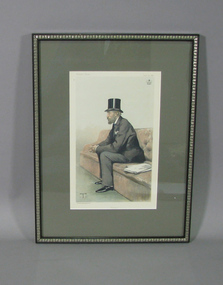
Page from Magazine, 23 Sep 1882
... Page from Vanity Fair featuring lithograph entitled 'TENNIS'. ...Tennis Page from Vanity Fair featuring lithograph entitled 'TENNIS'. ...Page from Vanity Fair featuring lithograph entitled 'TENNIS'. Materials: Paper, Ink, Cardboard, Glass, Metal, Woodtennis -
 Tennis Australia
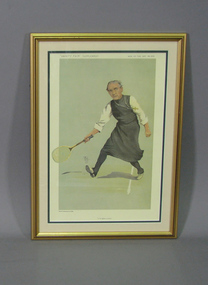
Page from Magazine, Circa 1895
... Page from Vanity Fair Supplement, section 'MEN OF THE DAY NO.2273', featuring a colour lithograph entitled 'IN HIS LIGHTER MOMENTS'. ...Tennis Page from Vanity Fair Supplement, section 'MEN OF THE DAY NO.2273', featuring a colour lithograph entitled 'IN HIS LIGHTER MOMENTS'. ...Page from Vanity Fair Supplement, section 'MEN OF THE DAY NO.2273', featuring a colour lithograph entitled 'IN HIS LIGHTER MOMENTS'. UV glass. Materials: Paper, Ink, Wood, Cardboard, Glasstennis -
 Tennis Australia
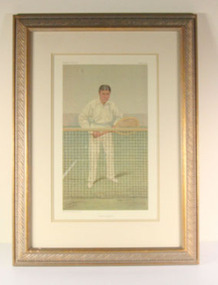
Page from Magazine, 1-Sep-04
... Framed page from Vanity Fair magazine with illustration of male tennis player in white tennis attire, standing behind net, ready to receive ball. ...Tennis Framed page from Vanity Fair magazine with illustration of male tennis player in white tennis attire, standing behind net, ready to receive ball. ...Framed page from Vanity Fair magazine with illustration of male tennis player in white tennis attire, standing behind net, ready to receive ball. Caption reads 'Thrice Champion'. Date at top right. Materials: Wood, Paper, Ink, Glasstennis -
 Kew Historical Society Inc
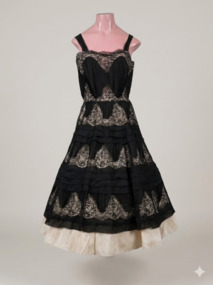
Clothing - Cocktail Dress, House of Lucas, 1950s
... The company was a pioneer in Australian textiles, producing the country's very first knitted nylon tricot and manufacturing luxury Vanity Fair lingerie under license for the domestic market. ...The company was a pioneer in Australian textiles, producing the country's very first knitted nylon tricot and manufacturing luxury Vanity Fair lingerie under license for the domestic market. ...Founded in Ballarat, Victoria in 1888 by Eleanor Lucas, by the mid-20th century, the Lucas Clothing Factory employed hundreds of local workers (popularly known as the "Lucas Girls"). The company was a pioneer in Australian textiles, producing the country's very first knitted nylon tricot and manufacturing luxury Vanity Fair lingerie under license for the domestic market. As Lucas shifted from utility wear and intimate apparel into upscale daytime and evening wear during the 1940s and 1950s, they launched specialised fashion lines. The Jill Heriote line was created as their signature high-end ready-to-wear and cocktail range. The line became widely celebrated for its elite tailoring, structure, and use of both premium local and imported fabrics Designers working under this line, such as Eve Ogilvie, translated sophisticated European aesthetic trends directly to the Australian market..This garment represents a pinnacle of mid-century regional Australian fashion manufacturing. Operating from Ballarat, Victoria, E. Lucas & Co. utilised elite local designers to compete directly with imported European couture houses. The gown showcases the firm’s pioneering expertise in fine, permanent textile pleating, applied here to luxury pure silk rather than everyday synthetics.This bias-cut silk and lace cocktail dress sold under the label 'Jill Heriote' for the House of Lucas, Ballarat, features a narrow waist and a dramatically flared skirt. The overdress is constructed from intricate, black imitation Valenciennes machine-made lace. It layers over a cream synthetic underdress that peeks through the openwork and extends structurally past the hemline. The bodice is designed with delicate shoulder straps leading into a sweetheart neckline. Its form-fitting structure showcases panels of finely pleated black silk, creating texture across the bust. Below, the full skirt alternates between sheer black lace segments and contrasting horizontal bands of smooth black silk.Label" 'LUCAS / Jill Heriote / in pure silk fabric'jill heriote, house of lucas -- ballarat (vic.), fashion -- 1950s, cocktail dresses, manufacturing -- ballarat -
 Wodonga & District Historical Society Inc
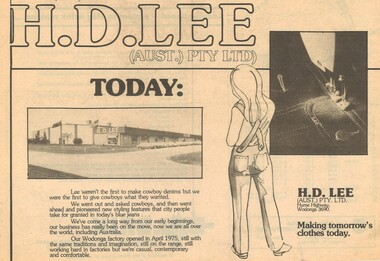
Article - H. D. Lee Wodonga
... Lee (Aust) was established in 1973 as a joint venture between Yakka Pty Ltd and Vanity Fair. In 1973 it decided to move to Albury-Wodonga, encouraged by government decentralisation assistance, lower overheads and the central location of the region. ...Lee (Aust) was established in 1973 as a joint venture between Yakka Pty Ltd and Vanity Fair. In 1973 it decided to move to Albury-Wodonga, encouraged by government decentralisation assistance, lower overheads and the central location of the region. ...H.D. Lee (Aust) was established in 1973 as a joint venture between Yakka Pty Ltd and Vanity Fair. In 1973 it decided to move to Albury-Wodonga, encouraged by government decentralisation assistance, lower overheads and the central location of the region. H.D. Lee opened a temporary pilot factory with 12 staff in Kiewa Street, Albury, in January 1974 while a new 50,000 sq. ft. factory for 400 staff was built on council land in West Wodonga. This was erected by local builders Zauner Construction, completed in late 1974 and began operations in April 1975. The factory became Australia’s second largest jeans manufacturer and employment in Wodonga at times exceeded 400 staff. In 1991 Yakka, which already owned 50 per cent of the H.D. Lee shares, bought out the rest. It quickly moved to reduce staff and transferred the administration to Broadmeadows. By 1997, the workforce had fallen to 110, and production of Lee and Faberge jeans, jackets and shorts gave way mostly to industrial wear.This item is significant because it documents an important industry and employer in Wodonga in the 1970s.A newspaper article explaining the H. D. Lee business in Wodonga.h. d. lee, decentralisation victoria -
 Wodonga & District Historical Society Inc
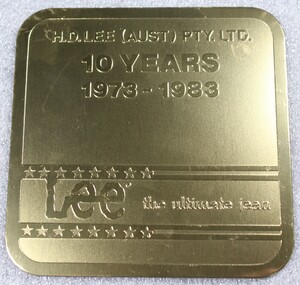
Memorabilia - Souvenir Coasters - H. D. Lee Pty. Ltd, Stephen Daly, 1983
... Lee (Aust) was established in 1973 as a joint venture between Yakka Pty Ltd and Vanity Fair. In 1973 it decided to move to Albury-Wodonga, encouraged by government decentralisation assistance, lower overheads and the central location of the region. ...Lee (Aust) was established in 1973 as a joint venture between Yakka Pty Ltd and Vanity Fair. In 1973 it decided to move to Albury-Wodonga, encouraged by government decentralisation assistance, lower overheads and the central location of the region. ...H.D. Lee (Aust) was established in 1973 as a joint venture between Yakka Pty Ltd and Vanity Fair. In 1973 it decided to move to Albury-Wodonga, encouraged by government decentralisation assistance, lower overheads and the central location of the region. H.D. Lee opened a temporary pilot factory with 12 staff in Kiewa Street, Albury, in January 1974 while a new 50,000 sq. ft. factory for 400 staff was built on council land in West Wodonga. This was erected by local builders Zauner Construction, completed in late 1974 and began operations in April 1975. The factory became Australia’s second largest jeans manufacturer and employment in Wodonga at times exceeded 400 staff. In 1991 Yakka, which already owned 50 per cent of the H.D. Lee shares, bought out the rest. It quickly moved to reduce staff and transferred the administration to Broadmeadows. By 1997, the workforce had fallen to 110, and production of Lee and Faberge jeans, jackets and shorts gave way mostly to industrial wear.These coasters represent an industry which was a major employer in Wodonga. The establishment of H. D. Lee (Aust) was a direct result of Australian government's policy of decentralisation in the 1970s. A blue box containing 6 coasters to commemorate 10 years of H.D. Lee operations in Australia. Coasters are gold and include the Lee company logo. The box also includes information regarding the background of the manufacturer, Paul-Stephen Daly.On top half of coaster "H.D. LEE (AUST) PTY LTD /10 YEARS/ 1973-1983" Between lines of stars "Lee the ultimate jean"h.d. lee, wodonga, decentralisation, paul-stephen daly -
 Flagstaff Hill Maritime Museum and Village
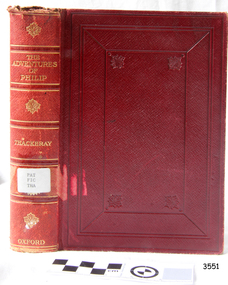
Book - A Fictional Story, William Makepeace Thackeray et al, The Adventures of Philip, 1908
... He achieved immense fame with Vanity Fair (1847–1848), establishing himself as Charles Dickens’s chief literary rival. ...He achieved immense fame with Vanity Fair (1847–1848), establishing himself as Charles Dickens’s chief literary rival. ...The Adventures of Philip on His Way Through the World was originally serialised in The Cornhill Magazine from 1861 to 1863 and is Thackeray's final completed novel. The story is heavily semi autobiographical, reflecting Thackeray's own youth, early struggles, and financial losses. The narrative follows Philip Firmin, a passionate, blustering, but fundamentally good hearted young man. He stands to inherit a comfortable fortune from his late mother. However, Philip is completely betrayed by his own father, the aristocratic and deceitful Dr Brandon Firmin. The doctor secretly squanders, swindles, and speculates away his son's entire inheritance, leaving Philip financially ruined. Forced to make his own way in the world, Philip moves to Paris to work as a struggling journalist. He falls in love and marries Charlotte Baynes, despite having almost no income. The novel becomes an intense critique of Victorian societal expectations, exploring the crushing anxiety of genteel poverty, the snobbery of wealthy relatives, and Philip's struggle to maintain his pride and integrity while desperately trying to support his growing family.The Adventures of Philip Author: William Makepeace Thackeray Publisher: Henry Frowde Oxford University Press Date: 1908fictionThe Adventures of Philip on His Way Through the World was originally serialised in The Cornhill Magazine from 1861 to 1863 and is Thackeray's final completed novel. The story is heavily semi autobiographical, reflecting Thackeray's own youth, early struggles, and financial losses. The narrative follows Philip Firmin, a passionate, blustering, but fundamentally good hearted young man. He stands to inherit a comfortable fortune from his late mother. However, Philip is completely betrayed by his own father, the aristocratic and deceitful Dr Brandon Firmin. The doctor secretly squanders, swindles, and speculates away his son's entire inheritance, leaving Philip financially ruined. Forced to make his own way in the world, Philip moves to Paris to work as a struggling journalist. He falls in love and marries Charlotte Baynes, despite having almost no income. The novel becomes an intense critique of Victorian societal expectations, exploring the crushing anxiety of genteel poverty, the snobbery of wealthy relatives, and Philip's struggle to maintain his pride and integrity while desperately trying to support his growing family.shipwrecked-coast, flagstaff-hill, flagstaff-hill-maritime-museum, warrnambool, maritime-museum, shipwreck-coast, flagstaff-hill-maritime-village, shipwrecked-artefact, book, pattison collection, warrnambool library, warrnambool mechanics’ institute, ralph eric pattison, corangamite regional library service, warrnambool city librarian, mechanics’ institute library, victorian library board, warrnambool books and records, warrnambool children’s library, great ocean road, the virginians-, william makepeace thackeray -
 Flagstaff Hill Maritime Museum and Village
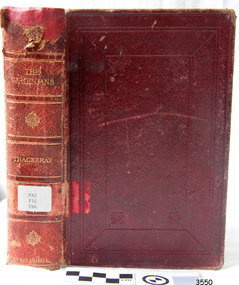
Book - A Fictional Story, William Makepeace Thackeray, The Virginians, 1908
... He achieved immense fame with Vanity Fair (1847–1848), establishing himself as Charles Dickens’s chief literary rival. ...He achieved immense fame with Vanity Fair (1847–1848), establishing himself as Charles Dickens’s chief literary rival. ...The Virginians: A Tale of the Last Century was originally published in serial numbers from 1857 to 1859. It is a sweeping historical novel set against the backdrop of the Seven Years’ War and the lead-up to the American Revolutionary War. It acts as a sequel to Thackeray’s earlier masterpiece, The History of Henry Esmond. The plot follows Henry Esmonds twin grandsons, George and Harry Warrington. Born in Virginia, the brothers are separated when the studious older twin, George, is presumed dead after a disastrous military expedition alongside a young George Washington. The plot goes on to tell of the younger, more impulsive twin, Harry, travelling to England to visit wealthy relatives. Mistaken for a rich heir, he gets swept up in high society, falls prey to fortune hunters, and racks up massive gambling debts. George unexpectedly resurfaces alive, saves his brother from ruin, and the narrative eventually tracks their split allegiances as the American Revolution begins to fracture the family.The Virginians Author: William Makepeace Thackeray Publisher: Henry Frowde Oxford University Press Date: 1908 The Virginians-- A tale of the last centuryfictionThe Virginians: A Tale of the Last Century was originally published in serial numbers from 1857 to 1859. It is a sweeping historical novel set against the backdrop of the Seven Years’ War and the lead-up to the American Revolutionary War. It acts as a sequel to Thackeray’s earlier masterpiece, The History of Henry Esmond. The plot follows Henry Esmonds twin grandsons, George and Harry Warrington. Born in Virginia, the brothers are separated when the studious older twin, George, is presumed dead after a disastrous military expedition alongside a young George Washington. The plot goes on to tell of the younger, more impulsive twin, Harry, travelling to England to visit wealthy relatives. Mistaken for a rich heir, he gets swept up in high society, falls prey to fortune hunters, and racks up massive gambling debts. George unexpectedly resurfaces alive, saves his brother from ruin, and the narrative eventually tracks their split allegiances as the American Revolution begins to fracture the family. shipwrecked-coast, flagstaff-hill, flagstaff-hill-maritime-museum, warrnambool, maritime-museum, shipwreck-coast, flagstaff-hill-maritime-village, shipwrecked-artefact, book, pattison collection, warrnambool library, warrnambool mechanics’ institute, ralph eric pattison, corangamite regional library service, warrnambool city librarian, mechanics’ institute library, victorian library board, warrnambool books and records, warrnambool children’s library, great ocean road, the virginians-, william makepeace thackeray -
 Flagstaff Hill Maritime Museum and Village
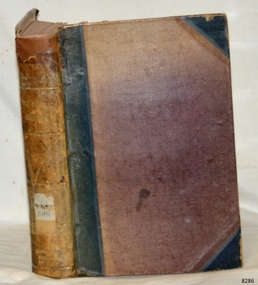
Book - Literary Work, John Bunyan, The Pilgrims Progress, 1850
... He must navigate legendary, treacherous obstacles like the Slough of Despond, the temptations of Vanity Fair, and a terrifying battle with the demon Apollyon. ...Written in 1678, The Pilgrim's Progress is a deeply influential Christian allegory that tracks the spiritual journey of a man named Christian. Weighed down by a crushing burden on his back (representing his sins), Christian flees his home in the "City of Destruction", after reading a holy book. Guided by the evangelist Evangelist, he embarks on a perilous trek toward the Celestial City (Heaven). Along the way, his journey brings him face-to-face with a cast of characters who personify spiritual triumphs and trials, such as Faithful, Hopeful, Mr Worldly Wiseman, and Giant Despair. He must navigate legendary, treacherous obstacles like the Slough of Despond, the temptations of Vanity Fair, and a terrifying battle with the demon Apollyon. The narrative is structured as a dream sequence experienced by the narrator. Because the second half follows Christian's wife, Christiana, and their children on the same path, it functions as both an adventure tale and a road map for the Puritan concept of salvation. It should be noted that the 1850 George Virtue printing is a classic example of a mid-Victorian luxury reprint. It is highly notable because it was curated by the popular non-conformist minister and author Rev. Robert Philip.The Pilgrims Progress Author: John Bunyan Curated By: Rev. Robert Philip Publisher: George Virtue Date: 1850 Further Information: Red hardcover with a red spine and reinforced corners, lettering in gilt. The spine has a Library label with an inscription.fictionWritten in 1678, The Pilgrim's Progress is a deeply influential Christian allegory that tracks the spiritual journey of a man named Christian. Weighed down by a crushing burden on his back (representing his sins), Christian flees his home in the "City of Destruction", after reading a holy book. Guided by the evangelist Evangelist, he embarks on a perilous trek toward the Celestial City (Heaven). Along the way, his journey brings him face-to-face with a cast of characters who personify spiritual triumphs and trials, such as Faithful, Hopeful, Mr Worldly Wiseman, and Giant Despair. He must navigate legendary, treacherous obstacles like the Slough of Despond, the temptations of Vanity Fair, and a terrifying battle with the demon Apollyon. The narrative is structured as a dream sequence experienced by the narrator. Because the second half follows Christian's wife, Christiana, and their children on the same path, it functions as both an adventure tale and a road map for the Puritan concept of salvation. It should be noted that the 1850 George Virtue printing is a classic example of a mid-Victorian luxury reprint. It is highly notable because it was curated by the popular non-conformist minister and author Rev. Robert Philip. flagstaff hill, warrnambool, shipwrecked coast, flagstaff hill maritime museum, maritime museum, shipwreck coast, flagstaff hill maritime village, great ocean road, book, pattison collection, warrnambool library, warrnambool mechanics’ institute, ralph eric pattison, corangamite regional library service, warrnambool city librarian, mechanics’ institute library, victorian library board, warrnambool books and records, warrnambool children’s library, the pilgrims progress, john bunyan
