
Showing 2 items matching "various other charts for wind velocities "
-
 Moorabbin Air Museum
Book - Aerial navigation, Charts of the Atmosphere for Aeronauts and Aviators
... ...Various other charts for wind velocities & frequencies...Aerial navigation Relative heights/atmospheric density & temperature Average temperature/barometric pressure/wind velocity & pressure up to 30000 feet Wind pressures for constant velocities up to 10000 &30000 feet Various other charts for Blue Hill Various other charts for wind velocities & frequencies Collection of atmospheric charts, circa 1911 Charts of the Atmosphere for Aeronauts and Aviators Book Aerial navigation ...Collection of atmospheric charts, circa 1911non-fictionCollection of atmospheric charts, circa 1911relative heights/atmospheric density & temperature, average temperature/barometric pressure/wind velocity & pressure up to 30000 feet, wind pressures for constant velocities up to 10000 &30000 feet, various other charts for blue hill, various other charts for wind velocities & frequencies -
 Department of Energy, Environment and Climate Action
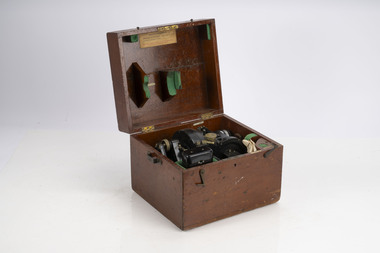
Balloon Theodolite 1943
... other (horizontal) azimuth. There are vernier scales and in some cases micrometres that give precise readouts of the relative position of the telescope to each axis. The instrument is set up so that it is level and it is pointed towards true north with both scales reading 0 degrees exactly. A balloon is released in front of the theodolite. It is sighted at timed intervals (usually one minute apart) and the position of the theodolite's telescope (azimuth and elevation) is recorded. It can chart the direction and velocity of winds at various...other (horizontal) azimuth. There are vernier scales and in some cases micrometres that give precise readouts of the relative position of the telescope to each axis. The instrument is set up so that it is level and it is pointed towards true north with both scales reading 0 degrees exactly. A balloon is released in front of the theodolite. It is sighted at timed intervals (usually one minute apart) and the position of the theodolite's telescope (azimuth and elevation) is recorded. It can chart the direction and velocity of winds at various ...Used to measure the rate of rise of helium balloons The telescope is mounted on two movable axes. One axis (vertical) rotates to change elevation, the other (horizontal) azimuth. There are vernier scales and in some cases micrometres that give precise readouts of the relative position of the telescope to each axis. The instrument is set up so that it is level and it is pointed towards true north with both scales reading 0 degrees exactly. A balloon is released in front of the theodolite. It is sighted at timed intervals (usually one minute apart) and the position of the theodolite's telescope (azimuth and elevation) is recorded. It can chart the direction and velocity of winds at various altitudes The rate of ascent of a balloon is mostly dependant on the balloon's drag and its "free lift" (the vertical pull of the balloon). There is some degree of control over these these factors, and as a result, it possible to know approximately how high our balloon will be at any given time after its release. Given a known height and an angular direction (read off the theodolite) to the balloon, a fix is made of the horizontal movement component of the balloon's travel as it moves through different altitudes. The horizontal movement is due to the winds blowing the balloon around at the altitudes that the balloon is traveling throughTheodolite used to measure the rate of rising helium balloons The rate of rise is used in atmospheric calculations such as upper winds and determining inversion layersforests commission victoria (fcv), bushfire, weather
