
Showing 7 items matching "vernacular building"
-
 Coal Creek Community Park & Museum
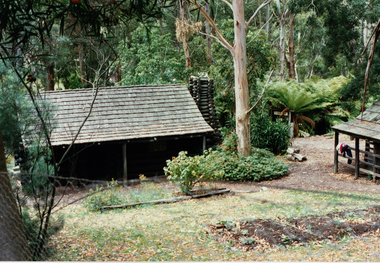
Photograph, Log Cabin and bushland - Coal Creek Community Park & Museum
... ...vernacular building...The building was constructed on-site circa 1980s, and has since been demolished. bush setting Coal Creek Community Park & Museum log cabin pioneer architecture vernacular building Kodak paper, printer code on reverse SQPIX 00420 NNNNA this image shows the rear view of the log cabin and the corner of an adjacent building, surrounded by bushland at Coal Creek Community Park & Museum. ...This image is significant as a surviving visual record of the log cabin building and adjacent structure. The building was constructed on-site circa 1980s, and has since been demolished.this image shows the rear view of the log cabin and the corner of an adjacent building, surrounded by bushland at Coal Creek Community Park & Museum.Kodak paper, printer code on reverse SQPIX 00420 NNNNAbush setting, coal creek community park & museum, log cabin, pioneer architecture, vernacular building -
 The Beechworth Burke Museum
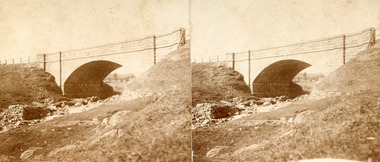
Photograph - Stereoscopic Photograph, Unknown c1875
... buildings made with the granite unique to the area, the honey-toned material distinct to Beechworth. This photograph is historically significant as it provides insight into the industrial development of Beechworth and the surrounding area, contributed to by the goldfields. The photograph further captures the representation of vernacular ...Depicted in the photograph is Newtown Bridge or the Newtown Falls Bridge, in Beechworth, Victoria. Noted for its location, detailed craftsmanship and stonemasonry by Scottish stonemasons the Newtown Bridge was built in the 19th century provincial town of Beechworth (completed in 1875). The bridge was built over Spring Creek, spanning 6.3 meters wide and 24.8 meters tall. Beechworth held a distinct role in the administrative and commercial management of Victoria's north-eastern goldfields, with many objects and structures still well preserved from the towns establishment. The bridge indicates the growth of the town, replacing a previous timber structure as well as its association to the mining activity in the area and the rapid increase in Australia's economy that led to investment and development of roads and railways. The local granite used in the construction of the single arch Newtown Bridge makes the bridge and other buildings made with the granite unique to the area, the honey-toned material distinct to Beechworth. This photograph is historically significant as it provides insight into the industrial development of Beechworth and the surrounding area, contributed to by the goldfields. The photograph further captures the representation of vernacular engineering traditions and Scottish stonemasonry.Two sepia-toned rectangular photographs featuring a bridge in the background printed on matte photographic paper mounted on card.Reverse: 97.2324/ Newtown Bridge/ Beechworthbridge, newtown beechworth, newtown bridge, newtown, beechworth, beechworth falls bridge, beechworth mining district, spring creek, -
 Eltham District Historical Society Inc
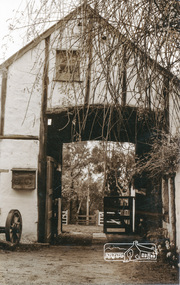
Photograph, Stables, Montsalvat
... "Many of the buildings (including.. the stable near the animal yard) were designed by Justus Jorgensen in Gothic and/or vernacular styles using mud brick and recycled materials" - Victorian Heritage Database Photo possibly taken by Peter Bassett-Smith. ..."Many of the buildings (including.. the stable near the animal yard) were designed by Justus Jorgensen in Gothic and/or vernacular styles using mud brick and recycled materials" - Victorian Heritage Database Photo possibly taken by Peter Bassett-Smith. ...Photograph of stables at Montsalvat, Eltham. Montsalvat is an artist colony, established by Justus Jorgensen in 1934. It is home to over a dozen buildings, houses and halls set amongst richly established gardens on 48,562 m2 (12 acres) of land (Wikpedia). "Many of the buildings (including.. the stable near the animal yard) were designed by Justus Jorgensen in Gothic and/or vernacular styles using mud brick and recycled materials" - Victorian Heritage Database Photo possibly taken by Peter Bassett-Smith. No date. Montsalvat is historically, technically, architecturally, aesthetically, socially and spiritually significant to the State of Victoria.The Montsalvat complex is historically significant because it was established in 1934 by the noted artist and architect Justus Jorgensen. (Victorian Heritage Register)1 photographeltham, montsalvat, stables -
 Robin Boyd Foundation
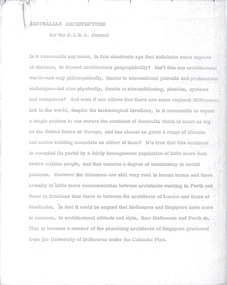
Document - Manuscript, Robin Boyd, Australian Architecture, 1971
... Discussion of Architectural professional techniques (organisation of the profession, from the societies, registration etc and the growth in the profession, office practices) public and private practices (eg Commonwealth Department of Works,), research and regulations (eg building research, CSIRO), and theory and practice (the vernacular, the professional and the creative)....Discussion of Architectural professional techniques (organisation of the profession, from the societies, registration etc and the growth in the profession, office practices) public and private practices (eg Commonwealth Department of Works,), research and regulations (eg building research, CSIRO), and theory and practice (the vernacular, the professional and the creative). ...Discussion of Architectural professional techniques (organisation of the profession, from the societies, registration etc and the growth in the profession, office practices) public and private practices (eg Commonwealth Department of Works,), research and regulations (eg building research, CSIRO), and theory and practice (the vernacular, the professional and the creative).Original manuscript of an article published as 'Architecture in Australia’ in RIBA Journal, Vol.78, No.1, January 1971, pp.11-20.Typewritten (p/copy), quarto, 22 pagesaustralian architecture, royal australian institute of architects, the architecture profession, package dealing, australian architecture students association, public and private practice, commonwealth department of works, building research, csiro, building regulations, john andrews, robin boyd, manuscript -
 Box Hill Historical Society
Book, Penguin, Australia's home: its origins, builders and occupiers, 1968
... Dwellings Australia Architecture> domestic Camberwell Canterbury Surrey Hills Box Hill Social life and customs This book, a study of the vernacular in domestic building in Australia, is concerned for the most part with the small houses which have taken up some two-thirds of the building capacity of the nation. ...This book, a study of the vernacular in domestic building in Australia, is concerned for the most part with the small houses which have taken up some two-thirds of the building capacity of the nation. Some styles of housing are described. Canterbury, Surrey Hills, Camberwell and Box Hill get a mention on page 54.This book, a study of the vernacular in domestic building in Australia, is concerned for the most part with the small houses which have taken up some two-thirds of the building capacity of the nation. Some styles of housing are described. Canterbury, Surrey Hills, Camberwell and Box Hill get a mention on page 54.dwellings, australia, architecture> domestic, camberwell, canterbury, surrey hills, box hill, social life and customs -
 Harcourt Valley Heritage & Tourist Centre
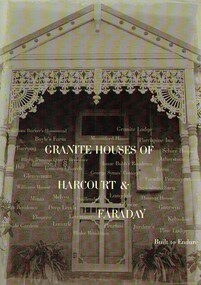
Book, Granite Houses of Harcourt & Faraday, 2014
... building in stone. Advocacy by the Harcourt Valley Heritage Committee ensured the retention, in the face of demolition threat, of a unique collection of homes, many owner-built and of vernacular architecture. ...When the Harcourt Valley was the subject of route selection /environmental effects survey in connection with the upgrade of the Calder Highway into Freeway the Harcourt Valley Heritage Committee enumerated and researched the unique collection of granite homes to be found in the valley. The publication gives a short account of the builders and illustrates the various techniques of building in stone. Advocacy by the Harcourt Valley Heritage Committee ensured the retention, in the face of demolition threat, of a unique collection of homes, many owner-built and of vernacular architecture. A4 size book of 42 pages with full colour ilustrationsGranite Houses of Harcourt & Faraday -
Emerald Museum & Nobelius Heritage Park
Photograph - Silver Wells farm relics, Unknown photographer
... The register highlights its uniqueness, particularly in the diverse vernacular construction methods employed in the various buildings, most of which were erected during the 1870s. ...The Ure family played a pivotal role as early pioneers in the development of Gembrook. In 1874, John Ure made a significant decision to secure 213 acres of land in this burgeoning region. Accompanied by his wife, Jane (also known as Jean), and their two sons, Alexander (born in 1872) and John (born in 1873), all hailing from Scotland, they embarked on their journey to Gembrook. During their time in Gembrook, two more sons, Robert (born in 1875) and James Buchanan (born in 1881), were born. It was here that the Ure family established their homestead, which they aptly named Silver Wells, inspired by the remarkably pure water source they uncovered when digging their initial well. Silver Wells became a hub of activity, featuring a collection of essential buildings, including multiple houses, machinery sheds, barns, a cheese room, dairy, and a boiler room. Notably, it also housed a post office and a store, complete with a butchers' room, catering to the needs of the local mining community that had flocked to the area in search of precious gold and silver deposits in nearby rivers. The Ures remained deeply involved in the operation of the store, situated in what was known as North Gembrook, until the year 1901. At that point, the commercial centre of the town shifted toward the area surrounding the Railway Station, coinciding with the rise of the Puffing Billy line.The photograph holds strong historic significance for it depicts Silver Wells. The estate holds a special place on the Victorian Heritage Register. The register highlights its uniqueness, particularly in the diverse vernacular construction methods employed in the various buildings, most of which were erected during the 1870s. For instance, the stables showcase the drop slab method, a distinctive construction technique. The original house and post office, on the other hand, exhibit the use of notched logs, a rare form of building in Colonial Victoria. The dairy extension is skillfully crafted with split weatherboards, adding to the architectural diversity of the site. The roofing materials also reflect the era's construction practices, with a blend of bark or shingles originally in use, although these have since been replaced with corrugated iron.A rectangular black and white photograph printed on photographic paper. Depicted is a photograph of a sign directing patrons to "Silver Wells." There are pieces of equipment in the foreground and background, including bowls, canisters and tins, among others.Obverse: "Silver Wells" / ( OLD GEMBROOK ) / OPEN TODAY 10-5/1870s, silver wells, gembrook, ure family
