
Showing 10 items matching "vertebrates"
-
 Federation University Historical Collection
Book, Robert Wiedersheim, Elements of the Comparative Anatomy of Vertebrates, 1886
... Elements of the Comparative Anatomy of Vertebrates,......vertebrates...Elements of the Comparative Anatomy of Vertebrates, Book Book Robert Wiedersheim W. Newton Parker Macmillan and Co., Limited ...This book was purchased for the Ballarat School of Mines library on 18 March 1887. It was book no 792 in the library.Green cloth cover, with gold lettering on the spine. 345 pages, with 279 woodcut illustrations.ballarat school of mines, anatomy, vertebrates, robert wiedersheim, w newton parker -
 Merri-bek City Council
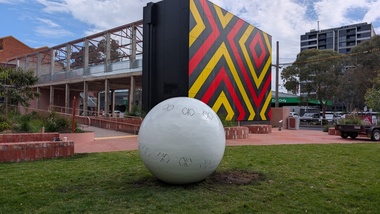
Sculpture - Aluminium, Aunty Kim Wandin et al, Balam Balam, 2025
... It recognises that butterflies as pollinators are an important food source for birds and other vertebrates, and are a part of a living, interconnected planetary system. ...It recognises that butterflies as pollinators are an important food source for birds and other vertebrates, and are a part of a living, interconnected planetary system. ...'Balam Balam', by Aunty Kim Wandin and Christine Joy’s (Murrup Biik) is located at Balam Balam Place. This artwork responds to the name of the site and represents the earth and the extraordinary migratory journeys that butterflies make around our planet, referencing their resilience and strength. It recognises that butterflies as pollinators are an important food source for birds and other vertebrates, and are a part of a living, interconnected planetary system. They are indicator species for healthy environments. Grounded in a deep relationship with Country and a commitment to creating culturally rich artwork, Murrup Biik's 'Balam Balam' honours Aboriginal knowledge, ceremony, and community connection.merri-bek public art collection -
 Bendigo Historical Society Inc.
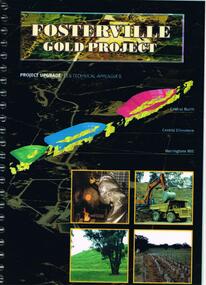
Document - FOSTERVILLE GOLD MINE COLLECTION: PROJECT UPGRADE TECHNICAL APPENDICES
... Topics: hydro geological assessment; surface drainage study, noise emission to residential properties, flora survey, tailings dam site; flora survey Wellesford Forest; Daley's Hill Plant List; diurnal Avifauna Survey - Wellesford Forest; survey of vertebrate fauna - Wellesford Forest; brief summary of fauna - Daley's Hill, Axedale, Aboriginal Archaeological survey; archaeological investigation Fosterville; traffic survey - Fosterville Sulphide Project; traffic report....BENDIGO Mining Fosterville Gold Mine hydro geological assessment surface drainage study noise emission to residential properties flora survey tailings dam site flora survey Wellesford Forest Daley's Hill Plant List diurnal Avifauna Survey - Wellesford Forest survey of vertebrate fauna - Wellesford Forest brief summary of fauna - Daley's Hill Axedale Aboriginal Archaeological survey archaeological investigation Fosterville traffic survey - Fosterville Sulphide Project traffic report. ...Black cover book, wire binding. Pages in reports numbered individually, overall approx 250 page report. On front: "Fosterville Gold Project' Project upgrade, EES Technical Appendix B. Central North, Central Ellesmere, Harringtons Hill." Page 1 'Perseverance Exploration Pty Limited' Book contains technical appendices. Topics: hydro geological assessment; surface drainage study, noise emission to residential properties, flora survey, tailings dam site; flora survey Wellesford Forest; Daley's Hill Plant List; diurnal Avifauna Survey - Wellesford Forest; survey of vertebrate fauna - Wellesford Forest; brief summary of fauna - Daley's Hill, Axedale, Aboriginal Archaeological survey; archaeological investigation Fosterville; traffic survey - Fosterville Sulphide Project; traffic report.bendigo, mining, fosterville gold mine, hydro geological assessment, surface drainage study, noise emission to residential properties, flora survey, tailings dam site, flora survey wellesford forest, daley's hill plant list, diurnal avifauna survey - wellesford forest, survey of vertebrate fauna - wellesford forest, brief summary of fauna - daley's hill, axedale, aboriginal archaeological survey, archaeological investigation fosterville, traffic survey - fosterville sulphide project, traffic report. -
 The Beechworth Burke Museum
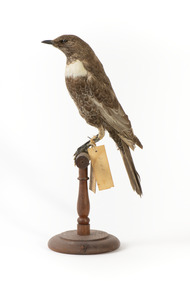
Animal specimen - Ring Ouzel, Trustees of the Australian Museum, 1860-1880
... The diet of this species consists of invertebrates, some small vertebrates and a wide range of fruit. This specimen is part of a collection of almost 200 animal specimens that were originally acquired as skins from various institutions across Australia, including the Australian Museum in Sydney and the National Museum of Victoria (known as Museums Victoria since 1983), as well as individuals such as amateur anthropologist Reynell Eveleigh Johns between 1860-1880. ...The diet of this species consists of invertebrates, some small vertebrates and a wide range of fruit. This specimen is part of a collection of almost 200 animal specimens that were originally acquired as skins from various institutions across Australia, including the Australian Museum in Sydney and the National Museum of Victoria (known as Museums Victoria since 1983), as well as individuals such as amateur anthropologist Reynell Eveleigh Johns between 1860-1880. ...The Ring Ouzel is a member of the Thrush family, Turdis, of which there are about 85 different species, commonly located in Europe. They are found in upland Scotland, northern England, north west Wales and Dartmoor. This species is identified by their dark colouring which contrasts to the white crescent across the breast and the white edging on the wings and some body feathers which provides a scale-like appearance. The diet of this species consists of invertebrates, some small vertebrates and a wide range of fruit. This specimen is part of a collection of almost 200 animal specimens that were originally acquired as skins from various institutions across Australia, including the Australian Museum in Sydney and the National Museum of Victoria (known as Museums Victoria since 1983), as well as individuals such as amateur anthropologist Reynell Eveleigh Johns between 1860-1880. These skins were then mounted by members of the Burke Museum Committee and put-on display in the formal space of the Museum’s original exhibition hall where they continue to be on display. This display of taxidermy mounts initially served to instruct visitors to the Burke Museum of the natural world around them, today it serves as an insight into the collecting habits of the 19th century. This specimen is part of a significant and rare taxidermy mount collection in the Burke Museum. This collection is scientifically and culturally important for reminding us of how science continues to shape our understanding of the modern world. They demonstrate a capacity to hold evidence of how Australia’s fauna history existed in the past and are potentially important for future environmental research. This collection continues to be on display in the Museum and has become a key part to interpreting the collecting habits of the 19th century.The Ring Ouzel specimen is stylised perched on a wooden platform. It is a medium sized bird of the thrush family. This particular specimen is a brown colour with pale edging to the wing feathers rather than the plumage being a darker black which can help identify this bird as female. The feathers have a white edging on the stomach giving this bird a scaly appearance. The bird has a small dark bill, two glass eyes, black legs and a long tail. Around the front of the upper breast, the bird has a striking white crescent shaped band. "Label 1 110a. / Ring Thrush / Catalogue Page 29 / Lable 2 Furdus torquaters / [illegible] 10 OCT. 1859 / near Leiden /"taxidermy mount, taxidermy, animalia, burke museum, beechworth, australian museum, skin, reynell eveleigh johns, bird, european birds, ring ouzel, blackbird, ouzel -
Federation University Historical Collection
Article - Article - Women, Museums Australia: Women of Note; Lesley Kool, Paleontologist
... Lesley Kool is an honorary research associate in the Department of Vertebrate Palaeontology, Museums Victoria and does research in Palaeontology and Geology. ...Lesley Kool is an honorary research associate in the Department of Vertebrate Palaeontology, Museums Victoria and does research in Palaeontology and Geology. ...Lesley Kool is an honorary research associate in the Department of Vertebrate Palaeontology, Museums Victoria and does research in Palaeontology and Geology. Her current project is 'Polar turtles from the Aptian of Victoria, Australia' plus research into the Early Cretaceous fauna and flora of Victoria. A group of researchers from Monash University, including mammalogist, palaeontologist and environmentalist decided to follow up on the discovery of Australia’s first dinosaur bone, the Cape Paterson Claw by William Ferguson, at Eagles Nest in 1903. Lesley Kool joined them. Together with colleagues, including Mike Cleeland of Phillip Island, she has made and researched discoveries over the following 40 years that have, among other things, completely turned worldwide theories on their head about the origins of mammals and how cold-blooded dinosaurs could have existed and thrived within the Antarctic Circle for millions of years. Reflecting on the importance of the work to which she has contributed she says: “These animals were as Australian as the koala and the kangaroo, but very few people are aware they ever existed. We would like to change that view.” Lesley was a Research Assistant at Monash University from 1986 to 2006. She then became Honorary Research Associate at Museums Australia in 2006. Lesley was awarded the Medal of the Order of Australia for Paleontology.women of note, academic, lesley kool, paleontologist, museums australia, honorary research associate, cape paterson claw, eagles nest, monash university, research assistant, medal of the order of australia -
 The Beechworth Burke Museum
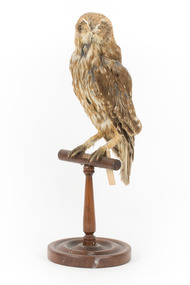
Animal specimen - Morepork, Trustees of the Australian Museum, 1860-1880
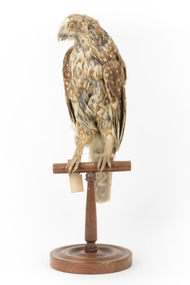
... They are mostly nocturnal and carnivorous (eating insects and small vertebrates). They reside in habitats with trees, they sleep in roosts and hunt mainly in the evenings and early morning. ...They are mostly nocturnal and carnivorous (eating insects and small vertebrates). They reside in habitats with trees, they sleep in roosts and hunt mainly in the evenings and early morning. ...The Morepork is a small brown and white spotted owl found in New Zealand, Tasmania and Norfolk Island. It is known by around twenty different names which are all onomatopoeic which emulate the birds distinctive two-pitched call. They are mostly nocturnal and carnivorous (eating insects and small vertebrates). They reside in habitats with trees, they sleep in roosts and hunt mainly in the evenings and early morning. Females are slightly bigger than males. This species attains full plumage in its third or fourth year. They can turn their heads 270 degrees." In Māori tradition the morepork was seen as a watchful guardian. It belonged to the spirit world as it is a bird of the night. Although the more-pork or ruru call was thought to be a good sign, the high pitched, piercing, ‘yelp’ call was thought to be an ominous forewarning of bad news or events." (NZ Department of Conservation). This specimen is part of a collection of almost 200 animal specimens that were originally acquired as skins from various institutions across Australia, including the Australian Museum in Sydney and the National Museum of Victoria (known as Museums Victoria since 1983), as well as individuals such as amateur anthropologist Reynell Eveleigh Johns between 1860-1880. These skins were then mounted by members of the Burke Museum Committee and put-on display in the formal space of the Museum’s original exhibition hall where they continue to be on display. This display of taxidermy mounts initially served to instruct visitors to the Burke Museum of the natural world around them, today it serves as an insight into the collecting habits of the 19th century.This specimen is part of a significant and rare taxidermy mount collection in the Burke Museum. This collection is scientifically and culturally important for reminding us of how science continues to shape our understanding of the modern world. They demonstrate a capacity to hold evidence of how Australia’s fauna history existed in the past and are potentially important for future environmental research. This collection continues to be on display in the Museum and has become a key part to interpreting the collecting habits of the 19th century.This Morepork (also known as the Masked Owl) is covered in brown and white plumage on its head and body. The white feathers delineate its round yellow eyes. Its belly and back are brown and white with the white feathering appearing spotted. This Morepork specimen sits on a wooden perch with his head turned to the left. A swing tag is attached to its left leg.Swing tag: 10 / Masked Owl / See Catalogue, page 3 /taxidermy mount, taxidermy, animalia, burke museum, beechworth, australian museum, skin, reynell eveleigh johns, bird, ruru, spotted owl, tasmanian spotted owl, morepork, mopoke, new zealand owls, new zealand birds, tasmanian owls, tasmanian birds, norfolk island owls, norfolk island birds -
 The Beechworth Burke Museum
Animal specimen - Morepork, Trustees of the Australian Museum, 1860-1880
... They are mostly nocturnal and carnivorous (eating insects and small vertebrates). They reside in habitats with trees, they sleep in roosts and hunt mainly in the evenings and early morning. ...They are mostly nocturnal and carnivorous (eating insects and small vertebrates). They reside in habitats with trees, they sleep in roosts and hunt mainly in the evenings and early morning. ...The Morepork is a small brown and white spotted owl found in New Zealand, Tasmania and Norfolk Island. It is known by around twenty different names which are all onomatopoeic which emulate the birds distinctive two-pitched call. They are mostly nocturnal and carnivorous (eating insects and small vertebrates). They reside in habitats with trees, they sleep in roosts and hunt mainly in the evenings and early morning. Females are slightly bigger than males. This species attains full plumage in its third or fourth year. They can turn their heads 270 degrees." In Māori tradition the morepork was seen as a watchful guardian. It belonged to the spirit world as it is a bird of the night. Although the more-pork or ruru call was thought to be a good sign, the high pitched, piercing, ‘yelp’ call was thought to be an ominous forewarning of bad news or events." (NZ Department of Conservation). This specimen is part of a collection of almost 200 animal specimens that were originally acquired as skins from various institutions across Australia, including the Australian Museum in Sydney and the National Museum of Victoria (known as Museums Victoria since 1983), as well as individuals such as amateur anthropologist Reynell Eveleigh Johns between 1860-1880. These skins were then mounted by members of the Burke Museum Committee and put-on display in the formal space of the Museum’s original exhibition hall where they continue to be on display. This display of taxidermy mounts initially served to instruct visitors to the Burke Museum of the natural world around them, today it serves as an insight into the collecting habits of the 19th century.This specimen is part of a significant and rare taxidermy mount collection in the Burke Museum. This collection is scientifically and culturally important for reminding us of how science continues to shape our understanding of the modern world. They demonstrate a capacity to hold evidence of how Australia’s fauna history existed in the past and are potentially important for future environmental research. This collection continues to be on display in the Museum and has become a key part to interpreting the collecting habits of the 19th century.This Morepork (also known as a Masked Owl) is covered in brown and white plumage on its head and body. The white feathers delineate its round yellow eyes. Its belly and back are brown and white with the white feathering appearing spotted. He sits on a wooden perch with his head turned to the left. A swing tag is attached to its leg.11 / Masked Owl / See Catalogue, page 3 /taxidermy mount, taxidermy, animalia, burke museum, beechworth, australian museum, skin, reynell eveleigh johns, bird, ruru, spotted owl, tasmanian spotted owl, morepork, mopoke, new zealand owls, new zealand birds, tasmanian owls, tasmanian birds, norfolk island owls, norfolk island birds -
 The Beechworth Burke Museum
Animal specimen - Freshwater Crocodile, Trustees of the Australian Museum, 1860-1880
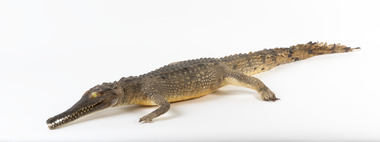
... This species of Crocodile mainly feed on invertebrate and vertebrate prey which includes insects, spiders, frogs, fish and small birds and mammals. ...This species of Crocodile mainly feed on invertebrate and vertebrate prey which includes insects, spiders, frogs, fish and small birds and mammals. ...The Freshwater Crocodile can measure up to 3 meters and is generally not considered to be a threat to humans. They reside in Northern Australia, Western Australia and the northern part of Cape York Peninsula in Queensland. They live in freshwater environments and make burrows among the roots of trees which fringe the waters they can be found in. This species of Crocodile mainly feed on invertebrate and vertebrate prey which includes insects, spiders, frogs, fish and small birds and mammals. They are also recognized as "cannibalistic" with the older Freshwater Crocodile occasionally preying on young hatchlings. These crocodiles are known for their "high walk" which they do to move on land. It is named "high walk" because the animal lifts their body off the ground using their long legs for height. They are able to walk considerable distances on land using this technique. In captivity, Freshwater Crocodiles are known to be hostile and aggressive to others of its species. This specimen is part of a collection of almost 200 animal specimens that were originally acquired as skins from various institutions across Australia, including the Australian Museum and the National Museum of Victoria, as well as individuals such amateur anthropologist Reynell Eveleigh Johns between 1860-1880. These skins were then mounted by members of the Burke Museum Committee and put-on display in the formal space of the Museum’s original exhibition hall where they continue to be on display. This display of taxidermy mounts initially served to instruct visitors to the Burke Museum of the natural world around them, today it serves as an insight into the collecting habits of the 19th century.This specimen is part of a significant and rare taxidermy mount collection in the Burke Museum. This collection is scientifically and culturally important for reminding us of how science continues to shape our understanding of the modern world. They demonstrate a capacity to hold evidence of how Australia’s fauna history existed in the past and are potentially important for future environmental research. This collection continues to be on display in the Museum and has become a key part to interpreting the collecting habits of the 19th century.The Freshwater Crocodile has a slender snout which is much smaller and thinner than its Saltwater counterpart. This specimen has dark grey and brown colouring with the darker colours concentrated around the face and upper torso of the Crocodile. There are darker stripes along the tail which features triangular scales and is long in length. The teeth are visible and bright yellow glass has been used to replace the eyes of this particular specimen. The crocodile has long but thin limbs which protrude from the sides of the body.taxidermy mount, taxidermy, animalia, burke museum, beechworth, australian museum, skin, reynell eveleigh johns, crocodile, freshwater crocodile, johnstone's crocodile -
 University of Melbourne, Tiegs Museum of Zoology
Grey Currawong (Strepera versicolor) mounted skeleton, Mid to late 19th century
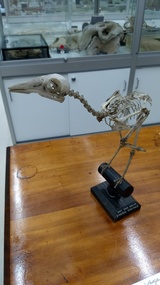
... ...vertebrate...The other items in this batch are, like this specimen, predominantly mounted articulated vertebrate skeletons: [Specimens are listed with accession number and name as written in the original register] MUZD1113 - 'Lepus timidus' (Mountain hare), mounted skeleton; currently on display in the Tiegs Zoology Museum MUZD1114 - 'Emydura' (Short-necked Turtle), mounted skeleton; currently on display in the Tiegs Zoology Museum MUZD1115 - 'Astur novaehollandiae' (Obsolete binomial name for Accipiter novaehollandiae - Grey Goshawk); mounted skeleton, currently in storage, disassembled, in the Tiegs Zoology Museum. ...The other items in this batch are, like this specimen, predominantly mounted articulated vertebrate skeletons: [Specimens are listed with accession number and name as written in the original register] MUZD1113 - 'Lepus timidus' (Mountain hare), mounted skeleton; currently on display in the Tiegs Zoology Museum MUZD1114 - 'Emydura' (Short-necked Turtle), mounted skeleton; currently on display in the Tiegs Zoology Museum MUZD1115 - 'Astur novaehollandiae' (Obsolete binomial name for Accipiter novaehollandiae - Grey Goshawk); mounted skeleton, currently in storage, disassembled, in the Tiegs Zoology Museum. ...The museum register is somewhat ambiguous but it is recorded - along with about 12 others - that this specimen was transferred from the 'Nat. Sc. Dept' in September 1899. The specimen also apparently has something to do with Frederick McCoy; his name is entered as the party that identified the skeleton. It seems certain that these were a batch (accession numbers MUZD1113-1126) of specimens given to the university teaching museum during the move of the state museum from the university campus to its subsequent site on Russell St. Examination of the Currawong skeleton (and some of the others in this batch) revels that the specimen has been remounted at some point. The other items in this batch are, like this specimen, predominantly mounted articulated vertebrate skeletons: [Specimens are listed with accession number and name as written in the original register] MUZD1113 - 'Lepus timidus' (Mountain hare), mounted skeleton; currently on display in the Tiegs Zoology Museum MUZD1114 - 'Emydura' (Short-necked Turtle), mounted skeleton; currently on display in the Tiegs Zoology Museum MUZD1115 - 'Astur novaehollandiae' (Obsolete binomial name for Accipiter novaehollandiae - Grey Goshawk); mounted skeleton, currently in storage, disassembled, in the Tiegs Zoology Museum. MUZD1116 - 'Grey crow-shrike ♂' (Grey Currawong), mounted skeleton; currently on display in the Tiegs Zoology Museum MUZD1117 - 'Herpestes, India' (Mongoose sp.), mounted skeleton; currently on display in the Tiegs Zoology Museum MUZD1118 - 'Macropus giganteus (aged[?]), Goulburn River' (Eastern Grey Kangaroo), ♀ skull; whereabouts unknown MUZD1119 - 'Macropus giganteus, ?' (Eastern Grey Kangaroo), skull; whereabouts unknown MUZD1120 - 'Raia ? lemprieri' (Obsolete binomial name for Dentiraja lemprieri -Thornback Skate), stuffed; whereabouts unknown MUZD1121 - 'Cyprinus carpio' (Common carp), skeleton - roughly prepared; whereabouts unknown MUZD1122 - 'Ovis' (Domestic sheep probably Jacob Sheep, '4 horned breed'), skull; whereabouts unknown MUZD1123 - 'Cervus canadensis (Wapiti)', skull and lower jaw - no horns; currently on display in the Tiegs Zoology Museum MUZD1124 - 'Antelope', no further information; whereabouts unknown MUZD1125 - 'Encope emarginata' (Echinoderm), currently on display in the Tiegs Zoology Museum MUZD1126 - 'Heterocentrotus trigonarius' (Pencil urchin), currently on display in the Tiegs Zoology Museum (accession number is not written on wooden base, but on the inside of the specimen.)Mounted skeleton of Grey Currawong (Strepera versicolor). Skeleton is mounted on a black wooden stand with a round base.Accession number '2259' is written in ink on the sternum. Wooden mount has black label with white text on the base reading 'GREY CROW SHRIKE/ STREPERA VERSICOLOR'. animal, vertebrate, bird, skeleton, frederick mccoy, national museum of victoria, passeriformes, artamidae -
 Emerald Museum & Nobelius Heritage Park
Book, Sites of Zoological Significance in the Westernport Region, 1984
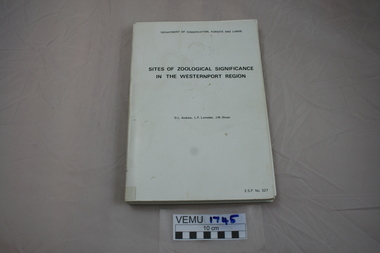
... The report contains the results of a survey of the vertebrate fauna of the Westernport catchment and a search of relevant literature, conducted between June 1979 and December 1981. ...Zoological Significance. The report contains the results of a survey of the vertebrate fauna of the Westernport catchment and a search of relevant literature, conducted between June 1979 and December 1981.White soft cover thick book, about A4 size. Prepared by the national Museum of Victoria for The Environmental Studies Division, Ministry of Conservation, Victoria 1984.
