
Showing 3 items matching "victorian pastoral leases"
-
 Victorian Aboriginal Corporation for Languages
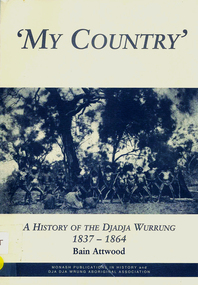
Book, Bain Attwood, 'My country' : a history of the Djadja Wurrung 1837-1864, 1999
... ...Victorian pastoral leases...Djadja Wurrung Dja Dja Wurrung Dja Dja Wrung Aboriginal Association Beembarmin Victorian pastoral leases Franklinford Fernihurst Edward Parker Caroline Morgan Thomas Dunolly Cummeragunja racial conflict racism Victorian social history maps, b&w illustrations, b&w photographs A description of the invasion of Djadja Wurrung land in Central Victoria which began in the mid 1830s. ...A description of the invasion of Djadja Wurrung land in Central Victoria which began in the mid 1830s.maps, b&w illustrations, b&w photographsdjadja wurrung, dja dja wurrung, dja dja wrung aboriginal association, beembarmin, victorian pastoral leases, franklinford, fernihurst, edward parker, caroline morgan, thomas dunolly, cummeragunja, racial conflict, racism, victorian social history -
 Monbulk RSL Sub Branch
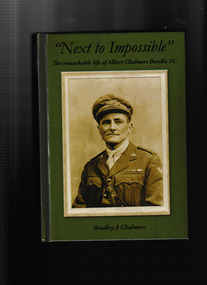
Book, Bradley A Chalmers, Next to impossible : the remarkable life of Albert Chalmers Borella VC, 2015
... Victorian Rangers, serving for a period of 18 months. He travelled to Melbourne in early 1910 and became a firefighter in the Metropolitan Fire Brigade, remaining in the city until early 1913 when he travelled to the Northern Territory to take up a pastoral lease, working a property on the Daly River until early 1915 when his financial situation forced him to leave the land. ...Albert Chalmers Borella was born at Borung, Victoria, 60 kilometres north-west of Bendigo. His parents were Louis Borella and Annie Borella née Chalmers. After attending state schools at Borung and Wychitella, Borella became a farmer, working around Borung and Echuca. He also enlisted as a part-time soldier in the Victorian Rangers, serving for a period of 18 months. He travelled to Melbourne in early 1910 and became a firefighter in the Metropolitan Fire Brigade, remaining in the city until early 1913 when he travelled to the Northern Territory to take up a pastoral lease, working a property on the Daly River until early 1915 when his financial situation forced him to leave the land.Index, ill, maps, p.510.Albert Chalmers Borella was born at Borung, Victoria, 60 kilometres north-west of Bendigo. His parents were Louis Borella and Annie Borella née Chalmers. After attending state schools at Borung and Wychitella, Borella became a farmer, working around Borung and Echuca. He also enlisted as a part-time soldier in the Victorian Rangers, serving for a period of 18 months. He travelled to Melbourne in early 1910 and became a firefighter in the Metropolitan Fire Brigade, remaining in the city until early 1913 when he travelled to the Northern Territory to take up a pastoral lease, working a property on the Daly River until early 1915 when his financial situation forced him to leave the land. world war 1914-1918 - personal narratives - australia, albert chalmers - biography -
 Royal Australasian College of Surgeons Museum and Archives
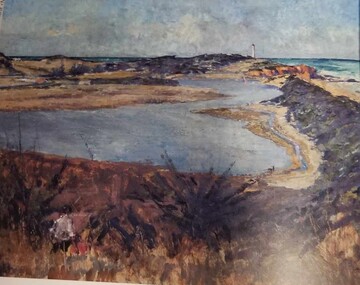
Painting - Painting of Airey's Inlet by Charles Bush, Bush, Charles, Airey's Inlet, c1800
... Victorian coast. It derives its name from John Airey, who took up a pastoral lease at Point Roadknight, slightly to the east, in 1839. ...Victorian coast. It derives its name from John Airey, who took up a pastoral lease at Point Roadknight, slightly to the east, in 1839. ...The large landscape of Airey’s Inlet was painted by the renowned Australian artist Charles Bush. It is a view of Airey’s Inlet, a small seaside town on the Great Ocean Road, about 120km southwest of Melbourne. Airey’s Inlet is one of the oldest settlements on this part of the Victorian coast. It derives its name from John Airey, who took up a pastoral lease at Point Roadknight, slightly to the east, in 1839. The landscape is painted in oil on board. The view depicted looks over the inlet and Painkalac Creek towards the Split Point lighthouse, built in 1891. There is a yacht sailing on the inlet, and figures on the path in the middle distance. In the left foreground is a painter at an easel, probably Bush’s longtime companion and fellow artist Phyl Waterhouse. The picture is framed, and measures 105 x 136cm overall. It was probably painted in the early 1950s. A brass plaque attached to the frame records that it is the gift of W.E.A. Hughes-Jones, a member of the Court of Examiners from 1952 to 1962. Artist Charles Bush (1919-1989) was born in the inner Melbourne suburb of Fitzroy on 23 November 1919. After attending high school in Coburg, he entered the National Gallery of Victoria art school in 1934 and studied under W.B. McInnes. He enlisted in 1940, and was appointed an official war artist from 1943 to 1946. In 1950 he won a British Council travel grant which enabled him to go on a study tour of Great Britain and Europe. A versatile and gifted artist, he won many prizes and awards throughout his career. He was equally at home in many genres of painting and drawing, but he excelled at portraits and landscapes. He died in Melbourne in November 1989.ARTISTS SIGNATURE BOTTOM RIGHT "BUSH"airey’s inlet, charles bush, w.e.a. hughes-jones
