
Showing 6 items matching "virginia woolf"
-
 Federation University Historical Collection
Book, Alice Mills, Virginia Woolf: The patterns of ordinary experience By Lorriane Sim, 2005
... Virginia Woolf: The patterns of ordinary experience By Lorriane Sim......Virginia Woolf...Barker Library (top floor) Mount Helen goldfields Lorraine Sim is a lecturer at University of Ballarat which is a predecessor of Federation University University of Ballarat Alumni Lecturer Staff Author Lorraine Sim Virginia Woolf The Patterns of Ordinary Experience Federation University Staff Author Offers a reading of Virginia Woolf's conception of Ordinary Experience Hardcovered book with paper jacket that is green with a black and white image and black writng Virginia Woolf: The patterns of ordinary experience By Lorriane Sim Book Alice Mills C.C. ...Offers a reading of Virginia Woolf's conception of Ordinary ExperienceHardcovered book with paper jacket that is green with a black and white image and black writng non-fictionOffers a reading of Virginia Woolf's conception of Ordinary Experienceuniversity of ballarat, alumni, lecturer, staff author, lorraine sim, virginia woolf, the patterns of ordinary experience, federation university staff author -
 Flagstaff Hill Maritime Museum and Village
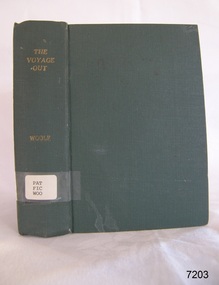
Book, The Voyage Out
... ...virginia woolf...The Voyage Out Author: Virginia Woolf Publisher: Duckworth and Co Date: 1915 ...The Warrnambool Mechanics' Institute’s publication collection is of both local and state significance. shipwrecked-coast flagstaff-hill flagstaff-hill-maritime-museum warrnambool maritime-museum shipwreck-coast flagstaff-hill-maritime-village shipwrecked-artefact book pattison collection warrnambool library warrnambool mechanics’ institute ralph eric pattison corangamite regional library service warrnambool city librarian mechanics’ institute library victorian library board warrnambool books and records warrnambool children’s library great ocean road the voyage out virginia woolf The label on the spine with the typed text PAT FIC WOO Pastedown front endpaper has a sticker from Warrnambool Public Library covered by a sticker from Corangamite Regional Library Service Front loose endpaper has a stamp from Corangamite Regional Library Service The Voyage Out Author: Virginia Woolf Publisher: Duckworth and Co Date: 1915 The Voyage Out Book ...Pattison Collection This item is from the ‘Pattison Collection’, a collection of books and records that was originally owned by the Warrnambool Mechanics’ Institute, which was founded in Warrnambool in 1853. By 1886 the Warrnambool Mechanics’ Institute (WMI) had grown to have a Library, Museum and Fine Arts Gallery, with a collection of “… choice productions of art, and valuable specimens in almost every branch and many wonderful national curiosities are now to be seen there, including historic relics of the town and district.” It later included a School of Design. Although it was very well patronised, the lack of financial support led the WMI in 1911 to ask the City Council to take it over. In 1935 Ralph Pattison was appointed as City Librarian to establish and organise the Warrnambool Library as it was then called. When the WMI building was pulled down in 1963 a new civic building was erected on the site and the new Warrnambool Library, on behalf of the City Council, took over all the holdings of the WMI. At this time some of the items were separated and identified as the ‘Pattison Collection’, named after Ralph Pattison. Eventually the components of the WMI were distributed from the Warrnambool Library to various places, including the Art Gallery, Historical Society and Flagstaff Hill. Later some were even distributed to other regional branches of Corangamite Regional Library and passed to and fro. It is difficult now to trace just where all of the items have ended up. The books at Flagstaff Hill Maritime Village generally display stamps and markings from Pattison as well as a variety of other institutions including the Mechanics’ Institute itself. RALPH ERIC PATTISON Ralph Eric Pattison was born in Rockhampton, Queensland, in 1891. He married Maude Swan from Warrnambool in 1920 and they set up home in Warrnambool. In 1935 Pattison accepted a position as City Librarian for the Warrnambool City Council. His huge challenge was to make a functional library within two rooms of the Mechanics’ Institute. He tirelessly cleaned, cleared and sorted a disarrayed collection of old books, jars of preserved specimens and other items reserved for exhibition in the city’s museum. He developed and updated the library with a wide variety of books for all tastes, including reference books for students; a difficult task to fulfil during the years following the Depression. He converted all of the lower area of the building into a library, reference room and reading room for members and the public. The books were sorted and stored using a cataloguing and card index system that he had developed himself. He also prepared the upper floor of the building and established the Art Gallery and later the Museum, a place to exhibit the many old relics that had been stored for years for this purpose. One of the treasures he found was a beautiful ancient clock, which he repaired, restored and enjoyed using in his office during the years of his service there. Ralph Pattison was described as “a meticulous gentleman whose punctuality, floorless courtesy and distinctive neat dress were hallmarks of his character, and ‘his’ clock controlled his daily routine, and his opening and closing of the library’s large heavy doors to the minute.” Pattison took leave during 1942 to 1942 to serve in the Royal Australian Navy, Volunteer Reserve as Lieutenant. A few years later he converted one of the Museum’s rooms into a Children’s Library, stocking it with suitable books for the younger generation. This was an instant success. In the 1950’s he had the honour of being appointed to the Victorian Library Board and received more inspiration from the monthly conferences in Melbourne. He was sadly retired in 1959 after over 23 years of service, due to the fact that he had gone over the working age of council officers. However he continued to take a very keen interest in the continual development of the Library until his death in 1969. WARRNAMBOOL PUBLIC LIBRARY The Warrnambool Mechanics’ Institute (WMI) was formed by a voluntary community group in 1863, within six years of Warrnambool’s beginnings, and its Reading Room opened in 1854. The WMI operated until 1963, at which time it was one of the oldest Mechanics’ Institutes in Victoria. Mechanics’ Institutes offered important services to the public including libraries, reading rooms and places to display and store collections of all sorts such as curiosities and local historical relics. In 1886 a Museum and Fine Arts Gallery were added to the WMI and by the beginning of the 20th century, there was also a billiards room and a School of Art. By this time all Mechanics’ Institutes in country Victoria had museums attached. Over the years the Warrnambool Mechanics’ Institute Library was also known as the Warrnambool Public Library the Warrnambool Library and the Free Library. Early funding from the government was for the “Free Library”. The inscription in a book “Science of Man” was for the “Warrnambool Public Library”, donated by Joseph Archibald in 1899. Another inscription in the book “Catalogue of Plants Under Cultivation in the Melbourne Botanic Gardens 1 & 2, 1883” was presented to the “Warrnambool Library” and signed by the author W.R. Guilfoyle. In 1903 the Warrnambool Public Library decided to add a Juvenile Department to library and stock it with hundreds of books suitable for youth. In 1905 the Public Library committee decided to update the collection of books and added 100 new novels plus arrangements for the latest novels to be included as soon as they were available in Victoria. In July 1911 the Warrnambool Council took over the management of the Public Library, Art Gallery, Museum and Mechanics’ Institute and planned to double the size of the then-current building. In 1953, when Mr R. Pattison was Public Librarian, the Warrnambool Public Library’s senior section 10,000 of the 13,000 books were fiction. The children’s section offered an additional 3,400 books. The library had the equivalent of one book per head of population and served around 33 per cent of the reading population. The collection of books was made up of around 60 per cent reference and 40 per cent fiction. The library was lending 400 books per day. In 1963 the Warrnambool City Council allocated the site of the Mechanics’ Institute building, which included the Public Library, Museum and Art Gallery, for the new Municipal Offices and the Collections were dispersed until 1971. The Warrnambool Library took over the Mechanics’ Institute Library’s holdings on behalf of the Warrnambool City Council. Since the closure of the Warrnambool Mechanics’ Institute the exact location and composition of the original WMI books and items have become unclear. Other materials have been added to the collection, including items from Terang MI, Warrnambool Court House and Customs House. Many of the books have been identified as the Pattison Collection, named after the Librarian who catalogued and numbered the books during his time as Warrnambool Public Librarian in the time before the Mechanics’ Institute closed. It seems that when Warrnambool became part of the Corangamite Regional Library some of the books and materials went to its head office in Colac and then back to Warrnambool where they were stored at the Art Gallery for quite some time. Some then went to the Warrnambool Historical Society, some stayed at the Art Gallery and some were moved to Flagstaff Hill Maritime Village. The various stamps and labels on the books held at Flagstaff Hill show the variety of the collection’s distribution and origin. The books in the collection at Flagstaff Hill Maritime Village date from the 1850s to the late 1950s and include rare and valuable volumes. Many of the books are part of the “Pattison Collection” after the Warrnambool’s Public Librarian, Mr R. Pattison. The Pattison Collection, along with other items at Flagstaff Hill Maritime Village, was originally part of the Warrnambool Mechanics' Institute’s collection. The Warrnambool Mechanics’ Institute Collection is primarily significant in its totality, rather than for the individual objects it contains. Its contents are highly representative of the development of Mechanics' Institute libraries across Australia, particularly Victoria. A diversity of publications and themes has been amassed, and these provide clues to our understanding of the nature of and changes in the reading habits of Victorians from the 1850s to the middle of the 20th century. The collection also highlights the Warrnambool community’s commitment to the Mechanics’ Institute, reading, literacy and learning in the regions, and proves that access to knowledge was not impeded by distance. These items help to provide a more complete picture of our community’s ideals and aspirations. The Warrnambool Mechanics Institute book collection has historical and social significance for its strong association with the Mechanics Institute movement and the important role it played in the intellectual, cultural and social development of people throughout the latter part of the nineteenth century and the early twentieth century. The collection of books is a rare example of an early lending library and its significance is enhanced by the survival of an original collection of many volumes. The Warrnambool Mechanics' Institute’s publication collection is of both local and state significance. The Voyage Out Author: Virginia Woolf Publisher: Duckworth and Co Date: 1915 The label on the spine with the typed text PAT FIC WOO Pastedown front endpaper has a sticker from Warrnambool Public Library covered by a sticker from Corangamite Regional Library Service Front loose endpaper has a stamp from Corangamite Regional Library Service shipwrecked-coast, flagstaff-hill, flagstaff-hill-maritime-museum, warrnambool, maritime-museum, shipwreck-coast, flagstaff-hill-maritime-village, shipwrecked-artefact, book, pattison collection, warrnambool library, warrnambool mechanics’ institute, ralph eric pattison, corangamite regional library service, warrnambool city librarian, mechanics’ institute library, victorian library board, warrnambool books and records, warrnambool children’s library, great ocean road, the voyage out, virginia woolf -
 Heidelberg Theatre Company Inc..
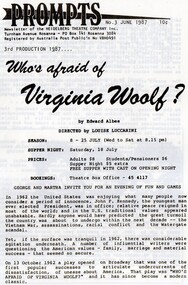
Program Review Newsletter Articles, Who's Afraid of Virginia Woolf? by Edward Albee directed by Louise Luccarini
... Who's Afraid of Virginia Woolf? by Edward Albee directed by Louise Luccarini...Heidelberg Theatre Company Inc.. 36 Turnham Ave Rosanna melbourne 1987 241 Louise Luccarini Who's Afraid of Virginia Woolf? by Edward Albee directed by Louise Luccarini Program Review Newsletter Articles ...1987, 241, louise luccarini -
 Bendigo Historical Society Inc.
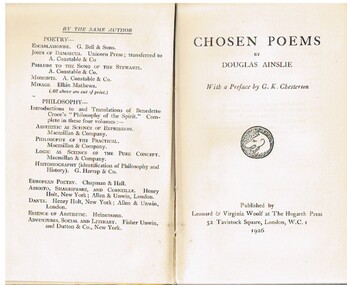
Book - ALEC H CHISHOLM COLLECTION: BOOK ''CHOSEN POEMS'' BY DOUGLAS AINSLIE
... ... LEONARD & VIRGINIA WOOLF...Published in 1926 by Leonard and Virginia Woolf at the Hogarth Press, London. Printed by Neill & Co., Edinburgh. ...Published in 1926 by Leonard and Virginia Woolf at the Hogarth Press, London. Printed by Neill & Co., Edinburgh. ...Book. ALEC H CHISHOLM COLLECTION. 168 page hardcover book of verse by Douglas Ainslie. Psychedelic colours on covers. Preface by G.K. Chesterton. Published in 1926 by Leonard and Virginia Woolf at the Hogarth Press, London. Printed by Neill & Co., Edinburgh. A printed extract from this book, on a separate loose page, is pasted inside the front cover. Handwritten in ink on this extract is ''Wishing you a Happy New Year. Your home is a treasure-house for my poetry! Am in America talking to many ------. I want to come to Australia. Can you arrange it !? See British Who's Who --- ---. Douglas (not A.D.) Ainslie'' Catalogue sticker '2053 AIN' on spine.Douglas Ainsliebooks, collections, poetry, alec h chisholm collection, douglas ainslie, leonard & virginia woolf, poetry -
 Eltham District Historical Society Inc
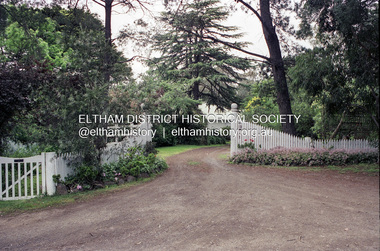
Negative - Photograph, Russell Yeoman, Stanhope, 10 Peter Street, Eltham, c.Sep. 2000
... Bishop Stephen was related to Sir Leslie Stephen (1832-1904), one of the great representative minds of Victorian Britain, first editor of the monumental Dictionary of National Biography and father of the famous novelist and essayist Virginia Woolf. John Harcourt, novelist and music critic, rented 'Stanhope 'while he and his wife Fay were building 'Clay Nuneham' (mudbrick) at the foot of Stanhope Hill near the creek. ...Bishop Stephen was related to Sir Leslie Stephen (1832-1904), one of the great representative minds of Victorian Britain, first editor of the monumental Dictionary of National Biography and father of the famous novelist and essayist Virginia Woolf. John Harcourt, novelist and music critic, rented 'Stanhope 'while he and his wife Fay were building 'Clay Nuneham' (mudbrick) at the foot of Stanhope Hill near the creek. ...Clem Christesen wrote a brief history of "Stanhope" which was reproduced in EDHS Newsletter No. 162 May 2005. STANHOPE HOUSE is situated on the crest of Stanhope Hill about ten minutes' walk westward from the Eltham railway station and is bounded by Peter, Fay and Stanhope Streets. The original property, comprising 15 ½ acres with a frontage on Diamond Creek, was bought in about 1900 by Will Longstaff (b. 1878, d London 1953), official war artist during World War I, who became famous for his painting 'The Ghosts of Menin Gate', France which is now in the Australian War Memorial, Canberra. The main residence, designed by Desbrowe Annear, was built of jarrah, with stucco walls and floors of Tasmanian hardwood The rooms were panelled with Californian redwood (sequoia). Away from house was a cottage (used as a studio), and stables, dairy and meat house. In 1919 Mr Theo. Handfield bought the property from Mrs Longstaff. On New Year 's Day 1924 most of the estate (eighty blocks) was auctioned. Bishop Reginald Stephen, Warden of Trinity College and distinguished scholar, bought the house and five acres in 1928. Dr and Mrs C.B. Christesen became the new owners in 1946 and subsequently extended the house on the north and south sides. 'Stanhope 'has had many very interesting art and literary associations. When Will Longstaff occupied it - he was a cousin of another well-known painter, Sir John Longstaff- various leading artists of the period, including Walter Withers who lived nearby, were frequent visitors. A son of Mr and Mrs Handfield, John, became a journalist and author, and now lives with his wife Esta at Homestead Road, Eltham. Bishop Stephen was related to Sir Leslie Stephen (1832-1904), one of the great representative minds of Victorian Britain, first editor of the monumental Dictionary of National Biography and father of the famous novelist and essayist Virginia Woolf. John Harcourt, novelist and music critic, rented 'Stanhope 'while he and his wife Fay were building 'Clay Nuneham' (mudbrick) at the foot of Stanhope Hill near the creek. Nina Christesen, academic and founding editor of Melbourne Slavonic Studies, was Head of the Department of Russian Language and Literature, University of Melbourne, from 1946 to 1977. Clem Christesen, poet, short story writer and painter, founded Australia's leading literary journal Meanjin Quarterly in 1940 and remained editor until 1975. Very many distinguished Australian and foreign writers, artists and academics-from Nobel prize-winning novelist Patrick White to the world's leading cellist Mstislav Rostropovich - have visited 'Stanhope ' over the years. The extensive garden is said to be one of the loveliest in Eltham. The main entrance is by way of Diamond and Peter Streets. film - kodak gc 400-6, russell yeoman collection, scan - 35mm negative, bishop stephen, clem christesen, eltham, nina mikhailovna christesen, peter street, stanhope, theo handfield, will longstaff -
 Eltham District Historical Society Inc
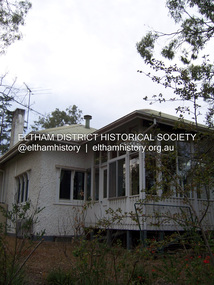
Photograph - Digital Photograph, Alan King, Stanhope, Peter Street, Eltham, 15 March 2008
... The next owner was related to novelist Virginia Woolf. Bishop Reginald Stephen, Warden of Trinity College, bought the house and five acres (2 ha) in 1928. ...The next owner was related to novelist Virginia Woolf. Bishop Reginald Stephen, Warden of Trinity College, bought the house and five acres (2 ha) in 1928. ...On the crest of Stanhope Hill at Peter Street, Eltham, stands the former home of a couple, Clem and Nina Christensen who had a major influence on the literary development of post World War 2 Australia. Covered under Heritage Overlay, Nillumbik Planning Scheme. Published: Nillumbik Now and Then / Marguerite Marshall 2008; photographs Alan King with Marguerite Marshall.; p109 On the crest of Stanhope Hill at Peter Street, Eltham, stands the former home of a couple, who had a major influence on the literary development of post World War Two Australia. In 1946, Clem and Nina Christensen bought the house, which had been designed by Harold Desbrowe Annear, considered to be one of Australia’s most innovative architects in the first quarter of the 20th century.1 That year the stucco building with a metal roof, built in 1910, was extended to the north and south. The main residence was built of jarrah, with stucco walls, floors of Tasmanian hardwood and rooms panelled with Californian redwood (sequoia). The property included a cottage, former stables, a dairy and meat-house. From its beginnings the property has attracted artists and intellectuals. Official World War One artist, Will Longstaff, bought the property – then 15½ acres (6ha) around 1900. Famous for his painting The Ghosts of Menin Gate, now in the Australian War Memorial Canberra, Longstaff was the cousin of another well-known painter, Sir John Longstaff. Several leading artists visited Longstaff at Stanhope including Walter Withers of the Heidelberg School, who lived in Brougham Street, Eltham. In 1919, Theo Handfield, father of author and journalist John Handfield, bought the property from Mrs Longstaff. Then in 1924 the land was subdivided and most of the estate (80 blocks) was auctioned. The next owner was related to novelist Virginia Woolf. Bishop Reginald Stephen, Warden of Trinity College, bought the house and five acres (2 ha) in 1928. He was related to Sir Leslie Stephen, the first editor of the Dictionary of National Biography and Woolf’s father. Novelist and music critic John Harcourt, was the next tenant, while he and his wife Fay, built their mud-brick house Clay Nuneham, at the foot of Stanhope Hill. Dr Clem and Mrs Nina Christensen, lived in the house until their deaths. Clem Christensen – who died aged 91 in 2003 – was a poet, short story writer and painter. However, he is most noted for founding Australia’s foremost literary journal2 Meanjin (originally Meanjin Papers), which he described as ‘democratic left of centre’, in Brisbane in 1940. Clem brought Meanjin to Melbourne in 1945 and remained editor until 1975. Enormously influential, Meanjin spawned and encouraged many of Australia’s best literary talents and it had an international reputation. Meanjin was the first to publish such writers as Judith Wright and David Malouf and it encouraged writers like Patrick White and Peter Carey. Nina Christensen – who died aged 89 in 2001 – was founding Editor of the Melbourne Slavonic Studies Journal and pioneered the study of Russian in Australia. In 1946 she established the Department of Russian Language and Literature at The University of Melbourne, which she led until 1977. Nina’s graduates largely staffed subsequent departments, in other Australian universities.3 However Nina’s Russian heritage and Clem’s outspoken views caused problems. They were forced to defend themselves in the Petrov inspired Royal Commission on Espionage in the 1950s, but were exonerated. The Christensens attracted and hosted many distinguished Australian and foreign writers, artists and academics, including Nobel prize-winning novelist, Patrick White and the world’s then leading cellist, Mstislav Rostropovich.4 Other writers and intellectuals who visited Stanhope were: Vance Palmer, Alan Marshall, A D Hope, Xavier Herbert, Nevil Shute, Geoffrey Dutton, Martin Boyd, Judah Waten, Bruce Grant, Dorothy Hewett and Sir Herbert Read. Painters included: Danila Vassilieff, Arthur Boyd, Albert Tucker, Justus Jörgensen, Robert Hughes and Clifton Pugh. Academics included: Manning Clark, Geoffrey Blainey, W Macmahon Ball, Richard Downing, Geoffrey Serle and scientist Tim Marshall. Politicians included: Jim Cairns, Pauline Toner, Lance Barnard, Sir Paul Hasluck, Sheryl Garbutt and performance artists included: film star Olivia Newton-John, members of the Bolshoi ballet and the Russian State Ballet of Siberia.5 Nina Christensen was honoured in 2006 at the Eltham Living and Learning Centre with the building of an amphitheatre designed by V Sverdlin.This collection of almost 130 photos about places and people within the Shire of Nillumbik, an urban and rural municipality in Melbourne's north, contributes to an understanding of the history of the Shire. Published in 2008 immediately prior to the Black Saturday bushfires of February 7, 2009, it documents sites that were impacted, and in some cases destroyed by the fires. It includes photographs taken especially for the publication, creating a unique time capsule representing the Shire in the early 21st century. It remains the most recent comprehenesive publication devoted to the Shire's history connecting local residents to the past. nillumbik now and then (marshall-king) collection, clem christesen, eltham, nina christesen, peter street, stanhope
