
Showing 3 items matching "volunteer act 1854"
-
 Flagstaff Hill Maritime Museum and Village
Photograph - Glass plate, circa 1866
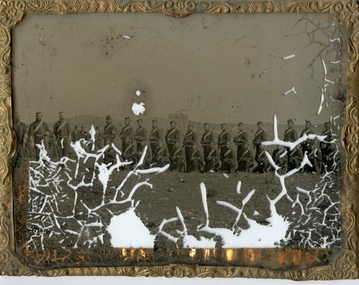
... ...volunteer act 1854...Around this time the citizens of Victoria were prospering from the gold rush but felt isolated and uneasy about their security in the colony. In 1854 the Volunteer Act was passed to provide some military defence. ...The photograph is also the only example of the early methods of glass plate photography in our collection. flagstaff hill warrnambool shipwrecked coast flagstaff hill maritime museum maritime museum shipwreck coast flagstaff hill maritime village great ocean road glass plate photography 19th century colonial forces military defence volunteer act 1854 volunteer rifle garrison artillery volunteer corps militia militia garrison band pillbox forage caps helpmann manifold and bostock 1853 lee enfield musket tintype Warrnambool Garrison 1860s Cannon Hill Manifold & Bostock flour mill 3-storey building Photograph, rectangular glass plate, positive sepia image. ...This glass plate photograph shows good detail of members of the Warrnambool Garrison posing for their photograph in front of a young township. There are other well-dressed citizens behind them. The three men with frogging on their sleeves were commanders were likely to be commanders. The men are facing north with Cannon Hill and the fortification area in the background. It dates from the 1860s. The firearms held appear to be 1853 pattern Lee Enfield muskets used by the British army in Crimea at this time and in Australia, rather than the later Martini Henry cartridge rifles. The uniforms match other photos of the Warrnambool Garrison Militia and Band in our Collection, taken up until the 1880s. The three storey building in the photograph is likely to be the Manifold & Bostock flour mill, built in 1854 near the ‘cutting’ in Merri Street, which was one of the main streets at the time; if one faced the building’s front from a vantage point and looked south to south-east, the hills around Flagstaff Hill and Cannon Hill would be behind that mill, and the Harbour behind the hills. This is the area of the Fortifications. The glass plate method of photography was widely used during the mid-19th to early-20th century. The donor and maker of the photograph are unknown. Around this time the citizens of Victoria were prospering from the gold rush but felt isolated and uneasy about their security in the colony. In 1854 the Volunteer Act was passed to provide some military defence. In 1858 the Warrnambool Volunteer Rifle Corps was established, disbanded in 1863, then a new Warrnambool Detachment was formed in September 1866. Legislation was passed in 1884 that replaced the volunteers’ corps with a partly paid, permanent Militia Defence Force. The batteries manning the coastal forts of Victoria were termed Garrison Artillery Companies. When the Army was federated in 1901 there were eight Militia Companies in Victoria. Warrnambool and Port Fairy together were known as 8 Coy AGA (Australian Garrison Artillery). Changes to formation and name continued into the 20th century.This photograph is a record of the very early local defence force, circa 1866. The photograph signifies the connection of the colony in Victoria to the growing need for security due to the unrest in Europe at that time. The photograph is also locally significant to the industry of the young township of Warrnambool, showing what is likely to be one of the first flour mills in the town. The photograph is also the only example of the early methods of glass plate photography in our collection. Photograph, rectangular glass plate, positive sepia image. Photograph has brass framed edges that fold over to the back, with mitred corners. The front edges are pressed with a decorative floral pattern. The photograph shows a group of thirty military men, standing or kneeling, in dark uniforms with pillbox forage caps, round-collared jackets with light buttons, light sashes worn from top left shoulder to bottom right side of waist belt, and long, straight-legged trousers. Three of these men have light braid around the buttons on the front of their jackets, light frogging on their sleeve cuffs and stripes on the outside seams of their trousers. The other twenty-seven men have plain uniforms and are holding firearms in their right hands, steadied with their left hands. Other figures are standing behind this group of soldiers, including three or four men wearing top hats, jackets and ties. In the background is a row of buildings. The central building is three stories high. Bare hills are in the far background. The foreground is uneven ground with patches of short grass. Photographer looking towards the south east and Cannon Hill, with the Warrnambool Garrison facing north, ca.1860s.flagstaff hill, warrnambool, shipwrecked coast, flagstaff hill maritime museum, maritime museum, shipwreck coast, flagstaff hill maritime village, great ocean road, glass plate, photography 19th century, colonial forces, military defence, volunteer act 1854, volunteer rifle, garrison artillery, volunteer corps, militia, militia garrison band, pillbox forage caps, helpmann, manifold and bostock, 1853 lee enfield musket, tintype, warrnambool garrison, 1860s, cannon hill, manifold & bostock, flour mill, 3-storey building -
 Narre Warren and District Family History Group
Document, Patricia M Frei, Historical indexes of the Canberra/Queanbeyan district, 2006
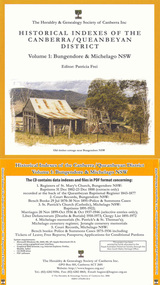
... 1854- May 1859 (to Jan 1864) & Cash Book: Sep 1844-Aug 1846 12. Selective notes from the Court of Claims: Register of Cases from 1835 13. Publicans Licences 1841-1862 recorded in the Deposition Book from 1838 14. Bench Records-Queanbeyan 1838-1896 Volume 3: Land and Other Records contains: 15. Research notes from the: Queanbeyan Conditional Purchase Registers 1862-1872, 1874-1877; Selections made 1870-1879 under the Volunteers Regulation Act ...Historical Indexes of the Canberra Queanbeyan District in 4 volumes Volume 1: Bungendore & Michelago NSW contains: 1. Registers of St. Mary's Church, Bungendore NSW: Baptisms 31 Dec 1882-23 Dec 1888 (extracts only) recorded at the back of the Queanbeyan Baptismal Register 1843-1877 2. Court Records, Bungendore NSW: Bench Books 29 Jul 1870-30 Nov 1891-Police & Summons Cases 3. St. Patrick's Church (Catholic), Michelago NSW: Baptisms 1891-1922; Marriages 20 Nov 1899-Oct 1936 & Oct 1937-1946 (selective entries only); Liber Defunctorum [Deaths & Burials] 1910-1973; Clergy List 1891-1972 4. Michelago memorials (St. Patrick's & St. Thomas's); Michelago cemetery register; Jerangle cemetery memorials 5. Court Records, Michelago NSW: Bench books: Police & Summons Cases 1875-1936 including Tickets of Leave; Free Reports; Passports; Applications for Conditional Pardons Volume 2: Council & Court Records, Queanbeyan NSW contains: 6. Selective notes from the: Minutes of meetings of Queanbeyan Municipal Council 1885-1926; Borough Council Record Book; Halloran & Co. vs Queanbeyan Municipal Council; Commons Trust Minute Book 1899-1916 7. Notes transcribed from the District Council Papers 1843-1847 8. Notes transcribed from the Yarrowlumla Shire Council Minutes Apr 1907-Feb 1950 9. Courthouse Records: Minutes of Proceedings in Court of Review, Queanbeyan (selective 1899-1903); Bailiffs Execution Book (selective entries 1897-1918) 10. Notes transcribed from the Bench of Magistrates Correspondence 1833-1851 11. Free Reports 1846-1847; Small Debts Register 1849-1864 (incl Return of Ticket of Leave Holders); Court of Requests-Judgement book Sep 1854- May 1859 (to Jan 1864) & Cash Book: Sep 1844-Aug 1846 12. Selective notes from the Court of Claims: Register of Cases from 1835 13. Publicans Licences 1841-1862 recorded in the Deposition Book from 1838 14. Bench Records-Queanbeyan 1838-1896 Volume 3: Land and Other Records contains: 15. Research notes from the: Queanbeyan Conditional Purchase Registers 1862-1872, 1874-1877; Selections made 1870-1879 under the Volunteers Regulation Act 1867; Conditional Purchase Registers, Queanbeyan 1862-1878; Dates of Birth-Juvenile Selectors 1872-1878 (selective) 16. Alienation of Lands 1812-1853 (selective Queanbeyan & district) incl. County Register 1829-1839 (King, St. Vincent, Murray Counties) 17. Land Selection 1869-1872, 1874-1876 (selective research notes on Queanbeyan & district) 18. Selective notes from the Royal Commission on the Site for a Federal Capital (site proposed at Queanbeyan: Wanniassa, Canberra, Lake George 1899-1902) 19. Teachers in Public Schools 1884 (selective Queanbeyan & district) 20. Notes transcribed from the Queanbeyan School of Arts Minute Book 21 Jul 1925-22 Jul 1935 21. Index to Obituaries & Personal Notices circa 1820s-2001 Volume 4: Parish Registers & Burial Records contains: 22. Deaths registered at Queanbeyan NSW 1856-1901 & Burials in outlying cemeteries 1856-1907 23. Queanbeyan NSW-Gemetery records transferred from denominational trustees 24. Supreme Crt of NSW-Probate Index 1800-1901 (extracts relating to the Queanbeyan district) 25. Supreme Crt of NSW-Wills & Administrations 1800-1901 (extracts only) 26. Cemetery transcriptions—Michelago, Riverside-Queanbeyan, Gundaroo, Upper Gundaroo, Barnsdale-Gundaroo, St.Thomas-Carwoola, Ss Peter & Paul—Hoskingtown (all NSW), Weetangerra, Hall, Tharwa (all ACT) 27. Anglican Church of St. John the Baptist, Canberra: baptisms 1845-1900; marriages 1845-1877; burials 1844-1915 (selective Gundaroo entries only) 28. Christ Church (Anglican), Queanbeyan (selective): baptisms 1838-1866; marriages 1838-1909, burials 1838-1880,1913-1917,1920-1968 29. St. Gregory's (Catholic), Queanbeyan: baptisms 1843-1920; marriages 1843-1857,1856-1898, 1881; burials 1844-1877,1937-1967 (selective) 30. Ministrations by RevT Hassall, Diocese of Goulburn: baptisms 1836; baptisms by T Hassall 1827-1834,1836; marr 1827-1833; burials 1827,1829 31. Fr. J.J. Therry's registers (Catholic baptisms, marriages & burials), Queanbeyan district 1820-1838 32. Anglican Church of St. Clement's, Yass NSW (Gundaroo entries only): baptisms 1839-1863; marriages 1839-1853; burials 1839-1875 33. Parish Registers, Gunning NSW, (Gundaroo entries only): baptisms 1839-1930; marriages 1840-1850; burials 1842-18554 optical discsnon-fictionHistorical Indexes of the Canberra Queanbeyan District in 4 volumes Volume 1: Bungendore & Michelago NSW contains: 1. Registers of St. Mary's Church, Bungendore NSW: Baptisms 31 Dec 1882-23 Dec 1888 (extracts only) recorded at the back of the Queanbeyan Baptismal Register 1843-1877 2. Court Records, Bungendore NSW: Bench Books 29 Jul 1870-30 Nov 1891-Police & Summons Cases 3. St. Patrick's Church (Catholic), Michelago NSW: Baptisms 1891-1922; Marriages 20 Nov 1899-Oct 1936 & Oct 1937-1946 (selective entries only); Liber Defunctorum [Deaths & Burials] 1910-1973; Clergy List 1891-1972 4. Michelago memorials (St. Patrick's & St. Thomas's); Michelago cemetery register; Jerangle cemetery memorials 5. Court Records, Michelago NSW: Bench books: Police & Summons Cases 1875-1936 including Tickets of Leave; Free Reports; Passports; Applications for Conditional Pardons Volume 2: Council & Court Records, Queanbeyan NSW contains: 6. Selective notes from the: Minutes of meetings of Queanbeyan Municipal Council 1885-1926; Borough Council Record Book; Halloran & Co. vs Queanbeyan Municipal Council; Commons Trust Minute Book 1899-1916 7. Notes transcribed from the District Council Papers 1843-1847 8. Notes transcribed from the Yarrowlumla Shire Council Minutes Apr 1907-Feb 1950 9. Courthouse Records: Minutes of Proceedings in Court of Review, Queanbeyan (selective 1899-1903); Bailiffs Execution Book (selective entries 1897-1918) 10. Notes transcribed from the Bench of Magistrates Correspondence 1833-1851 11. Free Reports 1846-1847; Small Debts Register 1849-1864 (incl Return of Ticket of Leave Holders); Court of Requests-Judgement book Sep 1854- May 1859 (to Jan 1864) & Cash Book: Sep 1844-Aug 1846 12. Selective notes from the Court of Claims: Register of Cases from 1835 13. Publicans Licences 1841-1862 recorded in the Deposition Book from 1838 14. Bench Records-Queanbeyan 1838-1896 Volume 3: Land and Other Records contains: 15. Research notes from the: Queanbeyan Conditional Purchase Registers 1862-1872, 1874-1877; Selections made 1870-1879 under the Volunteers Regulation Act 1867; Conditional Purchase Registers, Queanbeyan 1862-1878; Dates of Birth-Juvenile Selectors 1872-1878 (selective) 16. Alienation of Lands 1812-1853 (selective Queanbeyan & district) incl. County Register 1829-1839 (King, St. Vincent, Murray Counties) 17. Land Selection 1869-1872, 1874-1876 (selective research notes on Queanbeyan & district) 18. Selective notes from the Royal Commission on the Site for a Federal Capital (site proposed at Queanbeyan: Wanniassa, Canberra, Lake George 1899-1902) 19. Teachers in Public Schools 1884 (selective Queanbeyan & district) 20. Notes transcribed from the Queanbeyan School of Arts Minute Book 21 Jul 1925-22 Jul 1935 21. Index to Obituaries & Personal Notices circa 1820s-2001 Volume 4: Parish Registers & Burial Records contains: 22. Deaths registered at Queanbeyan NSW 1856-1901 & Burials in outlying cemeteries 1856-1907 23. Queanbeyan NSW-Gemetery records transferred from denominational trustees 24. Supreme Crt of NSW-Probate Index 1800-1901 (extracts relating to the Queanbeyan district) 25. Supreme Crt of NSW-Wills & Administrations 1800-1901 (extracts only) 26. Cemetery transcriptions—Michelago, Riverside-Queanbeyan, Gundaroo, Upper Gundaroo, Barnsdale-Gundaroo, St.Thomas-Carwoola, Ss Peter & Paul—Hoskingtown (all NSW), Weetangerra, Hall, Tharwa (all ACT) 27. Anglican Church of St. John the Baptist, Canberra: baptisms 1845-1900; marriages 1845-1877; burials 1844-1915 (selective Gundaroo entries only) 28. Christ Church (Anglican), Queanbeyan (selective): baptisms 1838-1866; marriages 1838-1909, burials 1838-1880,1913-1917,1920-1968 29. St. Gregory's (Catholic), Queanbeyan: baptisms 1843-1920; marriages 1843-1857,1856-1898, 1881; burials 1844-1877,1937-1967 (selective) 30. Ministrations by RevT Hassall, Diocese of Goulburn: baptisms 1836; baptisms by T Hassall 1827-1834,1836; marr 1827-1833; burials 1827,1829 31. Fr. J.J. Therry's registers (Catholic baptisms, marriages & burials), Queanbeyan district 1820-1838 32. Anglican Church of St. Clement's, Yass NSW (Gundaroo entries only): baptisms 1839-1863; marriages 1839-1853; burials 1839-1875 33. Parish Registers, Gunning NSW, (Gundaroo entries only): baptisms 1839-1930; marriages 1840-1850; burials 1842-1855queanbeyan nsw, canberra district (act), parish registers, burial records -
 Flagstaff Hill Maritime Museum and Village
Certificate - Musketry and Sergeant Qualifications, Victorian Military School of Instruction, 1887 - 1894
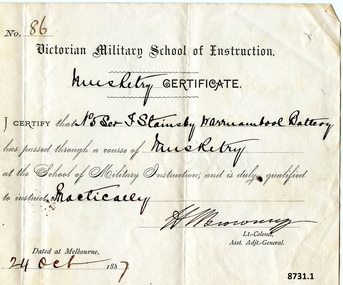
... The Crimean War began in 1854 and many people in colonial Australia were afraid of a Russian attack. In 1854 the Volunteer Act was passed to provide some military defence. ...The Crimean War began in 1854 and many people in colonial Australia were afraid of a Russian attack. In 1854 the Volunteer Act was passed to provide some military defence. ...The Crimean War began in 1854 and many people in colonial Australia were afraid of a Russian attack. In 1854 the Volunteer Act was passed to provide some military defence. In 1858 the Warrnambool Volunteer Rifle Corps was established, disbanded in 1863, then a new Warrnambool Detachment was formed in September 1866. In 1870 Australia became responsible for its own naval and military defence. The Permanent Victorian Artillery force was established. It was disbanded in 1880 then re-formed in 1882 as the Victorian Garrison Artillery Corps. Legislation was passed in 1884 that replaced the volunteers’ corps with a partly paid, permanent Militia Defence Force. Volunteer forces were established to strengthen the British Imperial troops posted here. A battery of artillery was raised in Victoria as well as in other Australian states. The Batteries manning the coastal forts of Victoria were termed Garrison Artillery Companies. When the Army was federated in 1901 there were eight Militia Companies in Victoria. Warrnambool and Port Fairy together were known as 8 Coy AGA (Australian Garrison Artillery). Changes to formation and name continued into the 20th century. In 1895 the Geelong, Warrnambool, Port Fairy and Portland Batteries became part of the Western District Garrison Artillery. Many of the volunteers who served in the Artillery were from rural areas. They belonged to rifle clubs and were experienced horsemen as well. Australia's defence at this time relied on these mounted troops, or Light Horse men. In 1899 the Victorian Garrison Artillery Corps amalgamated with the New South Wales and Queensland Permanent Artillery to become the Victorian Regiment of the Royal Australian Artillery (RAA). Then prior to Federation, the RAA and the Permanent Artillery of South Australia, Western Australia and Tasmania all combined, becoming the Royal Australian Artillery Regiment with two Batteries of Field Artillery; Battery A from Sydney and Battery B from Melbourne. These two certificates were awarded to Sergeant Thomas Stainsby who was a long-time member of the Warrnambool Garrison Artillery detachment during the 1880's and into the 1890's. He is mentioned in several newspaper reports of the era, as being an integral member of the local artillery detachments (as Sergeant-in-Charge, Gun Layer or Orderly) participating in local and statewide "Battery Competitions" that were very popular at this time. In one Annual Battery competition held in 1891 at Port Fairy, a target was moored in the bay and each detachment fired four rounds of "plugged shell" at it (at an estimated distance of 1900 yards). The local newspaper (the Warrnambool Standard) reported "the best work was reserved for the last detachment ... in charge of that old warrior Sergeant Stainsby ... who won the first prize with their four shots." Thomas Stainsby was an important member of the Warrnambool Artillery Battery in the years when it was competing for the "Sir William Clarke Trophy" The Sir William Clarke Trophy (a silver trophy) was given as a prize in 1885 to Victorian Militia Garrison Battery competition winners, for artillery firing target accuracy. A Battery needed to win the competition three times to keep the trophy and the Warrnambool Battery won it in 1887, 1889 and 1892. When the Warrnambool Militia Garrison Artillery had won the Trophy, for the third time, they became Absolute Possessors of the prize. Thomas Stainsby was born on October 25th, 1846, in Melbourne. He married Ellen Priddle in Geelong in 1869, and they moved to Camperdown and then Warrnambool in the 1870's. They had ten children. He was a bootmaker and had a shop in Fairy Street. Thomas died on September 26th, 1914, aged 67. His Obituary in the local paper said he "was very keen on cycling and pedestrianism ... and was actively associated with the old volunteer militia and held the position of Sergeant in the old Battery." Thomas Stainsby features in several photographs of the Warrnambool Battery held in the Flagstaff Hill collection. The Warrnambool Garrison has been added to the Victorian Heritage Register H1250 “for its intact battery and guns, a strong reminder of Victoria’s wealth and determination to protect itself from the perceived threat of invasion in the 1880’s.” The City of Warrnambool is one of several custodians of a collection of artillery pieces of heritage significance at a state, national and international level. These pieces are directly related to the defence of south-west Victoria in the 19th century. The care and preservation come under the Heritage Act 1995. The certificates belonging to Sergeant Thomas Stainsby are a significant example of the work and dedication of a Warrnambool Garrison volunteer.Two paper certificates awarded to Sergeant T. Stainsby. Certificate 8731 is from the "Victorian Military School of Instruction" and was awarded to Sergeant Stainsby of the Warrnambool Battery on 24th October 1887, for passing a course of "Musketry" which enabled him to become a qualified "practical" instructor. The certificate has printed and handwritten sections. Certificate 8732 is from the "Victorian Military Forces", dated 1st July 1894 and certifies that Sergeant Stainsby of the Warrnambool Battery Garrison Artillery passed through a course of Instruction and has qualified for the rank of "Sergeant in the Garrison Artillery, Victoria". The certificate has printed and handwritten sections, is yellowed with age and has some rips and tears along each edge and along its fold lines.Certificate 8731.1 - "No. 86" /Victorian Military School of Instruction/ Musketry CERTIFICATE. / I CERTIFY that No 5 Ser T Stainsby Warrnambool Battery / has passed through a course of Musketry /at the School of Military Instruction, and is duly qualified/ to instruct Practically/ [illegible signature]/Lt-Colonel/ Asst. Adjt.-General / Dated at Melbourne/ 24 Oct 1887." Certificate 8731.2 - "No 480 / Victorian Military Forces - /Re-issue / 2nd Class certificate /I certify that No 1 sergeant/ T Stainsby, Warrnambool Battery G.A. / has passed through a course of instruction / and is qualified for the rank of / Sergeant in the Garrison Artillery, Victoria/ Dated at Melbourne / 1st July 1894 [illegible signature] Lieut-Colonel /Comma? Artillery."flagstaff hill maritime museum and village, warrnambool, great ocean road, shipwreck coast, victorian garrison artillery, warrnambool battery, volunteer militia, garrison artillery, artillery detachment, battery competitions, warrnambool garrison volunteers, sergeant stainsby, thomas stainsby, sir w. clarke trophy, sir w. j. clarke trophy
