
Showing 32 items matching "w bedford"
-
 Port Melbourne Historical & Preservation Society
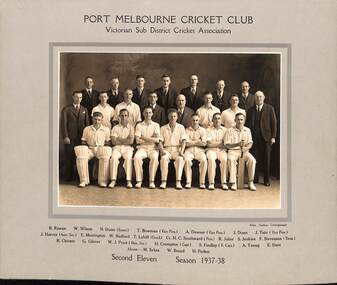
Photograph, Allan Studios Collingwood, Port Melbourne Cricket Club Second Eleven 1937.38, 1937-38
... ...W BEDFORD...Sec.) E MERRINGTON, W BEDFORD, T LAHIFF (Coach), Cr H C SOUTHWARD (Pres), R JULIER, S JENKINS, F STEVENSON (Treas.). ...Sec.) E MERRINGTON, W BEDFORD, T LAHIFF (Coach), Cr H C SOUTHWARD (Pres), R JULIER, S JENKINS, F STEVENSON (Treas.). ...Players in the Second Eleven in the 1937-8 season were: Back Row: B ROWAN, W WILSON, N DUNN (Scorer), T BOWMAN (Vice Pres.), A DOWNER (Vice Pres.), J DUNN, J TATE (Vice Pres). Centre Row: J HARVEY (Asst. Sec.) E MERRINGTON, W BEDFORD, T LAHIFF (Coach), Cr H C SOUTHWARD (Pres), R JULIER, S JENKINS, F STEVENSON (Treas.). Front Row: R CHIVERS, G GLOVER, W J PRICE (Hon. Sec.) H COMPTON (Captain) S FINDLAY (V. Captain), A YOUNG, E DARE. Absent: M SYKES, W BROAD, H PARKER.The sepia photograph on grey mounting board shows the Port Melbourne Cricket Club's Second Eleven for the season 1937-38. The team were part of the Victorian Sub District Cricket Association.sport - cricket, b rowan, w wilson, e merrington, w bedford, r julier, s jenkins, r chivers, g glover, a young, m sykes, w broad, h parker., port melbourne cricket club, pmcc, n dunn, t bowman, a downer, j tate, j harvey, tommy lahiff, henry carr southward, f stevenson, w j price, h compton, s findlay, e dare -
 Flagstaff Hill Maritime Museum and Village
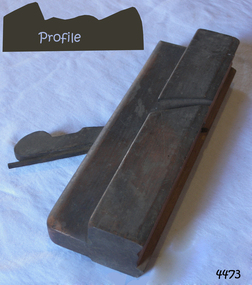
Tool - Moulding wood Plane, Mid to Late 19th Century
... Bedford Street. Richard retired somewhere between 1867 and 1871, but the business continued. The business is taken over by W M Marples & Sons and tools continued to be made in London until 1904 when manufacturing relocated to Sheffield. ...Bedford Street. Richard retired somewhere between 1867 and 1871, but the business continued. The business is taken over by W M Marples & Sons and tools continued to be made in London until 1904 when manufacturing relocated to Sheffield. ...A moulding plane is a specialised plane used for making the complex shapes found in wooden mouldings that are used to decorate furniture or other wooden objects. Traditionally, moulding planes were blocks of wear-resistant hardwood, often beech or maple, which were worked to the shape of the intended moulding. The blade or iron was likewise formed to the intended moulding profile and secured in the body of the plane with a wooden wedge. A traditional cabinetmakers shop might have many, perhaps hundreds, of moulding planes for the full range of work to be performed. Large crown mouldings required planes of six or more inches in width, which demanded great strength to push and often had additional peg handles on the sides, allowing the craftsman's apprentice or other workers to pull the plane ahead of the master who guided it. John Moseley & Son: Records indicate that before 1834, the firm is listed at number 16 New Street, London and according to an 1862 advertisement the shop had been established in New Street since 1730, The Sun insurance records from the time show that John Moseley was the possessor of a horse mill in the yard of his premises, which means that some kind of manufacturing was taking place, as the mill would have provided power to run a saw or perhaps a grinding wheel so the probability is that he did not just sell tools, he made them as well. John Moseley died in 1828 and his will he names his four sons: John, Thomas, William and Richard. To complicate matters he also had brothers with the same first names; brothers Richard (of Piccadilly) and William (of Peckham Rye) are named as two of the executors. Brother Thomas is not mentioned in this will, but became a minister and was one of the executors of brother Richard’s estate when he died in 1856. From John’s will, we also learn that, although the shop was in New Street, he resided in Lympstone, Devon. The family must have had a house in that county for quite some time as both sons Richard and William are baptised in Devon, although John and Thomas were baptised in London. In the 1841 and 1851 census records, we just find William in New Street, but in 1861 both William and Richard are listed there as toolmakers. That Richard was staying overnight at New Street was probably just accidental as in 1851 and 1871, we find him with his wife Jane and children in Clapham and Lambeth respectively. In 1851 Richard is listed as “assistant clerk cutlery warehouse” and in 1871 as “retired plane maker and cutler”. Although the actual place of work is not stated, one may assume he worked in the family business. 1862 is a year full of changes for the firm. In that year, William had a new property built at 27 Bedford Street. In the catalogue for the 1862 International Exhibition, 54 Broad Street (later 54-55 Broad Street) is listed for the first time, which may very well coincide with the split of the business into a retail and a wholesale branch. Around the same time, they must have moved from New Street to 17 & 18 King Street because their manufacturing premises had been pulled down to form the New Street from Cranbourne Street to King Street. In January 1865, William died and Richard continued the business. In 1867, the partnership he had with his son Walker and Thomas Elis Hooker, is dissolved. Richard continued tool making at King Street and Bedford Street. Richard retired somewhere between 1867 and 1871, but the business continued. The business is taken over by W M Marples & Sons and tools continued to be made in London until 1904 when manufacturing relocated to Sheffield. A vintage tool made by a well documented company, this item was made commercially for firms and individuals that worked in wood and needed a tool that could produce a ornamental finish to timber. The tool was used before routers and spindle moulders came into use after World War ll, a time when to produce a decorative moulding for a piece of furniture, door trims etc or other items had to be accomplished using hand tools and in particular one of these types of planes. These profiled planes came in various shapes and sizes to achieve a decorative finish. A significant tool from the mid to late 19th century that today is quite rare and sought after by collectors. It gives us a snapshot of how furniture and other decorative finishes were created on timber by the use of hand tools. Tools that were themselves hand made shows the craftsmanship used during this time not only to make a tool such as the subject item but also the craftsmanship needed to produce a decorative finish that was needed to be made for any timber item. Moulding Plane . J Moseley. maker and R Knight & J Heath also stamped stamped (Owners)flagstaff hill, warrnambool, shipwrecked-coast, flagstaff-hill, flagstaff-hill-maritime-museum, maritime-museum, shipwreck-coast, flagstaff-hill-maritime-village, plane moulding, moulding plane, plane, j heath, moseley -
 Flagstaff Hill Maritime Museum and Village
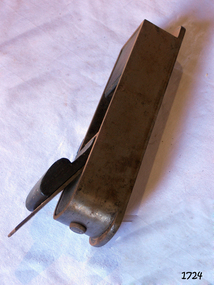
Tool - Wood Plane, Late 19th to early 20th century
... Bedford Street. Richard retired somewhere between 1867 and 1871, but the business continued. The business is taken over by W M Marples & Sons and tools continued to be made in London until 1904 when manufacturing relocated to Sheffield....Bedford Street. Richard retired somewhere between 1867 and 1871, but the business continued. The business is taken over by W M Marples & Sons and tools continued to be made in London until 1904 when manufacturing relocated to Sheffield. ...A moulding plane is a specialised plane used for making the complex shapes found in wooden mouldings that are used to decorate furniture or other wooden objects. Traditionally, moulding planes were blocks of wear-resistant hardwood, often beech or maple, which were worked to the shape of the intended moulding. The blade or iron was likewise formed to the intended moulding profile and secured in the body of the plane with a wooden wedge. A traditional cabinetmakers' shop might have many, perhaps hundreds, of moulding planes for the full range of work to be performed. Large crown mouldings required planes of six or more inches in width, which demanded great strength to push and often had additional peg handles on the sides, allowing the craftsman's apprentice or other workers to pull the plane ahead of the master who guided it. John Moseley & Son: Records indicate that before 1834, the firm is listed at number 16 New Street, London and according to an 1862 advertisement the shop had been established in New Street since 1730, The Sun insurance records from the time show that John Moseley was the possessor of a horse mill in the yard of his premises, which means that some kind of manufacturing was taking place, as the mill would have provided power to run a saw or perhaps a grinding wheel so the probability is that he did not just sell tools, he made them as well. John Moseley died in 1828 and his will named his four sons: John, Thomas, William and Richard. To complicate matters he also had brothers with the same first names; brothers Richard (of Piccadilly) and William (of Peckham Rye) are named as two of the executors. Brother Thomas is not mentioned in this will, but became a minister and was one of the executors of brother Richard's estate when he died in 1856. From John's will, we also learn that, although the shop was in New Street, he resided in Lympstone, Devon. The family must have had a house in that county for quite some time as both sons Richard and William are baptised in Devon, although John and Thomas were baptised in London. In the 1841 and 1851 census records, we just find William in New Street, but in 1861 both William and Richard are listed there as toolmakers. That Richard was staying overnight at New Street was probably just accidental as in 1851 and 1871, we find him with his wife Jane and children in Clapham and Lambeth respectively. In 1851 Richard is listed as “assistant clerk cutlery warehouse” and in 1871 as “retired plane maker and cutler”. Although the actual place of work is not stated, one may assume he worked in the family business. 1862 is a year full of changes for the firm. In that year, William had a new property built at 27 Bedford Street. In the catalogue for the 1862 International Exhibition, 54 Broad Street (later 54-55 Broad Street) is listed for the first time, which may very well coincide with the split of the business into a retail and a wholesale branch. Around the same time, they must have moved from New Street to 17 & 18 King Street because their manufacturing premises had been pulled down to form the New Street from Cranbourne Street to King Street. In January 1865, William died and Richard continued the business. In 1867, the partnership he had with his son Walker and Thomas Elis Hooker, is dissolved. Richard continued tool-making at King Street and Bedford Street. Richard retired somewhere between 1867 and 1871, but the business continued. The business is taken over by W M Marples & Sons and tools continued to be made in London until 1904 when manufacturing relocated to Sheffield.A vintage tool made by a well-known company, this item was made commercially for firms and individuals that worked in wood and needed a tool that could remove large amounts of timber. These jack or dressing planes came in various shapes and sizes to achieve a flat and even finish to timber surfaces and came in many sizes. A significant tool from the mid to late 19th century that is still in use today with early models sought after by collectors. It gives us a snapshot of how furniture and other finishes were created on timber by the use of cutting-edged hand tools. Tools that were themselves handmade show the craftsmanship used during this time not only to make a tool such as the subject item but also the craftsmanship needed to produce a decorative or even finish that was needed for the finishing of timber items.Jack Plane metal body with rose wood filler.Mosley & Sons London No 2flagstaff hill, warrnambool, flagstaff-hill, flagstaff-hill-maritime-museum, maritime-museum, shipwreck-coast, flagstaff-hill-maritime-village, john moseley & son, jack plane, woodworking tool, carpenders tools, cabinet makers tools -
 Federation University Historical Collection
Magazine - Booklet, Ballarat School of Mines Students' Magazine, 1943, 1943
... w. jolly...norman k. clark...barbara curwen-walker...beryl hawkins...betty d. willian...beryl bedford...List of Full Course Students' 1943, Editorial, News, Obituary, News and Notes, The Literary Society, Fumes from the Lab, Arts & Crafts Gossip, Sport, Commercial Notes, The Junior Techs ballarat school of mines magazine alan w. wilson wallace whiteside jean ballinger john r. elliott bill f. carroll maxwell richards margaret dark maxwell lawrence l. strick marion beckwith geoffrey biddington frances duffy ian d. mclachlan joy martin ian cooper valma falla percival d. fisher alma reid f. day n. pierce john procter dr pound mr mein a. mckenzie, ruth mole beryl grinter h. b. murphy margaret c. young w. c. watts john brittain winsome hender shirley dolan adeline helm j. f. lannen max coward alan e. daff b. scott lloyd o. lehmann ernest j. poppins b. egelton john h. prout roy e. mawby robert j. mckenzie phillip p. coulson j. lawry james owen john w. jolly norman k. clark barbara curwen-walker beryl hawkins betty d. willian beryl bedford glenis dow betty law norma eltringham jean lewis dorothy ritchie gwenda harrison eileen dawkins margaret lenaghan olga m. lawrence miss king mrs mcilvena h. packham b. refurn s. lang d. hart e. adams f. savage p. humphrey e. skilbeck a. carland b. doull r. ingleton f. reeve k. gowan b. holloway f. smith t. bennett mr bergin s. wallis d. struthberry k. saunders john lannen patricia allan joan walter Signed on front cover by "H. ...List of Full Course Students' 1943, Editorial, News, Obituary, News and Notes, The Literary Society, Fumes from the Lab, Arts & Crafts Gossip, Sport, Commercial Notes, The Junior Techs Black, green and gold soft covered magazine of 62 pages including advertisements. Artworks Mr Ferguson - By Beryl Grinter Miss Will - By Beryl Grinter Mr Tern - By Ruth Mole Editor - By Margaret Dark Digger - By Joan Walter Kangaroos - By Margaret Dark Lake Wendouree (Fairyland) - By Marion Beckwith Trees at Lake Wendouree - By John Lannen SMB - So much better - By Max Coward Miss Grigg - By Joan Walter Margaret By Joy Martin Head Study from Life - By Ruth Mole Joan - By Margaret Dark Study from Nature - By Beryl Grinter Muriel - By Ruth Mole Carrol - By Ruth Mole Murrell - By Beryl Grinter Betty - By Ruth Mole Kath - By Ruth Mole Pat - By Margaret Dark Betty - By Joan Walter Dorothy - By Joan Walter Margaret - By Margaret Dark Jeanie - By Joan Walter Lois - By Margaret Dark Peanut - By Beryl Grinter Curly - By Ruth Mole Joan - By Patricia Allan Alison - By Ruth Mole June - By Ruth Mole Ice Cream - By Margaret Dark Wright - By Beryl Grinter Willian - By Margaret Dark Duke - By Margaret Dark Redfern - By Beryl Grinter Tilgner - By Beryl Grinter Walla - By Joan Walter Fumbrey - By Joan Walter Coad - By Margaret Dark Fletcher - By Ruth Mole Legs - By Joan Walter Signed on front cover by "H. Yates".ballarat school of mines, magazine, alan w. wilson, wallace whiteside, jean ballinger, john r. elliott, bill f. carroll, maxwell richards, margaret dark, maxwell lawrence, l. strick, marion beckwith, geoffrey biddington, frances duffy, ian d. mclachlan, joy martin, ian cooper, valma falla, percival d. fisher, alma reid, f. day, n. pierce, john procter, dr pound, mr mein, a. mckenzie,, ruth mole, beryl grinter, h. b. murphy, margaret c. young, w. c. watts, john brittain, winsome hender, shirley dolan, adeline helm, j. f. lannen, max coward, alan e. daff, b. scott, lloyd o. lehmann, ernest j. poppins, b. egelton, john h. prout, roy e. mawby, robert j. mckenzie, phillip p. coulson, j. lawry, james owen, john w. jolly, norman k. clark, barbara curwen-walker, beryl hawkins, betty d. willian, beryl bedford, glenis dow, betty law, norma eltringham, jean lewis, dorothy ritchie, gwenda harrison, eileen dawkins, margaret lenaghan, olga m. lawrence, miss king, mrs mcilvena, h. packham, b. refurn, s. lang, d. hart, e. adams, f. savage, p. humphrey, e. skilbeck, a. carland, b. doull, r. ingleton, f. reeve, k. gowan, b. holloway, f. smith, t. bennett, mr bergin, s. wallis, d. struthberry, k. saunders, john lannen, patricia allan, joan walter -
 Flagstaff Hill Maritime Museum and Village
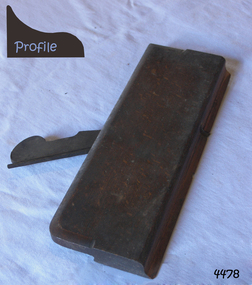
Tool - Plane, Mid to Late 19th Century
... Bedford Street. Richard retired somewhere between 1867 and 1871, but the business continued. The business is taken over by W M Marples & Sons and tools continued to be made in London until 1904 when manufacturing relocated to Sheffield. ...Bedford Street. Richard retired somewhere between 1867 and 1871, but the business continued. The business is taken over by W M Marples & Sons and tools continued to be made in London until 1904 when manufacturing relocated to Sheffield. ...A moulding plane is a specialised plane used for making the complex shapes found in wooden mouldings that are used to decorate furniture or other wooden objects. Traditionally, moulding planes were blocks of wear-resistant hardwood, often beech or maple, which were worked to the shape of the intended moulding. The blade or iron was likewise formed to the intended moulding profile and secured in the body of the plane with a wooden wedge. A traditional cabinetmakers shop might have many, perhaps hundreds, of moulding planes for the full range of work to be performed. Large crown mouldings required planes of six or more inches in width, which demanded great strength to push and often had additional peg handles on the sides, allowing the craftsman's apprentice or other workers to pull the plane ahead of the master who guided it. John Moseley & Son: Records indicate that before 1834, the firm is listed at number 16 New Street, London and according to an 1862 advertisement the shop had been established in New Street since 1730, The Sun insurance records from the time show that John Moseley was the possessor of a horse mill in the yard of his premises, which means that some kind of manufacturing was taking place, as the mill would have provided power to run a saw or perhaps a grinding wheel so the probability is that he did not just sell tools, he made them as well. John Moseley died in 1828 and his will he names his four sons: John, Thomas, William and Richard. To complicate matters he also had brothers with the same first names; brothers Richard (of Piccadilly) and William (of Peckham Rye) are named as two of the executors. Brother Thomas is not mentioned in this will, but became a minister and was one of the executors of brother Richard’s estate when he died in 1856. From John’s will, we also learn that, although the shop was in New Street, he resided in Lympstone, Devon. The family must have had a house in that county for quite some time as both sons Richard and William are baptised in Devon, although John and Thomas were baptised in London. In the 1841 and 1851 census records, we just find William in New Street, but in 1861 both William and Richard are listed there as toolmakers. That Richard was staying overnight at New Street was probably just accidental as in 1851 and 1871, we find him with his wife Jane and children in Clapham and Lambeth respectively. In 1851 Richard is listed as “assistant clerk cutlery warehouse” and in 1871 as “retired plane maker and cutler”. Although the actual place of work is not stated, one may assume he worked in the family business. 1862 is a year full of changes for the firm. In that year, William had a new property built at 27 Bedford Street. In the catalogue for the 1862 International Exhibition, 54 Broad Street (later 54-55 Broad Street) is listed for the first time, which may very well coincide with the split of the business into a retail and a wholesale branch. Around the same time, they must have moved from New Street to 17 & 18 King Street because their manufacturing premises had been pulled down to form the New Street from Cranbourne Street to King Street. In January 1865, William died and Richard continued the business. In 1867, the partnership he had with his son Walker and Thomas Elis Hooker, is dissolved. Richard continued tool making at King Street and Bedford Street. Richard retired somewhere between 1867 and 1871, but the business continued. The business is taken over by W M Marples & Sons and tools continued to be made in London until 1904 when manufacturing relocated to Sheffield. A vintage tool made by a well documented company, this item was made commercially for firms and individuals that worked in wood and needed a tool that could produce a ornamental finish to timber. The tool was used before routers and spindle moulders came into use after World War ll, a time when to produce a decorative moulding for a piece of furniture, door trims etc or other items had to be accomplished using hand tools and in particular one of these types of planes. These profiled planes came in various shapes and sizes to achieve a decorative finish. A significant tool from the mid to late 19th century that today is quite rare and sought after by collectors. It gives us a snapshot of how furniture and other decorative finishes were created on timber by the use of hand tools. Tools that were themselves hand made shows the craftsmanship used during this time not only to make a tool such as the subject item but also the craftsmanship needed to produce a decorative finish that was needed to be made for any timber item. Moulding Plane . J Moseley. maker and R Knight & J Heath also stamped stamped (Owners)flagstaff hill, warrnambool, shipwrecked-coast, flagstaff-hill, flagstaff-hill-maritime-museum, maritime-museum, shipwreck-coast, flagstaff-hill-maritime-village, plane moulding, moulding plane, plane, j heath, moseley -
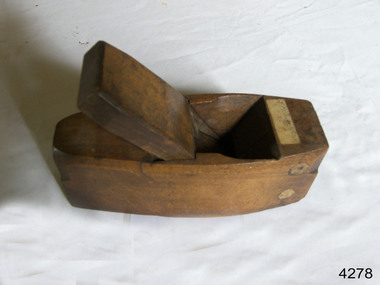 Flagstaff Hill Maritime Museum and Village
Tool - Smoothing Plane, Mid to Late 19th Century
... Bedford Street. Richard retired somewhere between 1867 and 1871, but the business continued. The business is taken over by W M Marples & Sons and tools continued to be made in London until 1904 when manufacturing relocated to Sheffield. ...Bedford Street. Richard retired somewhere between 1867 and 1871, but the business continued. The business is taken over by W M Marples & Sons and tools continued to be made in London until 1904 when manufacturing relocated to Sheffield. ...A smoothing plane is typically used after the work piece has been flattened and trued by the other bench planes, such as the jack, fore, and joiner planes. Smoothing planes can also be used to remove marks left by woodworking machinery. When used effectively alongside other bench planes, the smoothing plane should only need a handful of passes removing shavings as fine as 0.002 inches (0.051 mm) or less. The work piece is then ready to be finished, or can be further refined with a card scraper or sandpaper. The smoothing plane is usually held with both hands, and used in a similar manner to the other bench planes. Though designed for smoothing, a smoothing plane can be used as an 'all-round' bench tool and for rougher work depending on how it is set up. Being smaller than other bench planes, the smoothing plane is better able to work on smaller work pieces and around obstructions. Since the 1700s wooden smoothing planes have predominantly been 'coffin shaped' wider in the middle and slightly rounded making them more maneuverable. It has also been claimed that the coffin design exposes more end grain, enabling the plane to better adjust to changes in humidity. John Moseley & Son: Records indicate that before 1834, the firm is listed at number 16 New Street, London and according to an 1862 advertisement the shop had been established in New Street since 1730, The Sun insurance records from the time show that John Moseley was the possessor of a horse mill in the yard of his premises, which means that some kind of manufacturing was taking place, as the mill would have provided power to run a saw or perhaps a grinding wheel so the probability is that he did not just sell tools, he made them as well. John Moseley died in 1828 and his will he names his four sons: John, Thomas, William and Richard. To complicate matters he also had brothers with the same first names; brothers Richard (of Piccadilly) and William (of Peckham Rye) are named as two of the executors. Brother Thomas is not mentioned in this will, but became a minister and was one of the executors of brother Richard’s estate when he died in 1856. From John’s will, we also learn that, although the shop was in New Street, he resided in Lympstone, Devon. The family must have had a house in that county for quite some time as both sons Richard and William are baptised in Devon, although John and Thomas were baptised in London. In the 1841 and 1851 census records, we just find William in New Street, but in 1861 both William and Richard are listed there as toolmakers. That Richard was staying overnight at New Street was probably just accidental as in 1851 and 1871, we find him with his wife Jane and children in Clapham and Lambeth respectively. In 1851 Richard is listed as “assistant clerk cutlery warehouse” and in 1871 as “retired plane maker and cutler”. Although the actual place of work is not stated, one may assume he worked in the family business. 1862 is a year full of changes for the firm. In that year, William had a new property built at 27 Bedford Street. In the catalogue for the 1862 International Exhibition, 54 Broad Street (later 54-55 Broad Street) is listed for the first time, which may very well coincide with the split of the business into a retail and a wholesale branch. Around the same time, they must have moved from New Street to 17 & 18 King Street because their manufacturing premises had been pulled down to form the New Street from Cranbourne Street to King Street. In January 1865, William died and Richard continued the business. In 1867, the partnership he had with his son Walker and Thomas Elis Hooker, is dissolved. Richard continued tool making at King Street and Bedford Street. Richard retired somewhere between 1867 and 1871, but the business continued. The business is taken over by W M Marples & Sons and tools continued to be made in London until 1904 when manufacturing relocated to Sheffield. A vintage tool made by a well documented company, this item was made commercially for firms and individuals that worked in wood and needed a tool that could produce a smooth finish to timber. The tool was used when timber items needed to have a smooth finish these types of planes were used in conjunction with profiled planes that provided a decorative finish. A significant tool from the mid to late 19th century that today is quite rare and sought after by collectors. It gives us a snapshot of how furniture and other decorative finishes were created on timber by the use of hand tools. Tools that were themselves hand made shows the craftsmanship used during this time not only to make a tool such as the subject item but also the craftsmanship needed to produce a decorative finish that was needed to be made for any timber item. Smoothing Plane coffin design Maker J Moseley & Son London & 2 1/4"flagstaff hill, warrnambool, shipwrecked-coast, flagstaff-hill, flagstaff-hill-maritime-museum, maritime-museum, shipwreck-coast, flagstaff-hill-maritime-village, plane moulding, moulding plane, plane, j heath, moseley -
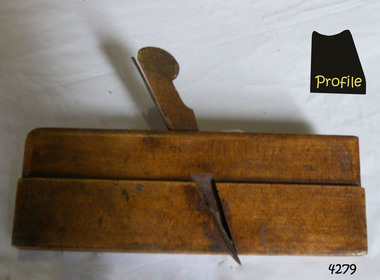 Flagstaff Hill Maritime Museum and Village
Tool - Moulding Plane, Mid to Late 19th Century
... Bedford Street. Richard retired somewhere between 1867 and 1871, but the business continued. The business is taken over by W M Marples & Sons and tools continued to be made in London until 1904 when manufacturing relocated to Sheffield. ...Bedford Street. Richard retired somewhere between 1867 and 1871, but the business continued. The business is taken over by W M Marples & Sons and tools continued to be made in London until 1904 when manufacturing relocated to Sheffield. ...A moulding plane is a specialised plane used for making the complex shapes found in wooden mouldings that are used to decorate furniture or other wooden objects. Traditionally, moulding planes were blocks of wear-resistant hardwood, often beech or maple, which were worked to the shape of the intended moulding. The blade or iron was likewise formed to the intended moulding profile and secured in the body of the plane with a wooden wedge. A traditional cabinetmakers shop might have many, perhaps hundreds, of moulding planes for the full range of work to be performed. Large crown mouldings required planes of six or more inches in width, which demanded great strength to push and often had additional peg handles on the sides, allowing the craftsman's apprentice or other workers to pull the plane ahead of the master who guided it. John Moseley & Son: Records indicate that before 1834, the firm is listed at number 16 New Street, London and according to an 1862 advertisement the shop had been established in New Street since 1730, The Sun insurance records from the time show that John Moseley was the possessor of a horse mill in the yard of his premises, which means that some kind of manufacturing was taking place, as the mill would have provided power to run a saw or perhaps a grinding wheel so the probability is that he did not just sell tools, he made them as well. John Moseley died in 1828 and his will he names his four sons: John, Thomas, William and Richard. To complicate matters he also had brothers with the same first names; brothers Richard (of Piccadilly) and William (of Peckham Rye) are named as two of the executors. Brother Thomas is not mentioned in this will, but became a minister and was one of the executors of brother Richard’s estate when he died in 1856. From John’s will, we also learn that, although the shop was in New Street, he resided in Lympstone, Devon. The family must have had a house in that county for quite some time as both sons Richard and William are baptised in Devon, although John and Thomas were baptised in London. In the 1841 and 1851 census records, we just find William in New Street, but in 1861 both William and Richard are listed there as toolmakers. That Richard was staying overnight at New Street was probably just accidental as in 1851 and 1871, we find him with his wife Jane and children in Clapham and Lambeth respectively. In 1851 Richard is listed as “assistant clerk cutlery warehouse” and in 1871 as “retired plane maker and cutler”. Although the actual place of work is not stated, one may assume he worked in the family business. 1862 is a year full of changes for the firm. In that year, William had a new property built at 27 Bedford Street. In the catalogue for the 1862 International Exhibition, 54 Broad Street (later 54-55 Broad Street) is listed for the first time, which may very well coincide with the split of the business into a retail and a wholesale branch. Around the same time, they must have moved from New Street to 17 & 18 King Street because their manufacturing premises had been pulled down to form the New Street from Cranbourne Street to King Street. In January 1865, William died and Richard continued the business. In 1867, the partnership he had with his son Walker and Thomas Elis Hooker, is dissolved. Richard continued tool making at King Street and Bedford Street. Richard retired somewhere between 1867 and 1871, but the business continued. The business is taken over by W M Marples & Sons and tools continued to be made in London until 1904 when manufacturing relocated to Sheffield. A vintage tool made by a well documented company, this item was made commercially for firms and individuals that worked in wood and needed a tool that could produce a ornamental finish to timber. The tool was used before routers and spindle moulders came into use after World War ll, a time when to produce a decorative moulding for a piece of furniture, door trims etc or other items had to be accomplished using hand tools and in particular one of these types of planes. These profiled planes came in various shapes and sizes to achieve a decorative finish. A significant tool from the mid to late 19th century that today is quite rare and sought after by collectors. It gives us a snapshot of how furniture and other decorative finishes were created on timber by the use of hand tools. Tools that were themselves hand made shows the craftsmanship used during this time not only to make a tool such as the subject item but also the craftsmanship needed to produce a decorative finish that was needed to be made for any timber item. Moulding Plane . Stamped HB on one end and 8 on otherflagstaff hill, warrnambool, shipwrecked-coast, flagstaff-hill, flagstaff-hill-maritime-museum, maritime-museum, shipwreck-coast, flagstaff-hill-maritime-village, plane moulding, moulding plane, plane, j heath, moseley -
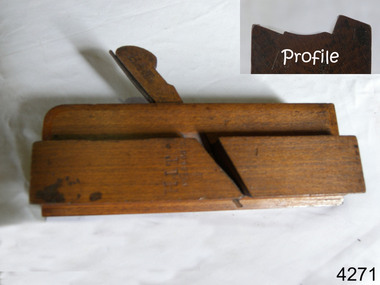 Flagstaff Hill Maritime Museum and Village
Tool - Moulding wood Plane, Mid to Late 19th Century
... Bedford Street. Richard retired somewhere between 1867 and 1871, but the business continued. The business is taken over by W M Marples & Sons and tools continued to be made in London until 1904 when manufacturing relocated to Sheffield. ...Bedford Street. Richard retired somewhere between 1867 and 1871, but the business continued. The business is taken over by W M Marples & Sons and tools continued to be made in London until 1904 when manufacturing relocated to Sheffield. ...A moulding plane is a specialised plane used for making the complex shapes found in wooden mouldings that are used to decorate furniture or other wooden objects. Traditionally, moulding planes were blocks of wear-resistant hardwood, often beech or maple, which were worked to the shape of the intended moulding. The blade or iron was likewise formed to the intended moulding profile and secured in the body of the plane with a wooden wedge. A traditional cabinetmakers shop might have many, perhaps hundreds, of moulding planes for the full range of work to be performed. Large crown mouldings required planes of six or more inches in width, which demanded great strength to push and often had additional peg handles on the sides, allowing the craftsman's apprentice or other workers to pull the plane ahead of the master who guided it. John Moseley & Son: Records indicate that before 1834, the firm is listed at number 16 New Street, London and according to an 1862 advertisement the shop had been established in New Street since 1730, The Sun insurance records from the time show that John Moseley was the possessor of a horse mill in the yard of his premises, which means that some kind of manufacturing was taking place, as the mill would have provided power to run a saw or perhaps a grinding wheel so the probability is that he did not just sell tools, he made them as well. John Moseley died in 1828 and his will he names his four sons: John, Thomas, William and Richard. To complicate matters he also had brothers with the same first names; brothers Richard (of Piccadilly) and William (of Peckham Rye) are named as two of the executors. Brother Thomas is not mentioned in this will, but became a minister and was one of the executors of brother Richard’s estate when he died in 1856. From John’s will, we also learn that, although the shop was in New Street, he resided in Lympstone, Devon. The family must have had a house in that county for quite some time as both sons Richard and William are baptised in Devon, although John and Thomas were baptised in London. In the 1841 and 1851 census records, we just find William in New Street, but in 1861 both William and Richard are listed there as toolmakers. That Richard was staying overnight at New Street was probably just accidental as in 1851 and 1871, we find him with his wife Jane and children in Clapham and Lambeth respectively. In 1851 Richard is listed as “assistant clerk cutlery warehouse” and in 1871 as “retired plane maker and cutler”. Although the actual place of work is not stated, one may assume he worked in the family business. 1862 is a year full of changes for the firm. In that year, William had a new property built at 27 Bedford Street. In the catalogue for the 1862 International Exhibition, 54 Broad Street (later 54-55 Broad Street) is listed for the first time, which may very well coincide with the split of the business into a retail and a wholesale branch. Around the same time, they must have moved from New Street to 17 & 18 King Street because their manufacturing premises had been pulled down to form the New Street from Cranbourne Street to King Street. In January 1865, William died and Richard continued the business. In 1867, the partnership he had with his son Walker and Thomas Elis Hooker, is dissolved. Richard continued tool making at King Street and Bedford Street. Richard retired somewhere between 1867 and 1871, but the business continued. The business is taken over by W M Marples & Sons and tools continued to be made in London until 1904 when manufacturing relocated to Sheffield. A vintage tool made by a well documented company, this item was made commercially for firms and individuals that worked in wood and needed a tool that could produce a ornamental finish to timber. The tool was used before routers and spindle moulders came into use after World War ll, a time when to produce a decorative moulding for a piece of furniture, door trims etc or other items had to be accomplished using hand tools and in particular one of these types of planes. These profiled planes came in various shapes and sizes to achieve a decorative finish. A significant tool from the mid to late 19th century that today is quite rare and sought after by collectors. It gives us a snapshot of how furniture and other decorative finishes were created on timber by the use of hand tools. Tools that were themselves hand made shows the craftsmanship used during this time not only to make a tool such as the subject item but also the craftsmanship needed to produce a decorative finish that was needed to be made for any timber item. Wood Moulding Plane J Moseley & Son maker also stamped (Previous Owners) HIT & E Dunstan, RA Dixon with an N inside a W flagstaff hill, warrnambool, shipwrecked-coast, flagstaff-hill, flagstaff-hill-maritime-museum, maritime-museum, shipwreck-coast, flagstaff-hill-maritime-village, plane moulding, moulding plane, plane, j heath, moseley -
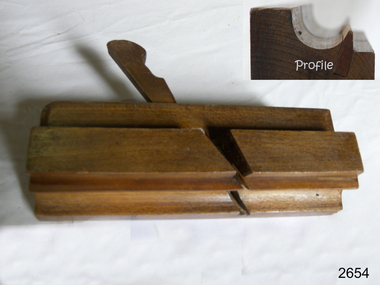 Flagstaff Hill Maritime Museum and Village
Tool - Moulding wood Plane, Mid to Late 19th Century
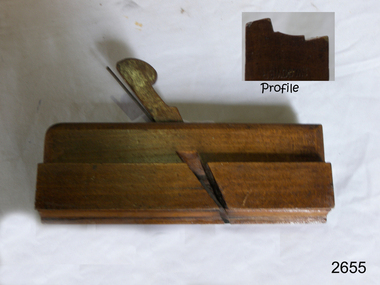
... Bedford Street. Richard retired somewhere between 1867 and 1871, but the business continued. The business is taken over by W M Marples & Sons and tools continued to be made in London until 1904 when manufacturing relocated to Sheffield. ...Bedford Street. Richard retired somewhere between 1867 and 1871, but the business continued. The business is taken over by W M Marples & Sons and tools continued to be made in London until 1904 when manufacturing relocated to Sheffield. ...A moulding plane is a specialised plane used for making the complex shapes found in wooden mouldings that are used to decorate furniture or other wooden objects. Traditionally, moulding planes were blocks of wear-resistant hardwood, often beech or maple, which were worked to the shape of the intended moulding. The blade or iron was likewise formed to the intended moulding profile and secured in the body of the plane with a wooden wedge. A traditional cabinetmakers shop might have many, perhaps hundreds, of moulding planes for the full range of work to be performed. Large crown mouldings required planes of six or more inches in width, which demanded great strength to push and often had additional peg handles on the sides, allowing the craftsman's apprentice or other workers to pull the plane ahead of the master who guided it. John Moseley & Son: Records indicate that before 1834, the firm is listed at number 16 New Street, London and according to an 1862 advertisement the shop had been established in New Street since 1730, The Sun insurance records from the time show that John Moseley was the possessor of a horse mill in the yard of his premises, which means that some kind of manufacturing was taking place, as the mill would have provided power to run a saw or perhaps a grinding wheel so the probability is that he did not just sell tools, he made them as well. John Moseley died in 1828 and his will he names his four sons: John, Thomas, William and Richard. To complicate matters he also had brothers with the same first names; brothers Richard (of Piccadilly) and William (of Peckham Rye) are named as two of the executors. Brother Thomas is not mentioned in this will, but became a minister and was one of the executors of brother Richard’s estate when he died in 1856. From John’s will, we also learn that, although the shop was in New Street, he resided in Lympstone, Devon. The family must have had a house in that county for quite some time as both sons Richard and William are baptised in Devon, although John and Thomas were baptised in London. In the 1841 and 1851 census records, we just find William in New Street, but in 1861 both William and Richard are listed there as toolmakers. That Richard was staying overnight at New Street was probably just accidental as in 1851 and 1871, we find him with his wife Jane and children in Clapham and Lambeth respectively. In 1851 Richard is listed as “assistant clerk cutlery warehouse” and in 1871 as “retired plane maker and cutler”. Although the actual place of work is not stated, one may assume he worked in the family business. 1862 is a year full of changes for the firm. In that year, William had a new property built at 27 Bedford Street. In the catalogue for the 1862 International Exhibition, 54 Broad Street (later 54-55 Broad Street) is listed for the first time, which may very well coincide with the split of the business into a retail and a wholesale branch. Around the same time, they must have moved from New Street to 17 & 18 King Street because their manufacturing premises had been pulled down to form the New Street from Cranbourne Street to King Street. In January 1865, William died and Richard continued the business. In 1867, the partnership he had with his son Walker and Thomas Elis Hooker, is dissolved. Richard continued tool making at King Street and Bedford Street. Richard retired somewhere between 1867 and 1871, but the business continued. The business is taken over by W M Marples & Sons and tools continued to be made in London until 1904 when manufacturing relocated to Sheffield. A vintage tool made by a well documented company, this item was made commercially for firms and individuals that worked in wood and needed a tool that could produce a ornamental finish to timber. The tool was used before routers and spindle moulders came into use after World War ll, a time when to produce a decorative moulding for a piece of furniture, door trims etc or other items had to be accomplished using hand tools and in particular one of these types of planes. These profiled planes came in various shapes and sizes to achieve a decorative finish. A significant tool from the mid to late 19th century that today is quite rare and sought after by collectors. It gives us a snapshot of how furniture and other decorative finishes were created on timber by the use of hand tools. Tools that were themselves hand made shows the craftsmanship used during this time not only to make a tool such as the subject item but also the craftsmanship needed to produce a decorative finish that was needed to be made for any timber item. Side Bead Single Box moulding plane J Moseley & Sons maker also stamped Healy 188 High Street Poplar Surrey (retailers) marked (owners A Bowen & J W Gower with a symbol "M"flagstaff hill, warrnambool, shipwrecked-coast, flagstaff-hill, flagstaff-hill-maritime-museum, maritime-museum, shipwreck-coast, flagstaff-hill-maritime-village, plane moulding, moulding plane, plane, j heath, moseley -
 Flagstaff Hill Maritime Museum and Village
Tool - Moulding wood Plane, Mid to Late 19th Century
... Bedford Street. Richard retired somewhere between 1867 and 1871, but the business continued. The business is taken over by W M Marples & Sons and tools continued to be made in London until 1904 when manufacturing relocated to Sheffield. ...Bedford Street. Richard retired somewhere between 1867 and 1871, but the business continued. The business is taken over by W M Marples & Sons and tools continued to be made in London until 1904 when manufacturing relocated to Sheffield. ...A moulding plane is a specialised plane used for making the complex shapes found in wooden mouldings that are used to decorate furniture or other wooden objects. Traditionally, moulding planes were blocks of wear-resistant hardwood, often beech or maple, which were worked to the shape of the intended moulding. The blade or iron was likewise formed to the intended moulding profile and secured in the body of the plane with a wooden wedge. A traditional cabinetmakers shop might have many, perhaps hundreds, of moulding planes for the full range of work to be performed. Large crown mouldings required planes of six or more inches in width, which demanded great strength to push and often had additional peg handles on the sides, allowing the craftsman's apprentice or other workers to pull the plane ahead of the master who guided it. John Moseley & Son: Records indicate that before 1834, the firm is listed at number 16 New Street, London and according to an 1862 advertisement the shop had been established in New Street since 1730, The Sun insurance records from the time show that John Moseley was the possessor of a horse mill in the yard of his premises, which means that some kind of manufacturing was taking place, as the mill would have provided power to run a saw or perhaps a grinding wheel so the probability is that he did not just sell tools, he made them as well. John Moseley died in 1828 and his will he names his four sons: John, Thomas, William and Richard. To complicate matters he also had brothers with the same first names; brothers Richard (of Piccadilly) and William (of Peckham Rye) are named as two of the executors. Brother Thomas is not mentioned in this will, but became a minister and was one of the executors of brother Richard’s estate when he died in 1856. From John’s will, we also learn that, although the shop was in New Street, he resided in Lympstone, Devon. The family must have had a house in that county for quite some time as both sons Richard and William are baptised in Devon, although John and Thomas were baptised in London. In the 1841 and 1851 census records, we just find William in New Street, but in 1861 both William and Richard are listed there as toolmakers. That Richard was staying overnight at New Street was probably just accidental as in 1851 and 1871, we find him with his wife Jane and children in Clapham and Lambeth respectively. In 1851 Richard is listed as “assistant clerk cutlery warehouse” and in 1871 as “retired plane maker and cutler”. Although the actual place of work is not stated, one may assume he worked in the family business. 1862 is a year full of changes for the firm. In that year, William had a new property built at 27 Bedford Street. In the catalogue for the 1862 International Exhibition, 54 Broad Street (later 54-55 Broad Street) is listed for the first time, which may very well coincide with the split of the business into a retail and a wholesale branch. Around the same time, they must have moved from New Street to 17 & 18 King Street because their manufacturing premises had been pulled down to form the New Street from Cranbourne Street to King Street. In January 1865, William died and Richard continued the business. In 1867, the partnership he had with his son Walker and Thomas Elis Hooker, is dissolved. Richard continued tool making at King Street and Bedford Street. Richard retired somewhere between 1867 and 1871, but the business continued. The business is taken over by W M Marples & Sons and tools continued to be made in London until 1904 when manufacturing relocated to Sheffield. A vintage tool made by a well documented company, this item was made commercially for firms and individuals that worked in wood and needed a tool that could produce a ornamental finish to timber. The tool was used before routers and spindle moulders came into use after World War ll, a time when to produce a decorative moulding for a piece of furniture, door trims etc or other items had to be accomplished using hand tools and in particular one of these types of planes. These profiled planes came in various shapes and sizes to achieve a decorative finish. A significant tool from the mid to late 19th century that today is quite rare and sought after by collectors. It gives us a snapshot of how furniture and other decorative finishes were created on timber by the use of hand tools. Tools that were themselves hand made shows the craftsmanship used during this time not only to make a tool such as the subject item but also the craftsmanship needed to produce a decorative finish that was needed to be made for any timber item. Side Bead Single Box moulding plane J Moseley & Sons maker also stamped Healy 188 High Street Poplar Surrey (retailers) marked (owners A Bowen & J W Gower Size 9/16"flagstaff hill, warrnambool, shipwrecked-coast, flagstaff-hill, flagstaff-hill-maritime-museum, maritime-museum, shipwreck-coast, flagstaff-hill-maritime-village, plane moulding, moulding plane, plane, j heath, moseley -
 Flagstaff Hill Maritime Museum and Village
Tool - Smoothing wood Plane, Mid to Late 19th Century
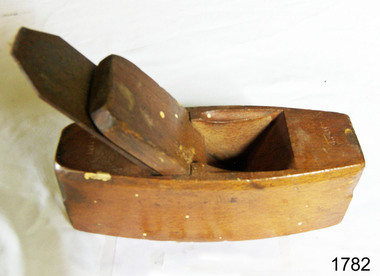
... Bedford Street. Richard retired somewhere between 1867 and 1871, but the business continued. The business is taken over by W M Marples & Sons and tools continued to be made in London until 1904 when manufacturing relocated to Sheffield. ...Bedford Street. Richard retired somewhere between 1867 and 1871, but the business continued. The business is taken over by W M Marples & Sons and tools continued to be made in London until 1904 when manufacturing relocated to Sheffield. ...A smoothing plane is a wood plane used for making a smooth surface to wood surfaces traditionally, these planes were blocks of wear resistant hardwood, often beech or maple, which were worked to the shape or size required. The blade, or iron was likewise formed to the intended flat or level profile and secured in the body of the plane with a wooden wedge. A traditional cabinetmakers shop might have many, perhaps hundreds, of moulding and smoothing planes for the full range of work to be performed. Large crown mouldings or smoothing plane surfaces required planes of six or more inches in width, which demanded great strength to push and often had additional peg handles on the sides, allowing the craftsman's apprentice or other worker to pull the plane ahead of the master who guided it. John Moseley & Son: Records indicate that before 1834, the firm is listed at number 16 New Street, London and according to an 1862 advertisement the shop had been established in New Street since 1730, The Sun insurance records from the time show that John Moseley was the possessor of a horse mill in the yard of his premises, which means that some kind of manufacturing was taking place, as the mill would have provided power to run a saw or perhaps a grinding wheel so the probability is that he did not just sell tools, he made them as well. John Moseley died in 1828 and his will he names his four sons: John, Thomas, William and Richard. To complicate matters he also had brothers with the same first names; brothers Richard (of Piccadilly) and William (of Peckham Rye) are named as two of the executors. Brother Thomas is not mentioned in this will, but became a minister and was one of the executors of brother Richard’s estate when he died in 1856. From John’s will, we also learn that, although the shop was in New Street, he resided in Lympstone, Devon. The family must have had a house in that county for quite some time as both sons Richard and William are baptised in Devon, although John and Thomas were baptised in London. In the 1841 and 1851 census records, we just find William in New Street, but in 1861 both William and Richard are listed there as toolmakers. That Richard was staying overnight at New Street was probably just accidental as in 1851 and 1871, we find him with his wife Jane and children in Clapham and Lambeth respectively. In 1851 Richard is listed as “assistant clerk cutlery warehouse” and in 1871 as “retired plane maker and cutler”. Although the actual place of work is not stated, one may assume he worked in the family business. 1862 is a year full of changes for the firm. In that year, William had a new property built at 27 Bedford Street. In the catalogue for the 1862 International Exhibition, 54 Broad Street (later 54-55 Broad Street) is listed for the first time, which may very well coincide with the split of the business into a retail and a wholesale branch. Around the same time, they must have moved from New Street to 17 & 18 King Street because their manufacturing premises had been pulled down to form the New Street from Cranbourne Street to King Street. In January 1865, William died and Richard continued the business. In 1867, the partnership he had with his son Walker and Thomas Elis Hooker, is dissolved. Richard continued tool making at King Street and Bedford Street. Richard retired somewhere between 1867 and 1871, but the business continued. The business is taken over by W M Marples & Sons and tools continued to be made in London until 1904 when manufacturing relocated to Sheffield. A vintage tool made by an unknown maker, that was made commercially for firms and individuals who worked in wood and needed a tool that could produce a flat or level finish to timber. These types of planes came in various shapes and sizes to achieve the required finish to timber surfaces used in cabinet making. This item is a significant tool from the mid to late 19th century that today is quite rare and sought after by collectors. It gives us a snapshot of how furniture and other decorative finishes were created on timber by the use of hand tools only. Smoothing Plane Coffin typeMaker J Moseley & Son London and 2¼" also has OS stamped on side (probably an owner)flagstaff hill, warrnambool, shipwrecked-coast, flagstaff-hill, flagstaff-hill-maritime-museum, maritime-museum, shipwreck-coast, flagstaff-hill-maritime-village, plane moulding, moulding plane, plane, j heath, moseley -
 Ringwood and District Historical Society
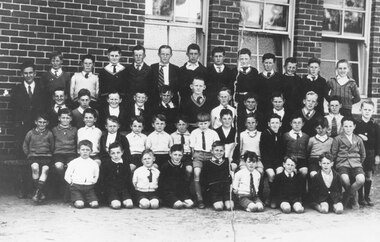
Photograph, St. Mary's School, Bedford Road, Ringwood. 1937-38. Group gathering of students
... W. Orr, J. Bowles, B. Grey, ??. Front Row - L. Hardingham, P. Gridley, ??, J. Orr, P. Alford, ??, P. Davern, V. Orr." Black and white photograph St. Mary's School, Bedford ...Black and white photographList of student names written on rear of backing sheet: Back Row - K. Rodaughan, D. Hannan, ? Ellis, M. Maidment, J. Davern, D. Morphett, ??, J. Kiker, J. Nolan, F. Hardidge, A. Orr, W. Steeth. 3rd Row - B. Bates, W. Smith, K. Hardidge, J. Ryan, B. Byrne, P. Stratton, W. Davern, F. Barro, ??, J. Lindsay, A. Smith, G. Pratt. 2nd Row - Byrne, ??, G. Robinson, J. Grey, ? Brown, ??, G. Robinson, J. Grey, ? Brown, ? Brown, ??, ??, K. Ryan, W. Connell, W. Orr, J. Bowles, B. Grey, ??. Front Row - L. Hardingham, P. Gridley, ??, J. Orr, P. Alford, ??, P. Davern, V. Orr." -
4th/19th Prince of Wales's Light Horse Regiment Unit History Room
Photograph, Prototype Armoured Vehicle, est 1930's or 40's
... w photograph that appears to be either a mock up or prototype of an an armoured vehicle. A turret mounting a 25 pdr (?) gun is on the back of a truck chassis. The driver's cabin is offset to the right and is armour protected as is the engine compartment. The truck is a Blitz or Bedford...w photograph that appears to be either a mock up or prototype of an an armoured vehicle. A turret mounting a 25 pdr (?) gun is on the back of a truck chassis. The driver's cabin is offset to the right and is armour protected as is the engine compartment. The truck is a Blitz or Bedford ...A b&w photograph that appears to be either a mock up or prototype of an an armoured vehicle. A turret mounting a 25 pdr (?) gun is on the back of a truck chassis. The driver's cabin is offset to the right and is armour protected as is the engine compartment. The truck is a Blitz or Bedford type.Vehicle is signed "F83431"photo, afv prototype -
 Bendigo Historical Society Inc.
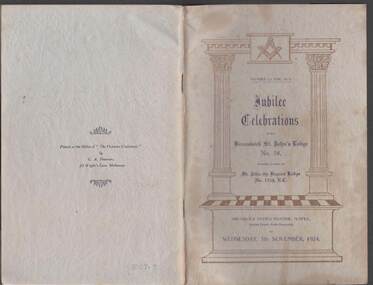
Book - BOOK: JUBILEE CELEBRATIONS, 5th November, 1924
... W Jones... Cornish Arms Hotel... Wor Bro William Dods... Wor Bro P F Donald... Wor Bro John Bedford...Some photos in the book are: Cornish Arms Hotel, Wor Bro William Dods, Wor Bro P F Donald, Wor Bro John Bedford, Wor Bro F G Manchester, Rt Wor Bro F G Manchester, Wor Bro E L Hayden, Wor Bro O R Snowball, Wor Bro Robert Bugg, Wor Bro D H Hogan, Very Wor Bro F W Seekamp, Wor Bro Edward Saunders, Wor Bro F W Murphy, Wor Bro Robert Yorke and the Brunswick United Masonic Temple, Printed at the Office of 'The Victorian Craftsman' by g. ...John's Lodge No. 78 1924 St John the Baptist Lodge No 1518 Brunswick United Masonic temple Wor Bro W Jones Cornish Arms Hotel Wor Bro William Dods Wor Bro P F Donald Wor Bro John Bedford Wor Bro F G Manchester Rt Wor Bro F G Manchester Wor Bro E L Hayden Wor Bro O R Snowball Wor Bro Robert Bugg Wor Bro D H Hogan Very Wor Bro F W Seekamp Wor Bro Edward Saunders Wor Bro F W Murphy Wor Bro Robert Yorke Brunswick United Masonic Temple Printed at the Office of 'The Victorian Craftsman,' by G.A. ...Light blue/grey book titled Jubilee Celebrations of the Brunswick St. John's Lodge No. 78 formerly known as St. John the Baptist Lodge No 1518. Celebrations were on Wednesday, 5th November, 1924. The book is a short history of the Brunswick St. John's Lodge, No. 78. Some photos in the book are: Cornish Arms Hotel, Wor Bro William Dods, Wor Bro P F Donald, Wor Bro John Bedford, Wor Bro F G Manchester, Rt Wor Bro F G Manchester, Wor Bro E L Hayden, Wor Bro O R Snowball, Wor Bro Robert Bugg, Wor Bro D H Hogan, Very Wor Bro F W Seekamp, Wor Bro Edward Saunders, Wor Bro F W Murphy, Wor Bro Robert Yorke and the Brunswick United Masonic Temple, Printed at the Office of 'The Victorian Craftsman' by g. A. Sharman, 23 Wright's Lane, Melbourne. Hand written on the first page 'With Compliments W Jones P.J.G.D. 5/11/24.Printed at the Office of 'The Victorian Craftsman,' by G.A. Sharman, 23 Wright's Lane, Melbourne.event, social, jubilee celebration, masonic society events (various) - jubilee celebrations of the brunswick st. john's lodge no. 78 1924, st john the baptist lodge no 1518, brunswick united masonic temple, wor bro w jones, cornish arms hotel, wor bro william dods, wor bro p f donald, wor bro john bedford, wor bro f g manchester, rt wor bro f g manchester, wor bro e l hayden, wor bro o r snowball, wor bro robert bugg, wor bro d h hogan, very wor bro f w seekamp, wor bro edward saunders, wor bro f w murphy, wor bro robert yorke, brunswick united masonic temple -
 Bendigo Historical Society Inc.
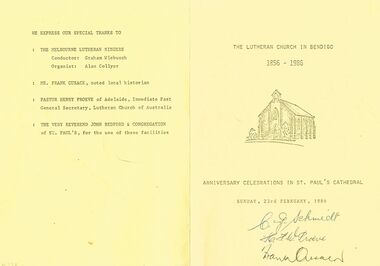
Document - THE LUTHERAN CHURCH IN BENDIGO, 1986
... Bedford & Congregation of St. Paul's... Markings signatures C J Schmidt... H J W...Bedford & Congregation of St. Paul's, for the use of these facilities. Markings: signatures of C J Schmidt, H J W Proeve, Frank Cusack. ...Bedford & Congregation of St. Paul's, for the use of these facilities. Markings: signatures of C J Schmidt, H J W Proeve, Frank Cusack. ...The Lutheran Church in Bendigo 1856 - 1986. 43 (Corner of Galvin Street and Barry Street, Bendigo. Red Brick with white trimmings.) Anniversary Celebrations in St. Paul's Cathedral, Sunday, 23rd February, 1986. Introduction: Clem Schmidt, Lutheran Pastor at Bendigo. Henry Prove: The Lutheran Church of Australia - Its development in the first five decades. Frank Cusack: The German contribution to early Bendigo. We express out special thanks to: The Melbourne Lutheran Singers, Conductor: Graham Wiebusch, Organist: Alan Collyer : Mr Frank Cusack, noted local historian : Pastor Henry Proeve of Adelaide, Immediate Past General Secretary, Lutheran Church of Australia : The Very Reverend John Bedford & Congregation of St. Paul's, for the use of these facilities. Markings: signatures of C J Schmidt, H J W Proeve, Frank Cusack. First 2 in blue pen 3rd in black pen.church, celebration, anniversary celebrations, the lutheran church 1856 - 1986. 43 galvin and barry street, . red white trimmings.) anniversary celebrations st. paul's cathedral, 23rd feb, 1986. clem schmidt, lutheran pastor. henry prove: the lutheran church of australia development decades. frank cusack: the german contribution: melbourne lutheran singers, conductor: graham wiebusch, organist: alan collyer : immediate past general secretary, lutheran church of australia : the very reverend john bedford & congregation of st. paul's, markings signatures c j schmidt, h j w proeve, frank cusack -
 Bendigo Historical Society Inc.
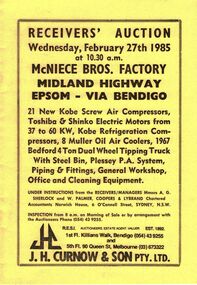
Document - IAN DYETT COLLECTION: AUCTION CATALOGUE - MCNIECE BROS FACTORY - BENDIGO
... W. Palmer, Coopers & Lybrand, Sydney. For sale were Air Compressors, Electric Motors, Refrigeration Compressors, Oil Air Coolers, 1967 Bedford 4 Ton Dual Wheel Tipping Truck with Steel Bin, P.A. ...W. Palmer, Coopers & Lybrand, Sydney. For sale were Air Compressors, Electric Motors, Refrigeration Compressors, Oil Air Coolers, 1967 Bedford 4 Ton Dual Wheel Tipping Truck with Steel Bin, P.A. ...Yellow covered auction catalogue with black printing for a sale at McNiece Bros. Factory, Midland Highway, Epsom - Via Bendigo on 27th February 1985 under instructions from the Receivers/Managers Messrs A.G. Sherlock and W. Palmer, Coopers & Lybrand, Sydney. For sale were Air Compressors, Electric Motors, Refrigeration Compressors, Oil Air Coolers, 1967 Bedford 4 Ton Dual Wheel Tipping Truck with Steel Bin, P.A. System, Piping & Fittings, General Workshop, Office and Cleaning Equipment. J H Curnow & Son Pty. Ltd. Were the auctioneers.business, auctioneers, j h curnow & son pty ltd, ian dyett collection - auction catalogue - mcniece bros. factory - bendigo, a g sherlock, w palmer coopers & lybrand, j h curnow & son pty ltd, f c dyett, i m dyett, n f dyett, bolton bros. pty ltd print -
 Bendigo Historical Society Inc.
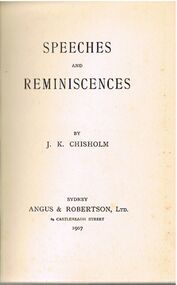
Book - ALEC H CHISHOLM COLLECTION: BOOK ''SPEECHES AND REMINISCENCES'' BY J.K.CHISHOLM
... W. C. Penfold, Sydney. Catalogue sticker ''2206 CHI'' on spine. Handwritten in ink on flyleaf ''A. P. Bedford...W. C. Penfold, Sydney. Catalogue sticker ''2206 CHI'' on spine. Handwritten in ink on flyleaf ''A. P. Bedford ...Book. ALEC H CHISHOLM COLLECTION. 124 page hardcover book of speeches and reminiscences by J. K. Chisholm who was one time President of the Camden Agricultural Society. Published in 1907 by Angus & Robertson Ltd, Sydney and printed by W. C. Penfold, Sydney. Catalogue sticker ''2206 CHI'' on spine. Handwritten in ink on flyleaf ''A. P. Bedford Esq with the author's sincere regards July 1907''. (Note: There is no clue in this book as to whether the author is related to Alec Chisholm. My own belief is that he is not. Rob Upson)J. K. Chisholmbooks, collections, speeches, alec h chisholm collection, j.k.chisholm, speeches -
Port Melbourne Historical & Preservation Society
Document - Payment to workers, J Kitchen & Sons, 1944
... w k atherton...mary shirley barnet...vera jean bedford...industry - manufacturing workers j kitchen & sons pty ltd patricia andrews gwendoline veronica anson w k atherton mary shirley barnet vera jean bedford ian allen block allan edward booth dorothy brown neva davis margaret fraser alma goulding elizabeth grey betty guegan norma johnson fay macdonald elizabeth mowbray leonara mcauley thelma mcmillan judith unverchan valda smith rita smith joy smith hugh ralston betty ralston kevin power a w duerend Reliable form 2050. ...Pages tied together with string, recording payment to Kitchen's workersReliable form 2050. Reliable line of ready made systemsindustry - manufacturing, workers, j kitchen & sons pty ltd, patricia andrews, gwendoline veronica anson, w k atherton, mary shirley barnet, vera jean bedford, ian allen block, allan edward booth, dorothy brown, neva davis, margaret fraser, alma goulding, elizabeth grey, betty guegan, norma johnson, fay macdonald, elizabeth mowbray, leonara mcauley, thelma mcmillan, judith unverchan, valda smith, rita smith, joy smith, hugh ralston, betty ralston, kevin power, a w duerend -
Port Melbourne Historical & Preservation Society
Exhibition Catalogue, "Sportstuff", 2001
... BEDFORD...Jim PENALUNA...David HOLT...Bill EARLE...Percy MAY...Jimmy DREW...Chris RAEBURN...Clyde HOLDING...William (Bill) HEGARTY...Walter Charles PONT...Frank GOMEZ...Tony STEWART...John W...Ross Street Rovers Watson's Baths Sport - Cricket Sport - Baseball Sport - Lawn Bowls Sport - Football Lifesaving Sport - Shooting Sport - Soccer Sport - Tennis Sport - Trugo Sailing Sport - Quoits Sport - Cycling Sport - Basketball Sport - Boxing Sport - Golf Sport - Gymnastics Sport - Athletics Port Melbourne Cricket Ground J L Murphy Reserve Railway United Football Club Victorian Sunday Football League Port Melbourne Colts Football Club Peggy HOWARD nee ANTONIO Bill PAYNE John MAY John KOSINDUSS Fred COY Jimmy JAMES Ken LINNETT Tony BOGDANOFF Tommy LAHIFF Tony CANNATELLI Graeme ANDERSON Ted FREYER Charles McLEOD James KELLY Robert McLEOD Reginald EARLE William (Bill) TILLEY J Kitchen & Sons Pty Ltd Eli 'Dick' Edwards Ron BEDFORD Peter BEDFORD Jim PENALUNA David HOLT Bill EARLE Percy MAY Jimmy DREW Chris RAEBURN Clyde HOLDING William (Bill) HEGARTY Walter Charles PONT Frank GOMEZ Tony STEWART John W STEWART Ron STRANKS Wilbraham Frederick Evelyn LIARDET Edward C CROCKFORD Town Clerks Sydney Sims ANDERSON Sea Bathing North Port Oval Alteration to document are written in ink Six page draft of catalogue for 2001 "Back to Port" 2 day exhibition "Sportstuff". ...No final copy of this catalogue exists, but this draft indicates the level of loans from over a dozen local sporting organisations plushistorical collections and researchon past events and organisations. Rare trophies, pennants and medals (including a Brownlow medal for Peter BEDFORD)required security precautions.Six page draft of catalogue for 2001 "Back to Port" 2 day exhibition "Sportstuff". Held at the Liardet Street Freemason's Hall during Port Melbourne Community Festival, in conjunction with all Port Melbourne sporting clubsAlteration to document are written in inkross street rovers, watson's baths, sport - cricket, sport - baseball, sport - lawn bowls, sport - football, lifesaving, sport - shooting, sport - soccer, sport - tennis, sport - trugo, sailing, sport - quoits, sport - cycling, sport - basketball, sport - boxing, sport - golf, sport - gymnastics, sport - athletics, port melbourne cricket ground, j l murphy reserve, railway united football club, victorian sunday football league, port melbourne colts football club, peggy howard nee antonio, bill payne, john may, john kosinduss, fred coy, jimmy james, ken linnett, tony bogdanoff, tommy lahiff, tony cannatelli, graeme anderson, ted freyer, charles mcleod, james kelly, robert mcleod, reginald earle, william (bill) tilley, j kitchen & sons pty ltd, eli 'dick' edwards, ron bedford, peter bedford, jim penaluna, david holt, bill earle, percy may, jimmy drew, chris raeburn, clyde holding, william (bill) hegarty, walter charles pont, frank gomez, tony stewart, john w stewart, ron stranks, wilbraham frederick evelyn liardet, edward c crockford, town clerks, sydney sims anderson, sea bathing, north port oval -
 Port Melbourne Historical & Preservation Society
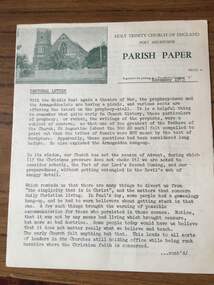
Document - Newsletter, Holy Trinity Anglican Church, Port Melbourne, Parish Paper, Nov 1973
... W H COFFEY...George VINES...Mrs MUSTON...P BEDFORD...Details information about the month of August 1974 for the Church and communicates information to parish goers Religion - Anglican (Holy Trinity) Deaths and Funerals Donald Arthur LANGFORD Lewis J MULLIN Archibald H CARMICHAEL Glynn E G MARSHALL Phillip LAWSON William A WOODS Elsie J BAXTER Eliza M AANENSEN Ernest J McCOLL William H KILPATRICK Allan A CALLICK Emily NEWTON-SIMPSON Georgia Anita FENNESSY Robert Michael FLAHERTY Raymond Bede GRZONEK Christine Carol BATH Leanne ALDERMAN Returned Services League RSL Sandridge Trugo Club South Melbourne Football Club Albert Park Bowling Club Henry MOLLOY Ged MUSTON W H COFFEY George VINES Mrs MUSTON P BEDFORD C TUNCKS John MOORE Port Melbourne Bowling Club Port Melbourne Football Club Port Melbourne Cricket Club F McGORLICK Mrs McGORLICK Lions Club W STUCKBURY J T McLEOD D JONES G CECIL Yvonne Margaret KITCHEN F A W 'Skip' SHORT Monthly parish newsletter for the month of November 1973 for Holy Trinity Church, Port Melbourne Parish Paper Document Newsletter, Holy Trinity Anglican Church, Port Melbourne ...Newsletter was written for Port Melbourne Holy Trinity Church. Details information about the month of August 1974 for the Church and communicates information to parish goersMonthly parish newsletter for the month of November 1973 for Holy Trinity Church, Port Melbournereligion - anglican (holy trinity), deaths and funerals, donald arthur langford, lewis j mullin, archibald h carmichael, glynn e g marshall, phillip lawson, william a woods, elsie j baxter, eliza m aanensen, ernest j mccoll, william h kilpatrick, allan a callick, emily newton-simpson, georgia anita fennessy, robert michael flaherty, raymond bede grzonek, christine carol bath, leanne alderman, returned services league, rsl, sandridge trugo club, south melbourne football club, albert park bowling club, henry molloy, ged muston, w h coffey, george vines, mrs muston, p bedford, c tuncks, john moore, port melbourne bowling club, port melbourne football club, port melbourne cricket club, f mcgorlick, mrs mcgorlick, lions club, w stuckbury, j t mcleod, d jones, g cecil, yvonne margaret kitchen, f a w 'skip' short -
 Narre Warren and District Family History Group
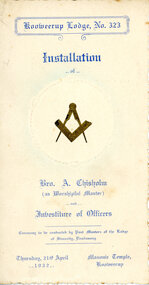
Programme, Installation for Bro. A Chisholm at Koo Wee Rup Masonic Lodge dated Thursday 21st April 1932
... Bedford...E V Blyth...E V C Blyth...G Bowden...R Cameron...A Chisholm...T Clapperton...A P Coburn...B Darlington...W...G T Bedford E V Blyth E V C Blyth G Bowden R Cameron A Chisholm T Clapperton A P Coburn B Darlington W Dawson W Eason A B Hewitt Koo Wee Rup Lodge No 323 T R Light C R G Livock G Lucas J C Mackin H D Mills W E Mills W K Paterson J D Preston Sun - Print Koo Wee Rup F Tattam L Vick C Wadsley E V Wadsley E R Williams A folded card printed in blue with different fonts used on thickened paper of a cream colour It has frilled edges Installation for Bro. ...A folded card printed in blue with different fonts used on thickened paper of a cream colour It has frilled edgesnon-fictiong t bedford, e v blyth, e v c blyth, g bowden, r cameron, a chisholm, t clapperton, a p coburn, b darlington, w dawson, w eason, a b hewitt, koo wee rup lodge no 323, t r light, c r g livock, g lucas, j c mackin, h d mills, w e mills, w k paterson, j d preston, sun - print koo wee rup, f tattam, l vick, c wadsley, e v wadsley, e r williams -
Glen Eira Historical Society
Document - ROTARY CLUB OF CAULFIELD
... Bedford F.... Bell Jim... Bunny D.... Cripps E.... Don John... Epstein Fred... Hattam J.... Howard W...Bedford F. Bell Jim Bunny D. Cripps E. Don John Epstein Fred Hattam J. Howard W. ...This file contains 13 official documents pertaining to the Rotary Club of Caulfield: 1/A typewritten copy of the constitution of the Rotary Club of Caulfield (undated). Said document is essentially an instruction manual detailing how the Club is to be administered and the duties of officials. 2/A page (unclear if intended for use as a poster or letter) announcing a Business Persons Breakfast to be held at St. Anthony’s Parish Hall on 19/11/1986, wherein Jeff Kennett, M.L.A., Leader of the Opposition of the Parliament of Victoria, will deliver a speech titled ‘Responsibility Before Rights’. 3/A booklet announcing the 25th anniversary celebration of the Rotary Club of Caulfield, to be held at Tudor Court on 24/02/1987. Contains the menu, national anthem, programme, and two lists – one of the founding members of the Club and one of the extant members of the Club. 4/Two copies of a booklet announcing a dinner, to be held at Tudor Court on 10/11/1987, wherein charter will be presented to the Rotary Club of Caulfield-Rosstown by District Governor Ian Knight. Contains a list of extant staff, the menu, the programme, a description of the history of the ‘Wembley Wheel of Friendship’, a list of charter members, and an account of the etymology of the name ‘Rosstown’. 5/Two copies of a page featuring four items of relevance to the Rotary Club of Caulfield. The first is an article (titled ‘Rotary scholar makes it’, author unspecified, source unspecified, undated) about Club scion Mark Collard receiving an MBA from Clarkson University. The second is an article (titled ‘New Caulfield Rotary’, author unspecified, source unspecified, undated) about the presentation dinner to which item 7 pertains. (This article is not present in its entirety, trailing off at the end.) The third is an announcement of a ‘progressive dinner’ to be held on 28/11/1987, also containing an announcement of a bicentennial conference to be held on 19/03/1988. The fourth is an announcement of what appears to be the initiation of some sort of historical re-enactment, the proceeds of which will fund the Rotary Club’s ‘Polio Plus’ project. A title (‘A Long Haul Through Caulfield’) suggests this item may be the header section of an article about said event, but if so, the remainder is not present. Contains three black-and-white photographs; one of Collard with an unidentified woman (presumably his wife), one of Club President Howie Dunlop congratulating Charter President Geoff Oscar, and one of some men riding on a horse-drawn cart. 6/Two copies of a booklet announcing a President Changeover Dinner, to be held on 28/06/1988. Contains the menu, programme, and a list of extant members. 7/Two copies of the weekly bulletin of the Rotary Club of Caulfield, dated 28/06/1988. Contains lists of faculty, notification of the Club’s decision to admit women, notification of upcoming events, a biography of guest speaker Fred Epstein, and a list of the times and places of alternative meetings. 8/Two photocopied statements of the receipts and expenditure of the Rotary Club of Caulfield, one for the period 01/10/1989 – 30/06/1990, and one for the period 01/07/1990 – 27/08/1990. 9/The photocopied minutes of a New Members Committee Meeting of the Rotary Club of Caulfield, dated 02/08/1990. Objects of discussion include fundraising methods and application of funds. 10/A booklet announcing Change Over Night, dated 21/06/1994. Contains the programme, menu, national anthem, and a list of extant faculty. 11/4 unbound pages announcing the winners of the Rotary Youth Photographic Awards, dated 1995 (a more specific date than this is not given). (Pages contain no photographs.) 12/A small note announcing the Murrumbeena Community Market, to be held on 04/12/2010, of which the Rotary Club of Caulfield is one of the sponsors. 13/A booklet announcing a dinner to celebrate the 50th anniversary of the Rotary Club of Caulfield, to be held on 23/02/2012. Contains the programme, menu, a list of past presidents, a description of the history of the Gifu Vase (a trophy in the Club’s possession), and a list of some of the charity projects the Club has been engaged in.rotary club of caulfield, clubs and associations, charitable organisations, kennett jeff m.l.a., st. anthony’s parish hall, grange road, neerim road, glenhuntly, festivals and celebrations, tudor court, gray robin, baird jack, lord john, king john, crittenden doug, gelme anthony, hunkin ed. rev., fryer roy, quine john, bedford f., bell jim, bunny d., cripps e., don john, epstein fred, hattam j., howard w., kerry g., kumnick j., kurrie s., lord l., morrison charles, nelson h., parton willis, perry bruce, pollard r., price f., skuse e., stillwell g., tilley norman, tomlinson charles, watson don, webster j., wilson duncan, fincher roy, wheller john, allen selwyn, christopher don, cohen godfrey, davis keith, davis lloyd, dornbierer w., dunlop howie, fillmore wally, ford john, ford peter, forshaw ken, gales brian, green myer, hind jim, humphreys john, hunter ian, lewis ray, melville jack, oscar geoff, penaluna harry, perlen louis, rampling ross, ronaldson keith, sherlock max, sicklemore graham, smith barry, stapleton ted, summers ron, tovey david, rotary club of caulfield-rosstown, knight ian, tudor court, kooyong road, bellmaine mark, langfelder kurt, morris rob, rome graeme, alma club, wilks street, wills david, blankfield mark, awards, wembley wheel of friendship, bellmaine loretta, cunningham david, cunningham jean, davis pam, davis rex, davis judith, forshaw hannah, graham jeremy, graham kara, hassing andre, hassing arlette, jacobs frank, jacobs june, langfelder judy, morris robert, morris angela, nettlebeck rosalie, oscar enid, rattray john, rattray diana, rome lorraine, sarah ted, sarah denise, sherlock helen, smith suzanne, stapleton jackie, turner brook, turner vicki, tuhiwai tamati, tuhiwai ravina, will arnold, will claire, rosstown, ross william murray, rosstown sugar works, collard mark, rotary foundation, keller chuck, campbell felicitie mrs., campbell jack cr., knight genny, albury civic centre, green tess, tantram avenue, quine gwen, beaver street, rosalind ray, rosalind lweis, devon street, little company of mary hospital, polio plus, smith ian, jackson adrian, miller peter, spence bert, wheller denise, coffey bill, financial documents, receipts, gilmartin e., moran d., kaan a., fillmore wal, coleman peter, coleman moyrha, wesley college elsternwick big band, puddy mark, fradkin barry, fitzgerald gerald, renton robert, herschberg gedeon, kinston david, montgomery peter, dawes shane, silberberg henry, zazryn ben, cohen michael, rotary youth photographic awards, photographic competitions, photography, terry ted mr., terry e. a. mr., eldridge hannah, cottral anne, abdullahi khalid, gostin cassie, podlabeniouk lena, diyab ahmed, draca julijana, pevkoski danilla, wooster heath, lesar dion, sansoni rachel, leatham chelsea, townsend jessie, barker megan, fitzgerald megan, maokhamphiou anthony, smith naomi, fraser sue-ellen, white tanya, murrumbeena community market, koornang uniting church, murrumbeena road, welsh heather, robinson david, kesselschmidt sima, potasz sophie, southwick david, cheyne gordon, ryall keith, arianti listy, westbrook natasha, pollard bob, hancock irey, lovett jack, cooper alby, rundle john, patkin nehama, mcmullen adele, douglas jennie, preston mark, resubal loreto, gifu vase, aoki seiichi, operation firewood, alfred hospital, bus of knowledge, australia day breakfast, bethlehem hospital, caulfield hospital -
 Warrnambool and District Historical Society Inc.
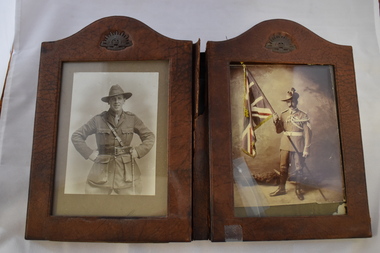
Artefact, Fold out leather frame with 2 sepia photographs of soldiers, Early 20th Century
... W stamped on the back in gold with a crown above it. The photograph of the WW1 soldier has Hana Studio Ltd 22**** which although unreadable has been matched with another photograph to read,” 22 Bedford St Strand London. ...W stamped on the back in gold with a crown above it. The photograph of the WW1 soldier has Hana Studio Ltd 22**** which although unreadable has been matched with another photograph to read,” 22 Bedford St Strand London. ...This frame contains two as yet unidentified soldiers from two of Australia’s earliest overseas conflicts. The WW1 soldier has the rank of Captain and the Boer War soldier has the three stripes of Sergeant. It is possible that he belongs to the Coronation Contingent of Edward V11 in 1902.These soldiers were selected form all over Australia with 42 coming from Victoria. The Australian War Memorial cites a number of approximately 16000 soldiers who fought in the Boer War from 1899-1902. Of that number 282 died in action or as a result of wounds while around 320 died as a result of disease and accidents. Six received the Victoria Cross as well as other awards for bravery. The First World War had more drastic consequences for Australia. From a population of less than 5 million, 416809 men enlisted of whom over 60,000 were killed with 156000 wounded gassed or taken prisoner. Australian fought from 1914-1918 from Egypt, Turkey, and the Western Front in Europe. These photographs are representative of many photos which are kept in remembrance of Australian soldiers who fought in wars particularly the two world wars. The Boer war photo is a rarer one.This bi- fold photo frame is rectangular in shape with a rounded section at each top. It is leather in composition and has the Rising Sun insignia in each arch which appears to be metal. There are glass covering two photographs one of a Boer War soldier and the other of WW1. It is hinged in the middle with a double layer of leather which is broken .The Boer war photograph has a coloured flag and medal ribbons. The two Rising Sun badges have Australian Commonwealth Military Forces. The frame itself has J C Vickery Regent St W stamped on the back in gold with a crown above it. The photograph of the WW1 soldier has Hana Studio Ltd 22**** which although unreadable has been matched with another photograph to read,” 22 Bedford St Strand London. The photograph of the Boer War soldier has no studio identity. warrnambool history, unknown soldiers of warrnambool, boer war soldier, world war 1 soldier -
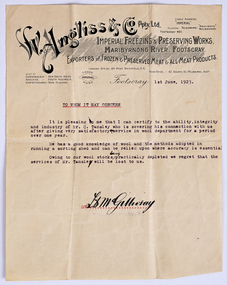 National Wool Museum
Archive - Letter of Recommendation, Charles Tansley, W. Angliss & Co. Pty. Ltd, 1 June 1923
... Bedford Modern College. He was sent home from England due to WW1 and was not enlisted due to health reasons. Charles married Mary Brownjohn in 1924, and together they moved to Geelong in the late 1920s. This letter, dated 1923, is a reference for Charles' work undertaken with W...Bedford Modern College. He was sent home from England due to WW1 and was not enlisted due to health reasons. Charles married Mary Brownjohn in 1924, and together they moved to Geelong in the late 1920s. This letter, dated 1923, is a reference for Charles' work undertaken with W ...This letter is part of a collection of archival documents including letters and certificates that relate to Charles Tansley. Charles Tansley was a wool classer mainly in Victoria, but also worked in Tasmania and New South Wales. In his career, he also worked as a wool valuer with Elders in Geelong. Charles was born in Melbourne in 1898 and was educated in England at Bedford Modern College. He was sent home from England due to WW1 and was not enlisted due to health reasons. Charles married Mary Brownjohn in 1924, and together they moved to Geelong in the late 1920s. This letter, dated 1923, is a reference for Charles' work undertaken with W. Angliss & Co. Pty. Ltd in Footscray.Letter on cream paper with black printed text and handwritten black text.[printed] TO WHOM IT MAY CONCERN / It is pleasing to me that I can certify to the ability, integrity / and industry of Mr. C. Tansley who is serving his connection with us / after giving very satisfactory service in wool department for a period / over one year.charles tansley, woolclassing, wool classer, farming, sheep, wool, agricultural industry, estates, tasmania, new south wales, pastoral industry, textile industry, education, reference letters, working life, geelong, training, mary brownjohn -
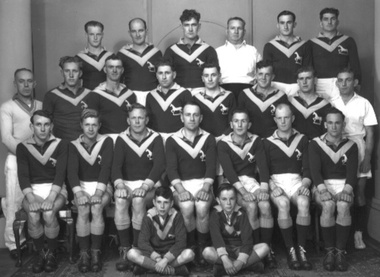 Box Hill Historical Society
Photograph - Box Hill football team and trainers, 1947
... Mihan> Alan Bedford> Keith Broadhead> Alan Sports and recreations B&w photo Photograph Box Hill football team and trainers ...Box Hill Football team and trainers, 1947. Partially identified, refer accompanying photo sheet. Names include: Alex Croft, Chick Lobb, Jack Vining, A. Thoms (trainer), Clive Philp, Joe Kiker, Trevor Wightman, Stan Parks, Jim Jago, Bobby Green, G. Billett, Alan Mihan, Keith Bedford (captain), Alan Broadhead.B&w photobox hill football team, croft> alex, lobb> chick, vining> jack, thoms> a., philp> clive, kiker> joe, wightman> trevor, parks> stan, jago> jim, green> bobby, billett> g., mihan> alan, bedford> keith, broadhead> alan, sports and recreations -
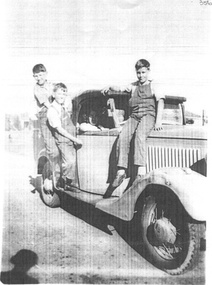 Box Hill Historical Society
Photograph - Motor Vehicles, 1940's
... Bedford truck collecting for the Red Cross, 1940's. Three youths also pictured. Trucks Swain> George (Mrs.) Swain> Sylvia (Mrs.) Naismith> Sylvia (Miss) Martin>- Thomson> Keith Transport Hargreaves> - B&w photo Photograph Motor Vehicles ...Mrs. Sylvia Swain driving a Bedford truck collecting for the Red Cross, 1940's. Three youths also pictured.B&w phototrucks, swain> george (mrs.), swain> sylvia (mrs.), naismith> sylvia (miss), martin>-, thomson> keith, transport, hargreaves> - -
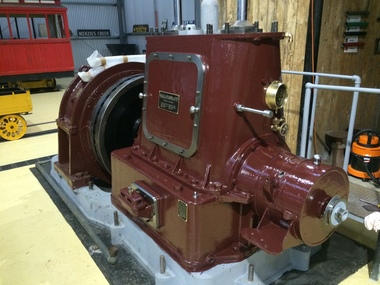 Puffing Billy Railway
Allen Twin Cylinder Engine Driving A Brush Electrical Generator
... Allen Twin Cylinder Engine Driving A Brush Electrical Generator Built by W. H. Allen & Co, Ltd ., Bedford, England ( serial Number R1/14738/4) it was used at Kodak Australia, Abbotsford plant , to provide power through the attached Brush Electrical Generator ( serial 21177 of 1929 ) for the photographic plant. ...Built by W. H. Allen & Co, Ltd ., Bedford, England ( serial Number R1/14738/4)...Allen Twin Cylinder Engine Driving A Brush Electrical Generator Built by W. H. Allen & Co, Ltd ., Bedford, England ( serial Number R1/14738/4) it was used at Kodak Australia, Abbotsford plant , to provide power through the attached Brush Electrical Generator ( serial 21177 of 1929 ) for the photographic plant. ...Allen Twin Cylinder Engine Driving A Brush Electrical Generator Built by W. H. Allen & Co, Ltd ., Bedford, England ( serial Number R1/14738/4) it was used at Kodak Australia, Abbotsford plant , to provide power through the attached Brush Electrical Generator ( serial 21177 of 1929 ) for the photographic plant. Donated by Kodak ( Australia ) Ltd. in 1966Historic - Industrial Twin Cylinder Engine Driving A Brush Electrical Generator used by Kodak Australia, at their Abbotsford plant, Abbotsford, Victoria, AustraliaTwin Cylinder Engine Driving A Brush Electrical Generator made of steel , iron, wrought iron, brassBuilt by W. H. Allen & Co, Ltd ., Bedford, England ( serial Number R1/14738/4)puffing billy, twin cylinder engine, brush electrical generator, w. h. allen & co, ltd -
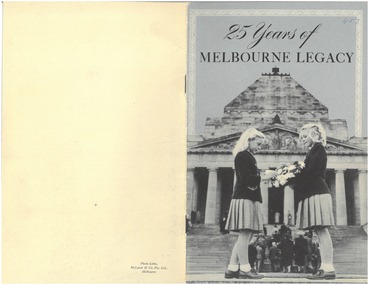 Melbourne Legacy
Booklet, 25 years of Melbourne Legacy (H57)
... It contains a list of the past presidents and Board of Management in 1948 included: President: E Sherwen Vice Presidents: (JLC) W G Lake; (Personnel) N Quail; (ILC) G I Malloch Liaison Officer: N J Bedford Elected Members: HD Stewart, W R G Hiscock Hon Treasurer: A J Court Hon Secretary: G B S Hart....It contains a list of the past presidents and Board of Management in 1948 included: President: E Sherwen Vice Presidents: (JLC) W G Lake; (Personnel) N Quail; (ILC) G I Malloch Liaison Officer: N J Bedford Elected Members: HD Stewart, W R G Hiscock Hon Treasurer: A J Court Hon Secretary: G B S Hart. ...A succinct account of the work of Melbourne Legacy to mark their first 25 years of service. Compare with 00936 which dealt with the first 21 years. By 1948 11,255 families and 27,747 children had been cared for at a total cost of ninety seven thousand, nine hundred and fifty five pounds. The major expenditure was on Residences such as Holmbush which accounted for 30% of the money. It contains a list of the past presidents and Board of Management in 1948 included: President: E Sherwen Vice Presidents: (JLC) W G Lake; (Personnel) N Quail; (ILC) G I Malloch Liaison Officer: N J Bedford Elected Members: HD Stewart, W R G Hiscock Hon Treasurer: A J Court Hon Secretary: G B S Hart.A snapshot of the work done by Melbourne Legacy between 1923 and 1948.4 sheets of card, folded and stapled, black on white with pale blue highlighting.'H57' in blue ballpoint on front cover.25th anniversary, silver jubilee, history -
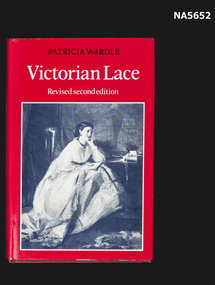 Whitehorse Historical Society Inc.
Book - Victorian Lace, Patricia Wardle, 1982
... W writings. Contents: - Lace fashion in the 19th century - Machine made lace in England, France and elsewhere Book Victorian Lace Patricia Wardle Ruth Bean, Victoria Farmhouse Carlton Bedford MK48 7LP England ...Revised edition documenting European Lace collecting and lace making.Hardcover book Red dust cover with B/W writings. Contents: - Lace fashion in the 19th century - Machine made lace in England, France and elsewherePatricia Wardle Victorian Lace, Revised second edition ISBN 0 903585 138lace collecting and making, european -
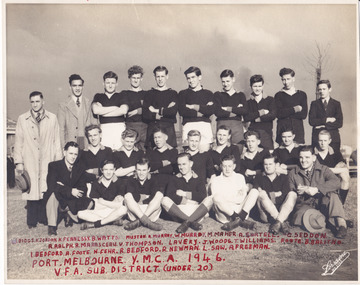 Port Melbourne Historical & Preservation Society
Photograph - Port Melbourne YMCA football team, Lorraine Studios, 1946
... W MURRAY...M MAHER...A SORTELL...C SEDDON...R RALPH...R MARASCEAU...V THOMPSON...LAVERY...J WOODS...T WILLIAMS...FOOTE...B BALITHO...I BEDFORD...Original photo held by Ron BEDFORD (Ballarat) and scan taken 24.05.2011 Sport - Australian Rules Football S BIGG K JORDAN K FENNESSY B WATTS MUSTAN R MURRAY W MURRAY M MAHER A SORTELL C SEDDON R RALPH R MARASCEAU V THOMPSON LAVERY J WOODS T WILLIAMS FOOTE B BALITHO I BEDFORD A FOOTE N FEHR R BEDFORD R NEWMAN L SAW A FREEMAN "Lorraine Studios" stamp on rear in red. 159 Bay St Port Melbourne. ...Original photo held by Ron BEDFORD (Ballarat) and scan taken 24.05.2011Black and white photo of Port Melbourne YMCA football team 1946, VFA sub-district (under 20). Players are identified on the photo."Lorraine Studios" stamp on rear in red. 159 Bay St Port Melbourne. Phone MX2763sport - australian rules football, s bigg, k jordan, k fennessy, b watts, mustan, r murray, w murray, m maher, a sortell, c seddon, r ralph, r marasceau, v thompson, lavery, j woods, t williams, foote, b balitho, i bedford, a foote, n fehr, r bedford, r newman, l saw, a freeman
