
Showing 499 items matching "w. bridges"
-
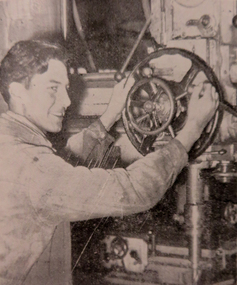 Federation University Historical Collection
Magazine - Booklet, Ballarat School of Mines Students' Magazine, 1952, 1952
... ...w. bridges...Flower, Literary Society, Prominent Personalities, Science School, News and Notes, Prize Presentation, The Apprentices, Boys Sport, Sun Youth Travel Memoirs, The Art School, His Majesty the Late King George VI, Commercial Notes, Gleanings Here and There, Junior School, Girls Sport, Sport, House Notes, Junior Technical School Students', Roll Call - Diploma Students 1952 ballarat school of mines magazine mr bryan c. sanos s. deans j. williams r. simpson c. g. fairbank d. treadwell e. aitkens g. birkett g. allen f. benjamin s. gillespie r. hullick h. mccallum h. harris j. walton e. walsh j. stevens b. clark rupert p. flower john bechervaise w. keith hindson a. james tinney walter c. tooth john d. bethune vilma sansom betty clark travers duncan joyce wilson lex lockhart jim w. beattie joyce stevens slim ingleton a. eddy john howard douglas george dean edgar bartrop colin mck. henry tom adams max kennedy jeff coward o. j. nilsen j. skuja s. rowe w. maddox a. kinnane d. fraser a. carpenter john james b. flavel j. murray d. schmidt g. habel t. duncan l. matthews n. spiers b. smith a. tonnisseu r. ingleton j. bethune j. mills j. mcneil b. schreenan w. carlyon d. stevens l. j. hillman k. hindson r. furlong j. beattie b. taylor g. heyes l. quilliam r. archer a. johnson m. gillin t. seabrook m. phillips j. sawyer c. restarick j. saggers g. ditchfield j. tinney don stewart j. faneco m. stevens w. tooth ron simpson bill maxwell graham searle jim tinney k. treloar j. barnes s. j. deans lynette j. blomeley georgina cox heather mcgregor janet saunders heather harris elizabeth mcarthur norma coffield pat lavery imelda lee gloria white valerie westbrook cynthia stone janice thompson clare mooney glenys perry faida lewis betty clarke marion volk isla veal valerie yates coralie mckenzie lorraine digby barbara henderson deidre wilson margaret henderson barbara ngip glenys sleeth anne duncan l. dwyer elaine leishman j. jenkin stirling gillespie w. bridges b. baldock b. braybrook e. mackie r. braybrook c. grose b. mackie c. garnham c. schmidtke t. lugg j. copeman b. tozer g. mathews n. sutherland r. lambert j. sanders m. quick j. collier g. pike r. digby r. quayle r. sharp n. brogden r. lyons p. stevens j. bastin b. kay k. duncan b. golding l. norman b. murnane k. hocking c. sealey b. langdon f. weightman m. birch r. stevenson r. stewart r. haintz k. mccoll k. jarvis l. hocking d. curtain r. lazarus e. boak j. fletcher b. orchard j. squires n. pike j. shrader l. reynolds m. ritchie g. smith d. parkes g. templeton m. wunhym v. vincent d. robertson d. lang l. horwood d. searle d. new v. jolly a. minotti b. beaumont m. marshall e. bowen j. rogers d. cody e. kinnane j. cunningham j. schrader r. horgan j. white n. flood j. matthews h. gale k. mitchell v. rowse j. mayne a. gilbert b. warrillow g. gilbert n. quick m. hall d. furlong n. lyons j. richards j. jones l. major d. baldock d. dow g. ruddick d. howell j. caddy b. singleton b. powell r. sharpe c. lockhart l. daff c. sharpe d. irish l. dow a. douglas n. twaites j. courtney l. beacham n. c. cartledege cliff sealey j. f. collier e. g. mackie m. g. quick b. l. collinson j. n. bastin g. e. timmins valerie mills j. a. jenkin w. cowan i. mitaxa n. c. leckie r. j. austin n. coffield d. quilliam r. courtney f. m. kilfoyle p. nunn King George VI Pale blue soft covered magazine with navy blue titles. ...School Council, Members of Staff, Editorial, Principal's Page, Magazine Committee, Obituary - Rupert P. Flower, Literary Society, Prominent Personalities, Science School, News and Notes, Prize Presentation, The Apprentices, Boys Sport, Sun Youth Travel Memoirs, The Art School, His Majesty the Late King George VI, Commercial Notes, Gleanings Here and There, Junior School, Girls Sport, Sport, House Notes, Junior Technical School Students', Roll Call - Diploma Students 1952Pale blue soft covered magazine with navy blue titles.ballarat school of mines, magazine, mr bryan, c. sanos, s. deans, j. williams, r. simpson, c. g. fairbank, d. treadwell, e. aitkens, g. birkett, g. allen, f. benjamin, s. gillespie, r. hullick, h. mccallum, h. harris, j. walton, e. walsh, j. stevens, b. clark, rupert p. flower, john bechervaise, w. keith hindson, a. james tinney, walter c. tooth, john d. bethune, vilma sansom, betty clark, travers duncan, joyce wilson, lex lockhart, jim w. beattie, joyce stevens, slim ingleton, a. eddy, john howard, douglas george dean, edgar bartrop, colin mck. henry, tom adams, max kennedy, jeff coward, o. j. nilsen, j. skuja, s. rowe, w. maddox, a. kinnane, d. fraser, a. carpenter, john james, b. flavel, j. murray, d. schmidt, g. habel, t. duncan, l. matthews, n. spiers, b. smith, a. tonnisseu, r. ingleton, j. bethune, j. mills, j. mcneil, b. schreenan, w. carlyon, d. stevens, l. j. hillman, k. hindson, r. furlong, j. beattie, b. taylor, g. heyes, l. quilliam, r. archer, a. johnson, m. gillin, t. seabrook, m. phillips, j. sawyer, c. restarick, j. saggers, g. ditchfield, j. tinney, don stewart, j. faneco, m. stevens, w. tooth, ron simpson, bill maxwell, graham searle, jim tinney, k. treloar, j. barnes, s. j. deans, lynette j. blomeley, georgina cox, heather mcgregor, janet saunders, heather harris, elizabeth mcarthur, norma coffield, pat lavery, imelda lee, gloria white, valerie westbrook, cynthia stone, janice thompson, clare mooney, glenys perry, faida lewis, betty clarke, marion volk, isla veal, valerie yates, coralie mckenzie, lorraine digby, barbara henderson, deidre wilson, margaret henderson, barbara ngip, glenys sleeth, anne duncan, l. dwyer, elaine leishman, j. jenkin, stirling gillespie, w. bridges, b. baldock, b. braybrook, e. mackie, r. braybrook, c. grose, b. mackie, c. garnham, c. schmidtke, t. lugg, j. copeman, b. tozer, g. mathews, n. sutherland, r. lambert, j. sanders, m. quick, j. collier, g. pike, r. digby, r. quayle, r. sharp, n. brogden, r. lyons, p. stevens, j. bastin, b. kay, k. duncan, b. golding, l. norman, b. murnane, k. hocking, c. sealey, b. langdon, f. weightman, m. birch, r. stevenson, r. stewart, r. haintz, k. mccoll, k. jarvis, l. hocking, d. curtain, r. lazarus, e. boak, j. fletcher, b. orchard, j. squires, n. pike, j. shrader, l. reynolds, m. ritchie, g. smith, d. parkes, g. templeton, m. wunhym, v. vincent, d. robertson, d. lang, l. horwood, d. searle, d. new, v. jolly, a. minotti, b. beaumont, m. marshall, e. bowen, j. rogers, d. cody, e. kinnane, j. cunningham, j. schrader, r. horgan, j. white, n. flood, j. matthews, h. gale, k. mitchell, v. rowse, j. mayne, a. gilbert, b. warrillow, g. gilbert, n. quick, m. hall, d. furlong, n. lyons, j. richards, j. jones, l. major, d. baldock, d. dow, g. ruddick, d. howell, j. caddy, b. singleton, b. powell, r. sharpe, c. lockhart, l. daff, c. sharpe, d. irish, l. dow, a. douglas, n. twaites, j. courtney, l. beacham, n. c. cartledege, cliff sealey, j. f. collier, e. g. mackie, m. g. quick, b. l. collinson, j. n. bastin, g. e. timmins, valerie mills, j. a. jenkin, w. cowan, i. mitaxa, n. c. leckie, r. j. austin, n. coffield, d. quilliam, r. courtney, f. m. kilfoyle, p. nunn, king george vi -
 Melbourne Tram Museum
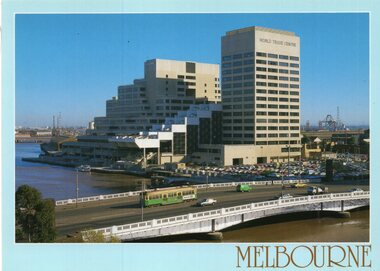
Postcard, Biscay Greetings, Spencer St bridge with a tram, mid to late 1980's
... ... Bridges... W...Trams tramways Spencer St Bridges W Class Colour postcard divided back - Biscay Greetings, series of featuring Spencer St bridge with a tram and the World Trade Centre building. ...Colour postcard divided back - Biscay Greetings, series of featuring Spencer St bridge with a tram and the World Trade Centre building. The back gives details of the building. Card has "Melbourne" in the bottom right hand corner. Back has space for name and address, stamp and a message and details of the postcard. Produced by Biscay Greetings, possibly mid to late 1980's. Card No. BG221trams, tramways, spencer st, bridges, w class -
 St Kilda Historical Society
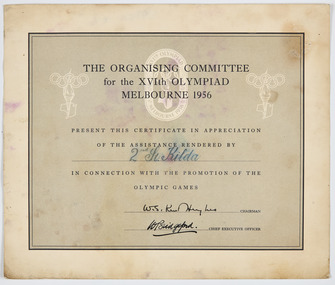
Document - Certificate, Certificate of Appreciation to 2nd St Kilda, 1956
... Signed in ink by the Chairman WS Kent Hughes and CEO W Bridge Ford....Signed in ink by the Chairman WS Kent Hughes and CEO W Bridge Ford. White and grey coloured paper printed in black. ...Certificate issued by the Organising Committee XVI Olympiad (1956) to '2nd St Kilda' for assisting in promoting the Games. White and grey coloured paper printed in black.The Organising Committee for the XVIth Olympiad Melbourne 1956 present this certificate in appreciation of the assistance rendered by 2nd St Kilda in connection with the promotion of the Olympic Games. Signed in ink by the Chairman WS Kent Hughes and CEO W Bridge Ford.1956 olympics -
 St Kilda Historical Society
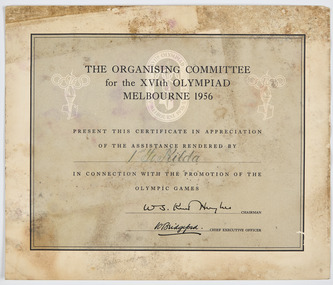
Document - Certificate, Certificate of Appreciation to Ist St Kilda, 1956
... Signed in ink by the Chairman WS Kent Hughes and CEO W Bridge Ford....Signed in ink by the Chairman WS Kent Hughes and CEO W Bridge Ford. White and grey coloured paper printed in black Certificate of Appreciation to Ist St Kilda Document Certificate ...Certificate issued by the Organising Committee XVI Olympiad (1956) to '1st St Kilda' for assisting in promoting the Games. White and grey coloured paper printed in blackThe Organising Committee for the XVIth Olympiad Melbourne 1956 present this certificate in appreciation of the assistance rendered by Ist St Kilda in connection with the promotion of the Olympic Games. Signed in ink by the Chairman WS Kent Hughes and CEO W Bridge Ford.1956 olympics -
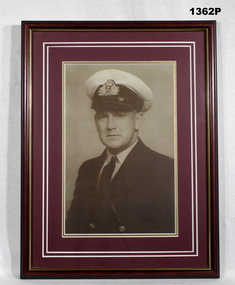 Bendigo Military Museum
Photograph - PHOTOGRAPH, FRAMED
... On back: Sub Lieutenant KENNETH W T BRIDGE DSC, Legion of Merit (US) RANVR - Coastwatcher, ...Refer Book 46. photography - photographs frame accessories military history - navy united states On back: Sub Lieutenant KENNETH W T BRIDGE DSC, Legion of Merit (US) RANVR - Coastwatcher, Brown plastic frame, gold trim, glass front, brown paper backing. ...Kenneth William Tweeddale BRIDGE DSC. Pre WW2 Kenneth worked in New Guinea from 1929 to 1941 as a Patrol Officer and then Assistant District Officer. He enlisted in the 2nd AIF No VX7794 on 10.3.1942 age 34 years 5 months. Initially posted too 3rd F.A Regt he was appointed A/Lieut on 26.5.1942 in “Z Special Unit”. Embarked for service in Aust mandated territory (NG) 31.8.1942, alloted to “M” Special Unit SWPA 7.5.1943, returned from special duties 11.9.1943, transferred to the retired list 8.10.1943. He was awarded by the U.S the “Legion of Merit” (Degree of Legionairre) for his work between Nov 1942 - July 1943 in the Sambare River and Salamaua area. He then joined the RANVR on 9.10.1943 in Intelligence and allotted to “Ferdinand Party” as a Sub Lieut. Embarcation dates are not listed but it appears he was in New Guinea in 1944 - 45. He was awarded the DSC for “Bravery and Enterprise in Recconnaisance Operations” on 16.2.1945. Appointment terminated in the RANVR on 8.1.1946. (SWPA) South West Pacific Area. (RANVR) Royal Australian Navy Volunteer Reserve. (DSC) Distinguished Service Cross. Refer Book 46.Brown plastic frame, gold trim, glass front, brown paper backing. Sepia photo, head & shoulders, peaked cap with white top, mounted with maroon border.On back: Sub Lieutenant KENNETH W T BRIDGE DSC, Legion of Merit (US) RANVR - Coastwatcher, photography - photographs, frame accessories, military history - navy, united states -
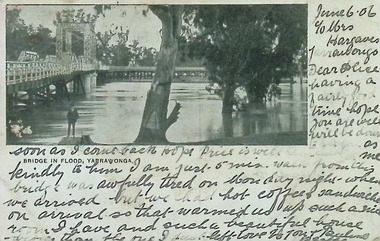 Williamstown Historical Society Inc
Postcard - Alice Evans Postcard Collection, 1905-1909
... Part of a collection of 142 Postcards. B&W depicting a bridge in flood, Yarrawonga, Victoria...Yarrawonga Flood Alice Evans Postcards Bridge in flood, Yarrawonga Part of a collection of 142 Postcards. B&W depicting a bridge in flood, Yarrawonga, Victoria Postcard Alice Evans Postcard Collection ..."Dear Alice" Is a collection of 142 Postcards from Australia and around world, almost all of which are addressed to Miss Alice Evans, No. 2 Cox Gardens, Williamstown, dated between 1905 - 1909. These postcards form part of a collection found in the ceiling of No. 2 Cox Gardens by a local builder and carpenter Gordon Peterson. Peterson was contracted to demolish the house in the mid 1970's. The cards were held in the Estate of Gordon Peterson, along with a photo of the cottage, before demolition until donation to the historical society by his descendants in 2024. Alice Edith Evans was born in Williamstown in 1885 to parents Benjamin Samuel Evans (1833-1900), a bootmaker from Ruabon, Denbighshire, Wales and Catherine (nee Jones) (1850-1915) from Eaglehawk, near Castlemaine. Alice had three older step sisters, and two younger brothers, Benjamin and Samuel, who sadly died in infancy. Alice’s father, Benjamin, had been married previously, his wife dying during childbirth, leaving him with three daughters to care for. After leaving school, Alice was employed as a clerk with Trevor Jones & Co. (real estate agents), until her declining health prevented her from working. She was an active and well known member of the Welsh Church and Sunday School on Ferguson Street and enjoyed singing and playing in local concerts. Well known in the community, a Grand Benefit Concert was organised in her honour on 9th April, 1910, at the Mechanics Institute, Williamstown. Hosted by Mayor Cr. Wymark, the event featured a delightful program of musical performances, showcasing both individual talents and the Carlton Club Choir. Tragically, Alice passed away due to the effects of her illness on 3rd December 1910, at the age of just 25. She is buried in Williamstown Cemetery. The postcards, written between 1905 to 1909, illustrate the social history of residents and everyday life at the turn of the century, using postcards as a means of communication.Part of a collection of 142 Postcards. B&W depicting a bridge in flood, Yarrawonga, VictoriaBridge in flood, Yarrawongayarrawonga, flood, alice evans postcards -
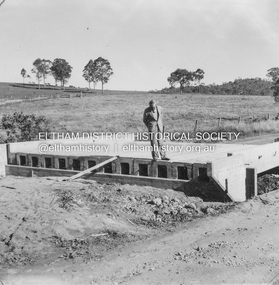 Eltham District Historical Society Inc
Album - Photograph, J.A. McDonald, Heidelberg-Kinglake Road, 2 May 1957
... Little Cox’s bridge (W. Wolf Contractor) 2nd May 1957 R.J. ...Little Cox’s bridge (W. Wolf Contractor) 2nd May 1957 R.J. ...Little Cox’s bridge (W. Wolf Contractor) 2nd May 1957 R.J. Ham on deckRecord of various Shire of Eltham infrastructure works undertaken during the period of 1952-1962 involving bridge and road reconstruction projects, sometimes with Eltham Shire Council Project Reference numbers quoted. It was during this period that a number of significant improvements were made to roads and new bridges constructed within the shire that remain in place as of present day (2022). In many situations, the photos provide a tangible visible record of infrastructure that existed throughout the early days of the Shire. The album was put together by or under the direction of the Shire Engineer, J.A. McDonald.infrastructure, shire of eltham, bridge construction, heidelberg-kinglake road, road construction, 1957-05-02, little cox’s bridge, r.j. ham -
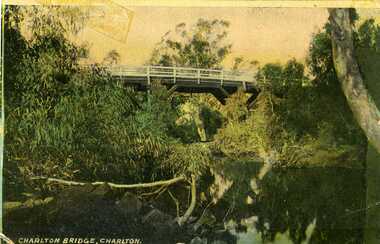 Charlton Golden Grains Museum Inc
Photograph - Coloured Postcard of Charlton Bridge, 1907
... Charlton Bridge, Charlton. W Wylie (Postcard series, Charlton)...Charlton Bridge, Charlton. W Wylie (Postcard series, Charlton)...Charlton Bridge, Charlton. W Wylie (Postcard series, Charlton) Avoca River Bridge Charlton Bridge, Charlton. ...Charlton Bridge, Charlton. W Wylie (Postcard series, Charlton)Unframed coloured postcard addressed to Miss Mary Spain (1907)Charlton Bridge, Charlton. W Wylie (Postcard series, Charlton)avoca river, bridge -
 Ringwood and District Historical Society
Photograph-B&W, Joan Walker, East Ringwood 2000-Eastfield Road Bridge, 2000
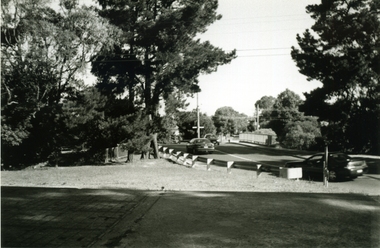
... East Ringwood 2000-Eastfield Road Bridge- B&W Photo from Album 6501...East Ringwood 2000-Eastfield Road Bridge- B&W Photo from Album 6501 East Ringwood 2000-Eastfield Road Bridge Photograph-B&W Joan Walker ...East Ringwood 2000-Eastfield Road Bridge- B&W Photo from Album 6501 -
 Port Melbourne Historical & Preservation Society
Photograph - Centenary Bridge, Port Melbourne, 1980
... B&W photo of Centenary Bridge from Port Melbourne Railway Station and railway siding c1980...centenary bridge transport - railways peter logan B&W photo of Centenary Bridge from Port Melbourne Railway Station and railway siding c1980 Photograph Centenary Bridge, Port Melbourne ...B&W photo of Centenary Bridge from Port Melbourne Railway Station and railway siding c1980centenary bridge, transport - railways, peter logan -
 Otway Districts Historical Society
Photograph, Gellibrand River railway bridge, 1901, 1901
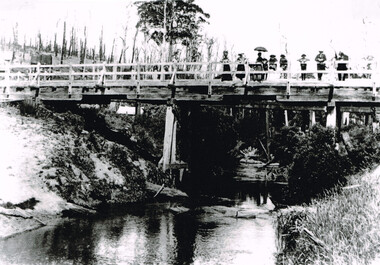
... Photograph, B/W, A4. Railway bridge over the Gellibrand River with people standing at the right-hand end, a railway water tank nearby on the left, and a tent underneath on the left....gellibrand, gellibrand river;railways; bridge; Photograph, B/W, A4. Railway bridge over the Gellibrand River with people standing at the right-hand end, a railway water tank nearby on the left, and a tent underneath on the left. ...Photograph, B/W, A4. Railway bridge over the Gellibrand River with people standing at the right-hand end, a railway water tank nearby on the left, and a tent underneath on the left.gellibrand, gellibrand river;railways; bridge; -
 Bendigo Historical Society Inc.
Newspaper - JENNY FOLEY COLLECTION: GUNS
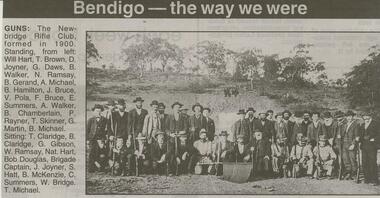
... McKenzie, C. Summers, W. Bridge, T. Michael. The clip is in a folder....McKenzie, C. Summers, W. Bridge, T. Michael. The clip is in a folder. ...BHS CollectionBendigo Advertiser '' The way we were'' from Tuesday, March 23, 2004. Guns: the Newbridge Rifle Club, formed in 1900. Standing, from left: Will Hart, T. Brown, D. Joyner, G. Daws, B. Walker, N. Ramsay, B. Gerard, A. Michael, B. Hamilton, J. Bruce, V. Pola, F. Bruce, E. Summers, A. Walker, B. Chamberlain, P. Rayner, T. Skinner, G. Martin, B. Michael. Sitting: T. Claridge, B. Claridge, G. Gibson, W. Ramsay, Nat. Hart, Bob Douglas, Brigade Captain, J. Joyner, S. Hatt, B. McKenzie, C. Summers, W. Bridge, T. Michael. The clip is in a folder.newspaper, bendigo advertiser, the way we were -
 Maccabi Victoria
Accessory, 1994
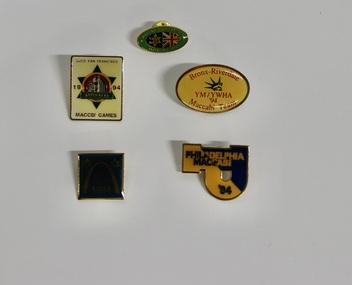
... Various pins from: 01: Great Britain - oval pin green, blue, red & gold "Maccabi Great Britain Cleveland 1994 with Maccabi logo in Hebrew & UK flag 02: SAN FRANCISCO - UJCC SAN FRANCISCO 1994 MACCBI (sic) GAMES blue, red, green, yellow & gold on cream w bridge logo & San Francisco in Hebrew 03: Bronx-Riverdale YM / YWHA '94 Maccabi Team in red on yellow & gold oval pin w part of Statue of Liberty head in blue as logo 04: PHILADELPHIA MACCABI '94 on sideways "P" blue & yellow on gold 05: ST LOUIS JCCA MACCABI 1994 in red and gold on blue w famous arch and magen davids in gold...Various pins from: 01: Great Britain - oval pin green, blue, red & gold "Maccabi Great Britain Cleveland 1994 with Maccabi logo in Hebrew & UK flag 02: SAN FRANCISCO - UJCC SAN FRANCISCO 1994 MACCBI (sic) GAMES blue, red, green, yellow & gold on cream w bridge logo & San Francisco in Hebrew 03: Bronx-Riverdale YM / YWHA '94 Maccabi Team in red on yellow & gold oval pin w part of Statue of Liberty head in blue as logo 04: PHILADELPHIA MACCABI '94 on sideways "P" blue & yellow on gold 05: ST LOUIS JCCA MACCABI 1994 in red and gold on blue w famous arch and magen davids in gold Accessory ...first held 1982 in MemphisJCC GAMES 1994 - held in Cleveland, USA 14-19 August 1994. Various pins from: 01: Great Britain - oval pin green, blue, red & gold "Maccabi Great Britain Cleveland 1994 with Maccabi logo in Hebrew & UK flag 02: SAN FRANCISCO - UJCC SAN FRANCISCO 1994 MACCBI (sic) GAMES blue, red, green, yellow & gold on cream w bridge logo & San Francisco in Hebrew 03: Bronx-Riverdale YM / YWHA '94 Maccabi Team in red on yellow & gold oval pin w part of Statue of Liberty head in blue as logo 04: PHILADELPHIA MACCABI '94 on sideways "P" blue & yellow on gold 05: ST LOUIS JCCA MACCABI 1994 in red and gold on blue w famous arch and magen davids in goldjcc maccabi games 13 -
4th/19th Prince of Wales's Light Horse Regiment Unit History Room
Poem, The Horses Stay Behind, 1919
... On the outbreak of peace, costs became important and it was deemed too costly to have horses repatriated to Australia - except for one horse, "Sandy", owned by General W T Bridges who died at Gallipoli in 1915 Quarantine was offered as a reason for not permitting the walers to return to Australia. ...On the outbreak of peace, costs became important and it was deemed too costly to have horses repatriated to Australia - except for one horse, "Sandy", owned by General W T Bridges who died at Gallipoli in 1915 Quarantine was offered as a reason for not permitting the walers to return to Australia. ...During WW1 Australia sent 39,348 Walers overseas to the AIF. Many Light Horsemen enlisted with their horses with a government promise that they would be able to bring their horses home with them. On the outbreak of peace, costs became important and it was deemed too costly to have horses repatriated to Australia - except for one horse, "Sandy", owned by General W T Bridges who died at Gallipoli in 1915 Quarantine was offered as a reason for not permitting the walers to return to Australia. However, the horses would have had a long sea voyage, giving time for problems to emerge. Many of the fit horses were sold to the Indian ArmyFramed print of poem "The Horses Stay behind". In days to come we'll wander west and cross the range again; We'll hear the bush birds singing in the green trees after rain; We'll canter through the Mitchell grass and breast the bracing wind: But we'll have other horses. Our chargers stay behind. Around the fire at night we'll yarn about old Sinai; We'll fight our battles o'er again; and as the days go by There'll be old mates to greet us. The bush girls will be kind. Still our thoughts will often wander to the horses left. I don't think I could stand the thought of my old fancy hack Just crawling round old Cairo with a Gyppo on his back. Perhaps some English tourist out in Palestine may find My broken-hearted waler with a wooden plough behind. No; I'd better shoot him and tell a little lie: "He floundered in a wombat hole and then lay down to die" May be I'll be court-martialled; but I'm damned if I'm inclined To go back to Australia and leave my horse behind. Trooper Bluegum -
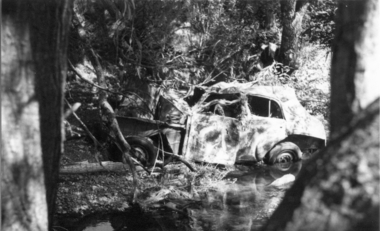 Darebin Parklands Association
Pollution in Darebin Creek 10th February 1976, 10/2/1976
... B&W photograph. Below railway bridge. This item and all other Darebin Parklands Association archival material is now held by State Library Victoria (Accession No: YMS 13746). ...pollution B&W photograph. Below railway bridge. This item and all other Darebin Parklands Association archival material is now held by State Library Victoria (Accession No: YMS 13746). ...B&W photograph. Below railway bridge. This item and all other Darebin Parklands Association archival material is now held by State Library Victoria (Accession No: YMS 13746). Please contact State Library Victoria if access is required.pollution -
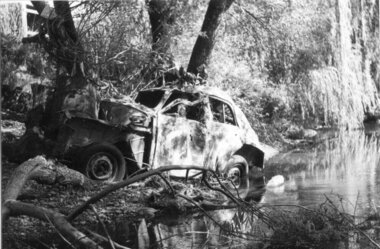 Darebin Parklands Association
Pollution in Darebin Creek 10th February 1976, 1976
... B&W photograph. Below Railway Bridge. This item and all other Darebin Parklands Association archival material is now held by State Library Victoria (Accession No: YMS 13746). ...People often pushed cars and supermarket trolleys over the edge of the cliff at the end of Waverley Avenue. B&W photograph. Below Railway Bridge. This item and all other Darebin Parklands Association archival material is now held by State Library Victoria (Accession No: YMS 13746). ...People often pushed cars and supermarket trolleys over the edge of the cliff at the end of Waverley Avenue.B&W photograph. Below Railway Bridge. This item and all other Darebin Parklands Association archival material is now held by State Library Victoria (Accession No: YMS 13746). Please contact State Library Victoria if access is required. -
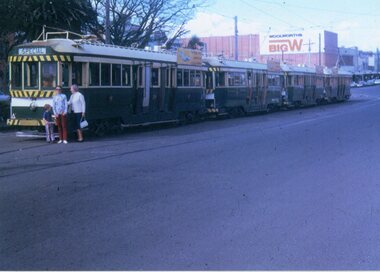 Ballarat Tramway Museum
Photograph - Colour Photograph/s - set of 2, Theo Dunstan, Aug. 1971
... No. 34 showing "Special". Has Big W and Bridge St. in the background. A small family group standing by the front of No. 34. 3246.2 - ditto but without the family group. ...Sturt St City Loop Bridge St tram 34 Set of two colour prints from a scanned slide image, loaned by donor and some black and white prints 3246.1 - No. 34 and three other bogie trams parked in the City Loop. No. 34 showing "Special". Has Big W ...Set of two colour prints from a scanned slide image, loaned by donor and some black and white prints 3246.1 - No. 34 and three other bogie trams parked in the City Loop. No. 34 showing "Special". Has Big W and Bridge St. in the background. A small family group standing by the front of No. 34. 3246.2 - ditto but without the family group. Colour Prints made by commercial machine printer direct from images on Kodak Xtralife Paper. Taken 23/8/1971 - the last Sunday of full operations? For high resolution image see btm3246i1h and 3246i2h. sturt st, city loop, bridge st, tram 34 -
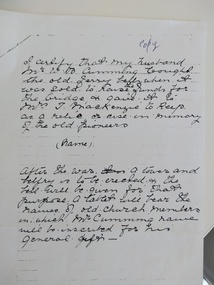 Peterborough History Group
Letter - Statement regarding location of the old ferry call bell
... this letter explains that the bell was sold to raise funds for construction of the bridge. Mr W. B Cumming bought the bell and passed it to Mrs T. ...When a ferry was the only way to cross the river, a bell was rung to call the ferryman. this letter explains that the bell was sold to raise funds for construction of the bridge. Mr W. B Cumming bought the bell and passed it to Mrs T. ...When a ferry was the only way to cross the river, a bell was rung to call the ferryman. this letter explains that the bell was sold to raise funds for construction of the bridge. Mr W. B Cumming bought the bell and passed it to Mrs T. McKenzie. this statement was written and signed by Mrs W.B.Cumming and further states the expectation that a tower and belfry would be constructed, along with a plaque memorialising church members and Mr W.B Cumming.Significant because it specifies what happened to the Ferry call bell, which was very important when the ferry was the only way to cross the river. Photocopy of a statement by Mrs W. B Cumming explaining the history of the bellbells, ferry, curdies river, curdies river bridge, curdies river ferry, mr w.b. cumming, peterborough -
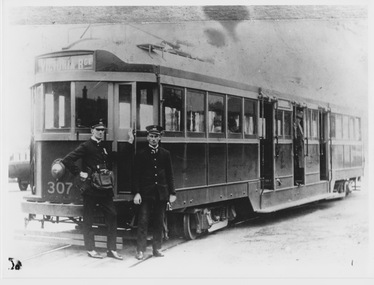 Melbourne Tram Museum
Photograph - W class 307 and crew, 1924-1928
... W class...tram 307...Victoria Bridge...Photograph shows W class 307 standing on slightly curved track displaying destination "Victoria Bridge" and no route number box attached. ...Photograph shows W class 307 standing on slightly curved track displaying destination "Victoria Bridge" and no route number box attached. ...Photograph shows W class 307 standing on slightly curved track displaying destination "Victoria Bridge" and no route number box attached. The uniformed motorman and conductor stand on the roadway next to the front driver's cab where the trolley pole has been tied down. The conductor wears his coin bag and the driver is holding the tram's key and air brake handle. An elderly male passenger with coat stands at the drop-centre doorway and other passengers are inside. The car body of W 307 was built by Holden Motor Body Builders in South Australia in 1924 as part of a large contract to build W class trams. Victoria Bridge was the termini of both the Collins Street and Victoria Parade cable tram that closed in 1929 and the Mont Albert electric tram from Union Road, via Whitehorse Road and Kew Junction. Perhaps this photograph is of the Mont Albert terminus although the curved track suggests otherwise.Yields information about early W class tramcars . Black and white photograph with penciled dates on rearPencil writing reads "Between 2/9/24 & 19/3/28" trolley pole, drop-centre, w class, tram 307, victoria bridge, route number box, key, air brake handle, car body, holden motor body builders, mont albert, termini -
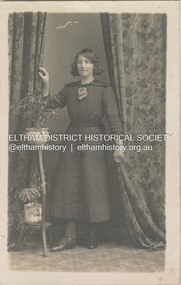 Eltham District Historical Society Inc
Photograph, W. Mason & Co, Believed to be Mary Ann Shillinglaw, c.1915
... ...W. Mason & Co. Photographer 144 Bridge Rd Melbourne...Post Card printed on back with photographer's details: W. Mason & Co., 144 Bridge Road, Richmond. W. Mason & Co. operated from this adress from 1903-c.1932 POSTCARD 1905-1940s Like the carte-de-visite, postcards enjoyed a collecting craze by large numbers of people, and were often kept in albums through which the interested visitor could browse. ...Post Card printed on back with photographer's details: W. Mason & Co., 144 Bridge Road, Richmond. W. Mason & Co. operated from this adress from 1903-c.1932 POSTCARD 1905-1940s Like the carte-de-visite, postcards enjoyed a collecting craze by large numbers of people, and were often kept in albums through which the interested visitor could browse. ...Post Card printed on back with photographer's details: W. Mason & Co., 144 Bridge Road, Richmond. W. Mason & Co. operated from this adress from 1903-c.1932 POSTCARD 1905-1940s Like the carte-de-visite, postcards enjoyed a collecting craze by large numbers of people, and were often kept in albums through which the interested visitor could browse. Postcards were posted or exchanged in huge numbers. Postal authorities in Australia only allowed the private printing of postcards from 1898. At this time the back of the card was reserved for the address and postage stamp, and the front was used for the message and a picture. In 1902 British authorities allowed a "divided back", so that the left side could be used for the message, the right side for the address and stamp, and the whole of the front was devoted to the picture. France followed suit in 1904, Germany and Australia in 1905, and the United States in 1907. - Frost, Lenore; Dating Family Photos 1850-1920; Valiant Press Pty. Ltd., Berwick, Victoria 1991marg ball collection, postcard, 1903-1932, 1915, mary ann shillinglaw (1880-1963), w. mason & co. photographer 144 bridge rd melbourne -
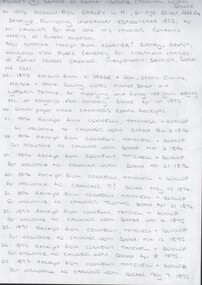 Bendigo Historical Society Inc.
Document - CONNELLY, TATCHELL, DUNLOP COLLECTION: ACCOUNTS ESTATE OF ESTHER ISABELLE CANNING, 1893 - 1895
... Connelly, Tatchell & Dunlop - Accounts - Estate of Esther Isabelle Canning. 1 - 1893 - Acc from Oakley W H, Bridge St Bendigo. Furnishing Undertaker, Established 1853, to Mr Canning for the late Mrs Canning. ...Connelly, Tatchell & Dunlop - Accounts - Estate of Esther Isabelle Canning. 1 - 1893 - Acc from Oakley W H, Bridge St Bendigo. Furnishing Undertaker, Established 1853, to Mr Canning for the late Mrs Canning. ...Document. Connelly, Tatchell & Dunlop - Accounts - Estate of Esther Isabelle Canning. 1 - 1893 - Acc from Oakley W H, Bridge St Bendigo. Furnishing Undertaker, Established 1853, to Mr Canning for the late Mrs Canning. Contains details of funeral expenses. Also contains receipt from Courtier? Sidney, Sexton, Kangaroo Flat Public Cemetery for Interment charges of Esther Isobel Canning. Independent Section, Label No 2221. 2 - 1895 - Acc from W Beebe & Son, Steam Granite, Marble & Stone Sawing Works, Mitchell St and Lyttleton Terrace, for supplying and fixing red gum edging etc at Kangaroo Flat Cemetery. Dated Apr 1st 1895. 3 - Blank paper titled Canning's Estate Receipts. 4 - 1894 - Receipt from Connelly, Tatchell & Dunlop for allowance to Canning John. Dated Feb 6 1894. 5 - 1894 - Receipt from Connelly, Tatchell & Dunlop for allowance to Canning John dated Mr 3 1894. 6 - 1894 - Receipt from Connelly, Tatchell & Dunlop for allowance to Canning John dated Mar 31 1894. 7 - 1894 - Receipt from Connelly, Tatchell & Dunlop for allowance to Canning T? dated May 19 1894. 8 - 1894 - Receipt from Connelly, Tatchell & Dunlop for allowance to Canning Thomas dated Apr 21 1894. 9 - 1895 - Receipt from Connelly, Tatchell & Dunlop for allowance to Canning John dated Jan 14 1895. 10 - 1895 - Receipt from Connelly, Tatchell & Dunlop for allowance to Canning John dated Mar 12 1895. 11 - 1895 - Receipt from Connelly, Tatchell & Dunlop for allowance to Canning John dated Apr 8 1895. 12 - Receipt from Connelly, Tatchell & Dunlop for allowance to Canning John dated May 7 1895.cottage, miners, connelly, tatchell & dunlop, oakley w h, mr canning, mrs canning, courtier? sidney, kangaroo flat public cemetery, w beebe & son, canning john, canning thomas -
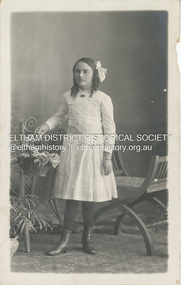 Eltham District Historical Society Inc
Photograph, Phillip Shillinglaw's neice, May, c.1910
... ...W. Mason & Co. Photographer 144 Bridge Rd Melbourne...So good bye from your loving cousin Mary 100 xxxxxxxxxxxxxx" Possibilities to investigate are the Kidd side families: Wilson Stewart Renolds Mills Mason Williams Post Card printed on back with photographer's details: W. Mason & Co., 144 Bridge Road, Richmond. W. Mason & Co. operated from this adress from 1903-c.1932 POSTCARD 1905-1940s Like the carte-de-visite, postcards enjoyed a collecting craze by large numbers of people, and were often kept in albums through which the interested visitor could browse. ...So good bye from your loving cousin Mary 100 xxxxxxxxxxxxxx" Possibilities to investigate are the Kidd side families: Wilson Stewart Renolds Mills Mason Williams Post Card printed on back with photographer's details: W. Mason & Co., 144 Bridge Road, Richmond. W. Mason & Co. operated from this adress from 1903-c.1932 POSTCARD 1905-1940s Like the carte-de-visite, postcards enjoyed a collecting craze by large numbers of people, and were often kept in albums through which the interested visitor could browse. ...Believed to be addressed to her cousin, Mary Ann Shillinglaw, from May ? - This could be Ethel May Bottle b. 1883, daughter of Edward Henry Bottle and step-daughter of Catherine Shillinglaw but this type of post-card photo only commenced in 1905 when she would have been 22. The girl looks more like 15. It is not known if Elizabeth Docherty (nee Shillinglaw) had any children. Born 1861 and married 1894 at 33 years of age, it is possible that she could have had a daughter who would have been 15 in 1910. "Dear Mary I hope this will find you all well. I hope Uncle Phillip is better. This is for the home it is among the lot. You must excuse me for sending one among the lot I haven’t enough to go all round. I will get more copied and send one to Carrie and Florrie. Well I think I have told you all this time I haven’t much room. So good bye from your loving cousin Mary 100 xxxxxxxxxxxxxx" Possibilities to investigate are the Kidd side families: Wilson Stewart Renolds Mills Mason Williams Post Card printed on back with photographer's details: W. Mason & Co., 144 Bridge Road, Richmond. W. Mason & Co. operated from this adress from 1903-c.1932 POSTCARD 1905-1940s Like the carte-de-visite, postcards enjoyed a collecting craze by large numbers of people, and were often kept in albums through which the interested visitor could browse. Postcards were posted or exchanged in huge numbers. Postal authorities in Australia only allowed the private printing of postcards from 1898. At this time the back of the card was reserved for the address and postage stamp, and the front was used for the message and a picture. In 1902 British authorities allowed a "divided back", so that the left side could be used for the message, the right side for the address and stamp, and the whole of the front was devoted to the picture. France followed suit in 1904, Germany and Australia in 1905, and the United States in 1907. - Frost, Lenore; Dating Family Photos 1850-1920; Valiant Press Pty. Ltd., Berwick, Victoria 1991marg ball collection, shillinglaw family photo album 3, postcard, 1903-1932, 1910, agnes mary shillinglaw 1881-1968, ethel may bottle, mary ann shillinglaw (1880-1963), w. mason & co. photographer 144 bridge rd melbourne -
 Eltham District Historical Society Inc
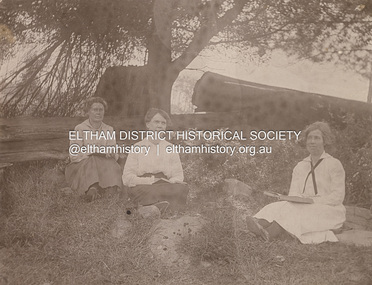
Photograph, Elizabeth Shillinglaw in middle, possibly sister Mary on right, c.1925
... Post Card printed on back with photographer's details: W. Mason & Co., 144 Bridge Road, Richmond. W. Mason & Co. operated from this adress from 1903-c.1932 POSTCARD 1905-1940s Like the carte-de-visite, postcards enjoyed a collecting craze by large numbers of people, and were often kept in albums through which the interested visitor could browse. ...Post Card printed on back with photographer's details: W. Mason & Co., 144 Bridge Road, Richmond. W. Mason & Co. operated from this adress from 1903-c.1932 POSTCARD 1905-1940s Like the carte-de-visite, postcards enjoyed a collecting craze by large numbers of people, and were often kept in albums through which the interested visitor could browse. ...Elizabeth (Lizzie) Ann Shillinglaw born August 15, 1879 at Bundoora, Victoria was the fith child of Phillip Shillinglaw and Sarah Ann (nee Kidd). She commenced school at Eltham State School No. 209 (Register No. 391) in 1883 at age 3 years, her final year being 1892. She was engaged to a local Eltham lad who enslisted in the First World War and presented her with a gold ring with Lizzie inscribed on it. He never returned from war and Lizzie never married. Lizzie was quite involved with the local Methodist church where father Phillip was a Lay Preacher. She also had a dress making business in Smitrh Street, Collingwood. At the time of her father's death in 1914 she was living at 18 Stanley Street, Richmond. She returned to Wattle Brae in Eltham where she and her unmarried sisters, Mary and Ada and brother Ernest Samuel continued to live. Mary Shillinglaw born November 5, 1880 at Bundoora, Victoria was the sixth child of Phillip Shillinglaw and Sarah Ann (nee Kidd). She commenced school at Eltham State School No. 209 (Register No. 423) in 1885 at age 4 years. Mary did not marry and spent most of her life at Wattle Brae (Shillinglaw Cottage). In his Will, Phillip Shillinglaw provided that any of his unwed sisters would be able to live at Wattle Brae, rent free. When Eltham Shire Council aquired the property in 1963 to build new Shire Offices, both Mary and her sister Lizzie (also unmarried) were still living at the cottage. Council paid for the women to relocate. Mary moved to Elizabeth House, a nursing home in Ivanhoe but found it very hard to adapt to her new surroundings and living consdtions. She died there only a few months after departing Eltham on October 29, 1963 at age 83 years. Lizzie died June 28, 1972 at age 93 years. Post Card printed on back with photographer's details: W. Mason & Co., 144 Bridge Road, Richmond. W. Mason & Co. operated from this adress from 1903-c.1932 POSTCARD 1905-1940s Like the carte-de-visite, postcards enjoyed a collecting craze by large numbers of people, and were often kept in albums through which the interested visitor could browse. Postcards were posted or exchanged in huge numbers. Postal authorities in Australia only allowed the private printing of postcards from 1898. At this time the back of the card was reserved for the address and postage stamp, and the front was used for the message and a picture. In 1902 British authorities allowed a "divided back", so that the left side could be used for the message, the right side for the address and stamp, and the whole of the front was devoted to the picture. France followed suit in 1904, Germany and Australia in 1905, and the United States in 1907. - Frost, Lenore; Dating Family Photos 1850-1920; Valiant Press Pty. Ltd., Berwick, Victoria 1991marg ball collection, postcard, 1925, elizabeth (lizzie) ann shillinglaw (1879-1972), elizabeth docherty (nee shillinglaw 1861-1942)*, mary ann shillinglaw (1880-1963), reading -
 Federation University Historical Collection
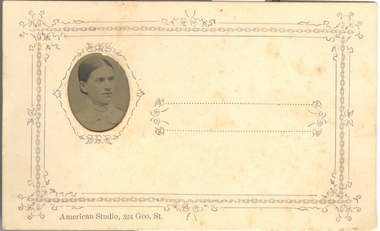
Photograph - Little Gem tintype, American Studio, Portrait of a Woman, (exact)
... Kenny, Bridge St, Ballarat; - Marinus W. Bent, Sandhurst (Bendigo); - George Fisher, Victoria; - Anson Brothers, Hobart Town. ...Kenny, Bridge St, Ballarat; - Marinus W. Bent, Sandhurst (Bendigo); - George Fisher, Victoria; - Anson Brothers, Hobart Town. ...The tintype (or ferrotype or Melainotype) was produced on metallic sheet (not, actually, tin) instead of glass. The plate was coated with collodion and sensitized just before use. It was introduced by Adolphe Alexandre Martin in 1853. The most common size was about the same as the carte-de-visite, 5.5cm x 9.0cm, but both larger and smaller ferrotypes were made. The smallest were "Little Gem" tintypes, about the size of a postage-stamp, made simultaneously on a single plate in a camera with 12 or 16 lenses. They were often produced by travelling photographers, and were cheaper than Ambrotypes so made photography available to working classes, not just to the more well-to-do. The print would come out laterally reversed (as one sees oneself in a mirror). Being quite rugged, tintypes could be sent by post. Tintypes were eventually superseded by gelatin emulsion dry plates in the 1880s, though street photographers in various parts of the world continued with this process until the 1950s. (Above information abridged from http://www.rleggat.com/photohistory/history/tintype.htm) The firm of Gove and Allen opened in Sydney in 1880 and were responsible for the belated popularizing of the gem tintype in Australia. The firm traded as both The American Gem Studio and The American Studio. Others franchises were opened in Melbourne, Ballarat and Sandhurst (Bendigo). The Sandhurst branch closed in 1882 and Adelaide in 1884. All Gove and Allen studios had ceased trading by 1885. The studio addresses were: 23 King William St, Adelaide; 324 George St, Sydney; 95 Swanston St, Melbourne; Howard Place, Sandhurst; 7 Queen St, Brisbane; The card mounts used in Gove and Allen studios in Australia are identical to those used in America. They were initially made of plain white card with embossing around the oval image opening in the mount while some also had simple geometric and floral printed designs as well. Although Gove and Allen studios produced the majority of gem tintypes in Australia, other studios offered them including: - London, American & Sydney Photo Company, 328 George St, Sydney; - David Edelsten, 55 & 57 Bourke St, Melbourne; - Burman's Portrait Rooms, St. George's Hall, 209 Bourke St, Melbourne; - Bell's Gem Portrait Studio, 57 Bourke St East, Melbourne; - R. H. Kenny, Bridge St, Ballarat; - Marinus W. Bent, Sandhurst (Bendigo); - George Fisher, Victoria; - Anson Brothers, Hobart Town. (Abridged information from http://members.ozemail.com.au/~msafier/photos/tintypes.html) A tintype portrait of a woman's head, attached to a card.Printed lower left hand side of the card "American Studio, 324 Geo. St."tintype, american studio, woman, unidentified woman, women, photograph -
 Federation University Historical Collection
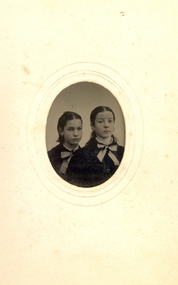
Photograph - Tintype, Portrait of two young girls
... Kenny, Bridge St, Ballarat; - Marinus W. Bent, Sandhurst (Bendigo); - George Fisher, Victoria; - Anson Brothers, Hobart Town. ...Kenny, Bridge St, Ballarat; - Marinus W. Bent, Sandhurst (Bendigo); - George Fisher, Victoria; - Anson Brothers, Hobart Town. ...The tintype (or ferrotype or Melainotype) was produced on metallic sheet (not, actually, tin) instead of glass. The plate was coated with collodion and sensitized just before use. It was introduced by Adolphe Alexandre Martin in 1853. The most common size was about the same as the carte-de-visite, 5.5cm x 9.0cm, but both larger and smaller ferrotypes were made. The smallest were "Little Gem" tintypes, about the size of a postage-stamp, made simultaneously on a single plate in a camera with 12 or 16 lenses. They were often produced by travelling photographers, and were cheaper than Ambrotypes so made photography available to working classes, not just to the more well-to-do. The print would come out laterally reversed (as one sees oneself in a mirror). Being quite rugged, tintypes could be sent by post. Tintypes were eventually superseded by gelatin emulsion dry plates in the 1880s, though street photographers in various parts of the world continued with this process until the 1950s. (Above information abridged from http://www.rleggat.com/photohistory/history/tintype.htm) The firm of Gove and Allen opened in Sydney in 1880 and were responsible for the belated popularizing of the gem tintype in Australia. The firm traded as both The American Gem Studio and The American Studio. Others franchises were opened in Melbourne, 6 Sturt St Ballarat and Sandhurst (Bendigo). The Sandhurst branch closed in 1882 and Adelaide in 1884. All Gove and Allen studios had ceased trading by 1885. The studio addresses were: 23 King William St, Adelaide; 324 George St, Sydney; 95 Swanston St, Melbourne; Howard Place, Sandhurst; 7 Queen St, Brisbane; The card mounts used in Gove and Allen studios in Australia are identical to those used in America. They were initially made of plain white card with embossing around the oval image opening in the mount while some also had simple geometric and floral printed designs as well. Although Gove and Allen studios produced the majority of gem tintypes in Australia, other studios offered them including: - London, American & Sydney Photo Company, 328 George St, Sydney; - David Edelsten, 55 & 57 Bourke St, Melbourne; - Burman's Portrait Rooms, St. George's Hall, 209 Bourke St, Melbourne; - Bell's Gem Portrait Studio, 57 Bourke St East, Melbourne; - R. H. Kenny, Bridge St, Ballarat; - Marinus W. Bent, Sandhurst (Bendigo); - George Fisher, Victoria; - Anson Brothers, Hobart Town. (Abridged information from http://members.ozemail.com.au/~msafier/photos/tintypes.html) .2) A tintype portrait of two girls heads, attached to a card. The girls are wearing a cloak with a large bow at the frontlittle gem, women, children, photography, tintype -
 Federation University Historical Collection
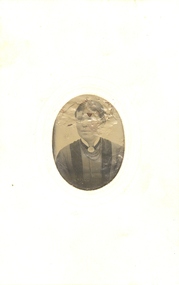
Photograph - Little Gem tintype, Portrait of a Woman
... Kenny, Bridge St, Ballarat; - Marinus W. Bent, Sandhurst (Bendigo); - George Fisher, Victoria; - Anson Brothers, Hobart Town. ...The tintype (or ferrotype or Melainotype) was produced on metallic sheet (not, actually, tin) instead of glass. The plate was coated with collodion and sensitized just before use. It was introduced by Adolphe Alexandre Martin in 1853. The most common size was about the same as the carte-de-visite, 5.5cm x 9.0cm, but both larger and smaller ferrotypes were made. The smallest were "Little Gem" tintypes, about the size of a postage-stamp, made simultaneously on a single plate in a camera with 12 or 16 lenses. They were often produced by travelling photographers, and were cheaper than Ambrotypes so made photography available to working classes, not just to the more well-to-do. The print would come out laterally reversed (as one sees oneself in a mirror). Being quite rugged, tintypes could be sent by post. Tintypes were eventually superseded by gelatin emulsion dry plates in the 1880s, though street photographers in various parts of the world continued with this process until the 1950s. (Above information abridged from http://www.rleggat.com/photohistory/history/tintype.htm) The firm of Gove and Allen opened in Sydney in 1880 and were responsible for the belated popularizing of the gem tintype in Australia. The firm traded as both The American Gem Studio and The American Studio. Others franchises were opened in Melbourne, Ballarat and Sandhurst (Bendigo). The Sandhurst branch closed in 1882 and Adelaide in 1884. All Gove and Allen studios had ceased trading by 1885. The studio addresses were: 23 King William St, Adelaide; 324 George St, Sydney; 95 Swanston St, Melbourne; Howard Place, Sandhurst; 7 Queen St, Brisbane; The card mounts used in Gove and Allen studios in Australia are identical to those used in America. They were initially made of plain white card with embossing around the oval image opening in the mount while some also had simple geometric and floral printed designs as well. Although Gove and Allen studios produced the majority of gem tintypes in Australia, other studios offered them including: - London, American & Sydney Photo Company, 328 George St, Sydney; - David Edelsten, 55 & 57 Bourke St, Melbourne; - Burman's Portrait Rooms, St. George's Hall, 209 Bourke St, Melbourne; - Bell's Gem Portrait Studio, 57 Bourke St East, Melbourne; - R. H. Kenny, Bridge St, Ballarat; - Marinus W. Bent, Sandhurst (Bendigo); - George Fisher, Victoria; - Anson Brothers, Hobart Town. (Abridged information from http://members.ozemail.com.au/~msafier/photos/tintypes.html) .3) A tintype portrait of a woman, attached to a card. little gem, tintype, woman, unidentified woman, women -
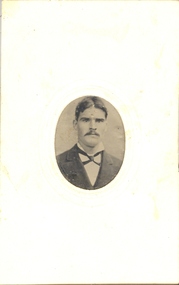 Federation University Historical Collection
Photograph - Little Gem tintype, Portrait of a Man
... Kenny, Bridge St, Ballarat; - Marinus W. Bent, Sandhurst (Bendigo); - George Fisher, Victoria; - Anson Brothers, Hobart Town. ...Kenny, Bridge St, Ballarat; - Marinus W. Bent, Sandhurst (Bendigo); - George Fisher, Victoria; - Anson Brothers, Hobart Town. ...The tintype (or ferrotype or Melainotype) was produced on metallic sheet (not, actually, tin) instead of glass. The plate was coated with collodion and sensitized just before use. It was introduced by Adolphe Alexandre Martin in 1853. The most common size was about the same as the carte-de-visite, 5.5cm x 9.0cm, but both larger and smaller ferrotypes were made. The smallest were "Little Gem" tintypes, about the size of a postage-stamp, made simultaneously on a single plate in a camera with 12 or 16 lenses. They were often produced by travelling photographers, and were cheaper than Ambrotypes so made photography available to working classes, not just to the more well-to-do. The print would come out laterally reversed (as one sees oneself in a mirror). Being quite rugged, tintypes could be sent by post. Tintypes were eventually superseded by gelatin emulsion dry plates in the 1880s, though street photographers in various parts of the world continued with this process until the 1950s. (Above information abridged from http://www.rleggat.com/photohistory/history/tintype.htm) The firm of Gove and Allen opened in Sydney in 1880 and were responsible for the belated popularizing of the gem tintype in Australia. The firm traded as both The American Gem Studio and The American Studio. Others franchises were opened in Melbourne, Ballarat and Sandhurst (Bendigo). The Sandhurst branch closed in 1882 and Adelaide in 1884. All Gove and Allen studios had ceased trading by 1885. The studio addresses were: 23 King William St, Adelaide; 324 George St, Sydney; 95 Swanston St, Melbourne; Howard Place, Sandhurst; 7 Queen St, Brisbane; The card mounts used in Gove and Allen studios in Australia are identical to those used in America. They were initially made of plain white card with embossing around the oval image opening in the mount while some also had simple geometric and floral printed designs as well. Although Gove and Allen studios produced the majority of gem tintypes in Australia, other studios offered them including: - London, American & Sydney Photo Company, 328 George St, Sydney; - David Edelsten, 55 & 57 Bourke St, Melbourne; - Burman's Portrait Rooms, St. George's Hall, 209 Bourke St, Melbourne; - Bell's Gem Portrait Studio, 57 Bourke St East, Melbourne; - R. H. Kenny, Bridge St, Ballarat; - Marinus W. Bent, Sandhurst (Bendigo); - George Fisher, Victoria; - Anson Brothers, Hobart Town. (Abridged information from http://members.ozemail.com.au/~msafier/photos/tintypes.html) .4) A tintype portrait of a man, attached to a card. little gem, tintype, man, unidentified man -
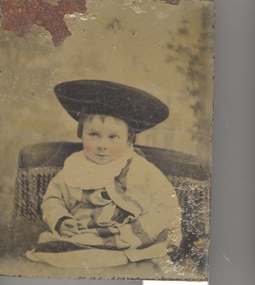 Federation University Historical Collection
Photograph - Photograph - Little Gem tintype, Possibly American Studio, Portrait of a child
... Kenny, Bridge St, Ballarat; - Marinus W. Bent, Sandhurst (Bendigo); - George Fisher, Victoria; - Anson Brothers, Hobart Town. ...Kenny, Bridge St, Ballarat; - Marinus W. Bent, Sandhurst (Bendigo); - George Fisher, Victoria; - Anson Brothers, Hobart Town. ...The tintype (or ferrotype or Melainotype) was produced on metallic sheet (not, actually, tin) instead of glass. The plate was coated with collodion and sensitized just before use. It was introduced by Adolphe Alexandre Martin in 1853. The most common size was about the same as the carte-de-visite, 5.5cm x 9.0cm, but both larger and smaller ferrotypes were made. The smallest were "Little Gem" tintypes, about the size of a postage-stamp, made simultaneously on a single plate in a camera with 12 or 16 lenses. They were often produced by travelling photographers, and were cheaper than Ambrotypes so made photography available to working classes, not just to the more well-to-do. The print would come out laterally reversed (as one sees oneself in a mirror). Being quite rugged, tintypes could be sent by post. Tintypes were eventually superseded by gelatin emulsion dry plates in the 1880s, though street photographers in various parts of the world continued with this process until the 1950s. (Above information abridged from http://www.rleggat.com/photohistory/history/tintype.htm) The firm of Gove and Allen opened in Sydney in 1880 and were responsible for the belated popularizing of the gem tintype in Australia. The firm traded as both The American Gem Studio and The American Studio. Others franchises were opened in Melbourne, Ballarat and Sandhurst (Bendigo). The Sandhurst branch closed in 1882 and Adelaide in 1884. All Gove and Allen studios had ceased trading by 1885. The studio addresses were: 23 King William St, Adelaide; 324 George St, Sydney; 95 Swanston St, Melbourne; Howard Place, Sandhurst; 7 Queen St, Brisbane; The card mounts used in Gove and Allen studios in Australia are identical to those used in America. They were initially made of plain white card with embossing around the oval image opening in the mount while some also had simple geometric and floral printed designs as well. Although Gove and Allen studios produced the majority of gem tintypes in Australia, other studios offered them including: - London, American & Sydney Photo Company, 328 George St, Sydney; - David Edelsten, 55 & 57 Bourke St, Melbourne; - Burman's Portrait Rooms, St. George's Hall, 209 Bourke St, Melbourne; - Bell's Gem Portrait Studio, 57 Bourke St East, Melbourne; - R. H. Kenny, Bridge St, Ballarat; - Marinus W. Bent, Sandhurst (Bendigo); - George Fisher, Victoria; - Anson Brothers, Hobart Town. (Abridged information from http://members.ozemail.com.au/~msafier/photos/tintypes.html) A tintype portrait of a child, attached to a card. little gem, child, hat -
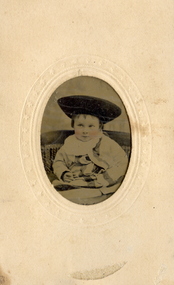 Federation University Historical Collection
Photograph - Photo - Little Gem tintype, Possibly American Studio, Portrait of a child
... Kenny, Bridge St, Ballarat; - Marinus W. Bent, Sandhurst (Bendigo); - George Fisher, Victoria; - Anson Brothers, Hobart Town. ...Kenny, Bridge St, Ballarat; - Marinus W. Bent, Sandhurst (Bendigo); - George Fisher, Victoria; - Anson Brothers, Hobart Town. ...The tintype (or ferrotype or Melainotype) was produced on metallic sheet (not, actually, tin) instead of glass. The plate was coated with collodion and sensitized just before use. It was introduced by Adolphe Alexandre Martin in 1853. The most common size was about the same as the carte-de-visite, 5.5cm x 9.0cm, but both larger and smaller ferrotypes were made. The smallest were "Little Gem" tintypes, about the size of a postage-stamp, made simultaneously on a single plate in a camera with 12 or 16 lenses. They were often produced by travelling photographers, and were cheaper than Ambrotypes so made photography available to working classes, not just to the more well-to-do. The print would come out laterally reversed (as one sees oneself in a mirror). Being quite rugged, tintypes could be sent by post. Tintypes were eventually superseded by gelatin emulsion dry plates in the 1880s, though street photographers in various parts of the world continued with this process until the 1950s. (Above information abridged from http://www.rleggat.com/photohistory/history/tintype.htm) The firm of Gove and Allen opened in Sydney in 1880 and were responsible for the belated popularizing of the gem tintype in Australia. The firm traded as both The American Gem Studio and The American Studio. Others franchises were opened in Melbourne, Ballarat and Sandhurst (Bendigo). The Sandhurst branch closed in 1882 and Adelaide in 1884. All Gove and Allen studios had ceased trading by 1885. The studio addresses were: 23 King William St, Adelaide; 324 George St, Sydney; 95 Swanston St, Melbourne; Howard Place, Sandhurst; 7 Queen St, Brisbane; The card mounts used in Gove and Allen studios in Australia are identical to those used in America. They were initially made of plain white card with embossing around the oval image opening in the mount while some also had simple geometric and floral printed designs as well. Although Gove and Allen studios produced the majority of gem tintypes in Australia, other studios offered them including: - London, American & Sydney Photo Company, 328 George St, Sydney; - David Edelsten, 55 & 57 Bourke St, Melbourne; - Burman's Portrait Rooms, St. George's Hall, 209 Bourke St, Melbourne; - Bell's Gem Portrait Studio, 57 Bourke St East, Melbourne; - R. H. Kenny, Bridge St, Ballarat; - Marinus W. Bent, Sandhurst (Bendigo); - George Fisher, Victoria; - Anson Brothers, Hobart Town. (Abridged information from http://members.ozemail.com.au/~msafier/photos/tintypes.html) .5) A tintype portrait of a child, attached to a card. little gem, photography, child, portrait -
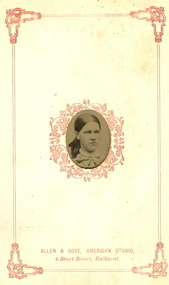 Federation University Historical Collection
Photograph - Photograph - Little Gem tintype, American Studio, Portrait of a Woman
... Kenny, Bridge St, Ballarat; - Marinus W. Bent, Sandhurst (Bendigo); - George Fisher, Victoria; - Anson Brothers, Hobart Town. ...Kenny, Bridge St, Ballarat; - Marinus W. Bent, Sandhurst (Bendigo); - George Fisher, Victoria; - Anson Brothers, Hobart Town. ...The tintype (or ferrotype or Melainotype) was produced on metallic sheet (not, actually, tin) instead of glass. The plate was coated with collodion and sensitized just before use. It was introduced by Adolphe Alexandre Martin in 1853. The most common size was about the same as the carte-de-visite, 5.5cm x 9.0cm, but both larger and smaller ferrotypes were made. The smallest were "Little Gem" tintypes, about the size of a postage-stamp, made simultaneously on a single plate in a camera with 12 or 16 lenses. They were often produced by travelling photographers, and were cheaper than Ambrotypes so made photography available to working classes, not just to the more well-to-do. The print would come out laterally reversed (as one sees oneself in a mirror). Being quite rugged, tintypes could be sent by post. Tintypes were eventually superseded by gelatin emulsion dry plates in the 1880s, though street photographers in various parts of the world continued with this process until the 1950s. (Above information abridged from http://www.rleggat.com/photohistory/history/tintype.htm) The firm of Gove and Allen opened in Sydney in 1880 and were responsible for the belated popularizing of the gem tintype in Australia. The firm traded as both The American Gem Studio and The American Studio. Others franchises were opened in Melbourne, 6 Sturt St Ballarat and Sandhurst (Bendigo). The Sandhurst branch closed in 1882 and Adelaide in 1884. All Gove and Allen studios had ceased trading by 1885. The studio addresses were: 23 King William St, Adelaide; 324 George St, Sydney; 95 Swanston St, Melbourne; Howard Place, Sandhurst; 7 Queen St, Brisbane; The card mounts used in Gove and Allen studios in Australia are identical to those used in America. They were initially made of plain white card with embossing around the oval image opening in the mount while some also had simple geometric and floral printed designs as well. Although Gove and Allen studios produced the majority of gem tintypes in Australia, other studios offered them including: - London, American & Sydney Photo Company, 328 George St, Sydney; - David Edelsten, 55 & 57 Bourke St, Melbourne; - Burman's Portrait Rooms, St. George's Hall, 209 Bourke St, Melbourne; - Bell's Gem Portrait Studio, 57 Bourke St East, Melbourne; - R. H. Kenny, Bridge St, Ballarat; - Marinus W. Bent, Sandhurst (Bendigo); - George Fisher, Victoria; - Anson Brothers, Hobart Town. (Abridged information from http://members.ozemail.com.au/~msafier/photos/tintypes.html) A tintype portrait of a woman's head, attached to a card. Printed on the lower edge of the card "Allen & Gove, American Studion, 6 Sturt St, Ballarat"ballarat, american studio, little gem, allen gove, tintype, woman, unidentified woman, photography
