
Showing 6 items matching "w.h. treganowan"
-
 Emerald Museum & Nobelius Heritage Park
Instrument - Obstetrical forceps, Milne-Murray, Robert, 1890s-1920s
... ...W.H. Treganowan...In the 1920s Dr Bottomley and business partner W.H. Treganowan initiated the Emerald Country Club syndicate to purchase land from Carl Axel Nobelius' Gembrook Nurseries estate, which led to the formation of the golf course and Country Club facilities. ...In the 1920s Dr Bottomley and his business partner W.H. Treganowan initiated the Emerald Country Club syndicate and purchased land from the Gembrook Nurseries estate to build a golf course and Country Club....In the 1920s Dr Bottomley and business partner W.H. Treganowan initiated the Emerald Country Club syndicate to purchase land from Carl Axel Nobelius' Gembrook Nurseries estate, which led to the formation of the golf course and Country Club facilities. ...These Victorian-era obstetrical forceps are from the collection of equipment used by Dr William Bottomley. Dr Bottomley was born in Fitzroy in 1881 and obtained a Bachelor of Surgery from the University of Melbourne in 1906. He lived in South Yarra with a weekend log cabin called Forest Lodge in Emerald and practiced in Collins Street in Melbourne. In the 1920s Dr Bottomley and business partner W.H. Treganowan initiated the Emerald Country Club syndicate to purchase land from Carl Axel Nobelius' Gembrook Nurseries estate, which led to the formation of the golf course and Country Club facilities. Bottomley Drive in Emerald is named after Dr Bottomley; the street is located near Silver Birches, the house commissioned by the doctor from modernist architect Harry Norris. 'Action traction' obstetrical forceps were invented by Dr Robert Milne-Murray, a practicing physician at the Royal Maternity and the Simpson Memorial Pavilion in Edinburgh in 1891. They were designed to allow the attending physician to obtain a secure hold on the infant before pulling backwards on the handle to facilitate the baby's birth. Forceps to extract fetuses from women who would otherwise die during complications in labour have been used as a last resort since 1500 BCE, though it has only been in the last 300-500 years that forceps design has shifted to focusing on saving the lives of both mother and infant. These are fenestrated forceps, with a hollow 'blade' or loop, which have been superseded as a design by solid models that are less likely to cause compression damage to the baby's head.These items are significant as they provide insights into medical practice in the early Twentieth-Century in Melbourne and surrounds. They are also significant because they were used by Dr William Bottomley, who owned property in Emerald and whose business dealings significantly shaped the development of the town.The silver-coloured item is approximately fifteen centimetres long; it has a solid metal handle bar and a stem leading to a flat panel with two holes that are designed to connect it to the body of the forceps. These forceps are from the collection of equipment used by Dr William Bottomley, who practiced in Collins Street in Melbourne after receiving his Bachelor of Surgery from the University of Melbourne in 1906. Dr Bottomley had a weekend residence in Emerald. In the 1920s Dr Bottomley and his business partner W.H. Treganowan initiated the Emerald Country Club syndicate and purchased land from the Gembrook Nurseries estate to build a golf course and Country Club.1890s, 1900s, 1910s william bottomley, w.h. treganowan, medical equipment, women's health, medical practice, forceps, birth, obstetrics, forest lodge, silver birches, harry norris, emerald country club and golf course -
Emerald Museum & Nobelius Heritage Park
Award - Trophy, A.P. Co, 1934
... ...W.H. Treganowan...ESS Treganowan House Cup Presented by Cr. W.H. Treganowan 1934 Gold Lily Mackinnon Ray Smith 1935 Green Agnes Hogan Ron Nicholls 1936 Gold Audrey Ayers Tom Worrell 1937 Gold Kathleen Wright Williams Stephens 1938 Gold Dorothy Jones William Stephen...Emerald Victoria Australia school history schools and colleges sports W.H. Treganowan L Mackinnon R Smith A Hogan R Nicholls A Ayers T Worrell K Wright W Stephens D Jones H Larrter ESS Treganowan House Cup Presented by Cr. ...Trophy inaugurated in 1934 by H. Larter. Children were divided into 2 houses - Green and Gold - and competed in sporting events, gardens, etc.Trophy cup, EPNS, on bakelite baseESS Treganowan House Cup Presented by Cr. W.H. Treganowan 1934 Gold Lily Mackinnon Ray Smith 1935 Green Agnes Hogan Ron Nicholls 1936 Gold Audrey Ayers Tom Worrell 1937 Gold Kathleen Wright Williams Stephens 1938 Gold Dorothy Jones William Stephenemerald, victoria, australia, school history, schools and colleges, sports, w.h. treganowan, l mackinnon, r smith, a hogan, r nicholls, a ayers, t worrell, k wright, w stephens, d jones, h larrter -
Emerald Museum & Nobelius Heritage Park
Functional object - Apothecary weights, H.B. Selby, 1900s
... ...W.H. Treganowan...In the 1920s Dr Bottomley and business partner W.H. Treganowan initiated the Emerald Country Club syndicate to purchase land from Carl Axel Nobelius' Gembrook Nurseries estate, which led to the formation of the golf course and Country Club facilities. ...W F Bottomley W.H. Treganowan Harry Norris Forest Lodge Silver Birches medical practice drug dispensing pharmacy equipment H.B. ...These Victorian-era apothecary scales are from the collection of equipment used by Dr William Bottomley. Dr Bottomley was born in Fitzroy in 1881 and obtained a Bachelor of Surgery from the University of Melbourne in 1906. He lived in South Yarra with a weekend log cabin called Forest Lodge in Emerald and practiced in Collins Street in Melbourne. These weights were used with a scale to dispense correct quantities of drugs or ingredients; the tweezers may have been used to combine substances on the glass slide ready for use. In the 1920s Dr Bottomley and business partner W.H. Treganowan initiated the Emerald Country Club syndicate to purchase land from Carl Axel Nobelius' Gembrook Nurseries estate, which led to the formation of the golf course and Country Club facilities. Bottomley Drive in Emerald is named after Dr Bottomley; the street is located near Silver Birches, the house commissioned by the doctor from modernist architect Harry Norris. These weights were used with a scale to dispense correct quantities of drugs or ingredients; the tweezers may have been used to combine substances on the glass slide ready for use. The apothecary system of weights was tailored to measuring medicinal ingredients; it and the Troy system (which was used for measuring precious metals such as silver and gold) both have twelve ounces to the pound, in comparison to the Avoirdupois method which was used for heavier items and had sixteen ounces to the pound. These measurement systems were used extensively throughout the world until the 1960s when the widespread adoption of the metric system standardised processes.These items are significant as they provide insights into medical practice in the early Twentieth-Century in Melbourne and surrounds. They are also significant because they were used by Dr William Bottomley, who owned property in Emerald and whose business dealings significantly shaped the development of the town.Wooden box with a metal latch, maker's label and owner's name. Inside the box there is a black cloth lining to encase eight brass and five tin weights, a glass slide and tweezers. There is space for an additional brass weight and eight tin weights, but these spaces are empty.Obverse: D W H BOTTOMLEY / H.B SELBY & CO. LTD. / SCIENTIFIC APPARATUS / MELBOURNE & SYDNEY /emerald, victoria, australia, gold weights, apothecary weights, bottomley, fischer, dr. w f bottomley, w.h. treganowan, harry norris, forest lodge, silver birches, medical practice, drug dispensing, pharmacy equipment, h.b. selby & co, emerald country club and golf course -
Emerald Museum & Nobelius Heritage Park
Instrument - Obstetricah forceps, Milne-Murray, Robert, 1890s-1920s
... ...W.H. Treganowan...In the 1920s Dr Bottomley and business partner W.H. Treganowan initiated the Emerald Country Club syndicate to purchase land from Carl Axel Nobelius' Gembrook Nurseries estate, which led to the formation of the golf course and Country Club facilities. ...In the 1920s Dr Bottomley and business partner W.H. Treganowan initiated the Emerald Country Club syndicate to purchase land from Carl Axel Nobelius' Gembrook Nurseries estate, which led to the formation of the golf course and Country Club facilities. ...These Victorian-era obstetrical forceps are from the collection of equipment used by Dr William Bottomley. Dr Bottomley was born in Fitzroy in 1881 and obtained a Bachelor of Surgery from the University of Melbourne in 1906. He lived in South Yarra with a weekend log cabin called Forest Lodge in Emerald and practiced in Collins Street in Melbourne. These Victorian-era 'action traction' obstetrical forceps were invented by Dr Robert Milne-Murray, a practicing physician at the Royal Maternity and the Simpson Memorial Pavilion in Edinburgh in 1891. They were designed to allow the attending physician to obtain a secure hold on the infant before pulling backwards on the handle to facilitate the baby's birth. In the 1920s Dr Bottomley and business partner W.H. Treganowan initiated the Emerald Country Club syndicate to purchase land from Carl Axel Nobelius' Gembrook Nurseries estate, which led to the formation of the golf course and Country Club facilities. Bottomley Drive in Emerald is named after Dr Bottomley; the street is located near Silver Birches, the house commissioned by the doctor from modernist architect Harry Norris. 'Action traction' obstetrical forceps were invented by Dr Robert Milne-Murray, a practicing physician at the Royal Maternity and the Simpson Memorial Pavilion in Edinburgh in 1891. They were designed to allow the attending physician to obtain a secure hold on the infant before pulling backwards on the handle to facilitate the baby's birth. Forceps to extract fetuses from women who would otherwise die during complications in labour have been used as a last resort since 1500 BCE, though it has only been in the last 300-500 years that forcep design has shifted to focusing on saving the lives of both mother and infant. These are fenestrated forceps, with a hollow 'blade' or loop, which have been superseded as a design by solid models that are less likely to cause compression damage to the baby's head.These items are significant as they provide insights into medical practice in the early twentieth-century in Melbourne and surrounds. They are also significant because they were used by Dr William Bottomley, who owned property in Emerald and whose business dealings significantly shaped the development of the town.The silver-coloured item is approximately thirty centimetres long and features two rounded metal loops opened and closed by manipulating the stem of the object, which ends in short feet that attach to a separate handle.1890s, 1900s, 1910s william bottomley, w.h. treganowan, medical practice, women's health, obstetrics, forceps, robert milne-murray, birth, forest lodge, silver birches, harry norris, emerald country club and golf course -
Emerald Museum & Nobelius Heritage Park
Document - Manuscript, Friends of Emerald Lake Park, An Introduction to the History of Emerald Lake Park, 2001
... ...W.H. Treganowan...Emerald Victoria Australia nurseries (plants) Parks Shire of Ferntree Gully Victoria Australia Shire of Sherbrooke Victoria Australia Emerald Lake Park Friends of Emerald Lake Park Nobelius Nursery Gembrook Nurseries W.H. Treganowan Gus Ryberg Amphitheatre The Pines Amphitheatre The Gums Amphitheatre Bunurong Amphitheatre Carl Stemp Amphitheatre 5 A4 typewritten and photocopied pages.Paper An Introduction to the History of Emerald Lake Park Document Manuscript Friends of Emerald Lake Park ...An information paper produced in 2001 for distribution to members of the Friends of Emerald Lake Park.5 A4 typewritten and photocopied pages.Paperemerald, victoria, australia, nurseries (plants), parks, shire of ferntree gully victoria australia, shire of sherbrooke victoria australia, emerald lake park, friends of emerald lake park, nobelius nursery, gembrook nurseries, w.h. treganowan, gus ryberg amphitheatre, the pines amphitheatre, the gums amphitheatre, bunurong amphitheatre, carl stemp amphitheatre -
 Seaworks Maritime Museum
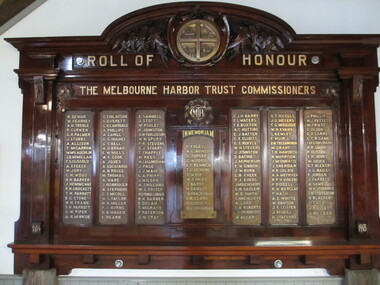
Honour Board, Melbourne Harbour Trust
... MCKEDDIE, W.H EVANS, S. KEWLEY, F. MUIR, F.W. TREGANOWAN, M. GRANT, T.R. HAWWORTH, N. ...MCKEDDIE, W.H EVANS, S. KEWLEY, F. MUIR, F.W. TREGANOWAN, M. GRANT, T.R. HAWWORTH, N. ...Belonged to the Melbourne Harbour Trust Commissionersarge, wooden, rectangular "Roll of Honour" board for the Melbourne Harbour Trust Commissioners. It was their honourary board for employees who went to the 1st World War. comprised of seven panels with names of people carved into them. The centre panel has "in Memorium' in brass lettering and is raised out from the three panels which flank it on either side. The main lettering across the top of the board is made from brass, and is attached to the wood. A circular brass crest is featured in the centre top of the board, which is flanked by carved gum leaves and nuts. The date "1918" is also cast in brass and attached to the lower front right hand side of the board.1918 circa."ROLL OF HONOUR/ THE MELBOURNE HARBOR TRUST COMMISSIONERS/ MHT/ IN MEMORIAM/ R. DEWAR, W. KEARNEY, A.H. TREBLE, R. CURWEN, G.R. PALMER, J. STUBBS, A. ALLISON, T. MCCARRON, W. MCLAUGHLIN, J.D. MCMILLAN, F.S. CLISSOLD, A. STEEGE, W. JORY, C.H. WOOD, H.H. BARKER, J. HEMINGWAY, R.H. CROCKETT, T.W. PARROTT, E.G. STONE, W.H. FRAME, S.H. PARROTT, V.W. PIPER, A.R MCBRIDE/ D. FINLAYSON, S.EVERETT, G.O. LAWRENCE, A. PHILLIPS, A. CAHILL, G.C. HUGHES, G.S BELL, A.D. BROAD, C.W. MILLS, A.C. COOK, A. JONES, A. COCCIARDI, A.N. ROYCE, M. THOMAS, A.WARE, J. RISBRIDGER, A. STEPHENS, G.S. MCCOLL, W.S. TAYLOR, H.A. MILLER, P.J. BURNS, D.B. MACKIE, F. HEARN/ E. SAMBELL, J. STOTT, W. POOLEY, R. JOHNSTON, A.W. FERGUSSON, W.H. SPURR, P.R. STEVENS, D.J. STUART, T. CHAPPLE, W. REED, W.J ALLINGHAM, J. PAGE, J.J. MAIR, C.A PHIPPS, J. WILSON, A.J WILLIAMS, W.L. FOSTER, W.S PENHALLURIACK, R.N. BARBER, E. DOLAN, T. MCGRATH, P. PATERSON, J.W. GRAY/ C.J.H.BARRY, F.L. WATERS, F.E. BUXTON, A.C. NUTTING, E.J BATTEN, C.E. ELLIOTT, C.T. RUFFLE, W.H. STEVENS, J. JOHNSTON, D. BATHIE, J. MCPHERSON, T.W. GIBBON, J.W. BURN, C.H. CHEEK, P.J. EVANS, J. MUCHEMORE, G.N. SADLEIR, W.D. SMITH, C HINCHCLIFFE, A. CARD, F.A. ROBERTS, C.E. TROWBRIDGE, W. ALLAN/ V.T. NICKELS, J.G MEYERS, T.G. MCKEDDIE, W.H EVANS, S. KEWLEY, F. MUIR, F.W. TREGANOWAN, M. GRANT, T.R. HAWWORTH, N. NORRISON, J. MCDONALD, J. SHERIDAN, H.R. GOLDIE, A.A. METHVEN, H.P.H VINVENT, P. RIDDELL, R.W. BARCLAY, P. NASH, A.E. WHYTE, W. DAWSON, J.F LEISTER, J. MCNEILL, H. STAFFORD/ J. PHILLIPS, W.J. PETTETT, W. PRIEST, C. OLSON, G.D. CARRE, L.C.R GAME, I.M COWLISHAW, R.R. SMITH, P. DUSTING, T.H. JONES, W. DOWIE, G.T. BEASELY, J.G BAILEY, F. JORDAN, J. FARRELL, A. DAWE, W.H. STUBBINGS, C.W. STEFFENSON, H. BLACKEBY, H. TATE, J. BASSETT, J. MCLEAN/ IN MEMORIAM, P. FOLEY, A.C. JOHNSON, S. TURNER, C.W FORD, E.F RENNICK, T.G. HOBERG, T. WEIR, W.S HICKS, J. BARRY, H. DANIEL, W. ROADKNIGHT, L.N CLARK, R. DYSON, H.G JOHANSON/ 1914/1918
