
Showing 5 items matching "wagon transport agriculture wheel"
-
 Orbost & District Historical Society
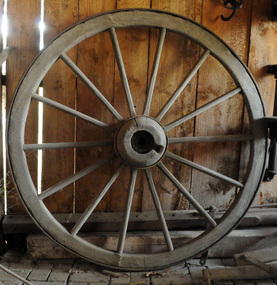
wagon wheel, late 19th century -early 20th century
... wagon transport agriculture wheel...Wagon wheels were required equipment in Australia early days. They were used for transporting goods, commodities, agricultural materials, supplies, and sometimes people. Horse-drawn wagons are an important part of Orbost’s agricultural history. wagon transport agriculture wheel A large wagon wheel with 14 wooden spokes and hub. ...Wagon wheels were required equipment in Australia early days. They were used for transporting goods, commodities, agricultural materials, supplies, and sometimes people. Horse-drawn wagons are an important part of Orbost’s agricultural history. A large wagon wheel with 14 wooden spokes and hub. There are steel bands around the hub.wagon transport agriculture wheel -
 Orbost & District Historical Society
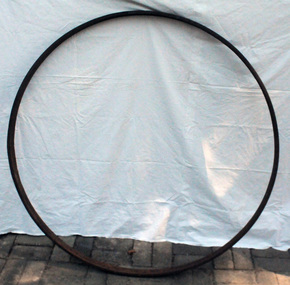
iron wheel rim
... wheel-rim wagon transport agriculture...wagon wheels. The red hot metal rim expands when hot, so it can be fitted to the wagon wheel. Then it contracts to create a tight fit as it cools after being dropped into a tank of water. Horse-drawn wagons are an important part of Orbost’s agricultural history. Light buggies were popular with farmers for trips into town before the common use of motorised vehicles. wheel-rim wagon transport ...This was probably for a light buggy. Heavy farm, and lumber wagons had wider tires. It would have been made by a blacksmith. The blacksmith fitted steel rims onto wooden wagon wheels. The red hot metal rim expands when hot, so it can be fitted to the wagon wheel. Then it contracts to create a tight fit as it cools after being dropped into a tank of water.Horse-drawn wagons are an important part of Orbost’s agricultural history. Light buggies were popular with farmers for trips into town before the common use of motorised vehicles.A large iron rim for a wagon wheel.wheel-rim wagon transport agriculture -
 Orbost & District Historical Society
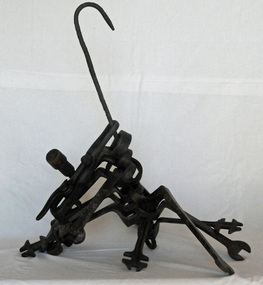
buggy spanners, late 19th century -early 20th century
... wagons are an important part of Australia’s agricultural history. Light buggies were popular with farmers for trips into town before the common use of motorised vehicles. tool wagon-wrench-spanner transport A collection of thirteen iron wheel spanners on an iron hook. ...These were used on a horse-drawn wagons, carriages, stagecoaches, and carts. A wheelwright would use this tool to make or repair the wheels. All sizes of buggy spanners, or wagon wrenches, were needed as wagon wheels were of many different sizes. Horse-drawn wagons are an important part of Australia’s agricultural history. Light buggies were popular with farmers for trips into town before the common use of motorised vehicles.A collection of thirteen iron wheel spanners on an iron hook. One spanner has a wooden handle and is an adjustable spanner.tool wagon-wrench-spanner transport -
 Orbost & District Historical Society
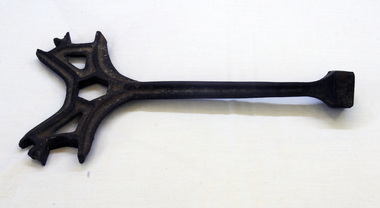
buggy spanner, late 19th century -first half 20th century
... wagons are an important part of Australia’s agricultural history. Light buggies were popular with farmers for trips into town before the common use of motorised vehicles. buggy-spanner tool transport A metal buggy wheel spanner for various applications. buggy spanner ...These were used on a horse-drawn wagons, carriages, stagecoaches, and carts. A wheelwright would use this tool to make or repair the wheels. Horse-drawn wagons are an important part of Australia’s agricultural history. Light buggies were popular with farmers for trips into town before the common use of motorised vehicles.A metal buggy wheel spanner for various applications.buggy-spanner tool transport -
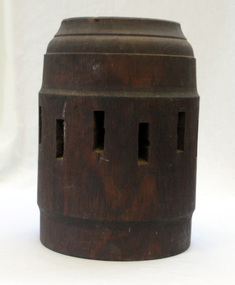 Orbost & District Historical Society
wheel hubs, first half 20th century
... Wagon wheels were required equipment in Australia early days. They were used for transporting goods, commodities, agricultural materials, supplies, and sometimes people. Horse-drawn wagons are an important part of Orbost’s agricultural history. wheel ...Wagon wheels were required equipment in Australia early days. They were used for transporting goods, commodities, agricultural materials, supplies, and sometimes people. Horse-drawn wagons are an important part of Orbost’s agricultural history.Two large solid elm bullock dray wheel hubs. They have a hole through the centre for spokes and have cut out sections at the sides. They are possibly hand-made. 456.1 is lighter coloured.wheel-hubs transport-bullock handcraft carving
