
Showing 633 items matching "walker street"
-
 Stawell Historical Society Inc
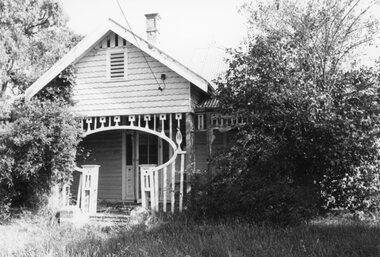
Photograph, Henderson Family's Wooden Home in Walker Street Stawell
... Henderson Family's Wooden Home in Walker Street Stawell...Wooden Home Walker Street (Henderson)...Stawell Historical Society Inc 46 Longfield St Stawell grampians Wooden Home Walker Street (Henderson) Stawell Henderson Family's Wooden Home in Walker Street Stawell Photograph ...Wooden Home Walker Street (Henderson)stawell -
 Stawell Historical Society Inc
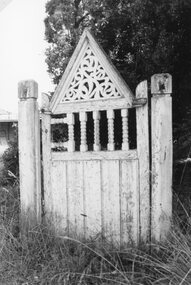
Photograph, Henderson Family's Home's Wooden Gate in Walker Street Stawell
... Henderson Family's Home's Wooden Gate in Walker Street Stawell ...Wooden gate on Home Walker Street (Henderson)...Stawell Historical Society Inc 46 Longfield St Stawell grampians Wooden gate on Home Walker Street (Henderson) Stawell Henderson Family's Home's Wooden Gate in Walker Street Stawell Photograph ...Wooden gate on Home Walker Street (Henderson)stawell -
 Stawell Historical Society Inc
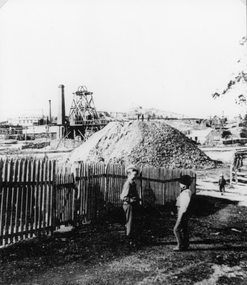
Photograph, Magdala cum Moonlight Mine looking from Walker Street
... Magdala cum Moonlight Mine looking from Walker Street ...Two boys in front of view of mullock heap and mine site with poppet head and smoke stacks in rear of photo. stawell gold mining Mine and waste heap with two boys and fence in foreground Magdala cum Moonlight Mine looking from Walker Street Photograph ...Magdala cum Moonlight Mine. Two boys in front of view of mullock heap and mine site with poppet head and smoke stacks in rear of photo.Mine and waste heap with two boys and fence in foregroundstawell gold mining -
 Flagstaff Hill Maritime Museum and Village
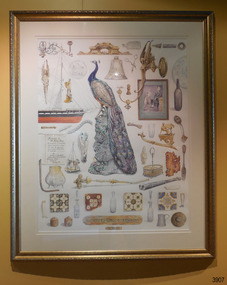
Artwork, other - Framed poster, Tim Walker, Loch Ard Shipwreck, circa 2010
... Walker...Warrnambool & District Artists’ Society...Warrnambool Art Gallery...Poster...Henna Street...Walker...Henna Street Picture Framers...Loch Ard Shipwreck Artwork, other Framed poster Tim Walker Henna Street Picture Framers ...Tim Walker’s work is an eye-catching array of shipwreck artefacts and associated items. They help tell the story of the 19th century ships that travelled across the world full of people and cargo that are now part of our history. The work was commissioned especially for Flagstaff Hill and highlights the famous story of the 1878 ‘Loch Ard’ shipwreck. The images also include two small items from the 1981 ‘Fiji’ shipwreck. Local professional artist Timothy “Tim” Walker was born in Britain in 1970. He was self-taught had the desire to use his talents for full-time work. He specialised in painting local scenes, landscape and people of Warrnambool and district after he moved there in 1990. As he worked at the location of his subjects, people often told him interesting and amusing stories. He soon became involved in the Warrnambool and District Artists’ Society, where he has served for a period as President. In 2010 Warrnambool Art Gallery hosted an exhibition “Nine Lives” with works from nine local artists including Tim Walker. The ‘LOCH ARD’ 1873-1878 - brief history The clipper ship ‘Loch Ard’ was a built in Scotland in 1873. In 1978 the ship was sailing to Melbourne with 54 people on board as well as a mixed cargo of items, some of which were bound for the 1880 International Exhibition in Melbourne. On June 1st 1878 it was very close to its destination when it crashed into Mutton Bird Island, east of Port Campbell. Only two people survived. The wreck was re-discovered in 1967, almost a century later, and the site continues to provide evidence of the range of goods imported into the Colony of Victoria in the post-Gold Rush era. Flagstaff Hill divers in the 1970s reported finds of “Bottles of champagne, window panes, rolls of zinc, barrels of cement, iron rails, clocks, lead shot, corrugated iron, lead, marble, salad oil bottles, ink bottles, copper wire, gin bottles, rolls of carpet, floor tiles, copper rivets, gas light fittings, pocket knives, toys, crystal chandeliers, beer mugs, cutlery, candles sticks, wick scissors, cow bells, and sauce bottles.” The famous Loch Ard Peacock was also on board. The ‘FIJI’ 1875-1891 – brief history The barque ‘Fiji’ was built in Ireland in 1875. The sailing ship left Hamburg in May 1891, bound for Melbourne with a crew of twenty-five plus the captain. The ‘Fiji’ had almost reached her destination after a trip of 100 days at sea when, on September 5th 1891, she struck rock 300 metres from the shore at Moonlight Head, near Cape Otway. Eleven men lost their lives but with the help of locals including members of the Rocket Rescue Crew, the rest of the men were saved. In anticipation of Christmas, the cargo had included a wide variety of children’s toys, amongst which were dolls with china limbs, wooden rocking horses, miniature ships, and red and white rubber balls. There were also cases of dynamite, pig iron, steel goods, spirits, sailcloth, tobacco, fencing wire, concrete, 400 German pianos, concertinas and other musical instruments, artists’ supplies, porcelain, furniture, china and candles. This artwork has historical significance as it shows a small sample of the variety of items on board the late 19th century ships bound for Australia in the Colonial and late God Rush period. The cargo contained personal luggage, items intended as gifts, and goods ordered for domestic, commercial or industrial use. The wreck sites of both vessels, ‘Loch Ard’ and ‘Fiji’ are classified on the Victorian Heritage Register as significant and are now protected by government law. The sites are popular with divers and provide interpretive material regarding social and maritime history. Framed poster of a watercolour painting by Tim Walker, gilt frame, behind glass. Subject is a group of objects, most of which are connected with the 1878 shipwreck Loch Ard, such as items recovered from the shipwreck and the famous ‘Loch Ard Peacock’. Two items are from the wreck of the ‘Fiji’. Inscriptions on ingot, a handwritten letter, bell, clear bottle, and small plaque.On ingot: “PONTIFEX & WOOD. LONDON”. On letter: “Presented to Mr. Thomas Pearce”. On small ingot: “TIM WALKER”. On bell: “LOCH ARD”. On clear bottle “THE SINGER MANUFACTURING COMPANY“. On plaque: TIM WALKER”.warrnambool, flagstaff hill maritime museum, maritime museum, shipwreck coast, flagstaff hill maritime village, great ocean road, flagstaff hill, loch ard, fiji, watercolour, timothy walker, tim walker, warrnambool & district artists’ society, warrnambool art gallery, poster, henna street picture framers, cargo, print -
 Melbourne Tram Museum
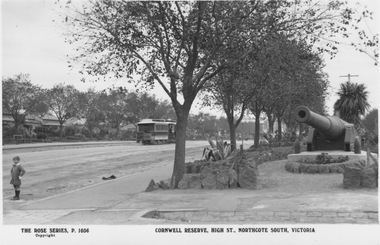
Postcard - Cornwell Reserve, High Street, Northcote South, 1913-1920s
... ...Walker Street...Photograph looks north along High Street from Walker Street with a Northcote line cable tram travelling northward and a large cannon located at right. ...Photograph looks north along High Street from Walker Street with a Northcote line cable tram travelling northward and a large cannon located at right. ...Photograph looks north along High Street from Walker Street with a Northcote line cable tram travelling northward and a large cannon located at right. Two cannons were placed at this point either side of High Street in June 1913 by the Northcote South Ratepayer’s Association. The cannons were originally built in England in 1884/8 5 and installed in Melbourne's South Channel Fort off Sorrento to defend against possible Russian invasion. Cornwell Reserve is now known as High Street Linear Reserve.Yields information about High Street Northcote South Postcard with label below photograph and postcard markings on rear. On front: 'The Rose Series P 1056 Cornwell Reserve, High Street, Northcote South'; on rear: 'Postcard - A real photograph Produced in Australia'high street, northcote, walker street, cable tram, large cannon, south channel fort, cornwell reserve, high street linear reserve. -
 Waverley RSL Sub Branch
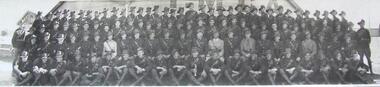
Photograph Seymour 1936 4Div. RAE 2nd and 6th Field Co, H M Walker, Seymour 1936 4Div. RAE 2nd and 6th Field Co, 1936
... Photograph Black and white mounted on a grey cardboard backing bearing the photographers imprint H M Walker 117 Collins Street Melbourne...RAE 2nd and 6th Field Co H M Walker 117 Collins Street Melbourne....RAE 2nd and 6th Field Co H M Walker 117 Collins Street Melbourne. Photograph Black and white mounted on a grey cardboard backing bearing the photographers imprint H M Walker 117 Collins Street Melbourne Seymour 1936 4Div. ...Photograph Black and white mounted on a grey cardboard backing bearing the photographers imprint H M Walker 117 Collins Street MelbourneSeymour 1936 4Div. RAE 2nd and 6th Field Co H M Walker 117 Collins Street Melbourne. -
 Whitehorse Historical Society Inc.
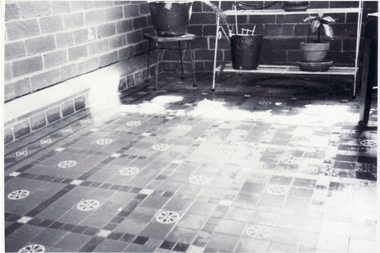
Photograph, Edgar Fredrick Walker Home, 1/09/1976 12:00:00 AM
... walker...edgar frederick...benares street...Black and white photo of porch tiles on Edgar Fredrick Walker home, Benares Street (Walker Estate) Mitcham...Black and white photo of porch tiles on Edgar Fredrick Walker home, Benares Street (Walker Estate) Mitcham Edgar Fredrick Walker Home Photograph Photograph ...Black and white photo of porch tiles on Edgar Fredrick Walker home, Benares Street (Walker Estate) Mitchamwalker estate, walker, edgar frederick, benares street, mitcham, australian tesselated tile co. pty. ltd. -
 Whitehorse Historical Society Inc.
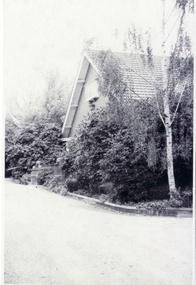
Photograph, Home of Edgar Walker, 1/09/1976 12:00:00 AM
... walker...edgar edwardes...meerut street...Black and white photo of home of Edgar Walker, Meerut Street, Mitcham...Black and white photo of home of Edgar Walker, Meerut Street, Mitcham Home of Edgar Walker Photograph Photograph ...Black and white photo of home of Edgar Walker, Meerut Street, Mitchamwalker, edgar edwardes, meerut street, mitcham, australian tesselated tile co. pty. ltd. -
 Bendigo Historical Society Inc.
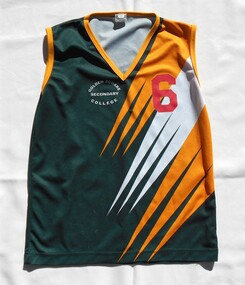
Uniform - GSSC School Sports Singlet
... SPORTS SERVICE 2 WALKER STREET BRAESIDE VICTORIA 3195 03 9580 3511 MADE IN AUSTRAKIA" Tag 2 "Polyester" Washing instructions....SPORTS SERVICE 2 WALKER STREET BRAESIDE VICTORIA 3195 03 9580 3511 MADE IN AUSTRAKIA" Tag 2 "Polyester" Washing instructions. ...Golden Square High School in the city of Bendigo, was established in temporary accommodation at Camp Hill Primary School in central Bendigo in 1960. With the completion of the new school's buildings, it moved to Golden Square in 1962, providing for Forms 1 to 6, now known as years 7 to 12. In 1978 it became a 7–10 school and was one of the original feeder schools to Bendigo Senior High School. In 1986, a Hearing Impaired Unit was established and in 1990 it underwent a name change to become Golden Square Secondary College. The Golden Square Secondary College campus closed on 28 November 2008. It merged with Kangaroo Flat and Flora Hill secondary colleges as part of the implementation of the Bendigo Education Plan. Its buildings were demolished. (Wikipedia https://en.wikipedia.org/wiki/Golden_Square_Secondary_College) This uniform collection belonged to Anna Matthews, daughter of the donor, who attended GSSC as part of the last group enrolled before the school closed in 2008. Golden Square Secondary College dark green sport singlet with with V neck and arm holes with yellow trim. LHS of singlet has tapering diagonal geometric white and yellow stripes. Fabric has self patterned geometric pattern. Size 16. White embroidered letters "Golden Square Secondary College" on RHS and red iron on "6" (10 cm) on LHS. Iron on "6" (20 cm) centre back.White tag 1." SPORTS SERVICE 2 WALKER STREET BRAESIDE VICTORIA 3195 03 9580 3511 MADE IN AUSTRAKIA" Tag 2 "Polyester" Washing instructions.gssc, golden square secondary college, uniform, bendigo education plan., sports singlet -
 Whitehorse Historical Society Inc.
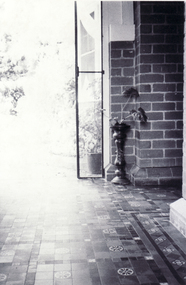
Photograph, Edgar Fredrick Walker Home, 1/09/1976 12:00:00 AM
... walker...edgar frederick...benares street...Black and white photo of porch tiles of Edgar Fredrick Walker home, Benares Street, Mitcham (Walker estate)...Black and white photo of porch tiles of Edgar Fredrick Walker home, Benares Street, Mitcham (Walker estate) Edgar Fredrick Walker Home Photograph Photograph ...Black and white photo of porch tiles of Edgar Fredrick Walker home, Benares Street, Mitcham (Walker estate)walker estate, walker, edgar frederick, benares street, mitcham, australian tesselated tile co. pty. ltd. -
 City of Ballarat Libraries
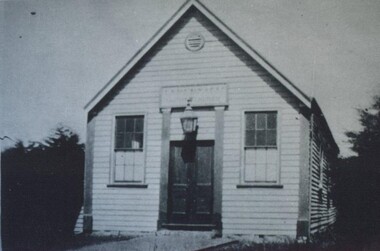
Photograph - Card Box Photographs, Baptist Tabernacle, Sebastopol circa 1925
... The tabernacle was located on the west side of Albert Street between Vickers and Walker Streets. It was demolished in 1930....City of Ballarat Libraries Eureka Centre Eureka Street Ballarat East goldfields The tabernacle was located on the west side of Albert Street between Vickers and Walker Streets. It was demolished in 1930. Baptist Tabernacle Church Building Albert Street Sebastopol Baptist Tabernacle, Sebastopol circa 1925. ...The tabernacle was located on the west side of Albert Street between Vickers and Walker Streets. It was demolished in 1930.baptist tabernacle, church, building, albert street, sebastopol -
 Uniting Church Archives - Synod of Victoria
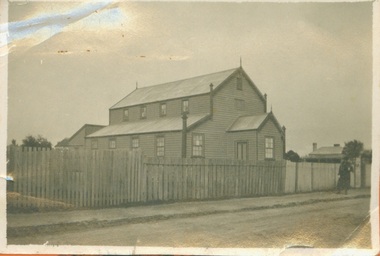
Photograph, Undated c.1900
... The church moved from Albert Street to Walker Street in around 1882....The church moved from Albert Street to Walker Street in around 1882. sebastopol, welsh, congregational, chapel, zion From J.D. ...The "Zion" Welsh Independent Chapel was established in Albert Street Sebastopol in 1861. The church moved from Albert Street to Walker Street in around 1882.B & W exterior photograph of the Zion Congregational Church, Sebastopol.From J.D. Northey to Rev S. M ... (?) Taken around the turn of the century before the hedge was planted.sebastopol, welsh, congregational, chapel, zion -
 Whitehorse Historical Society Inc.
Document, Walker Estate: special character area, 1/05/1999 12:00:00 AM
... ...Walker Estate...Agra Street...Whitehorse Historical Society Inc. 2-10 Deep Creek Road Mitcham melbourne Mitcham Road Mitcham Walker Estate Agra Street Mitcham Benares Street Mitcham Calcutta Street Mitcham Delhi Street. ...Urban character study of the Walker EstateUrban character study of the Walker EstateUrban character study of the Walker Estatemitcham road, mitcham, walker estate, agra street, mitcham, benares street, mitcham, calcutta street, mitcham, delhi street. mitcham, meerut street, mitcham, simla street, mitcham -
 Whitehorse Historical Society Inc.
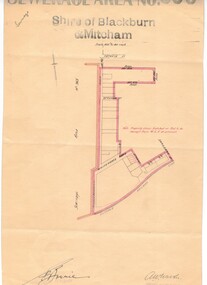
Map, Sewerage area No 966, 1/06/1933 12:00:00 AM
... ...attunga street...walker...Whitehorse Historical Society Inc. 2-10 Deep Creek Road Mitcham melbourne middleborough road blackburn sergeant street stuart street thiele court blackburn north attunga street walker a. w. borrie e. shire of blackburn and mitcham sewerage and sanitation Map of sewerage are no. 965 covering part of North Blackburn. ...Map of sewerage are no. 965 covering part of North Blackburn.Map of sewerage are no. 965 covering part of North Blackburn. Note that Stuart Street is now part of Thiele Court. Map of sewerage are no. 965 covering part of North Blackburn. middleborough road, blackburn, sergeant street, stuart street, thiele court, blackburn north, attunga street, walker, a. w., borrie, e., shire of blackburn and mitcham, sewerage and sanitation -
 Whitehorse Historical Society Inc.
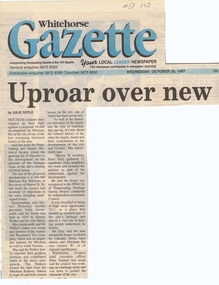
Article, Uproar over new units, 29/10/1997 12:00:00 AM
... ...meerut street...walker...Mitcham residents and the Nunawading and District Historical Society have joined the growing list of objectors to a proposed 16 unit development at the corner of Mitcham Road and Meerut Street on the site of one of the few remaining historical homes in the area. The house was built in 1934 by Stanley and Helen Walker. ...mitcham road mitcham meerut street walker stanley helen arrowsmith valda daly peter seamer Mitcham residents and the Nunawading and District Historical Society Mitcham residents and the Nunawading and District Historical Society have joined the growing list of objectors to a proposed 16 unit development at the corner of Mitcham Road and Meerut Street on the site of one of the few remaining historical homes in the area. ...Mitcham residents and the Nunawading and District Historical SocietyMitcham residents and the Nunawading and District Historical Society have joined the growing list of objectors to a proposed 16 unit development at the corner of Mitcham Road and Meerut Street on the site of one of the few remaining historical homes in the area. The house was built in 1934 by Stanley and Helen Walker. Mr Walker's family was owner and operator of the Australian Tessellated Tile Company, an important industry for Mitcham and Victoria. The house was recognised in the 1994 City of Nunawading Heritage Survey Project and was classified as being of high local significance,Mitcham residents and the Nunawading and District Historical Societymitcham road, mitcham, meerut street, walker, stanley, helen, arrowsmith, valda, daly, peter, seamer -
 Federation University Historical Collection
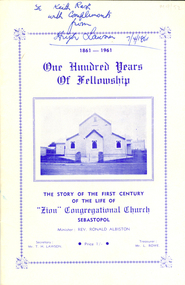
Booklet, Alex. King & sons, Printer, The Story of the First Century of the Life of "Zion" Congregational Church, Sebastopol, 1961, 1961
... The former "Zion" Congregational Church was on the corner of Walker Street and Beverin Street in Sebastopol. ...Barker Library (top floor) Mount Helen goldfields The former "Zion" Congregational Church was on the corner of Walker Street and Beverin Street in Sebastopol. ...The former "Zion" Congregational Church was on the corner of Walker Street and Beverin Street in Sebastopol. Its origins began as 'Zion" Welsh Independent Church in Albert Street, Sebastopol. The Uniting Church in Australia was inaugurated in June 1977, at which time the Sebastopol Methodist Church joined with the Zion Congregational Church on Walker Street, Sebastopol and became Sebastopol Uniting Church. The block to the south of the church was purchased in 1982, the occupying house demolished and the area cleared and later sealed for parking. In 1984 the interior of the church was renovated and plans were drawn up for further additions and alterations to the Sunday school, which were carried out in 1989, adding a kitchen and toilet built by Jeff Menhennett & SonsWhite soft covered booklet of 20 pages with blue printing. Written in biro on front cover "To Keith Rash with compliments from Hugh Lawson 7/4/1961"zion congregational church, sebastopol, carmel welsh church, zion hall, hugh lawson, sebastopol unitng church -
Whitehorse Historical Society Inc.
Newspaper - Article, Residents fear for streetscape, 28/09/1994
... Street...Mitcham...Walker...'Residents fear for streetscape' ' Mitcham Mansion,' (Walker home), Meerut Street, Mitcham, land subdivision opposite....Whitehorse Historical Society Inc. 2-10 Deep Creek Road Mitcham melbourne Meerut Street Mitcham Walker Edgar Edwardes Australian Tesselated Tile Co Pty Ltd Barelli Ken Land Subdivision 'Residents fear for streetscape' ' Mitcham Mansion,' (Walker home), Meerut Street, Mitcham, land subdivision opposite. ...'Residents fear for streetscape' ' Mitcham Mansion,' (Walker home), Meerut Street, Mitcham, land subdivision opposite.meerut street, mitcham, walker, edgar edwardes, australian tesselated tile co pty ltd, barelli, ken, land subdivision -
 Whitehorse Historical Society Inc.
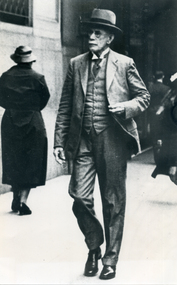
Photograph, Walker, Edgar Edwardes
... Black and white photograph of Edgar Edwardes Walker in Pitt Street, Sydney in 1936 See also ND22...Then in 1922 he bought the company which he ran until he was 73 years old. walker edgar edwardes australian tesselated tile co. pty. ltd Black and white photograph of Edgar Edwardes Walker in Pitt Street, Sydney in 1936 See also ND22 Walker, Edgar Edwardes Photograph Photograph ...Edgar Edwardes Walker was the first manager of the Australia Tesselated Tile Factory. Then in 1922 he bought the company which he ran until he was 73 years old.Black and white photograph of Edgar Edwardes Walker in Pitt Street, Sydney in 1936 See also ND22walker, edgar edwardes, australian tesselated tile co. pty. ltd -
 Whitehorse Historical Society Inc.
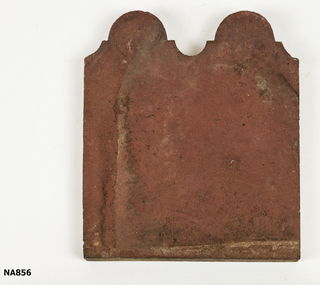
Ceramic - Tile
... Tile came from home of Stanley Walker, Benares Street, Mitcham. Stanley was son of E.E.Walker. ...Whitehorse Historical Society Inc. 2-10 Deep Creek Road Mitcham melbourne Tile came from home of Stanley Walker, Benares Street, Mitcham. Stanley was son of E.E.Walker. ...Tile came from home of Stanley Walker, Benares Street, Mitcham. Stanley was son of E.E.Walker. Prop of Australian Tesselated Tile Co.Terra cotta tile used for garden edge.ceramics, terracotta -
 Whitehorse Historical Society Inc.
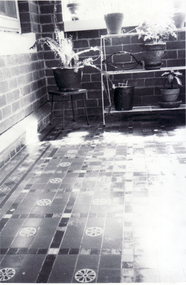
Photograph, Edgar Fredrick Walker Home, 1/09/1976 12:00:00 AM
... walker...edgar edwardes...edgar frederick...benares street...Black and white photo of porch tiles of Edgar Fredrick Walker home in Benares Street, Mitcham (Walker Estate) at what is now the home of Dr. ...Black and white photo of porch tiles of Edgar Fredrick Walker home in Benares Street, Mitcham (Walker Estate) at what is now the home of Dr. ...Black and white photo of porch tiles of Edgar Fredrick Walker home in Benares Street, Mitcham (Walker Estate) at what is now the home of Dr. Inches. These tiles were inspired by visit to India made by E.E. Walkerwalker estate, walker, edgar edwardes, edgar frederick, benares street mitcham, inches, dr., australian tesselated tile co. pty. ltd. -
 Bendigo Historical Society Inc.
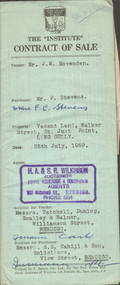
Document - H.A & S.R. WILKINSON COLLECTION: CONTRACT OF SALE
... For vacant land, Walker Street, St. Just Point, Long Gully, being part of Crown allotment 429, section A at St. ...For vacant land, Walker Street, St. Just Point, Long Gully, being part of Crown allotment 429, section A at St. ...This business was owned by father and son, Henry Archibald Wilkinson and Samuel Ronald "Ron" Wilkinson. Henry (1882-1954) was born in Shepparton and died in Bendigo. He was married to Grace Hovendon in 1908. Samuel Ronald "Ron" (1914-1995), Henry's son, was married to Florence Jean McKerlie in 1937.Contract of sale dated 25th July, 1959 between Mr. J.M. Hovendon (seller) and Mr. P. & Mrs. F.E. Stevens (buyer). Solicitor for vendor: Messrs. Tatchell, Dunlop, Smalley & Balmer, Williamson Street, Bendigo. Solicitor for purchaser: Messrs. E.S. Cahill & Son, View Street, Bendigo. For vacant land, Walker Street, St. Just Point, Long Gully, being part of Crown allotment 429, section A at St. Just Point, Parish of Sandhurst, County of Bendigo land described in certificate of title volume 8046 folio 521. Price 180 pounds.organization, business, h.a. & s.r wilkinson real estate -
 Flagstaff Hill Maritime Museum and Village
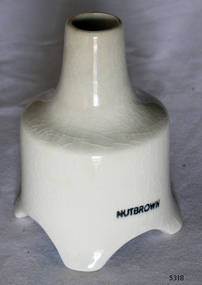
Domestic object - Pie funnel, Thomas M Nutbrown, 1932 to 1940
... Thomas M Nutbrown started manufacturing kitchenware in 1927 from his factory on Walker Street, Blackpool. He registered the company in 1932 and over the following years his company was exporting goods all over the world. ...Thomas M Nutbrown started manufacturing kitchenware in 1927 from his factory on Walker Street, Blackpool. He registered the company in 1932 and over the following years his company was exporting goods all over the world. ...A pie funnel is a hollow ceramic tool that bakers place in the center of pies to prevent bubbling over. They can also be called pie vents, because that hollow core allows steam to escape during baking. Thomas M Nutbrown started manufacturing kitchenware in 1927 from his factory on Walker Street, Blackpool. He registered the company in 1932 and over the following years his company was exporting goods all over the world. His company pioneered many unseen kitchen gadgets and utensils onto the market and had many products patented. Today Nutbrown continues original techniques and craftsmanship to produce kitchenware that give its products a distinctive character.A kitchen item that in the 1930s was a unique addition to any housewives kitchen from a UK company that is still producing these types of products today. Pie Funnel, ceramic white glaze, "Nutbrown" printed on side.flagstaff hill, warrnambool, shipwrecked-coast, flagstaff-hill-maritime-museum, shipwreck-coast, flagstaff-hill-maritime-village, pie funnel, porcelain pie funnel, baking utensil, cooking equipment, kitchenware, nutbrown pie funnel, nutbrown -
 Wodonga & District Historical Society Inc
Functional object - Ceramic pie Funnel, Thomas M. Nutbrown, c1930
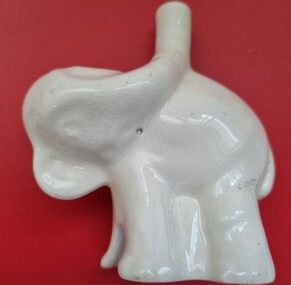
... This pie funnel was produced by Thomas M Nutbrown who started manufacturing kitchenware in 1927 from his factory on Walker Street, Blackpool. He registered the company in 1932 and over the following years his company was exporting goods all over the world. ...This pie funnel was produced by Thomas M Nutbrown who started manufacturing kitchenware in 1927 from his factory on Walker Street, Blackpool. He registered the company in 1932 and over the following years his company was exporting goods all over the world. ...A ceramic pie funnel was a hollow ceramic tool that bakers and home cooks placed in the centre of pies to prevent the contents bubbling over. The hollow core allowed steam to escape during baking leaving the pie crust as light and flaky inside as on the surface. They came in a variety of shapes and sizes. This pie funnel was produced by Thomas M Nutbrown who started manufacturing kitchenware in 1927 from his factory on Walker Street, Blackpool. He registered the company in 1932 and over the following years his company was exporting goods all over the world. His company pioneered many unseen kitchen gadgets and utensils onto the market and had many products patented. The company closed in 1988.This item was typical of kitchenware used widely in the early twentieth century when a broader range of food items were home cooked.A ceramic pie funnel in the shape of an elephant. This is marked “NUTBROWN PIE FUNNEL Made in England” and was made by a company called Thomas M. Nutbrown Ltd of Blackpool. It also has a registered design number which is a little indistinct but is probably No 860928. It dates from the 1930’s and is in very good condition.On side of elephant in black ink "NUTBROWN/ PIE FUNNEL/ Made in England/ Reg. No 860928"domestic appliances, pie funnel, kitchenware early 20th century -
 Ballarat Tramway Museum
Photograph - Black & White Photograph/s, mid 1940s
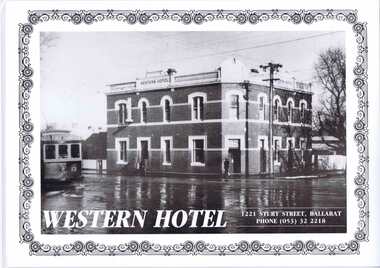
... Street scene highlights Western Hotel on a wet afternoon, by clothing on street walkers & bare branched trees, late Autumn to early spring. ...Street scene highlights Western Hotel on a wet afternoon, by clothing on street walkers & bare branched trees, late Autumn to early spring. ...Yields information and history of the Western Hotel through photographs, in the form of a laminated table mat.Plastic placement with a reproduction of a Post War II(?1946 colour scheme),of tram No.13 turning into Ripon Street North travelling to View Point. Street scene highlights Western Hotel on a wet afternoon, by clothing on street walkers & bare branched trees, late Autumn to early spring. Reverse of side of plastic placemat portrays Western Hotel in Victorian Centenary year of 1938. Images rescanned 29/10/2013.trams, tramways, ballarat trams, secv, sturt st -
 Ringwood and District Historical Society
Flyer, Land Sale Brochure, Glamis Park Estate (Wantirna, Vic.) - 1959
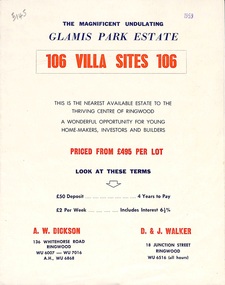
... Subdivision includes Wantirna streets - Wantirna Road, Carnarvon Avenue, Inchcape Avenue, St Thomas Avenue, St Davids Drive, Dudley Avenue, Angus Avenue. Agents - A.W. Dickson, 136 Whitehorse Road, Ringwood, Telephone WU 6007, WU 7016, A.H. WU 6868. D. & J. Walker...Subdivision includes Wantirna streets - Wantirna Road, Carnarvon Avenue, Inchcape Avenue, St Thomas Avenue, St Davids Drive, Dudley Avenue, Angus Avenue. Agents - A.W. Dickson, 136 Whitehorse Road, Ringwood, Telephone WU 6007, WU 7016, A.H. WU 6868. D. & J. Walker ...Street name Carnarvon Avenue on the subdivision plan became Selkirk Avenue at some stage during or subsequent to development of the Estate.Bi-folded advertisement for sale of residential allotments, including summary of subdivision features and local facilities.Subdivision includes Wantirna streets - Wantirna Road, Carnarvon Avenue, Inchcape Avenue, St Thomas Avenue, St Davids Drive, Dudley Avenue, Angus Avenue. Agents - A.W. Dickson, 136 Whitehorse Road, Ringwood, Telephone WU 6007, WU 7016, A.H. WU 6868. D. & J. Walker, 18 Junction Street, Ringwood, Telephone WU 6516 (all hours). -
 Eltham District Historical Society Inc
Photograph, Peter Pidgeon, Heritage Excursion: Mud Brick Meander, 6 March 2021
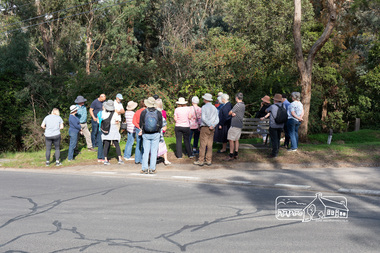
... Corner of Diamond Street and Peter Street, Eltham. Walkers gather for the beginning of the walk led by local historian Russell Yeoman. ...Eltham District Historical Society Inc 728 Main Rd Eltham melbourne Corner of Diamond Street and Peter Street, Eltham. Walkers gather for the beginning of the walk led by local historian Russell Yeoman. ...Corner of Diamond Street and Peter Street, Eltham. Walkers gather for the beginning of the walk led by local historian Russell Yeoman. The tree-covered hill that forms the western backdrop to the Eltham town centre exhibits many characteristics that are considered to contribute to the special character of Eltham. They include unmade streets, steeply sloping land, extensive tree cover and a large number of mud brick and pise (rammed earth) houses. A number of these were constructed in the 1940s and 50s by well-known builders John Harcourt and Alistair Knox. A significant proportion from this period were constructed by owner-builders. We walked around the upper part of the hill in the area of Kerrie Crescent and Peter Street. We visited several interesting houses (for external viewing only). The walk commenced at 2pm at the corner of Diamond Street and Peter Street (Melway ref 21H4) and was about 2 km. This free walk was open to the general public as well as Society members. Whilst COVID restrictions did not require the wearing of masks in the open, masks had to be carried and all attendees registered with name and contact number or via QR registration.Born Digital (8 images)covid-19, eltham, eltham district historical society, heritage excursion, mudbrick, peter street, diamond street, russell yeoman -
 Flagstaff Hill Maritime Museum and Village
Ship Log, 1900-1920
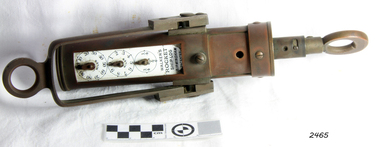
... Thomas Walker first went into business to manufacture stoves at 58 Oxford Street Birmingham. ...Thomas Walker first went into business to manufacture stoves at 58 Oxford Street Birmingham. ...Thomas Walker & Son was internationally renowned in the manufacturing of ships logs. Founding father Thomas Walker (1805–1871), an engineer in Birmingham, patented a mechanical log in 1878 which was a recording instrument that attached to a rail at the stern of a vessel connected by a long cord with a rotor which was towed behind the ship. The instrument dial recorded the distance travelled. Thomas Walker first went into business to manufacture stoves at 58 Oxford Street Birmingham. Walker’s self-feeding stove was widely lauded at the Paris Exhibition of 1855, winning a prize medal and kick starting the first of many notable innovations for the Walker family's manufacturing business. However, it wasn’t until working on an earlier ships log model invented by his Uncle that Thomas Walker became interested in the further development of this device, used to ascertain a ship’s speed. Walker continued to improve on the common log for the company of Massey & Sons and these improvements were deemed revolutionary. This log became a firm favourite of the West India Association (British-based organisation promoting ties and trade with the British Caribbean) and the most common log in use for two generations. It took till 1861 for Thomas Walker and his son, Thomas Ferdinand Walker (1831-1921) to patent the first Walker log of many. Together, with the introduction of the A1 Harpoon Log two years later, they established the Walker Log Business as a force to be reckoned with. By the time of his passing in 1871, Thomas Walker Snr had not only founded a family business with considerable staying power but also instilled a tradition of public service. Having sat as a representative on the Birmingham Town Council for 15 years and played an active role in public works, he was soon given the nickname of ‘Blue Brick Walker’. Much like his father, Thomas Ferdinand Walker changed the face of the maritime industry. His patent of 1897, the ‘Cherub’ log, was a notable departure from the past providing a far more accurate reading and replacing the majority of logs of the age. They were the first to produce an electric log and the Walker factory was one of the first to introduce the 48 hour work week for employees. This ship log was invented and made by a significant marine instrument maker and innovator of machinery. It demonstrates the huge leap taken to improve navigational accuracy at sea with an instrument that was in use for decades. Ship Log, three analogue dials calibrated in increments of Miles, the Rocket Log is a nautical instrument for measuring a vessel’s speed and distance traveled. The floating log was drawn behind the ship over a fixed time period in order to measure the distance traveled. The counter could measure enough miles to cover the maximum distance traveled by a ship in one day. The log has two distinct parts; a brass register, made by Walker, showing the distance recorded and the rotator made by Reynolds, that spins in the water driving the counter. both parts are connected by a linked chain. The register has a cylindrical brass body approx 4.5 cm diameter containing registering mechanism with hardened steel bearings. Distance is indicated by the three pointers on enamel plate as follows: graduated every 10 miles from 0-100; every mile from 1-10; every 1/4 mile from 1/4 -1. A brass sling and eye secured to the body enables it to be attached to the taffrail. The original rotator would have had a cylindrical tapered wooden body, approx 4.5 cm in diameter with three metal alloy fins or could be all made from brass. A towing eye is fitted to the tapered end. The two pieces of apparatus are connected by a length of linked chain, length 22.9 cm."Walkers Rocket Ship-Log Birmingham (Patented)" printed on face-plate. "Made by Thomas Walker".flagstaff hill, warrnambool, shipwrecked-coast, flagstaff-hill, flagstaff-hill-maritime-museum, maritime-museum, shipwreck-coast, flagstaff-hill-maritime-village, ship log, rocket log, mechanical ship log, measuring instrument, marine instrument, nautical instrument, speed recording instrument, ship log register, walker ship log, walkers rocket ship-log, thomas walker, thomas walker & son, thomas ferdinand walker, walker log business, reynolds ship log rotor, taffrail log, taff rail log, west india association -
 Flagstaff Hill Maritime Museum and Village
Ship Log Rotor, 1930s
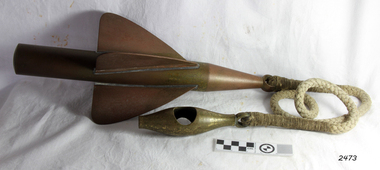
... Thomas Walker first went into business to manufacture stoves at 58 Oxford Street Birmingham. ...Thomas Walker first went into business to manufacture stoves at 58 Oxford Street Birmingham. ...Thomas Walker & Son was internationally renowned in the manufacturing of ships logs, founding father, Thomas Walker (1805–1871), an engineer in Birmingham, patented a mechanical log in 1878 which was a recording instrument that attached to a rail at the stern of a vessel connected by a long cord with a rotor which was towed behind the ship. The instrument dial recorded the distance travelled. Thomas Walker first went into business to manufacture stoves at 58 Oxford Street Birmingham. Walker’s self-feeding stove was widely lauded at the Paris Exhibition of 1855, winning a prize medal and kick starting the first of many notable innovations for the Walker family's manufacturing business. However, it wasn’t until working on an earlier ships log model invented by his Uncle that Thomas Walker became interested in the further development of this device, used to ascertain a ship’s speed. Walker continued to improve on the common log for the company of Massey & Sons and these improvements were deemed revolutionary. This log became a firm favourite of the West India Association (British-based organisation promoting ties and trade with the British Caribbean). and the most common log in use for two generations. It took till 1861 for Thomas Walker and his son, Thomas Ferdinand Walker (1831-1921) to patent the first Walker log of many. Together, with the introduction of the A1 Harpoon Log two years later, they established the Walker Log Business as a force to be reckoned with. By the time of his passing in 1871, Thomas Walker Snr had not only founded a family business with considerable staying power but also instilled a tradition of public service. Having sat as a representative on the Birmingham Town Council for 15 years and played an active role in public works, he was soon given the nickname of ‘Blue Brick Walker’. Much like his father, Thomas Ferdinand Walker changed the face of the maritime industry. His patent of 1897, the ‘Cherub’ log, was a notable departure from the past providing a far more accurate reading and replacing the majority of logs of the age. They were the first to produce an electric log and the Walker factory was one of the first to introduce the 48 hour work week for employees. This ship log rotor was invented and made by a significant marine instrument maker and innovator of machinery. It demonstrates the huge leap taken to improve navigational accuracy at sea with an instrument that was in use for decades and still is today. Therefore it is a worthy addition to the Flagstaff Maritime collection as it demonstrates another aspect of maritime navigation.A Walkers Cherub III Patent mechanical ship brass rotor with with four vane's one marked with an anchor and "T. W. Cherub 441", The log is attached to a brass swivel with a short length of rope. Has T W Cherub 441 marked on a vane.flagstaff hill, warrnambool, shipwrecked-coast, flagstaff-hill, flagstaff-hill-maritime-museum, maritime-museum, shipwreck-coast, flagstaff-hill-maritime-village, log rotor, taffrail log, thomas walker, marine technology, marine instrument, navigation, ship speed, measurment -
 Flagstaff Hill Maritime Museum and Village
Instrument - Ship Log, Early 20th Century
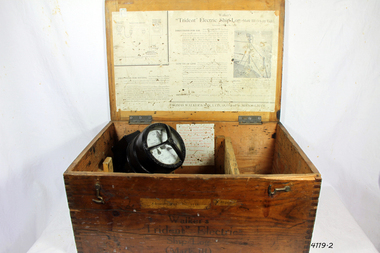
... Thomas Walker first went into business to manufacture stoves at 58 Oxford Street Birmingham. ...Thomas Walker first went into business to manufacture stoves at 58 Oxford Street Birmingham. ...In times past the only way to measure a ship’s speed was to throw a wood log into the water and observe how fast it moved away from the ship. In the 16th century, the log was fastened to a rope knotted at set intervals. The log was thrown over the stern (back) of the vessel and a crew member counted the number of knots that were paid out in a set time. From this, they could estimate the vessel's speed through the water. This was known as streaming the log and is also the derivation of the knot as a measurement of nautical speed. Various manufacturers of nautical equipment had sought over the years to perfect the operation of determining a ship's speed and it wasn't until Thomas Walker and his son Ferdinand developed a mechanical system that eventually made this task became easy for marine navigators. Thomas Walker & Son were internationally renowned in the manufacturing of ship logs the founding father, Thomas Walker (1805–1871), an engineer in Birmingham, patented his mechanical log in 1878 which was a recording instrument that attached to a rail at the stern of a vessel connected by a long cord with a rotor which was towed behind the ship. The instrument dial then recorded the distance travelled. Thomas Walker first went into business to manufacture stoves at 58 Oxford Street Birmingham. Walker’s self-feeding stove was widely lauded at the Paris Exhibition of 1855, winning a prize medal and kickstarting the first of many notable innovations for the Walker family's manufacturing business. However, it wasn’t until working on an earlier ship’s log model invented by his Uncle that Thomas Walker became interested in the further development of this device, used to ascertain a ship’s speed. Walker continued to improve on the common log for the company of Massey & Sons and these improvements were deemed revolutionary. This log became a firm favourite of the West India Association (a British-based organisation promoting ties and trade with the British Caribbean), being the most common log in use for two generations. It took until 1861 for Thomas Walker and his son, Thomas Ferdinand Walker (1831-1921) to patent the first Walker log of many. Together, with the introduction of the A1 Harpoon Log two years later, they established the Walker Log Business as a force to be reckoned with. By his passing in 1871, Thomas Walker Snr had not only founded a family business with considerable staying power but also instilled a tradition of public service. Having sat as a representative on the Birmingham Town Council for 15 years and played an active role in public works, he was soon given the nickname of ‘Blue Brick Walker’. Much like his father, Thomas Ferdinand Walker changed the face of the maritime industry. His patent of 1897, the ‘Cherub’ log, was a notable departure from the past providing a far more accurate reading and replacing the majority of logs of the age. They were the first to produce an electric log (Trident) and the Walker factory was one of the first to introduce the 48-hour work week for employees.The ship log was invented and made by a significant marine instrument maker and innovator of machinery. It demonstrates the huge leap taken to improve navigational accuracy at sea with an instrument that was in use for decades.Ships Log, Walker Trident electric motor, in wooden box with instructions inside box. The motor dial with electric cord is still inside box.Inscription "Admiralty patent number 3332" and "Walker Trident Electric Ship Log (Mark III), 15-25 volt". On top of lid, hand written, is "G TAYLOR"flagstaff hill, warrnambool, shipwrecked-coast, flagstaff-hill, flagstaff-hill-maritime-museum, maritime-museum, shipwreck-coast, flagstaff-hill-maritime-village, ships log, thomas walker & son, electric ships log, marine navigation, thomas ferdinand walker, ship log -
 Flagstaff Hill Maritime Museum and Village
Ship Log, 1900-1920
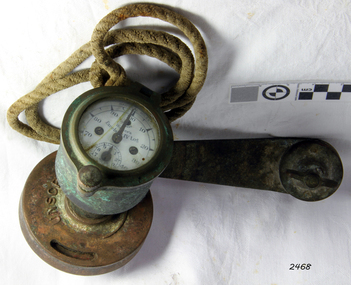
... Thomas Walker first went into business to manufacture stoves at 58 Oxford Street Birmingham. ...Thomas Walker first went into business to manufacture stoves at 58 Oxford Street Birmingham. ...The Excelsior IV Log is a nautical instrument for measuring a vessel’s speed and distance travelled. When navigating a ship it is essential to be able to estimate the boat’s speed and distance travelled to determine its position at sea. In times past the only way to measure a ship’s speed was to throw a wood log into the water and observe how fast it moved away from the ship. In the 16th century, the log was fastened to a rope knotted at set intervals. The log was thrown over the stern (back) of the vessel and a crew member counted the number of knots that were paid out in a set time. From this, they could estimate the speed of the vessel through the water. This was known as streaming the log and is also the derivation of the knot as a measurement of nautical speed. The Walker’s Excelsior Mark IV instrument was designed for smaller vessels, such as yachts, launches and fishing vessels. Historical: Thomas Walker & Son was internationally renowned in the manufacturing of ships logs, founding father , Thomas Walker (1805–1871), an engineer in Birmingham, patented a mechanical log in 1878 which was a recording instrument that attached to a rail at the stern of a vessel connected by a long cord with a rotor which was towed behind the ship. The instrument dial recorded the distance travelled. Thomas Walker first went into business to manufacture stoves at 58 Oxford Street Birmingham. Walker’s self-feeding stove was widely lauded at the Paris Exhibition of 1855, winning a prize medal and kick starting the first of many notable innovations for the Walker family's manufacturing business. However, it wasn’t until working on an earlier ship’s log model invented by his Uncle that Thomas Walker became interested in the further development of this device, used to ascertain a ship’s speed. Walker continued to improve on the common log for the company of Massey & Sons and these improvements were deemed revolutionary. This log became a firm favourite of the West India Association (British-based organisation promoting ties and trade with the British Caribbean), being the most common log in use for two generations. It took until 1861 for Thomas Walker and his son, Thomas Ferdinand Walker (1831-1921) to patent the first Walker log of many. Together, with the introduction of the A1 Harpoon Log two years later, they established the Walker Log Business as a force to be reckoned with. By the time of his passing in 1871, Thomas Walker Snr had not only founded a family business with considerable staying power but also instilled a tradition of public service. Having sat as a representative on the Birmingham Town Council for 15 years and played an active role in public works, he was soon given the nickname of ‘Blue Brick Walker’. Much like his father, Thomas Ferdinand Walker changed the face of the maritime industry. His patent of 1897, the ‘Cherub’ log, was a notable departure from the past providing a far more accurate reading and replacing the majority of logs of the age. They were the first to produce an electric log and the Walker factory was one of the first to introduce the 48 hour work week for employees. The ship log was invented and made by a significant marine instrument maker and innovator of machinery. It demonstrates the huge leap taken to improve navigational accuracy at sea with an instrument that was in use for decades.Ship's Taff Rail Log, rope attached. Walker's Excelsior IV Log model. Nautical miles dials: units and 10's. "Walker's Excelsior IV Log", "Made in England by Thomas Walker, Birmingham"flagstaff hill, warrnambool, shipwrecked-coast, flagstaff-hill, flagstaff-hill-maritime-museum, maritime-museum, shipwreck-coast, flagstaff-hill-maritime-village, log register, taff rail log, taffrail log, marine navigation, a1 harpoon log, cherub’ log, walker’s excelsior mark iv log, ship’s log instrument, mechanical ship’s log, measure ship’s speed, nautical instrument, navigation instrument, massey & sons, thomas walker, blue brick walker, thomas walker & son, thomas ferdinand walker, 48 hour work week
