
Showing 78 items matching "wall telephone"
-
 Numurkah & District Historical Society
Equipment - Wall Telephone
... Wall Telephone...Wall telephone...Wooden Wall telephone with hand piece on the left side, bell at the top and all resting on wood (1907?)...Equipment Wall Telephone ...Installed at Nathalia 1938 at 137 (Niell) and later at Cobbledick's (1953)Wooden Wall telephone with hand piece on the left side, bell at the top and all resting on wood (1907?)Manufacturer's sticker inside phonewall telephone, phone, nathalia -
 Department of Energy, Environment and Climate Action
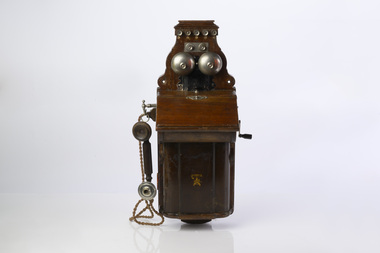
Ericsson 'Commonwealth' wall telephone Model AB535
... Ericsson 'Commonwealth' wall telephone Model AB535...The Commonwealth Ericsson Wall Telephone was adopted in 1901 by the Post Master General as the standard magneto telephone throughout Australia. ...Vintage wall telephone The case originally housed two No6 dry-cell batteries to power the speaker (early models used a pair of Leclanche-like wet-cell batteries - the drawing from 1911 indicates that wet-cell batteries were still in use at that time). ...The Commonwealth Ericsson Wall Telephone was adopted in 1901 by the Post Master General as the standard magneto telephone throughout Australia. ...The Commonwealth Ericsson Wall Telephone was adopted in 1901 by the Post Master General as the standard magneto telephone throughout Australia. It was designated by the Australian Post Office as: "Telephone No.1 - Magneto Wall, Commonwealth Type" The No1 was widely used in country areas and new installations of this type continued throughout the 1920s. Although classified as obsolete in 1951, several were still in service in country areas into the mid-1960s before the phone systems were fully automated. The phone was originally connected to a 'party' line (several connections to a common wire), and the winder was turned in various combinations of long and short turns (being the codes unique to each individual connection) to alert the other party of an incoming call. Anyone could listen in on a party line, although courtesy prevented it occurring most of the time. Central telephone exchanges rendered the party line obsolete. Vintage wall telephone The case originally housed two No6 dry-cell batteries to power the speaker (early models used a pair of Leclanche-like wet-cell batteries - the drawing from 1911 indicates that wet-cell batteries were still in use at that time). Batteries became obsolete when the phone was connected to a central exchange. A plastic speaker horn was fitted in 2025 - the original was missing on front - L M ERICSSON & Co STOCKHOLM inside - serial number: 496018 H 5 (this serial number identifies the phone as being manufactured in 1904) inside - slip of paper identifies date of manufacture as 1904 inside aftermarket writing - F.W.31forests commission victoria (fcv), communications -
 Warrnambool and District Historical Society Inc.
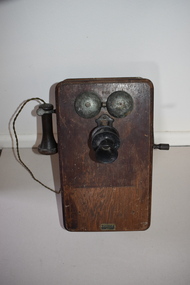
Wall Telephone, Early 20th century
... Wall Telephone...The wall telephone, powered by dry cells, was an invention of the late 1870s. ...This telephone piece is contained within a brown wooden box with a back board that has curved edges and extends over the edges of the box. On the back there are three metal screws for attaching the box to a wall or door. ...The wall telephone, powered by dry cells, was an invention of the late 1870s. ...Magneto wall telephones such as this one were commonly in use in Australia around the end of the 19th century and the beginning of the 20th century. The wall telephone, powered by dry cells, was an invention of the late 1870s. In the first half of the 20th century many old wall telephones were restored and put back in use by the Australian P.M.G. when there was a shortage of telephones in the 1930s Depression and during World War Two. This item, a reminder of the days of early technology, has no known local provenance but is retained for display and research purposes.This telephone piece is contained within a brown wooden box with a back board that has curved edges and extends over the edges of the box. On the back there are three metal screws for attaching the box to a wall or door. The front section of the box has curved edges with an inset panel around the edges. There is a metal turning handle on one side of the box and on the other side there is a metal clip holding a hearing piece attached to the box by a cord. On the front of the box is a speaking piece attached to the box by a metal piece. Attached to the front of the box are two semi-circular ringing pieces now situated some centimetres out from the box. The box was originally varnished but the edges are now rubbed and there are some splotches of paint. vintage wall telephones, history of warrnambool, magneto wall telephones -
 Kiewa Valley Historical Society
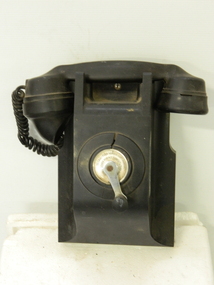
Telephone - Wall Mounted
... Telephone - Wall Mounted...wall mounted telephone; state electricity commission of victoria; kiewa hydro electric scheme; telecommunications; switchboard...Telephones were mounted on the wall and were operated by turning a small handle situated in the middle of the phone. ...Black bakelite wall mounted telephone with handset connected by black spiral plastic cord. ...Also refer to article in "This Week" Newsletter 30th June 2023 and attached to KVHS 0050 wall mounted telephone; state electricity commission of victoria; kiewa hydro electric scheme; telecommunications; switchboard On white circle in centre of dial: "To call turn handle and lift hand set. / When finished replace handset and turn handle" Handset embossed on inner side: 164 55 Black bakelite wall mounted telephone with handset connected by black spiral plastic cord. ...Telephones were mounted on the wall and were operated by turning a small handle situated in the middle of the phone. This connected the speaker to the switch board where they were 'put through' to the other end (speaker).Wall phones were used by State Electricity Commission of Victoria workers and their families on the Kiewa Hydro Electric Scheme. The SECV had a switchboard located at Mt Beauty. Also refer to article in "This Week" Newsletter 30th June 2023 and attached to KVHS 0050Black bakelite wall mounted telephone with handset connected by black spiral plastic cord. The round dial in the centre has a small handle with knob for turning. The base is silver steel with screws to attach it to the wall. The handset has a circular end with 4 small holes for the ear and the other end, the speaker end has 3 rings of small holes and a curved protective mouth piece to direct speech into the holes.On white circle in centre of dial: "To call turn handle and lift hand set. / When finished replace handset and turn handle" Handset embossed on inner side: 164 55wall mounted telephone; state electricity commission of victoria; kiewa hydro electric scheme; telecommunications; switchboard -
 Kiewa Valley Historical Society
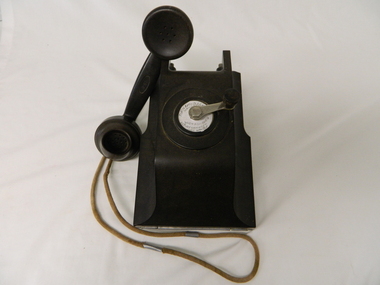
Telephone - Wall Mounted 184, Circa mid 1900s
... Telephone - Wall Mounted 184......wall telephone...This Australian Post Office 184 black coloured bakelite wall mounted phone was initially developed by Ericsson Telephones Ltd Britain. ...The hand piece (large ear and voice receptors)is placed vertically above the dial up winder. Telephone - Wall Mounted 184 Ericsson Telephones Ltd ...This handset appeared via Australia Post Office and was to some degree manufactured in Britain just prior to 1939. During and after World War II these handsets were made in Australia. The handset belonged to the SEC Victoria and later the Kiewa Hydro Electricity Scheme. As this unit has a winder arm (to notify the switchboard) it would have resided in a workshop/machine shop and not in an office. The durability of the bakelite covering gave good protection in any environment. In years later the bakelite came in colours. This type of handset being able to endure rough handling was ideal for the surroundings of the alpine terrain. It would have been at the various outside outposts or foreman posts as swift communications was essential and communications with all sectors of work in the Hydro Electricity Scheme was mandatory, not only for safety reasons but also for efficient operational day to day progress. Also refer to article in "This Week" Newsletter 30th June 2023. Article attached to paper copy.This Australian Post Office 184 black coloured bakelite wall mounted phone was initially developed by Ericsson Telephones Ltd Britain. It was used by the SEC Office based at Mount Beauty and therefore has a winder (for power and notification to the switchboard. The hand piece (large ear and voice receptors)is placed vertically above the dial up winder.On the winder plate in hand writing is" turn handle lift handset" and below the handle "when finished replace handset turn handle"sec communications, wall telephone, internal communications kiewa hydro electricity scheme -
 Whitehorse Historical Society Inc.
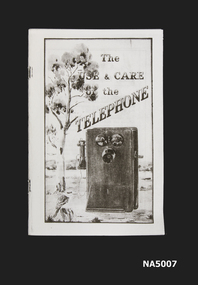
Booklet - Instruction Booklet
... Wall Telephone in Museum...(Photocopied) instruction manual for wall telephone....Wall Telephone in Museum (Photocopied) instruction manual for wall telephone. ...(Photocopied) instruction manual for wall telephone.wall telephone in museum -
 Ballarat Heritage Services
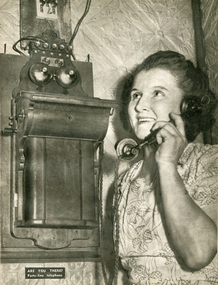
Image - Black and White, Woman on a party-line wall telephone, c1950, c1950
... Woman on a party-line wall telephone, c1950...Woman on a party-line wall telephone, c1950 Image - Black and White ...A black and white image of a woman on a handset of a timeline.. telephone, operator, cats, party-line -
 Department of Energy, Environment and Climate Action
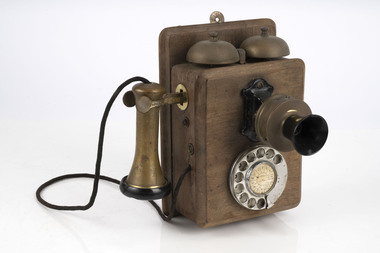
Equipment - Telephone Automatic Wall
... Telephone Automatic Wall...Telephone Automatic Wall From 1940s...Forests Commission Victoria (FCV) Communications Telephone Automatic Wall From 1940s Equipment Telephone Automatic Wall ...Telephone Automatic Wall From 1940sforests commission victoria (fcv), communications -
 Flagstaff Hill Maritime Museum and Village
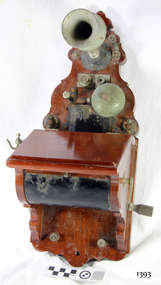
Telephone, 29 Oct 1895
... ...Wall Telephone...Telephone for wall metal and wood mouthpiece separate and set in board, earpiece missing. ...flagstaff hill warrnambool shipwrecked-coast flagstaff-hill flagstaff-hill-maritime-museum maritime-museum shipwreck-coast flagstaff-hill-maritime-village Telephone Wall Telephone Ericsson Telephone for wall metal and wood mouthpiece separate and set in board, earpiece missing. ...Telephone for wall metal and wood mouthpiece separate and set in board, earpiece missing. Crank handle at side instruction for installation set at centre beneath hinged lid. Ericsson brandflagstaff hill, warrnambool, shipwrecked-coast, flagstaff-hill, flagstaff-hill-maritime-museum, maritime-museum, shipwreck-coast, flagstaff-hill-maritime-village, telephone, wall telephone, ericsson -
 Anglesea and District Historical Society
Phone
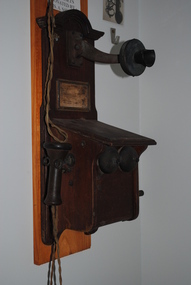
... Fiddleback wooden wall telephone with central battery and writing desk and card instruction frame. ...wooden wall phone fiddleback Card on front: not legible Fiddleback wooden wall telephone with central battery and writing desk and card instruction frame. ...Fiddleback wooden wall telephone with central battery and writing desk and card instruction frame. Introduced circa 1906. Has transmitter and receiver and crank handle.Card on front: not legiblewooden wall phone, fiddleback -
 Mont De Lancey
Telephone
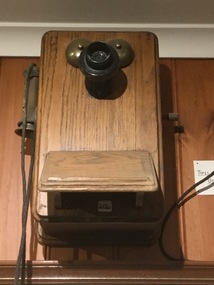
... 'British Ericsson' Wall type telephone Circa 1900...This is similar to first telephone at Wandin North Post Office 1908 telephones wall telephones 'British Ericsson' Wall type telephone Circa 1900 Telephone ...This is similar to first telephone at Wandin North Post Office 1908'British Ericsson' Wall type telephone Circa 1900telephones, wall telephones -
 Mont De Lancey
Telephone
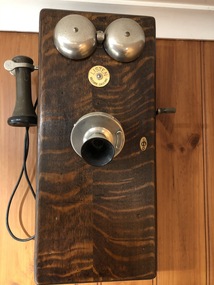
... Wind-up, wall type telephone, with a mouthpiece, ear piece and twin bells....A type of early telephone used in Wandin, Victoria, Australia. wall telephones telephones "Listen before calling" Wind-up, wall type telephone, with a mouthpiece, ear piece and twin bells. ...A type of early telephone used in Wandin, Victoria, Australia.Wind-up, wall type telephone, with a mouthpiece, ear piece and twin bells."Listen before calling"wall telephones, telephones -
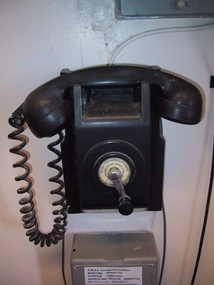 Parks Victoria - Gabo Island Lightstation... There are three, black Bakelite, wall mounted, crank handle telephones across the lightstation; one in the former assistant keeper’s quarters, and two in the former head keeper’s quarters. ...Black bakelite telephone, wall mounted with reciever/ handset on spiral cord attached to the body of the phone. ...Outer perimeter of circular LABEL,"TO CALL:-TURN HANDLE & LIFT HANDSET / WHEN FINISHED PEPLACE HANDSET & TURN HANDLE" Black bakelite telephone, wall mounted with reciever/ handset on spiral cord attached to the body of the phone. ...There are three, black Bakelite, wall mounted, crank handle telephones across the lightstation; one in the former assistant keeper’s quarters, and two in the former head keeper’s quarters. The phone has instructions for its use on the crank dial. Two have a coiled handset cord, which dates the phone to just after 1949 when these came into use. The third has a smooth cord and must pre date 1949. Another much older wall mounted phone remains in the lighthouse. The four telephones at Gabo Island formed an intercom system that facilitated communication between the lighthouse and lightstation buildings. They demonstrate the necessity for employing various methods of communication in a remotely located lighthouse as well as communication between the lightstation buildings. Telephones of the same wall mounted, crank dial type remain at Cape Otway, Point Hicks. As fixtures, the telephones belong to the building fabric and are included in the existing listing of the Gabo Island Lightstation in the Victorian Heritage Register (H1773). These intact items of equipment have first level contributory significance for their historic value and provenance.Black bakelite telephone, wall mounted with reciever/ handset on spiral cord attached to the body of the phone. There is a crank handle attached to the front of the telephone.On dial under crank handle. Outer perimeter of circular LABEL,"TO CALL:-TURN HANDLE & LIFT HANDSET / WHEN FINISHED PEPLACE HANDSET & TURN HANDLE"
 -
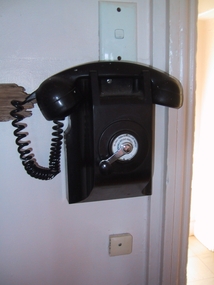 Parks Victoria - Gabo Island Lightstation
Telephone
... Telephones x 3 (GILS 0001, 0038, 0070; attached fixtures) There are three, black Bakelite, wall mounted, crank handle telephones across the lightstation; one in the former assistant keeper’s quarters, and two in the former head keeper’s quarters. ...Black bakelite telephone, wall mounted with reciever/ handset on spiral cord attached to the body of the phone. ...Outer perimeter of circular LABEL,"TO CALL:-TURN HANDLE & LIFT HANDSET / WHEN FINISHED PEPLACE HANDSET & TURN HANDLE" Black bakelite telephone, wall mounted with reciever/ handset on spiral cord attached to the body of the phone. ...Telephones x 3 (GILS 0001, 0038, 0070; attached fixtures) There are three, black Bakelite, wall mounted, crank handle telephones across the lightstation; one in the former assistant keeper’s quarters, and two in the former head keeper’s quarters. The phone has instructions for its use on the crank dial. Two have acoiled handset cord, which dates the phone to just after 1949 when these came into use. The third has a smooth cord and must pre date 1949 (GILS 0070). Another much older wallmounted phone remains in the lighthouse (GILS 0041; attached fixture; see above 6.1). The four telephones at Gabo Island formed an intercom system that facilitated communication between the lighthouse and lightstation buildings. They demonstrate the necessity for employing various methods of communication in a remotely located lighthouse as well as communication between the lightstation buildings. Telephones of the same wall mounted, crank dial type remain at Cape Otway and Point Hicks As fixtures, the telephones belong to the building fabric and are included in the existing listing of the Gabo Island Lightstation in the Victorian Heritage Register (H1773). These intact items of equipment have first level contributory significance for their historic value and provenance.Black bakelite telephone, wall mounted with reciever/ handset on spiral cord attached to the body of the phone. There is a crank handle attached to the front of the telephone.On dial under crank handle. Outer perimeter of circular LABEL,"TO CALL:-TURN HANDLE & LIFT HANDSET / WHEN FINISHED PEPLACE HANDSET & TURN HANDLE" -
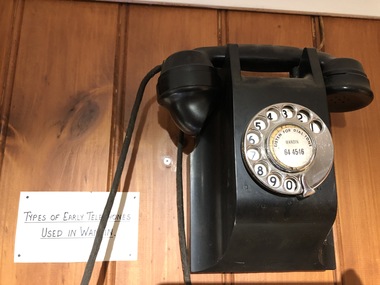 Mont De Lancey
Telephone
... Black wall type bakelite telephone, with finger operated metal dial, and combined earpiece and mouthpiece attached to a cord....A type of early telephone used in Wandin, Victoria, Australia. wall telephones telephones "Listen for dial tone" "Wandin 64 4546" Black wall type bakelite telephone, with finger operated metal dial, and combined earpiece and mouthpiece attached to a cord. ...A type of early telephone used in Wandin, Victoria, Australia.Black wall type bakelite telephone, with finger operated metal dial, and combined earpiece and mouthpiece attached to a cord."Listen for dial tone" "Wandin 64 4546"wall telephones, telephones -
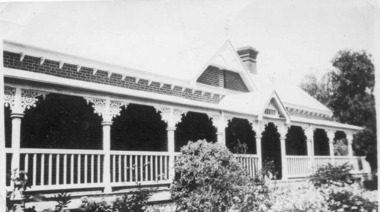 Tatura Irrigation & Wartime Camps Museum
Folio, Garfield
... |The building still contains the original Ericson wall telephone with its tag inside dated 1906. The house contains many features such as Jacobean over mantel and fire surround in the dining room, stained glass, a push button bell, and a stair well leading to an underground living area used in the summer for coolness. ...|The building still contains the original Ericson wall telephone with its tag inside dated 1906. The house contains many features such as Jacobean over mantel and fire surround in the dining room, stained glass, a push button bell, and a stair well leading to an underground living area used in the summer for coolness. ...GARFIELD ž Kilmartin Road, Cooma.|John Thomas Dougherty, an American, came to the Tatura area in 1874. He married Emily Whitnell from Whroo in 1883 and they had nine children.|He started building Garfield in 1886 and it was not completed until 1897. The building was named after President Garfield of America.|The building still contains the original Ericson wall telephone with its tag inside dated 1906. The house contains many features such as Jacobean over mantel and fire surround in the dining room, stained glass, a push button bell, and a stair well leading to an underground living area used in the summer for coolness. A new glass stair well was installed in the 1980®s to allow more light into the area. J.T. Dougherty died 1936.Photos and foolscap sized documents in a black A 4 size folder.documents, agreements -
Maldon Vintage Machinery Museum Inc
Telephone, Estimated 1930s
... Black bakelite wall mounted dial type telephone. Removable metal base for access and mounting. ...Black bakelite wall mounted dial type telephone. Removable metal base for access and mounting. ...Black bakelite wall mounted dial type telephone. Removable metal base for access and mounting. Chrome circular dial.No markings, probably PMG issue.communications, telephonic -
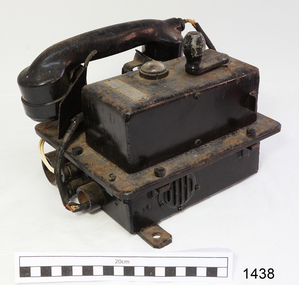 Flagstaff Hill Maritime Museum and Village
Telephone
... Telephone for wall, metal, black in colour with metal box, crank handle and plastic handpiece. ...flagstaff hill warrnambool shipwrecked-coast flagstaff-hill flagstaff-hill-maritime-museum maritime-museum shipwreck-coast flagstaff-hill-maritime-village telephone telephone manufacturing co, london communications Telephone for wall, metal, black in colour with metal box, crank handle and plastic handpiece. ...Telephone for wall, metal, black in colour with metal box, crank handle and plastic handpiece. Made by the "Telephone Manufacturing Co, London." Wiring cover between handpiece and phone is perishing. flagstaff hill, warrnambool, shipwrecked-coast, flagstaff-hill, flagstaff-hill-maritime-museum, maritime-museum, shipwreck-coast, flagstaff-hill-maritime-village, telephone, telephone manufacturing co, london, communications -
 Orbost & District Historical Society
telephone, L M ERICSSON & CO, c. 1901
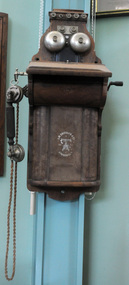
... telephone-communication wall-phone...A wall-mounted telephone with a handpiece connected by a cord to the left hand side of the main box. ...A wall phone used in the early 20th Century in Australia, this one in the Orbost district. telephone-communication wall-phone L M ERICSSON & CO TRADE MARK STOCKHOLM A wall-mounted telephone with a handpiece connected by a cord to the left hand side of the main box. ...A wall phone used in the early 20th Century in Australia, this one in the Orbost district.A wall-mounted telephone with a handpiece connected by a cord to the left hand side of the main box. On the right hand side is a winder. Near the top of the box are two round silver gongs which make the ringing sound of the phone call. The box is mostly made of wood, with the front-bottom section with a metal facing which is able to be opened to reveal the mechanism behind (including the battery). The phone has a wooden writing slope attached to the front. On the front of the metal section of the box are the words L M ERICSSON & CO trade mark STOCKHOLM. L M ERICSSON & CO TRADE MARK STOCKHOLMtelephone-communication wall-phone -
 Parks Victoria - Gabo Island Lightstation
Telephone
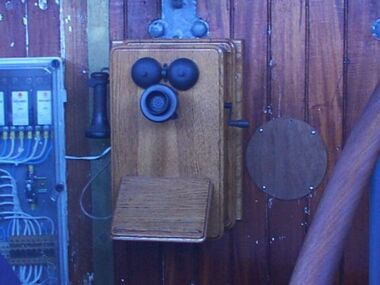
... The four telephones provided an intercom system that facilitated communication between the lightstation buildings. Four other wall...Telephone, wall-mounted in a wooden surround. Black crank handle on right-hand side. ...It is significant for its historic value and provenance, and relative uniqueness in a Victorian lighthouse. Telephone, wall-mounted in a wooden surround. Black crank handle on right-hand side. ...It has been restored by lightstation staff in 2002. The phone has a fixed mouth piece and is attached to the lantern room wall on a timber box mount. Dating from the early twentieth century, it is the earliest of four telephones at the lightstation and the sole box-mounted model, and is also the only telephone in the lighthouse. It has a crank handle, a separate black hand piece and an inclined horizontal shelf for jotting down notes. The four telephones provided an intercom system that facilitated communication between the lightstation buildings. Four other wall-mounted phones remain at the Cape Nelson Lightstation but unlike the Gabo Island example they do not provide a rest for jotting down notes. As a fixture, the telephone is part of the building fabric and is included in the existing Victorian Heritage Register extent of registration for the Gabo Island Lightstation (H1773). As a fixture, the telephone is part of the building fabric and is included in the existing Victorian Heritage Register extent of registration for the Gabo Island Lightstation (H1773). It is significant for its historic value and provenance, and relative uniqueness in a Victorian lighthouse.Telephone, wall-mounted in a wooden surround. Black crank handle on right-hand side. Separate black hand piece on left-hand side attached to main body by a fabric covered cord. The mouthpiece is fixed to the front of the telephone. There is a wooden rest attached to the lower front of phone on an angle. There are two half circular bells attached to the phone above the mouthpiece. -
 Department of Energy, Environment and Climate Action
Altona Collection Photography and Cataloguing - November 2024
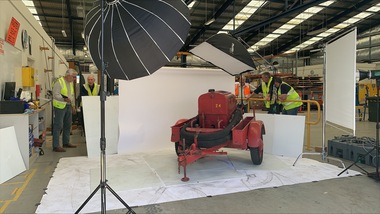
... The oldest item is probably the Ericsson wall telephone from 1904. There are also many unique items, but the CSIRO incendiary machine and ping-pong incendiary machine developed at Altona probably had the most significant impact on fire management in Australia. ...The oldest item is probably the Ericsson wall telephone from 1904. There are also many unique items, but the CSIRO incendiary machine and ping-pong incendiary machine developed at Altona probably had the most significant impact on fire management in Australia. ...In November 2024, a small group of cheerful volunteers from the Forests Commission Retired Personnel Association (FCRPA) toiled over nine days to dust-off, photograph and record nearly 300 artifacts in DEECA's Altona Museum. It followed a similar project at the FCRPA's Beechworth Museum in February 2024. The Altona project was generously supported by DEECA / FFMVic to engage professional photographer Mark Jesser from Wodonga whose boundless energy and good humour helped to create these amazing images. Special thanks go to the FFMVic Chief Fire Officer, Chris Hardman, as well as Andrew Stanios and Kat Jensen for making it happen. FFMVic crews and the ever-patient staff from Altona took a strong interest and also helped to shift some of the heavy items like pumps and the Bedford tanker which was very welcome. The Forests Commission and its successors continuously encouraged bushfire research and innovation. In 1946 a large parcel of industrial land was purchased at North Altona as a fire cache and workshop. The Altona workshop became a hotbed of new technological thingumajigs… a marvellous blend of Aladdin’s Cave of Wonders coupled with Wallace and Gromit’s madcap contraptions… an exhilarating place where lots of gizmos were invented and tested… mostly with astounding results... but nearly always with some head-scratching frustrations… and thankfully not too much explosive mayhem. In fact, a lot of Australia’s pioneering equipment development was led by staff from Altona, often in collaboration with other State forestry and fire authorities. The CSIRO also contributed significantly. The US Forest Service, the US Bureau of Land Management and US State agencies such as the California Department of Forestry and Fire (CalFire) as well as the Canadian Forest Service faced similar challenges and proved strong and willing partners in sharing knowledge, ideas, equipment and expertise over many decades. The collection at Altona started in the 1970s by fire equipment wizard Barry (Rocky) Marsden. As obsolete equipment was returned to the Fire Protection Workshop for auction, Rocky began the process of selecting some which would be interesting to retain and display. The items at Altona represent just a small sample of the amazing story of Victoria's forestry and bushfire heritage. The largest item was undoubtedly the Bedford tanker which took two days and nearly 1000 photos which were later stitched together with photoshop. The oldest item is probably the Ericsson wall telephone from 1904. There are also many unique items, but the CSIRO incendiary machine and ping-pong incendiary machine developed at Altona probably had the most significant impact on fire management in Australia. There are plenty of gaps in the collection, but some items are in regional DEECA offices. The FCRPA's Beechworth collection was merged with the Altona collection in 2025. It is hoped that the museum will be renamed to honour Rocky Marsden. There may be some additions to the Altona museum over time, but space is limited. The museum is available to visit by appointment. Peter McHugh - January 2025 forests commission victoria (fcv) -
 Parks Victoria - Point Hicks Lightstation
Telephones
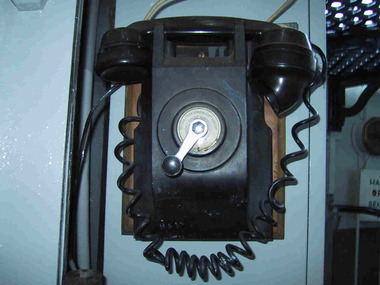
... The four phones formed an intercom system that facilitated communication between the lightstation buildings. Three telephones of the same wall-mounted, crank dial type remain at Gabo Island Lightstation; four remain at Cape Otway and five older examples remain at Cape Nelson Lightstation As fixtures attached to the wall, the four telephones are considered to be part of the building fabric and therefore included in the existing Victorian Heritage Register listing for the lightstation (VHR 1983)....Four telephones with a crank handle mounted on a wooden base, one is fixed to the wall of the lantern room and is black bakelite. ...As fixtures attached to the wall, the four telephones are considered to be part of the building fabric and therefore included in the existing VHR listing for the lightstation (VHR 1983). ...The lightstation was connected by telephone to Cann River in 1928. The lighthouse retains ablack Bakelite telephone attached to the lantern room wall on timber box mount. It has a crank handle with instructions for its use on the crank dial, and a coiled handset cord, which probably dates the phone to just after 1949 when coiled examples like these began to replace fabric covered smooth cords. An image in 1991 shows the phone in the lower level of the lantern room It is one of four telephones at the lightstsation; with two others attached to walls in the assistant keepers’ quarters, and one in the head keeper’s quarters. The four phones formed an intercom system that facilitated communication between the lightstation buildings. Three telephones of the same wall-mounted, crank dial type remain at Gabo Island Lightstation; four remain at Cape Otway and five older examples remain at Cape Nelson Lightstation As fixtures attached to the wall, the four telephones are considered to be part of the building fabric and therefore included in the existing Victorian Heritage Register listing for the lightstation (VHR 1983).As fixtures attached to the wall, the four telephones are considered to be part of the building fabric and therefore included in the existing VHR listing for the lightstation (VHR 1983).Four telephones with a crank handle mounted on a wooden base, one is fixed to the wall of the lantern room and is black bakelite. Yes -
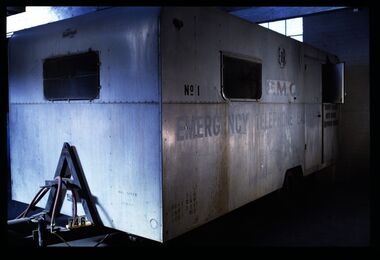 National Communication Museum
Vehicle - Mobile Telephone Exchange, c. 1965
... The main frame room contains many metres of coiled black covered cable, a black covered magneto wall telephone with 300 type handset; grey plastic jumper cords, a rack of termination points and wire with wasp nests attached. ...The main frame room contains many metres of coiled black covered cable, a black covered magneto wall telephone with 300 type handset; grey plastic jumper cords, a rack of termination points and wire with wasp nests attached. ...Manufactured in the 1960s, this mobile emergency telephone exchange was fitted into a caravan. Part of the Shepparton Division State Disaster Plan, the caravan could be towed to areas affected by disasters to enable communications to recommence. The caravan remained in service until approximately 1974.Mobile infrastructure plays an important role in Australian communications, owing to the often remote and hostile environments in which Australians live and work. Exchanges such as this facilitated phone calls in the aftermath of an emergency, particularly for hospitals, police and other emergency services. Today, Mobile Exchange on Wheels (MEOWs), Cell on Wheels (CoW) and Satellite Cell on Wheels (SatCOW) - which provide temporary landline and broadband services, mobile phone coverage and service in areas without communications infrastructure respectively - are a critical part of emergency response procedures for natural disasters such as fire and flood. Though technology has progressed, the need for rapid service in remote areas remains a present concern of the communications service providers in Australia. This mobile service infrastructure is historically significant as an early example of a service which has evolved over decades, yet is still needed today. The exchange, as a representative example of a vehicle which would provide early-response in a disaster, is socially significant as a facilitator of critical communications needs in devastated communities: access to emergency services and contact with family and friends. The exchange itself, intact from its period of use, provides an insight into technology of the 1970s.Mobile emergency exchange housed in a caravan trailer on 2 wheel base, duralin body, steel tow bar, Caravan divided into 3 sections; the exchange room; the relay room and the main frame room. The exchange room contains 3 switchboards, a folding table, cupboards, benches and switch rack (.1). table (.2), steel bar for attaching the table (.3), back boards of switchboards (.4-.6), switches (.7-.16), box of switches (.17). There is a wall phone magneto, 300 type handset on wall and 2 skylights with wire screens. .11? hat pegs and shelf; there are 2 fluorescent tubes for lighting, all in exchange section. The floor is covered with 2 tone grey tiles and there are wire mesh on outside of windows and a geometric curtain inside behind switch rack. There is a flywire screen door as well as exterior door. The relay room has a sectioned door so half can open at a time. Room contains a cupboard with folding bench top beneath a curtained window. The opposite wall has a bank of batteries and transmission condensers; there is a shelf above window, one fluorescent tube and fuse boxes. Tiles on floor also. The main frame room contains many metres of coiled black covered cable, a black covered magneto wall telephone with 300 type handset; grey plastic jumper cords, a rack of termination points and wire with wasp nests attached. There is a small iron step under door, a fluorescent tube on wall and 3 hat hooks. Roll of Paper Handtowels (.18), cord and handle (.19), red exchange cords and plugs (.20-.22), plastic aluminium runners (.23,.24), headset (.25,.26), logbook (.27), battery readings (.28), box containing papers circuit drawings etc (.29-.93), paper lists off wall (.94,.95). Books, record books etc (.96-.103). Manila folder (.104) containing circuit drawings (105-.124). Wooden drawer (.125), metal drawer containing subscribers master cards, record of faults cards, particular switchboards connected, Junction line cards (.126). Box of valves (.127), box of clamps (.128). Box of 2000 type rack fuses, red 1 1/2 AMPS, black 3 AMP, blue 1/2 AMP (.129). Box of sleeves for covering wire joints (.130), plastic beakers (.131,.132), soap (.133), box of white plastic squares (.134), time switch "Venner BF/43 time switch" Made in England (.135), box of bolts, knobs etc (.136), box of switchboard number indicators (.137), fuse (.138), fuse wire (.139), football card (.140). Box of cartridge fuse 6 AMP (.141). Envelope of drawing pins, rubber bands (.142), black plastic, paper tape centres (.143-.152), metal plug (.153), 2 signs "Beware of vehicles" (.154-.155). Paper listing Naringal East automatic conversion (.156). Green Commonwealth of Australia note pad (.157). Wiring plug for tail lights (.158). Black fuse plugs (.159,.160). Box of bolts (.161). 2 sections of blue plastic coated wires (.162,.163). Gloves used for working on batteries (.164-.167). Wasp nests (.168,.169). White fuse (.170). Photographs of van in use (.171,.172)..1 on front: "ANOTHER / MOBILETRAIL / PRODUCT" "MAX SPEED / 25MPH" "TRAILER BRAKES / --- / " On sides: "EMERGENCY TELEPHONE EXCHANGE" "NO 1" "PMG" "TCQ / GROSS 250 / TARE 182 / LOAD 162" "6" "COUNTRY BRANCH / NORTH REGION / [SHEPPARTON DIVISION]" "LAW'S SIGNS" "Telecom Australia" On back: "DANGER / LONG LOAD" "MQA 3787" .133: "FIR OIL" "AUSTRALIA"mobile telephone exchanges, mobile telecommunications trailers, trailers, transport, natural disaster, black saturday, bushfires, floods, emergency communications -
 Marysville & District Historical Society
Postcard (item) - Colour postcard, Nucolorvue Productions Pty. Ltd, Marysville Victoria, Pre 2009
... wall. This postcard was produced by Nucolorvue Productions as a souvenir of Marysville. marysville king parrot victoria nucolorvue productions postcard souvenir KING PARROT Marysville, Victoria. NU-COLOR-VUE/ AUSTRALIA'S NATIONAL POSTCARD COMPANY AFFIX/ STAMP/ HERE/ 17 MA 012/ NCV 7778 ADDRESS/ POSTCODE COPYRIGHT/ Nucolorvue Productions Pty. Ltd.,/ Telephone ...A colour photograph of a King Parrot perched on a stone wall.A colour photograph of a King Parrot sitting on a stone wall. This postcard was produced by Nucolorvue Productions as a souvenir of Marysville.KING PARROT Marysville, Victoria. NU-COLOR-VUE/ AUSTRALIA'S NATIONAL POSTCARD COMPANY AFFIX/ STAMP/ HERE/ 17 MA 012/ NCV 7778 ADDRESS/ POSTCODE COPYRIGHT/ Nucolorvue Productions Pty. Ltd.,/ Telephone: (03) 560-1788 Made in Australiamarysville, king parrot, victoria, nucolorvue productions, postcard, souvenir -
 Marysville & District Historical Society
Postcard (item) - Colour postcard, Nucolorvue Productions Pty. Ltd, Marysville Victoria, Pre 2009
... wall. This postcard was produced by Nucolorvue Productions as a souvenir of Marysville. marysville king parrot victoria nucolorvue productions postcard souvenir KING PARROT Marysville, Victoria. NU-COLOR-VUE/ AUSTRALIA'S NATIONAL POSTCARD COMPANY AFFIX/ STAMP/ HERE/ 17 MA 012/ NCV 7778 ADDRESS/ POSTCODE COPYRIGHT/ Nucolorvue Productions Pty. Ltd.,/ Telephone ...A colour photograph of a King Parrot perched on a stone wall.A colour photograph of a King Parrot sitting on a stone wall. This postcard was produced by Nucolorvue Productions as a souvenir of Marysville.KING PARROT Marysville, Victoria. NU-COLOR-VUE/ AUSTRALIA'S NATIONAL POSTCARD COMPANY AFFIX/ STAMP/ HERE/ 17 MA 012/ NCV 7778 ADDRESS/ POSTCODE COPYRIGHT/ Nucolorvue Productions Pty. Ltd.,/ Telephone: (03) 560-1788 Made in Australiamarysville, king parrot, victoria, nucolorvue productions, postcard, souvenir -
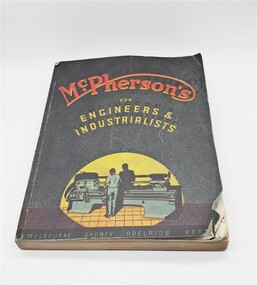 Glenelg Shire Council Cultural Collection
Book - Tool Catalogue, McPherson's Limited, McPherson's FOR ENGINEERS & INDUSTRIALISTS, 1949
... wall. The book has 448 pages. Front cover: McPherson's FOR ENGINEERS & INDUSTRIALISTS MELBOURNE SYDNEY ADELAIDE PERTH Back Cover- McPherson's Ltd. 546-566 COLLINS STREET MELBOURNE * Telephone: MY270 * Telegraphic Address: "MERCHANT" MELBOURNE...wall. The book has 448 pages. Front cover: McPherson's FOR ENGINEERS & INDUSTRIALISTS MELBOURNE SYDNEY ADELAIDE PERTH Back Cover- McPherson's Ltd. 546-566 COLLINS STREET MELBOURNE * Telephone: MY270 * Telegraphic Address: "MERCHANT" MELBOURNE McPherson's FOR ENGINEERS & INDUSTRIALISTS Book Tool Catalogue McPherson's Limited ...This book is a catalogue issued for machinery merchants, tool specialists, suppliers of engineers' requisites, manufacturers of pumps, bolts, nuts, rivets, makers of high grade machine tools.Book is covered by green card and printed on the front with the title and a cartoon sketch/picture of a man standing facing away from viewer at a large industrial piece of machinery. Appears to be working. Picture includes an orange tiled floor and yellow wall. The book has 448 pages. Front cover: McPherson's FOR ENGINEERS & INDUSTRIALISTS MELBOURNE SYDNEY ADELAIDE PERTH Back Cover- McPherson's Ltd. 546-566 COLLINS STREET MELBOURNE * Telephone: MY270 * Telegraphic Address: "MERCHANT" MELBOURNEnon-fictionThis book is a catalogue issued for machinery merchants, tool specialists, suppliers of engineers' requisites, manufacturers of pumps, bolts, nuts, rivets, makers of high grade machine tools. -
 Eltham District Historical Society Inc
Photograph, Peter Pidgeon, 820 Main Road, Eltham, 2 Aug. 2022
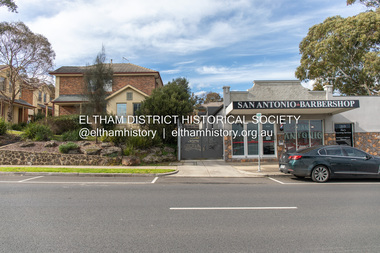
... The public telephone was initially mounted on the wall but later moved to the street. ...The public telephone was initially mounted on the wall but later moved to the street. ...In 1855 the first post office opened in Eltham under the management of Thomas Hunniford. It was a weatherboard building located on the eastern side of Main Road just south of Bridge Street. During the 1880s under the managment of Hunniford's daughter, Anne, the building was modernised with a new awning and upper facade. In late 1925 a new brick building was erected immediately next door (820 Main Road). Following the death of Anne Hunniford in December 1928, J.N Burgoyne was appointed Postmaster. The extension to the right of the store was erected in 1939 for a new telephone exchange adjacent to the store and post office. A continuous telephone service operated by Mr Burgoyne and his family commenced operation 18 November 1939. Approximately 70 extensions were routed through the new exchange, 40 of which were transferred from the Greensborough Exchange. Entry to the exchange was via a separate door on Main Road or via the shop. The public telephone was initially mounted on the wall but later moved to the street. The present store is a barber shop and it remains, though heavily modified, one of only three remaining shop fronts from the early 1900s in Eltham. Comparison photo: SEPP_0700, 00140, SEPP_0701, SEPP_0702 Part of a presentation by Peter Pidgeon to the Society, 13 August 2022 showcasing a series of photographs taken by John Henry Clark over the period 1895 to 1930. John Henry Clark was the youngest of three boys born to William Henry Clark (1823-1877) and Maria White (1843-1914). He and his brothers, William Charles Clark (1872-1945), Clement Kent Clark (1874-1912) operated a photography business (Clark Bros.) from 25 Thomas Street, Windsor near Prahran during the period c.1894 to 1914. Following death of Clement in September 1912 and their mother in 1914, the Clark Bros business appears to have dissolved, the premises demolished, and a new house was under construction in 1915. John set up business independently in 1914 operating out of 29 Moor Street, Fitzroy where he is registered in the 1914 and 1915 Electoral Rolls. By 1916 John had relocated to Eltham where he continued his practice as a photographer and took many of the early images around the district of Little Eltham. Around 1930 John changed professions and opened a small cobbler's shop in 1931 near the pond opposite Dalton Street adjacent to the Jarrold family cottage. He never married and continued his profession as a bootmaker from this little shop, maintaining a close relationship with Mrs Jarrold for the rest of their lives. His bootmaker shop remains today beside the Whitecloud cottage and is one of only three remaining shops in the area from the early 20th century.Comparative photo taken 2022 with one taken from same location over 100 years earlier by noted local photographer J.H. ClarkBorn Digitaleltham, j.h. clark photo (2022), main road, 820 main road, burgoyne store -
 Eltham District Historical Society Inc
Photograph - Digital Photograph, Marguerite Marshall, Art Gallery at Clifton Pugh's Artists' Colony, Dunmoochin, Barreenong Road, Cottles Bridge, 5 February 2008
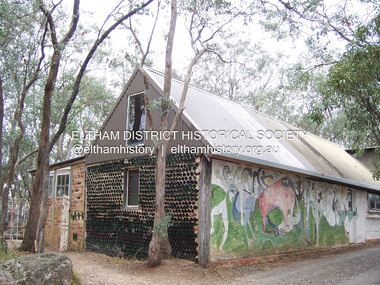
... It was so small that the only room he could find for his telephone was on the fork of a tree nearby.5 Over the years the mud-brick house grew to 120 squares in the style now synonymous with Eltham. It had thick adobe walls...It was so small that the only room he could find for his telephone was on the fork of a tree nearby.5 Over the years the mud-brick house grew to 120 squares in the style now synonymous with Eltham. It had thick adobe walls ...Art Gallery with mural painted by Clifton Pugh (1924-1990) at his Artists' Colony, Dunmoochin, Barreenong Road, Cottles Bridge. Following military service in the second world war, Clifton Pugh studied under artist Sir William Dargie at the National Gallery School in Melbourne as well as Justus Jorgensen, founder of Montsalvat. For a while he lived on the dole but also worked packing eggs for the Belot family saving sufficient to purchase six acres (2.4 ha) of land at Barreenong Road, Cottles Bridge. He accumulated more land and persuaded several other artists and friends to buy land nearby, resulting in a property of approximately 200 acres, stablishing it as one of the first artistic communes in Australia alongside Montsalvat in Eltham. It was around 1951 that Pugh felt he had '"done moochin' around" and so the name of the property evolved. He bought timber from Alistair Knox to build his house on the crest of a hill. Inspired by local goldminer's huts, it was a one room wattle-and-daub structure with dirt floor. Over the years it expanded with thick adobe walls made from local clay, high ceilings and stone floors. All materials other than the local earth were sourced from second hand materials, most found at wreckers' yards. Artists from across the nation were drawn to Dunmoochin, with several setting up houses and shacks on the property, maintaining their independence but sharing their artistic zeal. Artists who worked or resided at Dunmoochin included Mirka Mora, John Perceval, Albert Tucker, Fred Williams, Charles Blackman, Arthur Boyd and John Olsen. In 2002, Pugh's house along with its treasure trove of art and a library of some 20,000 books was destroyed by fire. Traces of Pugh's home remain with the presence of the Victorian doorframe archway with leadlight of intricate design, procured from a demolished Melbourne mansion; and two bronze life-sized female statues created by Pugh and cast by Matcham Skipper. In place of Pugh's house rose two double-storey mud-brick artists' studios topped with corrugated iron rooves curved like the wings of a bird with accommodation for seven. The original studios, gallery and other buildings survived the fire. Covered under Heritage Overlay, Nillumbik Planning Scheme. Published: Nillumbik Now and Then / Marguerite Marshall 2008; photographs Alan King with Marguerite Marshall.; p153 It’s not surprising that artist Clifton Pugh was drawn to Cottles Bridge to establish his artists’ colony Dunmoochin. Undisturbed by the clamour of modern life at Barreenong Road, Pugh was surrounded by the Australian bush he loved, and where his ashes were later scattered. The 200 acres (81ha) of bushland, broken by glimpses of rolling hills, has more than 50 species of orchids and Pugh shared his property with native animals including kangaroos, emus, phascogales, wombats, and diverse bird life. Pugh encouraged these creatures to join him in the bush by creating, with Monash University, a holding station where the animals were raised. Dunmoochin inspired Pugh for such paintings as in a book on orchids and the Death of a Wombat series.1 But his love for the bush was accompanied by the fear that Europeans were destroying it and much of his painting illustrated this fear and his plea for its conservation.2 However it was his house rather than the surrounding bush that was to be destroyed. Tragically in 2002 Pugh’s house, with its treasure of art and library of 20,000 art books, was destroyed by fire. Traces of the beauty of Pugh’s home still remain, however, in the magnificent Victorian doorframe archway with leadlight of intricate design procured from a demolished Melbourne mansion; and two bronze life-sized female statues created by Pugh and cast by Matcham Skipper. Now in place of Pugh’s house, are two double-storey mud-brick artists’ studios topped with corrugated roofs curved like birds’ wings, with accommodation for seven. The original studios, gallery and other buildings remain.3 Pugh grew up on his parents’ hobby farm at Briar Hill and attended the Briar Hill Primary School, then Eltham High School and later Ivanhoe Grammar. At 15 he became a copy boy for the Radio Times newspaper, then worked as a junior in a drafting office. Pugh was to have three wives and two sons. After serving in World War Two in New Guinea and Japan, Pugh studied under artist Sir William Dargie, at the National Gallery School in Melbourne.4 Another of his teachers was Justus Jörgensen, founder of Montsalvat the Eltham Artists’ Colony. Pugh lived on the dole for a while and paid for his first six acres (2.4ha) at Barreenong Road by working as an egg packer for the Belot family. Pugh accumulated more land and persuaded several other artists and friends to buy land nearby, resulting in the 200 acre property. They, too, purchased their land from the Belot family by working with their chickens. Around 1951 Pugh felt he had ‘Done moochin’ around’ and so the name of his property was born. Pugh bought some used timber from architect Alistair Knox to build his house on the crest of a hill. Inspired by local goldminers’ huts it was a one-room wattle-and-daub structure with a dirt floor. It was so small that the only room he could find for his telephone was on the fork of a tree nearby.5 Over the years the mud-brick house grew to 120 squares in the style now synonymous with Eltham. It had thick adobe walls (sun-dried bricks) made from local clay, high ceilings and stone floors with the entire structure made of second-hand materials – most found at wreckers’ yards. Pugh’s first major show in Melbourne in 1957, established him as a distinctive new painter, breaking away from the European tradition ‘yet not closely allied to any particular school of Australian painting’.6 Pugh became internationally known and was awarded the Order of Australia. He won the Archibald Prize for portraiture three times, although he preferred painting the bush and native animals. In 1990 not long before he died, Pugh was named the Australian War Memorial’s official artist at the 75th anniversary of the landing at Gallipoli. Today one of Pugh’s legacies is the Dunmoochin Foundation, which gives seven individual artists or couples and environmental researchers the chance to work in beautiful and peaceful surroundings, usually for a year. By November 2007, more than 80 people had taken part, and the first disabled artist had been chosen to reside in a new studio with disabled access.1 In 1989, not long before Pugh died in 1990 of a heart attack at age 65, he established the Foundation with La Trobe University and the Victorian Conservation Trust now the Trust for Nature. Pugh’s gift to the Australian people – of around 14 hectares of bushland and buildings and about 550 art works – is run by a voluntary board of directors, headed by one of his sons, Shane Pugh. La Trobe University in Victoria stores and curates the art collection and organises its exhibition around Australia.2 The Foundation aims to protect and foster the natural environment and to provide residences, studios and community art facilities at a minimal cost for artists and environmental researchers. They reside at the non-profit organisation for a year at minimal cost. The buildings, some decorated with murals painted by Pugh and including a gallery, were constructed by Pugh, family and friends, with recycled as well as new materials and mud-bricks. The Foundation is inspired by the tradition begun by the Dunmoochin Artists’ Cooperative which formed in the late 1950s as one of the first artistic communes in Australia. Members bought the land collaboratively and built the seven dwellings so that none could overlook another. But, in the late 1960s, the land was split into private land holdings, which ended the cooperative. Dunmoochin attracted visits from the famous artists of the day including guitarists John Williams and Segovia; singer and comedian Rolf Harris; comedian Barry Humphries; and artists Charles Blackman, Arthur Boyd and Mirka Mora. A potters’ community, started by Peter and Helen Laycock with Alma Shanahan, held monthly exhibitions in the 1960s, attracting local, interstate and international visitors – with up to 500 attending at a time.3 Most artists sold their properties and moved away. But two of the original artists remained into the new millennium as did relative newcomer Heja Chong who built on Pugh’s property (now owned by the Dunmoochin Foundation). In 1984 Chong brought the 1000-year-old Japanese Bizan pottery method to Dunmoochin. She helped build (with potters from all over Australia) the distinctive Bizan-style kiln, which fires pottery from eight to 14 days in pine timber, to produce the Bizan unglazed and simple subdued style. The kiln, which is rare in Australia, is very large with adjoining interconnected ovens of different sizes, providing different temperatures and firing conditions. Frank Werther, who befriended Pugh as a fellow student at the National Gallery Art School in Melbourne, built his house off Barreenong Road in 1954. Werther is a painter of the abstract and colourist style and taught art for about 30 years. Like so many in the post-war years in Eltham Shire, as it was called then, Werther built his home in stages using mud-brick and second-hand materials. The L-shaped house is single-storey but two-storey in parts with a corrugated-iron pitched roof. The waterhole used by the Werthers for their water supply is thought to be a former goldmining shaft.4 Alma Shanahan at Barreenong Road was the first to join Pugh around 1953. They also met at the National Gallery Art School and Shanahan at first visited each weekend to work, mainly making mud-bricks. She shared Pugh’s love for the bush, but when their love affair ended, she designed and built her own house a few hundred yards (metres) away. The mud-brick and timber residence, made in stages with local materials, is rectangular, single-storey with a corrugated-iron roof. As a potter, Shanahan did not originally qualify as an official Cooperative member.This collection of almost 130 photos about places and people within the Shire of Nillumbik, an urban and rural municipality in Melbourne's north, contributes to an understanding of the history of the Shire. Published in 2008 immediately prior to the Black Saturday bushfires of February 7, 2009, it documents sites that were impacted, and in some cases destroyed by the fires. It includes photographs taken especially for the publication, creating a unique time capsule representing the Shire in the early 21st century. It remains the most recent comprehenesive publication devoted to the Shire's history connecting local residents to the past. nillumbik now and then (marshall-king) collection, art gallery, clifton pugh, dunmoochin, cottlesbridge, cottles bridge, barreenong road -
 Eltham District Historical Society Inc
Photograph - Digital Photograph, Marguerite Marshall, Doorway of Clifton Pugh's former house at Dunmoochin, Barreenong Road, Cottles Bridge, 5 February 2008
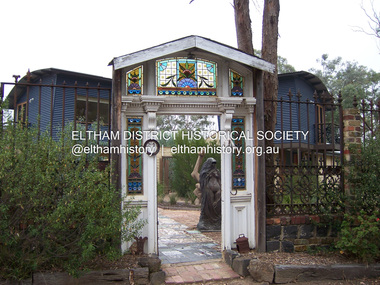
... It was so small that the only room he could find for his telephone was on the fork of a tree nearby.5 Over the years the mud-brick house grew to 120 squares in the style now synonymous with Eltham. It had thick adobe walls...It was so small that the only room he could find for his telephone was on the fork of a tree nearby.5 Over the years the mud-brick house grew to 120 squares in the style now synonymous with Eltham. It had thick adobe walls ...Following military service in the second world war, Clifton Pugh studied under artist Sir William Dargie at the National Gallery School in Melbourne as well as Justus Jorgensen, founder of Montsalvat. For a while he lived on the dole but also worked packing eggs for the Belot family saving sufficient to purchase six acres (2.4 ha) of land at Barreenong Road, Cottles Bridge. He accumulated more land and persuaded several other artists and friends to buy land nearby, resulting in a property of approximately 200 acres, stablishing it as one of the first artistic communes in Australia alongside Montsalvat in Eltham. It was around 1951 that Pugh felt he had '"done moochin' around" and so the name of the property evolved. He bought timber from Alistair Knox to build his house on the crest of a hill. Inspired by local goldminer's huts, it was a one room wattle-and-daub structure with dirt floor. Over the years it expanded with thick adobe walls made from local clay, high ceilings and stone floors. All materials other than the local earth were sourced from second hand materials, most found at wreckers' yards. Artists from across the nation were drawn to Dunmoochin, with several setting up houses and shacks on the property, maintaining their independence but sharing their artistic zeal. Artists who worked or resided at Dunmoochin included Mirka Mora, John Perceval, Albert Tucker, Fred Williams, Charles Blackman, Arthur Boyd and John Olsen. In 2002, Pugh's house along with its treasure trove of art and a library of some 20,000 books was destroyed by fire. Traces of Pugh's home remain with the presence of the Victorian doorframe archway with leadlight of intricate design, procured from a demolished Melbourne mansion; and two bronze life-sized female statues created by Pugh and cast by Matcham Skipper. In place of Pugh's house rose two double-storey mud-brick artists' studios topped with corrugated iron rooves curved like the wings of a bird with accommodation for seven. The original studios, gallery and other buildings survived the fire. Covered under Heritage Overlay, Nillumbik Planning Scheme. Published: Nillumbik Now and Then / Marguerite Marshall 2008; photographs Alan King with Marguerite Marshall.; p155 It’s not surprising that artist Clifton Pugh was drawn to Cottles Bridge to establish his artists’ colony Dunmoochin. Undisturbed by the clamour of modern life at Barreenong Road, Pugh was surrounded by the Australian bush he loved, and where his ashes were later scattered. The 200 acres (81ha) of bushland, broken by glimpses of rolling hills, has more than 50 species of orchids and Pugh shared his property with native animals including kangaroos, emus, phascogales, wombats, and diverse bird life. Pugh encouraged these creatures to join him in the bush by creating, with Monash University, a holding station where the animals were raised. Dunmoochin inspired Pugh for such paintings as in a book on orchids and the Death of a Wombat series.1 But his love for the bush was accompanied by the fear that Europeans were destroying it and much of his painting illustrated this fear and his plea for its conservation.2 However it was his house rather than the surrounding bush that was to be destroyed. Tragically in 2002 Pugh’s house, with its treasure of art and library of 20,000 art books, was destroyed by fire. Traces of the beauty of Pugh’s home still remain, however, in the magnificent Victorian doorframe archway with leadlight of intricate design procured from a demolished Melbourne mansion; and two bronze life-sized female statues created by Pugh and cast by Matcham Skipper. Now in place of Pugh’s house, are two double-storey mud-brick artists’ studios topped with corrugated roofs curved like birds’ wings, with accommodation for seven. The original studios, gallery and other buildings remain.3 Pugh grew up on his parents’ hobby farm at Briar Hill and attended the Briar Hill Primary School, then Eltham High School and later Ivanhoe Grammar. At 15 he became a copy boy for the Radio Times newspaper, then worked as a junior in a drafting office. Pugh was to have three wives and two sons. After serving in World War Two in New Guinea and Japan, Pugh studied under artist Sir William Dargie, at the National Gallery School in Melbourne.4 Another of his teachers was Justus Jörgensen, founder of Montsalvat the Eltham Artists’ Colony. Pugh lived on the dole for a while and paid for his first six acres (2.4ha) at Barreenong Road by working as an egg packer for the Belot family. Pugh accumulated more land and persuaded several other artists and friends to buy land nearby, resulting in the 200 acre property. They, too, purchased their land from the Belot family by working with their chickens. Around 1951 Pugh felt he had ‘Done moochin’ around’ and so the name of his property was born. Pugh bought some used timber from architect Alistair Knox to build his house on the crest of a hill. Inspired by local goldminers’ huts it was a one-room wattle-and-daub structure with a dirt floor. It was so small that the only room he could find for his telephone was on the fork of a tree nearby.5 Over the years the mud-brick house grew to 120 squares in the style now synonymous with Eltham. It had thick adobe walls (sun-dried bricks) made from local clay, high ceilings and stone floors with the entire structure made of second-hand materials – most found at wreckers’ yards. Pugh’s first major show in Melbourne in 1957, established him as a distinctive new painter, breaking away from the European tradition ‘yet not closely allied to any particular school of Australian painting’.6 Pugh became internationally known and was awarded the Order of Australia. He won the Archibald Prize for portraiture three times, although he preferred painting the bush and native animals. In 1990 not long before he died, Pugh was named the Australian War Memorial’s official artist at the 75th anniversary of the landing at Gallipoli. Today one of Pugh’s legacies is the Dunmoochin Foundation, which gives seven individual artists or couples and environmental researchers the chance to work in beautiful and peaceful surroundings, usually for a year. By November 2007, more than 80 people had taken part, and the first disabled artist had been chosen to reside in a new studio with disabled access.1 In 1989, not long before Pugh died in 1990 of a heart attack at age 65, he established the Foundation with La Trobe University and the Victorian Conservation Trust now the Trust for Nature. Pugh’s gift to the Australian people – of around 14 hectares of bushland and buildings and about 550 art works – is run by a voluntary board of directors, headed by one of his sons, Shane Pugh. La Trobe University in Victoria stores and curates the art collection and organises its exhibition around Australia.2 The Foundation aims to protect and foster the natural environment and to provide residences, studios and community art facilities at a minimal cost for artists and environmental researchers. They reside at the non-profit organisation for a year at minimal cost. The buildings, some decorated with murals painted by Pugh and including a gallery, were constructed by Pugh, family and friends, with recycled as well as new materials and mud-bricks. The Foundation is inspired by the tradition begun by the Dunmoochin Artists’ Cooperative which formed in the late 1950s as one of the first artistic communes in Australia. Members bought the land collaboratively and built the seven dwellings so that none could overlook another. But, in the late 1960s, the land was split into private land holdings, which ended the cooperative. Dunmoochin attracted visits from the famous artists of the day including guitarists John Williams and Segovia; singer and comedian Rolf Harris; comedian Barry Humphries; and artists Charles Blackman, Arthur Boyd and Mirka Mora. A potters’ community, started by Peter and Helen Laycock with Alma Shanahan, held monthly exhibitions in the 1960s, attracting local, interstate and international visitors – with up to 500 attending at a time.3 Most artists sold their properties and moved away. But two of the original artists remained into the new millennium as did relative newcomer Heja Chong who built on Pugh’s property (now owned by the Dunmoochin Foundation). In 1984 Chong brought the 1000-year-old Japanese Bizan pottery method to Dunmoochin. She helped build (with potters from all over Australia) the distinctive Bizan-style kiln, which fires pottery from eight to 14 days in pine timber, to produce the Bizan unglazed and simple subdued style. The kiln, which is rare in Australia, is very large with adjoining interconnected ovens of different sizes, providing different temperatures and firing conditions. Frank Werther, who befriended Pugh as a fellow student at the National Gallery Art School in Melbourne, built his house off Barreenong Road in 1954. Werther is a painter of the abstract and colourist style and taught art for about 30 years. Like so many in the post-war years in Eltham Shire, as it was called then, Werther built his home in stages using mud-brick and second-hand materials. The L-shaped house is single-storey but two-storey in parts with a corrugated-iron pitched roof. The waterhole used by the Werthers for their water supply is thought to be a former goldmining shaft.4 Alma Shanahan at Barreenong Road was the first to join Pugh around 1953. They also met at the National Gallery Art School and Shanahan at first visited each weekend to work, mainly making mud-bricks. She shared Pugh’s love for the bush, but when their love affair ended, she designed and built her own house a few hundred yards (metres) away. The mud-brick and timber residence, made in stages with local materials, is rectangular, single-storey with a corrugated-iron roof. As a potter, Shanahan did not originally qualify as an official Cooperative member.This collection of almost 130 photos about places and people within the Shire of Nillumbik, an urban and rural municipality in Melbourne's north, contributes to an understanding of the history of the Shire. Published in 2008 immediately prior to the Black Saturday bushfires of February 7, 2009, it documents sites that were impacted, and in some cases destroyed by the fires. It includes photographs taken especially for the publication, creating a unique time capsule representing the Shire in the early 21st century. It remains the most recent comprehenesive publication devoted to the Shire's history connecting local residents to the past. nillumbik now and then (marshall-king) collection, art gallery, clifton pugh, dunmoochin, cottlesbridge, cottles bridge, barreenong road -
 Eltham District Historical Society Inc
Negative - Photograph, Burgoyne family outside J.N. Burgoyne's Store, Main Road, Eltham, Vic, 1940
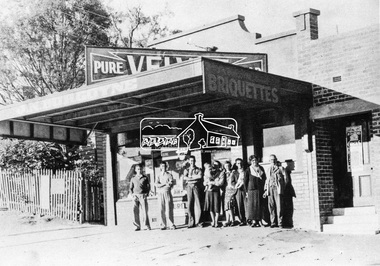
... The public telephone was initially mounted on the wall but later moved to the street. ...The public telephone was initially mounted on the wall but later moved to the street. ...The store built in 1925 was located on Main Road just south of Bridge Street (present day No. 820 Main Road). An extension was added to the right in 1939. The store was built in late 1925 at the same time as Mr C. Nicholls’s new store was constructed. Both were considered modern shops, and an improvement on most, business establishments of the time. Mr. Nicholls’s store included alongside it a modern, weatherboard villa residence. Mr. Burgoyne’s store incorporated the post and telegraph office, which was operated by John Neville Burgoyne’s half-aunt, Miss Anne Hunniford until her death in 1928 at which time J.N. Burgoyne became postmaster. The unsealed footpath in front is reasonably extensive as not visible is a concrete kerb and channel which was laid from the Post Office to John Street during Nov-Dec 1926. Footpath construction in front of Burgoyne’s store commenced August 1942. The extension to the right of the store was erected in 1939 for a new telephone exchange adjacent to the store and post office. A continuous telephone service operated by Mr Burgoyne and his family commenced operation 18 November 1939. Approximately 70 extensions were routed through the new exchange, 40 of which were transferred from the Greensborough Exchange. Entry to the exchange was via a separate door on Main Road or via the shop. The public telephone was initially mounted on the wall but later moved to the street. Cross Ref: 0701 of the store c.1934This photo forms part of a collection of photographs gathered by the Shire of Eltham for their centenary project book,"Pioneers and Painters: 100 years of the Shire of Eltham" by Alan Marshall (1971). The collection of over 500 images is held in partnership between Eltham District Historical Society and Yarra Plenty Regional Library (Eltham Library) and is now formally known as the 'The Shire of Eltham Pioneers Photograph Collection.' It is significant in being the first community sourced collection representing the places and people of the Shire's first one hundred years.Digital image 4 x 5 inch B&W Negshire of eltham pioneers photograph collection, burgoyne's shop, eltham, main road, post office, shops
