
Showing 8 items matching "wallpaper panels"
-
 Villa Alba Museum
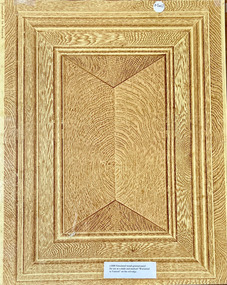
Wallpaper sample - Simulated wood grain dado panel, c.1880
... Wallpaper sample - Simulated wood grain dado panel......wallpaper panels...Heritage interiors Wallpapers 19th century design simulated woodgrain wallpaper panels 1880s P. In (w) Simulated woodgrain panel for use as a dado and marked "warranted to varnish" on the selvedge. ...Part of a collection of historic wallpapers collected by Phyllis Murphy, most of whose wallpapers were donated to the collection of Historic Houses Sydney. This wallpaper sample, annotated and encased in mylar was used by Phyllis for educational purposes, and donated by her son to Villa Alba Museum's collection in 2025.Simulated woodgrain panel for use as a dado and marked "warranted to varnish" on the selvedge. The design features a complex, radial grain pattern within a mitred corner frame. P. In (w)heritage interiors, wallpapers, 19th century design, simulated woodgrain, wallpaper panels, 1880s -
 Flagstaff Hill Maritime Museum and Village
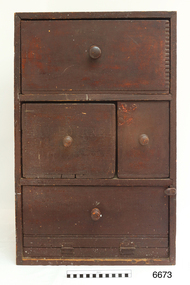
Furniture - Cupboard, c. 1890
... Cupboard is lined with newspaper and wallpaper. Panels on left side are braced by attaching a metal scraper. ...Cupboard is lined with newspaper and wallpaper. Panels on left side are braced by attaching a metal scraper. ...The materials used to build the colonial cupboard have been gathered from various sources and recycled. In those days, it was normal to keep all manner of items 'just in case' they could be repurposed for another item. The brand "Laurel" on one of the wooden panels is from the Mobil Oil company's kerosene. There In the words of the donor, Betty Stone, "Made by Ellis Dale of Latrigg Wangoom, Warrnambool c 1890. The cupboard consists of packing cases stamped with original brand names. One drawer made from a gelignite packing case is of special significance as the Dale family owned a bluestone quarry known as The Dale Bluestone Quarries at Wangoom situated about three miles east of Warrnambool. Ellis Dale, second son of William Dale and Elizabeth (nee Chamberlain) Dale, was born in Wangoom, Warrnambool on 21 November 1860. His father, William Dale, a quarryman from Saddleworth, Yorkshire migrated to Australia in 1852; seven years later - in 1859- he purchased the quarries on twenty acres of land situated in Wangoom at the corner of what is now known as Dales and Aberline Roads. Later, when his two eldest sons, William Jnr and Ellis, reached ten or eleven years of age they worked with their father in the quarries. The work was arduous and dangerous as gelignite was used to blast the bluestone. In 1890 Ellis Dale married Ann Lees, daughter of Lees and Sarah (nee Chamberlain) Lees of Wangoom, Warrnambool. Initially Ellis and Ann Dale resided in a two roomed bluestone cottage which Ellis built a little further up the hill from his parents' home on the Dale family property. A few years later, in order to accommodate their growing family, additional rooms were added making a spacious, comfortable weatherboard home situated in Dales Road which they named Latrigg. Ellis Dale constructed this cupboard soon after he and Ann first set up home in their little stone cottage in 1890. When the home was rebuilt, the home-made cupboard was moved into the larger kitchen, and although Latrigg was well furnished, it remained in the corner between the kitchen door and the large wood stove where it served its purpose very well as it was used for storing ironing utensils. The lower compartment with the hinged drop-door was designed to store the flat irons which were heated on the wood stove, while the ironing blanket and cover, iron holders and other items were stored in the drawers. The Dale quarrying and contracting business existed in Wangoom, Warrnambool for over eighty years as after William Dale’s death. Ellis Dale together with his son lvor, continued on until he died in 1940. (Note: For additional information please refer to Betty Stone’s book “Pioneers and Places - A History of three Warrnambool Pioneering Families” i.e. Chamberlain, Dale and Lees Families)This item is associated with families of Chamberlain, Dale and Lees. These families are listed in the "Pioneers' Register" for Warrnambool Township and Shire, 1835-1900, published by A.I.G.S. Warrnambool Branch.Cupboard, rare example of a Colonial Cupboard, wooden. Made by Ellis Dale from packing cases; several brand names are evident inc. Gelignite and Laurel. Cupboard is lined with newspaper and wallpaper. Panels on left side are braced by attaching a metal scraper. Comprises four compartments, three have round wooden handles, lower compartment has a hinged, drop down door. (From the Chamberlain, Dale and Lees Collection)Brands on wooden panels of cupboard include "Gelignite" and "Laurel" (Laurel is a brand of kerosene)flagstaff hill, warrnambool, shipwrecked coast, flagstaff hill maritime museum, maritime museum, shipwreck coast, flagstaff hill maritime village, great ocean road, chamberlain, dale, lees, stone, betty stone, warrnambool pioneers, dale bluestone quarries, wangoom, cupboard, colonial cupboard, furniture, gelignite, packing crate, ellis dale, laurel -
 Bendigo Military Museum
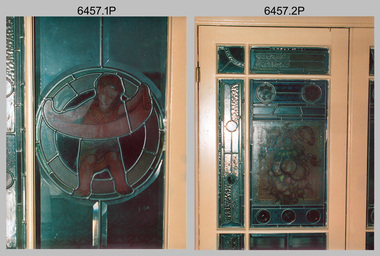
Photograph - Army Survey Regiment - Fortuna Interior, Bendigo, c1985
... panel wardrobe (concealed marble bath inside). .7) - Photo, colour, c1985. Fortuna Villa – Main bathroom’s solid cedar toilet chest and water pitcher set. .8) to .14) - Photo, colour, c1985. Fortuna Villa – Drawing Room bay leadlight windows. .15) to .16) - Photo, colour, c1985. Fortuna Villa – Cupola stairway leadlight windows. .17) - Photo, colour, c1985. Fortuna Villa – Dining/ballroom doorway with velvet wallpaper...panel wardrobe (concealed marble bath inside). .7) - Photo, colour, c1985. Fortuna Villa – Main bathroom’s solid cedar toilet chest and water pitcher set. .8) to .14) - Photo, colour, c1985. Fortuna Villa – Drawing Room bay leadlight windows. .15) to .16) - Photo, colour, c1985. Fortuna Villa – Cupola stairway leadlight windows. .17) - Photo, colour, c1985. Fortuna Villa – Dining/ballroom doorway with velvet wallpaper ...This set of 22 photographs was taken inside Army Survey Regiment’s Fortuna Villa circa 1985. The photos feature some of Fortuna Villa’s interior. Unfortunately, the magnificent array of colours and hand-painted features of Fortuna’s leadlight windows are not highlighted with light transmission, as the photographer did not take the photos in the daytime. See item 6456.30P, for photos of Fortuna Villa’s exterior and The Army Survey Regiment’s out-buildings that were taken at the same time.This set of 22 photographs was taken inside Army Survey Regiment’s Fortuna Villa circa 1985. The colour photographs were printed on photographic paper and are part of the Army Survey Regiment’s Collection. The photographs were scanned at 300 dpi. .1) & .2) - Photo, colour, c1985. Fortuna Villa – Reception/Music Room leadlight windows. .3) - Photo, colour, c1985. Fortuna Villa – Entrance foyer door and leadlight windows. .4) - Photo, colour, c1985. Fortuna Villa – Entrance foyer vaulted ceiling. .5) - Photo, colour, c1985. Fortuna Villa – Dressing Room bay leadlight windows. .6) - Photo, colour, c1985. Fortuna Villa – Dressing Room wood panel wardrobe (concealed marble bath inside). .7) - Photo, colour, c1985. Fortuna Villa – Main bathroom’s solid cedar toilet chest and water pitcher set. .8) to .14) - Photo, colour, c1985. Fortuna Villa – Drawing Room bay leadlight windows. .15) to .16) - Photo, colour, c1985. Fortuna Villa – Cupola stairway leadlight windows. .17) - Photo, colour, c1985. Fortuna Villa – Dining/ballroom doorway with velvet wallpaper. .18) - Photo, colour, c1985. Fortuna Villa – Dining/ballroom. .19) - Photo, colour, c1985. Fortuna Villa – Billiard room’s timber vaulted ceiling. .20) & .21) - Photo, colour, c1985. Fortuna Villa – Top floor nursery samples of original wallpaper. .22) - Photo, colour, c1985. Fortuna Villa – Top floor ballroom/gymnasium’s elaborate vaulted ceiling.There are brief descriptions on a note behind each photograph.royal australian survey corps, rasvy, army survey regiment, army svy regt, fortuna, asr -
 Villa Alba Museum
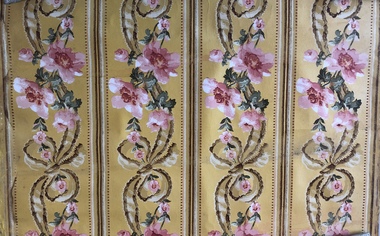
Decorative object - Wallpaper sample : Roses and bows
... These include artefacts (wallpapers, textiles, carpet samples), furnishings, printed materials (catalogues, books, periodicals), and pictures (photographs). decorative arts & design wall coverings – history wallpapers – history interior decoration – history Sections of a dado featuring a vertical design of roses and bows within bordered narrow panels. ...The Villa Alba Museum is cultural institution committed to the collection, study and display of 19th century interior decorative finishes, and the components of 19th and 20th century interior decoration. These include artefacts (wallpapers, textiles, carpet samples), furnishings, printed materials (catalogues, books, periodicals), and pictures (photographs).Sections of a dado featuring a vertical design of roses and bows within bordered narrow panels. The colourway includes shades of pink for the roses, green for the leaves, and brown for the bows, against a solid yellow background. The white of the backing paper is used within the design to create an illusion of depth in the pattern.decorative arts & design, wall coverings – history, wallpapers – history, interior decoration – history -
 Villa Alba Museum
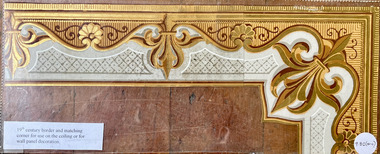
Wallpaper sample - Border and matching corner, 19th century
... wallpapered ceilings P. B2 (m-c) 19th century border and matching corner for use as architectural detailing on a ceiling or for wall panel decoration. ...Part of a collection of historic wallpapers collected by Phyllis Murphy, most of whose wallpapers were donated to the collection of Historic Houses Sydney. This wallpaper sample, annotated and encased in mylar was used by Phyllis for educational purposes, and donated by her son to Villa Alba Museum's collection in 2025.19th century border and matching corner for use as architectural detailing on a ceiling or for wall panel decoration. The pattern includes: whiplash curves, botanical inspiration and geometric accents. The central motif resembles a stylised flowerer lily. The flanking diamond mesh pattern (lattice style) provide a structured contrast to the central figure. The middle of the design, to be used as a dado or on a ceiling, simulates varnished planks of wood. P. B2 (m-c)heritage interiors, wallpapers, 19th century design, wallpaper borders, wallpaper corners, wallpapered ceilings -
 Villa Alba Museum
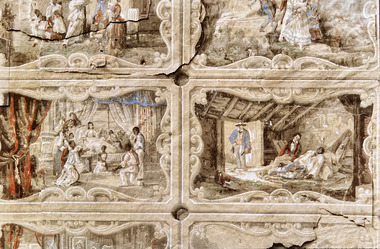
Wallpaper sample - Historical scene, c.1850
... Heritage interiors Wallpapers 19th century interior design Narrative panels Uncle Tom's Cabin Uncle Tom's Cabin wallpaper (Black Rock House) reconstructed from fragments by PCM Wallpaper sample - Historical scene ...Part of a collection of historic wallpapers collected by Phyllis Murphy, most of whose wallpapers were donated to the collection of Historic Houses Sydney. This wallpaper sample, annotated and encased in mylar was used by Phyllis for educational purposes, and donated by her son to Villa Alba Museum's collection in 2025.Uncle Tom's Cabin wallpaper (Black Rock House) reconstructed from fragments by PCMheritage interiors, wallpapers, 19th century interior design, narrative panels, uncle tom's cabin -
 Villa Alba Museum
Wallpaper sample - Narrative scene, mid 19th century
... Heritage interiors Wallpapers 19th century design architectural friezes classical motif Narrative panels Wallpaper sample featuring scenes adapted from Harriet Beecher Stowe's 1852 anti-slavery novel, Uncle Tom's Cabin. ...Part of a collection of historic wallpapers collected by Phyllis Murphy, most of whose wallpapers were donated to the collection of Historic Houses Sydney. This wallpaper sample, annotated and encased in mylar was used by Phyllis for educational purposes, and donated by her son to Villa Alba Museum's collection in 2025.Wallpaper sample featuring scenes adapted from Harriet Beecher Stowe's 1852 anti-slavery novel, Uncle Tom's Cabin. The scenic/narrative printed wallpaper comprised of visual vignettes depicting various characters and narrative moments from the highly influential novel. heritage interiors, wallpapers, 19th century design, architectural friezes, classical motif, narrative panels -
 Villa Alba Museum
Wallpaper sample - Narrative scene, mid 19th century
... Heritage interiors Wallpapers 19th century design architectural friezes classical motif Narrative panels Wallpaper sample featuring scenes adapted from Harriet Beecher Stowe's 1852 anti-slavery novel, Uncle Tom's Cabin. ...Part of a collection of historic wallpapers collected by Phyllis Murphy, most of whose wallpapers were donated to the collection of Historic Houses Sydney. This wallpaper sample, annotated and encased in mylar was used by Phyllis for educational purposes, and donated by her son to Villa Alba Museum's collection in 2025.Wallpaper sample featuring scenes adapted from Harriet Beecher Stowe's 1852 anti-slavery novel, Uncle Tom's Cabin. The scenic/narrative printed wallpaper comprised of visual vignettes depicting various characters and narrative moments from the highly influential novel. heritage interiors, wallpapers, 19th century design, architectural friezes, classical motif, narrative panels
