
Showing 6 items matching "wandin football club"
-
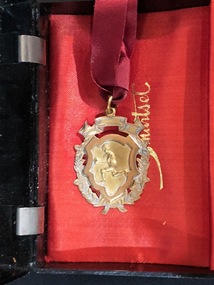 Mont De Lancey
Medals, 1929
... Gold coloured Wandin Football club medallion with red ribbon....King 1929" Gold coloured Wandin Football club medallion with red ribbon. Medals ...Warded to Mr. C. King for most improved player under 21 years, 1929 Season.Gold coloured Wandin Football club medallion with red ribbon."W.F.C. Most Improved Player Under 21 Years C. King 1929" -
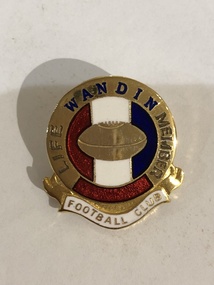 Mont De Lancey
Medal
... Wandin Football Club Life Member...Gaudion in 1963 Wandin Football Club Life Member Round gold, red, white and blue lacquer medal. ...Awarded to L. Gaudion in 1963Round gold, red, white and blue lacquer medal.Wandin Football Club Life Member -
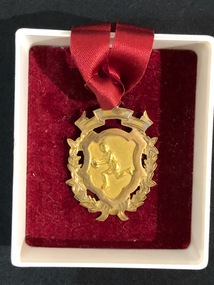 Mont De Lancey
Medallion, 1929
... Gold Medallion from Wandin Football Club attached to red ribbon, in a white plastic box with red felt....Gold Medallion from Wandin Football Club attached to red ribbon, in a white plastic box with red felt. ...Gold Medallion from Wandin Football Club attached to red ribbon, in a white plastic box with red felt."W.F.C. Most Improved Player F. Gaudion 1929."sports medals -
 Emerald Museum & Nobelius Heritage Park
Photograph - Emerald Football Club, 1977, Unknown maker, 1977
... ...wandin football club...football oval, watched by seven spectators including a junior player in uniform. Three umpires are also featured in the image as the moment of play pictured involves a high tackle. Cars, trees and facilities such as spectator stands and club buildings are visible in the background. Notes on the reverse of the image indicate this photograph depicts the 1977 Preliminary Grand Final between the Emerald and Wandin...The Emerald Football Club is still active in the area; the Wandin Football Club appears to have been active until at least 2019. ...Emerald Football Club was formed in 1905, one of the first teams in the Mountain District Football Association (renamed the Yarra Valley Mountain District Football League in 1967). The club has changed its official colours three times, playing firstly under blue and white colours, then green and gold before adopting the red and black colours shown in the photograph and still used today. The club has also been known variously as the 'Emites', the 'Redlegs' and the current 'Bombers.' A joint Australian Football League (AFL) and La Trobe University Centre for Sport and Social Impact study discusses the importance of local football teams for fostering community cohesion and relationships and distributing information and health and social issues to local people. Local football and other sporting teams are integral to the economic and social development of an area and are therefore significant far beyond the immediate players or families associated with the club.The photograph is significant for its insights into the history of sports and recreation in the Emerald region in the 1970s. It depicts a key moment between the Emerald Football Club (the 'Bombers') and Wandin Football Club (the 'Bulldogs'). The Emerald Football Club is still active in the area; the Wandin Football Club appears to have been active until at least 2019. Australian Rules Football has a long history in the region and played a fundamental role in community life.Colour rectangular photograph printed on photographic paper. The photograph depicts four men playing Australian Rules Football at a suburban football oval, watched by seven spectators including a junior player in uniform. Three umpires are also featured in the image as the moment of play pictured involves a high tackle. Cars, trees and facilities such as spectator stands and club buildings are visible in the background. Notes on the reverse of the image indicate this photograph depicts the 1977 Preliminary Grand Final between the Emerald and Wandin teams. The reverse of the image lists players Kevin Spence and Syd Jinnette and umpires Ted Meyer and Stan Morris.Reverse: in / 8 / 8 / 1977 Preliminary Final Yea / Emerald V Wandin / Kevin Spence / Syd Jinnette / Umpires / Ted Meyer / Stan Morris /1970s, clubs, associations, societies, sports, australian rules football, bombers, wandin football club, bulldogs, umpiring, kevin spence, syd jinnette, ted meyer, stan morris -
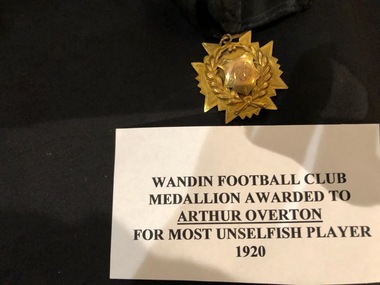 Mont De Lancey
Medal, 1920
... Most Unselfish player awarded by Wandin Football Club to Arthur Overton in 1920....Most Unselfish player awarded by Wandin Football Club to Arthur Overton in 1920. sports medals "Presented by W.F.C. ...Most Unselfish player awarded by Wandin Football Club to Arthur Overton in 1920.Gold 'star burst' shape medal attached to shield shaped medal by a gold ring, with a black ribbon"Presented by W.F.C. Most Unselfish Player 1920"sports medals -
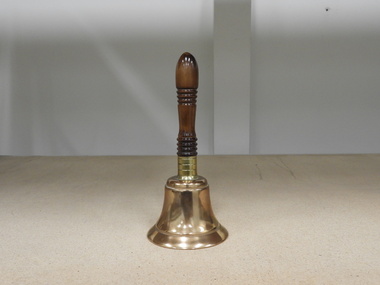 Carlton Football Club
Hand Held Bell, Hand Held Bell with a small inscription on the inside
... Wandin property to come home. Why Al chimes in for Carlton Tony De Bolfo, Carlton Media Feb 20, 2014 11:05AM Alan Espie with the famous bell. (Photo: Carlton Football Club ...The bell was used for Trade Week to signify "time's up" at Optus Oval. Prior to this it was used to let Alan Espie's children on their Wandin property to come home.Why Al chimes in for Carlton Tony De Bolfo, Carlton Media Feb 20, 2014 11:05AM Alan Espie with the famous bell. (Photo: Carlton Football Club) Alan Espie with the famous bell. (Photo: Carlton Football Club) Related Etched into the rim of the bell Alan Espie has rung at every trade week gathering since 1994 is a touching quote attributed to his grandson. Dear Pa, May you always ring true blue, Love Harry Just thinking about that inscription often brings big Al to tears. The story of the Espie bell has its origins at the old family property at Wandin in the picturesque Yarra Valley, in the days when the Espies’ kids were at the neighboring creek fossicking for local platypus. “If they got too far away we’d ring an old cowbell,” Espie recalled, “and years later, my daughter Jo brought me this replacement bell from some second-hand naval place”. “Not long after Shane (O’Sullivan) asked me to officiate at trade week and that’s when the bell came into vogue.” A permanent fixture at trade week, Espie would ring the bell to signal the opening of trading when club recruiters gathered – initially within the confines of the Carlton Heroes Stand at Visy Park, more recently at Etihad Stadium. In those early days at Carlton he caused a stir as bell ringer, drawing curious responses from officiating journalists, recruiters and coaches alike. “I even remember (Kevin) Sheedy asking me if I was selling muffins,” he recalled. Then, when trade day was relocated to Etihad, Espie’s daughter thought it appropriate to get the bell inscribed. “Because the bell was leaving Carlton, Jo got it inscribed on my grandson’s behalf, because he was only four or five then. When I saw what was inscribed I was tearful,” Espie said. “The bell is very important to me, particularly at this time, because Jo is battling health problems at the moment, my grandson is autistic and she’s fought like hell to get him through.” Espie joined Carlton’s Under 19 committee on the eve of the senior Premiership season of 1979 and managed the club’s junior squads, the Bert Deacon Squad included. “I worked very closely with Geoff Southby, ‘Swan’ McKay and Trevor Keogh when they were coaching the Under 19s and I was recruiting as well,” he said. “In 1981 and ’82 I forward scouted for ‘Parko’ (David Parkin) and later on I did the same for ‘Wallsy’ (Robert Walls). After that I coordinated recruiting in central Victoria and it was nothing for me to do 25,000ks a year in my own car – and I loved every minute of it.” Espie’s passion for Carlton and empathy for its wartime players Bert Deacon, Ollie Grieve and Jack “Chooka” Howell can be sourced to his childhood years. His grandparents lived not far from the old ground on Wilson Street “and that’s how I got in for the ’45 Grand Final”. “My uncle, who had just got back from the war, grabbed a ladder from Wilson Street and set it up against the barbed wire fence at the ground. I climbed the ladder and caught my arm on the barbed wire, but I got over the top and saw the game while I straddled the fence,” Espie said. “What I saw was what you would today call ‘spotfires’ and I reckon it took football 20 years to get rid of it.” Today, Espie continues to ring in the yearly trade talk days at AFL headquarters (with the notable exception of 2012 when he was hospitalized), but he’s in no doubt as to where the bell belongs. “This bell has had nothing to do with Wandin but everything to do with Carlton - and with the 150th year of the club I think the bell stays here (at Visy Park). I still hope to ring the bell for the AFL this year, but at least I’ll know where it is,” Espie said. “I’ve told Jo about this and she tells me Harry’s rapt, because he’s a big Carlton supporter and he’s so happy his name is on the bell.”Wooden handle attached to a brass bell."Dear Pa, may you always ring true blue, Love Harry"
