
Showing 9 items matching "war service homes act"
-
 Bendigo Military Museum
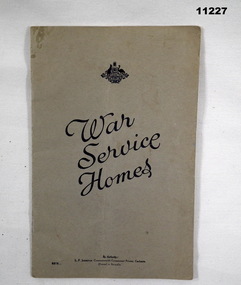
Booklet - WAR SERVICE HOMES, PROVISIONS OUTLINE, War Service Homes Division, An Outline of the Provisions of the War Service Homes Act, 1918-1949, 1949
... An Outline of the Provisions of the War Service Homes Act, 1918-1949.......War Service Homes Act...Booklet outlines the provisions for loans under the War Service Homes Act 1918-1949. Part of the Staley Collection. ...Booklet outlines the provisions for loans under the War Service Homes Act 1918-1949. Part of the Staley Collection. ...Booklet outlines the provisions for loans under the War Service Homes Act 1918-1949. Part of the Staley Collection. See Cat. No. 10758,2P for details of the Staley Collection.A5 sized booklet with gray coloured card cover. Pages attached with two metal staples. Text on cover below Australian Coat of Arms. All in black, 21 pages with cut edges. Text on pages in black type.staley collection, war service homes act, booklet -
 Orbost & District Historical Society
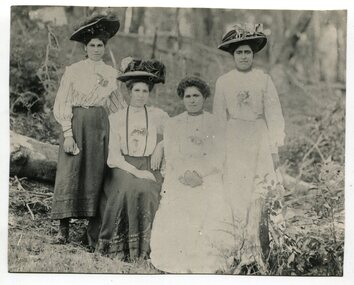
black and white photograph, late 19th century - early 20th century
... act George and Agnes had to leave the reserve along with their nine girls. They moved to Newmerella, situated outside the township of Orbost. This was the place that George and his wife and children came to call home. Soon after, George and Agnes would add to their family bringing the total of children to fourteen, the last five of whom were boys. At the time of the First World War George’s boy’s volunteered their services...act George and Agnes had to leave the reserve along with their nine girls. They moved to Newmerella, situated outside the township of Orbost. This was the place that George and his wife and children came to call home. Soon after, George and Agnes would add to their family bringing the total of children to fourteen, the last five of whom were boys. At the time of the First World War George’s boy’s volunteered their services ...This is a photograph of the four daughters of Mrs George Thomas. L -R : Elleen Parsons, Julia Eaton, Eva Murray and Violet Gay. George Thomas and Gtranny Thomas lived at Newmerella on Grand View Road until the 1950's. In the Newmerella Koorie Community, there were about 15 families. The family was a very well-respected local Aboriginal family. . George was a stockman for Jas Stirling. From Colin Thomas "I learned that George Thomas was Kitty Johnson’s oldest son. As a young boy George had been found by the Reverend John Bulmer, in addition to other young Aboriginal children in the bush around the Lake Tyers area. He had gathered them all together and took them onto the reserve at the Mission. After quite a number of years had passed George had met and fallen in love with a young half-caste girl, known as Agnes Patterson. Agnes was of Monaro descent and came from New South Wales. George and Agnes got married at Lake Tyers. Because of the half-caste act George and Agnes had to leave the reserve along with their nine girls. They moved to Newmerella, situated outside the township of Orbost. This was the place that George and his wife and children came to call home. Soon after, George and Agnes would add to their family bringing the total of children to fourteen, the last five of whom were boys. At the time of the First World War George’s boy’s volunteered their services and joined the army. When in Europe one of the boys sustained an injury which caused the loss of an arm. Following the end of the war the boys came home, as men." The Thomas family was a well-respected family in Newmerell in the late 19th and first half of the 20th century. The daughter were well known for their needlework and craft skills.A black / white photograph of four women wearing log skirts / dresses and elaborate hats, two sitting on a log and two standing on either side.thomas-family newmerella koori-family -
 Vision Australia
Audio (sub-item) - Sound recording, Marjorie West, Guest of the Week: Keith Glover, 13 December 2001
... War interrupted this plan, and he joined the Army and became a 2 man act with Happy Hammond, as part of the Entertainment Unit which was part of the platoon. After service in PNG, he returned home...War interrupted this plan, and he joined the Army and became a 2 man act with Happy Hammond, as part of the Entertainment Unit which was part of the platoon. After service in PNG, he returned home ...Marjorie West interviews Keith Glover, a broadcaster with 3LO, ABC, Radio Australia and RPH. He speaks of his early life in Sydney and his passion for radio, slightly delayed with his father insisting that he obtain a tertiary education beforehand. War interrupted this plan, and he joined the Army and became a 2 man act with Happy Hammond, as part of the Entertainment Unit which was part of the platoon. After service in PNG, he returned home to a contract with the ABC in Queensland later joined by his wife Gwyneth. In 1955, the family moved to Melbourne and he was chosen to be one the announcers for the Melbourne Olympic Games. A small stint as a newsreader for the ABC, a compere for the ABC dance band on Songs that Sold a Million, a televised version of a Glee club, Kindergarten of the Year radio show with Ann Dryer, the popular Mailbag program which generated hundreds of letters each week, and talking magazine narrator are among the many and varied jobs he did during his career. Recorded on 13 December 2001.keith glover, marjorie west -
 Wodonga & District Historical Society Inc
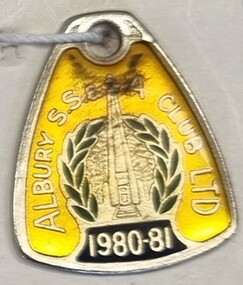
Badge - Membership Albury S.S & A, Perfection Badges, 1980 - 1981
... home. Instead of a memorial hall, the idea of a licensed club gained favour. This was to be not merely for RSL men who had served overseas, but for many ex-servicemen who had not left Australia. Using the Memorial Hall Fund, the RSL bought the old Commercial Club buildings at 611 Dean Street, which had been a Service Rest Room throughout the war and up to February 1946. The SS&A Club was formally opened in October 1946 and was registered under the Liquor Act...home. Instead of a memorial hall, the idea of a licensed club gained favour. This was to be not merely for RSL men who had served overseas, but for many ex-servicemen who had not left Australia. Using the Memorial Hall Fund, the RSL bought the old Commercial Club buildings at 611 Dean Street, which had been a Service Rest Room throughout the war and up to February 1946. The SS&A Club was formally opened in October 1946 and was registered under the Liquor Act ...The Albury Sailors, Soldiers and Airmen’s Club traces its origins back to the Albury and District War Services Hall Appeal Committee. This group of the World War I diggers, service groups and parents of men serving in World War II set out to raise 14,000 pounds for a Services Memorial Hall. After the war ended, the Memorial Hall Fund was far short of its target. Also, different attitudes prevailed when the boys came home. Instead of a memorial hall, the idea of a licensed club gained favour. This was to be not merely for RSL men who had served overseas, but for many ex-servicemen who had not left Australia. Using the Memorial Hall Fund, the RSL bought the old Commercial Club buildings at 611 Dean Street, which had been a Service Rest Room throughout the war and up to February 1946. The SS&A Club was formally opened in October 1946 and was registered under the Liquor Act in 1947. The foundation stone of the new building in Olive Street was laid by Lt General Sir John Northcott, May 2, 1959. The building was opened July 15,1960 by Governor of NSW, Sir Eric Woodward. It has since undergone many extensions and developments to become a modern facility but still continues to honour its origins with the inclusion of its War MemorialThis badge is representative of the role played by licensed clubs in the local community.Enamelled membership badges for the S.S & A. Club in Albury. Many people from both Albury and Wodonga hold membership the club which provides employment and social activities for people from both sides of the Murray RIver.Red Badge, around the centre image of the Albury War Memorial: "ALBURY S.S.& A CLUB LTD/ 1981-82" On reverse: "MEMBER/NOT TRANSFERABLE/2302/PERFECTION BADGES/SYDNEY/770775" Yellow Badge, around the centre image of the Albury War Memorial: "ALBURY S.S.& A CLUB LTD/ 1980-81"albury s.s & a club, social clubs, licensed clubs albury -
 City of Greater Bendigo - Civic Collection
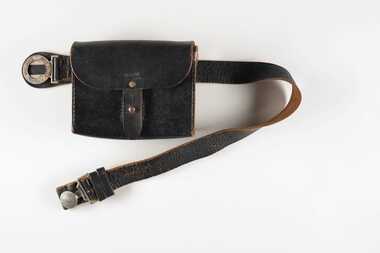
Uniform - Telegram Satchel
... War 2, the rise of the internet in the 1990s and the widespread installation of the telephones in homes saw the need for telegrams to greatly decline. When the Commonwealth Post and Telegraph Act was passed in June 1902, and a national Postmaster General's Department (the PMG) was established the responsibility for the nation's mail and telephone services fell on Post Offices. ...War 2, the rise of the internet in the 1990s and the widespread installation of the telephones in homes saw the need for telegrams to greatly decline. When the Commonwealth Post and Telegraph Act was passed in June 1902, and a national Postmaster General's Department (the PMG) was established the responsibility for the nation's mail and telephone services fell on Post Offices. ...Electrical telegraphs were point to point text messaging systems primarily used from the 1840's until the late 20th century. It was the first electrical telecommunications system and were sent by an operator or telegrapher using Morse code. Social telegrams were also encouraged and special pictorial forms and envelopes were designed such as the special purple form and envelope which was used when conveying condolence details during World War 2.(fn. Powerhouse https://collection.powerhouse.com.au/object/163103). There was a brief resurgence in telegraphy during World War I but the decline continued as the world entered the Great Depression years of the 1930s. Although telegraph lines continued to play an important part in distributing news feeds from news agencies post World War 2, the rise of the internet in the 1990s and the widespread installation of the telephones in homes saw the need for telegrams to greatly decline. When the Commonwealth Post and Telegraph Act was passed in June 1902, and a national Postmaster General's Department (the PMG) was established the responsibility for the nation's mail and telephone services fell on Post Offices. The Bendigo Post Office, built in 1887 and situated on Pall Mall was the central distribution centre for receiving and delivering telegrams and continued to deliver communication and postal services until 1997. Now a Visitor Centre, dedicated volunteers at the Post Office continued to demonstrate and educate the public about telegraphic services and the development of this unique form of communication up until 2019 when Covid 19 disrupted every day life, coupled with the death Ted Rankins (the last Post Master and a long term telegraph volunteer at the Post Office). This satchel was used by Junior Postal Workers in Bendigo to carry telegrams which were delivered by bicycle in the early years and is part of the postal collection donated by the Rankins family in memory of Ted. Small, dark coloured rectangle, leather satchel with attached belt and ornate buckle. Satchel is made of four pieces of leather: two side pieces, one piece which is folded to create the front, bottom, back and flap and one piece for the central strap. The central strap has a single hole through which a metal toggle is inserted to secure the flap closed. Stitching is evident around the side seams, around the metal toggle and inside flap where strap is attached and has been reinforced. Satchel has four metal tabs to secure the top front to the top sides and an internal pocket on inside. The leather belt is attached to the back outside of the satchel with four metal press studs. The left side buckle also has reinforced stitching. Both sides of the buckle have decorative elements with the words Post Office / Communications/ Australia on the left side around outer circular edge. Underside of right side of buckle end has the words AROS pressed into it. Inside flap of satchel; Australia / Post / Telegram / Boys written in marker. Buckle; Post Office / Communications / Australia. Underside of right side of buckle end; AROS Internal; Gold address sticker with Ted Rankins contact details.ted rankins collection, bendigo post office, bendigo tourism, city of greater bendigo tourism, post office collection -
 City of Greater Bendigo - Civic Collection
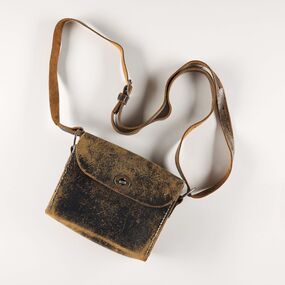
Uniform - Telegram Satchel
... War 2, the rise of the internet in the 1990s and the widespread installation of the telephones in homes saw the need for telegrams to greatly decline. When the Commonwealth Post and Telegraph Act was passed in June 1902, and a national Postmaster General's Department (the PMG) was established the responsibility for the nation's mail and telephone services fell on Post Offices. ...War 2, the rise of the internet in the 1990s and the widespread installation of the telephones in homes saw the need for telegrams to greatly decline. When the Commonwealth Post and Telegraph Act was passed in June 1902, and a national Postmaster General's Department (the PMG) was established the responsibility for the nation's mail and telephone services fell on Post Offices. ...Electrical telegraphs were point to point text messaging systems primarily used from the 1840's until the late 20th century. It was the first electrical telecommunications system and were sent by an operator or telegrapher using Morse code. Social telegrams were also encouraged and special pictorial forms and envelopes were designed such as the special purple form and envelope which was used when conveying condolence details during World War 2.(fn. Powerhouse https://collection.powerhouse.com.au/object/163103). There was a brief resurgence in telegraphy during World War I but the decline continued as the world entered the Great Depression years of the 1930s. Although telegraph lines continued to play an important part in distributing news feeds from news agencies post World War 2, the rise of the internet in the 1990s and the widespread installation of the telephones in homes saw the need for telegrams to greatly decline. When the Commonwealth Post and Telegraph Act was passed in June 1902, and a national Postmaster General's Department (the PMG) was established the responsibility for the nation's mail and telephone services fell on Post Offices. The Bendigo Post Office, built in 1887 and situated on Pall Mall was the central distribution centre for receiving and delivering telegrams and continued to deliver communication and postal services until 1997. Now a Visitor Centre, dedicated volunteers at the Post Office continued to demonstrate and educate the public about telegraphic services and the development of this unique form of communication up until 2019 when Covid 19 disrupted every day life, coupled with the death Ted Rankins (the last Post Master and a long term telegraph volunteer at the Post Office). This satchel was used by Junior Postal Workers in Bendigo to carry telegrams which were delivered by bicycle in the early years. Small, rectangle, leather satchel with attached shoulder strap and buckle. Satchel is made of five pieces of leather: two side pieces, one piece which is folded to create the front, bottom, back and flap and two small pieces to hold strap ring. The flap has a single hole through which a metal toggle is inserted to secure the flap closed. Satchel has four metal tabs to secure the top front to the top sides and an internal pocket on inside. The leather strap is attached to the top of the side seams of the satchel with circular metal rings and two metal press studs. Inside flap: Sticker with '540B'bendigo post office, bendigo tourism, city of greater bendigo tourism, making a nation exhibition, post office collection -
 City of Greater Bendigo - Civic Collection
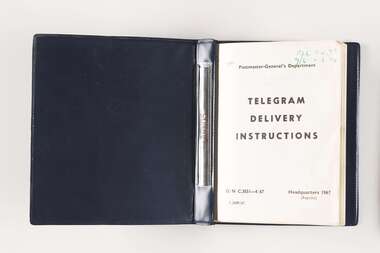
Manual, Post Master General's Department, Telegram Delivery Instructions, 1967
... War 2, the rise of the internet in the 1990s and the widespread installation of the telephones in homes saw the need for telegrams to greatly decline. When the Commonwealth Post and Telegraph Act was passed in June 1902, and a national Postmaster General's Department (the PMG) was established the responsibility for the nation's mail and telephone services fell on Post Offices. ...War 2, the rise of the internet in the 1990s and the widespread installation of the telephones in homes saw the need for telegrams to greatly decline. When the Commonwealth Post and Telegraph Act was passed in June 1902, and a national Postmaster General's Department (the PMG) was established the responsibility for the nation's mail and telephone services fell on Post Offices. ...Electrical telegraphs were point to point text messaging systems primarily used from the 1840's until the late 20th century. It was the first electrical telecommunications system and were sent by an operator or telegrapher using Morse code. Social telegrams were also encouraged and special pictorial forms and envelopes were designed such as the special purple form and envelope which was used when conveying condolence details during World War 2.(fn. Powerhouse https://collection.powerhouse.com.au/object/163103). There was a brief resurgence in telegraphy during World War I but the decline continued as the world entered the Great Depression years of the 1930s. Although telegraph lines continued to play an important part in distributing news feeds from news agencies post World War 2, the rise of the internet in the 1990s and the widespread installation of the telephones in homes saw the need for telegrams to greatly decline. When the Commonwealth Post and Telegraph Act was passed in June 1902, and a national Postmaster General's Department (the PMG) was established the responsibility for the nation's mail and telephone services fell on Post Offices. The Bendigo Post Office, built in 1887 and situated on Pall Mall was the central distribution centre for receiving and delivering telegrams and continued to deliver communication and postal services until 1997. Now a Visitor Centre, dedicated volunteers at the Post Office continued to demonstrate and educate the public about telegraphic services and the development of this unique form of communication up until 2019 when Covid 19 disrupted every day life, coupled with the death Ted Rankins (the last Post Master and a long term telegraph volunteer at the Post Office). This book was issued to Junior Postal Workers in Bendigo to guide them in the delivery of telegrams and designed to fit into their delivery satchels and carried while on the job. In the early years telegrams were delivered by bicycle and this manual is part of the postal collection donated by the Rankins family in memory of Ted. Small, blue, vinyl covered manual. Contains thirty printed pages covering all aspects of how to correctly deliver telegrams. Topics include 'Loss of telegram', 'Undelivered Telegram', 'special Delivery' and 'Beware of Dogs'. Bound with two ring metal clip. Front cover; Australian Post Office / Telecommunications Division / Telegram / Delivery / Instructions / Headquarters / 1962 Various annotations and updates throughout. ted rankins collection, bendigo post office, bendigo tourism, city of greater bendigo tourism, post office collection -
 City of Greater Bendigo - Civic Collection
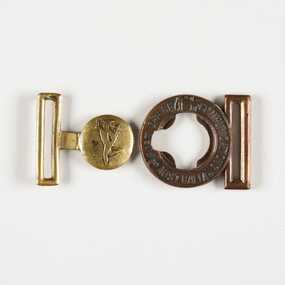
Uniform - Buckle from Telegram Satchel Belt, Post Master General's Department et al
... War 2, the rise of the internet in the 1990s and the widespread installation of the telephones in homes saw the need for telegrams to greatly decline. When the Commonwealth Post and Telegraph Act was passed in June 1902, and a national Postmaster General's Department (the PMG) was established the responsibility for the nation's mail and telephone services fell on Post Offices. ...War 2, the rise of the internet in the 1990s and the widespread installation of the telephones in homes saw the need for telegrams to greatly decline. When the Commonwealth Post and Telegraph Act was passed in June 1902, and a national Postmaster General's Department (the PMG) was established the responsibility for the nation's mail and telephone services fell on Post Offices. ...Electrical telegraphs were point to point text messaging systems primarily used from the 1840's until the late 20th century. It was the first electrical telecommunications system and were sent by an operator or telegrapher using Morse code. Social telegrams were also encouraged and special pictorial forms and envelopes were designed such as the special purple form and envelope which was used when conveying condolence details during World War 2.(fn. Powerhouse https://collection.powerhouse.com.au/object/163103). There was a brief resurgence in telegraphy during World War I but the decline continued as the world entered the Great Depression years of the 1930s. Although telegraph lines continued to play an important part in distributing news feeds from news agencies post World War 2, the rise of the internet in the 1990s and the widespread installation of the telephones in homes saw the need for telegrams to greatly decline. When the Commonwealth Post and Telegraph Act was passed in June 1902, and a national Postmaster General's Department (the PMG) was established the responsibility for the nation's mail and telephone services fell on Post Offices. The Bendigo Post Office, built in 1887 and situated on Pall Mall was the central distribution centre for receiving and delivering telegrams and continued to deliver communication and postal services until 1997. Now a Visitor Centre, dedicated volunteers at the Post Office continued to demonstrate and educate the public about telegraphic services and the development of this unique form of communication up until 2019 when Covid 19 disrupted every day life, coupled with the death Ted Rankins (the last Post Master and a long term telegraph volunteer at the Post Office). This belt buckle was used on the leather satchels used by Junior Postal Workers in Bendigo to carry telegrams which were delivered by bicycle in the early years. The buckle is part of the postal collection donated by the Rankins family in memory of Ted Rankins.Circular belt buckle from telegram delivery satchel belt. Inner buckle depicts the Greek deity Hermes who personifies the transmission of information and was adopted as an allegorical representation of the function of postal services. Outer buckle; Post Office / Communications / Australia. Centre top outer buckle; emu, kangaroo and shield Inner buckle; Hermes (left facing)bendigo post office, bendigo tourism, city of greater bendigo tourism, post office collection, ted rankins collection -
 The Beechworth Burke Museum
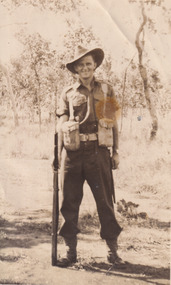
Photograph, c.1914
... service, alongside those who fell at Lagnicourt, is commemorated at the Australian National Memorial in Villers-Bretonneux, France along with other national Australian memorial sites. Photography played an important part in World War 1. Photographs of men in their military uniforms served as propaganda during the Great War to reassure civilians back at home of the military prowess of their nation and the bravery of their men. It did this while hiding the true horrors which faced the men in battle. These photographs, which includes those taken at home prior to embarking overseas like Fred Foster’s, act ...This photograph depicts a soldier, credited on the reverse as Fred Foster. The young man is dressed in military attire and is standing tall with a gun beside him. He is located in the Australian bush and the date of the photograph is unknown. Frederick “Fred” Arthur Foster was nephew to famous Bushranger Edward “Ned” Kelly. He was born on the 15th of March 1889 in Forbes, New South Wales. He was the eldest son of Catherine “Kate” Kelly and William Henry “Bricky” Foster. After the death of his mother in October of 1898 from apparent drowning, Foster (then aged 9) was raised by his grandmother Ellen Kelly (née Quinn) at Eleven Mile Creek in Victoria. On the 29th of June 1915, 26 year old Foster travelled to Melbourne, Victoria and enlisted in the Australian Army. He was a Private in the 17th Infantry Battalion (originally C.Company, 47th battalion). He previously was attached to the 55th Battalion but transferred in 1916. Prior to enlisting in the army, Foster worked as a Bee Keeper and served in the 16th Light Horse regiment at Benalla. Foster had blue eyes, brown hair and was of Presbyterian faith. On the 28th of February 1917, Foster travelled to France aboard SS “Golden Eagle”. He was killed in action in Lagnicourt, France on the 15th of April 1917 at 28 years old. The Battle in Lagnicourt France, on the Western Front, occurred from the 1st of March to the 30th of April of 1917 and was the location of fierce fighting between Germany and the British Empire. Germany became aware of a weakness they had along the Hindenburg Line, one of these weaknesses was located in Lagnicourt which is a small village in Northern France. Therefore, the Germans decided to launch a counter-attack in this area on the 15th of April at dawn. During this fight, German forces captured several batteries of the 1st Australian Division’s artillery but the Australians led a strong counter-attack by four of their battalions and recaptured the village and most of the guns from the German forces. German forces were forced into a premature withdrawal. This battle was not undertaken in typical WW1 “trench” style warfare. Instead, the battle was up on the ground in what was described as “old open style warfare”. In this battle, slightly more than 1000 casualties were Australian, with 300 of these prisoners of war. German forces suffered a loss of over 2300 casualties with 360 taken captive. Foster was one of 43 in his regiment who died, 87 were wounded and 51 reported missing. Foster was buried at location in Lagnicourt and whilst the grave was initially marked, it is now unknown. Foster’s service, alongside those who fell at Lagnicourt, is commemorated at the Australian National Memorial in Villers-Bretonneux, France along with other national Australian memorial sites.Photography played an important part in World War 1. Photographs of men in their military uniforms served as propaganda during the Great War to reassure civilians back at home of the military prowess of their nation and the bravery of their men. It did this while hiding the true horrors which faced the men in battle. These photographs, which includes those taken at home prior to embarking overseas like Fred Foster’s, act as censored memory for those who have lost a loved one at war. It enables families to remember their relatives in their youth and standing proudly rather than having to face the actual danger and horror which faced these men at the front line. The battle of Lagnicourt France was a victory for the European Empire and therefore, men who lost their lives protecting their countries became heroes and were awarded posthumous medals for their service. Photos of soldiers in their uniforms, were undertaken by men like Foster, so their families would be able to retain their memories and likeness before they embarked for war. Many men were killed or horribly wounded so these images were important for reminding families about their sons/ husbands/ brothers/ cousins and friends. This photo is a part of the Burke Museum Kelly album which includes numerous photographs relating to the Kelly Gang. As the son of Kate Kelly and William “Bricky” Foster, Fred Foster is an important part of the Kelly story after the execution of Edward “Ned” Kelly which has information it can impart relating to the history of the family after 1880. Whilst an important element of the Kelly Album, Foster’s photograph is also historically important in its own right for its connection to the Great War and the experiences of a soldier at the Western Front.Original sepia rectangular photograph developed on matte photographic paper, unmounted.Reverse: (Top right corner of reverse:) FRED FOSTER/ (Top centre of reverse:) Kate Kelly's son.kelly album, fred foster, kate kelly, photograph, australian soldier, the kelly gang, australian bush, burke museum, sepia photo, gum trees, family of the kelly gang, world war i, langnicourt, france, great war, 1917, ned kelly, frederick foster, william "bricky" foster, ellen kelly, military history, australian military
