
Showing 9 items matching "war service homes division"
-
 Federation University Historical Collection
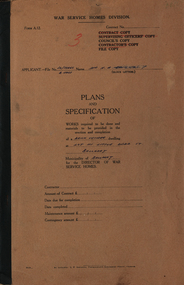
Booklet and Plans, Plans and Specification of Works ... at Lot 111 Little Dodd St, Ballarat, c1961, c1961
... war service homes division...War Service Homes Division...war service homes division little dodds street plans and specifications contract of sale tenancy agreement Ballarat Brown card cover on plans and specifications for a bick veneer dwelling in Little Dodd Street, Ballarat East. ...Brown card cover on plans and specifications for a bick veneer dwelling in Little Dodd Street, Ballarat East.war service homes division, little dodds street, plans and specifications, contract of sale, tenancy agreement, ballarat -
 Lara RSL Sub Branch
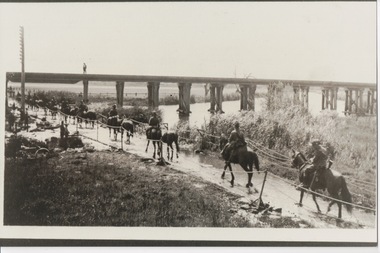
Photograph, Set 4 photographs. and others for Torquay Light Horse camp, 1940
... war. Training was increased for the militia at both home bases and regional training camps. The camp at Torquay in 1940, commanded by Major General Rankin, was at Divisional strength. By the end of the camp some felt that the Division was ready for active service...war. Training was increased for the militia at both home bases and regional training camps. The camp at Torquay in 1940, commanded by Major General Rankin, was at Divisional strength. By the end of the camp some felt that the Division was ready for active service ...These images capture for all time Light Horsemen travelling through Geelong on their way to camp at Torquay for the last Group meeting in Australia . information following - details obtained from .........https://torquayhistory.com/light-horse-brigade/ On Australia Day, 1997, Sir John Young unveiled this plaque on Point Danger, Torquay. Torquay history, Light Horse Training Camp, WW2 Plaque at Pt. Danger Note----- (See images to view plaque) The plaque identifies a significant event in Torquay’s history and the sentiments of ‘change’ for the Light Horse Brigade – from horses to machines. In 1940 the four Light Horse Regiments (4th, 8th, 13th and 20th), some 5000 Light Horse and 2000 horses camped and trained at Torquay. Three other regiments, formerly mounted on horses, were also at Torquay ‘mounted’ on privately owned trucks and cars. Division troops included Artillery, Engineers, Signals, Field Ambulance and other branches of the Army necessary to enable a Division to function. It wasn’t just the sheer numbers of men coming to this little town that made the event significant, it was also the fact that the men of the Light Horse were dramatic, almost glamorous figures and it is easy to see their exploits as some splendid adventure. Horses have played a special role in the story of Australia. They were the only means of transport across this huge country, so it was necessary for everyone to have the ability to ride a horse. When war broke out in 1899 between Britain and the Boers of South Africa (“Boer” was Dutch for “farmer”) Australia sent troops to fight. At first Britain was wary of using untried, unprofessional colonial cavalrymen but soon saw that the slouch-hatted Australian “bushmen” were a match for the fast-moving and unconventional mounted commandos of the Boers. The Australians proved themselves to be expert rough-riding horsemen and good shots. Bush life had hardened them to go for long periods with little food and water. They also showed remarkable ability to find their way in a strange country and use its features for cover, in both attack and defence. By 1914, when Australia joined the war against Germany, there were 23 Light Horse regiments of militia volunteers. Many men from these units joined the Light Horse regiments of the Australian Imperial Force (AIF). Men were given remounts (if not using their own horses) – army horses bought by Commonwealth purchasing officers from graziers and breeders. These were called “walers” because they were a New South Wales stockhorse type – strong, great-hearted animals with the strains of the thoroughbred and semi-draught to give them speed, strength and stamina. On 1st November, 1914, Australia’s First Infantry Division and the first four Light Horse regiments sailed for England in a fleet of transport ships. The first of the Light Horse arrived at Gallipoli in May without their horses. Back with their horses after Gallipoli, they were formidable combatants across the Sinai and Palestine. Some British commanders observed that the light horseman moved with a “lazy, slouching gait, like that of a sleepy tiger” but described how the promise of battle “changes that careless gait, into a live athletic swing that takes him over the ground much quicker than other troops”. They had Light Horse, Torquay, training campdeveloped a reputation as formidable infantrymen. The Turks called them “the White Ghurkas” – a reference to their deadly skill with the bayonet. The Arabs called them “The Kings of the Feathers”. The plume had originally been a battle honour of the Queensland Mounted Infantry for their work in the shearer’s strike of 1891. During WW1 it was adopted by almost all the Light Horse Regiments. It was the proud badge of the light horseman. The most famous of their battles was the attack on Beersheba- the charge of the 4th Light Horse Brigade. Mounted infantrymen and their superb walers had carried out one of the most successful cavalry charges in history – against what seemed impossible odds. They surprised the Turks by charging cavalry-style, when they would normally have ridden close to an objective then dismounted to fight. The fall of Beersheba swung the battle tide against the Turks in Palestine; and changed the history of the Middle East. While 19 men from the Surf Coast Shire served with the 4th Light Horse over the course of WW1, only four were involved in the charge of Beersheba- John GAYLARD, Philip QUINN.(Winchelsea); Wallace FINDLAY (Anglesea); Harry TRIGG (Bambra). After the war, Light Horse units played a key role in the Australian Government’s compulsory military training programme. The Citizen Military Forces (C.M.F.) thrived on the glamour of the wartime Light Horse tradition, ignoring the possibility that motor vehicles would soon replace the horses. When training was no longer compulsory, the C.M.F. regiments declined and horses became more of a luxury during the 1930s depression years of poverty and unemployment. Some regiments were motorised. Then, in 1939, Australia joined Britain in another world war. Training was increased for the militia at both home bases and regional training camps. The camp at Torquay in 1940, commanded by Major General Rankin, was at Divisional strength. By the end of the camp some felt that the Division was ready for active service. Gradually, over the next four years, the Australian Light Horse units were mounted on wheels and tracks and the horses were retired. Six men enlisted at the Torquay camp and another 57 men and women enlisted at Torquay for service in WW2. Those who served in the Militia provided valuable Officers and NCOs and men for the armed services during the war. Each infantry division of the 2nd AIF had a Light Horse regiment attached to it. But the day of the Australian mounted soldier hadn’t quite passed. During World War II, Australia’s 6th Cavalry Regiment formed a mounted unit they called “The Kelly Gang” which did valuable scouting work. In New Guinea, a mounted Light Horse Troop did patrol duty and helped carry supplies. Some fully equipped walers were flown into Borneo for reconnaissance in rugged mountain country. But by the end of the war, in 1945, the horse had disappeared from the Australian Army. References: Australian Light Horse Association www.lighthorse.org.au National Australia Archives Australian War Memorial Surf Coast Shire WW1 memorials www.togethertheyserved.com The Light horse- a Cavalry under Canvas Light Horse, Training Camp, Torquay, WW2 Late in 1939 it was decided to set up a Lighthorse training camp in Torquay to train both men and horses for the battles of the Second World War. Horses, men and equipment came on special trains from all over Victoria and NSW, and as you would expect horseman came from areas such as Omeo and Sale, the Wimmera and the Western District. They arrived at the Geelong racecourse for watering in the Barwon River and then were ridden across the ford at the breakwater and began their 11 mile trek to Torquay. Light Horse, Training Camp, Torquay, WW2 Tent city By the end of January 1940 the camp at Torquay accommodated some 5000 men and 2500 horses of the Second Cavalry Division. The rows of horses, tents and huts near Blackgate Road were quite a sight. While the cavalrymen engaged in exercises on the land and on the beaches, many of the troops took over the Torquay School for special training of men and officers. Mr Bob Pettit local farmer and Councillor for the Barrabool Shire, wrote about the Light horse in the Surf Coast Community News in 1985 saying “They used to travel about the district riding four abreast in one long convoy. To my annoyance they went through my property and shut all the gates behind them. I had certain gates open to let stock in to the water holes and it would take me three -quarters of an hour to follow the horsemen up and put all the gates right again” he continued “the men from the Light Horse were here when the fire went through in March 1940. He recalled an incident when early one morning, as some one blew the bugle, a soldier putting a white sheet on the line frightened the horses. They panicked and ran off in all directions. Six went over the cliff near Bird Rock, five were never found, and the rest were gathered up after nearly a fortnight in the bush around Addiscott and Anglesea" Light Horse, Training Camp, Torquay, WW2, Geelong Parade Geelong parade The training camp culminated in a parade through the streets of Geelong on March 12th 1940. The salute was given at the Town Hall and the troops continued on a route to the You Yang’s for a training exercise. Note-----(see media section for photograph) The Camp was abandoned in mid 1940 as it was deemed unsuitable for training during winter and the cost of a permanent camp could not be justified if it could not be used all year. Historic.......Rare,,,Interpretive.Sepia photographs.set of four ....post card size ....Horses &LighthorsemenNo 1, Lighthorsemen Regiment Geelong 1940......No 2 Light Horse at Breakwater Geelong 1938 to 1940....No 3 Light Horse at Breakwater Geelong 1938 to 1940.....No 4 Light Horse crossing Breakwater camped at Geelong Showgrounds. These markings are on reverse of photographs.light horsemengeelong 1940., world war 2 -
 Bendigo Military Museum
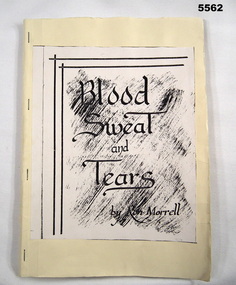
Book, Blood, Sweat and Tears
... Service in WW2 of Ron Morrell No.4985826 1/5 Sherwood Foresters, 18th Division. Joined in England and posted to Singapore where captured as POW and was at Changi. Diary was written in 1986. He later migrated to Australia. Refer Cat No. 316, 305P for details. Diary Changi WW2 POW Title on front "Blood, Sweat and Tears by Ron Morrell". Contents are all handwritten. Home made book of the Diary of Ron Morrell, from enlistment through being a Prisoner of War ...Diary outlining History of Service in WW2 of Ron Morrell No.4985826 1/5 Sherwood Foresters, 18th Division. Joined in England and posted to Singapore where captured as POW and was at Changi. Diary was written in 1986. He later migrated to Australia. Refer Cat No. 316, 305P for details.Home made book of the Diary of Ron Morrell, from enlistment through being a Prisoner of War to discharge. Yellow cardboard cover with title sheet glued on front. Four staples and 45 pages inside contain maps and history of service, all handwritten with some maps and sketches all in black and white.Title on front "Blood, Sweat and Tears by Ron Morrell". Contents are all handwritten.diary, changi, ww2, pow -
 Otway Districts Historical Society
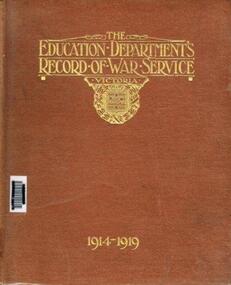
Book, Government Printer, The Education Department's Record of War Service, Victoria, 1914-1919, c.1921
... division employed by the Education Department. 146 died. But it was not only teachers who contributed to the war effort. Children and parents gave 400,000 articles of comfort sent abroad, contributed as a rough estimate 460 tons of supplies to hospitals at home, made contributions of £50,000 to The Young Workers' Patriotic Guild, and £217,419 for the war savings effort in the schools, and £422, 470 in general school subscriptions. great war wwi victoria education department victoria teachers enlistments honors decorations war service records first world war world war one This book, published to keep before teachers and children expamples of service and sacrifice in a great cause, is presented to the Hordern Vale School. ...From the beginning of World War 1 in August, 1914, until it ended in November, 1918, teachers from across Victoria enlisted for the Australian Imperial Force and embarked for overseas. Anzac, the Sinai Desert, the vast fields of France, and in Palestine the Education Department soldier-teachers toiled manfully thoughout. Of the 752 enlistments 724 were teachers, two were School Medical Officers, one was a School Nurse, one an Inspector of Schools, while the remaining 24 belonged to the clerical division employed by the Education Department. 146 died. But it was not only teachers who contributed to the war effort. Children and parents gave 400,000 articles of comfort sent abroad, contributed as a rough estimate 460 tons of supplies to hospitals at home, made contributions of £50,000 to The Young Workers' Patriotic Guild, and £217,419 for the war savings effort in the schools, and £422, 470 in general school subscriptions.Hardcover book, bound with brown cloth cover and gold embossed title containing 306 pages, black and white photographs and illustrations and text. This book, published to keep before teachers and children expamples of service and sacrifice in a great cause, is presented to the Hordern Vale School. It should be kept in an honoured place as a souirce of guidance and inspiration for successive generations.great war, wwi, victoria, education department victoria, teachers, enlistments, honors, decorations, war service records, first world war, world war one -
 Sunshine and District Historical Society Incorporated
Equipment - Jean Helen Bridges First Aid Box, Photograph and First Aid Books
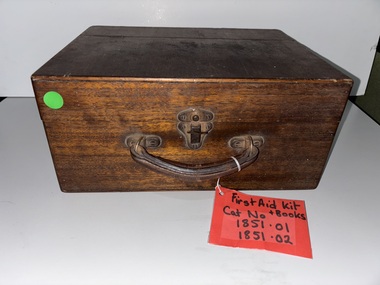
... division at Bondi Junction Theatre service helped people to bomb shelters. At Johns Ambulance, this First Aid Kit was used in World War II by Jean Helen Bridges. She was a member of St Johns Ambulance in Sydney during World War II, now in aged care but previously lived in St Albans First Aid Jean Helen Bridges 1851.01 - Wooden First Aid Box 1851.02 - First Aid To The Injured Book 1851.03 - Photo of Helen Bridges 1851.04 - Home Nursing Book Wooden First Aid Box with contents including First Aid To The Injured Book, Photo of Helen Bridges and Home Nursing Book Equipment Jean Helen Bridges First Aid Box, Photograph and First Aid Books ...Helen served in the ambulance division at Bondi Junction Theatre service helped people to bomb shelters. At Johns Ambulance, this First Aid Kit was used in World War II by Jean Helen Bridges. She was a member of St Johns Ambulance in Sydney during World War II, now in aged care but previously lived in St AlbansWooden First Aid Box with contents including First Aid To The Injured Book, Photo of Helen Bridges and Home Nursing Book1851.01 - Wooden First Aid Box 1851.02 - First Aid To The Injured Book 1851.03 - Photo of Helen Bridges 1851.04 - Home Nursing Bookfirst aid, jean helen bridges -
 Canterbury History Group
Booklet - Australian Comforts Fund Victorian Division, Australian Comforts Fund Victorian Division, June 1940
... 13 knitting patterns for those in active service World War 2 - June 1940 Knitting patterns from home to soldiers at war Knitting World War 2 1939-1945 Uniforms Australian Comforts Fund Victorian Division 19 pages Booklet Australian Comforts Fund Victorian Division Australian Comforts Fund Victorian Division Renwick Pride ...13 knitting patterns for those in active service World War 2 - June 1940Knitting patterns from home to soldiers at war 19 pages knitting, world war 2 1939-1945, uniforms, australian comforts fund victorian division -
 8th/13th Victorian Mounted Rifles Regimental Collection
Medal - WWI Iron Cross
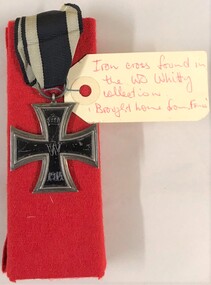
... Division and later transferred to Anzac Provost Corps with the Regt No 71. He was Mentioned in Dispatches in 1918 and awarded the Meritorious Service Medal in 1919. It is likely he brought the medal home as a souvenir of the war...Division and later transferred to Anzac Provost Corps with the Regt No 71. He was Mentioned in Dispatches in 1918 and awarded the Meritorious Service Medal in 1919. It is likely he brought the medal home as a souvenir of the war ...Warrant Officer Henry Whitty, a native of Tocumwal, enlisted at Cobram 2/1/1915 and was allocated to 13th Light Horse Regiment with Regt No 509. In France he was seconded to HQ 2nd Division and later transferred to Anzac Provost Corps with the Regt No 71. He was Mentioned in Dispatches in 1918 and awarded the Meritorious Service Medal in 1919. It is likely he brought the medal home as a souvenir of the war.Small fabric covered display board holding a German Iron Cross and a paper label explaining the provenance of the medal.On label "Iron Cross found in the WO Whitty collection. Brought home from France."iron cross, german, world war one, wwi, tocumwal, cobram, 13th, light horse, provost -
 Kew Historical Society Inc
Book, Brown, Prior, Anderson Pty Ltd, The Australian Soldiers' Pocket Book : Containing useful information for Australian soldiers, 1940
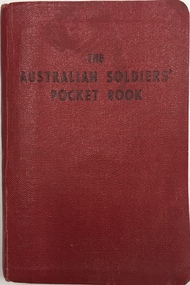
... war 1939-1945 hugh george ferguson Handwritten inside cover: "VX23812 / Hugh G. Ferguson / Palestine / 1.10.40" Handwritten Owner's details: Name "Ferguson, Hugh G."; Reg No. "VX81232"; Rank: "SGT"; Unit: "ADMIN HQ A.I.F."; Home Address: "16 Fellowes St Kew"; Next of Kin: "Wife"; Date of Birth: "24.6.1900"; Weight: "10st 6lbs"; Date: "1.10.40"; Height: "5ft 6ins" Booklet produced in 1940 for members of the 2nd AIF by the Australian Comforts Fund Victorian Division. The 128-page pocket-sized book could be carried everywhere and provided Australian soldiers with a wide range of useful information about the requirements of war service ...Booklet produced in 1940 for members of the 2nd AIF by the Australian Comforts Fund Victorian Division. The 128-page pocket-sized book could be carried everywhere and provided Australian soldiers with a wide range of useful information about the requirements of war service and many other important details such as: The Laws and Customs of War - including Geneva Convention guidelines, notes on spies and insignia of rank; Things a Soldier should Know - including over 60 points; Signaling - including flags, morse code, shipboard bell times and time zone; Decorations Awarded to Australians in the Great War; Arabic and Japanese words; First Aid for gas injuries etc.; Australian Historical Events, facts and figures etc.; and Conduct Overseas - including expectations of behaviour when representing Australia. non-fictionaustralian comforts fund (victoria), second world war 1939-1945, hugh george ferguson -
 Kew Historical Society Inc
Booklet, Australian Comforts Fund (Victorian Divsion), Voluntary War Workers Record, 1918
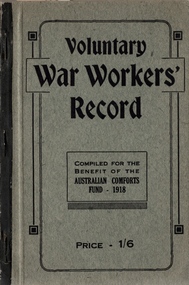
... Service Fund'; Australian Comforts Fund, Victorian Division; Victoria League of Western Australia. During World War II the state bodies were called : The Lord Mayor's Patriotic and War Fund of New South Wales; the Australian Comforts Fund, Victorian Division; the Australian Comforts Fund, Queensland Division; the Australian Comforts Fund, Tasmanian Division; the Fighting Forces Comforts Fund SA Inc; the Victoria League Camp Comforts Fund ( W A ) Australian Comforts Fund commissioners conducted its activities in the field, holding honorary rank as officers of the Army or Air Force. World War 1 publication for the home ...The Australian Comforts Fund was established in August 1916 to co-ordinate the activities of the state based patriotic funds, which were established earlier in World War I. Mainly run by women, they provided and distributed free comforts to the Australian 'fit' fighting men in all the battle zones. They became divisions of the Australian Comforts Fund. The Council of the Fund comprised two delegates from New South Wales, Victoria and Queensland and one from the states of Western Australia, South Australia and Tasmania. The Executive headquarters was located in Sydney. It ceased operation on 10 April 1920 and was reconstituted in World War II in June 1940 and ceased operation again on 27 June 1946. The state bodies in World War I were: New South Wales: the 'Citizens' 'War Chest' Fund; Queensland Patriotic Fund; South Australia: League of Loyal Women; Tasmania: 'On Active Service Fund'; Australian Comforts Fund, Victorian Division; Victoria League of Western Australia. During World War II the state bodies were called : The Lord Mayor's Patriotic and War Fund of New South Wales; the Australian Comforts Fund, Victorian Division; the Australian Comforts Fund, Queensland Division; the Australian Comforts Fund, Tasmanian Division; the Fighting Forces Comforts Fund SA Inc; the Victoria League Camp Comforts Fund ( W A ) Australian Comforts Fund commissioners conducted its activities in the field, holding honorary rank as officers of the Army or Air Force.World War 1 publication for the home front with Kew listingsVoluntary War Workers Record, compiled for the benefit of the Australian Comforts Fund - 1918. Price - 1/6. the publication includes sections on Kew.australian comforts fund, australian comforts fund (victoria)
