The Beechworth Burke Museum
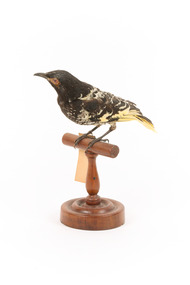
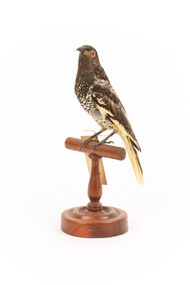
Animal specimen - Regent Honey-Eater, Trustees of the Australian Museum, 1860-1880
... ...warty-faced honey-eater...regent honeyeater...The Warty-faced honeyeater Formerly more widely distributed in south-eastern mainland Australia from Rockhampton, Queensland to Adelaide, South Australia, the Regent Honeyeater is now confined to Victoria and New South Wales, and is strongly associated with the western slopes of the Great Dividing Range. ...The striking Regent Honeyeater (Warty-faced honeyeater) has a black head, neck and upper breast, a lemon yellow back and breast scaled black, with the underparts grading into a white rump, black wings with conspicuous yellow patches, and a black tail edged yellow. ...Swing-tag:
56a. /
Warty-Faced Honeyeater /
See Catalogue, page 18...This collection continues to be on display in the Museum and has become a key part to interpreting the collecting habits of the 19th century. taxidermy mount taxidermy animalia burke museum beechworth australian museum skin reynell eveleigh johns bird australian bird honey-eater warty-faced honey-eater regent honeyeater critically endangered yellow Swing-tag:
56a. /
Warty-Faced Honeyeater /
See Catalogue, page 18 The striking Regent Honeyeater (Warty-faced honeyeater) has a black head, neck and upper breast, a lemon yellow back and breast scaled black, with the underparts grading into a white rump, black wings with conspicuous yellow patches, and a black tail edged yellow. ...
The Warty-faced honeyeater Formerly more widely distributed in south-eastern mainland Australia from Rockhampton, Queensland to Adelaide, South Australia, the Regent Honeyeater is now confined to Victoria and New South Wales, and is strongly associated with the western slopes of the Great Dividing Range. The Regent Honeyeater is found in eucalypt forests and woodlands, particularly in blossoming trees and mistletoe. It is also seen in orchards and urban gardens. This species is critically endangered. They are native to Southeastern Australia.
Specimen is mounted accurately. Colour around the eyes is red whereas they are yellow normally.
This specimen is part of a collection of almost 200 animal specimens that were originally acquired as skins from various institutions across Australia, including the Australian Museum in Sydney and the National Museum of Victoria (known as Museums Victoria since 1983), as well as individuals such as amateur anthropologist Reynell Eveleigh Johns between 1860-1880. These skins were then mounted by members of the Burke Museum Committee and put-on display in the formal space of the Museum’s original exhibition hall where they continue to be on display. This display of taxidermy mounts initially served to instruct visitors to the Burke Museum of the natural world around them, today it serves as an insight into the collecting habits of the 19th century. This specimen is part of a significant and rare taxidermy mount collection in the Burke Museum. This collection is scientifically and culturally important for reminding us of how science continues to shape our understanding of the modern world. They demonstrate a capacity to hold evidence of how Australia’s fauna history existed in the past and are potentially important for future environmental research.
This collection continues to be on display in the Museum and has become a key part to interpreting the collecting habits of the 19th century.The striking Regent Honeyeater (Warty-faced honeyeater) has a black head, neck and upper breast, a lemon yellow back and breast scaled black, with the underparts grading into a white rump, black wings with conspicuous yellow patches, and a black tail edged yellow. In males, the dark eye is surrounded by yellowish warty bare skin. Females are smaller, with a bare yellowish patch under the eye only, and have less black on the throat. Young birds resemble females, but are browner and have a paler bill. The colouring of this particular specimen helps identify it as male.Swing-tag:
56a. /
Warty-Faced Honeyeater /
See Catalogue, page 18taxidermy mount, taxidermy, animalia, burke museum, beechworth, australian museum, skin, reynell eveleigh johns, bird, australian bird, honey-eater, warty-faced honey-eater, regent honeyeater, critically endangered, yellow

 The Beechworth Burke Museum
 The Beechworth Burke Museum