
Showing 11 items matching "water dipper"
-
 City of Moorabbin Historical Society (Operating the Box Cottage Museum)
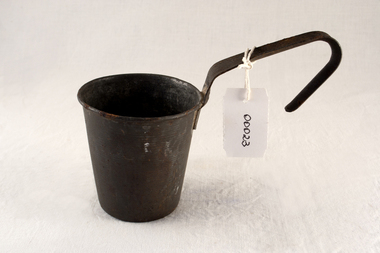
Functional object - Kitchen equipment, water-dipper, c1920
... Kitchen equipment, water-dipper...A pump was built to draw water for use by the family and this tin dipper would have been used for drinking water. ...A tin water-dipper for obtaining drinking water from water pump...The Lachlan Mackinnon family were early settlers in Moorabbin Shire Early settlers had to sink wells on their land and build water pumps in order to obtain water. This tin dipper would have been used for drinking at the water pump . ...Early settlers could only obtain clean water by sinking a well on their land. A pump was built to draw water for use by the family and this tin dipper would have been used for drinking water. The Lachlan Mackinnon family were early settlers in Moorabbin ShireEarly settlers had to sink wells on their land and build water pumps in order to obtain water. This tin dipper would have been used for drinking at the water pump . In 1846 Lachlan and Charles Mackinnon bought 117 acres of land in the 'Dendy's Special Survey' from J.B.Were This area is now known as the suburb of 'McKinnon' and may have been named after them.A tin water-dipper for obtaining drinking water from water pumpmoorabbin, wells, water supply, pioneers, ormond, bentleigh, mckinnon, market gardeners, early settlers, kitchen equipment, water pumps, mackinnon jessie, mackinnon donald, mackinnon lachlan, mackinnon charles, mackinnon daniel -
 Tatura Irrigation & Wartime Camps Museum
Domestic object - Dipper, 1940's
... ...water dipper...Made by internees at Camp 3, Tatura and used there as a domestic utensil/water dipper or dispenser....Made by internees at Camp 3, Tatura and used there as a domestic utensil/water dipper or dispenser. dipper tatura ww2 camp 3 domestic utensils Camp 3 internees water dipper Handmade galvanised metal cylindrical dipper with handle Dipper Domestic object Dipper ...Made by internees at Camp 3, Tatura and used there as a domestic utensil/water dipper or dispenser.Handmade galvanised metal cylindrical dipper with handledipper, tatura, ww2 camp 3, domestic, utensils, camp 3 internees, water dipper -
 Williamstown Historical Society Inc
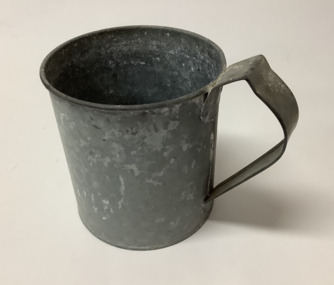
Domestic object - "Willow" water dipper, 1928
... "Willow" water dipper ...Small galvanized iron dipper with soldered handle, mainly for transferring water...."Willow" Small galvanized iron dipper with soldered handle, mainly for transferring water. Domestic object "Willow" water dipper ...This galvanized iron dipper was made by the "Willow" company, in the 1920's. The company was founded by Ralph and Richard, sons of Ralph Wilson, Sen., (c.1826 - 14/6/1901), with start-up capital from their parents. They began making tin cans in 1887 and constructed a factory in North Melbourne, and established the "Willow" brand in the 1920s, making Coolgardie safes, billies and other metal cookware, and became W.M.Y and A.H Wilson Ltd.Small galvanized iron dipper with soldered handle, mainly for transferring water."Willow" -
 City of Moorabbin Historical Society (Operating the Box Cottage Museum)
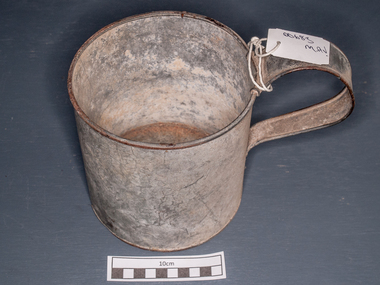
Laundry Equipment, tin dipper, c1930
... These tin dippers were used on washing day for carrying water as required...c1930 A tin dipper for water, probably used in the Laundry...These tin dippers were used on washing day for carrying water as required This tin dipper is a reminder of wash days when women used coppers, wringers, mangles, large troughs and clothes lines before the introduction of washing machines and clothes dryers. pioneers early settlers market gardeners moorabbin brighton cheltenham laundry c1930 A tin dipper for water, probably used in the Laundry Laundry Equipment, tin dipper Unrecorded person ...These tin dippers were used on washing day for carrying water as requiredThis tin dipper is a reminder of wash days when women used coppers, wringers, mangles, large troughs and clothes lines before the introduction of washing machines and clothes dryers.c1930 A tin dipper for water, probably used in the Laundrypioneers, early settlers, market gardeners, moorabbin, brighton, cheltenham, laundry -
 Greensborough Historical Society
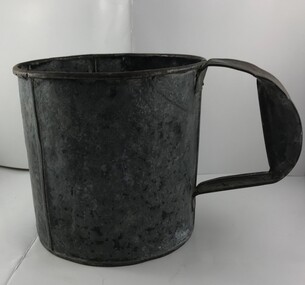
Domestic object - Laundry dipper, Galvanised laundry dipper, 1930c
... Used in laundry to transfer "dippers" of water from one vessel to another, such as removing hot water from a laundry copper....Used in laundry to transfer "dippers" of water from one vessel to another, such as removing hot water from a laundry copper. laundry dipper laundry equipment Galvanised steel container with handle. ...Used in laundry to transfer "dippers" of water from one vessel to another, such as removing hot water from a laundry copper.Galvanised steel container with handle.laundry dipper, laundry equipment -
 Flagstaff Hill Maritime Museum and Village
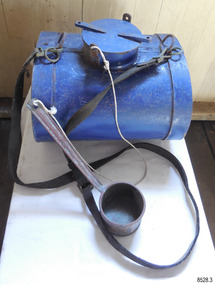
Equipment - Water Canteen and Ladle, mid-to-late 19th century
... dipper...canteen and ladle...water...Flagstaff Hill Maritime Museum and Village Flagstaff Hill Maritime Museum Maritime Village Warrnambool Great Ocean Road Lady Bay shipwreck life-saving lifesaving rescue crew rescue rocket rescue rocket crew lifeboat men beach rescue line rescue rescue equipment volunteer lifesavers volunteer crew life saving rescue crew lifesaving rescue crew rocket apparatus survival canteen rescue canteen dipper cup canteen and dipper canteen and ladle water canteen Water canteen and ladle; blue painted oval metal cylinder with a removable round threaded lid. ...The horizontal water canteen has been carefully designed to fit snugly on the hip when worn with the straps diagonally across the body. The ladle allows quick and easy scooping of the contents to refresh the lifeboat and rocket launching crew, and the survivors of the disaster Saving lives in Warrnambool – The coastline of South West Victoria is the site of over 600 shipwrecks and many lost lives; even in Warrnambool’s Lady Bay there were around 16 known shipwrecks between 1850 and 1905, with eight lives lost. Victoria’s Government responded to the need for lifesaving equipment and, in 1858, the provision of rocket and mortar apparatus was approved for the lifeboat stations. In 1859 the first Government-built lifeboat arrived at Warrnambool Harbour and a shed was soon built for it on the Tramway Jetty, followed by a rocket house in 1864 to safely store the rocket rescue equipment. In 1878 the buildings were moved to the Breakwater (constructed from 1874-1890), and in 1910 the new Lifeboat Warrnambool arrived with its ‘self-righting’ design. For almost a hundred years the lifesaving and rescue crews, mostly local volunteers, trained regularly to rehearse and maintain their rescue skills. They were summoned when needed by alarms, gunshots, ringing bells and foghorns. In July 1873 a brass bell was erected at Flagstaff Hill specifically to call the rescue crew upon news of a shipwreck. Some crew members became local heroes but all served an important role. Rocket apparatus was used as recently as the 1950s. Rocket Rescue Method - The Government of Victoria adopted lifesaving methods based on Her Majesty’s Coast Guard in Great Britain. It authorised the first line-throwing rescue system in 1858. Captain Manby’s mortar powered a projectile connected to a rope, invented in 1808. The equipment was updated to John Dennett’s 8-foot shaft and rocket method that had a longer range of about 250 yards. From the 1860s the breeches buoy apparatus was in use. The apparatus was suspended on a hawser line and manually pulled to and from the distressed vessel carrying passengers and items. In the early 1870s Colonel Boxer’s rocket carried the light line, which was faked, or coiled, in a particular way between pegs in a faking box to prevent twists and tangles when fired. The angle of firing the rocket to the vessel in distress was measured by a quadrant-type instrument on the side of the rocket machine. Decades later, in about 1920, Schermuly invented the line-throwing pistol that used a small cartridge to fire the rocket. The British Board of Trade published instructions for both the beach rescue crew and ship’s crew. It involved setting up the rocket launcher on shore at a particular angle measured by the quadrant, inserting a rocket that had a lightweight line threaded through its shaft, and then firing it across the stranded vessel, the line issuing freely from the faking board. A tally board was then sent out to the ship with instructions in four languages. The ship’s crew would haul on the line to bring out the heavier, continuous whip line, then secure the attached whip block to the mast or other sturdy part of the ship. The rescue crew on shore then hauled out a stronger hawser line, which the ship’s crew fixed above the whip block. The hawser was then tightened using the block on the shore end of the whip. The breeches buoy and endless whip are then attached to the traveller block on the hawser, allowing the shore crew to haul the breeches buoy to and from the vessel, rescuing the stranded crew one at a time. Beach apparatus equipment - In the mid-1800s the equipment could include a line throwing set, coiled line in wooden carrying case, rockets, cartridges, breeches buoy, hawser and traveller block, line-throwing pistol, beach cart, hand barrow, sand anchor, crotch pole, and tools such as spade, pick, mallet and hawser cutter. Around the 1860s Warrnambool had a Rocket House installed beside the Harbour. This water canteen is significant for its connection with local history, maritime history and marine technology. Lifesaving has been an important part of the services performed from Warrnambool's very early days, supported by State and Local Government, and based on the methods and experience of Great Britain. Hundreds of shipwrecks along the coast are evidence of the rough weather and rugged coastline. Ordinary citizens, the Harbour employees, and the volunteer boat and rescue crew, saved lives in adverse circumstances. Some were recognised as heroes, others went unrecognised. In Lady Bay, Warrnambool, there were around 16 known shipwrecks between 1850 and 1905. Many lives were saved but tragically, eight lives were lost.Water canteen and ladle; blue painted oval metal cylinder with a removable round threaded lid. Two adjustable leather shoulder straps are attached to the canteen through metal rings on the sides of the lid. A blue-painted copper ladle with a fixed, 45-degree angled handle is attached to the canteen with a length of string. The water canteen is designed to be carried horizontally.flagstaff hill maritime museum and village, flagstaff hill, maritime museum, maritime village, warrnambool, great ocean road, lady bay, shipwreck, life-saving, lifesaving, rescue crew, rescue, rocket rescue, rocket crew, lifeboat men, beach rescue, line rescue, rescue equipment, volunteer lifesavers, volunteer crew, life saving rescue crew, lifesaving rescue crew, rocket apparatus, survival canteen, rescue canteen, dipper, cup, canteen and dipper, canteen and ladle, water canteen -
 Bendigo Historical Society Inc.
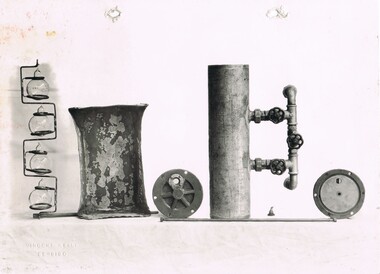
Photograph - BILL ASHMAN COLLECTION: FOUR BUOY HOUSE UNIT
... After a few weeks treatment by pouring in a dipper full of Scalebuoy Water daily the results of the process can be seen. ...After a few weeks treatment by pouring in a dipper full of Scalebuoy Water daily the results of the process can be seen. ...Black and white photo by Vincent Kelly. Typed on the back: Four Buoy house unit. Dish in picture is an old iron dish which has been used for fowls to drink out of. The photo speaks for it self. After a few weeks treatment by pouring in a dipper full of Scalebuoy Water daily the results of the process can be seen. Note the patches where the scale formations have been removed. The photographer's name - Vincent Kelly Bendigo is imprinted in the bottom left corner.sciences, instruments - general, scalebuoy, bill ashman collection - correspondence, four buoy house unit, vincent kelly -
 Whitehorse Historical Society Inc.
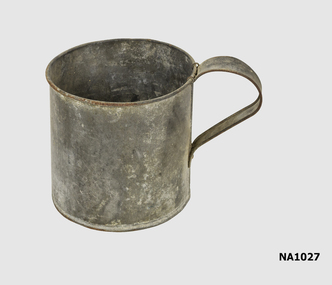
Functional object - Dipper
... Metal dipper used in laundry for ladling water....DOMESTIC ITEMS Cleaning Metal dipper used in laundry for ladling water. Functional object Dipper ...Metal dipper used in laundry for ladling water.domestic items, cleaning -
 Kew Historical Society Inc
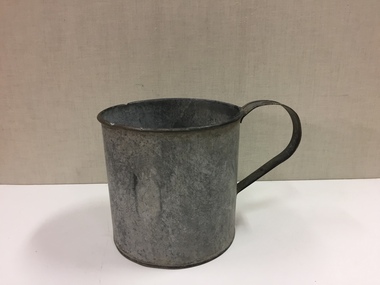
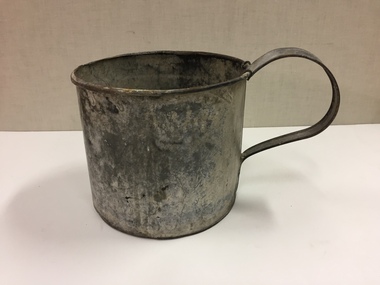
Equipment, Galvanised Iron Laundry Dipper, 20th Century
... A dipper was used to transfer clean water to the wash tub...A dipper was used to transfer clean water to the wash tub laundry dipper household objects Cylindrical galvanised iron laundry dipper with handle. ...A dipper was used to transfer clean water to the wash tubCylindrical galvanised iron laundry dipper with handle.laundry dipper, household objects -
 Kew Historical Society Inc
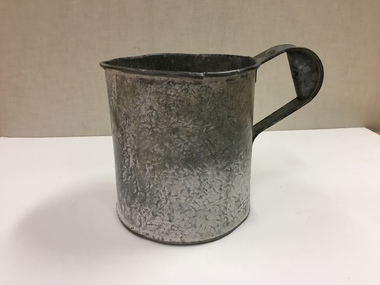
Equipment, Galvanised Iron Laundry Dipper, 20th Century
... A dipper was used to transfer clean water to the wash tub...A dipper was used to transfer clean water to the wash tub laundry equipment laundry dippers galvanised iron objects Cylindrical galvanised iron laundry dipper with handle. ...A dipper was used to transfer clean water to the wash tubCylindrical galvanised iron laundry dipper with handle.laundry equipment, laundry dippers, galvanised iron objects -
 Kew Historical Society Inc
Equipment, Galvanised Iron Laundry Dipper, 20th Century
... A dipper was used to transfer clean water to the wash tub...A dipper was used to transfer clean water to the wash tub laundry dippers laundry equipment hand-washing Cylindrical galvanised iron laundry dipper with handle. ...A dipper was used to transfer clean water to the wash tubCylindrical galvanised iron laundry dipper with handle.laundry dippers, laundry equipment, hand-washing
