
Showing 65 items matching "water tapping"
-
 Marysville & District Historical Society
THE TRIANGLE NEWS-VOL 2 NO 35-NOVEMBER 11 1977
... ...water tapping...marysville victoria australia wirreanda a winner water tapping debutante ball photos super bags marysville senior citizens debutante ball bingo community care centre for sale boyles rainfall open house manuel's waterworks trust auction fire brigade scouts kindergarten roster 1st marysville l.a. wanted to buy golf church of england missionary sunday crossways restaurant cricket THE TRIANGLE NEWS-VOL 2 NO 35-NOVEMBER 11 1977 ...marysville, victoria, australia, wirreanda a winner, water tapping, debutante ball photos, super bags, marysville senior citizens, debutante ball, bingo, community care centre, for sale, boyles, rainfall, open house, manuel's, waterworks trust, auction, fire brigade, scouts, kindergarten roster, 1st marysville l.a., wanted to buy, golf, church of england missionary sunday, crossways restaurant, cricket -
 City of Moorabbin Historical Society (Operating the Box Cottage Museum)
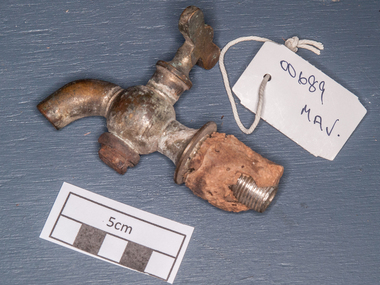
Tools, small brass water tap, c1900
... Tools, small brass water tap...c1900 Water tap, small brass...This Water tap is typical of those used by early settlers in Moorabbin Shire early settlers pioneers market gardeners moorabbin bentleigh brighton cheltenham tools metal workers plumbers c1900 Water tap, small brass Tools, small brass water tap early settler ...This Water tap is typical of those used by early settlers in Moorabbin Shire c1900 Water tap, small brassearly settlers, pioneers, market gardeners, moorabbin, bentleigh, brighton, cheltenham, tools, metal workers, plumbers -
 Stawell Historical Society Inc
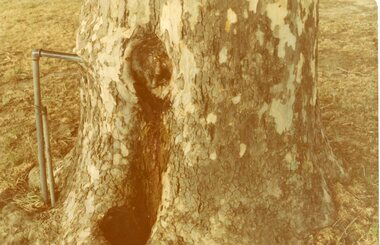
Photograph, Central Park Tree with Water Tap, C 1960's 2012
... Central Park Tree with Water Tap...Central Park –Tree with Water Tap...Central Park Tree with Water Tap Photograph ...Central Park –Tree with Water TapFour (4) Colour Photographs of a tree with a Water pipe embedded in it. One older and smaller than the other three.stawell, central park -
 Nhill Aviation Heritage Centre
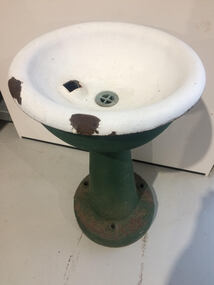
Memorabilia - Water bubble drinker, c1940s
... Cast iron drinker stand and basin white enamel coated with one square hole for water bubble tap and one drain fitting. ...This drinker was purchased by Walter Dart from the RAAF clearance sale on the aerodrome after the war. drinker bubble basin stand walter dart bubbler dart Cast iron drinker stand and basin white enamel coated with one square hole for water bubble tap and one drain fitting. Memorabilia Water bubble drinker ...This drinker was purchased by Walter Dart from the RAAF clearance sale on the aerodrome after the war.Cast iron drinker stand and basin white enamel coated with one square hole for water bubble tap and one drain fitting. drinker bubble, basin, stand, walter dart, bubbler, dart -
 Stawell Historical Society Inc
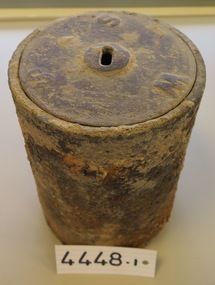
Memorabilia - Realia
... Stawell Water Supply – Steel, Pipe/Tap Cover...Stawell Stawell Water Supply – Steel, Pipe/Tap Cover Memorabilia Realia ...Stawell Water Supply – Steel, Pipe/Tap Coverstawell -
 Bendigo Historical Society Inc.
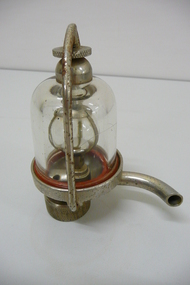
Tool - BENDIGO ELECTRONIC COMPANY SCALEBUOY, 1940 - 1950
... Its essential part is a sealed glass bulb containing a small amount of mercury and a combination of gases.This particular variety was made to be connected to a water tap with a screw attachment and a small outlet pipe. ...Its essential part is a sealed glass bulb containing a small amount of mercury and a combination of gases.This particular variety was made to be connected to a water tap with a screw attachment and a small outlet pipe. ...Invented by a member of the Abbott family of Bendigo, scalebuoys came in various sizes and had a variety of uses such as the mining industry to prevent scale build up in boilers, automotive for car radiators and domestic for water purification. Its essential part is a sealed glass bulb containing a small amount of mercury and a combination of gases.This particular variety was made to be connected to a water tap with a screw attachment and a small outlet pipe. Scalebuoy sent to Alan Cowling from work colleague, Pat Curran in Tasmania. Pat Curran was working as the CEO of a retirement village and found the scalebuoys in the equipment there. Noting the Bendigo manufacturing logo, he decided to send it to Alan. The original owner of the scalebuoys is unknown.sciences, instruments - general, scalebuoy -
Maldon Vintage Machinery Museum Inc
Steam Engine, Estimated late 19th century
... Boiler is not sound so engine is connected to an independent steam/air source to be operated for display purposes. 150 cm flywheel on LHS looking forward toward the front. Brass water drain tap on firebox. Also other brass fittings on firebox. ...Boiler is not sound so engine is connected to an independent steam/air source to be operated for display purposes. 150 cm flywheel on LHS looking forward toward the front. Brass water drain tap on firebox. Also other brass fittings on firebox. ...Large 4 wheeled single cylinder (horizontal) steam engine designed to be towed. Fire box painted black, boiler and steam cylinder green, wheels red. Boiler is not sound so engine is connected to an independent steam/air source to be operated for display purposes. 150 cm flywheel on LHS looking forward toward the front. Brass water drain tap on firebox. Also other brass fittings on firebox. Cast brass disc with red background fixed high on firebox :- "Marshal Sons & Co. / Made expressly / to the order / Shut, No. 45781, Open / of / Robison Bros / South Melbourne." "10017" raised in relief on firebox door. machinery; engines; steam power source -
 Friends of Westgarthtown
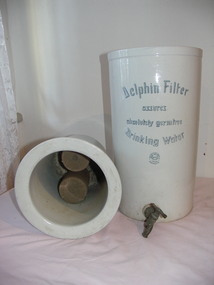
Functional object - Water filter
... Glazed earthernware white cylindrical water filter with brass tap at base and blue writing printed on front above tap. ...Glazed earthernware white cylindrical water filter with brass tap at base and blue writing printed on front above tap. ...Glazed earthernware white cylindrical water filter with brass tap at base and blue writing printed on front above tap. Filter has two pieces- outer cylinder with tap and internal cylinder with two filters inside.Printed on front "Delphin Filter assures absolutely germfree Drinking Water". Circular trademark reads, "Delphin Filter Company, Vienna, Made in Austria."domestic items, food and drink consumption, water, delphin, vienna, austria, germfree, filter, drinking water. -
Maldon Vintage Machinery Museum Inc
Steam Engine, 1877
... Timber front turntable and back brake pad assembly. Brass water drain tap on firebox. Also other brass fittings on firebox....Timber front turntable and back brake pad assembly. Brass water drain tap on firebox. Also other brass fittings on firebox. ...Restored by Maldon Flywheelers Association. Originally owned and used by Zemster Brothers of "Brook Mount" Shellbourne.Known as "Aunty Jack"Large 4 wheeled 9 HP single cylinder (horizontal) steam engine, designed to be towed. Front wheels smaller than rear. Folding smoke stack with spark arrestor. Fire box and smoke stack painted black, boiler and steam cylinder green, wheels grey. In working order but engine is connected to an independent steam/air source to be operated for display purposes. 150 cm flywheel on LHS looking forward toward the front. Timber front turntable and back brake pad assembly. Brass water drain tap on firebox. Also other brass fittings on firebox.On brass ring near top of firebox:- "Serial No. 5672, Marshal Sons & Co. / Limited / Engineers / Gainsborough England". Metal plate on front turntable:- "Restoration of the Front Undercarriage / and retubing of the boiler by / Castlemaine Technical School / 1979". Cast in relief on wheel hubs:- "Marshal Sons & Co. Gainsborough".machinery - engines - steam -
Ballarat Tramway Museum
Ephemera - Tramcar Internal Roof Ad, State Electricity Commission of Victoria (SECV), "Buy a BRIQUETTE hot water service", about 1960
... Buy a BRIQUETTE hot water service" with a tap in the bottom left hand corner, and steam on bottom edge - Birnie Briquette sign & hand holding two sixpences - 1959 or coins....Buy a BRIQUETTE hot water service" with a tap in the bottom left hand corner, and steam on bottom edge - Birnie Briquette sign & hand holding two sixpences - 1959 or coins. ...Heavy cardboard sheet with printed sheet pasted to one side advertising Briquettes for Hot Water. "Pay less money for more hot water!" Buy a BRIQUETTE hot water service" with a tap in the bottom left hand corner, and steam on bottom edge - Birnie Briquette sign & hand holding two sixpences - 1959 or coins.secv, advertisements, briquettes -
 Bendigo Historical Society Inc.
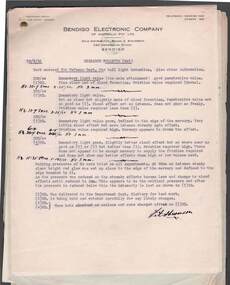
Document - BILL ASHMAN COLLECTION: CORRESPONDENCE
... Items include Tail light invention for Defence Dept. 18/9/41, Heat of glass, Refractive Index Tests on Melbourne Tap Water 31/7/42, Research Data, Manufacture of the Buoys 18/1/43, Specifications 1/12/42, List of substances with their Atomic No., Symbol, Atomic Weight, Melting Point and Year of discovery and a hand drawn diagram for an experiment. ...Items include Tail light invention for Defence Dept. 18/9/41, Heat of glass, Refractive Index Tests on Melbourne Tap Water 31/7/42, Research Data, Manufacture of the Buoys 18/1/43, Specifications 1/12/42, List of substances with their Atomic No., Symbol, Atomic Weight, Melting Point and Year of discovery and a hand drawn diagram for an experiment. ...Group of paper pinned together of various experiments. Items include Tail light invention for Defence Dept. 18/9/41, Heat of glass, Refractive Index Tests on Melbourne Tap Water 31/7/42, Research Data, Manufacture of the Buoys 18/1/43, Specifications 1/12/42, List of substances with their Atomic No., Symbol, Atomic Weight, Melting Point and Year of discovery and a hand drawn diagram for an experiment. Bendigo Electronic Company of Australia Pty Ltdsciences, instruments - general, scalebuoy, bill ashman collection - correspondence, bendigo electronic company of australia pty ltd, defence dept, capt slattery, f a stevenson -
 Bendigo Historical Society Inc.
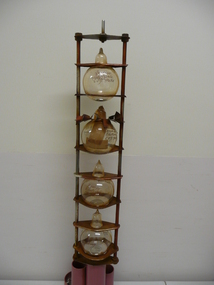
Tool - BILL ASHMAN COLLECTION: MULTIPLE SCALEBUOY
... An electromagnetic apparatus containing mercury, promoted for its ability to convert ordinary tap water in the home into therapeutic bathing and drinking water with healing powers related to a wide range of medical conditions. ...An electromagnetic apparatus containing mercury, promoted for its ability to convert ordinary tap water in the home into therapeutic bathing and drinking water with healing powers related to a wide range of medical conditions. ...Four scalebuoys stacked above each other in a metal frame one with a copper turbine arrangement on top. An electromagnetic apparatus containing mercury, promoted for its ability to convert ordinary tap water in the home into therapeutic bathing and drinking water with healing powers related to a wide range of medical conditions. The scalebuoy was also sold for a remarkably diverse list of other uses and benefits. Invented by Richard Hartley Smith Abbott, a well known Bendigo businessman following World War 1.Bendigo Electronic Coy Patd A.C. Scalebuoysciences, instruments - general, scalebuoy, bendigo-history-inventions-business-abbott -
 Falls Creek Historical Society
Document - Circular To Prospective Builders - Recent Policy Decision Of Committee
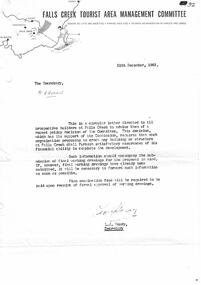
... It also reminds Licensees that at no time can the raceline at Falls Creek be tapped for water supply without the permission of the State Electricity Commission of Victoria. ...It also reminds Licensees that at no time can the raceline at Falls Creek be tapped for water supply without the permission of the State Electricity Commission of Victoria. ...Bob (Herman) Hymans (a former member of the Royal Netherlands Navy) was born in Bloemendaal, Holland on 30th September 1922. During World War II he fought against the Japanese in the Dutch East Indies (now Indonesia) and was imprisoned in Changi and on the Burma Railway. After gaining qualifications as a Ski Instructor, Bob arrived in Falls Creek in July 1950. Working as an Instructor and Supervisor at Bogong Lodge, Bob decided his future was in accommodation. He was successful in negotiating an indenture for land from the State Electricity Commission (SEC). It took Bob two years to build his Grand Coeur Chalet but, tragically, it was burned down in August 1961. Bob also built the first Chairlift in Australia. This was a single chairlift and the structure was built from wooden electricity poles. He was constantly full of new ideas and proposals for the village. Bob Hymans died on 7th July 2007. This Collection of documents and letters tells the story of Bob's endeavours to develop Falls Creek into the ski village it is today.This item is significant because it documents actions taken by the Falls Creek Tourist Area Management Committee in their role overseeing the Tourist Area.A circular to all prospective builders at Falls Creek to advise them that each organisation proposing to erect any building or structure at Fells Creek must furnish satisfactory assurances of its financial ability to complete the development. It also reminds Licensees that at no time can the raceline at Falls Creek be tapped for water supply without the permission of the State Electricity Commission of Victoria. falls creek tourist area management committee, falls creek administration, falls creek accommodation, ski championships -
 Kiewa Valley Historical Society
Pot Large with Tap, Circa 1950
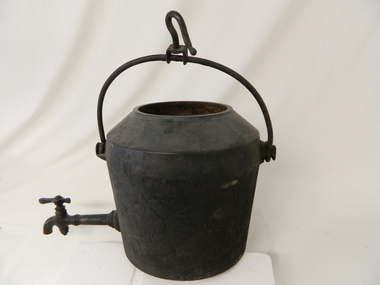
... The "tap" is made from brass and has a simple elongated "bar" control swivel at the end to control the water flow. ...The "tap" is made from brass and has a simple elongated "bar" control swivel at the end to control the water flow. ...This type of cast iron kettle was used by pioneer families, mainly rural in the early 1900's upon open fires (log). It covered rural activities that needed a constant readily available source of boiling water, in or mainly outside the kitchen of homesteads. This kettle was used in the early to late 1900's for the refreshment of stock men and farmers that had irregular "tea" breaks under sometimes hard and gruelling conditions.This kettle belonged to and was used by a Kiewa Valley, pioneer family, the Roper Family. This kettle was moved from their Kiewa Valley property to their hut built on the Bogong High Plains. The Bogong High Plains area provided Kiewa Valley cattlemen a good supply of fodder to supplement their Kiewa Valley grazing areas. This "camp draft" activity , in the high plains, could take up to six weeks.This large cast iron modified camp pot (cauldron) has a long tap connection located at the bottom end. The "tap" is made from brass and has a simple elongated "bar" control swivel at the end to control the water flow. The tap suggests that only water was heated (to a constant boil) for the replenishment of cattlemen's, or other horse rider's, tea or coffee mugs. Refreshments at a "temporary" location on the Bogong High Plains. There was a "log" hut built by the Roper family as temporary accommodation for cattlemen and other family members.Ot the flat bottom "FIRST QUALITY 2 GALLONS"camp fire cooking utensils, hot plate, cast iron cooking appliance, drovers kitchen -
 Bendigo Historical Society Inc.
Photograph - HILDA HILL COLLECTION: BLACK AND WHITE PHOTOS, 1918-1920
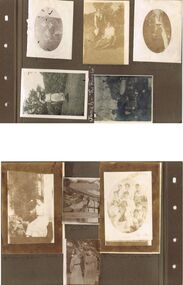
... Three boys and two dogs All boys dressed in dark coats and shorts long socks two of the boys are on their haunches, Background is a gabled roof and 2 chimneys, white fence, between two of the boys is a water tap on a medium height pipe, Durvol December 1919. ...Three boys and two dogs All boys dressed in dark coats and shorts long socks two of the boys are on their haunches, Background is a gabled roof and 2 chimneys, white fence, between two of the boys is a water tap on a medium height pipe, Durvol December 1919. ...Hilda Hill Collection. Black & White Photos of Hill Family Total 9. Three girls at SHLC 1918 with white sashes and medallions, dark clothing with white collars, background is garden scene , photo has over exposure problem which gives a lighter print, 24 September 1918, could it be a ladies college of education? Al standing wearing white blouse and dark dress holding a white hat standing and Gert sitting and holding a white hat in front of a bush wearing a white blouse and a light coloured skirt, background is forested area, 'The Pines' January 9th 1919. Claire dressed in dark dress and wearing a white hat with her hands together, oval photo, 'The Ranche', October 23 1918. Jonah wearing a hat and white dress with colourful hemline standing before a large hedge holding a parasol, large tree background left, 'The Ranche'. Three boys and two dogs All boys dressed in dark coats and shorts long socks two of the boys are on their haunches, Background is a gabled roof and 2 chimneys, white fence, between two of the boys is a water tap on a medium height pipe, Durvol December 1919. Moll Noonan seated on a round backed chair wearing a white dress, right background shows the side of a building, at knee level sis a broad leafed plant, other shrubbery in the background, 'The Ranche' November 1918. Ettie seated on a staircase and holding a dog, lady is wearing a broad brimmed hat, One Tree Hill April 18 1920. Two ladies in lightly coloured dresses standing in a garden setting, lady on left has a black sash waistband, Durvol December 1919 . Group of seven girls and 4 boys, all of the girls are dressed in white, front girl has black neck accessory, 'The Pines' January 9 1919 No. 7 Reservoir.Hilda Hill Personal Collectionaustralia, history, post war life -
 Eltham District Historical Society Inc
Document - Folder, McLean, 1984-1999
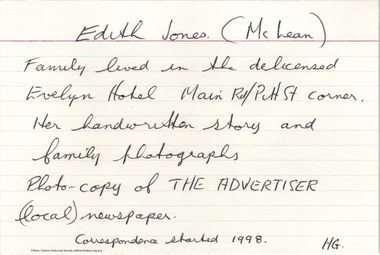
... There was no Eltham Fire Brigade and no water on tap. Describes the horror she and her sister felt when they walked up the street and discovered it was their home on fire. ...There was no Eltham Fire Brigade and no water on tap. Describes the horror she and her sister felt when they walked up the street and discovered it was their home on fire. ...References to McLean family, Hector John McLean and Louisa Frances (nee Green) and six daughters who lived in Eltham during the period 1930 to 1934 inclusive. Lived in the former Evelyn Hotel at the time it was destroyed by fire and being part of the Centenary Parade in 1934 where the family won the Group Section for their entry “Pioneers of Eltham” Reminiscences provided by Edith Jones (nee M1934 flood, ballroom, baptism, barber shop, bittern, boy scouts, bremner's flat, burgoyne's shop, cable tram, cemetery road, centenary celebrations, centenary parade, christening, coach house, collis grocery, dalton street, depression, dole, dorothy jean mclean, edith jones (nee mclean), eltham fire brigade, eltham high school, eltham higher elementary school, eltham lower park, eltham railway station, eltham state school no. 209, evelyn hotel, fire damage - buildings, flinders naval depot, fordham, gladys evelyn mclean, gold mining, gwenneth mae mclean, gwladys evelyn mclean, headmistress, hector john mclean, isherwood house and shop, louisa frances mclean (nee green), metery road, methodist church, miss finnin, miss grant cottage, motor bike races, mrs barrett, mrs bremner, mrs hurley, olive isabel mclean, parade, phoebe lillian mclean, picnic, pioneers of eltham, pitt street, research fire brigade, rev. r.g. arthur, shed, shops, st margarets church hall, st margaret's church, stables, state savings bank of victoria, susso books, todaro, vinnie willet, warrandyte bridge, warrandyte, wingrove park, yarra river -
 Flagstaff Hill Maritime Museum and Village
Equipment - Syringe, Late 19th - early 20th century
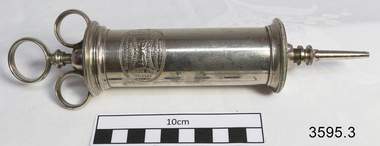
... The use of sterile water or saline as opposed to tap water or bacteriostatic agent (eg dilute hydrogen peroxide) can decrease the risk of infection. ...The use of sterile water or saline as opposed to tap water or bacteriostatic agent (eg dilute hydrogen peroxide) can decrease the risk of infection. ...How to safely syringe ear wax Irrigation, or ear syringing, should be performed only after taking a full history, doing an ear examination and explaining the potential complications to the patient. It is also important to ensure appropriate assembly and use of equipment. Gentle irrigation of the ear canal can be performed with a large syringe (20 mL) and warm water. The use of sterile water or saline as opposed to tap water or bacteriostatic agent (eg dilute hydrogen peroxide) can decrease the risk of infection. Direct visualisation of the ear canal is not necessary for safe and effective syringing. The tip of the syringe should not pass the outer one-third of the ear canal (approximately 8 mm) – the use of a rounded nozzle may assist with this. The jet of water should be aimed towards the edge of the cerumen to enable the debris to flow out of the ear canal. Cease immediately if the patient experiences pain or if bleeding occurs. Mechanical jet irrigators are available and some allow better control of water pressure and direction of spray. After syringing, examine the external canal and tympanic membrane. Document the patient’s consent, procedure, and pre- and post-examination findings. https://www.racgp.org.au/afp/2015/october/ear-wax-management This ear syringe was donated to Flagstaff Hill Maritime Village by the family of Doctor William Roy Angus, Surgeon and Oculist. It is part of the “W.R. Angus Collection” that includes historical medical equipment, surgical instruments and material once belonging to Dr Edward Ryan and Dr Thomas Francis Ryan, (both of Nhill, Victoria) as well as Dr Angus’ own belongings. The Collection’s history spans the medical practices of the two Doctors Ryan, from 1885-1926 plus that of Dr Angus, up until 1969. ABOUT THE “W.R.ANGUS COLLECTION” Doctor William Roy Angus M.B., B.S., Adel., 1923, F.R.C.S. Edin.,1928 (also known as Dr Roy Angus) was born in Murrumbeena, Victoria in 1901 and lived until 1970. He qualified as a doctor in 1923 at University of Adelaide, was Resident Medical Officer at the Royal Adelaide Hospital in 1924 and for a period was house surgeon to Sir (then Mr.) Henry Simpson Newland. Dr Angus was briefly an Assistant to Dr Riddell of Kapunda, then commenced private practice at Curramulka, Yorke Peninsula, SA, where he was physician, surgeon and chemist. In 1926, he was appointed as new Medical Assistant to Dr Thomas Francis Ryan (T.F. Ryan, or Tom), in Nhill, Victoria, where his experiences included radiology and pharmacy. In 1927 he was Acting House Surgeon in Dr Tom Ryan’s absence. Dr Angus had become engaged to Gladys Forsyth and they decided he would take time to further his studies overseas in the UK in 1927. He studied at London University College Hospital and at Edinburgh Royal Infirmary and in 1928, was awarded FRCS (Fellow from the Royal College of Surgeons), Edinburgh. He worked his passage back to Australia as a Ship’s Surgeon on the on the Australian Commonwealth Line’s T.S.S. Largs Bay. Dr Angus married Gladys in 1929, in Ballarat. (They went on to have one son (Graham 1932, born in SA) and two daughters (Helen (died 12/07/1996) and Berenice (Berry), both born at Mira, Nhill ) Dr Angus was a ‘flying doctor’ for the A.I.M. (Australian Inland Ministry) Aerial Medical Service in 1928 . The organisation began in South Australia through the Presbyterian Church in that year, with its first station being in the remote town of Oodnadatta, where Dr Angus was stationed. He was locum tenens there on North-South Railway at 21 Mile Camp. He took up this ‘flying doctor’ position in response to a call from Dr John Flynn; the organisation was later known as the Flying Doctor Service, then the Royal Flying Doctor Service. A lot of his work during this time involved dental surgery also. Between 1928-1932 he was surgeon at the Curramulka Hospital, Yorke Peninsula, South Australia. In 1933 Dr Angus returned to Nhill where he’d previously worked as Medical Assistant and purchased a share of the Nelson Street practice and Mira hospital from Dr Les Middleton one of the Middleton Brothers, the current owners of what was once Dr Tom Ryan’s practice. Dr L Middleton was House Surgeon to the Nhill Hospital 1926-1933, when he resigned. [Dr Tom Ryan’s practice had originally belonged to his older brother Dr Edward Ryan, who came to Nhill in 1885. Dr Edward saw patients at his rooms, firstly in Victoria Street and in 1886 in Nelson Street, until 1901. The Nelson Street practice also had a 2 bed ward, called Mira Private Hospital ). Dr Edward Ryan was House Surgeon at the Nhill Hospital 1884-1902 . He also had occasions where he successfully performed veterinary surgery for the local farmers too. Dr Tom Ryan then purchased the practice from his brother in 1901. Both Dr Edward and Dr Tom Ryan work as surgeons included eye surgery. Dr Tom Ryan performed many of his operations in the Mira private hospital on his premises. He too was House Surgeon at the Nhill Hospital 1902-1926. Dr Tom Ryan had one of the only two pieces of radiology equipment in Victoria during his practicing years – The Royal Melbourne Hospital had the other one. Over the years Dr Tom Ryan gradually set up what was effectively a training school for country general-practitioner-surgeons. Each patient was carefully examined, including using the X-ray machine, and any surgery was discussed and planned with Dr Ryan’s assistants several days in advance. Dr Angus gained experience in using the X-ray machine there during his time as assistant to Dr Ryan. Dr Tom Ryan moved from Nhill in 1926. He became a Fellow of the Royal Australasian College of Surgeons in 1927, soon after its formation, a rare accolade for a doctor outside any of the major cities. He remained a bachelor and died suddenly on 7th Dec 1955, aged 91, at his home in Ararat. Scholarships and prizes are still awarded to medical students in the honour of Dr T.F. Ryan and his father, Dr Michael Ryan, and brother, John Patrick Ryan. ] When Dr Angus bought into the Nelson Street premises in Nhill he was also appointed as the Nhill Hospital’s Honorary House Surgeon 1933-1938. His practitioner’s plate from his Nhill surgery states “HOURS Daily, except Tuesdays, Fridays and Saturday afternoons, 9-10am, 2-4pm, 7-8pm. Sundays by appointment”. This plate is now mounted on the doorway to the Port Medical Office at Flagstaff Hill Maritime Village, Warrnambool. Dr Edward Ryan and Dr Tom Ryan had an extensive collection of historical medical equipment and materials spanning 1884-1926 and when Dr Angus took up practice in their old premises he obtained this collection, a large part of which is now on display at the Port Medical Office at Flagstaff Hill Maritime Village in Warrnambool. During his time in Nhill Dr Angus was involved in the merging of the Mira Hospital and Nhill Public Hospital into one public hospital and the property titles passed on to Nhill Hospital in 1939. In 1939 Dr Angus and his family moved to Warrnambool where he purchased “Birchwood,” the 1852 home and medical practice of Dr John Hunter Henderson, at 214 Koroit Street. (This property was sold in1965 to the State Government and is now the site of the Warrnambool Police Station. ). The Angus family was able to afford gardeners, cooks and maids; their home was a popular place for visiting dignitaries to stay whilst visiting Warrnambool. Dr Angus had his own silk worm farm at home in a Mulberry tree. His young daughter used his centrifuge for spinning the silk. Dr Angus was appointed on a part-time basis as Port Medical Officer (Health Officer) in Warrnambool and held this position until the 1940’s when the government no longer required the service of a Port Medical Officer in Warrnambool; he was thus Warrnambool’s last serving Port Medical Officer. (The duties of a Port Medical Officer were outlined by the Colonial Secretary on 21st June, 1839 under the terms of the Quarantine Act. Masters of immigrant ships arriving in port reported incidents of diseases, illness and death and the Port Medical Officer made a decision on whether the ship required Quarantine and for how long, in this way preventing contagious illness from spreading from new immigrants to the residents already in the colony.) Dr Angus was a member of the Australian Medical Association, for 35 years and surgeon at the Warrnambool Base Hospital 1939-1942, He served as a Surgeon Captain during WWII1942-45, in Ballarat, Victoria, and in Bonegilla, N.S.W., completing his service just before the end of the war due to suffering from a heart attack. During his convalescence he carved an intricate and ‘most artistic’ chess set from the material that dentures were made from. He then studied ophthalmology at the Royal Melbourne Eye and Ear Hospital and created cosmetically superior artificial eyes by pioneering using the intrascleral cartilage. Angus received accolades from the Ophthalmological Society of Australasia for this work. He returned to Warrnambool to commence practice as an ophthalmologist, pioneering in artificial eye improvements. He was Honorary Consultant Ophthalmologist to Warrnambool Base Hospital for 31 years. He made monthly visits to Portland as a visiting surgeon, to perform eye surgery. He represented the Victorian South-West subdivision of the Australian Medical Association as its secretary between 1949 and 1956 and as chairman from 1956 to 1958. In 1968 Dr Angus was elected member of Spain’s Barraquer Institute of Barcelona after his research work in Intrasclearal cartilage grafting, becoming one of the few Australian ophthalmologists to receive this honour, and in the following year presented his final paper on Living Intrasclearal Cartilage Implants at the Inaugural Meeting of the Australian College of Ophthalmologists in Melbourne In his personal life Dr Angus was a Presbyterian and treated Sunday as a Sabbath, a day of rest. He would visit 3 or 4 country patients on a Sunday, taking his children along ‘for the ride’ and to visit with him. Sunday evenings he would play the pianola and sing Scottish songs to his family. One of Dr Angus’ patients was Margaret MacKenzie, author of a book on local shipwrecks that she’d seen as an eye witness from the late 1880’s in Peterborough, Victoria. In the early 1950’s Dr Angus, painted a picture of a shipwreck for the cover jacket of Margaret’s book, Shipwrecks and More Shipwrecks. She was blind in later life and her daughter wrote the actual book for her. Dr Angus and his wife Gladys were very involved in Warrnambool’s society with a strong interest in civic affairs. Their interests included organisations such as Red Cross, Rostrum, Warrnambool and District Historical Society (founding members), Wine and Food Society, Steering Committee for Tertiary Education in Warrnambool, Local National Trust, Good Neighbour Council, Housing Commission Advisory Board, United Services Institute, Legion of Ex-Servicemen, Olympic Pool Committee, Food for Britain Organisation, Warrnambool Hospital, Anti-Cancer Council, Boys’ Club, Charitable Council, National Fitness Council and Air Raid Precautions Group. He was also a member of the Steam Preservation Society and derived much pleasure from a steam traction engine on his farm. He had an interest in people and the community He and his wife Gladys were both involved in the creation of Flagstaff Hill, including the layout of the gardens. After his death (28th March 1970) his family requested his practitioner’s plate, medical instruments and some personal belongings be displayed in the Port Medical Office surgery at Flagstaff Hill Maritime Village, and be called the “W. R. Angus Collection”. Ear wax is an ongoing problem for many people, and its safe and easy removal is important. The W.R. Angus Collection is significant for still being located at the site it is connected with, Doctor Angus being the last Port Medical Officer in Warrnambool. The collection of medical instruments and other equipment is culturally significant, being an historical example of medicine from late 19th to mid-20th century. Dr Angus assisted Dr Tom Ryan, a pioneer in the use of X-rays and in ocular surgery. Ear syringe from the W.R. Angus Collection with barrel, plunger and tip. Inscription on oval shaped plaque on barrel. Inscription on oval shaped plaque on barrel "10th / UNIVERSITY COLLEGE HOSPITAL" & "MAYER & MELTZER / MAKERS, LONDON" & " TO THE / HOSPITAL OF DESEASES (SIC) OF THE THROAT"" & "TO THE / HOSPITAL / FOR WOMEN" & "TO THE / MIDDLESEX / HOSPITAL" plus "R" inscribed on each side of the handlewarrnambool, shipwreck coast, great ocean road, flagstaff hill maritime village, maritime museum, dr angus, w.r. angus, dr t f ryan, medical instrument, surgical equipment, warrnambool base hospital, nhill base hospital, mira hospital, flying doctor, medical treatment, syringe, ear syringe, ear wax -
 Flagstaff Hill Maritime Museum and Village
Bottle Corker, late 1800's to early 1900's
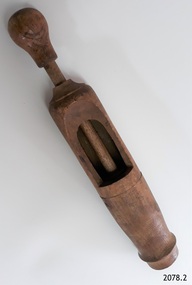
... TAP THE PLUNGER WITH A MALLET OR HAMMER.” This hand held, wooden bottle corker would have been used by soft drink or wine producers to insert corks into their bottles to seal the drink inside. It seems it may have had a metal tip on the end of the plunger, as do other similar bottle corkers, because this plunger has a compressed end and a ring shape impressed into the wood a little way up from the tip. How to use the bottle corker … - soak a long, bullet shaped cork in water ...This hand held, wooden bottle corker would have been used by soft drink or wine producers to insert corks into their bottles to seal the drink inside. It seems it may have had a metal tip on the end of the plunger, as do other similar bottle corkers, because this plunger has a compressed end and a ring shape impressed into the wood a little way up from the tip. How to use the bottle corker … - soak a long, bullet shaped cork in water to soften it - place the bottle corker over the bottle’s neck - insert the cork through the side opening and place onto the metal funnel - push the plunger down onto the cork, forcing it into the tapered, which will squeeze the cork to size as it enters the bottle. Use a mallet or hammer if necessary The design of this bottle corker is very similar to “"Redlich's Apparatus for Corking Bottles", which was invented and patented by Henry Redlich of Chicago, USA, in 1862, US patent #35,325. H. Redlich’s gave the following instructions for the use of the bottle corker: “DIRECTIONS: SOAK THE CORK, DROP INTO THE OPENING AND TAP THE PLUNGER WITH A MALLET OR HAMMER.” This hand held, wooden bottle corker would have been used by soft drink or wine producers to insert corks into their bottles to seal the drink inside. It seems it may have had a metal tip on the end of the plunger, as do other similar bottle corkers, because this plunger has a compressed end and a ring shape impressed into the wood a little way up from the tip. How to use the bottle corker … - soak a long, bullet shaped cork in water to soften it - place the bottle corker over the bottle’s neck - insert the cork through the side opening and place onto the metal funnel - push the plunger down onto the cork, forcing it into the tapered, which will squeeze the cork to size as it enters the bottle. Use a mallet or hammer if necessary The design of this bottle corker is very similar to “"Redlich's Apparatus for Corking Bottles", which was invented and patented by Henry Redlich of Chicago, USA, in 1862, US patent #35,325. H. Redlich’s gave the following instructions for the use of the bottle corker: “DIRECTIONS: SOAK THE CORK, DROP INTO THE OPENING AND TAP THE PLUNGER WITH A MALLET OR HAMMER.” Bottle corker, a hand operated wooden corking device for sealing bottles. Bottle corker has two parts comprising a wooden plunger rod with knob handle, and wooden cylinder containing a metal tube that is flared to a funnel shape on the top. The cylinder has a hole the diameter of the rod at both ends and an oval insertion slot in one side. The tip of the plunger rod is slightly compressed and it has an indented line around the circumference as though it has had something attached to it. Manufactured in the late 1899s to early 1900s in Melbourne.flagstaff hill, warrnambool, shipwrecked coast, flagstaff hill maritime museum, maritime museum, shipwreck coast, flagstaff hill maritime village, great ocean road, cork -
 Flagstaff Hill Maritime Museum and Village
Functional object - Barrel Spigot, H Gage, Early 20th century
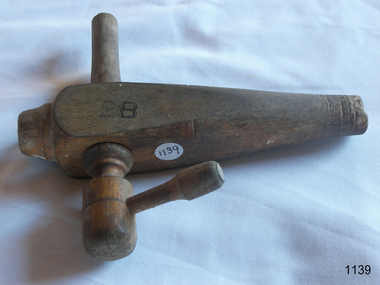
... Ancient Greek and Roman first used spigots in their bathhouses for obtaining water from aqueducts, routing it into pipes and buildings, and finally into their tubs or baths. The subject spigot or tap in Flagstaff collection was used in wine, beer, or spirits barrels to dispense the liquid contained within. ...Ancient Greek and Roman first used spigots in their bathhouses for obtaining water from aqueducts, routing it into pipes and buildings, and finally into their tubs or baths. The subject spigot or tap in Flagstaff collection was used in wine, beer, or spirits barrels to dispense the liquid contained within. ...Ancient Greek and Roman first used spigots in their bathhouses for obtaining water from aqueducts, routing it into pipes and buildings, and finally into their tubs or baths. The subject spigot or tap in Flagstaff collection was used in wine, beer, or spirits barrels to dispense the liquid contained within. A spigot definition is a device that controls the flow of liquid from a container. As mentioned earlier the Greeks and Romans created theirs for use in plumbing water later spigots were adapted to use in barrels or casks. An item still in use today in wine and beer barrels to dispense liquid and although spigots today are made from differing materials other than wood their function has not changed over the centuries.Wooden barrel spigotMarked "H Gage Maker Melbourne" on the side & 2B marked in black flagstaff hill, warrnambool, flagstaff-hill-maritime-museum, maritime-museum, shipwreck-coast, flagstaff-hill-maritime-village, barrel spigot, cask tap, h gage melbourne, coopering accessories -
Marysville & District Historical Society
THE TRIANGLE NEWS-VOL 37 NO 36-OCTOBER 1 2010
... shepparton water treatment...river to tap...marysville victoria australia national water week goulburn-murray water shepparton water treatment river to tap tour alexandra goulburn broken catchment donation to yea community murrindindi shire council THE TRIANGLE NEWS-VOL 37 NO 36-OCTOBER 1 2010 ...marysville, victoria, australia, national water week, goulburn-murray water, shepparton water treatment, river to tap tour alexandra, goulburn broken catchment, donation to yea community, murrindindi shire council -
 Flagstaff Hill Maritime Museum and Village
Functional object - Tap, mid-late 19th century
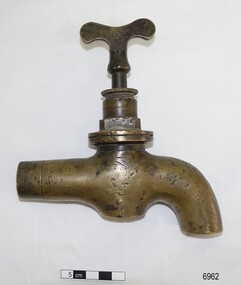
... Tap salvaged from shipwreck...Brass fittings...Steam engine fittings...Water...tap came from the Loch Ard shipwreck, wrecked on Mutton Bird Island, east of Port Campbell, Victoria, on 1st June 1878. This could easily be the case but there is no provenance for it. ROBERT BEST, BRASS FOUNDRY Circa 1840 Robert Best founded his brass foundry business and was referred to as a Brass Chandelier of Birmingham”. In 1864 an advertisement in the Journal of Gas Lighting, Water...Flagstaff Hill Warrnambool Shipwrecked coast Flagstaff Hill Maritime Museum Maritime Museum Shipwreck coast Flagstaff Hill Maritime Village Great Ocean Road Robert Best brass foundry Best and Hobson Best & Llyod Birmingham brass foundry brass tap BEST brand tap Heavy duty brass tap Industrial brass tap Boiler tap 19th century plumbing 19th century tapware 19th century plumbing fitting Tap with butterfly handle Tap salvaged from shipwreck Brass fittings Steam engine fittings Water-cock fitting “BEST” on one side of the tap handle (Also, a label from the donor attached to the tap “from the wreckage of the LOCH ARD") Tap, brass, heavy-duty, with butterfly handle. ...This type of large, brass tap is typical of the plumbing fittings manufactured in the late 19th and early 20th centuries. The tap has encrustations and concretion inside, showing that it had been in the sea for quite some time. The pipe leading to the spout is squashed, nicked and appears to have been sawn or broken off. It could have once been part of the plumbing from a ship, perhaps from one of the boilers used in the kitchen, for bathing or for laundry or cleaning. The name “BEST” on the tap signifies that it could have been made by Robert Best who began his Birmingham brass foundry c. 1840, and even though The information from the donor is that tap was given to her father (1906-1982) who lived in the Warrnambool district. It was likely given by a cray fisherman or diver, who said that the tap came from the Loch Ard shipwreck, wrecked on Mutton Bird Island, east of Port Campbell, Victoria, on 1st June 1878. This could easily be the case but there is no provenance for it. ROBERT BEST, BRASS FOUNDRY Circa 1840 Robert Best founded his brass foundry business and was referred to as a Brass Chandelier of Birmingham”. In 1864 an advertisement in the Journal of Gas Lighting, Water Supply, & Sanitary Improvement announces Best and Hobson, late Robert Best, 100 Charlotte Street Birmingham, manufacturers of Chandeliers, Brass and iron fittings, Steam and Water-cocks etc. gas apparatus of every description, Plumber's brass foundry, with works at Birmingham and Great Bridge, Staffordshire. In 1867 Best & Lloyd was formed, after Best and Hobson went into liquidation, manufacturing at the Cambray Works of Wattville Road, Handsworth. It was a light industrial engineering works and one of the owners was Robert Dudley Best’s father. Robert Dudley Best (1892-1984) later took over the business of Best & Lloyd. The company is still in business at Downing Street, Smethwick, Birmingham. In 1878, brass ship furniture and bell fittings stamped “BEST” was made by William Udal & Co., who advertised as manufacturers of BEST cast and stamped brass foundry goods. This large brass tap is typical of industrial tapware of the mid-late 19th and 20th centuries. The location of the tap, when found, is associated with the Warrnambool district and could have easily been from a shipwreck due to the encrustation found inside the tap. Due to its design and manufacturer, the tap is associated with the mid-late 19th and early 20th-century manufacture of plumbing fittings. Tap, brass, heavy-duty, with butterfly handle. The design and style are typical of the plumbing of the late 1800s. Inscription pressed into the handle, within rectangular border "BEST". Encrustation and concretion are inside the tap spout. “BEST” on one side of the tap handle (Also, a label from the donor attached to the tap “from the wreckage of the LOCH ARD")flagstaff hill, warrnambool, shipwrecked coast, flagstaff hill maritime museum, maritime museum, shipwreck coast, flagstaff hill maritime village, great ocean road, robert best brass foundry, best and hobson, best & llyod, birmingham brass foundry, brass tap, best brand tap, heavy duty brass tap, industrial brass tap, boiler tap, 19th century plumbing, 19th century tapware, 19th century plumbing fitting, tap with butterfly handle, tap salvaged from shipwreck, brass fittings, steam engine fittings, water-cock fitting -
 Flagstaff Hill Maritime Museum and Village
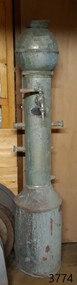
Functional object - Water Boiler, Jackson Boilers Ltd, 1920s
... Water boiler, free standing Jackson's Tube boiler. A tall metal cylindrical stand with a metal sphere on top and several pipe fittings on the sides. A brass tap...Details are also impressed into the cylinder above the tap. Functional object Water Boiler England Midlands UK Leeds Jackson Boilers Ltd John Murch ...Jackson Boilers Ltd., brass founders, electro platers and sheet metal works made this tube water boiler. It was a fitting in the vessel Reginald M, a small cargo ship built at Port Adelaide in 1922 and named after her builder and first owner, John Murch. The Reginald M was launched at Largs Bay, South Australia, in 1922 to carry cargo around South Australia that included guano, barley, wool, horses, cattle, timber, explosives, potatoes, shell grit, and gypsum. It passed through numerous owners over the years and primarily maintained its purpose as a cargo vessel. In 1975, the decommissioned Reginald M was purchased by Flagstaff Hill Maritime Museum as an attraction. Although restoration efforts were undertaken and maintained for the craft above the water line, deterioration occurred below the surface and resulted in the ship being unsafe for visitors to board. It was broken up and removed from Flagstaff Hill in 2018, but items such as the historical boiler remain in Flagstaff Hill’s Collection. JACKSON BOILERS LTD.: - In 1911, Henry Jackson was the Managing Director at Jackson Boilers Ltd. He had gained around 30 years’ experience as a tin plate worker, plumber and gas fitter at Ilkey in 1881, then at Leeds by 1901. By 1921, he had changed employment from Jackson Boilers to Managing Director of Patent Water Boilers. During World War I, Jackson Boilers Ltd of Leeds performed war work like many other manufacturers at that time. The firm made cases for the explosive picric acid and electroplated fuse hole plugs. In 1918, the firm employed 15 males and 19 females. Jacksons Boilers became very successful throughout the first half of the twentieth century with showrooms and sales offices in Scotland, the Midlands and Southern England. It also had an office in Dublin, Ireland. In the post-war 1920s, the firm’s production included instantaneous water boilers and coffee machines for cafes, restaurants and canteens. Jackson Boilers also began to supply shipping lines with catering water boilers for their ships. The firm applied for a USA patent for the tube boiler in 1930, for the design which appears to have been invented in 1926. A 1971 advertisement adds the credentials, Members of the Catering Equipment Manufacturers’ Association. The tube water boiler was designed specifically for use in a ship's restaurant or dining area and patented by Jackson Boilers Ltd. of Leeds. The boiler is significant as a patented design, illustrating the evolution of maritime, commercial and domestic water boilers that have led to many innervations and improvements in today's boilers that are used in heating and in producing hot water for domestic and catering use. It is also significant as it is one of the earlier boilers the Jackson company made in the early 1920s before they applied for a US patent on their revised design in 1926.Water boiler, free standing Jackson's Tube boiler. A tall metal cylindrical stand with a metal sphere on top and several pipe fittings on the sides. A brass tap with a lever handle is connected to the front. A plaque with maker's details is attached under the tap. Details are also impressed into the cylinder above the tap.Jackson Boilers Leeds Ltd. "JACKSON'S PATENT" . Other details indecipherable. flagstaff hill maritime museum and village, flagstaff hill maritime museum, flagstaff hill, maritime museum, maritime village, warrnambool, great ocean road, leeds, jackson boilers ltd, jackson boilers, henry jackson, brass founders, electro platers, sheet metal works, patent water boilers, leeds manufacturer, tube water boiler, domestic boiler, tube domestic boiler, tube boiler, water heaters, water boilers, self-feeding water boilers, sheet metal work instantaneous water heaters, engineering, allied trades, metal workers, metal trade, food machinery, hospitality equipment, ship equipment, ship water boiler, ship heater, catering boilers, café boiler, restaurant boiler, canteen boiler, catering equipment manufacturers’ association, cema, kitchen equipment, kitchen appliance, war work, world war i, wwi, picric acid, picric acid cases, fuse hole plugs, electro plated fuse hole plugs, reginald m, cargo ship, port adelaide, 1922, john murch -
 Flagstaff Hill Maritime Museum and Village
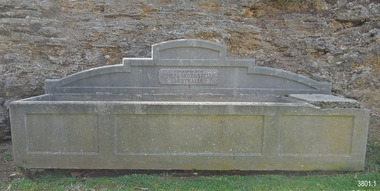
Container - Horse trough, Annis & George Bills, circa Dec. 1932
... watering trough to a colourful garden bed of agapanthus plants. By February 2013 the horse trough had been transferred to Flagstaff Hill for display in the Maritime Village’s grounds. This trough is one of hundreds provided by the Annis and George Bills Estate Trust since 1927 for the welfare of working horses and dogs. The original concrete cap over the small compartment is still retained. There are also markings on the right side of the trough where it probably had a birdbath, tap...watering trough to a colourful garden bed of agapanthus plants. By February 2013 the horse trough had been transferred to Flagstaff Hill for display in the Maritime Village’s grounds. This trough is one of hundreds provided by the Annis and George Bills Estate Trust since 1927 for the welfare of working horses and dogs. The original concrete cap over the small compartment is still retained. There are also markings on the right side of the trough where it probably had a birdbath, tap ...This horse trough is the only survivor of the two troughs originally installed in Raglan Parade, Warrnambool, in 1932. It was later moved to the Pony Club at Albert Part, near the north corner of Coulstock and Craig Streets. Over the time there its purpose was changed from a horse watering trough to a colourful garden bed of agapanthus plants. By February 2013 the horse trough had been transferred to Flagstaff Hill for display in the Maritime Village’s grounds. This trough is one of hundreds provided by the Annis and George Bills Estate Trust since 1927 for the welfare of working horses and dogs. The original concrete cap over the small compartment is still retained. There are also markings on the right side of the trough where it probably had a birdbath, tap or a dish for the horseman’s dog, similar to other troughs donated elsewhere by the Trust. Less than half of the troughs produced for the Annis and George Bills Trust still survive. In 2017 Felicity Watson, National Trust Victoria’s advocacy manager, said that the troughs were treasures and becoming rare, with more than a dozen across Victoria now being heritage protected. ABOUT ANNIS AND GEORGE BILLS The 1927 Will of George Bills included setting up the Annis and George Bills Estate Trust, which provided for hundreds of horse troughs to be supplied and installed throughout Australia, Britain, USA and other parts of the world for the welfare of horses. Town and city councils could apply to the Trustees for a horse trough for their communities. George “Joe” Bills was born in Brighton, England, in 1859. The family migrated first to New Zealand then to Australia in 1873, settling in the Echuca-Moama district. George moved to Brisbane in 1882 where he met Annis Swann, formerly from Sheffield. Both were animal lovers. George and Annis married 1885 and moved to Sydney to join George’s brother Henry in his mattress wire weaving business, later known as the Bills Brothers. They patented their own machine in 1893 and the business became very profitable. George was able to donate to charities that supported his passion to improve animal welfare. He and Annis joined the Victorian Society for the Protection of Animals and in 1924 George received a Life Membership with the RSPCA. George retired in 1908. The couple moved to Hawthorn, Victoria, in 1910, where they donated troughs for the work horses of Melbourne. During a visit to England Annis passed away. In 1927 George moved from Hawthorn to Camberwell, where he passed away at the end of that year. George had requested in his Will that a trust fund be set up from his estate "…construct and erect and pay for horse troughs wherever they may be of the opinion that such horse troughs are desirable for the relief of horses and other dumb animals either in Australasia, in the British Islands or in any other part of the world subject to the consent of the proper authorities being obtained." The troughs were to bear a plaque inscribed “Donated by Annis and George Bills, Australia”. In 1927 the cost to make a trough was about £13 (which converts to about $1079 in 2020 ), plus transport and installation costs. Most of the troughs were installed between 1930 and 1939 in Victoria and New South Wales. It is estimated that over that time around 500-700 Bills Horse Troughs were installed in Australia and another 50 overseas. Most of the troughs made in Victoria had three moulded front panels like this trough, and no panels moulded on the rear, whereas troughs made in NSW had four panels on the front and five on the back. Victorian troughs were made by a Bills’ relative, J H Phillips. Later, other manufactures for the Trust’s troughs included Rocla Concrete Pipes Ltd, in Auburn Road, Hawthorn, Victoria, who produced to the same original design. No further troughs produced after the end of World War II. A memorial to Annis and George Bills was first erected in Hawthorn in 1929. It included a drinking fountain and a dog dish. Its current location is unknown. In 1964 the George Bills RSPCA Resource Centre opened in Burwood East. This Bills horse trough is nationally significant as one of the surviving examples of the standard Bills memorial horse troughs that still has its compartment cap and evidence of it once having had attached fittings, possibly for a birdbath or dog dish. This trough has State historical significance for being produced in the early 1930s by a business in Hawthorn, Victoria. This example of a Bills horse trough is significant for being in comparatively good condition. The trough is locally significant for being the sole survivor of the two Bills horse troughs installed in the City of Warrnambool in 1932, originally installed on Raglan Parade and continued to be used in the community at the Pony Club, then finally transferred to its current location at Flagstaff Hill by early 2013. It is culturally significant as it represents the community’s dependence on horses for travel and transportation previous to motorised vehicles. It is morally significant as a generous gift from a couple concerned with the welfare of animals.Horse trough; a long narrow rectangular container used for storing water. Trough is made from pre-cast concrete with one large open compartment and a small covered compartment. The base of the small compartment is raised slightly above the base of the trough and is covered by a removable concrete cap. The design of the front of the trough includes three panels moulded into it that align with the shape of the back pediment (panel). The pediment is shaped with side arcs that step up to a wide centre arc. A rectangular concrete plaque is cast into the centre of the pediment and is engraved with the names of the original donors, Annis and George Bills. The trough was made in Hawthorn, Victoria, by J H Phillips circa 1932. “DONATED BY / ANNIS & GEORGE BILLS / AUSTRALIA”flagstaff hill, warrnambool, shipwrecked coast, flagstaff hill maritime museum, maritime museum, shipwreck coast, flagstaff hill maritime village, great ocean road, annis and george bills, bills trust, j h phillips, rocla concrete pipes ltd, hawthorn, water trough, watering trough, horse trough, animal welfare, bills horse trough -
 Flagstaff Hill Maritime Museum and Village
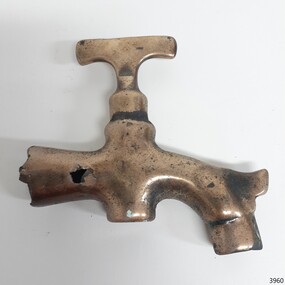
Functional object - Tap, Ca. 1855
... ...water tap...The collection as a whole is historically significant for representing aspects of Victoria's maritime history and its potential to interpret social and historical themes. flagstaff hill warrnambool flagstaff hill maritime museum maritime museum shipwreck coast flagstaff hill maritime village great ocean road shipwreck artefact schomberg brass tap plumbing fitting water tap tap Brass tap, flat horizontal handle, horn-shaped finish above the spout. ...The brass tap was recovered from the wreck of the Schomberg sailing ship. It is severed at the pipe end before the position where the join would have been. This could have happened after the shipwreck or at the time of salvage. ABOUT THE SCHOMBERG (October 6 to December 27, 1855)- When the ship Schomberg was launched in 1855, she was considered the most perfect clipper ship ever to be built. James Baine’s Black Ball Line had commissioned her for their fleet of passenger liners. The Aberdeen builders designed her to sail faster than the clippers designed the three-masted wooden clipper ship to be fast. The timber used for the diagonal planking was British oak with layers of Scottish larch. This luxury emigrant vessel was designed for superior comfort. She had ventilation ducts to provide air to the lower decks and a dining saloon, smoking room, library and bathrooms for the first-class passengers. The master for Schomberg’s maiden voyage was Captain ‘Bully’ Forbes. He drunkenly predicted at her launch that he would make the journey between Liverpool and Melbourne in 60 days. Schomberg departed Liverpool on 6 October 1855 with 430 passengers and 3000 tons of cargo including iron rails and equipment intended the build the Geelong Railway and a bridge over the Yarra from Melbourne to Hawthorn. The poor winds slowed Schomberg’s sail across the equator. She was 78 days out of Liverpool when she ran aground on a sand spit near Peterborough, Victoria, on 27 December; the sand spit and currents were not marked on Forbes’s map. The ship’s Chief Officer spotted the coastal steamer SS Queen at dawn and sent a signal. The master of the SS Queen approached the stranded vessel and all of Schomberg’s passengers safely disembarked. In 1975, 120 years after the Schomberg was wrecked, divers from Flagstaff Hill found an ornate communion set at the wreck site along with many other artefacts. In 1978 a diamond ring was discovered under the concretion in the lid of the communion set, which is currently on display. Former Director of Flagstaff Hill, Peter Ronald, had salvaged most of the artefacts from the wreck. This tap is significant as an example of an item in common use in the mid-19th century. The Schomberg collection as a whole is of historical and archaeological significance at a State level. Flagstaff Hill’s collection of artefacts from the Schomberg is also significant for its association with the Victorian Heritage Registered shipwreck (VHR S 612). The collection is of prime significance because of the relationship between the objects salvaged, as together they help us to interpret the story of the Schomberg. The collection as a whole is historically significant for representing aspects of Victoria's maritime history and its potential to interpret social and historical themes. Brass tap, flat horizontal handle, horn-shaped finish above the spout. The fixture has been severed at the pipe connection end. The surface has since been polished. There is a hole in the side of the pipe near the vertical fitting. It was recovered from the wreck of the Schomberg.flagstaff hill, warrnambool, flagstaff hill maritime museum, maritime museum, shipwreck coast, flagstaff hill maritime village, great ocean road, shipwreck artefact, schomberg, brass tap, plumbing fitting, water tap, tap -
 Greensborough Historical Society
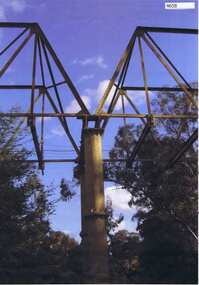
Photograph, Maroondah aqueduct pipe bridge 2011, 2011_
... in 1891 the Watts River (near Healesville) was tapped. It supplied water to Melbourne, via the Maroondah aqueduct. ...in 1891 the Watts River (near Healesville) was tapped. It supplied water to Melbourne, via the Maroondah aqueduct. ...in 1891 the Watts River (near Healesville) was tapped. It supplied water to Melbourne, via the Maroondah aqueduct. The Maroondah Reservoir, northeast of Melbourne, was completed in 1927 and water was piped via the Maroondah aqueduct to the northern suburbs. It was replaced by large pipes in the 1980s. Parts of the aqueduct structure remain.Copy of colour photographaqueduct pipe bridge greensborough, maroondah aqueduct -
Glenelg Shire Council Cultural Collection
Instrument - Instrument (hygrometer?), n.d
... water. Alloy, painted black, pressure chamber, glass column, alloy funnel and tap, pounds per square inch gauge,air pressure valve...water. Alloy, painted black, pressure chamber, glass column, alloy funnel and tap, pounds per square inch gauge,air pressure valve Instrument Instrument (hygrometer?) ...Port of Portland collectionAn instrument for measuring the specific gravity of water. Alloy, painted black, pressure chamber, glass column, alloy funnel and tap, pounds per square inch gauge,air pressure valve -
 City of Moorabbin Historical Society (Operating the Box Cottage Museum)
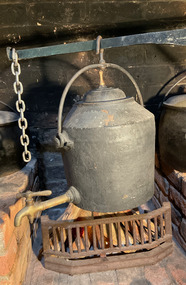
Functional object - Clark's cast iron kettle with brass tap on a swing arm known as a "crane", T & C Carke & Sons
... This type of kettle, with a tap was known as a “fountain”, gave ready access to boiling water. This meant that water could be kept hot all day by the fire, and the water topped up as necessary. ...This type of kettle, with a tap was known as a “fountain”, gave ready access to boiling water. This meant that water could be kept hot all day by the fire, and the water topped up as necessary. ...This very heavy type of iron kettle was hung on a hinged swing-arm, known as a “crane”, in the kitchen fireplace. This type of kettle, with a tap was known as a “fountain”, gave ready access to boiling water. This meant that water could be kept hot all day by the fire, and the water topped up as necessary. The metal arm was swung out from the fire -place to access the hot water relatively safely.This "fountain" was used by one of the pioneer families in the City of Moorabbin.Cast Iron Tea Kitchen, comprising a kettle, with a lid, a hook attached to swivel handle and a brass tap attached to side of kettle. T & C Clark & Co 12 Galls imprinted on lid.T & C Clark & Co -
 Orbost & District Historical Society
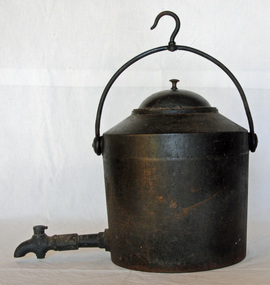
water fountain, Late 19th century
... The tap has a simple control swivel at the end to control the water flow....The tap has a simple control swivel at the end to control the water flow. water fountain Kenrick and Sons ...This type of cast iron kettle was used by pioneer families, mainly rural in the early 1900's upon open fires. It provided a source of boiling water, in or mainly outside the kitchen of homesteads. Early homes often had an open fire containing a fountain, buckets and kettles that hung from a hook in the fireplace. These containers supplied hot water for cooking, washing and cups of tea. The fountain was placed on hob until needed and then hung over fire.This water fountain would have been used by early settlers in Orbost before the connection of electricity.A large cast iron water fountain. It has a hook on the curved swinging handle and a tap at the front. This large cast iron camp pot or cauldron has a long tap connection located at the bottom end at the front. The tap has a simple control swivel at the end to control the water flow.On lid 1934.1 - 3 to 4 On base 1934.2 - A. Kenrick & Sons 4 Gallskettle cast-iron kenrick domestic kitchen -
 Orbost & District Historical Society
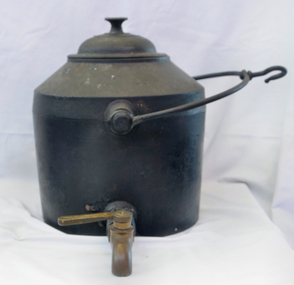
water fountain, late 19th century
... water for cooking, washing and cups of tea. Fountain was placed on hob until needed and then hung over fire. This kettle is an example of a common domestic item used in early Orbost before electricity was widespread. cooking domestic kettle fountain-iron ironware Lid - Clark & Co * 4 Galls. Bottom - Clark & Co - 4 Gallons FINEST QUALITY T & C CLARK & CO Large black iron fountain with swing handle and hook for using over a fire. Large brass tap ...Iron fountain used on open fires etc. Donated by Mrs Norah Osborne, wife of Bruce , principal of High School. Early homes often had an open fire containing a fountain, buckets and kettles that hung from a hook in the fireplace. These containers supplied hot water for cooking, washing and cups of tea. Fountain was placed on hob until needed and then hung over fire.This kettle is an example of a common domestic item used in early Orbost before electricity was widespread.Large black iron fountain with swing handle and hook for using over a fire. Large brass tap and handle. Lid - Clark & Co * 4 Galls. Bottom - Clark & Co - 4 Gallons FINEST QUALITY T & C CLARK & COcooking domestic kettle fountain-iron ironware -
 Orbost & District Historical Society
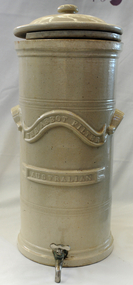
Filter - water cooler, late 19th century
... water. Tall, stoneware, cylindrical, cream coloured with handles and tap. Tap is stainless steel....water. Tall, stoneware, cylindrical, cream coloured with handles and tap. Tap is stainless steel. ...Domestic water filters would have been used in Orbost before water was reticulated to all town houses and on rural properties using tank water.This is an example of a domestic ceramic container used to hold and filter water in the early 20th century."The Abbot Filter" used to cool water. Tall, stoneware, cylindrical, cream coloured with handles and tap. Tap is stainless steel."The Abbot Filter" - Australianwater-supply abbot-filter container water-cooler
