
Showing 8 items matching "waterbury"
-
 Coal Creek Community Park & Museum
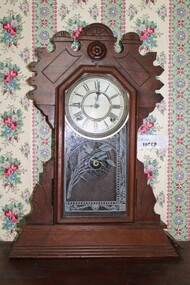
Carved Timber Mantel Clock, Waterbury Clock Co
... Roman numeral face, swinging pendulum. 11017.1 - Pendulum Suspension Spring - wire, Hook on end, metal tab on the other 11017.2 - pendulum, silver colour, inscribed face 'fast/slow' and Waterbury Clock Co. Patented Dec 11th, 1883 11017.3 - clock winding key, silver colour Founded in 1857 in Waterbury, Connecticut, The Waterbury Clock Co. gained a reputation and patented many inventions including the first affordable mass-produced pocket watch, the Waterbury Watch. the first alarm clock with a snooze button and the first wristwatch with a luminous dial. ...11017.2 - Fast, Slow, Patented Dec 11th 1883, Waterbury Clock Co....11017.2 - Fast, Slow, Patented Dec 11th 1883, Waterbury Clock Co. Brown carved timber clock, c.1890s. ...Brown carved timber clock, c.1890s. Glass door with elaborate wheat and boarder design. Roman numeral face, swinging pendulum. 11017.1 - Pendulum Suspension Spring - wire, Hook on end, metal tab on the other 11017.2 - pendulum, silver colour, inscribed face 'fast/slow' and Waterbury Clock Co. Patented Dec 11th, 1883 11017.3 - clock winding key, silver colour Founded in 1857 in Waterbury, Connecticut, The Waterbury Clock Co. gained a reputation and patented many inventions including the first affordable mass-produced pocket watch, the Waterbury Watch. the first alarm clock with a snooze button and the first wristwatch with a luminous dial. In the 1960s, the Waterbury Clock Co. merged with the United States Time Corporation to become the Timex Corporation. 11017.2 - Fast, Slow, Patented Dec 11th 1883, Waterbury Clock Co. -
 Emerald Museum & Nobelius Heritage Park
Domestic object - Oil lamp, Plume & Atwood Manufacturing Company, 1850s-1910s
... ...Waterbury...Inscription on push button: Waterbury Conn. P & A MFG CO / Made in USA (Note that P & A MFG CO stands for Plume and Atwood Manufacturing Company)...Kerosene became a safe and affordable lamp fuel in the 2nd half of the 19th century. kerosene lamp Waterbury Connecticut USA Inscription on push button: Waterbury Conn. ...Oil lamps were a necessary feature of everyday domestic and working life in Emerald before the advent of electricity in 1934. Kerosene became a safe and affordable lamp fuel in the 2nd half of the 19th century.Oil lamp - 8-sided solid glass base with 8-sided solid glass bowl and glass chimney. Manufacturer: Plume & Atwood (USA). Belonged to local collector, Alan Rockett (now aged 93) who later gave it to Bill Black who has now in turn donated it to the Museum.Inscription on push button: Waterbury Conn. P & A MFG CO / Made in USA (Note that P & A MFG CO stands for Plume and Atwood Manufacturing Company)kerosene lamp, waterbury, connecticut, usa -
 Mont De Lancey
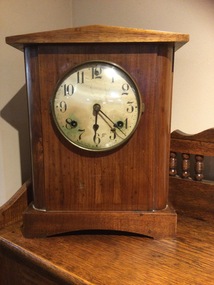
Domestic object - Mantel Clock
... Inside the case is a Waterbury Clock Co of USA key and the internal workings are visible. ...'Duff' brand brass plaque on back of cover. The key has 'Waterbury Clock Co USA' stamped on it....Inside the case is a Waterbury Clock Co of USA key and the internal workings are visible. ...The mantel clock has a rich history that dates back to the 18th century. These smaller clocks were designed during an age when people wanted elegant timepieces that fit on mantels or shelves. Their compact size and decorative designs made them a popular choice for homes of the time. They graced the mantelpieces or tables in homes, serving as both functional timepieces and sophisticated decorations. These clocks often feature ornate wooden carvings and intricate designs, with their gentle ticking and chimes adding a cozy ambiance to living spaces. It was used by Harold and Jean Parker.An antique wooden mantel clock made in USA with an Australian made Duff brand oak case with a plain angled top with round shaped pillar styled sides. It has a white ceramic dial face with black digits and black metal hands. The dial is covered by a glass and gold trimmed covering that may be opened on the right side. Inside the case is a Waterbury Clock Co of USA key and the internal workings are visible. It is not in working order.'Duff' brand brass plaque on back of cover. The key has 'Waterbury Clock Co USA' stamped on it.clocks, timepieces, clock components, clock keys, mantel clocks -
 Bendigo Military Museum
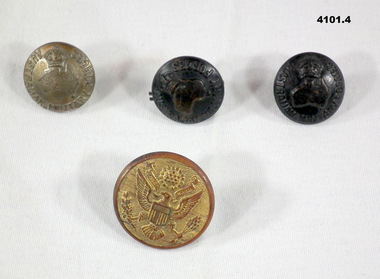
Uniform - BUTTONS, UNIFORM, C 1939 - 45
... .1) .2) .3) “Australian Military Forces” .4) On the reverse side, “Waterbury Button Co CONN.”...Buttons uniforms .1) .2) .3) “Australian Military Forces” .4) On the reverse side, “Waterbury Button Co CONN.” .1) light metal coloured button with map of Australia and crown etched on. .2) & .3) dark metal coloured buttons with same as .1) .4) Yellow coloured button with the American Eagle etched on. ....1) light metal coloured button with map of Australia and crown etched on. .2) & .3) dark metal coloured buttons with same as .1) .4) Yellow coloured button with the American Eagle etched on..1) .2) .3) “Australian Military Forces” .4) On the reverse side, “Waterbury Button Co CONN.”buttons, uniforms, -
Emerald Museum & Nobelius Heritage Park
Domestic object - Oil lamp, Plume & Atwood Manufacturing Company, 1850s-1910s
... ...Waterbury...Kerosene became a safe and affordable lamp fuel in the 2nd half of the 19th century. kerosene lamp Waterbury Connecticut USA Plume & Atwood Manufacturing Company Inscription on push button: Eagle P & A MFG CO / Made in USA (Note that P & A MFG CO stands for Plume and Atwood Manufacturing Company) Oil lamp - 8-sided solid glass base with 8-sided solid glass bowl and glass chimney. ...Oil lamps were a necessary feature of everyday domestic and working life in Emerald before the advent of electricity in 1934. Kerosene became a safe and affordable lamp fuel in the 2nd half of the 19th century.Oil lamp - 8-sided solid glass base with 8-sided solid glass bowl and glass chimney. Manufacturer: Plume & Atwood (USA). Belonged to local collector, Alan Rockett (now aged 93) who later gave it to Bill Black who has now in turn donated it to the Museum.Inscription on push button: Eagle P & A MFG CO / Made in USA (Note that P & A MFG CO stands for Plume and Atwood Manufacturing Company)kerosene lamp, waterbury, connecticut, usa, plume & atwood manufacturing company -
 Flagstaff Hill Maritime Museum and Village
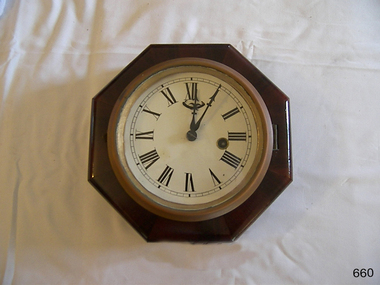
Clock, 1867-1870
... In 1850 Jerome formed the Jerome Manufacturing Co. as a joint-stock company with Benedict & Burnham, brass manufacturers of Waterbury. In 1853 the company then became known as the New Haven Clock Co, producing 444,000 clocks and timepieces annually, then the largest clock maker in the world. ...In 1850 Jerome formed the Jerome Manufacturing Co. as a joint-stock company with Benedict & Burnham, brass manufacturers of Waterbury. In 1853 the company then became known as the New Haven Clock Co, producing 444,000 clocks and timepieces annually, then the largest clock maker in the world. ...Chauncey Jerome (1793–1868) was an American clock maker in the early to mid 19th century. He made a fortune selling his clocks, and his business grew quickly. Jerome was born in Canaan USA in 1793 son of a blacksmith and nail-maker. He began his career in Plymouth, making dials for long-case clocks where he learned all he could about clocks, particularly clock cases, and then went to New Jersey to make seven-foot cases for clocks mechanisms. In 1816 he went to work for Eli Terry making "Patent Shelf Clocks," learning how to make previously handmade cases using machinery. Deciding to go into business for himself, Jerome began to make cases, trading them to Terry for wooden movements. In 1822 Jerome moved his business to Bristol New Haven, opening a small shop with his brother Noble and began to produce a 30-hour and eight-day wooden clocks. By 1837 Jerome's company was selling more clocks than any of his competitors. A one-day wood-cased clock, which sold for six dollars had helped put the company on the map. A year later his company was selling that same clock for four dollars. The company also sold one line of clocks at a wholesale price of 75 cents and by 1841 the company was showing an annual profit of a whopping $35,000, primarily from the sale of its brass movements. In 1842 Jerome moved his clock-case manufacturing operation to St. John Street in New Haven. Three years later, following a fire that destroyed the Bristol plant, Jerome relocated the entire operation to Elm City factory. Enlarging the plant, the company soon became the largest industrial employer in the city, producing 150,000 clocks annually. In 1850 Jerome formed the Jerome Manufacturing Co. as a joint-stock company with Benedict & Burnham, brass manufacturers of Waterbury. In 1853 the company then became known as the New Haven Clock Co, producing 444,000 clocks and timepieces annually, then the largest clock maker in the world. Jerome's future should have been secure but in 1855 he bought out a failed Bridgeport clock company controlled by P.T. Barnum, which wiped him out financially, leaving the Jerome Manufacturing Co. bankrupt. Jerome never recovered from the loss. By his admission, he was a better inventor than a businessman. When Jerome went bankrupt in 1856 the New Haven Clock Company purchased the company. One of the primary benefits of Jerome purchasing New Haven in the first place was the good reputation of the Jerome brand and the network of companies that remained interested in selling its clocks. In England, Jerome & Co. Ltd. sold Jerome clocks for the New Haven company until 1904, when New Haven purchased the English firm outright. After his involvement with the New Haven Company in 1856, Jerome traveled from town to town, taking jobs where he could, often working for clock companies that had learned the business of clock making using Jerome's inventions. On returning to New Haven near the end of his life, he died, penniless, in 1868 at the age of 74. The company struggled on after Jerome's bankruptcy until after World War II, when the company endeavored to continue through disruptions caused by a takeover along with poor sales, finally having to fold its operations in 1960 a little more than 100 years after it had been founded. The item is significant as it is associated with Chauncey Jerome who had made a historic contribution to the clock making industry during the 19th century when he began to substitute brass mechanisms for wooden mechanisms in his clocks. This was said to be the greatest and most far-reaching contribution to the clock industry. Because of his discovery of stamping out clockwork gears rather than using castings, Jerome was producing the lowest-priced clocks in the world. That can only add to his significance as the major clock manufacture of the 19th century. Jerome may have made and lost, a fortune selling his clocks but was perhaps the most influential and creative person associated with the American clock business during the mid-19th century. Also, he had served his community as a legislator in 1834, a Presidential elector in 1852 and mayor of New Haven, Connecticut from 1854 to 1855.Eight day movement wall clock with Roman numerals, octagonal shaped rosewood veneered casing, hinged face with locking clip. Wound from front. Face has adjustment for Fast-to-Slow.Part paper label on back of case can just make out "Jerome" and "ight and One" probable meaning is "Eight and One Day" describing the movements operational time between winding the mechanism.flagstaff hill, warrnambool, shipwrecked-coast, flagstaff-hill, flagstaff-hill-maritime-museum, maritime-museum, shipwreck-coast, flagstaff-hill-maritime-village, clock maker, jerome & co, new haven, chauncey jerome, canaan -
 Flagstaff Hill Maritime Museum and Village
Functional object - Clock, 1867-1870
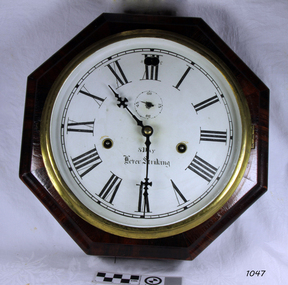
... In 1850 Jerome formed the Jerome Manufacturing Co. as a joint-stock company with Benedict & Burnham, brass manufacturers of Waterbury. In 1853 the company then became known as the New Haven Clock Co, producing 444,000 clocks and timepieces annually, then the largest clock maker in the world. ...In 1850 Jerome formed the Jerome Manufacturing Co. as a joint-stock company with Benedict & Burnham, brass manufacturers of Waterbury. In 1853 the company then became known as the New Haven Clock Co, producing 444,000 clocks and timepieces annually, then the largest clock maker in the world. ...Chauncey Jerome (1793–1868) was an American clock maker in the early to mid 19th century. He made a fortune selling his clocks, and his business grew quickly. Jerome was born in Canaan USA in 1793 son of a blacksmith and nail-maker. He began his career in Plymouth, making dials for long-case clocks where he learned all he could about clocks, particularly clock cases, and then went to New Jersey to make seven-foot cases for clocks mechanisms. In 1816 he went to work for Eli Terry making "Patent Shelf Clocks," learning how to make previously handmade cases using machinery. Deciding to go into business for himself, Jerome began to make cases, trading them to Terry for wooden movements. In 1822 Jerome moved his business to Bristol New Haven, opening a small shop with his brother Noble and began to produce a 30-hour and eight-day wooden clocks. By 1837 Jerome's company was selling more clocks than any of his competitors. A one-day wood-cased clock, which sold for six dollars had helped put the company on the map. A year later his company was selling that same clock for four dollars. The company also sold one line of clocks at a wholesale price of 75 cents and by 1841 the company was showing an annual profit of a whopping $35,000, primarily from the sale of its brass movements. In 1842 Jerome moved his clock-case manufacturing operation to St. John Street in New Haven. Three years later, following a fire that destroyed the Bristol plant, Jerome relocated the entire operation to Elm City factory. Enlarging the plant, the company soon became the largest industrial employer in the city, producing 150,000 clocks annually. In 1850 Jerome formed the Jerome Manufacturing Co. as a joint-stock company with Benedict & Burnham, brass manufacturers of Waterbury. In 1853 the company then became known as the New Haven Clock Co, producing 444,000 clocks and timepieces annually, then the largest clock maker in the world. Jerome's future should have been secure but in 1855 he bought out a failed Bridgeport clock company controlled by P.T. Barnum, which wiped him out financially, leaving the Jerome Manufacturing Co. bankrupt. Jerome never recovered from the loss. By his admission, he was a better inventor than a businessman. When Jerome went bankrupt in 1856 the New Haven Clock Company purchased the company. One of the primary benefits of Jerome purchasing New Haven in the first place was the good reputation of the Jerome brand and the network of companies that remained interested in selling its clocks. In England, Jerome & Co. Ltd. sold Jerome clocks for the New Haven company until 1904, when New Haven purchased the English firm outright. After his involvement with the New Haven Company in 1856, Jerome traveled from town to town, taking jobs where he could, often working for clock companies that had learned the business of clock making using Jerome's inventions. On returning to New Haven near the end of his life, he died, penniless, in 1868 at the age of 74. The company struggled on after Jerome's bankruptcy until after World War II, when the company endeavored to continue through disruptions caused by a takeover along with poor sales, finally having to fold its operations in 1960 a little more than 100 years after it had been founded. The item is significant as it is associated with Chauncey Jerome who had made a historic contribution to the clock making industry during the 19th century when he began to substitute brass mechanisms for wooden mechanisms in his clocks. This was said to be the greatest and most far-reaching contribution to the clock industry. Because of his discovery of stamping out clockwork gears rather than using castings, Jerome was producing the lowest-priced clocks in the world. That can only add to his significance as the major clock manufacture of the 19th century. Jerome may have made and lost, a fortune selling his clocks but was perhaps the most influential and creative person associated with the American clock business during the mid-19th century. Also, he had served his community as a legislator in 1834, a Presidential elector in 1852 and mayor of New Haven, Connecticut from 1854 to 1855.Clock, marine, in octagonal rosewood veneer case. Roman numerals to dial, has a seconds dial. 2 key-winding holes slow-to-Fast adjustment pin through dial. Small lever in lower edge of case activates a chime. "8 day, 8 inch, Lever Striking escarpment " Paper label on the back of the clock "Jerome & Co, New Haven, Conn" "Manufacturers of every variety of Office and Home Clocks and Time Pieces".flagstaff hill, warrnambool, shipwrecked-coast, flagstaff-hill, flagstaff-hill-maritime-museum, maritime-museum, shipwreck-coast, flagstaff-hill-maritime-village, clock, jerome & co, new haven, clock maker, chauncey jerome -
Federation University Historical Collection
Book, D.C. Davies et al, Metalliferous Minerals and Mining, 1892, 1892
... mining minerals quartz nova scotia california germany ural mountains gold deposits virginia new england new brunswick brazil australia new south wales mount morgan new zealand africa statistics india phillipines aruba island silver russia nevada ruby hill, nevada utah emma mine, nevada colarado red mountain district, colorado yankee girl mine arizona mexico peru bolivia chili\copper south africa italy austria norway swedan france cornwall dolcoath mine sandstone parys mines of anglesea carnarvonshire cardiganshire wicklow, ireland mississippi valley wisconsin lake superior wyoming cuba jamaica venezuela south australia york peninsula flinders ranges japan tin banca malaysia bohemia saxony sweden spain cligga point rin lodes of cornwall andalusia belgium shropshire isle of man durham westmoreland limestone flintshire dengigshire canada lead zinc siberia hungary silesia sardinia algeria ireland new jersey iron lancashire missouri michigan superstitions equipment cages stopes winzes timbering ventilation fans drilling boring dynamite electricity blasting horse whims water wheels boilers petterson's elephant ore stamp stamper battery jogs linkenbach table panning cradle quartz mining hydraulic mining alluvia; mining altai mountains north wales neugluck mine freiberg christbescherung mine drei prinzen lode miask woodville, virginia gongo soco, brazil sierra nevada, california st john del rey mine, brazil leydenberg gold field, south africa banket reefs, transvaal kongsberg, norway santa rosa mine, peru huelva, spain dolcoath mine, cornwall parys mine, anglesea waterbury copper mine, lake superior copiapo, chilli altenberg, saxony whea; uny, cornwall wast wheel mine. redruth, cornwall cligga point, cornwall old hewas mine, cornwall hartz, germany snailbeach mine, shropshire llangynog, north wales van mine, mongomeryshire Brown hard covered, illustrated book of 518 pages. ...Brown hard covered, illustrated book of 518 pages. It includes a bookplate of the Ballarat Ironworkers' and Polytechnical Association Library Rules. The book was bequethed to the Ironworkers' Association by the late James Oddie.mining, minerals, quartz, nova scotia, california, germany, ural mountains, gold deposits, virginia, new england, new brunswick, brazil, australia, new south wales, mount morgan, new zealand, africa, statistics, india, phillipines, aruba island, silver, russia, nevada, ruby hill, nevada, utah, emma mine, nevada, colarado, red mountain district, colorado, yankee girl mine, arizona, mexico, peru, bolivia, chili\copper, south africa, italy, austria, norway, swedan, france, cornwall, dolcoath mine, sandstone, parys mines of anglesea, carnarvonshire, cardiganshire, wicklow, ireland, mississippi valley, wisconsin, lake superior, wyoming, cuba, jamaica, venezuela, south australia, york peninsula, flinders ranges, japan, tin, banca, malaysia, bohemia, saxony, sweden, spain, cligga point, rin lodes of cornwall, andalusia, belgium, shropshire, isle of man, durham, westmoreland, limestone, flintshire, dengigshire, canada, lead, zinc, siberia, hungary, silesia, sardinia, algeria, ireland, new jersey, iron, lancashire, missouri, michigan, superstitions, equipment, cages, stopes, winzes, timbering, ventilation, fans, drilling, boring, dynamite, electricity, blasting, horse whims, water wheels, boilers, petterson's elephant ore stamp, stamper battery, jogs, linkenbach table, panning, cradle, quartz mining, hydraulic mining, alluvia; mining, altai mountains, north wales, neugluck mine, freiberg, christbescherung mine, drei prinzen lode, miask, woodville, virginia, gongo soco, brazil, sierra nevada, california, st john del rey mine, brazil, leydenberg gold field, south africa, banket reefs, transvaal, kongsberg, norway, santa rosa mine, peru, huelva, spain, dolcoath mine, cornwall, parys mine, anglesea, waterbury copper mine, lake superior, copiapo, chilli, altenberg, saxony, whea; uny, cornwall, wast wheel mine. redruth, cornwall, cligga point, cornwall, old hewas mine, cornwall, hartz, germany, snailbeach mine, shropshire, llangynog, north wales, van mine, mongomeryshire
