
Showing 6 items matching "wedding dowry"
-
 Australian Multicultural Community Services
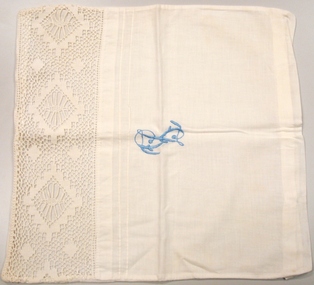
pillow case, Zofia Godlewska, maiden name Mioduszewska, craft, 40s
... ...wedding dowry...The pillow case was a part of the wedding dowry of Zofia Mioduszewska. She maid it herself. ...The pillow case was a part of the wedding dowry of Zofia Mioduszewska. She maid it herself. ...The pillow case was a part of the wedding dowry of Zofia Mioduszewska. She maid it herself. It was tradition that every young girl had to prepare her own items needed in her new household. Made in 40s. example of embroidery from Podlachiawhite, linen pillow case initials ZG (Zofia Godlewska)craft, podlachia, poland, embroidery, wedding dowry -
 Embroiderers Guild, Victoria
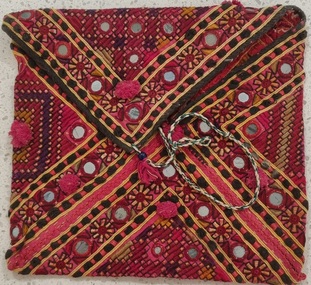
Textile - Indian Banjara Dowry Bag, 19 th C
... "Bagchi" or dowry bags, traditionally handmade and gifted during weddings and engagements...."Bagchi" or dowry bags, traditionally handmade and gifted during weddings and engagements. ...Traditional Banjara (Tribal) bag from regions like Kutch in Gunjarat or Rajasthan, India. "Bagchi" or dowry bags, traditionally handmade and gifted during weddings and engagements.Heavily embroidered in a geometric design with shisha mirrors in reds, black and cream. Small pom poms attached. Cream and blue cord and blue bead.bag, india -
 Embroiderers Guild, Victoria
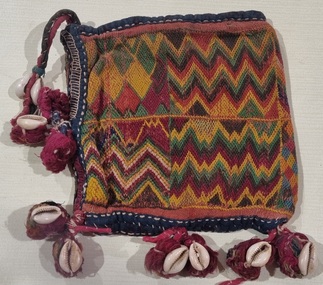
Functional object - Indian Banjara Dowry Bag, 20 th C
... "Bagchi" or dowry bags, traditionally handmade and gifted during weddings and engagements. ..."Bagchi" or dowry bags, traditionally handmade and gifted during weddings and engagements. ...Traditional Banjara (also known as Lambani) are an historically nomadic trading community originating in the Mewar region of Rajasthan, before migrating across central and southern India. "Bagchi" or dowry bags, traditionally handmade and gifted during weddings and engagements. Cowrie shells symbolize prosperity and good luck.Indian Banjara dowry bag embroidered on linen/cotton with Florentine style stitches in red, yellow, green and blue. Nine red tassels with cowrie shells attached and draw string with two cowrie shells attached.india, bag -
 Embroiderers Guild, Victoria
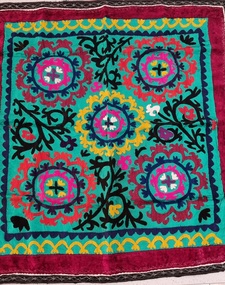
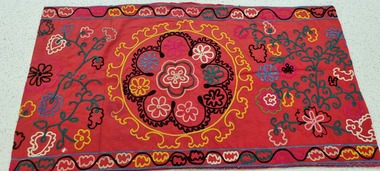
Textile - Uzbekistan Embroidered Panel, 20 th C
... They were traditionally made by brides and their mothers as part of a dowry, and presented to the groom on his wedding day. They represented the binding together of two families, and were adorned with symbols of luck, health, long life and fertility. ...They were traditionally made by brides and their mothers as part of a dowry, and presented to the groom on his wedding day. They represented the binding together of two families, and were adorned with symbols of luck, health, long life and fertility. ...A suzani is a large, hand-embroidered textile panel; the word comes from the Persian word suzan, which means needle. Originating from nomadic tribes in Tajikistan, Uzbekistan, Kazakhstan and other Central Asian countries, suzanis have become highly collectable and valued for their beautiful decoration and fine craftsmanship. They were traditionally made by brides and their mothers as part of a dowry, and presented to the groom on his wedding day. They represented the binding together of two families, and were adorned with symbols of luck, health, long life and fertility. Suzanis are made from cotton, sometimes silk. The pattern is first drawn onto the cotton, before being embroidered on narrow portable looms. They are usually produced in two or more pieces, meaning that they can be worked on by more than one person, before being stitched together. Just four stitches — tambour, basma, chain and kanda-khayol Panel of embroidered Suzani on green polyester fabric with maroon velvet border. Embroidered with stylized floral circular designs and foliage. Designs are embroidered in white, yellow, orange, bronze, pink, brown and black thread in tambour stitch. Backing is red cotton fabric. Border strips are embellished with machine patterned stitching. -
 Embroiderers Guild, Victoria
Textile - Uzbekistan Embroidered Cushion Cover, 20 th C
... They were traditionally made by brides and their mothers as part of a dowry, and presented to the groom on his wedding day. They represented the binding together of two families, and were adorned with symbols of luck, health, long life and fertility. ...They were traditionally made by brides and their mothers as part of a dowry, and presented to the groom on his wedding day. They represented the binding together of two families, and were adorned with symbols of luck, health, long life and fertility. ...A suzani is a large, hand-embroidered textile panel; the word comes from the Persian word suzan, which means needle. Originating from nomadic tribes in Tajikistan, Uzbekistan, Kazakhstan and other Central Asian countries, suzanis have become highly collectable and valued for their beautiful decoration and fine craftsmanship. They were traditionally made by brides and their mothers as part of a dowry, and presented to the groom on his wedding day. They represented the binding together of two families, and were adorned with symbols of luck, health, long life and fertility. Suzanis are made from cotton, sometimes silk. The pattern is first drawn onto the cotton, before being embroidered on narrow portable looms. They are usually produced in two or more pieces, meaning that they can be worked on by more than one person, before being stitched together. Just four stitches — tambour, basma, chain and kanda-khayol Cushion cover of embroidered Suzani on red cotton fabric. Embroidered with stylized floral design and foliage. Designs are embroidered in white, yellow, orange, bronze, pink, brown and black thread in tambour stitch. -
 Embroiderers Guild, Victoria
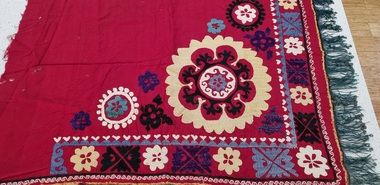
Textile - Uzbekistan Embroidered Panel, 20 th C
... They were traditionally made by brides and their mothers as part of a dowry, and presented to the groom on his wedding day. They represented the binding together of two families, and were adorned with symbols of luck, health, long life and fertility. ...They were traditionally made by brides and their mothers as part of a dowry, and presented to the groom on his wedding day. They represented the binding together of two families, and were adorned with symbols of luck, health, long life and fertility. ...A suzani is a large, hand-embroidered textile panel; the word comes from the Persian word suzan, which means needle. Originating from nomadic tribes in Tajikistan, Uzbekistan, Kazakhstan and other Central Asian countries, suzanis have become highly collectable and valued for their beautiful decoration and fine craftsmanship. They were traditionally made by brides and their mothers as part of a dowry, and presented to the groom on his wedding day. They represented the binding together of two families, and were adorned with symbols of luck, health, long life and fertility. Suzanis are made from cotton, sometimes silk. The pattern is first drawn onto the cotton, before being embroidered on narrow portable looms. They are usually produced in two or more pieces, meaning that they can be worked on by more than one person, before being stitched together. Just four stitches — tambour, basma, chain and kanda-khayol Part of a piece of embroidered Suzani in red cotton with corner embroidered with circular designs and framed corner panel. Designs are embroidered in white, cream, blue and black thread in tambour stitch. Backing is a floral yellow fabric. Green tassels on two sides with spangles attached.
