
Showing 81 items matching "welded metal"
-
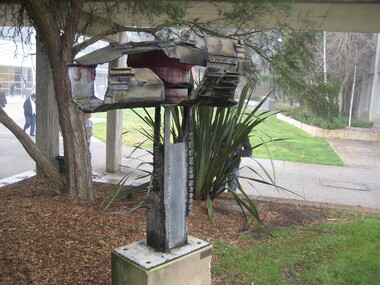 Federation University Art Collection
Sculpture - Sculpture - welded Metal, 'Organic Form' by Inge King, c1967
... Sculpture - welded Metal......welded metal...'Organic Form' by Inge King Sculpture Sculpture - welded Metal Inge King ...Inge KING (26 November 1915 – 23 April 2016) Born Berlin, Germany Arrived Australia 1951 Inge King trained as a wood carver and studied at the Berlin Academy (1937-1939), Royal Academy London (1940), and the Glascow School of Art (1941-1943) . She moved to London in 1947 and began carving organic abstract forms in wood and stone. In 1949-50 she went on a study tour to the United States of America where she was inspired to work in metal . Inge King arrived in Australia in 1951 and she completed several large scale public works. Between 1961 and 1975 Inge King lectured at the Institute of Early Childhood Development, Kew. From 1976 to 1987 she lectured in Sculpture at Royal Melbourne Institute of Technology. She was a founding member of the Ceminal Centre Five group, and she actively lobbied architects, governments and State galleries to include modernist sculptures in their plans and displays. In 1991 Inge King joined the first National Trust of Australia (Victoria) Public Art Committee, advising on public art at risk and worthy of Trust classification. The Australian Women's Art Register describes Inge King as having been at the forefront of developing a non figurative vocabulary in Australian Sculpture. Welded bronzed steel sculpture painted black and red. This sculpture by Inge King was purchased in 1967 with funds raised by staff and students of Ballarat Teachers' College, a predecessor institution of Federation University Australia. During this era a collection was made which resulted in an annual purchase or commission of an artwork of note. The Federation University Art Collection features over 1000 works and was listed as a 'Ballarat Treasure' in 2007. Signed 'I. King' on the lower steel plate. art, artwork, inge king, king, sculpture, ballarat teachers' college collection, welded metal, metal sculpture -
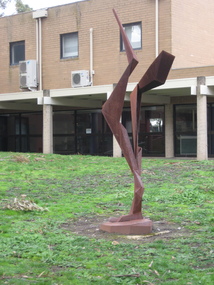 Federation University Art Collection
Sculpture - Artwork, [Untitled] by Chris White, c1986
... Welded metal sculture....The Art Collection features over 2000 works and was listed as a 'Ballarat Treasure' in 2007. art artwork sculpture Welded metal sculture. [Untitled] by Chris White Sculpture Artwork White, Chris White, Chris ...Chris WHITE Chris White is a sculptor and installation artist This item is part of the Federation University Art Collection. The Art Collection features over 2000 works and was listed as a 'Ballarat Treasure' in 2007.Welded metal sculture.art, artwork, sculpture -
 Glenelg Shire Council Cultural Collection
Photograph - Photograph - Portland Harbour No 5 Wharf construction, n.d
... Shows 2 workmen, one welding metal formwork...Shows 2 workmen, one welding metal formwork Photograph Photograph - Portland Harbour No 5 Wharf construction ...Port of Portland Authority Archivesport of portland archives -
The Ed Muirhead Physics Museum
Clockwork Chart Recorder
... No. of pieces: 2 (with removable parts) Assembled, soldered/welded. Metal: plated. Wood: varnished. Accessories: key. ...No. of pieces: 2 (with removable parts) Assembled, soldered/welded. Metal: plated. Wood: varnished. Accessories: key. ...No. of pieces: 2 (with removable parts) Assembled, soldered/welded. Metal: plated. Wood: varnished. Accessories: key. Surface finish: coated. -
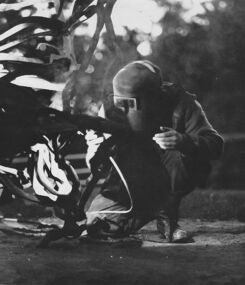 Montsalvat
Photograph, Matcham Skipper Welding
... Black and white photograph of Matcham Skipper welding a metal sculpture. ...Matcham Skipper Photograph Metalwork Montsalvat None Black and white photograph of Matcham Skipper welding a metal sculpture. Matcham Skipper Welding Photograph ...Black and white photograph of Matcham Skipper welding a metal sculpture. Nonematcham skipper, photograph, metalwork, montsalvat -
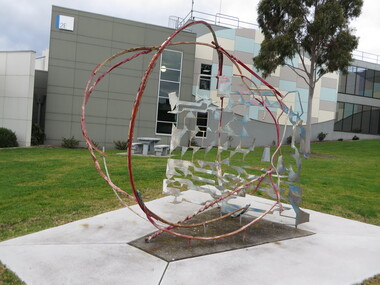 Federation University Art Collection
Sculpture, Anthea Williams
... Anthea WILLIAMS The sculptural practice of Gippsland-based artist Anthea Williams includes welded metals, moulds and assemblages. She has lectured Visual Arts at Federation University, Churchill and has many years experience as a technician at Latrobe Regional Gallery. ...Anthea WILLIAMS The sculptural practice of Gippsland-based artist Anthea Williams includes welded metals, moulds and assemblages. She has lectured Visual Arts at Federation University, Churchill and has many years experience as a technician at Latrobe Regional Gallery. ...Anthea WILLIAMS The sculptural practice of Gippsland-based artist Anthea Williams includes welded metals, moulds and assemblages. She has lectured Visual Arts at Federation University, Churchill and has many years experience as a technician at Latrobe Regional Gallery. Large steel sculptureanthea williams, gippsland art collection, sculpture -
 Coal Creek Community Park & Museum
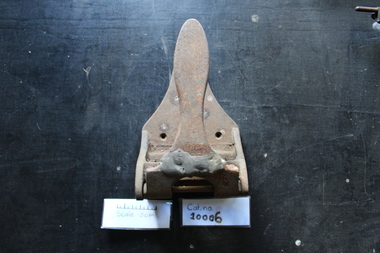
Hole Puncher
... Metal, Rusty, Welded, Really Poor Condition...Metal, Rusty, Welded, Really Poor Condition Hole Puncher ...Metal, Rusty, Welded, Really Poor Condition -
 Orbost & District Historical Society
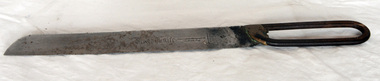
bread knife, 1950's 1970's
... The original handle has been replaced by a metal handle welded on....The original handle has been replaced by a metal handle welded on. bread knife Leppington (Cutlers) ...This knife would have had an original bone handle which may have been damaged beyond repair. It has been replaced by a sturdy metal one so as to retain the quality blade. This item shows the self-reliance of families in preserving valued domestic possessions.A bread knife. The original handle has been replaced by a metal handle welded on.Bread Knife Leppington (Cutlers) Firth Brearley Sheffield Eng. Stainlessknife cutlery leppington firth-brearley -
 Deaf Children Australia
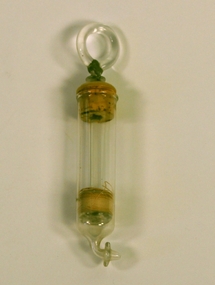
Glass Ear Syringe, Early 20thC, possibly 1890-1910
... cap and handle repaired with metal welding. ...cap and handle repaired with metal welding. Glass Ear Syringe ...Early 20th Century glass syringe Glass syringe, with open circular hand crip and string resistence wound around cork stopper, with bakelite (?) cap and handle repaired with metal welding. deaf children australia, syringe, ear syringe, glass syringe -
 Flagstaff Hill Maritime Museum and Village
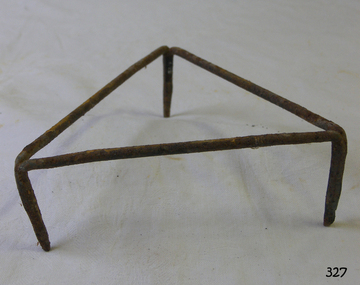
Domestic object - Iron stand
... Triangular shaped stand made from metal rods welded together at feet. Painted black....Flagstaff Hill Flagstaff Hill Maritime Museum and Village Warrnambool Maritime Museum Maritime Village Great Ocean Road Shipwreck Coast iron stand triangular iron stand ironing Laundry Equipment Triangular shaped stand made from metal rods welded together at feet. Painted black. ...Households from the 18th century onwards used a hot iron to removed wrinkles and creases in fabric such as clothing, table and bed linen This simple iron stand provided a rest for a hot iron between use during an ironing session and a place for the iron to cool when the session was completed. This item is associated with domestic life during the 19th and early 20th centuries. Triangular shaped stand made from metal rods welded together at feet. Painted black.flagstaff hill, flagstaff hill maritime museum and village, warrnambool, maritime museum, maritime village, great ocean road, shipwreck coast, iron stand, triangular iron stand, ironing, laundry equipment -
 Warrnambool and District Historical Society Inc.
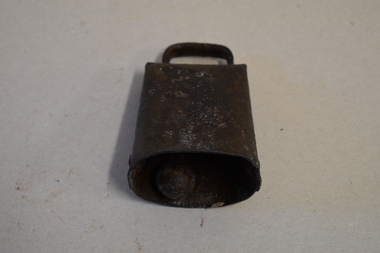
Bell, Cow, Late 19th century
... This is a piece of metal welded to form a cover or a bell container with a bottom opening to hold a metal clapper which is held in place by a metal ring. ...Although this item has no known local provenance it is retained as an early example of the bells placed around animals’ necks to stop them from straying. animal husbandry warrnambool history of warrnambool cow bell This is a piece of metal welded to form a cover or a bell container with a bottom opening to hold a metal clapper which is held in place by a metal ring. ...This item was originally made to put around a farm or herd animal to enable it to be identified and found if it strayed. Horses, cows, goats and oxen were the animals most commonly given neck bells in Australia as a way of identifying and finding cattle particularly in areas where prpoerties were unfenced or when droving large herds of mixed cattle. Drovers often marked these bells as a way of identifying which cattle belonged to them. Some of these bells from the 1860's onwards were imported to Australia and some were manufactured locally. The cow bell in various sizes is often still produced to sell to tourists, particularly those in Europe. Many of these souvenir bells contain some form of art work. Although this item has no known local provenance it is retained as an early example of the bells placed around animals’ necks to stop them from straying. This is a piece of metal welded to form a cover or a bell container with a bottom opening to hold a metal clapper which is held in place by a metal ring. The top has a metal handle. The bell is very rusted and stained.animal husbandry, warrnambool, history of warrnambool, cow bell -
 Maffra Sugarbeet Museum
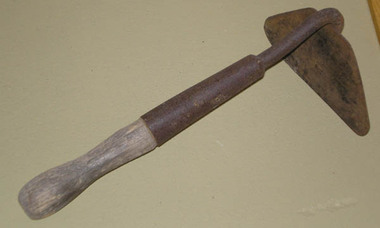
Beet Hoe
... onto a bent holder, which is in turn welded to the metal extension of the handle. There is cloth inside the ferrule.... onto a bent holder, which is in turn welded to the metal extension of the handle. There is cloth inside the ferrule. ...These hoes were the standard thinning tool for sugarbeet, and allowed a standard space between seedlings. Thinning was back-breaking work, usually carried out by a transient work force.These hoes are probably still commonly in the possession of old gardeners. They are important as the only tool required of a large, transient workforce that worked under extremely difficult conditions.A metal thinning hoe of four piece construction, with a turned wooden handle attached to the tool by a nail. The blade is welded onto a bent holder, which is in turn welded to the metal extension of the handle. There is cloth inside the ferrule.sugarbeet -
 Numurkah & District Historical Society
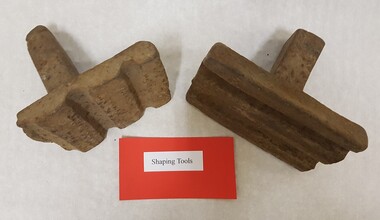
Blakcsmith shaping tools x 2
... This metal piece has a rectangular metal handle welded onto it...This metal piece has a rectangular metal handle welded onto it Blakcsmith shaping tools x 2 ...2 x metal/iron shaping tools. Flat rectangular metal piece has corrugated pattern underneath. This metal piece has a rectangular metal handle welded onto itblacksmith, forge, shaping tool -
 Ballarat Tramway Museum
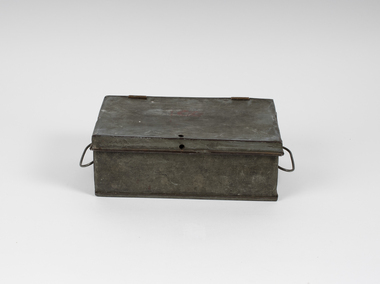
Functional object - Conductors Tin D81, 1950s ?
... Metal box formed from four sheets of metal, spot welded together with a formed lid, hinged to box and fitted with a hasp and staple. ...BTM Ballarat Tramway Museum Conductors Tin Fares Tickets Metal box formed from four sheets of metal, spot welded together with a formed lid, hinged to box and fitted with a hasp and staple. ...Each crew member was issued with a series of tins, A, B and C which allowed for the various days and weekends to enable Revenue Clerks to accept returns and restock the tins with new tickets etc.Has a strong association with tram crews and the ticket / revenue collection system. Metal box formed from four sheets of metal, spot welded together with a formed lid, hinged to box and fitted with a hasp and staple. Stamped with red lettering reading "D81". btm, ballarat tramway museum, conductors tin, fares, tickets -
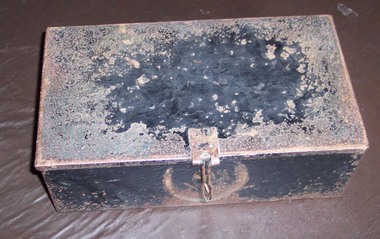 Ballarat Tramway Museum
Functional Object - Metal Box, Conductors tin, 1950's
... Metal box formed from four sheets of metal, spot welded together with a formed lid, hinged to box and fitted with a hasp and staple. ...Trams tramways Crews Tickets Revenue Journal Metal box formed from four sheets of metal, spot welded together with a formed lid, hinged to box and fitted with a hasp and staple. ...The box used by SEC Ballarat and Bendigo tram crews for holding their ticket outfits and making returns to the Revenue Clerks. Fitted with a padlock - see Reg. Item 3673. .Issued to a crew member with Traffic No. 62 - Roy Courtney. Each crew member was issued with a series of tins, A, B, and C which allowed for the various days and weekends to enable Revenue Clerks to accept returns and restock the tins with new tickets etc. Known to crews as "Two bottle boxes" - could fit two bottles of ale into them. The actual manufacturer is not known - could have been SEC workshops. See item 8917 for an MMTB tin.Has a strong association with tram crews and the ticket / revenue collection system. Tram crews used them to contain their tickets and to undertake their returns. Also used to "hide" bottles of ale., Has a strong association with tram crews and the ticket / revenue collection system. Tram crews used them to contain their tickets and to undertake their returns. Also used to "hide" bottles of ale.Metal box formed from four sheets of metal, spot welded together with a formed lid, hinged to box and fitted with a hasp and staple. Box painted black and lettered "62A". trams, tramways, crews, tickets, revenue journal -
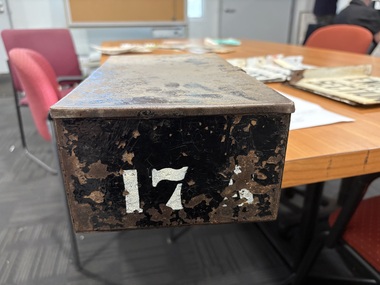 Ballarat Tramway Museum
Functional Object - Metal Box - set of two, SECV Conductors tin, 1950's
... Set of two metal boxes formed from four sheets of metal, spot welded together with a formed lid, hinged to box and fitted with a hasp and staple. ...Trams tramways Crews Tickets Revenue Journal Set of two metal boxes formed from four sheets of metal, spot welded together with a formed lid, hinged to box and fitted with a hasp and staple. ...The box used by the SECV Ballarat and Bendigo tram crews for holding their ticket outfits and making returns to the Revenue Clerks. Able to be fitted with a padlock - see Reg. Item 3673. Issued to a crew member with Traffic Nos. 17 and 44. Each crew member was issued with a series of tins, A, B, and C which allowed for the various days and weekends to enable Revenue Clerks to accept returns and restock the tins with new tickets etc. Known to crews as "Two bottle boxes" - could fit two bottles of ale into them. The actual manufacturer is not known - could have been SEC workshops. See item 8917 for an MMTB tin.Has a strong association with tram crews and the ticket / revenue collection system. Tram crews used them to contain their tickets and to undertake their returns. Also used to "hide" bottles of ale.Set of two metal boxes formed from four sheets of metal, spot welded together with a formed lid, hinged to box and fitted with a hasp and staple. Box painted black and lettered "17A" and "44B"trams, tramways, crews, tickets, revenue journal -
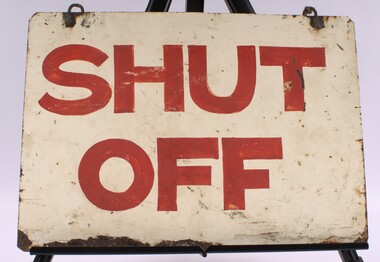 Ballarat Tramway Museum
Sign, Launceston Municipal Transport, Shut Off
... Steel plate, painted with white top coat both sides and words "Shut Off" painted in red on both sides and two metal loops welded onto enable sign to be suspended alongside the trolley wire, using a span wire....Trams tramways Launceston Trolley Buses Overhead Steel plate, painted with white top coat both sides and words "Shut Off" painted in red on both sides and two metal loops welded onto enable sign to be suspended alongside the trolley wire, using a span wire. ...Steel plate, painted with white top coat both sides and words "Shut Off" painted in red on both sides and two metal loops welded onto enable sign to be suspended alongside the trolley wire, using a span wire.trams, tramways, launceston, trolley buses, overhead -
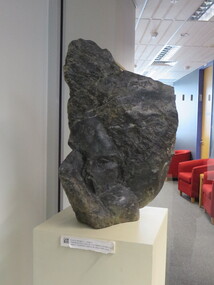 Federation University Art Collection
Sculpture - Artwork -Sculpture, Representation of Das From A Temple in Area, c2000
... His early work used welded and cast metal objects. In the 1980s he transitioned to marble sculpture Clive Murray White was Head of Sculpture at the Monash University Churchill (now Federation University Gippsland). ...His early work used welded and cast metal objects. In the 1980s he transitioned to marble sculpture Clive Murray White was Head of Sculpture at the Monash University Churchill (now Federation University Gippsland). ...Clive MURRAY-WHITE (20 February 1946 - ) Born Walton-on-Thames, Surrey, England Arrived Australia 1959 With an impressive career that has included sculpting marble for over 25 years Clive Murray-White has informed his at practice by studying at Brisbane Central Technical College, Guildford School of Art, United Kingdom, Royal Melbourne Institute of Technology and Preston Institute of Technology, Monash University. His early work used welded and cast metal objects. In the 1980s he transitioned to marble sculpture Clive Murray White was Head of Sculpture at the Monash University Churchill (now Federation University Gippsland). He established the Cowwarr Art Space with Carolyn Crossley. Sculpture of a head carved from Cooper's Creek Black Limestone. artwork, artist, sculpture, gippsland campus -
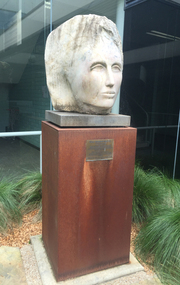 Federation University Art Collection
Sculpture, 'Hygea' by Clive Murray-White, 2008
... His early work used welded and cast metal objects. In the 1980s he transitioned to marble sculpture Clive Murray White was Head of Sculpture at the Monash University Churchill (now Federation University Gippsland). ...His early work used welded and cast metal objects. In the 1980s he transitioned to marble sculpture Clive Murray White was Head of Sculpture at the Monash University Churchill (now Federation University Gippsland). ...Clive MURRAY-WHITE (20 February 1946 - ) Born Walton-on-Thames, Surrey, England Arrived Australia 1959 With an impressive career that has included sculpting marble for over 25 years Clive Murray-White has informed his at practice by studying at Brisbane Central Technical College, Guildford School of Art, United Kingdom, Royal Melbourne Institute of Technology and Preston Institute of Technology, Monash University. His early work used welded and cast metal objects. In the 1980s he transitioned to marble sculpture Clive Murray White was Head of Sculpture at the Monash University Churchill (now Federation University Gippsland). He established the Cowwarr Art Space with Carolyn Crossley.Marble sculpture of Hygia, the Greek goddess of health and healing. Daughter of Asciepius the God of Medicine, Hygeia symbolises the preservation of good heallth and prevention of illness. Presented to the Gippsland Medical School from the Campus. churchill, gippslands campus, clive murray white, sculpture, clive murray-white -
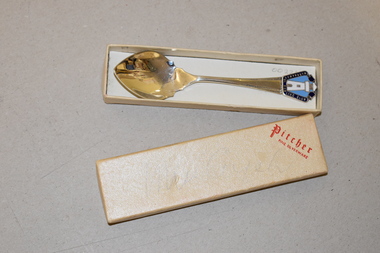 Warrnambool and District Historical Society Inc.
Souvenir Spoon, Pitcher Company, Warrnambool Bowling Club, 1970s
... It has a coloured metal piece welded into the top of the spoon. This has been enamelled in blue, white and silver and has an image of a lighthouse and some printing. ...It has a coloured metal piece welded into the top of the spoon. This has been enamelled in blue, white and silver and has an image of a lighthouse and some printing. ...This is a souvenir jam spoon which would have been given or sold to Warrnambool Bowling Club members and visitors to Warrnambool. The game of lawn bowls was first played in Warrnambool in 1868 but the present day Warrnambool Bowls Club was founded in 1890, with a bowling green in Liebig Street, Warrnambool. Today the club has its facilities in Kelp Street Warrnambool and its logo features a Warrnambool lighthouse.This spoon is a memento of the Warrnambool Bowls Club and shows the type of souvenir popular with members and tourists some 40 or 50 years ago. This is an electro-plated nickel silver jam spoon. It has a coloured metal piece welded into the top of the spoon. This has been enamelled in blue, white and silver and has an image of a lighthouse and some printing. There are also some markings on the back of the spoon. The spoon is in a cream-coloured cardboard box which is rectangular-shaped. Spoon: Warrnambool Bowling Club Pitcher EPNS A1 Box: Pitcher Fine Silverware warrnambool bowls club, history of warrnambool -
NMIT (Northern Melbourne Institute of TAFE)
Video recordings: Instructional NMCOT and NMIT 1980s
... welding. Roof plumbing: fitting outlet. Friction in engineering (20 min). Grafting and budding techniques. (1986) (Duration 10.00) Horticultural courses at Collingwood College of TAFE. [No date] (10 min). Making a hand made thread. [No date] [No time] Making a hand-made thread Manual metal...welding. Roof plumbing: fitting outlet. Friction in engineering (20 min). Grafting and budding techniques. (1986) (Duration 10.00) Horticultural courses at Collingwood College of TAFE. [No date] (10 min). Making a hand made thread. [No date] [No time] Making a hand-made thread Manual metal ...U-Matic Video recordings (Master tapes) mostly dated in the 1980s. Alphabetically: A house of all trades [No date] (14 min). An Introduction to floor managing An introduction to floor managing. Architrave: running the mould. Solid plastering. [No date] (17 min). Boom spray calibration (turf management). [No date] (6 min). Drafting. Module C51 Step no 4.(footwear) (1987) [No time] (Edit master) Fibrous plastering (1988) (Duration 11.00) Firm foundations: presenting a case for finance (21 min) Flux cored arc welding. Roof plumbing: fitting outlet. Friction in engineering (20 min). Grafting and budding techniques. (1986) (Duration 10.00) Horticultural courses at Collingwood College of TAFE. [No date] (10 min). Making a hand made thread. [No date] [No time] Making a hand-made thread Manual metal arc welding [No date] (24 min). Master saddlery; stitching: 1 saddle, 2 back. Microphones and their use in location sound recording [No date] [No time] Microphones and their uses in location sound recording Mold cutting [No date] [No time] Plain sailing: a film about business planning (20 min). Potentiometers, Part 1. (1983)(16 min). Preparation of artwork for video tape production (1977)(162 min). Preparation of instructional video tapes (1977)(12 min). Roof plumbing: fixing eaves cutters: Part 1 – fixing methods. [no time] Saddlery: hand stitching Safe saddle making. (1985) [No time] Solid plastering/Setting in Plaster and lime (1987) (Duration 10.00) (Edit master) Special electronic effects in video production. [No date] [No time] Splitting a stone using plugs and feathers [No date, possibly 1987] (Duration 9.40) (Master edit) The necessary art; videotape lighting: practical tips. (1974)(15 min). Tiling a staircase (1987) (Duration 25.00) (master edit) Water resistant board (W.R. Board): What is a word processor (26 min). WR Board northern metropolitan college of tafe, handbooks, nmit -
Bendigo Historical Society Inc.
Document - ROYAL PRINCESS THEATRE COLLECTION: PROGRAM OF COMING EVENTS, 1916
... Oxy Acetylene welding of all metals. Bartlett Bros. Photographers. ...Oxy Acetylene welding of all metals. Bartlett Bros. Photographers. ...Princess Theatre Bendigo - Program of coming events in c1917. Coming Events: Gonsalez, Italian Grand Opera Company, commencing Monday May 7, for 3 nights' season. The Brilliant and Incomparable Gonzalez, Italian Grand Opera Company. Opening Production_Verdi's Immortal Masterpiece Il Trovatore. Page 3. Monday, May 7, 1917. Il Trovatore. Opera in 4 acts. Music by G Verdi. Cast of Characters: Signorinas: De Revers, Russ, Capelli. Signors: Scamuzzi, Cacialli. Chorus of voices. Overture at 8pm sharp. Director of Orchestra: Giovanni Gonsalez. Leader of Orchestra: Mr S de Tarczynski. Cello Soloist: Mr Laurie Kennedy. Page 9 Farewell Night. Wednesday, May 9, 1917 Faust, Opera in 5 acts. Music by Gounod. Cast of Characters: Signors Balboni, Cacialli, Filippini, Cesaroni. Signorinas: Visoni, Russ, Piccolo. Overture at 7.45pm sharp. Director of Orchestra: Giovanni Gonsalez. Leader of Orchestra: Mr S de Tarczynski. Cello: Mr Laurie Kennedy. Cast members: Signors Balboni, Cacialli, Filippini and Cesaroni. Signorinas: Visoni, Russ and Piccolo. Director of Orchestra: Giovanni Gonzalez. Leader of Orchestra: Mr S de Tarczynski. Cello Soloist: Mr Laurie Kennedy. Page 11, Repertoire of Operas to be produced by the Gonsalez Opera Company to Wednesday, May 9. Monday, May 7, at 8pm. Cavalleia Rusticana, I Pagliacci. Wednesday, May 9 at 7.45pm. Faust. Between the acts. The story of 'Cavalleria Rusticana' is based on truth and reality alone. It is built up on the fact Turridu, a young peasant, has loved and wooed Lola before . . . . . . Of all the many successful productions in which Mme. Petrova, the celebrated Metro star, appeared, 'The Black Butterfly,' in which she appears in this Theatre, on Thursday, Friday and Saturday, next, is considered her greatest, In 'The Black Butterfly . . . The story of 'Rigoletto' is taken from Victor Hugo's drama 'Le roi S'amuse.' In it the Duke of Mantua a wild and unprincipled youth makes love to every . . . Programme Compiled. Wholly Set Up and Printed by The Cambridge Press, Phone 130. Market Sq., Bendigo. Many ads appear throughout the brochure: Allan's, 253 Mitchell Street Bendigo. Ph 244. W Brown, 171 Mitchell Street, 'Centerway' 105 View Street, Bendigo's Leading Pastrycook & Caterer. Hume & Iser: English and Canadian wallpapers. Timber Merchants & Iron Mongers, full range of stoves, Mantlepieces, grates, tiles, bath-heaters, bathroomware, Berger's Paints. Phones: Yard 48, Showroom 470. Cambridge Press: For artistic programmes, menus, concert tickets, At-Home Cards, and Commercial Printing. Ph 130. Delves' Café, Dainty Service. 'Class' Suppers at moderate Cost. Ph 805. Next to Royal Bank (above Hampton's). Bendigo Business College: Evening Commercial Classes, book-keeping, typewriting, shorthand. Applications to James E Holland, F.P.S.A. Pianoforte & Organ Tuning. A B Challen, Qualified Tuner Ph 319, 42 Rowan St., Bendigo. Chatfield Bros. The Motor Experts, High Street, Bendigo. Ph 609. Car repairs, New cars, hire cars, something for your car. Service Station for Ford car parts, Dunlop & Goodyear tyres. Accessories of all kinds stocked. Oxy Acetylene welding of all metals. Bartlett Bros. Photographers. Bartlett Bros' Studios, (R W Bugg, Proprietor) Williamson St, (opp Hotel Shamrock). Half & Half (Registered) Non-Alcoholic and Invigorating. Manufactured by C J Glover, Ph 343, Chapel Street, Bendigo. R D Ellis, Ladies & Gents Tailor, 241 Mitchell Street, (opposite Morley Johnson's). Nursery (Rose) at Epsom, Stock to be Sold at Half Usual Price. Mr S H Hunt, who has 33 prizes & championships, has accepted a position with Brunning's of Bendigo and has sold the of his 10,000 Roses to them. There are . . . Baker & Woods, 313 Hargreaves St, Ph 209. Electric light installed in your home. 'THE BEEHIVE' Bendigo's Famous Store. Blouses of Beauty, Coats of Comfort, Costumes of Character, Dresses of Delight, Skirts of Style, Millinery of Merit are Permantant Features of Bendigo's Famous Store 'The Beehive'. Best by Test, Leggos of Bendigo 'Progress' Tomato Sauce on the table, wether at home or in the restaurant, there should always be Leggos of Bendigo 'Progress' Tomato Sauce. It's the kind of Sauce you enjoy to the last-no bitting acidity-but a Delicious and Delicate Flavor combined with a Smoothness always agreeable to the palate,. Leggo's 'Progress' Sauce is the result of the . . . H M Leggo& Co Manufacturers, Bendigo. Est. 1881.The Cambridge Press, Market Sq. Bendigo Ph 130program, theatre, princess theatre bendigo -
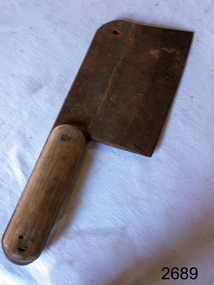 Flagstaff Hill Maritime Museum and Village
Cleaver
... metal. Has small hole to hang & small hole in wooden handle. Handle attached by 2 rivets. Blade has welding along it....metal. Has small hole to hang & small hole in wooden handle. Handle attached by 2 rivets. Blade has welding along it. ...Cleaver - metal. Has small hole to hang & small hole in wooden handle. Handle attached by 2 rivets. Blade has welding along it.flagstaff hill, warrnambool, shipwrecked-coast, flagstaff-hill, flagstaff-hill-maritime-museum, maritime-museum, shipwreck-coast, flagstaff-hill-maritime-village, flagstaff hill, warrnambool, shipwrecked-coast, flagstaff-hill, flagstaff-hill-maritime-museum, maritime-museum, shipwreck-coast, flagstaff-hill-maritime-village -
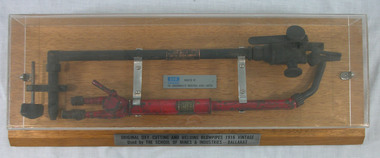 Federation University Historical Collection
Tool, British Oxygen Company Ltd, Oxy-cutting and Welding Blow Pipes, c 1904
... Pipes mounted by metal bar and hooks to polished wooden board. Display case is 69.0cm x 12.0cm x 25.0cm Oxy-cutting and Welding Blow Pipes Tool British Oxygen Company Ltd ...In 1903 the oxyacetylene welding process was developed. Around the same time, new cryogenic air separation processes, based on work undertaken by Carl von Linde and others, replaced the barium oxide process. This paved the way for larger scale and more efficient production. British Oxygen Company, [1905 to 1969] was formally BRIN'S Oxygen Company Ltd from 1886 to 1905. In 1969 it became BOC. These Blowpipes were used at the Ballarat School of Mine c1916 Interesting article = 1917. https://trove.nla.gov.au/newspaper/article/1629321Boxed Universal Blow Pipe, presented under a perspex top. Pipes mounted by metal bar and hooks to polished wooden board. Display case is 69.0cm x 12.0cm x 25.0cmBoth pipes have metal plates indicating information of maker.blowpipes, ocyacetylene, ballarat school of mines, welding, cutting, commonwealth industrial gases, boc, brin's oxygen company, british oxygen company -
 Flagstaff Hill Maritime Museum and Village
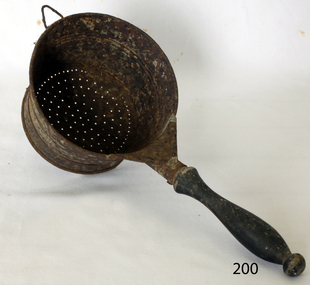
Domestic object - Colander, 1900-1920
... Strainer or colander, metal, with concave base and wood handle, plated metal construction with welded or folded seams. Handle painted black, perforated base....This item gives a snapshot into domestic life around the late 19th and early 20th centuries and the types of kitchen equipment in use. flagstaff hill warrnambool flagstaff hill maritime museum maritime museum shipwreck coast flagstaff hill maritime village great ocean road strainer food strainer seive food preparation kitchen ware None Strainer or colander, metal, with concave base and wood handle, plated metal construction with welded or folded seams. Handle painted black, perforated base. ...A colander, sieve or cullender is a kitchen utensil used to strain foods such as pasta or to rinse vegetables. The perforated nature of the bowl allows liquid to drain through while retaining the solids inside it is sometimes also called a pasta strainer or kitchen sieve. Conventionally, colanders are made of a light metal, such as aluminum or thinly rolled stainless or plated steel, colanders are also made of plastic, silicone, ceramic, and enamelware. The word colander comes from the Latin Colum meaning sieve.Early 20th century kitchen item possibly of French manufacture due to the design and shape of the bowl this design appears to have been favoured by the French around 1910 for smaller Colanders. This item gives a snapshot into domestic life around the late 19th and early 20th centuries and the types of kitchen equipment in use.Strainer or colander, metal, with concave base and wood handle, plated metal construction with welded or folded seams. Handle painted black, perforated base.Noneflagstaff hill, warrnambool, flagstaff hill maritime museum, maritime museum, shipwreck coast, flagstaff hill maritime village, great ocean road, strainer, food strainer, seive, food preparation, kitchen ware -
 Flagstaff Hill Maritime Museum and Village
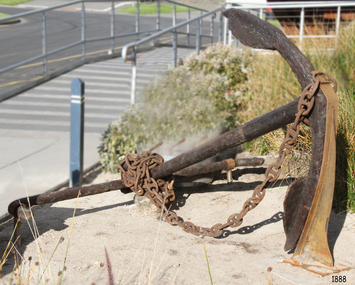
Equipment - Anchor, Before 1831
... Flat hammer-welded flukes on opposing curved arms and a peaked crown. It has a metal, elbowed stock or cross-bar and a heavy-duty pinned, flat-ring shackle for the anchor chain. ...Flat hammer-welded flukes on opposing curved arms and a peaked crown. It has a metal, elbowed stock or cross-bar and a heavy-duty pinned, flat-ring shackle for the anchor chain. ...The anchor is from the wooden sailing ship CHILDREN, which was wrecked at Childers Cove east of Warrnambool on the 14th of January 1839 with the loss of 16 lives. The Children anchor was raised from the wreck site by Flagstaff Hill Divers: Peter Ronald, Garry Hayden (Terang, still), Tim Goodall (now Warrnambool), and Colin Goodall (now Warrnambool), on Sunday, 3rd January 1974. A week or so later, it was dragged up the cliffs and taken to Warrnambool. It is now on display near the entrance to the Maritime Museum and Village. It appears to be a Pering’s Improved Anchor, developed at Portsmouth after 1813. The addition of broad curvature to the anchor arms provided a stronger purchase than the pre-existing Admiralty Old Pattern Long Shanked Anchor with straight arms. However, the evidence of hammer-welding of the separate pieces of the arms and palms to the central shank, peaked crown and flat palms, suggests the manufacture is before the 1831 Rodger’s Anchor design, which cast both arms and their flukes as one piece that was then attached to the shank by a bolt through the crown. This identification seems consistent with the date of the CHILDREN’s construction in 1824. The CHILDREN was a three-masted barque with a wooden hull built at Liverpool in England. The vessel was bought by the Henty family of Portland (Australia Felix) in 1837 for regular coastal trading between Van Diemens Land (now Tasmania), the Port Phillip District of New South Wales and South Australia. Only 255 tons burden (92 feet in length, with a beam of 25 feet and depth of 17 feet), it sailed from Launceston bound for Adelaide in late December 1838, on its first Australian voyage and under the English master who had brought the barque out, Captain H. Browne. On board the CHILDREN were 24 passengers, including 9 children, the captain and 14 crew; livestock of 1500 sheep, 8 bullocks and 7 horses; general cargo of beef, pork, tobacco, tripe, butter, limejuice, horse hair, currants, lead shot, beer and spirits; 5,000 house bricks from London; and six whaling boats with associated whaling gear. The vessel was battered by gale-force north-westerly winds shortly after setting out from Launceston on 11 January 1839, and adverse sailing conditions persisted for the next four days. At 11 pm on the 14th of January 1839, and many miles north and east of the captain’s navigated position, the CHILDREN struck the Pinnacle, a limestone stack off what is now called Childers Cove. Within half an hour, the ship was destroyed. As well as the loss of livestock and cargo, 16 passengers and crew perished, including the captain, six men, one woman and nine children. In 1931, shifting sands at Childers Cove uncovered the skeleton of an adult male. In 1951, another two skeletons were exposed by storms, an adult male and a child. In 1963, some district scuba divers retrieved a small signal cannon from the site. And in 1974, Flagstaff Hill recovered the anchor and some house bricks. The anchor recovered from the Children's wreck is significant as part of the equipment of the early 19th-century barque. The 1839 wreck and recovered artefacts are examples of the construction methods and materials used in that era and can be used to study the evolution of shipbuilding methods and principles. The wreck of the Children is of state significance as one of colonial Victoria’s earliest and most significant maritime disasters, and one of the first vessels lost in the Western District. This is recognised by its inclusion on the Victorian Heritage Register, VHR No. S116. Little is left on the seabed to mark the tragedy, apart from some of the house bricks intended for the Henty settlement. A large forged, wrought iron anchor from the wreck of the CHILDREN. Flat hammer-welded flukes on opposing curved arms and a peaked crown. It has a metal, elbowed stock or cross-bar and a heavy-duty pinned, flat-ring shackle for the anchor chain. It is in fair condition but extensively corroded after 135 years on the seabed. flagstaff hill, flagstaff hill maritime museum and village, warrnambool, maritime museum, maritime village, great ocean road, shipwreck coast, shipwreck artefact, children, barque, three-masted, liverpool, childer’s cove, port campbell, 1839 shipwreck, 1939 wreck, james henty and co, henty brothers, captain h. browne, first mate t. gay, second mate w. wentworth, portland, portland bay, anchor, ship’s anchor, peter ronald, garry hayden, tim goodall, colin goodall, pering’s improved anchor -
 Federation University Historical Collection
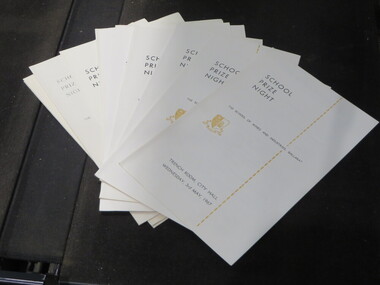
Booklet - Printed Programme, Ballarat School of Mines Prize Night Programs, 1961-1975, 1960-1975
... Metal Trades Division, Apprenticeship Commission 1972 R.J. Dobell, Regional Directorof Education, Ballarat 1973 B.J. McCulloch, Manager, ELectrical Supply, Mid-Western Regions, State Electricty Commission. 1974 W.J.C. North, Managing Director, Australian Timken Pty Ltd 1975 I.D. McCoy, Managing Director, James Selkirk Pty Ltd ballarat school of mines prize night ballarat town hall Trench Room lower civic hall wendouree municipal hall Commercial Awards dressmaking woolclassing turning and fitting tool and die-making oxywelding electric welding boiler making panel beeting motor mechanics electrical mechanics arpentry and joinery plumbing and gasftting M.B. ...The Ballarat School of Mines Prize Night was held at the Ballarat Town Hall Trench Room from 1960-1971, the Lower Civic Hall 1972, Wendouree Municipal Hall 1973-1975. The prizes awarded were for the work done in the previous year. Guest speakers: 1960 J. Lonsdale, Production Manager, M.B. John & Hattesley Ltd. 1961 E.J. Neale, Manager Ballaarat Gas Company 1962 W.G. Smith, Director, Myer Empirium (Ballarat) Pty Limited and Member of the School of Mines Council 1963 K.C. Webb, Member of the School of Mines Council 1964 A.E. Stohr Vice-President of the School of Mines Council 1965 B.J. Nicholson, Factory Manager, Australian Timken Pty Ltd and Chairman of the Ballarat PRoductivity Group 1966 L.C. Yandell, District Inspector of Schools 1967 J.L. Trevenen, Vice-President, Victorian Automobile Chamber of Commerce 1968 A.C. Eldridge, Assistant Director of Technical Commission of Victoria 1969 W.J. Anderson, General Manager, Bendix Mintex Pty LtdS. Martin-Brown, Managing Director, Firth Cleveland Pty Ltd 1971 S.F. Newman, Manager Director, Engineering Products Pty Ltd, Employer Representative, Metal Trades Division, Apprenticeship Commission 1972 R.J. Dobell, Regional Directorof Education, Ballarat 1973 B.J. McCulloch, Manager, ELectrical Supply, Mid-Western Regions, State Electricty Commission. 1974 W.J.C. North, Managing Director, Australian Timken Pty Ltd 1975 I.D. McCoy, Managing Director, James Selkirk Pty Ltd Four page booklets listing students who won a trade prize at the Ballarat School of Mines. From 1960 to 1971 the awards were held at the Ballarat Town Hall Trench Room, in 1972 it was held at the Lower Civic Hall, and from 1973 to 1975 it was held at the Wendouree Municipal Hall. ballarat school of mines, prize night, ballarat town hall, trench room, lower civic hall, wendouree municipal hall, commercial, awards, dressmaking, woolclassing, turning and fitting, tool and die-making, oxywelding, electric welding, boiler making, panel beeting, motor mechanics, electrical mechanics, arpentry and joinery, plumbing and gasftting, m.b. john, h.e. arblaster, harry arblaster, w.g. smith, a.e. stohr, ken webb -
Federation University Historical Collection
Book - Book - Scrapbook, Ballarat School of MInes: Scrapbook of Newspaper Cuttings, Book 24, April 1985 to October 1985
... The papers concerned are The Courier, Ballarat, The Australian, The Age over the period of 8 April 1985 to 10 October 1985. teaching positions advertised pre-employment courses courses available industrial electrical engineers society trevor henderson wins award geoffrey blainey launches history of the school of mines wendouree tech high wins football six-day tree seminar at old ballarat east gardens ian duggan wins welding award smb facing big changes challenges writing workshops give pleasure ania walwicz - writer artist smb's famous head - r w richards antarctic hero dies - 92 jim bell head of engineering lee wallis head of plumbing and sheet metal ballarat council to replace statue of malcolm fraser staff farewelled captain moonlight slept here carpentary at smb will be moved dick richard's obituary hairdressing seminar flagstaff college of tafe smb kim odgers first woman - certificate of technology in surveying apprentices compete in work skill finals peter brown - carpentry ricky hains - engineering drawing craig haintz - fitting and turning lynn wheeler - hairdressing brendan mceldrew - fitter daryl edwards - electrical wiring phillip smith - construction steelworker dr murray gillan former smb student now dean - faculty of engineering - swinburne institute of technology tom walsh top farm apprentice for 1984 andrew gibbs top sheetmetal apprentice ballarat unique educational centre steven smith top motor mechanic for 1984 ricky hains selected fo skill olympics in japan lynne wheeler wins silver medal in hairdressing lynne kirkpatrick - most outstanding apprentice of 1985 lynne kirkpatrick - certificate of woolclassing david brown motor mechanic apprentice vacc award smb level one apprentice central highlands/wimmera regional tafe awards lynne kirkpatrick wool classer leigh gillbert building trade darrenhumphris automotive trades ian duggan metal trades peter flett electrical trades e j tippett resigns from smb council courses for young job-seekers $7 million project takes shape ballarat municipal observatory being restored breaking down more barriers disabled employment support smb grant for job training in modern office skills ricky hains receives smb's centenary medallion when centres for disabled will be redundant nursing aide girls' award jenny westin bronwyn fleming sharon rook leanne adams tracey foley tammy lench maxine cloks ministry for arts visit lydiard street closed between grant and dana streets dangers that lurk at work ministry of employment and training forgotten hero is resurrected baldwin spencer barry hill blackburn report on post-compulsory schooling schools - what changes are needed gifts for ballarat gardens michael taffe presenting rose to smb heritage roses in australia courier 10/9/85 meri gracin smbfood services department chokkie vegetable learning the skills of hospitality courier gardening seminar at smb kevin heinze smb redevelopment on target eating their way to health trevor mckenzie helen schaper steven marsden farmer lynne kirkpatrick outstanding silvana faulkner equal opportunities officer women try non-traditional jobs Book with beige cover, front, spiral bound. ...Collection of newspaper articles related to Ballarat School Of Mines.They cover activities and advertisements for staff. The papers concerned are The Courier, Ballarat, The Australian, The Age over the period of 8 April 1985 to 10 October 1985.Book with beige cover, front, spiral bound. teaching positions advertised, pre-employment courses, courses available, industrial electrical engineers society, trevor henderson wins award, geoffrey blainey launches history of the school of mines, wendouree tech high wins football, six-day tree seminar at old ballarat east gardens, ian duggan wins welding award, smb facing big changes, challenges, writing workshops give pleasure, ania walwicz - writer artist, smb's famous head - r w richards, antarctic hero dies - 92, jim bell head of engineering, lee wallis head of plumbing and sheet metal, ballarat council to replace statue of malcolm fraser, staff farewelled, captain moonlight slept here, carpentary at smb will be moved, dick richard's obituary, hairdressing seminar, flagstaff college of tafe, smb, kim odgers first woman - certificate of technology in surveying, apprentices compete in work skill finals, peter brown - carpentry, ricky hains - engineering drawing, craig haintz - fitting and turning, lynn wheeler - hairdressing, brendan mceldrew - fitter, daryl edwards - electrical wiring, phillip smith - construction steelworker, dr murray gillan, former smb student now dean - faculty of engineering - swinburne institute of technology, tom walsh top farm apprentice for 1984, andrew gibbs top sheetmetal apprentice, ballarat unique educational centre, steven smith top motor mechanic for 1984, ricky hains selected fo skill olympics in japan, lynne wheeler wins silver medal in hairdressing, lynne kirkpatrick - most outstanding apprentice of 1985, lynne kirkpatrick - certificate of woolclassing, david brown motor mechanic apprentice, vacc award smb level one apprentice, central highlands/wimmera regional tafe awards, lynne kirkpatrick, wool classer, leigh gillbert building trade, darrenhumphris automotive trades, ian duggan metal trades, peter flett electrical trades, e j tippett resigns from smb council, courses for young job-seekers, $7 million project takes shape, ballarat municipal observatory being restored, breaking down more barriers, disabled employment support, smb grant for job training in modern office skills, ricky hains receives smb's centenary medallion, when centres for disabled will be redundant, nursing aide girls' award, jenny westin, bronwyn fleming, sharon rook, leanne adams, tracey foley, tammy lench, maxine cloks, ministry for arts visit, lydiard street closed between grant and dana streets, dangers that lurk at work, ministry of employment and training, forgotten hero is resurrected, baldwin spencer, barry hill, blackburn report on post-compulsory schooling, schools - what changes are needed, gifts for ballarat gardens, michael taffe presenting rose to smb, heritage roses in australia, courier 10/9/85, meri gracin smbfood services department, chokkie vegetable, learning the skills of hospitality, courier gardening seminar at smb, kevin heinze, smb redevelopment on target, eating their way to health, trevor mckenzie, helen schaper, steven marsden, farmer lynne kirkpatrick outstanding, silvana faulkner equal opportunities officer, women try non-traditional jobs -
 Shepparton RSL Sub Branch
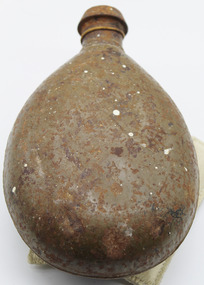
Water Bottle. WW1. German, Circa WW1
... Made in three sections - welded. water bottle ww1 german None All Metal WW1 German Water Bottle Missing Stopper, Cover, Leather Strapping and Hook plus string to neck which is 7cm. ...WW1 German Infantry Water Bottle. Made in three sections - welded. All Metal WW1 German Water Bottle Missing Stopper, Cover, Leather Strapping and Hook plus string to neck which is 7cm.Nonewater bottle, ww1, german -
 Federation University Historical Collection
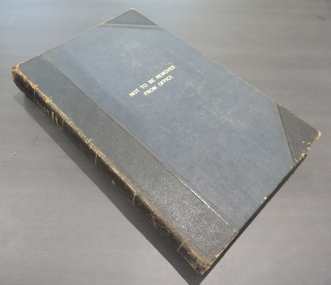
Books, H.E. Daw Government Printer, Ballarat School of Mines and Industries Departmental Papers, 1914-1950, 1914-1950
... Examinations include: Agriculture, Algebra, Architecture, Arithmetic, Applied Mechanics, Assaying, Biology, Botany, Boilermaking, Building Design, Blacksmithing, Bricklaying, Carpentry and Joinery, Coachbuilding, Cabinet Making, Civil Engineering, Cabinet Making, Commercial, Chemistry, Engineering Drawing, Economics, English, Electrical technology, Electricity and Magnetism, Electric Wiring, Electric Welding, Electrical Fitting, Electrical Trades, Food Analysis, Geology, Geological Mapping, Graphics, Geometry, Heat Engines, Heat Treatment, Hydraulics, Hand Railing, Instrument Making, Millinery, Milling and Gearouting, Machine Shop Practice. Metal...Examinations include: Agriculture, Algebra, Architecture, Arithmetic, Applied Mechanics, Assaying, Biology, Botany, Boilermaking, Building Design, Blacksmithing, Bricklaying, Carpentry and Joinery, Coachbuilding, Cabinet Making, Civil Engineering, Cabinet Making, Commercial, Chemistry, Engineering Drawing, Economics, English, Electrical technology, Electricity and Magnetism, Electric Wiring, Electric Welding, Electrical Fitting, Electrical Trades, Food Analysis, Geology, Geological Mapping, Graphics, Geometry, Heat Engines, Heat Treatment, Hydraulics, Hand Railing, Instrument Making, Millinery, Milling and Gearouting, Machine Shop Practice. Metal ...Used at the Ballarat School of Mines and the Ballarat Technical Art SchoolThis collection of examinations is significant because of its completeness with the full range of examinations between 1914 and 1950.Large leather bound books, with leather spine, containing all examinations held at the Ballarat School of Mines (including the Ballarat Technical Art School and Ballarat Junior Technical School). The examination papers were supplied and printed by the Education Department, Victoria. Examinations include: Agriculture, Algebra, Architecture, Arithmetic, Applied Mechanics, Assaying, Biology, Botany, Boilermaking, Building Design, Blacksmithing, Bricklaying, Carpentry and Joinery, Coachbuilding, Cabinet Making, Civil Engineering, Cabinet Making, Commercial, Chemistry, Engineering Drawing, Economics, English, Electrical technology, Electricity and Magnetism, Electric Wiring, Electric Welding, Electrical Fitting, Electrical Trades, Food Analysis, Geology, Geological Mapping, Graphics, Geometry, Heat Engines, Heat Treatment, Hydraulics, Hand Railing, Instrument Making, Millinery, Milling and Gearouting, Machine Shop Practice. Metal Founding, Mining, Metallurgy, Mineralogy, Mathematics, Motor Mechanics, Mine Surveying, Mining Mechanics, Petrology, Physics, Painting and Decorating, Pattern Making, Plastering, Plumbing and Gasfitting, Printing, Refrigeration, Spelling, Science , Shorthand, Surveying. Signwriting. Sheet Metalwork, Toolmaking, Ladies Tailoring, Trigonometry, Typewriting, Welding, Commercial Geography. Millinery, Dressmaking, Needlework, Decorative Needlework, Architecture, Building Design and Construction, Art (Composition in Form and Colour), Art (Casting Clay MOdels) Art (Drapery), Art (Drawing the Human Figure From Casts), Art (Drawing the Antique from Memory), Art (Drawing from Memory); Art (Drawing Plant Forms from Nature, Art (Drawing Plant Forms From Memory), Art (Drawing from Models and Objects), (Drawing From a Flat Example). Art (Drawing in Light and Shade from a Cast of Ornament or Lower Nature), Art (Drawing Ornament from the Cast), Art (Drawing from Models or Objects), Art (Drawing fro Dressmakers' and Milliners' Fashions), Art (Drawing With the Brush), Art (Drawing from a Flat Example); Art (Modelled Design), Art (General Design), Art (Embossed Leatherwork), Art (Practical Plane Geometry), Art (Practical Solid Geometry), Art (Geometrical Drawing), Carpentry and Joinery, Art (Human Anatomy), Art (Historic Ornament), Art (House Decoration), Art (LEttering), Signwriting, Art (Light Metalwork), Art (Modelling), Art (Modelling the Human Figure from a Life), Art (Stencilling); Art (Wood Carving) Refrigeration, Teaching, Boilermaking, Blacksmithing, Carpentry and Joinery, Coachbuilding and Carriage Drafting, Electric Wiring, Electrical Fitting, Graining and Marbling, Instrument Making , Machine Shop Practice, Metal Founding, Milling and Gear Cutting, Motor Mechanics, Painting and Decorating, Sheet Metalwork, Toolmaking, Printing, Pattern Making, Plumbing and gasfitting, examinations, ballarat school of mines, ballarat technical art school, trades, education department victoria, agriculture, algebra, architecture, arithmetic, applied mechanics, assaying, biology, botany, boilermaking, building design, blacksmithing, bricklaying, carpentry and joinery, coachbuilding, cabinet making, civil engineering, commercial, chemistry, engineering drawing, economics, english, electrical technology, electricity and magnetism, electric wiring, electric welding, electrical fitting, electrical trades, food analysis, geology, geological mapping, graphics, geometry, heat engines, heat treatment, hydraulics, hand railing, instrument making, millinery, milling and gearouting, machine shop practice, metal founding, mining, metallurgy, mineralogy, mathematics, motor mechanics, mine surveying, mining mechanics, petrology, physics, painting and decorating, pattern making, plastering, plumbing and gasfitting, printing, refrigeration, spelling, science, shorthand, surveying, signwriting, sheet metalwork, toolmaking, ladies tailoring, trigonometry, typewriting, welding., dressmaking, needlework, decorative needlework, architecture, building design and construction, art (composition in form and colour), art (casting clay models), art (drapery), art (drawing the human figure from casts), art (drawing the antique from memory), art (drawing from memory), art (drawing plant forms from nature, art (drawing plant forms from memory), art (drawing from models and objects), (drawing from a flat example), art (drawing in light and shade from a cast of ornament or lower nature), art (drawing ornament from the cast), art (drawing from models or objects), art (drawing for dressmakers' and milliners' fashions), art (drawing with the brush), art (drawing from a flat example), art (modelled design), art (general design), art (embossed leatherwork), art (practical plane geometry), art (practical solid geometry), art (geometrical drawing), art (human anatomy), art (historic ornament), art (house decoration), art (lettering), art (light metalwork), art (modelling), art (modelling the human figure from a life, art (stencilling), art (wood carving), teaching, coachbuilding and carriage drafting, graining and marbling, milling and gear cutting, commercial geography, exams, examination book
