
Showing 41 items matching "welsh in victoria"
-
 Sunshine and District Historical Society Incorporated
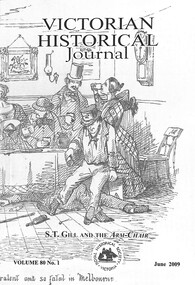
Journal - Victorian Historical Journal Volume 80 Number 1 June 2009, Royal Historical Society of Victoria, June 2009
... ...Welsh in Victoria...Monash University Gold Mining Squatters Australian Rules Football Sport and Racing in Melbourne Welsh in Victoria Victorian landscapes The Victorian Historical Journal, first published as the Victorian Historical Magazine in 1911, is the official journal of record and scholarly publication of the Royal Historical Society of Victoria. ...The Victorian Historical Journal, first published as the Victorian Historical Magazine in 1911, is the official journal of record and scholarly publication of the Royal Historical Society of Victoria. It is the second oldest history journal in Australia. It has become a vast collaborative history of Victoria with hundreds of individual contributors and topics and has itself become a primary source for researchers.Paperback book with glossy front covernon-fictionThe Victorian Historical Journal, first published as the Victorian Historical Magazine in 1911, is the official journal of record and scholarly publication of the Royal Historical Society of Victoria. It is the second oldest history journal in Australia. It has become a vast collaborative history of Victoria with hundreds of individual contributors and topics and has itself become a primary source for researchers. monash university, gold mining, squatters, australian rules football, sport and racing in melbourne, welsh in victoria, victorian landscapes -
 Lakes Entrance Historical Society
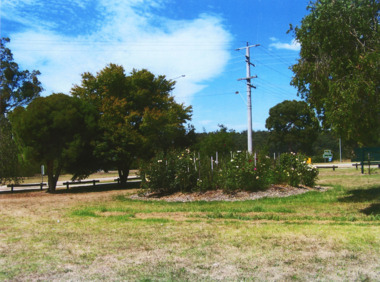
Photograph - Nowa Nowa Community Health Centre Garden 2014, Judy Davies
... Colour photographs of Nowa Nowa Community Health Centre Memorial Gardens established in June 2000 from an idea of Nellie Melba Welsh Nowa Nowa Victoria...Public Health Gardens community Colour photographs of Nowa Nowa Community Health Centre Memorial Gardens established in June 2000 from an idea of Nellie Melba Welsh Nowa Nowa Victoria Photograph Nowa Nowa Community Health Centre Garden 2014 Judy Davies ...Colour photographs of Nowa Nowa Community Health Centre Memorial Gardens established in June 2000 from an idea of Nellie Melba Welsh Nowa Nowa Victoriapublic health, gardens, community -
 Bendigo Historical Society Inc.
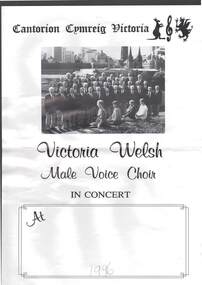
Document - MERLE HALL COLLECTION: BENDIGO PERFORMANCE OF ''VICTORIA WELSH MALE VOICE CHOIR'', 1996
... MERLE HALL COLLECTION: BENDIGO PERFORMANCE OF ''VICTORIA WELSH MALE VOICE CHOIR''...Bendigo performance of ''Victoria Welsh Male Voice Choir'' - Poster with blank space for where the performance is ''At'' - with photo of choir group before Melbourne background. ...BENDIGO Entertainment Theatre Bendigo performance of ''Victoria Welsh Male Voice Choir'' - Poster with blank space for where the performance is ''At'' - with photo of choir group before Melbourne background. ...Bendigo performance of ''Victoria Welsh Male Voice Choir'' - Poster with blank space for where the performance is ''At'' - with photo of choir group before Melbourne background. The poster has a handwritten inscription of ''1996''bendigo, entertainment, theatre -
 Ballarat Heritage Services
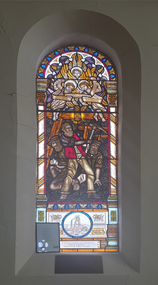
Photograph - Photgraph, Clare Gervasoni, Stained Glass Window in Carmel Welsh Church, Sebastopol, 05/10/2022
... Carmel Welsh Church is located at 365 Albert Street, Sebastopol and is the only identified Welsh Presbyterian church surviving in Victoria,. It was built in 1865-6 to the design of Henry Richards Caselli, and of distinctive architectural character combining round arched windows of almost a Renaissance character, mediaevalising buttresses, and extremely chunky gable eaves of a domestic character, including square finials and raking brackets. ...Carmel Welsh Church is located at 365 Albert Street, Sebastopol and is the only identified Welsh Presbyterian church surviving in Victoria,. It was built in 1865-6 to the design of Henry Richards Caselli, and of distinctive architectural character combining round arched windows of almost a Renaissance character, mediaevalising buttresses, and extremely chunky gable eaves of a domestic character, including square finials and raking brackets. ...Carmel Welsh Church is located at 365 Albert Street, Sebastopol and is the only identified Welsh Presbyterian church surviving in Victoria,. It was built in 1865-6 to the design of Henry Richards Caselli, and of distinctive architectural character combining round arched windows of almost a Renaissance character, mediaevalising buttresses, and extremely chunky gable eaves of a domestic character, including square finials and raking brackets. It was established in 1861, the members and adherents were predominantly Welsh, the Welsh language was spoken freely and there were regular services in Welsh.Digital photograph of ta stained glass window in the Carmel Welsh church, Sebastopol.In memory of the Welsh Miners who from the darkness of the mines brought the light of Christ to Carmelcarmel welsh church, sebastopol, church, henry richards caselli, welsh, stained glass, miners -
 Ballarat Heritage Services
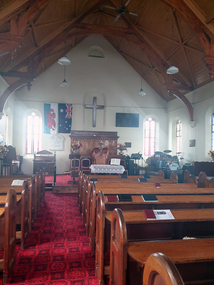
Photograph - Photgraph, Carmel Welsh Church, Sebastopol, 05/10/2022
... Carmel Welsh Church is located at 365 Albert Street, Sebastopol and is the only identified Welsh Presbyterian church surviving in Victoria,. It was built in 1865-6 to the design of Henry Richards Caselli, and of distinctive architectural character combining round arched windows of almost a Renaissance character, mediaevalising buttresses, and extremely chunky gable eaves of a domestic character, including square finials and raking brackets. ...Carmel Welsh Church is located at 365 Albert Street, Sebastopol and is the only identified Welsh Presbyterian church surviving in Victoria,. It was built in 1865-6 to the design of Henry Richards Caselli, and of distinctive architectural character combining round arched windows of almost a Renaissance character, mediaevalising buttresses, and extremely chunky gable eaves of a domestic character, including square finials and raking brackets. ...Carmel Welsh Church is located at 365 Albert Street, Sebastopol and is the only identified Welsh Presbyterian church surviving in Victoria,. It was built in 1865-6 to the design of Henry Richards Caselli, and of distinctive architectural character combining round arched windows of almost a Renaissance character, mediaevalising buttresses, and extremely chunky gable eaves of a domestic character, including square finials and raking brackets. It was established in 1861, the members and adherents were predominantly Welsh, the Welsh language was spoken freely and there were regular services in Welsh.Digital photograph of the interior of the bluestone Welsh church, Sebastopol, Ballarat.carmel welsh church, sebastopol, church, henry richards caselli, welsh -
 Ballarat Heritage Services
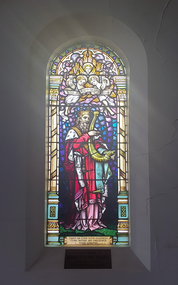
Photograph - Photgraph, Clare Gervasoni, Stained Glass Window in Carmel Welsh Church, Sebastopol, 05/10/2022
... Carmel Welsh Church is located at 365 Albert Street, Sebastopol and is the only identified Welsh Presbyterian church surviving in Victoria,. It was built in 1865-6 to the design of Henry Richards Caselli, and of distinctive architectural character combining round arched windows of almost a Renaissance character, mediaevalising buttresses, and extremely chunky gable eaves of a domestic character, including square finials and raking brackets. ...Carmel Welsh Church is located at 365 Albert Street, Sebastopol and is the only identified Welsh Presbyterian church surviving in Victoria,. It was built in 1865-6 to the design of Henry Richards Caselli, and of distinctive architectural character combining round arched windows of almost a Renaissance character, mediaevalising buttresses, and extremely chunky gable eaves of a domestic character, including square finials and raking brackets. ...Carmel Welsh Church is located at 365 Albert Street, Sebastopol and is the only identified Welsh Presbyterian church surviving in Victoria,. It was built in 1865-6 to the design of Henry Richards Caselli, and of distinctive architectural character combining round arched windows of almost a Renaissance character, mediaevalising buttresses, and extremely chunky gable eaves of a domestic character, including square finials and raking brackets. It was established in 1861, the members and adherents were predominantly Welsh, the Welsh language was spoken freely and there were regular services in Welsh.Digital photograph of ta stained glass window in the Carmel Welsh church, Sebastopol.Serve the Lord with gladness, come before his presence with singing. In loving memory of David William Davies Died Dec. 28th 1932 Choirmaster 1875 to 1885carmel welsh church, sebastopol, church, henry richards caselli, welsh, stained glass, david william davies, choirmaster -
 Ballarat Heritage Services
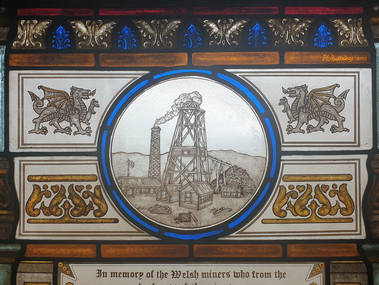
Photograph, Clare Gervasoni, Stained Glass Window in Carmel Welsh Church, Sebastopol, 08/10/2022
... Carmel Welsh Church is located at 365 Albert Street, Sebastopol and is the only identified Welsh Presbyterian church surviving in Victoria,. It was built in 1865-6 to the design of Henry Richards Caselli, and of distinctive architectural character combining round arched windows of almost a Renaissance character, mediaevalising buttresses, and extremely chunky gable eaves of a domestic character, including square finials and raking brackets. ...Carmel Welsh Church is located at 365 Albert Street, Sebastopol and is the only identified Welsh Presbyterian church surviving in Victoria,. It was built in 1865-6 to the design of Henry Richards Caselli, and of distinctive architectural character combining round arched windows of almost a Renaissance character, mediaevalising buttresses, and extremely chunky gable eaves of a domestic character, including square finials and raking brackets. ...Carmel Welsh Church is located at 365 Albert Street, Sebastopol and is the only identified Welsh Presbyterian church surviving in Victoria,. It was built in 1865-6 to the design of Henry Richards Caselli, and of distinctive architectural character combining round arched windows of almost a Renaissance character, mediaevalising buttresses, and extremely chunky gable eaves of a domestic character, including square finials and raking brackets. It was established in 1861, the members and adherents were predominantly Welsh, the Welsh language was spoken freely and there were regular services in Welsh.Digital photograph of ta stained glass window in the Carmel Welsh church, Sebastopol.In memory of the Welsh miners who from the darkness of the mines brought the light of Christ to Carmel.carmel welsh church, sebastopol, church, henry richards caselli, welsh, stained glass, welsh miners, poppet head -
 Ballarat Heritage Services
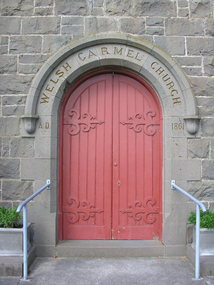
Photograph - Photgraph, Door at Carmel Welsh Church, Sebastopol, c2017
... Carmel Welsh Church is located at 365 Albert Street, Sebastopol and is the only identified Welsh Presbyterian church surviving in Victoria,. It was built in 1865-6 to the design of Henry Richards Caselli, and of distinctive architectural character combining round arched windows of almost a Renaissance character, mediaevalising buttresses, and extremely chunky gable eaves of a domestic character, including square finials and raking brackets. ...Carmel Welsh Church is located at 365 Albert Street, Sebastopol and is the only identified Welsh Presbyterian church surviving in Victoria,. It was built in 1865-6 to the design of Henry Richards Caselli, and of distinctive architectural character combining round arched windows of almost a Renaissance character, mediaevalising buttresses, and extremely chunky gable eaves of a domestic character, including square finials and raking brackets. ...Carmel Welsh Church is located at 365 Albert Street, Sebastopol and is the only identified Welsh Presbyterian church surviving in Victoria,. It was built in 1865-6 to the design of Henry Richards Caselli, and of distinctive architectural character combining round arched windows of almost a Renaissance character, mediaevalising buttresses, and extremely chunky gable eaves of a domestic character, including square finials and raking brackets. It was established in 1861, the members and adherents were predominantly Welsh, the Welsh language was spoken freely and there were regular services in Welsh.Digital photograph of the door of the bluestone Welsh church, Sebastopol, Ballarat.carmel welsh church, sebastopol, bluestone, church, henry richards caselli, welsh -
 Bendigo Historical Society Inc.
Document - MERLE HALL COLLECTION: DOCUMENTS RELATING TO ORGANIZATIONS (NOT BENDIGO BASED)
... re obtaining an FM radio broadcasting licence- Central Victorian Community Broadcasting Association; b. paper presented at Bendigo seminar for ''Regionalism and the Arts'' 13/7/1985 by Ric McCracken, Footscray Community Arts Centre; c. 12 page booklet ''Info Pak - the Community Arts Paper'' published by the Footscray Community Arts Centre, 1978; d. 4 -paged Newsletter of the Victoria Welsh Male Voice Choir, issue 1, May2002 ''Tongues of Fire''; e. 8-paged booklet describing the Robert Blackwood Hall, Monash University, Clayton (pub. ...re obtaining an FM radio broadcasting licence- Central Victorian Community Broadcasting Association; b. paper presented at Bendigo seminar for ''Regionalism and the Arts'' 13/7/1985 by Ric McCracken, Footscray Community Arts Centre; c. 12 page booklet ''Info Pak - the Community Arts Paper'' published by the Footscray Community Arts Centre, 1978; d. 4 -paged Newsletter of the Victoria Welsh Male Voice Choir, issue 1, May2002 ''Tongues of Fire''; e. 8-paged booklet describing the Robert Blackwood Hall, Monash University, Clayton (pub. ...Documents relating to organizations (not Bendigo based): a. Flyer (bi fold) ''A Community Radio Station for Central Victoria?'' re obtaining an FM radio broadcasting licence- Central Victorian Community Broadcasting Association; b. paper presented at Bendigo seminar for ''Regionalism and the Arts'' 13/7/1985 by Ric McCracken, Footscray Community Arts Centre; c. 12 page booklet ''Info Pak - the Community Arts Paper'' published by the Footscray Community Arts Centre, 1978; d. 4 -paged Newsletter of the Victoria Welsh Male Voice Choir, issue 1, May2002 ''Tongues of Fire''; e. 8-paged booklet describing the Robert Blackwood Hall, Monash University, Clayton (pub. Ca. 1971?); f. 26- paged ''Work Guide - How to establish an Artist In Community project'' , published by the Community Arts Resource Centre, East Melbourne , 1989; g. info sheet on residential schools, Jan 1979 - ''Mime and Dance Education'', Dept of Continuing Education, University of New England; h. personal and artistic information re potter, Judy Lorraine , Wedderburn; i. Copied extracts from ''Australian Quilts - The People and Their Art'' descriptions of the work of nine quilters from The Quilters Guild, pub. By Simon Schuster (no date); j. letter from The Lieder Society of Victoria Inc to Arts Bendigo October 2001 re opportunities for concerts in area; k. information about various performances of the Australian Performing Group, APG, (Pram Factory) -no stated datemerle hall collection, community arts, australian performing group -
 Flagstaff Hill Maritime Museum and Village
Equipment - Hand Barrow, 1860s
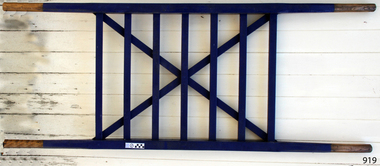
... This hand barrow, sometimes called a Welsh hand barrow, was used to transport a load of marine rescue equipment from the beach cart to the rescue site, particularly over hilly, uneven or rough terrain. Hand barrows were in common use in the 19th century. Saving lives in Warrnambool – The coastline of South West Victoria...This hand barrow, sometimes called a Welsh hand barrow, was used to transport a load of marine rescue equipment from the beach cart to the rescue site, particularly over hilly, uneven or rough terrain. Hand barrows were in common use in the 19th century. Saving lives in Warrnambool – The coastline of South West Victoria ...This hand barrow, sometimes called a Welsh hand barrow, was used to transport a load of marine rescue equipment from the beach cart to the rescue site, particularly over hilly, uneven or rough terrain. Hand barrows were in common use in the 19th century. Saving lives in Warrnambool – The coastline of South West Victoria is the site of over 600 shipwrecks and many lost lives; even in Warrnambool’s Lady Bay there were around 16 known shipwrecks between 1850 and 1905, with eight lives lost. Victoria’s Government responded to the need for lifesaving equipment and, in 1858, the provision of rocket and mortar apparatus was approved for the lifeboat stations. In 1859 the first Government-built lifeboat arrived at Warrnambool Harbour and a shed was soon built for it on the Tramway Jetty, followed by a rocket house in 1864 to safely store the rocket rescue equipment. In 1878 the buildings were moved to the Breakwater (constructed from 1874-1890), and in 1910 the new Lifeboat Warrnambool arrived with its ‘self-righting’ design. For almost a hundred years the lifesaving and rescue crews, mostly local volunteers, trained regularly to rehearse and maintain their rescue skills. They were summoned when needed by alarms, gunshots, ringing bells and foghorns. In July 1873 a brass bell was erected at Flagstaff Hill specifically to call the rescue crew upon news of a shipwreck. Some crew members became local heroes but all served an important role. Rocket apparatus was used as recently as the 1950s. Rocket Rescue Method - Rocket rescue became the preferred lifesaving method of the rescue crews, being much safer that using a lifeboat in rough seas and poor conditions. The Government of Victoria adopted lifesaving methods based on Her Majesty’s Coast Guard in Great Britain. It authorised the first line-throwing rescue system in 1858. Captain Manby’s mortar powered a projectile connected to rope, invented in 1808. The equipment was updated to John Dennett’s 8-foot shaft and rocket method that had a longer range of about 250 yards. From the 1860s the breeches buoy and traveller block rocket rescue apparatus was in use. It was suspended on a hawser line and manually pulled to and from the distressed vessel carrying passengers and items. In the early 1870s Colonel Boxer’s rocket rescue method became the standard in Victoria. His two-stage rockets, charged by a gunpowder composition, could fire the line up to 500-600 yards, although 1000 yards range was possible. Boxer’s rocket carried the light line, which was faked, or coiled, in a particular way between pegs in a faking box to prevent twists and tangles when fired. The angle of firing the rocket to the vessel in distress was measured by a quadrant-type instrument on the side of the rocket machine. Decades later, in about 1920, Schermuly invented the line-throwing pistol that used a small cartridge to fire the rocket. . The British Board of Trade regularly published instructions for both the beach rescue crew and ship’s crew. It involved setting up the rocket launcher on shore at a particular angle, determined by the Head of the crew and measured by the quadrant, inserting a rocket that had a light-weight line threaded through its shaft, and then firing it across the stranded vessel, the line issuing freely from the faking board. A continuous whip line was then sent out to the ship’s crew, who hauled it in then followed the instructions – in four languages - on the attached tally board. The survivors would haul on the line to bring out the heavier, continuous whip line with a tail block connected to it. They then secured the block to the mast or other strong part the ship. The rescue crew on shore then hauled out a stronger hawser line, which the survivors fixed above the whip’s tail block. The hawser was then tightened by the crew pulling on it, or by using the hooked block on the shore end of the whip and attaching it to a sand anchor. The breeches buoy was attached to the traveller block on the hawser, and the shore crew then used the whip line to haul the breeches buoy to and from the vessel, rescuing the stranded crew one at a time. The rescue crew wore scarlet, numbered armbands and worked on a numerical rotation system, swapping members out to rest them. This hand barrow is significant for its connection with local history, maritime history and marine technology. Lifesaving has been an important part of the services performed from Warrnambool's very early days, supported by State and Local Government, and based on the methods and experience of Great Britain. Hundreds of shipwrecks along the coast are evidence of the rough weather and rugged coastline. Ordinary citizens, the Harbour employees, and the volunteer boat and rescue crew, saved lives in adverse circumstances. Some were recognised as heroes, others went unrecognised. In Lady Bay, Warrnambool, there were around 16 known shipwrecks between 1850 and 1905. Many lives were saved but tragically, eight lives were lost.Hand barrow; a transporting device carried between two people walking one in front of the other. A wooden ladder-like frame with two handles at each end, blue painted body with unpainted handles. Seven equal-length slats are joined at equal distance between two parallel poles, and two longer slats are attached diagonally between the first and last slats as a brace. flagstaff hill maritime museum and village, flagstaff hill, maritime museum, maritime village, warrnambool, great ocean road, lady bay, warrnambool harbour, port of warrnambool, tramway jetty, breakwater, shipwreck, life-saving, lifesaving, rescue crew, rescue, rocket rescue, rocket crew, lifeboat men, beach rescue, line rescue, rescue equipment, rocket firing equipment, rocket rescue equipment, maritime accidents, shipwreck victim, rocket equipment, marine technology, rescue boat, lifeboat, volunteer lifesavers, volunteer crew, life saving rescue crew, lifesaving rescue crew, rocket apparatus, rocket rescue method, shore to ship, rocket apparatus rescue, stranded vessel, line throwing mortar, mortar, rocket rescue apparatus, line thrower, line throwing, lifeboat warrnambool, hand barrow, manual transport, welsh hand barrow -
 Flagstaff Hill Maritime Museum and Village
Document - Bank notice, List of Offices, ca Nov. 1877
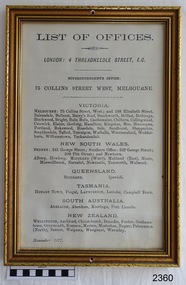
... Welsh. The Gallery transferred to the purpose-built building in Liebig Street in 1986 and the old bank building is now the Gallery club. The List of Offices of the Bank of Australasia has early Australian historical significance through its association with the Bank, which was established in 1834 by Royal Charter and opened in Sydney, Australia, in Sydney in 1835. The List is significant for showing the number and location of all of the Offices of the Bank of Australia in November 1877. This shows that Victoria ...The addresses given on the List for the London and Melbourne offices have connected the document to the Bank of Australasia. The List is dated November 1877 and shows the number and the location of all of the branches of the Bank at that point in time., a total of 77. - Victoria 35, New South Wales 14, Queensland 2, Tasmania 5, South Australia 5, New Zealand 16 Copies of the notice would have been displayed in all branches of the bank in both Australia and New Zealand to inform customers and perhaps impress them too with a large number of locations and the reference to the bank's connection with London. This document gives information on all bank offices throughout Australia and New Zealand. It refers to the Superintendent's Office address at 75 Collins Street West, Melbourne and is dated November 1877. This places the document at the time just before the new Melbourne office opened on the corner of Collins Street and Queen's Street in 1879. The Bank of Australasia was incorporated by Royal Charter of England in March 1834. It came to Australia on 14th December 1835, opening in Sydney. The Acting Superintendent of the Bank of Australasia in Sydney at that time was David Charters McArthur. He was Superintendent from 1867-to 1876. The Melbourne branch of the Bank of Australasia opened on 28th August 1838 in a two-roomed brick cottage on the north side of Little Collins Street. Two huge mastiff dogs were kept in the backyard and let loose at night to guard the bank. The government also provided an armed military sentinel. Due to the bank's rapid growth, a new building for the Melbourne branch was opened in 1840 at 75 Collins Street West. By 1879 the bank had been upgraded to a magnificent two-storey building on the corners of Collins and Queens Streets, with the entry on Collins Street. In 1951 the Bank of Australasia amalgamated with the Union Bank to form the Australia and New Zealand Bank, now known as the ANZ. Then in 1970, the ANZ merged with both the ES&A and the London Bank of Australia to form the ANZ Banking Group Limited. The ANZ Banking Group Ltd kindly donated a variety of historic items from the Bank of Australasia. BANK of AUSTRALASIA, WARRNAMBOOL – In 1854 Warrnambool had two banks, the Union Back and the Bank of Australasia. Later, completely different bank businesses opened; in 1867 the National Bank of Australasia, then in 1875 the Colonial Bank of Australasia. The original Bank of Australasia was established in Warrnambool in July 1854, and operated from a leased cottage on Merri Street, close to Liebig Street. The bank bought a stone building previously erected by drapers Cramond & Dickson on the corner of Timor and Gibson Streets. Samuel Hannaford was a teller and then Manager at the Warrnambool branch from 1855 to 1856. Warrnambool’s Council chose the Bank of Australasia as its bank 1856-57. In 1859 Roberts & Co. was awarded the contract to build the new Bank of Australasia branch for the sum of £3,000. The land was on a sand hill on the northeast corner of Timor and Kepler Streets and had been bought in 1855 from investor James Cust. The new building opened on May 21, 1860. The bank continued to operate there until 1951 when it merged with the Union Bank to form the ANZ Bank, which continued operating from its Liebig Street building. Warrnambool City Council purchased the former Bank of Australasia building in 1971 and renovated it, then on 3rd December 1973 it was officially opened as the Art Gallery by Cr. Harold Stephenson and Gallery Director John Welsh. The Gallery transferred to the purpose-built building in Liebig Street in 1986 and the old bank building is now the Gallery club. The List of Offices of the Bank of Australasia has early Australian historical significance through its association with the Bank, which was established in 1834 by Royal Charter and opened in Sydney, Australia, in Sydney in 1835. The List is significant for showing the number and location of all of the Offices of the Bank of Australia in November 1877. This shows that Victoria had 45 percent of all Offices. The framed document is locally significant for its association with the Bank of Australasia, Warrnambool's first bank, established in 1854. The bank continued to operate until the organisation's merger in 1951. It became the ANZ Bank, which is still in operation today. The Bank was an integral part of the establishment and growth of commerce in Colonial Warrnambool and throughout Australia.Document in a decorative gilt frame. Titled List of Bank Offices and dated November 1877, facsimile. Offices include London, and a variety of offices in Victoria, New South Wales, Queensland, Tasmania, South Australia and New Zealand. Round holes in the centre top and bottom of the frame. Text includes: "LONDON: 4 THREADNEEDLE STREET, E.C." "SUPERINTENDENT'S OFFICE: / 75 COLLINS STREET WEST, MELBOURNE" "Warrnambool" " November 1877" flagstaff hill, warrnambool, bank of australasia 1877, branches of bank of australasia 1877, banks in australia 1877, commerce 1877, shipwreck-coast, document, bank document, flagstaff hill maritime museum & village, bank of australasia, 1877, branches in australia, bank of london, offices in australia, offices in new zealand, commerce, banking, finance, shipwrecked coast, flagstaff hill maritime museum, maritime museum, shipwreck coast, flagstaff hill maritime village, great ocean road, boa, union bank, australia & new zealand bank, anz bank, david charters mcarthur, d c mcarthur, sydney, new south wales, currency, banknote, legal tender, list of bank offices -
 Flagstaff Hill Maritime Museum and Village
Equipment - Traveller pulley block, 1860s
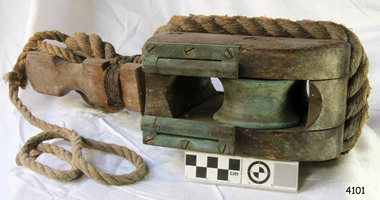
... Welsh hand barrow...Her Majesty’s Coast Guard...Harbour Board...Government of Victoria...Flagstaff Hill Maritime Museum and Village Flagstaff Hill Maritime Museum Maritime Village Warrnambool shipwreck life-saving lifesaving rescue crew rescue rocket rescue rocket crew lifeboat men beach rescue line rescue rescue equipment rocket firing equipment rocket rescue equipment maritime accidents shipwreck victim rocket equipment Marine technology rescue boat lifeboat volunteer lifesavers volunteer crew life saving rescue crew lifesaving rescue crew rocket apparatus rocket rescue method shore to ship rocket apparatus rescue stranded vessel line throwing mortar mortar rocket rescue apparatus line thrower line throwing Lifeboat Warrnambool beach apparatus breeches buoy petticoat breeches petticoat buoy traveller chair life jacket Traveller traveller block running block block pulley hawser faking faking box faked line faking board Italian hemp quadrant protractor tally board light line whip line endless whip beach cart hand barrow sand anchor Welsh hand barrow Her Majesty’s Coast Guard Harbour Board Government of Victoria Harbour Master L.S.R.C. ...The life saving breeches buoy was attached to a traveller block such as this one. The assembly was sent from shore to ship and back to transport the stranded people and goods safely to shore. Saving lives in Warrnambool – The coastline of South West Victoria is the site of over 600 shipwrecks and many lost lives; even in Warrnambool’s Lady Bay there were around 16 known shipwrecks between 1850 and 1905, with eight lives lost. Victoria’s Government responded to the need for lifesaving equipment and, in 1858, the provision of rocket and mortar apparatus was approved for the lifeboat stations. In 1859 the first Government-built lifeboat arrived at Warrnambool Harbour and a shed was soon built for it on the Tramway Jetty, followed by a rocket house in 1864 to safely store the rocket rescue equipment. In 1878 the buildings were moved to the Breakwater (constructed from 1874-1890), and in 1910 the new Lifeboat Warrnambool arrived with its ‘self-righting’ design. For almost a hundred years the lifesaving and rescue crews, mostly local volunteers, trained regularly to rehearse and maintain their rescue skills. They were summoned when needed by alarms, gunshots, ringing bells and foghorns. In July 1873 a brass bell was erected at Flagstaff Hill specifically to call the rescue crew upon news of a shipwreck. Some crew members became local heroes but all served an important role. Rocket apparatus was used as recently as the 1950s. Rocket Rescue Method - Rocket rescue became the preferred lifesaving method of the rescue crews, being much safer that using a lifeboat in rough seas and poor conditions. The Government of Victoria adopted lifesaving methods based on Her Majesty’s Coast Guard in Great Britain. It authorised the first line-throwing rescue system in 1858. Captain Manby’s mortar powered a projectile connected to rope, invented in 1808. The equipment was updated to John Dennett’s 8-foot shaft and rocket method that had a longer range of about 250 yards. From the 1860s the breeches buoy and traveller block rocket rescue apparatus was in use. It was suspended on a hawser line and manually pulled to and from the distressed vessel carrying passengers and items. In the early 1870s Colonel Boxer’s rocket rescue method became the standard in Victoria. His two-stage rockets, charged by a gunpowder composition, could fire the line up to 500-600 yards, although 1000 yards range was possible. Boxer’s rocket carried the light line, which was faked, or coiled, in a particular way between pegs in a faking box to prevent twists and tangles when fired. The angle of firing the rocket to the vessel in distress was measured by a quadrant-type instrument on the side of the rocket machine. Decades later, in 1920, Schermuly invented the line-throwing pistol that used a small cartridge to fire the rocket. . The British Board of Trade regularly published instructions for both the beach rescue crew and ship’s crew. It involved setting up the rocket launcher on shore at a particular angle, determined by the Head of the crew and measured by the quadrant, inserting a rocket that had a light-weight line threaded through its shaft, and then firing it across the stranded vessel, the line issuing freely from the faking board. A continuous whip line was then sent out to the ship’s crew, who hauled it in then followed the instructions – in four languages - on the attached tally board. The survivors would haul on the line to bring out the heavier, continuous whip line with a tail block connected to it. They then secured the block to the mast or other strong part the ship. The rescue crew on shore then hauled out a stronger hawser line, which the survivors fixed above the whip’s tail block. The hawser was then tightened by the crew pulling on it, or by using the hooked block on the shore end of the whip and attaching it to a sand anchor. The breeches buoy was attached to the traveller block on the hawser, and the shore crew then used the whip line to haul the breeches buoy to and from the vessel, rescuing the stranded crew one at a time. The rescue crew wore scarlet, numbered armbands and worked on a numerical rotation system, swapping members out to rest them.This traveller block is significant for its connection with local history, maritime history and marine technology. Lifesaving has been an important part of the services performed from Warrnambool's very early days, supported by State and Local Government, and based on the methods and experience of Great Britain. Hundreds of shipwrecks along the coast are evidence of the rough weather and rugged coastline. Ordinary citizens, the Harbour employees, and the volunteer boat and rescue crew, saved lives in adverse circumstances. Some were recognised as heroes, others went unrecognised. In Lady Bay, Warrnambool, there were around 16 known shipwrecks between 1850 and 1905. Many lives were saved but tragically, eight lives were lost. Wood and brass pulley block or 'traveller', used in conjunction with the Breeches Buoy. The block has double brass inline sheaves and brass rollers on each cheek of the pulley. Each shell is scored for the strop. The thimble on the strop has a wooden slat attached for quick release of the Breeches Buoy. A portion of rope is connected.flagstaff hill maritime museum and village, flagstaff hill, maritime museum, maritime village, warrnambool, shipwreck, life-saving, lifesaving, rescue crew, rescue, rocket rescue, rocket crew, lifeboat men, beach rescue, line rescue, rescue equipment, rocket firing equipment, rocket rescue equipment, maritime accidents, shipwreck victim, rocket equipment, marine technology, rescue boat, lifeboat, volunteer lifesavers, volunteer crew, life saving rescue crew, lifesaving rescue crew, rocket apparatus, rocket rescue method, shore to ship, rocket apparatus rescue, stranded vessel, line throwing mortar, mortar, rocket rescue apparatus, line thrower, line throwing, lifeboat warrnambool, beach apparatus, breeches buoy, petticoat breeches, petticoat buoy, traveller chair, life jacket, traveller, traveller block, running block, block, pulley, hawser, faking, faking box, faked line, faking board, italian hemp, quadrant, protractor, tally board, light line, whip line, endless whip, beach cart, hand barrow, sand anchor, welsh hand barrow, her majesty’s coast guard, harbour board, government of victoria, harbour master, l.s.r.c., lsrc -
 Federation University Historical Collection
Document, Dianne Campbell, Ballarat Lawyers 1853-1895 Research Folders, c2000-2021
... Vardy, Charles Von Ende) .9) Lawyers in Central Victoria W-Z (Henry Walker, Andrew Wallace, John Wellesley, Brereton Watson, C.G.M. Watson, James Watson, George Armytage, Thomas Watson, Patricius Welsh, John Westmore, Theodore Whipham, Arthur Whipham, Thomas H. ...Vardy, Charles Von Ende) .9) Lawyers in Central Victoria W-Z (Henry Walker, Andrew Wallace, John Wellesley, Brereton Watson, C.G.M. Watson, James Watson, George Armytage, Thomas Watson, Patricius Welsh, John Westmore, Theodore Whipham, Arthur Whipham, Thomas H. ...Folders of research notes on Ballarat Lawyers, including newspaper clippings, website information, etc. .1) Ballarat Lawyers - A (Australian Law Firm histories, Jamaican in Australia, History of the Court System, University of Melbourne Law Students c1870s, Melanie Senior, Cinque Oakley Senior Lawyers, 19th Century Castlemaine Police Courts, New Victorian County Court, Scots and the Law in Scotland, Solicitor online encyclopedia, Alfred Akehurst, Artur Akehurst, J.T. Ansdell, Butler Cole Aspinall, Alfred James Bailey, Henry Stephen Bailey, Matthew Baird, Hugh Sutherland Barrett, William Field Barrett, Redmond Barry, George Elliott Barton, George Frederick Bartrop, John Bell, Thomas Bellas, George Booker) .2) Ballarat Lawyers B (Hugh Sunderland Barrett, Peter Beckford, William Beckford, John T.F. Bowker, William Box, George Boyd, William Boykett, B. Browne, Richard Archer Burton, Alfred Butler) .3) Ballarat Lawyers C-E (Thomas B.S. Carwithen, J.B. Cathcart, John Alfred Chalk, David Clarke, John Collins, Matthew Combe, Thomas Spemcer Cope, Richard. Crouch, Charles Curwan-Walker, Frank H. Cole, John Rowland Davies, Charles J. Dawson, Christopher John Dease, J.E. Dixon, Robert Willian Dobson, Roy Dobson, Edward Doward, Charles R. Doward, Edgar R. Doward,) .4) Ballarat Lawyers F-G (Charles B. Finlayson, Peter T. Finn, John Findlay, John Fitzgerald, John Olsen Foss, Alexander Fraser, J.A. Doane, Andrew Garran, George Garrard, David Gaunson, William Gaunt, MAry Gaunt, F.T. Gell) .5) Ballarat Lawyers H-J: (Frederick Ham, Jeremy Harper, John H. Harris, solicitors, Amelia Harris, J. Henry Harris, Peter Blake, Henry Plomer, Arthur Plomer, Ballarat Chamber of Commerce, Freemasons, White Flat Drainage and Mining Company, Henry R. Nicholls, Francis Ham, Richard T. Harvey, Edward Heady, Peter Heinz, T.t. Hollway. Thomas tuke hollway, William Higgins, James V.M. Hitchins, frederick Hitchins, James Hitchins, Edward Hockley, Robert W. Holmes, Catherine Kain, JOhn Ireland, Richard D. Ireland, Peter Jacobs) .6) T.C. Williams, John Kidahl, Arthur W. King, Pendrell family, M.A. Lazarus, Edward Lewis, W.H. McCormick, Soho Foundry, Henry S, Ochiltree, James V. McCormick, McDonnell, Townsend MacDermott, Morgan McDOnnell, Percy McDonnell, Cyprian McDonnell, John McFarland, Samuel W, McGowan, Bill McGregor, David Madden, Charles Holthouse, J. Madden, Samuel Mann, Samuel F. Mann, Tobias Furneaux, Samuel Mann, Agar Wynne, thomas Mann, Henry MacDermott, Archibald Midnie, Arthur Nevett, Arthur H. Nevett, Alfred Mitchell, William Mitchell, H.W. Morrow, William Mitchell, Norman P. Must, George F. Oakley.) .7) Ballarat Lawyer Q-R (Henry S. Ochiltree, W.B. Ochiltree, Edward G. Ochiltree, J.J.P. O'Dee, Bernard O'Dowd, John Ogier, Cornish Lawyers in Central Victoria Q-R, John Bateman Paynter, J.B. Pearson, Mondle Emmanuel Phillips, Robert King Piers, Robert King Piers, Pinkerton, Frank Pinkerton, Martha Pinkerton, Charles Purcell, R.H. Ramsay, Henry Randall, James Randall, Thomas Randall, John Warrington Rogers, John M. S. Rodd, George Rutler) .8) Lawyers in Central Victoria S-W (Charles Salter, H. Holmes, George Staveley, Charles Salter, George T. Boyd, Edward Sandford, Henry G. Shaw, Thomas W. Snape, Thomas S. Standish, Charles Snape, Frederick C. Standish, Edith Snape, James Snape, Thomas Snape, Philip Snape, George Staveley, John G. Stoker, William Stone, Henry Sturt, Matthew W. Taylor, Bread and Cheese Club, R.D. Thompson, Roger D. Thompson, R.H. Ramsay, R.G. Turner, F.H. Tuthill, W.M.K. Vale, William Vale, May Vale, William L. Vardy, Gordon Vardy, William S. Vardy, Charles Von Ende) .9) Lawyers in Central Victoria W-Z (Henry Walker, Andrew Wallace, John Wellesley, Brereton Watson, C.G.M. Watson, James Watson, George Armytage, Thomas Watson, Patricius Welsh, John Westmore, Theodore Whipham, Arthur Whipham, Thomas H. Whipham, Frances Whipham, Thomas Bellas, James L. Willoughby, John Noble Williams, James Wisewould, Horace Wright, H.M. Wright, William Wright, Henry J. Wrixon, Agar Wynne, Samuel Young) . ballarat lawyers, ballarat, dianne campbell goldfields lawyers collection -
Marysville & District Historical Society
Document (Item) - Research Document, Rene de Koning, Murchison Street Named After Roderick Impey Murchison (1792-1871), 13-08-2022
... victoria...durham school...royal military college great marlow...peninsular war...charlotte hugonin...scotland...muir of ord...tarradale house...ross and cromarty...lower palaeozoic...old red sandstone...south wales...welsh...His liberality and social position plus the pride he took in his science were of immense value in furthering the cause of learning in Britain. roderick impey murchison murchison street marysville victoria durham school royal military college great marlow peninsular war charlotte hugonin scotland muir of ord tarradale house ross and cromarty lower palaeozoic old red sandstone south wales welsh borderland the silurian system graywacke rocks adam sedgwick permian the geology of russia in europe and the ural mountains siluria cambrian system silurian system geological survey of great britain geological society the geographical society british association for the advancement of science wollaston medal geology geologist An account of the life of Roderick Impey Murchison whom Murchison Street in Marysville in Victoria is named for. ...An account of the life of Roderick Impey Murchison whom Murchison Street in Marysville in Victoria is named for.An account of the life of Roderick Impey Murchison whom Murchison Street in Marysville in Victoria is named for. Roderick Murchison was one of the most distinguished geologists of the 19th century. His liberality and social position plus the pride he took in his science were of immense value in furthering the cause of learning in Britain.roderick impey murchison, murchison street, marysville, victoria, durham school, royal military college great marlow, peninsular war, charlotte hugonin, scotland, muir of ord, tarradale house, ross and cromarty, lower palaeozoic, old red sandstone, south wales, welsh borderland, the silurian system, graywacke rocks, adam sedgwick, permian, the geology of russia in europe and the ural mountains, siluria, cambrian system, silurian system, geological survey of great britain, geological society, the geographical society, british association for the advancement of science, wollaston medal, geology, geologist -
Marysville & District Historical Society
Document (Item) - Research Document, Rene de Koning, Sedgwick Street Named After Adam Sedgwick (1785 - 1873), 13-08-2022
... Victoria is named for. Adam Sedgwick was a British geologist and Anglican priest, one of the founders of modern geology. He proposed the Cambrian and Devonian period of the geological timescale. Based on work which he did on Welsh ...An account of the life of Adam Sedgwick whom Sedgwick Street in Marysville in Victoria is named for.An account of the life of Adam Sedgwick whom Sedgwick Street in Marysville in Victoria is named for. Adam Sedgwick was a British geologist and Anglican priest, one of the founders of modern geology. He proposed the Cambrian and Devonian period of the geological timescale. Based on work which he did on Welsh rock strata, he proposed the Cambrian period in 1835, in a joint publication in which Roderick Murchison also proposed the Silurian period. Later in 1840, to resolve what later became known as the Great Devonian Controversy about rocks near the boundary between the Silurian and Carboniferous periods, he and Murchison proposed the Devonian period. adam sedgwick, sedgwick street, marysville, victoria -
 Lara RSL Sub Branch
framed embroaded Patches & Brass military Medals, Blue material background Framed Patches & Medals
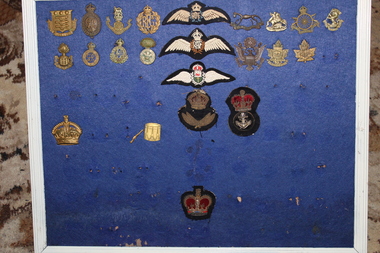
... Welsh Fusiliers Cap Badge. R.A. F. Service Dress Wings with King's Crown. American Eagle Brass - Army Officers Cap Badge. 45th Overseas Battalion - Canada Expeditionary Forces. 48th Battlion, Victoria, Canada - British Columbia Brass Cap Badge. ...Welsh Fusiliers Cap Badge. R.A. F. Service Dress Wings with King's Crown. American Eagle Brass - Army Officers Cap Badge. 45th Overseas Battalion - Canada Expeditionary Forces. 48th Battlion, Victoria, Canada - British Columbia Brass Cap Badge. ...Some are rare in natureBlue material - background, White timber frame surround with 18 metal military cap badges and 6 military cloth patches., Row 1 British Army Cap Badge - Royal Army Ordnance Corps. F1 Household Life guards, Cap Badge, Center G.R. below V. Oval with motto on outside Banner. Royal Lancashire Cap Badge.World War 1 R.F.C. - Royal Flying Corps Cap Badge. surrounded by Laurel Wreath with Crown on top. Circ. 1895 Royal Australian Air Force pilot's wings. The brevet has white cotton embroidered wings, a king's crown, and the letters 'R.A.A.F.' within a pale blue embroidered laurel wreath. Horse Badge - Small Brass - British Army Military. Saint George slaying he dragon - Small Brass Badge. Army Cyclist Corps - World War 1 Cap Badge. Duke of Wellington's Regimental Cap Badge. Row 2 Royal Inniskilling Fusiliers Corps 1895 = Shoulder Title - Officer's. Royal Horse Guards Brass Army Cap Badge. Brass Badge - Queen; Mary's Own - 18th Hussars. Vintage Royal Welsh Fusiliers Cap Badge. R.A. F. Service Dress Wings with King's Crown. American Eagle Brass - Army Officers Cap Badge. 45th Overseas Battalion - Canada Expeditionary Forces. 48th Battlion, Victoria, Canada - British Columbia Brass Cap Badge. World War 1. Row 3. Center World War 11 - Rhodesian Air Force Cloth Pilots wings . row 4 Center - Embossed Woven Crown with metal gold thread woven feathers under. Right - Embossed Woven Crown with Brass Gold Anchor below.- Navy Petty Officer Cap Badge. Row 5. Large Metal Gold color Crown - British Army Warrant Officers Badge. Small Brass Single Rifle with ACT on the Butt of the rifle. Brass Badge - Drummers Proficiency., Last Row - center Embossed woven Crown Red Felt on Blue Back.none - no labels6 cloth patches raised and embossed, 18 military brass metal cap badges vary in type and country and conflict. -
 Federation University Historical Collection
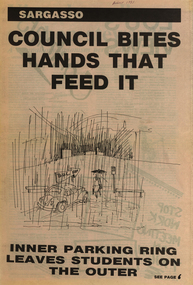
Newspaper, Saragasso, 1978-1981
... (Matthew Cuthbert, 2022) student union ballarat college of advanced education student union eureka newspaper Ballarat University College University of Ballarat Student union student association michael hayes carparking painters and dockers the saints elliott goblet len taylor Engineering russell bell michael thornton fiona kleinitz katie O'Callaghan darren parker ambrose nicholls tim jess Siva Shankar terry o'biren computers french nuclear tests muroroa atoll chris hutchinson hodges Robinson ballarat international Film Festival hugh jarse fred penhall catherine Righetti mathew cuthbert vicki morrison jerry goularas john shapham brian Sardeson peter glover roger burnley michael radman jodie chivell janell armfield sexual harassment east timor andrew sutherland metallica 3bbb rod harrison robyne sterns voluntary student unionism campus conservation corps melinda glisson christie pepperell paul harmes Azhar Albazzaz mat erbs russell bell michael thornton loren gale stephen deGabrielle floriene loder john winkelman lisa gleeson hecs higher education contribution scheme robyne sterns steve blomeley melissa auchline jane hyland rob sitch chrissie mildren eric ong hoodoo guros keith lanyon david fitzgerald vince zankin justin driscoll brian welsh chaplains orion pauline schenk caitlin french tom fermi lisa gleeson beth filipov ballarat film society mortlake buskers festival australian university games shivalli nanduri david jones merrion kent stephen hubert carly shaw simon kennedy david james michael thorton paul sproules jacek olchowick rape autism Eureka Stockade Memorial Trust halls of residence student residences peter joyce kath pengelly sam drew amie bird antonino atzori (nino) michelle menz mariela gledj rugby union hockey Sarag Freeman Seventeen copies of the Ballarat University College/University of Ballarat student newspaper 'Sargasso'. Saragasso Newspaper Australia Victoria ...Sargasso was a monthly newspaper of the Ballarat University College/University of Ballarat Student Union newspaper. Matthew Cuthbert worked on Sargasso from 1989 to 1991 when it was created on LC 2 Apple Mac, at that time one of the best Apple labs in the country. "The Ballarat Courier had four machine, we had a suite." (Matthew Cuthbert, 2022) Mathew Cuthbert was the founder of ‘Integration,’ an alterntive venue and nightclub, with local college band, ‘The Fat Thing’ . This club had a following of Grunge and New Indie music from the UK, namely Madchester, straight from the decks of the Chevron, Melbourne. He went on to study interactive Multimedia at Central Saint Martin’s, London. "It was a great time at Ballarat, a melding of arts, humanities, friendship, youth and a Bohemia of sorts." (Matthew Cuthbert, 2022)Seventeen copies of the Ballarat University College/University of Ballarat student newspaper 'Sargasso'.student union, ballarat college of advanced education student union, eureka, newspaper, ballarat university college, university of ballarat, student union, student association, michael hayes, carparking, painters and dockers, the saints, elliott goblet, len taylor, engineering, russell bell, michael thornton, fiona kleinitz, katie o'callaghan, darren parker, ambrose nicholls, tim jess, siva shankar, terry o'biren, computers, french nuclear tests, muroroa atoll, chris hutchinson, hodges robinson, ballarat international film festival, hugh jarse, fred penhall, catherine righetti, mathew cuthbert, vicki morrison, jerry goularas, john shapham, brian sardeson, peter glover, roger burnley, michael radman, jodie chivell, janell armfield, sexual harassment, east timor, andrew sutherland, metallica, 3bbb, rod harrison, robyne sterns, voluntary student unionism, campus conservation corps, melinda glisson, christie pepperell, paul harmes, azhar albazzaz, mat erbs, russell bell, michael thornton, loren gale, stephen degabrielle, floriene loder, john winkelman, lisa gleeson, hecs, higher education contribution scheme, robyne sterns, steve blomeley, melissa auchline, jane hyland, rob sitch, chrissie mildren, eric ong, hoodoo guros, keith lanyon, david fitzgerald, vince zankin, justin driscoll, brian welsh, chaplains, orion, pauline schenk, caitlin french, tom fermi, lisa gleeson, beth filipov, ballarat film society, mortlake buskers festival, australian university games, shivalli nanduri, david jones, merrion kent, stephen hubert, carly shaw, simon kennedy, david james, michael thorton, paul sproules, jacek olchowick, rape, autism, eureka stockade memorial trust, halls of residence, student residences, peter joyce, kath pengelly, sam drew, amie bird, antonino atzori (nino), michelle menz, mariela gledj, rugby union, hockey, sarag freeman -
 Flagstaff Hill Maritime Museum and Village
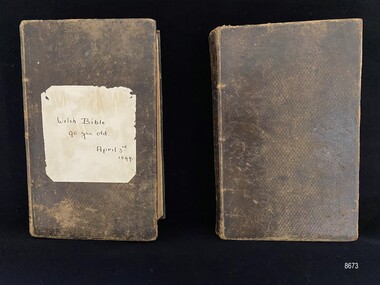
Book - Welsh Theological Dictionary - 2 volume, William Jones, A THEOLOGICAL DICTIONARY, 1837 & 1839
... Victoria. David worked as a gardener and, when land in the area was available to purchase, David and Alice claimed a selection on Noorat Road near Terang. They settled there for the remainder of their lives, expanding the property that they named, ‘Allambah’, and had six children. David died in 1911, aged 79, and Alice passed away the following year, aged 83. Two of David and Alice’s children, David jnr. and Grace adopted a daughter Nell Margaret Crick (nee Ellis). The Dictionaries were passed onto Nell with the misunderstanding (due to being written in the Welsh...Victoria. David worked as a gardener and, when land in the area was available to purchase, David and Alice claimed a selection on Noorat Road near Terang. They settled there for the remainder of their lives, expanding the property that they named, ‘Allambah’, and had six children. David died in 1911, aged 79, and Alice passed away the following year, aged 83. Two of David and Alice’s children, David jnr. and Grace adopted a daughter Nell Margaret Crick (nee Ellis). The Dictionaries were passed onto Nell with the misunderstanding (due to being written in the Welsh ...The Theological Dictionaries belonged to David and Alice Ellis, a young couple married in Dublin in 1855. They left for Australia on the Schomberg clipper ship on October 6 that same year, joining the other passengers for the luxury sailing ship’s first voyage, bound for Melbourne, Australia. The Schomberg was grounded on a sand spit near Peterborough. All passengers and crew were safely rescued. They had been allowed to take something small with them when leaving the sinking vessel, and as such, Alice took a small cane basket and coin purse. The Dictionaries were also amongst the couple’s possessions, along with a metal trunk, a Bible and a pair of candlesticks. These items were all later retrieved from the ship’s deck by the crew of a steamer sent from Melbourne. At that time, David was 23 years old (born in Wales, in 1832) and Alice was 26 (born in Ireland, 1829). The couple lived in Tasmania for a short period before settling in the Western Districts of Victoria. David worked as a gardener and, when land in the area was available to purchase, David and Alice claimed a selection on Noorat Road near Terang. They settled there for the remainder of their lives, expanding the property that they named, ‘Allambah’, and had six children. David died in 1911, aged 79, and Alice passed away the following year, aged 83. Two of David and Alice’s children, David jnr. and Grace adopted a daughter Nell Margaret Crick (nee Ellis). The Dictionaries were passed onto Nell with the misunderstanding (due to being written in the Welsh language) that they were Bibles. Nell pasted a piece of paper onto the front of the first volume recording ‘Welsh Bible 90 yrs old. April 3rd 1844’. The April date relates to the inscription inside both volumes and the 90 yrs old relates to the year Nell possibly received them, 1934. She has also added to the inscription page inside the first volume again recording ’Welsh Bible 90 yrs old. Miss. G Ellis “Allambah” Terang’. This implies that Grace Ellis had been the ‘keeper’ of the dictionaries. Grace and David Ellis were devout Christians which they passed on to their adopted daughter Nell, and were prominent members of the Noorat and Terang Presbyterian Churches. As David and Alice Ellis came out on the Schomberg in 1855, and the inscription inside both volumes of the Dictionary carries the date April 3rd 1844 and the name Thomas Ellis, it could be presumed that this was a family gift of significance to the couple as they began their new life in a country far away.The theological dictionaries are part of a group of donated possessions of David and Alice Ellis that have great significance as personal belongings, providing an insight into what emigrants considered important possessions to bring as they began a new life on the other side of the world. They are part of Flagstaff Hill’s collection of artefacts from the Schomberg shipwreck, which is listed on the Victorian Heritage Register (VHR S612). All items had been saved from the sinking luxury clipper ship, the Schomberg, in 1855. The ship has historical significance as a rare example of a large, fast clipper ship on the England to Australia run, built to carry emigrants at the time of the Victorian gold rush. The ship’s design included the technical advances needed to break sailing records between Europe and Australia. The relationship of the objects in Flagstaff Hill’s Schomberg collection allows potential interpretation of the story of the Schomberg. The collection of objects is archaeologically significant as the remains of an international passenger ship, as it represents aspects of Victoria’s shipping history, in addition to its association with the shipwreck and the ship.A two volume set Theological Dictionary in Welsh. Both books are covered in brown leather with gold embossed patterns and words on the spine. The words 'GEIRIADUR DUWINYDDOL' (Theological dictionary) are on both spines towards the top and towards the bottom the number 1 or 2 dependent on the volume. The first volume, at around 900 pages, is slightly larger than the second volume, around 740 pages. The first volume has had a plain piece of paper glued to the front with the words 'Welsh Bible, 90 yrs old, April 3rd 1844'. Each volume has an inscription to Thomas Ellis inside the front cover, the date April 3rd 1844 and other words in Welsh. The first volume has added writing (in different handwriting) on the inscription page. The books are laid out in dictionary format with the first volume going from ABE to HYP. The second volume begins at IAC and ends at YST, followed by an Appendix and Index. The first volume was published in 1837 and the second volume in 1839.Volume 1 - Thomas Ellis ... 6 words in Welsh ... Aprill 3/44 (Handwriting 1) - Welsh Bible 90 yrs old, Miss G. Ellis, "Allambah" Terang. (Handwriting 2) Volume 2 - Thomas Ellis ... 6 words in Welsh (same as volume 1) ... Aprill 3/44flagstaff hill maritime museum and village, great ocean road, shipwreck coast, theological dictionaries, welsh theological dictionaries, welsh bible, schomberg, sailing ship, schomberg passengers, schomberg ship, 1855, 1855 shipwreck, peterborough shipwreck, david and alice ellis, david ellis jnr, grace ellis, nell ellis, nell crick, allambah terang, terang presbyterian church -
 Flagstaff Hill Maritime Museum and Village
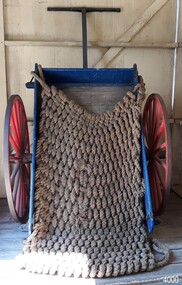
Vehicle - Beach cart and cover, Government of Victoria, 1860s
... Welsh hand barrow...Harbour Board...Government of Victoria...Flagstaff Hill Warrnambool Maritime Village Maritime Museum Shipwreck coast Great Ocean Road Flagstaff Hill Maritime Museum and Village Lady Bay Warrnambool Harbour Port of Warrnambool shipwreck life-saving lifesaving rescue crew rescue rocket rescue rocket crew beach rescue rescue equipment rocket rescue equipment rocket equipment Marine technology lifeboat volunteer lifesavers volunteer crew lifesaving rescue crew rocket apparatus shore to ship stranded vessel rocket rescue apparatus line thrower beach apparatus breeches buoy life jacket Rocket house rocket shed rocket machine rocket head rocket launcher rocket line beach rescue set rocket set beach cart hand barrow Welsh hand barrow Harbour Board Government of Victoria Harbour Master L.S.R.C. ...The beach cart was hand drawn by a team of six people; two in front, one on each side and two behind. The wide iron tyres on the the wheels helped prevent the cart from sinking into the sand. The load of heavy beach apparatus equipment was held in place by the hand worked rope net cover. It would be stored in the Rocket House packed and ready to use for practice or rescue. Beach apparatus equipment - In the mid-1800s the equipment could include a line throwing set, coiled line in wooden carrying case, rockets, cartridges, breeches buoy, hawser and traveller block, line-throwing pistol, beach cart, hand barrow, sand anchor, crotch pole, and tools such as spade, pick, mallet and hawser cutter. Around the 1860s Warrnambool had a Rocket House installed beside the Harbour. Saving lives in Warrnambool – The coastline of South West Victoria is the site of over 600 shipwrecks and many lost lives; even in Warrnambool’s Lady Bay there were around 16 known shipwrecks between 1850 and 1905, with eight lives lost. Victoria’s Government responded to the need for lifesaving equipment and, in 1858, the provision of rocket and mortar apparatus was approved for the lifeboat stations. In 1859 the first Government-built lifeboat arrived at Warrnambool Harbour and a shed was soon built for it on the Tramway Jetty, followed by a rocket house in 1864 to safely store the rocket rescue equipment. In 1878 the buildings were moved to the Breakwater (constructed from 1874-1890), and in 1910 the new Lifeboat Warrnambool arrived with its ‘self-righting’ design. For almost a hundred years the lifesaving and rescue crews, mostly local volunteers, trained regularly to rehearse and maintain their rescue skills. They were summoned when needed by alarms, gunshots, ringing bells and foghorns. In July 1873 a brass bell was erected at Flagstaff Hill specifically to call the rescue crew upon news of a shipwreck. Some crew members became local heroes but all served an important role. Rocket apparatus was used as recently as the 1950s. This cart and cover set is significant for its connection with local history, maritime history and marine technology. Lifesaving has been an important part of the services performed from Warrnambool's very early days, supported by State and Local Government, and based on the methods and experience of Great Britain. Hundreds of shipwrecks along the coast are evidence of the rough weather and rugged coastline. Ordinary citizens, the Harbour employees, and the volunteer boat and rescue crew, saved lives in adverse circumstances. Some were recognised as heroes, others went unrecognised. In Lady Bay, Warrnambool, there were around 16 known shipwrecks between 1850 and 1905. Many lives were saved but tragically, eight lives were lost.Beach cart; a blue and white painted, wooden cart with two, red coloured metal wheels. The wheels have twelve spokes and wide iron tyres. The cart has a long draw bar with T- handles at the end. It was pulled by two people, usually steered by another two and pushed by a further two. It was supplied by the Government of Victoria. There is an inscription on the front end panel. The cart has a removable hand worked rope cover. Stencilled in white paint “G of V” flagstaff hill, warrnambool, maritime village, maritime museum, shipwreck coast, great ocean road, flagstaff hill maritime museum and village, lady bay, warrnambool harbour, port of warrnambool, shipwreck, life-saving, lifesaving, rescue crew, rescue, rocket rescue, rocket crew, beach rescue, rescue equipment, rocket rescue equipment, rocket equipment, marine technology, lifeboat, volunteer lifesavers, volunteer crew, lifesaving rescue crew, rocket apparatus, shore to ship, stranded vessel, rocket rescue apparatus, line thrower, beach apparatus, breeches buoy, life jacket, rocket house, rocket shed, rocket machine, rocket head, rocket launcher, rocket line, beach rescue set, rocket set, beach cart, hand barrow, welsh hand barrow, harbour board, government of victoria, harbour master, l.s.r.c., lsrc -
 Flagstaff Hill Maritime Museum and Village
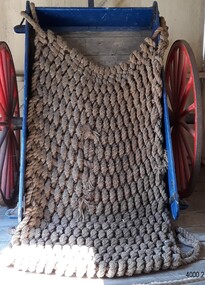
Equipment - Beach cart cover, Government of Victoria, 1860s
... Welsh hand barrow...Harbour Board...Government of Victoria...Flagstaff Hill Warrnambool Maritime Village Maritime Museum Shipwreck coast Great Ocean Road Flagstaff Hill Maritime Museum and Village Lady Bay Warrnambool Harbour Port of Warrnambool shipwreck life-saving lifesaving rescue crew rescue rocket rescue rocket crew beach rescue rescue equipment rocket rescue equipment Marine technology lifeboat volunteer lifesavers volunteer crew lifesaving rescue crew rocket apparatus stranded vessel rocket rescue apparatus beach apparatus life jacket rocket shed rocket line beach rescue set rocket set beach cart hand barrow Welsh hand barrow Harbour Board Government of Victoria Harbour Master L.S.R.C. ...The load of heavy beach apparatus life saving equipment was held in place on the beach cart by the hand worked rope net cover. It would be stored in the Rocket House packed and ready to use for practice or rescue. Beach apparatus equipment - In the mid-1800s the equipment could include a line throwing set, coiled line in wooden carrying case, rockets, cartridges, breeches buoy, hawser and traveller block, line-throwing pistol, beach cart, hand barrow, sand anchor, crotch pole, and tools such as spade, pick, mallet and hawser cutter. Around the 1860s Warrnambool had a Rocket House installed beside the Harbour. Saving lives in Warrnambool – The coastline of South West Victoria is the site of over 600 shipwrecks and many lost lives; even in Warrnambool’s Lady Bay there were around 16 known shipwrecks between 1850 and 1905, with eight lives lost. Victoria’s Government responded to the need for lifesaving equipment and, in 1858, the provision of rocket and mortar apparatus was approved for the lifeboat stations. In 1859 the first Government-built lifeboat arrived at Warrnambool Harbour and a shed was soon built for it on the Tramway Jetty, followed by a rocket house in 1864 to safely store the rocket rescue equipment. In 1878 the buildings were moved to the Breakwater (constructed from 1874-1890), and in 1910 the new Lifeboat Warrnambool arrived with its ‘self-righting’ design. For almost a hundred years the lifesaving and rescue crews, mostly local volunteers, trained regularly to rehearse and maintain their rescue skills. They were summoned when needed by alarms, gunshots, ringing bells and foghorns. In July 1873 a brass bell was erected at Flagstaff Hill specifically to call the rescue crew upon news of a shipwreck. Some crew members became local heroes but all served an important role. Rocket apparatus was used as recently as the 1950s. This cover was used with the beach cart. The cart is significant for its connection with local history, maritime history and marine technology. Lifesaving has been an important part of the services performed from Warrnambool's very early days, supported by State and Local Government, and based on the methods and experience of Great Britain. Hundreds of shipwrecks along the coast are evidence of the rough weather and rugged coastline. Ordinary citizens, the Harbour employees, and the volunteer boat and rescue crew, saved lives in adverse circumstances. Some were recognised as heroes, others went unrecognised. In Lady Bay, Warrnambool, there were around 16 known shipwrecks between 1850 and 1905. Many lives were saved but tragically, eight lives were lost.Rectangular rope cover, hand worked for the purpose of covering the beach cart. The cover is made from heavy rope in a pattern that looks similar to crochet. A loop has been worked into each corner.flagstaff hill, warrnambool, maritime village, maritime museum, shipwreck coast, great ocean road, flagstaff hill maritime museum and village, lady bay, warrnambool harbour, port of warrnambool, shipwreck, life-saving, lifesaving, rescue crew, rescue, rocket rescue, rocket crew, beach rescue, rescue equipment, rocket rescue equipment, marine technology, lifeboat, volunteer lifesavers, volunteer crew, lifesaving rescue crew, rocket apparatus, stranded vessel, rocket rescue apparatus, beach apparatus, life jacket, rocket shed, rocket line, beach rescue set, rocket set, beach cart, hand barrow, welsh hand barrow, harbour board, government of victoria, harbour master, l.s.r.c., lsrc, rocket house -
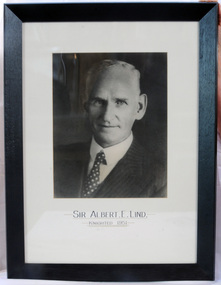 Orbost & District Historical Society
framed photo, APFA- Davisigns (PG & ME Davis)
... Lind was born in 1878 in East Charlton, Victoria, the son of Oliver Nicholas Lind, a farmer from Denmark, and his Welsh wife Mary Ann Clay. ...Lind was born in 1878 in East Charlton, Victoria, the son of Oliver Nicholas Lind, a farmer from Denmark, and his Welsh wife Mary Ann Clay. ...This photo was inherited with the building when the museum was established. Lind was born in 1878 in East Charlton, Victoria, the son of Oliver Nicholas Lind, a farmer from Denmark, and his Welsh wife Mary Ann Clay. In 1882, drought forced the family to move to East Gippsland where Lind was educated at Lucknow, and then to Bairnsdale in 1884 where he attended Bairnsdale state school. In October 1920, he was elected to the Victorian Legislative Assembly for the seat of Gippsland East for the Victorian Farmers' Union. Lind was made Minister of Forests, President of the Board of Land and Works and Commissioner of Crown Lands and Survey in Albert Dunstan's cabinet. He was knighted in 1951. In 1926 two national parks east of Orbost were named the Albert and the Lind national parks after him.A framed photo of Sir Albert Eli Lind. It is a black and white head and shoulders photo in a black wooden frame.Sir Albert E. Lind Knighted !951photograph politician lind-albert government -
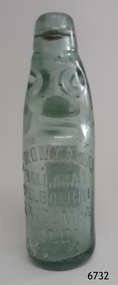 Flagstaff Hill Maritime Museum and Village
Domestic object - Codd neck bottle, E. Rowlands, 1921
... Victoria were prepared to pay the 'premium' imposed by inter-colonial customs duty payable at that time. By the 1890s, Rowlands had factories in Ballarat, Melbourne, Sydney, and Newcastle. He died in 1894 but his company continued until well after the Second World War when it was sold to Schweppes. Bottles such as this popular brand, containing soda water, were often used on paddle steamers for refreshments. An early manufacturing process producing the first mineral waters in Australia was invented and developed by an early Welsh ...The design of the bottle is called a Codd, sometimes referred to as a marble bottle or "Codd's patent bottle". During the mid-to-late 1800s, there were many inventions to keep the fizz in carbonated drinks such as ginger ale, soda water, and fruit drinks. Hiram Codd, an English engineer invented a successful process that he patented as "Codd's patented globe stopper bottle" in 1872. The Codd-neck bottle (commonly called Codd or marble bottle) is manufactured in two parts. The body of the bottle is cast in two sections. At the time of joining the sections, glass marble and rubber seal are inserted into the neck section. The lip is then applied to the top of the bottle. The Codd bottle is filled upside down as the pressure of the gas from the carbonated liquid holds the marble up and out of the way. When the bottle stands upright the gas pushes the marble up against the washer, creating a firm seal to keep the fizz inside. The bottle is opened by pushing the marble down firmly to allow some of the gas to escape. The marble drops down and is caught in a depression formed in the neck. When the bottle is tilted to pour or drink the liquid the marble rests in a dimple. Two Ballarat miners, Evan Rowland and Robert Lewis started manufacturing mineral and aerated waters, bitters, cordials, and liqueurs in 1854, in a tent on the shores of Lake Wendouree Ballarat. Another 13 firms at that time employed manual operations, whereas they introduced Taylor's No. 1 machine that speeded up the process and laid the foundation for their fortune. Evan Rowland was a pioneer in the aerated water trade in Australia. He was born on August 2, 1826, in North Wales. In 1852, during the gold rush, he emigrated to Melbourne, and in 1854 he went to Ballarat and formed a partnership with Robert Lewis, the firm being called ‘‘Rowlands & Lewis’’. Their next step was to secure a supply of pure water. Using mineral Waters that they found via a natural spring at Warrenheip, Victoria. From the outset, the beverages made from this water gained repute and were in great demand. Their business prospered so well that in 1858 they were able to build a factory at the corner of Sturt and Dawson Streets, Ballarat, and to fit with the most up-to-date machinery then in use. By 1870 their business had increased so much and demand had grown to such an extent that Mr. Rowlands erected another factory, covering over an acre of ground at the corner of Dana and Doveton Streets, costing £13,000. The factory was fitted with the most modern equipment of the time to manufacture cordials and aerated water. In 1873 Rowlands established an agency at 116 Collins St, Melbourne, because the demand for the products of the Melbourne factory became so large. The company expanded to Sydney opening a factory at the corner of Burns & Hay Streets Darling Harbour obtaining spring water to supply this plant from Katoomba in the Blue Mountains. The water was brought to Sydney by rail. In the meantime, the Melbourne concern had progressed so rapidly that in 1888 a magnificent factory embodying all the latest ideas and equipment was built in King Street Melbourne. Robert Lewis was a fellow Welshman born in 1816, and he arrived in Port Phillip in 1853 and became a partner in the early day with Evan Rowland but with lesser and shorter involvement in the firm, from which he retired in 1876. Robert Lewis was perhaps better known as Ballarat's first mayor and a Member of the Legislative Assembly. He was a strong supporter of local charities, president/treasurer of the Eisteddfod Committee, a major force in the development of the Ballarat Hospital, and he was the mayor of Ballarat five times, the first in 1863, (having been a counsellor as early as 1859) and for the last time in 1881. Lewis died in 1884 of a stroke in Ballarat. Rowlands continued in the firm and invented and patented an improved soda water bottle. The water used in Rowlands products was filtered four times but his attempts to use local corks failed on quality grounds. He was a stickler for quality, which was so good that many outside Victoria were prepared to pay the 'premium' imposed by inter-colonial customs duty payable at that time. By the 1890s, Rowlands had factories in Ballarat, Melbourne, Sydney, and Newcastle. He died in 1894 but his company continued until well after the Second World War when it was sold to Schweppes. Bottles such as this popular brand, containing soda water, were often used on paddle steamers for refreshments.An early manufacturing process producing the first mineral waters in Australia was invented and developed by an early Welsh migrant to Australia. The Evan Rowlands story gives an insight into the early development of manufacturing industries in Australia that allowed their workers and the towns they were situated in to prosper and develop into what they are today. A good example of hand blown glass.Bottle; clear glass Codd neck bottle with small marble in top. Once contained soda water or soft drink. Manufactured in 1921 by E. Rowlands of Ballarat, Melbourne, Katoomba and Sydney. The bottle is 'recyclable' - the message on the base says that it remains the property of E. Rowlands Pty Ltd. Inscriptions on three adhesive labels at time of donation"E. ROWLANDS BALLARAT MELBOURNE KATOOMBA AND SYDNEY". Imprinted into bas "1921" "THIS BOTTLE REMAINS THE PROPERTY OF E. ROWLANDS PTY LTD" On adhesive labels (3) " 1921 ON BASE (LASTED 1924) CODD PATENT 702" "SMALL SIZE. MARBLE TOP SODA WATER PAPER LABEL. USED" "ON PADDLE STEAMERS. POPULAR BRAND"flagstaff hill, warrnambool, shipwrecked-coast, flagstaff-hill, flagstaff-hill-maritime-museum, maritime-museum, shipwreck-coast, flagstaff-hill-maritime-village, bottle, codd bottle, hiram codd, glass marble bottle, e. rowlands bottle manufacturer, soda bottle australia, early recyclable bottle, codd's patent bottle, marble bottle, refreshments, soda water, marble top, 1920s, codd patent 702, handmade, blown -
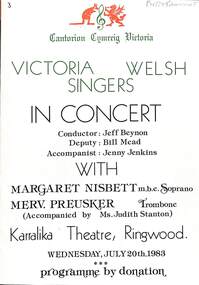 Ringwood and District Historical Society
Programme, Karralika Theatre - Victoria Welsh Singers In Concert on Wednesday, July 20th. 1983
... Karralika Theatre - Victoria Welsh Singers In Concert on Wednesday, July 20th. 1983...Pages 6 & 7 - Advertisements, Page 8 - THE CHOIR - A thank you from the choir and a brief description of their short history and the interests that have brought them together 8 page cream coloured programme with black typing and red and green headings Karralika Theatre - Victoria Welsh Singers In Concert on Wednesday, July 20th. 1983 Programme ...8 page cream coloured programme with black typing and red and green headingsCantorion Cymreig Victoria. Conductor: Jeff Beynon. Deputy: Bill Mead. Accompanist: Jenny Jenkins - WITH Margaret Nisbett m.b.e. Soprano - Merv. Preusker Trombone, accompanied by Ms. Judith Stanton. Programme by donation. Pages 2 & 3 - advertisements. Pages 4 & 5 - The Programme - Performers and arrangers include Bruce George, W.T.Davies, Merv.Preusker, Margaret Nisbett, J. Hughes (Soloist: Terry Thomas), John T. Davies, Emrys Jones, J.M. Capel, Arr. Doris Arnold, Compere: Cyril Platt. Pages 6 & 7 - Advertisements, Page 8 - THE CHOIR - A thank you from the choir and a brief description of their short history and the interests that have brought them together -
Eltham District Historical Society Inc
Document - Folder, Mann, John and Violet and family
... Victoria..."Overton" at Janefield..."Carseburn" at Arthurs Creek...Jane Mann...Christine Mann...David Mann...Walter Mann...James Mann...Violet Mann...Victorian Free Church Smith Street Collingwood...Ann Welsh...John Manan Violet Mann nee McKimmie Clipper packet "Ellen Stuart" Forfar Scotland Darebin Creek Victoria Arthurs Creek Victoria "Overton" at Janefield "Carseburn" at Arthurs Creek Jane Mann Christine Mann David Mann Walter Mann James Mann Violet Mann Victorian Free Church Smith Street Collingwood Ann Welsh Robert Mann William Mann Thomas Mann Henry Mann Preston Cemetery Carseburne sheep Yan Yean Cemetery Lindsay Mann David Moore Montsalvat Newspaper clippings, A4 photocopies, etc Mann, John and Violet and family Document Folder ...John Mann arrived from Forfar, Scotland, on the clipper packet "Ellen Stuart" in 1857 and rented a farm "Overton" at Janefield. Soon after he met Melbourne-born Violet McKimmie, whose parents had a property near Darebin Creek. They married on 25 September 1862, John 26 and Violet 19. In 1874 John selected a block on Arthurs Creek and built a slab and bark hut (still standing in 1984) and called their farm "Carseburn" after John's parish in Scotland. They had seven children: John, Jane, Christine, David, Walter, James and Violet. John was drowned in the Yarra in May 1875 and Violet struggled to meet the lease commitment. She wrote to her brother-in-law David Mann in New Zealand who came to her aid, and on 10 September 1876, they married at the Victorian Free church, Smith Street, Collingwood. They improved the farm and built a three-room house. in July 1883 they bought neighbouring land from Ann Welsh. With David, Violet had four more children: Robert, William and twins Thomas and Henry. In 1883, David died and was buried in the same grave as his brother in Preston Cemetery. The twins also died, Thomas just before and Henry just after their father. the children assisted with the farm and orchard, the business including crops, a dairy herd, Carseburne sheep, and breeding horses. Violet died at Yan Yean in 1925, aged 83. A grandson of John Mann, James Mann, lived in Henry Street, Greensborough and had given a talk at the Whittlesea Historical Society in 1983 on his family. Descendant Lindsay Mann was part of a creative writing group that published a book including a short story "The Mountain Tramway" is loosely based on his childhood and stories he was told then but was planning to write his family story. Contents Newspaper article: "Tragedy couldn't stop this pioneer", Diamond Valley News, 31 January 1984, story of Mann family. Newspaper article: "Tracing the history of ordinary. people," Diamond Valley News, 29 July 1986, story of Mann family, researched by descendant Lindsay Mann who grew up at the Mann property She-Oak at Yan Yean and has numerous family records. Newspaper article: "A realist who captures light," Diamond Valley News, 29 July 1986, David Moore, a realist painter had been working from a studio at Montsalvat and his exhibition of work from that period was to open 1 August 1986 at the Victorian Artists Society Galleries.Newspaper clippings, A4 photocopies, etcjohn manan, violet mann nee mckimmie, clipper packet "ellen stuart", forfar scotland, darebin creek victoria, arthurs creek victoria, "overton" at janefield, "carseburn" at arthurs creek, jane mann, christine mann, david mann, walter mann, james mann, violet mann, victorian free church smith street collingwood, ann welsh, robert mann, william mann, thomas mann, henry mann, preston cemetery, carseburne sheep, yan yean cemetery, lindsay mann, david moore, montsalvat -
 Warrnambool and District Historical Society Inc.
Photo, Negatives Pioneers of Warrnambool & District board, 1975
... Victoria. It is by no means a complete list of pioneers of the district but there are many well- known ones included. They come from a wide range of backgrounds and as such presents a cross section of our earliest settlers in the district from 1840's to 1860’s. warrnambool, warrnambool pioneer board, jack welsh, warrnambool art gallery, pioneers of warrnambool, foyles photography, lillian foyle, bernard framers, w mcaree, This negative album was prepared by John A Welsh MBE JP Dip M Eng Director Warrnambool Art Gallery 1/7/1975 to 11/12/1977.There are a number of grey lead notations possibly corrections against some of the names in the index. ...The following extract written by Karen Tyers Warrnambool Family history group explains the journey and background of the Warrnambool Pioneer Board. Warrnambool is fortunate to have a photographic record of some of its pioneers. They are commemorated on the Pioneers’ Board. The Pioneers’ Board with its elaborate frame measures approximately 2 metres by 3 metres and holds 204 photographs of Warrnambool’s early pioneers. In 1907 Edward Vidler, secretary of the Warrnambool & District Progress League and Chamber of Commerce and Industry, invited descendants of those who arrived in Warrnambool before 1860 to send photographs of their pioneer ancestors to commemorate the Diamond Jubilee of Warrnambool’s foundation in 1847. A charge of £1 for each photograph was set. Lillian Foyle of Foyle’s photographic studio, was engaged to colour the photographs and undertake the associated artwork. By December 1907 the honour board was on exhibition in Bernard’s Gallery, Melbourne. Unfortunately Vidler left Warrnambool in 1907 with the honour board expenses unpaid. The Progress League refused to take responsibility for the debt and the honour board remained with Foyle’s Studio for 17 years. In 1922 subscriptions were called for and £43 16s 6d was acknowledged. After a final determined effort was made in 1924, the £100 debt was collected and Charles Foyle, Lillian’s brother, accepted settlement of the debt. On 2 May 1924 the honour board was moved from Foyle’s Studio to the Art Gallery. For many years the honour board was in the entrance passage to the public library. After the library was demolished in 1975 the pictures were removed to the Art Gallery where it was restored by the Director of the Art Gallery, Jack Welsh. The board was later stored in an empty front room at Murweh and the dismantled frame stored in an outbuilding. By 1982 the honour board was in the foyer of the City Council offices. During the renovations of the interior of the council offices in 1997 the honour board was moved to the library where it remained until moved to HeritageWorks in March 2014. For a full list of names go to http://www.warrnamboolhistory.org.au/warrnambool-history/pioneers-board/ The Warrnambool pioneer Board is one of those rare items which can claim significance on most if not all of the primary and comparative significance criteria. As a collection of early pioneers in the district it provides a valuable resource for historians and researchers. It gives light to a social scene in the district much of which can be verified from diaries and other items held by the historical society and also available on websites such as Trove. It has relevance to this day with many family historians enquiring of people included on the board. The collation of the board is a story of great interest in itself. While there are images of 204 men on the board the only reference to a woman is Lillian Foyle the artist who was responsible for much of the artistic work on the board. It compares well in size and quality with a number of montages, and collations of images from around the state of Victoria. It is by no means a complete list of pioneers of the district but there are many well- known ones included. They come from a wide range of backgrounds and as such presents a cross section of our earliest settlers in the district from 1840's to 1860’s.Cardboard folder with black and grey mottled cover with 3 metal studs along spine and white paper label with the word negative printed in black on front cover. Inside is a printed index of pioneers with reference relating to board number and negative number. There are three loose strips of negatives and 20 pages with pockets to hold strips of negatives. Up to page 13 have negatives strips inserted. There are 15 large and one small print of some of the pioneers from the board.This negative album was prepared by John A Welsh MBE JP Dip M Eng Director Warrnambool Art Gallery 1/7/1975 to 11/12/1977.There are a number of grey lead notations possibly corrections against some of the names in the index.warrnambool, warrnambool pioneer board, jack welsh, warrnambool art gallery, pioneers of warrnambool, foyles photography, lillian foyle, bernard framers, w mcaree, -
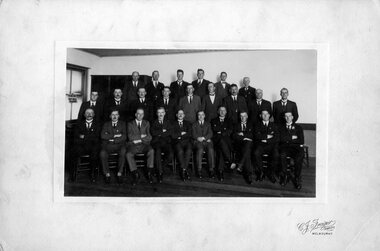 Victoria Police Museum
Photograph (Victoria Police), Police Officers group photo, 1920s
... victoria police museum...police officers...police academy...police force...C. J. Frazer...McDonald, Roderick...Langslov George Herbeter Docking...Cassidy, John...Welsh...victoria police museum police officers police academy police force C. J. Frazer McDonald, Roderick Langslov George Herbeter Docking Cassidy, John Welsh, Arthur McPherson General Blamey Adamson, William Victorian Police Association Adamson, William Police Council Grieve, John Elliott, Walter Dunn, Jim Burrows, George Hale, Fred Ogden, Jim Morgan, Tom Fleming, George McMillan, Murdock Secretary Gill Reporter White Heading, Charles McCorckell, Francis Feldtmann, Arthur Searle, John First Council Temperance Hotel Handwritten: (top left) 162 (top right) Ap 86 Paper glued with tape on the back, typewritten: First Council of the // Victorian Police Association. ...Black and white photograph mounted on grey frame. 16 Police Officers mounted on Horses. Black and white photograph mounted on bege frame. 25 men pose for photograph on 3row structure; they all wear polished suits. Men sitting at front row have their arms crossed, some in a serious countenance and other more witty. On the back there's piece of paper stuck which tells who are most of Police men in the picture - see Inscriptions. There's also velcrum piece on edges.Handwritten: (top left) 162 (top right) Ap 86 Paper glued with tape on the back, typewritten: First Council of the // Victorian Police Association. Left to right; Back row; Forget name of first one; John Searle; // Arthur Feldtman 7138; Francis McCorkell, Charles Heading; // White (Reporter) Middle Row. Gill (Police Association Secretary) ; Murdock McMillan; Uncertain next; George Fleming; Tom Morgan; Jim Ogden; Fred Hale; Uncertain name; George Burrows; Front row; Jim Dunn; Walter Elliott; John Grieve (Detective); Langslov // George Herbert Docking (Association President) General Blamey // William Adamson; McPherson; Arthur Wels; John // Cassiy. I Believe the 3rd person in centre row is Roderick McDonald but am not sure. // This picture was taken in the Temperance Hotel, Russel ST // Jim Ogden and myself were the only members of force who had joined after the police strike in 1923.victoria police museum, police officers, police academy, police force, c. j. frazer, mcdonald, roderick, langslov george herbeter docking, cassidy, john, welsh, arthur, mcpherson, general blamey, adamson, william, victorian police association, adamson, william, police council, grieve, john, elliott, walter, dunn, jim, burrows, george, hale, fred, ogden, jim, morgan, tom, fleming, george, mcmillan, murdock, secretary gill, reporter white, heading, charles, mccorckell, francis, feldtmann, arthur, searle, john, first council, temperance hotel -
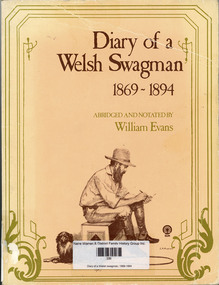 Narre Warren and District Family History Group
Book, Joseph Jenkins et al, Diary of a Welsh swagman, 1869-1894, 1977
... swagmen diaries Castlemaine area Maldon area itinerant labourer Joseph Jenkins was a Welsh itinerant labourer in late 1800s Victoria. Exceptional for a labourer at the time, Jenkins had a high level of literacy and kept detailed daily diaries for over 25 years, resulting in one of the most comprehensive accounts of early Victorian working life. ...Joseph Jenkins was a Welsh itinerant labourer in late 1800s Victoria. Exceptional for a labourer at the time, Jenkins had a high level of literacy and kept detailed daily diaries for over 25 years, resulting in one of the most comprehensive accounts of early Victorian working life.non-fictionJoseph Jenkins was a Welsh itinerant labourer in late 1800s Victoria. Exceptional for a labourer at the time, Jenkins had a high level of literacy and kept detailed daily diaries for over 25 years, resulting in one of the most comprehensive accounts of early Victorian working life.swagmen, diaries, castlemaine area, maldon area, itinerant labourer -
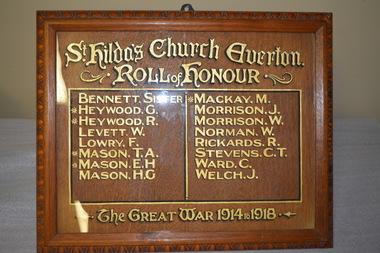 Wangaratta RSL Sub Branch
Honour Board - Framed Roll of Honour, St. Hilda's Church, Everton
... Victoria Hospital. The following year she was appointed Matron of the hospital ship "Herefordshire" which transported sick and wounded soldiers from the mouth of the Tigris River to Bombay. Her next appointment was to the 34th Welsh...Victoria Hospital. The following year she was appointed Matron of the hospital ship "Herefordshire" which transported sick and wounded soldiers from the mouth of the Tigris River to Bombay. Her next appointment was to the 34th Welsh ...St Hilda's Church Everton, WW1 Roll of Honour - contains 16 names of members of the Everton Community in Victoria who served during the First World War including Nursing Sister Alma Louisa BENNETT (1890-1922) who trained at Melbourne General Hospital. She moved to Western Australia and continued nursing until the advent of World War 1. She immediately sought to enlist but was not granted her request until 1916 and was eventually sent for nursing duties in India. Her arrival coincided with the first convey of wounded after the fall of Kut in Mesopotamia. She was immediately given charge of a ward at Victoria Hospital. The following year she was appointed Matron of the hospital ship "Herefordshire" which transported sick and wounded soldiers from the mouth of the Tigris River to Bombay. Her next appointment was to the 34th Welsh Hospital at Deolali 150 miles from Bombay. The hospital was huge and she took charge as Matron. After 17 months at Deolali BENNETT was awarded the Royal Red Cross Medal First Class one of the highest distinctions in the British Nursing Service. When peace was declared she travelled to England where she continued to nurse in an Army Hospital. During her stay she was invited to Buckingham Palace where she was presented with Red Cross Medal by King George V. BENNETT returned to Victoria and was invited to join the nursing staff at Melbourne's Epworth Hospital with prospects of becoming Matron. Ill health intervened and she died in September 1922. Item said to be made by the family of Gilbert and Richard Heywood both KIA and listed on honour roll.St Hilda's Church Everton Honour Roll contains 16 names of members including Nurse BENNETT, from the Everton Community in Victoria who served in WW1 Carved timber frame and mounting with 16 names in gold coloured paint listed in two columns."St Hilda's Church Everton' "Roll of Honour" "The Great War 1914 to 1918" Sister Bennett/Heywood G/Heywood R/Levett W/Lowry F/Mason T.A/Mason E.H/Mason H.G/MacKay M/Morrison J/Morrison W/Norman W/Rickards R/Steens C.T/Ward C/Welch J.everton, 1914-1918, roll of honour -
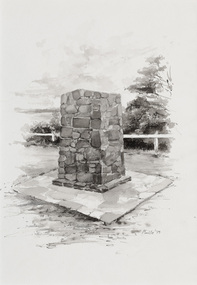 Bayside Gallery - Bayside City Council Art & Heritage Collection
Work on paper - ink and watercolour, Annette Meikle, Moysey Memorial, 1977
... Victoria in 1844 and leased land on the cliff-top. They built a cottage, cleared the land for sheep and cattle and established vegetable gardens. They later purchased the land and named it Beaumaris Park, derived from the name of the Welsh coastal resort where Edward I built Beau Marais castle....Victoria in 1844 and leased land on the cliff-top. They built a cottage, cleared the land for sheep and cattle and established vegetable gardens. They later purchased the land and named it Beaumaris Park, derived from the name of the Welsh coastal resort where Edward I built Beau Marais castle. annette meikle sandringham sketchbook elizabeth waters port phillip bay moysey memorial coastline stone cairn james and susannah moysey beaumaris Moysey Memorial Work on paper ink and watercolour Annette Meikle ...In 1977, artist Annette Meikle undertook a commission to illustrate a book recording stories of places and people in the Bayside area. It was published in 1978 as Sandringham Sketchbook, with text by Elizabeth Waters. The sketches were intended to record remaining examples of Bayside’s early architecture and environment, as well as reflect newer architectural changes. Meikle went on to donate 22 of these sketches to Bayside City Council in 2003. Erected in 1964, this stone cairn on Beach Road in Beaumaris marks the site of the wattle and daub cottage of James and Susannah Moysey. James, Susannah and their cousin Nicholas arrived in Victoria in 1844 and leased land on the cliff-top. They built a cottage, cleared the land for sheep and cattle and established vegetable gardens. They later purchased the land and named it Beaumaris Park, derived from the name of the Welsh coastal resort where Edward I built Beau Marais castle.Annette Meikle, Moysey Memorial 1977, ink and watercolour, 35 x 23.5 cm. Bayside City Council Art and Heritage Collection. Donated by the artist, 2003annette meikle, sandringham sketchbook, elizabeth waters, port phillip bay, moysey memorial, coastline, stone cairn, james and susannah moysey, beaumaris -
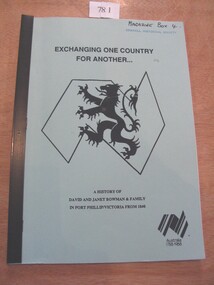 Stawell Historical Society Inc
Book, Marie and Graham Moore, Exchanging One Country for Another - A History of David and Janet Bowman & Family in Port Phillip/Victoria from 1840, 1988
... Victoria from 1840. Australia 1788-1988 Pale Blue card cover with black ink title below which is a stylised map of Australia and The Welsh lion Bi-Centential Logo in bottom Right Exchanging One Country for Another - A History of David and Janet Bowman & Family in Port Phillip/Victoria from 1840 Book Marie and Graham Moore ...Published for a reunion of David and Janet Bowman's decendentsPale Blue card cover with black ink title below which is a stylised map of Australia and The Welsh lion Bi-Centential Logo in bottom RightExchanging One Country for Another. A History of David and Janet Bowman & Family in Port Phillip/Victoria from 1840. Australia 1788-1988stawell immigration
